This is the second (Del Rey) Ballantine printing. Cover Artist: Darrell K. Sweet
The planet Ishtar has three suns: Bel, the "real" sun, the Life Giver. Ea, the Companion who warms the Ishtaran summers. Anu, the Demon Star. Mostly Anu is so far away that it is just a light in the Ishtaran sky. But once every thousand years it comes close. It is then that the barbarians must flee their scorched lands, and civilizations fall.
The natives call this Fire Time. Always before, its coming had meant the death of a civilization. But this time, the humans are here, and they have brought with them their magical technology. This time things could have been different. Too bad that the humans are suddenly faced with a war of their own, their own Fire Time.
Pseudonym A. A. Craig, Michael Karageorge, Winston P. Sanders, P. A. Kingsley.
Poul William Anderson was an American science fiction author who began his career during one of the Golden Ages of the genre and continued to write and remain popular into the 21st century. Anderson also authored several works of fantasy, historical novels, and a prodigious number of short stories. He received numerous awards for his writing, including seven Hugo Awards and three Nebula Awards.
Anderson received a degree in physics from the University of Minnesota in 1948. He married Karen Kruse in 1953. They had one daughter, Astrid, who is married to science fiction author Greg Bear. Anderson was the sixth President of Science Fiction and Fantasy Writers of America, taking office in 1972. He was a member of the Swordsmen and Sorcerers' Guild of America, a loose-knit group of Heroic Fantasy authors founded in the 1960s, some of whose works were anthologized in Lin Carter's Flashing Swords! anthologies. He was a founding member of the Society for Creative Anachronism. Robert A. Heinlein dedicated his 1985 novel The Cat Who Walks Through Walls to Anderson and eight of the other members of the Citizens' Advisory Council on National Space Policy.[2][3]
Poul Anderson died of cancer on July 31, 2001, after a month in the hospital. Several of his novels were published posthumously.
The best thing I can say about this book is that I wish it was a lot longer. Fire Time's world and premise could have sustained an epic story on the scale of Dune or greater (whether Anderson would have been up to the task is another question). As it is, it settles for exploring a small chunk of the implied setting - a single episode in a saga spanning thousands of years. It's an important episode, but a brief one nonetheless.
I couldn't find any information on whether Anderson was one of the American writers of his era influenced by Stapledon, but I constantly felt a phantom sensation while reading this that he must be. The set-up of a cyclical disaster that ravages again and again a nascent civilization, a crisis that will decide the path of the future, whose participants must rise above their baser instincts to prevail, even the centaurian and echinodermoid bauplans of the Ishtarians and the dauri were said to be some of the most common in the galaxy in Stapledon's Star Maker. The non-coercive and radically diverse civilization of the Gathering reads as a pre-industrial model of the kind of utopia Stapledon repeatedly described. The Ishtarians having the capacity for a higher level of moral and civilizational development than humanity due to the accidents of their evolution, and their symbiotic relationships with plants and insects living on their bodies is also Stapledonian. If he wasn't directly influenced by Stapledon, they must have had some thoughts in common at least.
It also recalls the earlier American novel Cycle of Fire, which had a very similar premise, right down to the existence of two separate tracks of biology for each part of the cycle. But where Clement took it simply as a puzzle-element as he tends to do, Anderson takes it more seriously as a problem. What effects might it have on the climatology of the planet? How would its inhabitants react and try to survive? The aside that the northern Tassui (who live near where Fire Time hits hardest) call the intruding star by a series of epithets, not to be repeated in succession lest they bring bad luck, is the kind of cultural detail that sets apart Clement's and Anderson's conception of this problem. While I enjoyed Clement's book, Anderson's demands more consideration.
Anderson's picture of the Ishtarians is of a species that is clearly superior to humanity. Longer-lived, more rational and in control of themselves, and capable of almost utopian social organization. They possess some of the foibles of humanity (the plot concerns a war among the Ishtarians), but in more modest doses. Unlike many depictions of such superbeings, they lack smugness or sanctimony which might make them insufferable. It is this superiority that forms the potential tragedy of the human characters. An unnecessary war fought by the humans against another species threatens human efforts to aid the civilization of Ishtar to survive through the Fire Time. If the Ishtarian civilization can survive, their joining the community of spacefaring civilizations might be able to prevent future wars and lead to a generally higher level of civilization. If they cannot be saved, there is no telling if there will ever be the will or the means to help them escape the cycle which traps them.
Anderson works hard to treat this grandiose conception evenly, juggling the perspectives of human and Ishtarian, barbarian and civilization, civilian and soldier. He also uses striking differences in diction to separate them, with the sections from the perspective of the Arminius-like barbarian leader Arnanak featuring antiquated and formal language in description and dialogue, giving it the feeling of a fantasy or historical novel. The civilized portions of the book are modern and casual in their style and diction, creating a strong contrast. Also presented are documentary covering the origins of the war between the humans and the Naqsans, and some scenes from that war. Anderson is mostly successful, but the treatment of several elements was brief .
The Ishtarian characters were more interesting to me than the human, especially the ambitious king Arnanak and his "might have been brothers" relationship with civilized general Larreka. My enjoyment of the humans was somewhat spoiled by Jill, one of the three main humans. I found her combination of beauty, being adored by everyone she knows, genius knowledge of Ishtar, etc. annoyingly perfect. I doubt others would be as (or at all) annoyed, and otherwise Anderson does a good job of giving an emotional tinge to all events by focussing upon the interrelationships of the characters and their feelings.
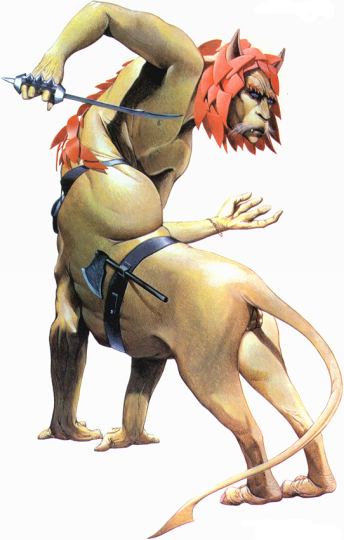
Fire Time was one of the less exciting drawings in Barlowe's Guide. Unlike Cycle of Fire, here Barlowe chose the more familiar "cold" life form over the more alien "hot". Maybe in the interest of balance? Whatever the reason, an Ishtarian is essentially a centaur with some extra bells and whistles. Barlowe also forgoes much texturing on the pelt, which is described as being "mossy", as well as rather smooth looking leaves. Normally he goes for as much as possible, making this an odd piece. The face reminds me a bit of one of those samurai helmets with the moustache on it.
This 1974 book by Poul Anderson (1926-2001) is in many ways standard Anderson, which means it's a good adventure story as well as solid science fiction--with some engaging characters, both human and alien. I have to note that I have long been a fan of the Scandinavian-American author, his early work, "Star Ways," the first of his many books that I read. My favorites among his books are " Tau Zero," "The High Crusade," and "Brain Wave." I've also enjoyed his Future History series which includes stories involving Imperial Agent Flandry and also his Time Patrol series. In this one--and I can't believe I have not read it until now--Anderson does some great world-building with his planet Ishtar. A small human colony has been established on this Earthlike world. And they have established good relations with some of the aliens of the planet. The Ishtarians are a centaurlike race who are, interestingly enough, superior to the humans in many ways as they are more powerful, faster, and much longer-lived. But they have a major problem--every 1000 years, an event called "the Fire Time" occurs when a giant red star called the "Demon Sun" approaches the planet. The planet is scorched, driving people south and bringing about the collapse of whatever civilization had developed. But, with the help of the humans and their magic technology, the civilized Ishtarians can hope to hold off gathering barbarian hordes and save their civilization. BUT the humans on Ishtar have a problem as well--Earth has gotten into a war with an alien species and it looks like the human colony on Ishtar will be caught in the middle of a war in space, a war they don't believe in....
Having read several Poul Anderson books now, I conclude that he stands out the most for his science fiction fantasies. Putting space ships and interstellar war alongside the domestic social and political problems of an alien race, Anderson makes the resulting civilization look natural. In fact, what he does so well is to give us familiarity through all the exoticism. He picks timeless and (apparently) universal emotions and goals, sets them in a future with far different possibilities and options, and leads us readers through an adventure where we understand the stakes, see the interconnections with our own time and world, and get fully caught up in the fanciful tale. For the bulk of the telling, this had great interpersonal conflict, based as it was on the limitations one has in pleasing others when hemmed in by constraints. There were some thoughtful and well-designed conflicts which left everyone in the book angry but which put the reader in sympathy with all of them. Written as it was in 1975, Cold War themes structured the story. This was a nice addition except that it became more and more obvious that Anderson was writing to entertain, not to speculate. The tensions and allegories and lessons from the real world were the product of a talented writer, not of someone wanting to make a statement, educate, or provoke. By the end I was embarrassed for having taken the book and its conflicts and scenarios more seriously than Anderson did.
Fire Time is the grand science fiction sense of wonder at its finest. It has hard science fiction elements, dealing with real possibilities of what biologically, geologically and sociologically happens to a planet when it has three suns to contend with. It has space opera elements as humanity is dealing with a far off war with another alien species. It has fantasy elements, as the main alien species, the Ishtarans, are comprised of centaurs who act rather Roman-esque in their honor code and fighting, and are at typical fantasy level technology. Fire Time is a striking blend of different sub-genres that is refreshing to read on a lot of levels.
The story opens and closes as a “story within a story”, a trope that I find rather fun. Someone is in front of a tribunal for violating Federation laws of non-interference, just like we’d expect to see in latter Star Trek: The Next Generation if Picard violated the prime directive, and I have to think that given Gene Roddenberry’s love for science fiction and this book’s prominence in the 1970s, that he may have drawn from Fire Time as a source for the larger world building of Star Trek that occurred in the 1980s.
Once into that framework, we’re thrown directly into an alien perspective. I found this jarring at first, and a bit difficult to read, which almost deterred me from reading the book. When it switched perspectives to a human again, a naval captain who was about to be stationed on this planet with three suns, I found that Mr. Anderson has an uncanny ability to separate his own voice from the voices of his characters, which, as this book unfolded with several viewpoints, made it all that much more intriguing. The aliens certainly had their own culture, and though they had a lot of humanity to them, felt like a truly distinct species, which I appreciated.
Mr. Anderson takes a lot of risks in the story as well. It doesn’t just stick in with our conflict, but tells us a lot of the goings on in human politics, especially with a war raging outside their space, of which this planet is deemed “strategic” for a base to service that war, even though it is remote and nothing of the sort. The perspective shifts are used to give us more of a global sense of the world around us, and it made me interested enough in this world that I would read other stories set in this larger world, which did originate from a different novel, The Star Fox. I had not read that, but enjoyed this book thoroughly without that backstory. It was very self-contained.
We see some perspective shifts that we wouldn’t encounter in a modern novel: a debate back on Earth over the war, formatted as a transcript and encyclopedia style history of Earth’s war with a starfarring alien race, a shift to a character in combat in the outer world for one chapter, another transcript style chapter of a couple of our main characters being recorded over an open line by the military on the planet Ishtar where this is set. As I said, Anderson took some risks, and they paid off in the way the reader connects to this story and sees a bigger world.
Thematically, Anderson does touch on some interesting human ideas. Every thousand years barbarians come and destroy civilization is a reflection of our own human culture in a lot of ways. There’s a strong anti-war sentiment which probably stems from this being written toward the end of the Vietnam war. The war outside Ishtar is often described as pointless, frivolous, with characters not understanding why we’re involved or putting our resources there. He doesn’t condemn all war in a hippie-pacifist manner, though, as the humans acknowledge that the fighting of the Ishtarans seems to have real purpose. A heavy theme of the individual defying government orders to do what’s right permeates through it, and what’s right isn’t necessarily what feels good or moral in the end either.
There’s some interesting romance in the book which adds a sense of realism to it, also showing our characters as flawed and not the user-heroes of a lot of the work we’d read in fiction prior to the 1970s. This sort of moral experimentation was going on in a lot of books at the time, though Mr. Anderson doesn’t get preachy like Heinlein with bizarre relationship structures, instead presenting infidelity as things that just happen, and the characters’ feelings reflect that there is both good and bad in that.
This science fiction novel by Poul Anderson may be some kind of answer or echo to Hal Clement’s Cycle of Fire In both cases, the story occurs on a planet that undergoes cyclical heat waves that nearly wipe out life on the planet, yet a hardy species of alien life perseveres and manages to establish a kind of civilization, which also follows cyclical patterns. Anderson’s version is somewhat more mundane (the creatures don’t metamorphose into a completely different form of life during “Fire Time”) but also somewhat more believable (the aliens don’t use crossbows on enemies that can’t be killed by piercing).
I found Anderson’s writing somewhat tough to slog through, but ultimately rewarding. He does a good job of putting some of the narrative into the words that aliens would use – but before you’ve even gotten a sense of what the aliens look like, this takes careful parsing. His prose tends to be detached and analytical, so you don’t notice the depth of the characters he’s developing. At first, I thought they were fairly generic and interchangeable, because he doesn’t give you much insight into their motivation as he describes their actions, but ultimately their actions start to speak for themselves. I was particularly impressed with the way he wrote the adversarial characters (I’m hesitant to label them “villains”), who become highly sympathetic as you get to know them, even as you realize that they are a threat to the protagonists. Similarly the aliens seem to be pretty generic “fuzzies” or leonide centaur beasts, but as you get to know more of their physiology and culture, you come to see that Anderson has thought them out more completely than it first appeared.
I wouldn’t rank this as among the very best sci fi of the period that I’ve read, but it was worth a single reading for me. I suspect aspects of it will stay with me and make me curious to see more of Anderson’s writing in the future.
Despite the corny cover art, this book was surprisingly good.
The Foreword brings the main characters, who are on trial on Earth, into the chamber of a just judge, who asks them to tell their story.
Then, most of the action takes place on Ishtar. It has three suns, one a red giant with an eccentric orbit that passes close enough to the planet to threaten life - particularly in the northern hemisphere - every 1,000 years. It's that time - Fire Time.
A group of Northern Ishtarians starts a war in an attempt to gain territory and survive Fire Time. The Southerners want to defend their territory. The human inhabitants are allies of the Southerners. However, they are unable to provide help because the Navy from Earth sets up an outpost on Ishtar for a war across the galaxy and requisitions all their supplies and weapons.
The characters are all sympathetic - Northern and Southern Ishtarians, human Ishtarians, and Navy Earthlings alike. The sadness of war is clear and the ending poignant without being tragic. And Anderson did a really interesting job creating the biology of Ishtar.
I read this book back in the drought of 1987. It helped me appreciate the experience a little better. I have so many books that It would take a novel to write a review on each one. I do like this writer and thisismy favorite book from him.
Poul Anderson achieves the magical feat of making a sequel that eclipses its predecessor with this 1974 novel that serves as a vague canonical and strong thematic sequel to his 1965 novel *The Star Fox*, which I read only a few weeks before this. It's been a few weeks since I've read this volume myself so I'm not sure if this review will be up to my usual quality, but whether or not it is I can assure you that *Fire Time* improves on just about every imaginable element - plot, worldbuilding, prose, etc - of *The Star Fox* with this book.
It starts by introducing the framing narrative of a few humans telling their story to Daniel Espina, Tribune of the human race - in simple terms, the embodiment of the human government's sense of justice. They're being tried for crimes which become gradual over the course of the rest of the book, which centers around the planet Ishtar, home to both a native species and human colonists who are running scientific studies and who have become friends with many of the southern Ishtarians. That being said, one of our main characters is a *northern* Ishtarian named Arnanak, who's gathering forces to fight the southerners before the coming of something roughly translatable into the "Fire Time." Our primary southern Ishtarian viewpoint is from Larreka, a captain of the "Gathering" which is being targeted by Arnanak. He seeks human help from the colonist's capital town of Primevera against both the Northerners and the impending Fire Time. Despite the assistance of a young woman named Jill Conway, whose bloodline Larreka befriended several generation ago, he's told by the disgruntled townspeople that because Earth has recently gotten into a war with an alien species, they might not be allowed to help; this eventual roadblock is set in place by Yuri Dejerine, captain of a human starship put into orbit around Ishtar in order to use Ishtar's human resources towards the war effort in the most efficient way possible even though it's a backwater world out of the path of war.
Next on the agenda is for the citizens of Primevera (like Jill and scientist Ian Sparling, who has a bit of a crush on Jill) to try convincing Dejerine that resources can be spared to save the Ishtarians from the cyclical movements of their three suns burning their civilization back into the barbaric ages of the north. This is . Bit of a doozy, ain't it?
The first thing I'd like to say is that Anderson totally wrote this book in homage to Hal Clement. This is rather plainly stated in the the dedication (which reads "For Hal Clement, worldsmith"), but it's equally apparent in the kind of world Anderson has made Ishtar with these complex orbital mechanics (akin to, say, the strange gravity and atmospheric properties of Clement's Mesklin or Tenebra) and the clashing native tribes which have unique physiologies and political relationships with each other. It's a coincidence that I've read Clement's three "Mesklin novels" over the last couple months (*Mission of Gravity*, *Close to Critical*, and *Star Light*, all good books), but a fairly helpful one because it helped me appreciate the Ishtarians' their feline-esque twist on centaurs, their manes of leaves, and all that good stuff more than I would've. The aliens definitely aren't the most alien and intriguing and awe-inspiring that I've seen written about, but they are interesting and the different factions of them have satisfyingly distinct relations to each other and the humans, which actually end up invoking much deeper themes than I expected them to.
*The Star Fox* was written during the Vietnam War and can hardly be read without thinking about that conflict. Anderson's whole view of the affair is rather militant and wouldn't gain much sympathy from readers today - the anti-war protestors are called the Militants for Peace and kidnap the protagonists' daughter, after all - but *Fire Time* seems to be riffing off American conflicts and interests in the Middle East and gives more cautious thought to the threat of violent conflict. I'd even go as far as to call it an anti-war novel, which won more affection from me as it will likely do for most of the people reading this review. There are good people on both sides, not just child-nabbing terrorists, which helps flesh everything out and make for a more engaging narrative.
This narrative is also more engaging than the first book's because both the prose and plot are more complex, smoother, and just better overall. The prose in this book uses more complex sentences and just seems to have a variety of structure and a sense of smoothness. It wasn't amazing wordsmithing, but it was pleasurable to read. The plot is probably smoother than *The Star Fox*'s because this was written as a novel and not as a fixup, but even so, it's got more layers between the different human and Ishtarian factions and successfully remains aware of the central crisis of astrophysics that threatens our characters' lives. At times, though, this crisis could be a bit confusing to read about; for example, each different vector of Ishtarians has different words to refer to all the different suns and the crisis they will bring (which can make for a confusing read, especially when expecting a lighter Anderson adventure), and I really would've loved a map to explain the north and the south and all of the physical locations covered a bit better. I just didn't always have as smooth of a reading experience as I would've liked to with just an elevation in writing and plotting proficiency.
The last notes I'll make will be on the characters. As implied before, they're solid and didn't bother me, but I also didn't find Anderson's person-painting prowess too enviable. The aliens are good and have that engaging streak of Poul Anderson nobility you find in a lot of his works, but they never feel too alien, and the humans never feel too complex. The character I'd honestly have liked to hear more about would be Ian Sparling's wife, but I never really minded reading about Sparling or Jill or the mayor. They were fine. If you don't like love triangles than I might not recommend this book for you, but aside from that naggle, everything in this department should be just slightly nicer than the otherwise "serviceable" label.
Overall, while I considered giving this book an 8/10 to one-up its older brother's light 7/10, I just can't put this book on that level with the kind of reading experience I had, so I'm giving it a strong 7.5/10. It's a good book that you don't need to read *The Star Fox* for (the only connection is that one character from that book appears in a radio broadcast on this one), and I'd recommend it if you come across it, even if other books have done anti-war war and Clement has done, well, Clement, better. I enjoyed my time on Ishtar and will keep a working eye out for other Anderson books in the wild, and I hope you will too.
To be fair, this isn't my typical kind of book. Poul's written things I've enjoyed and he's Poul, so this has been in the TBR for a long while and I needed a pool read. Did its usual sci-fi-space-science stuff that hold zero interest to me so I skimmed most of that. Killed off the best character, and another decent one, and turned a couple others into dreamy lovebirds. There were kernels of entertainment here, but the whole was not enjoyable.
Eine kleine Menschenkolonie lebt auf einem ET-Planeten. Die Bewohner sehen wie Zentauren aus. Sie sind technisch auf antikem Niveau. Aber sie leben Jahrhunderte und sind geistig und emotional stabiler als Menschen.
Original: Fire Time. Für die 240 Seiten hat Anderson einen riesigen Aufwand fürs Worldbuilding betrieben. Leider lässt er es alles raus: seitenlange Beschreibungen über Hintergründe: Geschichte, Biologie, Astronomie. Info-Dump-Alarm! Das störte mich am meisten. Aber auch davon abgesehen hatte ich Mühe, in den Roman rein zu kommen. Irgendwie ging mir vieles am A... vorbei und ich habe einige Absätze oder auch ganze Seiten übersprungen. Allerdings hat der Roman schon auch gewisse Qualitäten.
This story is a little reminiscent of Asimov's Nightfall (perhaps in the opposite direction, heh) but not as good. The overall sci-fi setting is interesting and definitely boasts some intriguing elements. However, the characters are mostly flat and the plot is a bit...I don't know, lacking? And it ends kind of abruptly. Not very memorable, I'm afraid. But again, there were certain elements and details that stood out to me as pretty cool or clever and they've stuck in my mind a lot more than the plot or characters.
Oh - I also rather enjoy the artwork on the cover of the hardcover edition. Not sure who the artist was - Anderson himself? - but it's cool.
This book is a bit of a mix. At 250 pages it is both too developed and under developed. There is enough of the main story; maybe even too much as sometimes the book drags. On the other hand, the planet and alien life Anderson developed for this book were interesting and could have been expanded out for a much longer science fiction novel (Note: Ishtarians are depicted in Barlowe's Guide to Extraterrestrials.)
One of the better Andersons I've read. Like always, a massive saga crammed into a tiny book, but this one is structured better with fewer gaps. A multi-POV look at a planet of humans and aliens, again, with compelling trappings of war and romance with all of its moral gray areas. Deserves more stars if only I had been more interested.
Classic science fiction with all that entails. That being said, the world of Ishtar and its sophants is quite fascinating, very well drawn; Anderson getting to call upon both his knowledge of history and extrapolating what various changes in biology would mean for a species. Not sure if the plot holds up to the promise of the world-building but a good read all the same.
This entire review has been hidden because of spoilers.
Anderson had a knack for developing alien species without losing out on the adventure that made his stories so much fun. This is a wonderful view into an alien culture on a planet with a much more elliptical orbit around its sun than Earth has.
It feels like you're dropped into the middle of a fully informed universe, one that is pretty complicated. That's great, except when there's so little exposition that you're just confused until the last third of the book.
Addresses an impending disaster on a truly alien planet from various points of view. A little dense and difficult to get into. I had trouble figuring out what the stakes were and why I should care. Your mileage may vary, obviously. Lots of people really like it.
For every high point, there were just as many low points in this book. Several passages were gripping in the tale the wove of two species surviving an essential apocalypse, while others are just as forgettable.
What happened to the idea of developing the idea of fire time? They decided not to develop that and instead focus on a love story about infidelity. Awesome. Not impressed.
As I remember it, I picked up Fire Time at a used bookstore a few years ago thinking it was a fantasy or sword and planet. It is not, being rather very much hard science fiction. (The High Crusade is the only other Poul Anderson I’ve read, but apparently Anderson wrote fantasy, space opera, and hard science fiction all.)
Fire Time takes place on a planet far from Earth. It is the rare planet inhabitable by humans, but their presence is largely limited to scientific work rather than any real colony. The planet is primarily inhabited by sapient lion-centaur creatures with a sword-and-shield level of technology. Habitation is spread across two large continents, one in the northern hemisphere and one in the southern hemisphere, with an island archipelago in between.
Humans largely stick to the south, the civilized continent. The Gathering, the loose federation of lion-centaur groups, extends into the southern tip of the northern continent, but it is mostly given over to barbarians. The civilization-barbarian divide is a product of the setup of the local solar system. It has three suns, and one causes serious problems when it gets to close. Unlike the Three-Body Problem, the problematic sun here at least is reliably so, causing a cataclysmic Fire Time (lasting several decades) every 1,000 years. Only the northern continent becomes inhabitable, but the southern continent faces its own cataclysmic refugee crisis every Fire Time.
This time promises to be different due to the human’s advanced technology. There are just two problems: Home-world politics means no help from outside the planet will be forthcoming and, indeed, normal supplies will be cut and on-world resources requisitioned. And a barbarian leader has welded the northern tribes into a fearsome force he intends take south as soldiers, not refugees.
It is big, world-spanning stuff, with lots of hard science fiction exposition, but the story focuses on five characters: the military officer sent to enforce the political decisions made back home, two native humans (one male and one female), a lion-centaur military leader from the Gathering with avuncular ties to the female human, and the lion-centaur leading the barbarians.
Fire Time was published almost 50 years ago but remains highly timely, dealing as it does with imperialism and refugee crises and climate change. Which isn’t to say that it is the sort of book that could be—or at least you would expect to be—published today. It doesn’t track simplistic contemporary orthodoxies and is the better for it. Take the imperialism angle. Earth (ruled by a single government) is embroiled in a war in a colony world it was largely dragged into by the colonists. It is very concerned about perceptions and what they might mean for that war effort. The planet where the story takes place is a backwater that doesn’t figure much into Earth politics, but its politicians don’t want to be seen as imperialistic by interfering in the affairs of another planet. Even if that “interference” would mean working with the Gathering to dramatically reduce the suffering from Fire Time. It’s complex and realistic, recognizing both that politics can make for bad policy and that just because somebody can slap “imperialism” on something doesn’t mean it is bad.
Your Mileage May Vary depending on how hard you want to dork out on the hard social science fiction aspect and the hard science fiction aspect. I’ve barely mentioned the latter, which tells you something about my own preferences, but there is a lot for the hard science fiction fan to dig their teeth into, from the lion-centaurs’ “manes” made of symbiotic plants to a parallel evolutionary track. I was mostly ambivalent, with my enjoyment being driven by the hard social science fiction aspect and the characterization, both of which are really good. I would also have preferred more action.
Poul Anderson was one of the most versatile writers of his generation. At a time when many pulp authors were restricting themselves to either science fiction or fantasy, Anderson was finding success within both genres. The more futuristic side of Anderson's writing also ran the gamut from "hard" sci-fi to bizarre, New Wave-influenced space opera. Unfortunately, my appreciation for Anderson's diversity is undercut by a growing recognition that his more sci-fi-oriented works have aged poorly: it's hardly controversial to say that Anderson's clinical prose style is an acquired taste, but I'll go one step further and say that his general approach to sci-fi plotting feels rather outdated. And that bring us to Fire Time- a relatively obscure sci-fi novel from 1974 that epitomizes both the best and the worst of Anderson's style. A novel that's equal parts brilliant and frustrating, with a bizarre world that's likely to stick with you far longer than its actual storyline.
Fire Time falls somewhere between high-concept sci-fi and space opera. More specifically, although the plot is driven by the actions of several characters, those individuals routinely take a back seat to Anderson's detailed worldbuilding. And it's via its setting that the novel truly stands out. Fire Time is centered upon the planet of Ishtar- a frontier world in a multi-star system where the approach of a second star (every 1000 years) periodically makes the planet's northern hemisphere unlivable. This spurs massive migrations among the planet's pre-industrial inhabitants- an incredibly long-lived species of centaur-like quadrupeds, and the story picks up just as the next "fire time" is about to begin. The only difference this time around is that humans have established a research colony on Ishtar, and those colonists have the ability to preserve society amongst the more civilized, southerly Ishtarians. But will the humans become directly involved when a charismatic northern warlord launches a massive invasion? And will the humans even be allowed to help when a brewing interstellar war necessitates the establishment of a Terran military base on the planet? An incredibly high stakes situation for both the native Ishtarians and the "nativized" human researchers.
As alluded to above, I adored the worldbuilding in Fire Time but have mixed feelings about everything else. First for the positives. Fire Time is a one-of-a-kind read. In particular, although the novel's climatological/ethnographic focus obviously owes a lot to Dune, the details here are entirely different and Anderson is far more scientifically rigorous than Frank Herbert. Hell, at one point there's even a quasi-academic about the evolution of parallel ecosystems in northern Ishtar, due to the presence of animals that metabolize distinct sets of proteins! On a related note, it's amazing how much detail Anderson packs into such a small book: at barely 200 pages, Ishtar might be more fully-realized than any sci-fi world of its era that isn't named Arrakis. And there's an awful lot of intriguing stuff here that's only tangentially related to the underlying plot. I would've loved to have read a follow-up novel that focused upon the sarcophage microbes or the billion-year-old terraforming attempt by travelers from the nearby planet of Tammuz.
All of this makes it even more frustrating that Anderson's execution is so uneven. These issues begin with the prose style: although Anderson's convoluted sentence structures and slightly literary vibe work well enough in a classic fantasy tale like The Broken Sword, in Fire Time I found his writing to be unnecessarily difficult. This definitely isn't a book that you can breeze through, despite its abbreviated length. Anderson also spends way too much time on what is easily the least interesting aspect of the plot, namely the affair between Jill Conway and Ian Spalding. In general, the Ishtarian characters are far more interesting than the humans, and Fire Time probably would've worked between is it was exclusively written from the perspective of the natives. The end result is a novel where the extended info dumps are far more engaging than the actual plot. And although Anderson is great at info-dumping, that's not enough for the novel to earn more than a 3-star rating.
Fire Time should please readers who are already a fan of Poul Anderson's style, but I'd hesitate to recommend the book to fans of modern science fiction. Even lovers of classic, 60's-70's-style science fiction can find friendlier places to begin their exploration of Anderson's massive catalogue.
Enjoyed this 1974 effort from Poul Anderson tremendously.
The cover implies a militaristic space opera, and in limited moments such action exists, but for the most part, Fire Time is a philosophical hard science fiction meditation on the tragedy of war and the simultaneous difficulties in achieving peace between opposing factions when all have reasonable justifications for their wants and actions.
And Anderson's world building is top-tier here, crafting multiple alien species with distinct, rich cultures, two distinct eco-systems on the same planet born of vastly different evolutionary starting points, and a complicated political infrastructure.
It's been said the Israel Palestine conflict was front of mind when Anderson wrote this book and it feels that way. Reminded in some odd way of Steven Barnes Lion's Blood with its collection of honorable, principled but politically pragmatic individuals put at odds with each other by circumstances beyond their control.
A few quibbles - Anderson's unrelenting references to female protagonist Jill Conway's exceptional beauty are sure to elicit groans from some contemporary readers - but otherwise, well worth reading for both the hard SF skill and measured sociological ruminations.
I am generally a Poul Anderson fan, but this is not one of his better outings. It is mildly incoherent in plot and character. No thread is particularly well developed, and some just sit there undeveloped, unclear whether or not they are interesting. I suppose we will never know. It reads like a cheap pulp fiction pot boiler but decades past the heyday of those. There are glimmers of greatness that last a page or two, particularly a treatise on alien biology starting on pg 76 of my edition and running a couple pages of wild-eyed ideas. Not too plausible but plenty interesting, and a respectable stab for Anderson, whose background is physics, not biology. In other places cheap writing shows through that would be embarrassing at any stage of his career: "You're looking good. Kind of thin: but, you know, that sun-bleached hair against that sun-tanned skin, your damn near a platinum blonde." Ugh. That didn't look good even when published in 1974. Surprisingly with that kind of prose, there was no romance beefcake cover pose featuring Fabio. I expected more of Anderson. But it does get two stars for interesting ideas, if weakly executed.
Clearly a post-Vietnam novel, Poul Anderson's Fire Time (1974) questions the validity of war - or certain wars - by giving his story twin wars, both among locals on planet Ishtar, and in the wider universe between humans and another alien species. The war out there affects things "at home" in a way that pushes the characters into difficult choices. But that's almost an excuse for world-building. In Ishtar, Anderson creates a planet under stress from a three-star system, and imagines how life might have evolved there. We're often in the Ishtarians' heads, but there's little succor from the human characters because the future is an alien place too. We're halfway through the book and still getting expository bits about the planet and its denizens, or else the side-war and ITS locales and participants. No wonder he dedicates it to Hal Clement (the hardest man in hard sf). And yet, once I got my bearings, I wanted to learn more about this intriguing world and see its protagonists safe and successful. And I was kind of sorry to leave Ishtar behind, some of its mysteries unsolved.
Anderson writes of a planet in a long-period binary star system facing a once-every-thousand-year climatic disaster from a close passage by both stars. The intelligent natives are divided between a loose "civilized" confederation and "barbarian" tribes outside, both jockeying for position for survival and strength in the aftermath - and both trying to play off the half-unknown factor of the new human scientific and military settlement.
Anderson narrates from all three points of view, very sympathetically. The buildup took longer than I would have preferred, but the setting carried things until the plot more than redeemed itself in the second half of the book.
Este es uno de esos libros donde el escenario te encanta, pero la historia no acaba de atraparte. Le ha faltado esa pizca de energía que te permite continuar capítulo tras capítulo y no aburrirte, deseando que acabe el libro. Los personajes son fantásticos, al menos a nivel de biología, pero carentes de cualquier carisma que te haga hacerlos actuar en la mente.
Si te gustan los mundos fantásticos y las genialidades genéticas, este es un libro cuyas especies de no te defraudarán, pero la historia, deja mucho que desear.
I normally like Anderson's work but I couldn't get into "Fire Time." I wasn't attached to any of the characters and I couldn't really care about the circumstances. It was as if the book never became more than a collection of words, sentences and paragraphs.
The premise is interesting, but so many involved details were thrown into the mix and were never adequately expressed in such a short book. Anderson might have taken the time to flesh this out more and present a tale that hooked the reader on a human level.