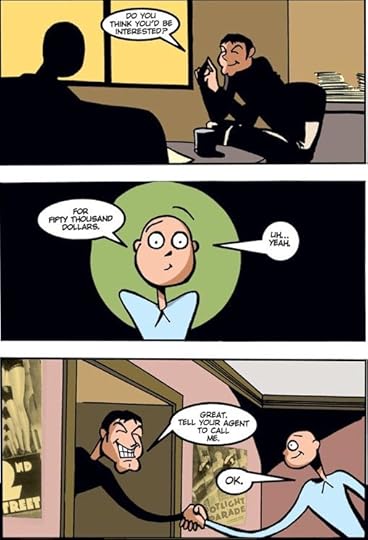
ENTERTAINMENT WEEKLY gave him an A, Hollywood insiders fell all over themselves to praise him, and fans everywhere gave him a full thumbs-up for hilarity. Now, on the heels of his praise and punishment, Brian Michael Bendis puts his sold-out miniseries, FORTUNE & GLORY, into one hefty volume. Marvel once again at the stupidity of Hollywood producers, the vanity of stars like Uma Thurman and Clint Eastwood, and the enthralling mood swings and ego nosedives of a little indie comic-book creator caught up in the maelstrom of the motion picture industry. Presented in a handy 6" X 9" format, this collection features brand-new pages left on the cutting room floor and not included in the original comics. The individual issues are becoming increasingly hard to find, and that's because everyone who read it didn't like it, they loved it. Featuring an introduction by Paul Dini, who himself knows a thing or two about the Hollywood machine.
A comic book writer and erstwhile artist. He has won critical acclaim (including five Eisner Awards) and is one of the most successful writers working in mainstream comics. For over eight years Bendis’s books have consistently sat in the top five best sellers on the nationwide comic and graphic novel sales charts.
Though he started as a writer and artist of independent noir fiction series, he shot to stardom as a writer of Marvel Comics' superhero books, particularly Ultimate Spider-Man.
Bendis first entered the comic world with the "Jinx" line of crime comics in 1995. This line has spawned the graphic novels Goldfish, Fire, Jinx, Torso (with Marc Andreyko), and Total Sell Out. Bendis is writing the film version of Jinx for Universal Pictures with Oscar-winner Charlize Theron attached to star and produce.
Bendis’s other projects include the Harvey, Eisner, and Eagle Award-nominated Powers (with Michael Avon Oeming) originally from Image Comics, now published by Marvel's new creator-owned imprint Icon Comics, and the Hollywood tell-all Fortune and Glory from Oni Press, both of which received an "A" from Entertainment Weekly.
Bendis is one of the premiere architects of Marvel's "Ultimate" line: comics specifically created for the new generation of comic readers. He has written every issue of Ultimate Spider-Man since its best-selling launch, and has also written for Ultimate Fantastic Four and Ultimate X-Men, as well as every issue of Ultimate Marvel Team-Up, Ultimate Origin and Ultimate Six.
Brian is currently helming a renaissance for Marvel’s AVENGERS franchise by writing both New Avengers and Mighty Avengers along with the successful ‘event’ projects House Of M, Secret War, and this summer’s Secret Invasion.
He has also previously done work on Daredevil, Alias, and The Pulse.
Brian Michael Bendis gives us a humorous, first-hand account of his initial foray into Hollywood. This was from when Bendis was still an indie darling, before he become the comics juggernaut he is today, first at Marvel, and now at DC. He was shopping around his first graphic novel A.K.A. Goldfish with comedic results. Everything sounds promising until he realizes everyone in Hollywood is full of shit. For those of you not in the know, Bendis used to actually draw all his own comics as well. He gives the book a nice comedic look that works well with the farcical but actually true story.
I am really impressed with this book. This is a side of Brian Bendis that one rarely see this days. Aside from the fact that he rarely draws now and instead focuses on his writing; his work is mostly Marvel now. We probably won't see Bendis' indie side anytime soon. I know he can draw and it's mostly of a noirish bent (Goldfish), but I've never seen any of his cartoony artwork until I read Fortune and Glory.
It is also a funny book, and though Bendis' Spider-Man can crack wise, Spidey got nothing on Bendis here. I really like how he gives a funny spin to his Hollywood experience shopping his scripts to studios.
One gem I will share was when Bendis was asked to rein in his Bendisism, or his predilecton for wordy dialogue. It's funny how he's aware of it; it's probably his most known tic on his comics work.
I really enjoyed this book. It's light reading which is really un-Bendis like. I hope he does more work in a similar vein.
Brian Michael Bendis' fictionalised dramatisation of what happened when one of his comics attracted the interest of the big Hollywood studios in 1998-99. Bendis details the scriptwriting process, 'taking meetings', 'green lighting' and other related processes involved with turning scripts into multi million dollar movies with satire and humour. 6 out of 12.
Fortune and Glory details Brian Bendis’ personal experience trying to adapt his comic Goldfish for the big screen. In it, he depicts Hollywood as this strange other land, one which constantly surprises while also living up to every stereotype we’ve all heard about it. Bendis also provides the artwork for the comic, a dramatic deviation from his creator owned work Torso while also feels stylistically similar in a really unique way.
From the first page, Bendis grabs readers here with his meta humour. Fortune and Glory is a much funnier book than Torso. Its source material enables it to inject natural meta comedy and commentary throughout. The plot and writing feel very personal, due to the story being aggressively autobiographical. You’d think a comic with non-sequiturs would read poorly, but Bendis’ writing style invites the reader’s attention by how personal he’s being. Bendis develops a pretty interesting dichotomy between himself and Hollywood. He depicts himself as a relatively homespun and sometimes naïve person, one who should feel uncomfortable in the boring meeting rooms of Los Angeles, but he is also depicted as being straightforward. Oftentimes this leads to a connection between himself and whichever Hollywood executive he’s talking to. For all the flack Bendis receives for his “Bendis speak,” which involves a lot of dialogue with much back and forth between characters, it’s a very effective way to structure a scene. This is doubly the case for this kind of story, where conversations with Hollywood executives go on for a long time, often with little of value ever being said.
If you’re also interested in reading Bendis’ perspective on his own work, I’m glad to report he delves into his origins as a comic book creator as well. He documents his various projects, even at one point explaining the origin of Torso, and he skillfully ties all of this into the story at hand and how it relates to his love affair with Hollywood.
As a time capsule, this provided some unique insight for me. More so than Torso, this comic showcases Bendis’ career at a certain point in time. He is arguably in his creative prime here, telling the story he wants in the way he wants it told, and he understands his personal relationship with his readers since this work is independent. It’s like he’s making this comic for you, sharing his personal anecdotes with you and taking you along for the ride. There are shades of Scott McCloud’s Understanding Comics, with Bendis’ directly addressing the reader.
Bendis’ art also feels radically different than Torso, which made very liberal use of inks and shadows, with vague expression-work and a large number of panels. With Fortune and Glory, Bendis clearly took a more cartoonist approach to the story, with easily-definable linework and expressive characters. Bendis in particular, as depicted in this comic, is a much more lively character than anyone in Torso. There are a lot of repeated panels in this comic, and, coupled with his traditional fast-talking dialogue, this is a masterfully-paced book. There is never a dull moment, and the great facial expressions he gives his characters oftentimes had me chuckling like an idiot.
Overall, Fortune and Glory comes highly recommended. Bendis’ early comics are some of the most unique and vibrant comics you’ll ever read, and this is no exception. The storytelling is fresh, the writing electric, and you just may find yourself laughing out loud more than once.
As an insider’s look at the demented and often sad process of Hollywood deal-making (to borrow from The Breakfast Club’s John Bender), the book is insightful and darkly funny. However, while I appreciated the insiders POV, ultimately I found myself only mildly engaged, likely because I wasn’t familiar with Bendis. Fans of his work or Marvel comics in general might enjoy this more, but for me, it was just okay. Still, it offers a unique peek into the absurdity of the Hollywood machine.
The book depicts his experiences navigating the labyrinth of development limbo—boring meeting rooms populated by people “straight out of a Coen Brothers casting call”, fueled by “nicotine, caffeine, and a palpable sense of desperation.” Bendis characterizes the lottery-like nature of selling scripts (in a town that only buys a select few each year) comes with the added bonuses of rejection and humiliation. If nothing else, the struggle provided plenty of material for this graphic novel, which leans heavily into its meta nature. But I bet people who would like it would really like it! 🙃 You’re welcome for this useful advice!
Took some time to get into it. Normally can breeze past a comic, but as lots of dialogue slowed the pace down. The paneling is 50/50, good in some parts and not so much in others.
Provides a good insight into Hollywood meetings and journey artist goes through to get their project greenlit. The inanity of some development executives is truly surprising. Can now understand why so many bad movies get made.
An interesting peek into the workings of Hollywood however and the different subject does make it a unique read.
Brian Michael Bendis, graphic novelist extraordinaire, makes with the funny as he tells the tale of his initiation in to the Hollywood life after making a splash with his early indie comic work. It's funny and self deprecating and heavy on the mocking of Hollywood executives but there's nothing here that anyone who has read almost anything honest about Hollywood before hasn't already heard. And the drawings are really cartoony, not at all like the gritty black & white stuff what he became famous for.
this was a cool idea and definitely had some really fun art but a lot of it was just like “so i went to this office” and just phone calls and boring conversation. i get that that’s basically what hollywood is but i just wasn’t into how it was being told. maybe i’ll pick it up some other time but as of right now this ain’t for me
Funny firsthand look at what happens to get a book into the Hollywood movie machine. Bend is spun through the meat grinder of screenwriting, pitching, optioning and all the other anxiety-ridden parts of movie production short of actually getting a movie made. Great read for those of us who will never be that close to the process.
Забавная автобиографичная история о том, как Брайан Майкл Бендис (который начинал как автор криминальных и нуар-комиксов и практически ровесник Брубейкера) в конце 1990-х обивал голливудские пороги в попытках экранизировать свою книгу. Как ходил на бесконечные, часто бессмысленные встречи, как писал (и переписывал) сценарий для фильма, потом снова ходил на встречи, и ещё встречи... И чем это всё закончилось (вряд ли будет спойлером сказать, что ничем).
В послесловии Бендис шутит, что он человек дела, и в отличие от десятков тысяч других неудавшихся сценаристов, которые каждый год перемалываются и выплёвываются Голливудом, у него есть возможность обратить этот печальный в иных обстоятельствах опыт себе на пользу, выпустив по нему комикс. Неожиданно для автора комикс оказался довольно популярным (в т.ч. в самом Голливуде) и очень даже неплохим. Также любопытно было посмотреть и на то, как Бендис рисует (получше некоторых других независимых авторов).
В общем, рекомендую тем, кому хоть немного интересна внутренняя кухня большого кинематографа, а также почему на экраны попадают только римейки, сиквелы и всякая тупая шняга, а нормальных фильмов шаром покати (особенно если вы считаете, что это из-за недостатка идей и оригинальных сценариев). Прикладываю небольшое превью.
Bendis tells the story of his foray into Hollywood and the people he encounters, while trying to pitch a movie idea. He shows the odd people he encounters and the even odder process. Bendis clearly shows his frustration and agony, a real person adrift in the world of movie development. The movie-world characters seem to be caricatures, but the more you see of them, the more you realize they are probably spot-on. (Spoiler alert: no film is ever made.) His artwork is simple. His text is fun. It's a comic book, right? His flow and format is a little unusual, but adds to the idea that all this stuff is whirling around him and he is trying to maintain his composure. One drawback is that the book is digest size (6 x 9) and the text is tiny; in some places, due to the size and coloring, it's almost unreadable. This TPB collects a 3-book series.
Note: I received access to read this book from the publisher in exchange for an honest review.
It is really interesting to see the "Hollywood" writer story from the perspective of a successful comic book writer and artist. The panels don't always have a logical flow to them, especially when you are only catching snippets of certain conversations. As someone who gave the Powers tv show a shot but ultimately didn't stick with it, I found it to be an endearing look at Bendis that makes me want to read more from him.
This was a fascinating book. I've always wanted to be a screenwriter, and I love that this book takes you inside the big mess that is Hollywood and shows what it's like. Brian Michael Bendis is a fantastic writer, and he really gets you into this autobiographical story. It doesn't hurt that I'm also sort of obsessed with comic book movies.
Regardless, I think this would be interesting story even to someone that wasn't as interested in the writing as I am.
I honestly can't beleive I haven't put this up here yet.... This tale of Brian Michael Bendis' attempt to take his work to the big screen before he became such a key part of the Marvel Comics infrastructure. It's an absolutely hystericla look at the insanity that is Hollywood. Really, its not possible to describe it past that point because without the growing context it's impossible to predict the nature of the system.
This was oookay. It was a story about how Bendis went to Hollywood. The pictures mostly just a gallery of talking Bendis heads, more of a webcomic than comic book. I guess if he were actually telling me this story I'd be listening, but I grew up in L.A., there are no surprises here. I know I'll never sell my animated series to Netflix.
Not recommended unless you REALLY love Bendis. Even then, it's basically just a webcomic blog.
Before he was a huge powerhouse writer for Marvel, Brian Michael Bendis was an indie crime comics writer and this is his humorous cartoon story of going to Hollywood and pitching Goldfish as a movie. It's a lot of fun, and an interesting snapshot of him before he starting his incredible run on superhero stories. I've read it a few times, and it's never failed to entertain.
An autobiographical account of the author's misadventures in Hollywood. It is a bit word balloon heavy and repetitive, but the story is certainly funny and surprisingly illuminating. Who knew that Hollywood (mal)functioned like that? The caricature type art was perfect. I particularly enjoyed seeing the author's version of himself, as a cross between a frog and some type of demented garden gnome.
I enjoyed this title from Brian Michael Bendis, although it was incredibly verbose. To be fair, a real life story centered on someone trying to get a movie made from their work is not likely to have space for a lot of wordless sequences, but this ends up being incredibly dense for a comic. At times I thought it might have made a better prose work.
It feels weird to say that reading about someone else's heartache and aggravation was entertaining and fun, but I'm quite sure the author and illustrator intended it to feel just that way - and really, what better result can there be?
A short, funny, and insightful comic book about a comic book writer, drawn and written by the comics writer himself (one of my favorites), experiencing Hollywood for the first time as a screenwriter.
This is a scarily accurate depiction of my current life. Perfect for anyone who needs to know they're not crazy, or who has a loved one breaking into "the biz," or who wants to go to film school.