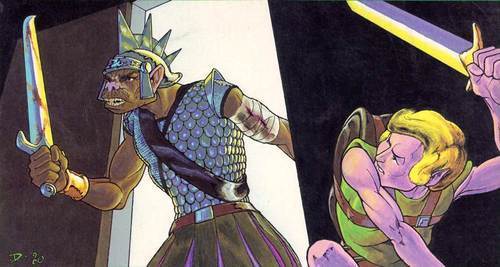
It is time to put a stop to the marauders! For years the coastal towns have been burned and looted by the forces of evil. You and your fellow adventurers have been recruited to root out and destroy the source of these raids. But beware, hundreds of good men and women have been taken by the slavers and have never been seen or heard from again!
David "Zeb" Cook is an American game designer best known for his work at TSR, Inc., where he was employed for over fifteen years. Cook grew up on a farm in Iowa where his father worked as a farmer and a college professor. In junior high school, Cook playing wargames such as Avalon Hill's Blitzkrieg and Afrika Korps. "I was primarily a wargamer, but there wasn't any role-playing available then," although in college, he was introduced to the Dungeons & Dragons role-playing game through the University of Iowa gaming club. Cook earned his B.A. in English (with a Theater minor) in 1977. He married his high school sweetheart, Helen, with whom he had one son, Ian. Cook became a high school teacher in Milligan, Nebraska, where his students gave him his nickname of "Zeb"; the name derives from his signature, which is dominated by a stroke resembling a 'Z'.
Marauding slave traders are raping and pillaging the coast! Is there anyone who can stop them?!
Slave Pits of the Undercity was one of TSR's early Dungeons & Dragons games. It was designed to be played in the tournament style and so much of the module (game book) focuses on tournament play. For instance, pre-rolled characters appropriate for such play are provided.
Perhaps because of this, the makers didn't focus as much on the plot as they could have. It was more like, "Here are some monsters to defeat. Have at 'em!"
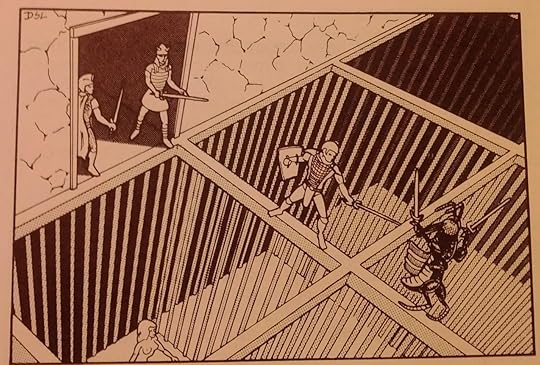
I mean, after all, this is marketed as a great, noble crusade against some particularly evil baddies. One would expect more "character" to evolve from this. A better storyline seemed all but inevitable. Instead, it's a bunch of set-piece battles and not a lot of problem solving. If anything, it's "obstacle solving": a dangerous pit to cross with a flimsy board, a beast whose gaze should be avoided, tall cages from which to rescue slaves and battle precariously upon...
A couple of new monsters, ant people and something called a sundew, were introduced here and they added a little something to the module's overall worth.
Slave Pits... other positives were that it was straightforward and easy to run, good for intermediate-level characters, simple enough for novice players, and you could seamlessly plug it into any common D&D world campaign. I was glad to do so and give my Dungeon Master-self a break from creating brand new adventures from scratch for my group, as I usually did.
Unfortunately, as will often happen with serious topics such as slavery, it killed the levity that often made D&D fun. While I was excited about playing this one, my group was not. They approached it with trepidation, retreating and quitting soon after one of the characters turned to stone. I thought maybe the plight of the slaves was getting them down, but no, not exactly. My brother, about 11 or 12 years old at the time, summed up their complaints best when he said, "I wanna go back to killing things and finding treasure!" So much for noble causes...
I recently played the second half in a tournament and it has a great mix of thinking and action. After reading it all the way through, I can see how the non-tournament version can have a lot of different outcomes. I really like how this adventure embraces the true spirit of AD&D; namely that it emphasizes player skill over what's on the character sheet. There's all these little "if the players think to ..." bits in it. For those wanting to run a low fantasy game, most of the monsters could pretty much be replaced by humans.
The first of the Slave Lords modules that go from A1 to A4, this is honestly one of my least favourite of the early adventure modules and for one particular reason. This was clearly planned for tournament play and while I understand that plot and lore might be secondary in that context, this release is mainly for people playing at home in the context of a campaign and this whole module doesn't even have a single named enemy.
There is no hook for the players and even when there are clearly interesting elements within the dungeon, such as what is clearly a temple to Gruumsh (although his name is never mentioned) the module does not use any of that for some juicy storytelling. All of the story development is up to the DM, and while that can be a good thing, it should also be an option for the DM to give the story their own style and change it at will, rather than be made to create it all out of whole cloth because of an absence of effort on the part of the module that they have acquired. What we get here are maps and general descriptions of rooms and while there are a couple of cool setpieces there is little motivation for the players if this is played straight out of the page.
Other modules in the A series would be much better about this, and later on when Scourge of the Slave Lords comes out in 1986, compiling A1 to A4, a new story is added to fill this very apparent gap. While that story might not be great, at least it's giving the DM some options. However this same month another Pit themed adventure module came out, this one starring a certain Spider Goddess which we will look at next time.
This adventure, which is a very interesting mix of underground and infiltration, appears to have been marketed mainly for tournament use. The notes for campaign use are tournament-like; for example, rather than detailing any of the negotiations that convince the PCs to take on the slavers, it simply notes that the PCs begin the game on the steps of the slaver temple.
Nor are there any notes on the slaves that the PCs are meant to save (and that are the reason the nearby countries didn’t just declare war on the slavers).
All of this, including the rewards that go unmentioned, would most likely have been slotted in by the DM to the DM’s own game world.
Also of interest, the cover image clearly shows a bearded female dwarf; this is confirmed in the list of pre-generated characters for tournament play.
This module is basically a dungeon with minimal backstory. Contains some interesting set-piece encounters and traps, and seems to follow the "old school" approach of being pretty deadly. Would be interesting to play through, but requires a large party of characters to have any chance.
I've decided to steadily purchase the 1st edition DnD (AD&D as we knew it) modules, mainly out of curiosity for those I never ran (I suspect I'll get those two for completeness sake). A1 was one of the earliest published modules, from 1980, and was similar to the others of that first cohort in being adapted from a tournament adventure (as were C1 and G1,2, and 3). the entire slaver series were tournament modules which has led to many perceiving them as too linear and 'rail-road' although I think that was only a massive issue with the latter in the series, and the supermodule A1-4 that TSR brought out (especially the link between A3 and A4). The premise of the module is that the players are hired to infiltrate the slavers hidden base in Highport and kill them, as well as gathering more intel. As you expect from a tournament adaptation it skips any time in the city and begins at a ruined temple that they think the slavers are working out of.
The upper level of the base is inside a ruined temple. There are several ways inside: the rear secret door is the usual starting place, but there's also a stable, a stonecutter shed, and a main gatehouse. Also it's possible to break in via a damaged roof into a burnt dormitory. There's a good selection of encounters on level 1, with four ways of descending to the dungeon level. Most are fairly sensible (orc guards, ghouls, a new plant monster, a magic cemetery, some harpies) with a few environmental challenges (a plank over several collapsed levels below). Some are really daft (orcs disguised as slaves, and loads of bloody dopplegangers ), including two basilisks lurking in the ruined central courtyard. Famously the east and west sides of the building don't seemingly link up, and there's no real access to the open central courtyard. Regarding the former, originally it was designed so the players in the tournament would drop into a tunnel via stairs then back up through a trapdoor into the false slaver lair (12). But the expansion of the dungeon past the more limited tournament map means that players may be likelier to stay down in the dungeon. Potentially they'd miss half of level one, depending on their way in (likely not explore the east half). With regards the courtyard, I think it was conceived that the players would possibly clamber over the ruined walls or descend after fighting guards up on the ruins of the roof? One solution I've seen is to have a crawl space or duck under a joist from the empty ruined rooms adjacent to the stairs down on the northern aspect of the temple. Or add a door I suppose, or allow a route through the bottom of the plank room (4). The finale on the ruined temple level is actually pretty cool, and it'd be a shame to miss the 'set piece' of fighting in the temple against the evil slaver cleric, and her minions. And the hidden troll (which is silly but funny). For the tournament this was the route down to the dungeon. Level two, the dungeons, is nicely designed and has some nice set pieces. It's past dirt tunnels bolstered by beams, part sewer, and part standard chambers. The second new monster, the Aspis, is well used here to give a variance from orcs and more orcs. The level is quite tough for 4th level characters, and I'd say at least 5th if not 6th would be better. The monsters are well organised and I like how the writer describes tactics. There's lots of cool encounters in here: the grubs in the surprisingly deep slurry; the sewer drain trap; the fight atop the cages; and the final BBEG battle against a tricksy thief, his pet weasels, and shed loads of orcs. Oddly neither BBEG is named. There's a link to A2 via map which could be easy to miss if the players go a strange route on level 2. It could easily be placed somewhere else to find though. By modern standards the adventure might seem too hack and slay but TBF that's what we all enjoyed in the 80s as teens. It could easily be played as a sneakier mission (at least level one can) or a deception. I think it needs some fleshing out of Highport if it were to run as part of a campaign. Overall, it is a surprisingly fun start to the series and I'd have enjoyed it in the day. Might even consider getting the 5e conversion on DMs Guild and putting some 5e players through it.
This entire review has been hidden because of spoilers.
I have a HUGE module collection so I thought I'd read a few. Started at A1! This is a tournament module and little effort has been put in to convert it for campaign use. The plot is very thin, you just rock up outside a temple, and the map and explanations don't work very well. I still have no idea how to get to the the basilisk lair! Why on Earth are the Aspis working with the orcs/humans/half orcs? I didn't realise this race was in Monster Manual II, mainly because it only has a picture of a cow, but they are actually quite a cool monster. I'll read A2 and see if it improves!