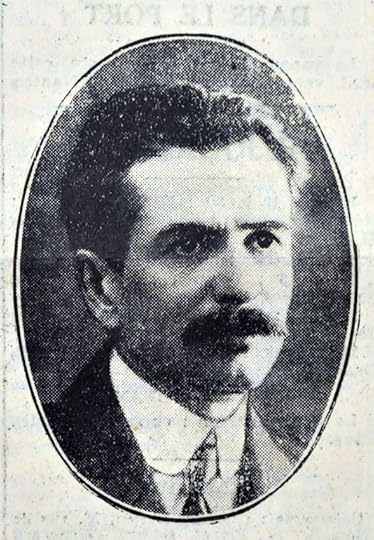
Marcel Tendron (Marc Elder his nom de plume) was a novelist, critic and art historian who spent most of his life in Nantes and its environs; not surprisingly then, it is reported that his many novels are all touched by the sea. In 1913 his fourth book, Le peuple de la mer (The People of the Sea) won the Prix Goncourt in the eleventh round as a compromise between the leading contenders, Le Grand Meaulnes and La maison blanche by a certain Léon Werth. A jury member later revealed that Du côté de chez Swann was briefly discussed, but Proust "n’avait pas fait acte de candidat."
So, what is there to say about a book that nobody remembers except Jean Echenoz?(*) Set just south of the Breton peninsula, close to the mouth of the Loire River, on the island of Noirmoutier at the turn of the 20th century, Le peuple de la mer presents a naturalistic picture of those who live from the sea - the fishermen, the shipwrights, the innkeepers, the women who work in the sardine canning factories and raise the children, merchants and customs agents. As is so often the case in small towns, the dominant emotion is envy fed by malicious gossip. But it doesn't stop at words on the isle of Noirmoutier; the book opens with an attempt to burn up a vessel under construction, an attempt providentially scuttled by the ship's anxious owner. So he names the ship Le Dépit des Envieux, and the gauntlet is cast.
In this slow moving novel full of lengthy and very apt description of the exterior of everything in sight, I was bemused to find little attempt by the author to penetrate into the interior of his characters, particularly after just finishing texts like Die Liebe der Erika Ewald by the very young Stefan Zweig, written a decade before Tendron's book and already full of Viennese Innerlichkeit. Not to mention the contemporary Du côté de chez Swann ! Nor is Tendron working out a connection between environment and behavior as Zola did decades before. There is no sign of Jean Cocteau's elegant irony nor of Andre Gide's preoccupation with morality. All is elemental, including the emotions.
Death, whose frigid shadow is sensed throughout the book, usually occurs off stage, and the fatal bad luck of some is the good fortune of the others. When murder removes central characters, not a finger is lifted nor further mention made. Life, such as it is, just goes on, even in the final section where the few who survive to retirement must watch the sea consume their sons and grandsons.
I wonder if this text - with objectified human beings having little sense of humanity or even community(**) at each other's throat verbally and literally, suspended in a perfectly indifferent and deadly Nature - could be some kind of precursor to the alienated texts written in the 20's and 30's, though those, I thought, had the butchery of World War I and the subsequent political, social and economic turmoil at their roots. Or maybe Le peuple de la mer is just a realistic look at a hard and brutish way of life.
(*) I exaggerate only a little.
(**) Except when fishermen from a neighboring town try to sell sardines to "their" factories, in which case the whole town beats the interlopers half to death and destroys their catch.
Знаком ли читатель с французскими островами? Если он прежде мог иметь знакомство с островом Уэсан, на котором происходило действие произведения «Девушки дождя» за авторством Андре Савиньона, то теперь он может познакомится с бытом жителей острова Нуармутье, что расположен на том же западном побережье, но в более густо населённом районе. Если читатель имеет представление о реке Луара, то её путь заканчивается как раз там, где возвышается над водной гладью остров Нуармутье, обречённый быть под водой, обнесённый дамбами, потому продолжая существовать. На этом острове не должны были жить люди, вследствие чего каждый день они проводят в борьбе за существование, сражаясь с морем. Да и без моря они существовать не смогут, так как являются рыбаками. Именно это нужно знать, приступая к знакомству с произведением Марка Элдера, на страницах которого смерть не воспринимается чем-то особенным. Просто об умерших на том острове не принято вспоминать.
" Le peuple de la mer" de Marc Elder (230p) Ed. La Découvrance
Bonjour les fous de lectures ....
Livre lu dans le cadre de mon défi "Je lis tous les Goncourt"; Prix reçu en 1913.
"Ce n'est pas l'homme qui prend la mer, c'est la mer qui prend l'homme" Au large de Noirmoutier, on vit au rythme de la mer. La mer à la fois rude et tendre, capricieuse ou docile. Les marins lui consacrent leur vie. Les femmes attendent ... ou pas. Les enfants, désirés ou oubliés , résistent... ou pas. Nous allons suivre trois familles, trois destins de marins.
Très belle écriture envoutante qui retrace parfaitement les émotions de ces rudes marins et de leurs familles ainsi leur fascination pour la mer.
Très belle découverte.
L'auteur a reçu ce prix alors qu'il avait moins de 30 ans et avait volé la vedette à Alain Fournier et Marcel Proust
J'ai bien aimé ce livre qui m'a donné envie de visiter l'île de Noirmoutier. Les descriptions des bateaux et de la mer donnent envie de partir à la conquête des Océans. Une belle découverte.