

What do you think?

Danny Smiřický
Two Murders in My Double Life
In Josef Škvorecký's first novel written in English, the narrator lives in two radically dissimilar the exile world of the post-Communist Czech Republic where old feuds, treacherous betrayals, and friendships persevere; and the comfortable, albeit bland world of middle-class Canada. Murder intrudes upon both world. One features a young female sleuth, a college beauty queen, jealousy in the world of academia, and a neat conclusion. The other is a tragedy caused by evil social forces and philosophies, in which a web of lies insidiously entangles Sidonia, the narrator's wife. A brilliantly stylish tour de force in which the bright, sarcastic comedy of one tale sharply contrasts with the dark, elegiac bitterness of the other, Two Murders in My Double Life confirms Škvorecký's reputation as a versatile and engaging writer.
192 pages, Paperback
First published January 1, 1996
About the author
Josef Škvorecký
131 books157 followersJosef Škvorecký, CM was a Czech writer and publisher who spent much of his life in Canada. Škvorecký was awarded the Neustadt International Prize for Literature in 1980. He and his wife were long-time supporters of Czech dissident writers before the fall of communism in that country. By turns humorous, wise, eloquent and humanistic, Škvorecký's fiction deals with several themes: the horrors of totalitarianism and repression, the expatriate experience, and the miracle of jazz.
Ratings & Reviews
Friends & Following
Create a free account to discover what your friends think of this book!
Community Reviews
Displaying 1 - 13 of 13 reviews

October 6, 2013
This is a low-key academic murder mystery featuring an older Canadian college English professor. I say “low-key” because the professor never really sets out to solve the murder of a colleague’s husband; he simply happens to notice conflicting stories told by the characters. There are no trench coats with pistols in the pocket. It helps that he has quite an ear for hallway and academic party gossip. And it happens that the detective investigating the case is in his class, writing about the crime for one of her course papers.
A second plot going on is that the professor and his wife immigrated to Canada from Czechoslovakia. She has been erroneously slandered as an informer on her former colleagues during their previous life under Communism. The immigrant Czechoslovakian press in Canada has picked up on this story from the presses back in the homeland.
The book is also about academic life in general. We learn that our main character is, let’s face it, a crotchety old man who enjoys calling the young women “girls” when the political correctness police let their guard down. He also times the lengths of visits of female students to offices of his male colleagues. It’s an interesting read but not a dynamic thriller.
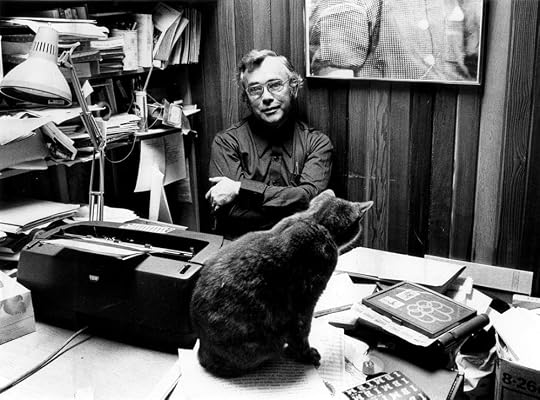
Wikipedia tells us that the author (1924-2012) was a Czech-Canadian writer and publisher. He spent half of his life in Canada, publishing and supporting banned Czech literature during the communist era. Škvorecký was awarded the Neustadt International Prize for Literature in 1980. He and his wife were long-time supporters of Czech dissident writers before the fall of communism in that country. Škvorecký's fiction deals with several themes: the horrors of totalitarianism and repression, the expatriate experience, and the miracle of jazz. He published about a dozen novels, half translated into English, and is probably best-know for The Cowards.
I’ve read two other books by this author (links below to my reviews):
The End of Lieutenant Boruvka
The Miracle Game
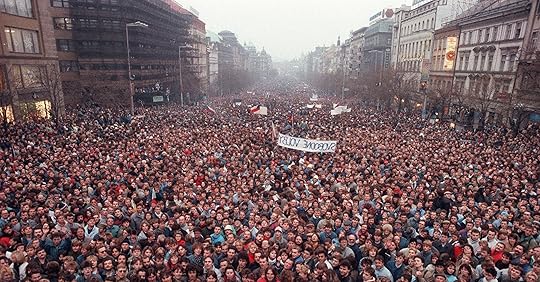
Photo of Prague uprising against communism in 1989 from theculturetrip.org
The author from theparisreview.org

May 29, 2014
This was Skvorecky's first novel written in English and indeed it is a rather dismal read. It lacks Skvorecky's characteristic sprightliness. It could be due to that the fact Skvorecky is simply better in Czech than in English. The morose and occasionally bitter tone is more likely due however to the fact that he wrote it under the worst circumstances. His wife had been publicly accused on spying on him and other Czech dissident writers for the Czech police. It was for Skvorecky a horrible experience which resulted in the unpleasant mood of the book.
Most of the dissident writers address the issue of informers in their works. Soljetnitsyne did in the Cancer Ward and Herta Mueller did in the Land of Green Plums. If you are interested in the issue then this book gains a fourth or even a fifth star.
The Two Murders in My Double Life describes the careful and patient methods used by police forces in communist countries to get people to rat on their friends. Skvorecky's descriptions of the situation in Czechoslavakia is essentially identical to what my relatives in Poland described to me. One tactic is very simple, they wait for you to blunder and then make you an offer that you can't or at least don't want to refuse. For example, the police catch driving while under the influence of alcohol. If you are close to someone they want to watch, they quash the charge in exchange for security reports. Another trick is even slier. They ask you to inform on a friend about an incident in which the friend has not done or said anything against the government. You talk thinking you will simply help disculpate your friend. However, now the police have you trapped. You are on record as an informer and never again dare refuse to provide information.
Skvorecky then addresses another sore issue. The individual police officers all retained their jobs after the communist regimes fell. Thus the same people who tricked and blackmailed individuals into becoming informants become the ones who can release or not release the names of those who talked.
This is dreadful literature but great history. Skvorecky's trademark charm is gone but he is after all entitled to have his say on what remains a very controversial topic.
Most of the dissident writers address the issue of informers in their works. Soljetnitsyne did in the Cancer Ward and Herta Mueller did in the Land of Green Plums. If you are interested in the issue then this book gains a fourth or even a fifth star.
The Two Murders in My Double Life describes the careful and patient methods used by police forces in communist countries to get people to rat on their friends. Skvorecky's descriptions of the situation in Czechoslavakia is essentially identical to what my relatives in Poland described to me. One tactic is very simple, they wait for you to blunder and then make you an offer that you can't or at least don't want to refuse. For example, the police catch driving while under the influence of alcohol. If you are close to someone they want to watch, they quash the charge in exchange for security reports. Another trick is even slier. They ask you to inform on a friend about an incident in which the friend has not done or said anything against the government. You talk thinking you will simply help disculpate your friend. However, now the police have you trapped. You are on record as an informer and never again dare refuse to provide information.
Skvorecky then addresses another sore issue. The individual police officers all retained their jobs after the communist regimes fell. Thus the same people who tricked and blackmailed individuals into becoming informants become the ones who can release or not release the names of those who talked.
This is dreadful literature but great history. Skvorecky's trademark charm is gone but he is after all entitled to have his say on what remains a very controversial topic.

October 10, 2019
An interesting novel that I didn't feel quite pulled together, and I'm not sure why. Josef Škvorecký is one of those widely praised writers whose work, to my shame, I haven't read (until now). This novel, first published in Canada in 1999 (whatever Goodreads might have you think), was his first in English rather than in his native Czech. Perhaps the transition from one language to another inhibited him? Although that doesn't seem a full explanation either, because my uneases are more to do with structural matters than mere use of prose.
Danny Smiřický, who apparently has appeared as Škvorecký's alter ego in other novels, is a libidinous but chaste Eng Lit lecturer in a Toronto university (as is Škvorecký); his specialty is in the field of crime fiction, seemingly US pulp in particular. His wife Sidonia is drinking herself to death. She's doing so because a "list" has been published in post-Communist Czechoslovakia (I assume before the Czech/Slovakia split) that names her as someone who finked to the secret police during the Communist years. The charge has a slight element of truth to it: she was pressured by one of the secret police to rat out her best friend Julie and instead gave him a report that totally exonerated Julie from all crimes against communist rectitude. (Apparently it was okay to bang Bulgarians but not Yugoslavs -- who knew?)
Unable, despite a successful lawsuit, to demolish the defamation, Sidonia resorts to the bottle: she's murdered, in other words, not just by those who would defame her for their own political reasons but also by all those useful idiots who'd rather believe the lies ("there's no smoke without a fire") than expend a single brain cell to question whether or not they're being manipulated. In this sense the novel, which reads very much as pre-internet, seems to herald the era of internet-fueled fake news and disinformation. The phenomenon Škvorecký was writing about in 1996 -- the way that evil and powerful agents, from governments to international corporations (hey, there, Rupert Murdoch!) and so on down, can create artificial realities that millions believe -- is of course very much in our faces now, as we try to cope with the fact that something like a third of Americans subscribe to government-prescribed conspiracy theories.
Sidonia's destruction by smear is one of the novel's two murder stories, and by far the more serious. The other is a sort of comedy of manners, a Golden Age-style mystery that's happening in the here and now: one of Smiřický's colleagues, a math prof and campus lothario called Hammett, is murdered in his study. Smiřický, navigating between extraordinarily hot students to whom he must remain no more than parental because of academic responsibilities and his loyal love for Sidonia, eventually, GAD-style, works out whodunnit.
We are, I think, supposed to reflect upon the difference between detective-story mysteries and the real-life destruction of human souls. I'm typing this at a time when Turkey, given the go-ahead by the current US administration, is about to commit what's widely expected to be an act of genocide against US allies, so pardon me if I seem a bit fucking sour on the "human souls" front.
The characters in the GAD story have names like Dorothy Sayers and Margery Allingham that I seem to have heard before; I'm not sure this sort of stuff is as clever as the author thinks it is. There's quite a lot else whose cleverness I doubt. One aspect that I had difficulty with was the swirling nature of the past narrative, which seemed to be autobiographical to a fault. In which year were these past events happening? I was never quite certain. Occasionally characters appeared whom obviously I was supposed to recognize yet whom I hadn't met before. Also annoying were the occasional conspiracy theories espoused by Smiřický/Škvorecký, such as that Ronald Reagan's seeming later-life muddlement was just a matter of "pinko" TV channels editing his speeches. Yeah, sure, and it wasn't the dementia at all.
I do truly wish I'd enjoyed this book more. I went into it with a great big cheesy grin on my face. By the time I'd finished it, that grin had faded a bit.
Danny Smiřický, who apparently has appeared as Škvorecký's alter ego in other novels, is a libidinous but chaste Eng Lit lecturer in a Toronto university (as is Škvorecký); his specialty is in the field of crime fiction, seemingly US pulp in particular. His wife Sidonia is drinking herself to death. She's doing so because a "list" has been published in post-Communist Czechoslovakia (I assume before the Czech/Slovakia split) that names her as someone who finked to the secret police during the Communist years. The charge has a slight element of truth to it: she was pressured by one of the secret police to rat out her best friend Julie and instead gave him a report that totally exonerated Julie from all crimes against communist rectitude. (Apparently it was okay to bang Bulgarians but not Yugoslavs -- who knew?)
Unable, despite a successful lawsuit, to demolish the defamation, Sidonia resorts to the bottle: she's murdered, in other words, not just by those who would defame her for their own political reasons but also by all those useful idiots who'd rather believe the lies ("there's no smoke without a fire") than expend a single brain cell to question whether or not they're being manipulated. In this sense the novel, which reads very much as pre-internet, seems to herald the era of internet-fueled fake news and disinformation. The phenomenon Škvorecký was writing about in 1996 -- the way that evil and powerful agents, from governments to international corporations (hey, there, Rupert Murdoch!) and so on down, can create artificial realities that millions believe -- is of course very much in our faces now, as we try to cope with the fact that something like a third of Americans subscribe to government-prescribed conspiracy theories.
Sidonia's destruction by smear is one of the novel's two murder stories, and by far the more serious. The other is a sort of comedy of manners, a Golden Age-style mystery that's happening in the here and now: one of Smiřický's colleagues, a math prof and campus lothario called Hammett, is murdered in his study. Smiřický, navigating between extraordinarily hot students to whom he must remain no more than parental because of academic responsibilities and his loyal love for Sidonia, eventually, GAD-style, works out whodunnit.
We are, I think, supposed to reflect upon the difference between detective-story mysteries and the real-life destruction of human souls. I'm typing this at a time when Turkey, given the go-ahead by the current US administration, is about to commit what's widely expected to be an act of genocide against US allies, so pardon me if I seem a bit fucking sour on the "human souls" front.
The characters in the GAD story have names like Dorothy Sayers and Margery Allingham that I seem to have heard before; I'm not sure this sort of stuff is as clever as the author thinks it is. There's quite a lot else whose cleverness I doubt. One aspect that I had difficulty with was the swirling nature of the past narrative, which seemed to be autobiographical to a fault. In which year were these past events happening? I was never quite certain. Occasionally characters appeared whom obviously I was supposed to recognize yet whom I hadn't met before. Also annoying were the occasional conspiracy theories espoused by Smiřický/Škvorecký, such as that Ronald Reagan's seeming later-life muddlement was just a matter of "pinko" TV channels editing his speeches. Yeah, sure, and it wasn't the dementia at all.
I do truly wish I'd enjoyed this book more. I went into it with a great big cheesy grin on my face. By the time I'd finished it, that grin had faded a bit.

January 8, 2024
Concordo com o que foi dito na resenha abaixo: seria melhor ter focado em uma das duas histórias, de preferência a que envolve o casal na Tchecoslováquia.
Sob o aspecto político, a trama tem um viés interessante, porque pega os primeiros anos da queda do comunismo no país e demonstra que, mesmo após a reabertura democrática, um processo de perseguição típico do antigo regime esteve em curso. A diferença, então, é que se acusava quem supostamente teria atuado como informante do regime. Tais acusações não se baseavam em provas, eram apenas inferências que levavam a distorções e injustiças.
Sidônia, a esposa do protagonista, viu-se citada injustamente nessa lista, não obstante tudo o que havia feito a favor da literatura tcheca no exterior.
Essa é uma das tramas, a outra tem a ver com um crime em ambiente universitário, por meio do qual se cria uma tentativa de "romance policial", mas, a meu ver, sem muito sucesso. A trama é confusa e não desperta muito interesse - o que é fatal para esse gênero de literatura.
Em determinado momento, o protagonista dá a entender que poderia escrever a história de Sidônia à moda de Dickens, pois ela vinha de uma trajetória de pobreza e superação que em muito lembraria as obras do escritor inglês. Taí: seria melhor o autor ter escrito esse livro.
Sob o aspecto político, a trama tem um viés interessante, porque pega os primeiros anos da queda do comunismo no país e demonstra que, mesmo após a reabertura democrática, um processo de perseguição típico do antigo regime esteve em curso. A diferença, então, é que se acusava quem supostamente teria atuado como informante do regime. Tais acusações não se baseavam em provas, eram apenas inferências que levavam a distorções e injustiças.
Sidônia, a esposa do protagonista, viu-se citada injustamente nessa lista, não obstante tudo o que havia feito a favor da literatura tcheca no exterior.
Essa é uma das tramas, a outra tem a ver com um crime em ambiente universitário, por meio do qual se cria uma tentativa de "romance policial", mas, a meu ver, sem muito sucesso. A trama é confusa e não desperta muito interesse - o que é fatal para esse gênero de literatura.
Em determinado momento, o protagonista dá a entender que poderia escrever a história de Sidônia à moda de Dickens, pois ela vinha de uma trajetória de pobreza e superação que em muito lembraria as obras do escritor inglês. Taí: seria melhor o autor ter escrito esse livro.
October 1, 2023
Je to první kniha, kterou jsem od J. Škvoreckého četla a nesedla mi. Jeho větné konstrukce a novotvary mi bránily číst s lehkostí, často jsem si větu musela číst znovu, abych pochopila. Navíc příběh Cibulkových seznamů byl aktuální v 90. letech a dnes už nezní tak naléhavě. I když jsem v té době politickou situaci velmi prožívala, dnes už mě to "nebere". Určitě si od pana Škvoreckého ještě něco přečtu, ale až za nějaký čas.

January 31, 2015
It's unclear whether this book is so mediocre because, for the first time, Skvorecky decided to write a novel in English, or because the subject matter (the accusation that his wife had been a collaborator with the StB) was so painful that he didn't want to dwell on it, or because he was just lazy, but, whatever the cause, Two Murders in My Double Life lacks the detail of emotion and behavior, and, consequently, the humor and sadness, that characterizes Skvorecky's work. The story of his wife's attempt to clear her name, which is, at least, interesting, is intertwined with a murder mystery, set at a Canadian college, that is so simultaneously light-weight and heavy-handed (the murder victim is named Raymond Hammett, a police officer is named Dorothy Sayers, etc.) as to be completely tedious.

December 25, 2008
Formerly big fish in small pond writes about the small pond he couldn't wait to get out of over and over.
I think Škvorecký is big because of things he DID, but not because of things he wrote. Parts of this reminded me of the infighting in the Sacramento poetry scene- like, really, the scene was not big enough for people to be so dramatically involved.
Also, I miss his translator Paul Wilson horribly whenever Škvorecký gets another translator or (in this case) tries to translate himself.
I think Škvorecký is big because of things he DID, but not because of things he wrote. Parts of this reminded me of the infighting in the Sacramento poetry scene- like, really, the scene was not big enough for people to be so dramatically involved.
Also, I miss his translator Paul Wilson horribly whenever Škvorecký gets another translator or (in this case) tries to translate himself.

September 6, 2011
Author hashed and rehashed sidonia and The List ad nauseum. The ending was poignant but I found myself feeling sad for these characters that their lives were so defined by the petty opinions of others. In that respect, they never escaped communism. I started skimming the sidonia parts toward the end and just reading the light but obvious mystery.

September 19, 2015
A short novel blending a murder mystery and a slander with horrible outcomes (certainly this latter story resonated for me as the victim of the vicious lies of my daughter-in-law). It also has renewed currency because it involves the lives of refugees. Funny and clever.

March 13, 2016
This book was an interesting look at exiles from the Czech Republic in Canada dealing with accusations from the homeland government. An interesting story, but I found the work to read like a newspaper article about the events.

August 28, 2013
Reminiscent of Nabokov, minus the weight and import.

March 25, 2019
Ve srovnání s díly jako Zbabělci, Konec nylonového věku, Legenda Emöke... ta trošku kulhá. Ale vypravěč je skvělý.

April 9, 2017
I didn't think that the book worked. Essentially, the author told two stories which weren't connected and which should have been told as two separate stories each of which would have had merit on it's own. I wasn't sure if I should/would finish the book as I have no time to stay with books I can't connect with, but I did, and in a way, I didn't regret the decision as it is obvious that Josef Škvorecký has huge potential. It is a very keen observer, and both the themes of his two stories and his language (even though English is not his mother tongue) are poignant.
This was the first book by Josef Škvorecký I have read, and it is, I understand, his first book that was written in English. I have some of his older work too (written in Czech), and I will give him another try at some other time as it is obvious that what he has to say is valuable.
This was the first book by Josef Škvorecký I have read, and it is, I understand, his first book that was written in English. I have some of his older work too (written in Czech), and I will give him another try at some other time as it is obvious that what he has to say is valuable.
Displaying 1 - 13 of 13 reviews