

What do you think?

The Hours
The Hours is a daring and deeply affecting novel inspired by the life and work of Virginia Woolf. A passionate, profound and haunting story of love and inheritance, hope and despair . Exiled in Richmond in the 1920s, taken from her beloved Bloomsbury and lovingly watched over by her husband Leonard, Virginia Woolf struggles to tame her rebellious mind and make a start on her new novel. In the brooding heat of 1940s Los Angeles, a young wife and mother yearns to escape the claustrophobia of suburban domesticity and read her precious copy of Mrs Dalloway. And in New York in the 1990s, Clarissa Vaughan steps out of her smart Greenwich Village apartment and goes shopping for flowers for the party she is giving in honour of her life-long friend Richard, an award-winning poet whose mind and body are being ravaged by AIDS. These are the characters in Michael Cunningham's exquisite and deeply moving novel, which takes Woolf's life and work as inspiration for a meditation on artistic behaviour, failure, love and madness. Moving effortlessy across the decades and between England and America, Cunningham's elegant, haunting prose explores the pain and trauma of creativity and the immutable relationship between writer and reader.
230 pages, Paperback
First published July 31, 1998
About the author
Michael Cunningham
105 books4,427 followersMichael Cunningham is the author of the novels A Home at the End of the World, Flesh and Blood, The Hours (winner of the Pen/Faulkner Award & Pulitzer Prize), Specimen Days, and By Nightfall, as well as the non-fiction book, Land's End: A Walk in Provincetown. His new novel, The Snow Queen, will be published in May of 2014. He lives in New York, and teaches at Yale University.
Ratings & Reviews
Friends & Following
Create a free account to discover what your friends think of this book!
Community Reviews
Displaying 1 - 30 of 7,727 reviews

August 21, 2015
”We throw our parties; we struggle to write books that do not change the world, despite our gifts and our unstinting efforts, our most extravagant hopes. We live our lives, do whatever we do, and then we sleep--it’s as simple and ordinary as that. A few jump out of windows or drown themselves or take pills; more die by accident; and most of us, the vast majority, are slowly devoured by some disease or, if we’ve very fortunate, by time itself.”
It’s about the hours right? Those few precious hours over a lifetime when we feel we have a chance to do something special, to prove that we can do something that will forever immortalize us as someone exceptional.
It was Charlotte who pressed this book upon me. We were at a party conducted by a Mrs. Clarissa Galloway.
“I hear you are on a reading binge.” She’d leaned in close, as she had a tendency to do with me. Her lips mere millimeters away from my ear. It made me shiver somewhere in the core of me.
When I was between assignments, which was all too frequent, I would read book after book; usually I would be in the middle of at least three at any one time. I was getting about four hours of sleep a night which right now was making me a cheap drunk. One martini was going to be more than enough.
“The Hours by Michael Cunningham, didn’t they make a film out of it with Kidman?”
She nodded. She leaned in close again. I often wondered if she knew what she did to me. “The book won a Pulitzer Prize. Catherine told me you just finished reading Mrs. Dalloway. This is a terrific follow-up.“
The sisters.
You couldn’t really be involved with one without being involved with the other. Catherine, my girlfriend, was writing a novel. It was brilliant in fact, but now was somewhat weighed down with its own brilliance. She was happy with the beginning and the ending, but the middle was not living up to the standards of the rest. Charlotte designed book covers for publishing companies. She had a gift for it, but frequently had to endure someone further up the chain asking for modifications, her masterpieces often becoming something more commercially appealing and soulless. When I was doing research on Virginia Woolf, before reading Mrs. Dalloway, I couldn’t help thinking of Catherine as Virginia and Charlotte as Vanessa.
”Vanessa laughs. Vanessa is firm of face, her skin a brilliant, scalded pink. Although she is three years older, she looks younger than Virginia, and both of them know it. If Virginia has the austere, parched beauty of a Giotto fresco, Vanessa is more like a figure sculpted in rosy marble by a skilled but minor artist of the late Baroque. She is distinctly earthly and even decorative figure, all billows and scrolls….”
As usual, I wasn’t really sure why I was at this party. I thought with remorse of the lost pages of reading the party had already cost me. I could see the books strategically scattered around the room of the flat. A book by each of my favorite reading places. This party was bad for me, and if it was not good for me, it had to be an absolute torture for Catherine.
I looked past Charlotte’s large, attentive eyes and could see that Catherine was pale. Her complexion was always pale, but there were various shades of pale that would tell me exactly what was going on with her. She closed her eyes and took too long to open them. I could tell it was time to go.
I leaned in and kissed Charlotte’s ear, raising the stakes, and then muttered in the sea shell of her ear that I was going to take Catherine home. Charlotte always smelled so good, but I was never able to quite identify the scent, something old, something new. Somehow it would be breaking the rules of the game to ask her. I walked over to Catherine and put my arm around her and kissed her on the side of her mouth. She looked at me with surprise. I could see the slender flutes of her nose flutter as she took me in. Could it be that she could sense her sister’s scent even among the mingling fragrances of flowers that filled Mrs. Galloway’s party?
She put her slender, fluted fingers on my shoulder. “I can feel one coming on.”
“I’m here to take you home.”
”She can feel the headache creeping up the back of her neck. She stiffens. No, it’s the memory of the headache, it’s her fear of the headache, both of them so vivid as to be at least briefly indistinguishable from the onset of the headache itself.”
I went to see Robert the next day. I’d read most of The Hours last night. Charlotte had been right. It was the perfect followup to Mrs. Dalloway. Robert had been my friend almost my entire life or at least for the segment of my life that I still wished to claim. He’d had a good career on the stage, had mother issues of course, and had always been unapologetically gay. The young nurse from Hospice was taking a vial of blood from him when I arrived. There was something so intimate about blood letting. I averted my eyes as if I’d just caught her furtively giving him a hand job.
“I’m so weak. This is it, my friend.” His voice, the voice that had boomed out to theaters full of people, had been reduced to a whisper.
I patted his hand. He weakly grasped it. I left my fingers there surrounded by the parchment of his hand. “You’ve rallied before.” I’d meant to put exuberance into that sentence, but somehow it all went wrong. My voice cracked and tears sprang to my eyes.
“Oh, come on now. Tears now? You should have wept with joy when I looked like a young Marlon Brando. Not now, not over this decrepit body. If you were a true friend, you’d pick me up and hurl me out that window.”
I thought of Septimus from Mrs. Dalloway and Richard from The Hours. It was almost too much.
“Don’t say that.” My voice was still shaking. I freed my hand from his grasp to wipe my eyes. When I put my hand back on the bed, his hand was gone.
“Do you think six floors would be enough to kill me? God, what a tragedy if it only breaks my bones, and leaves me somehow alive with fresh sources of pain. I was thinking about it the other day. I wouldn’t want to fall on the concrete. I want to land on a car. I want to explode through the top like they show in the movies. You own a car, don’t you? Couldn’t you park it beneath my window?”
“You are hurting me, Robert.”
He sighed. Closing those magnificent blue eyes that had mesmerized women and men in equal numbers, “That is the last thing that I want to do to you, my friend.”
When I got back to the flat, they must not have heard me. Catherine was leaning over Charlotte. ”Virginia leaned forward and kisses Vanessa on the mouth. It is an innocent kiss, innocent enough, but just now,...it feels like the most delicious and forbidden of pleasures. Vanessa returns the kiss.” I wanted to wrap my arms around both of them and nudge them across the room to the bed. I wondered if Leonard Woolf had ever had such desires? They might have willingly went, but then what? By trying to hold them closer, I’d only lose them both.
I cleared my throat and hung up my jacket. When I turned around, they were both looking at me with clear, intelligent eyes. Two sisters, so different, but so much alike as to be indistinguishable when standing in the same space.
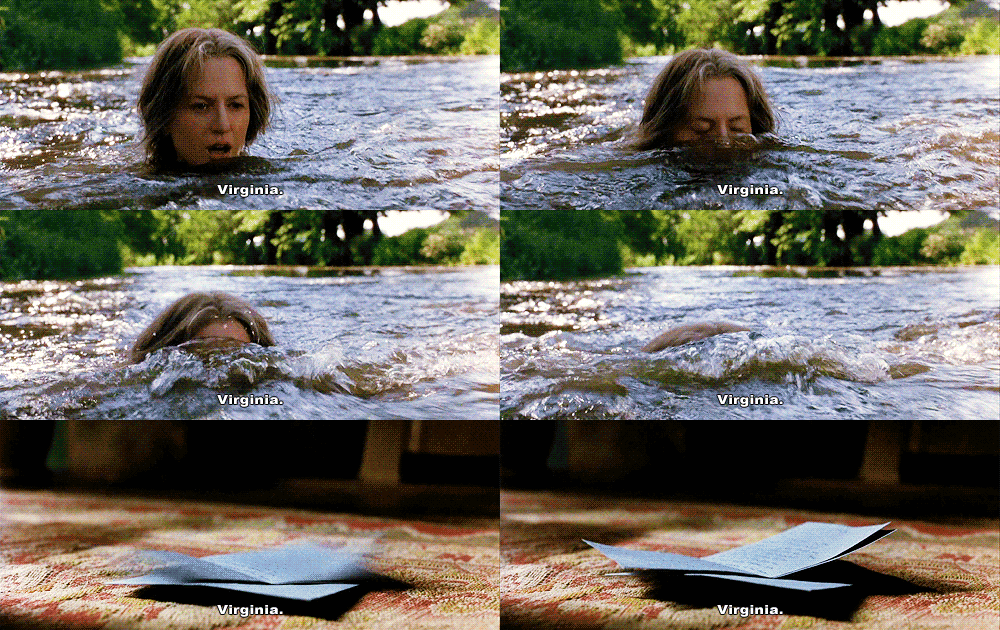
It was hard not to think about the big stone. ”She selects one roughly the size and shape of a pig’s skull. The one that took her down to the depths of the river. The one that would not let her escape the embrace of the water even if her natural desire for self-preservation had kicked in. The stone was too real to be denied.
Catherine had read Mrs. Dalloway and was now reading The Hours. She had needed a break from her own writing anyway. Reading sometimes gave her a fresh source of inspiration. I wasn’t sure about her reading either book, but both together could enhance her already acute suicidal tendencies. I’d seen her more than once raking a butter knife across her wrists as if testing how it would feel. I’d had the gas oven taken out and replaced it with an electric one.
I read her diary.
She wasn’t particularly careful with it. She left it out all the time, rarely tucking it back under the mattress on our bed. I don’t know if she trusted me not to read it or she, being a writer, always wanted an audience for her writing. ”Everything she sees feels as if it’s pinned to the day the way etherized butterflies are pinned to the board.” She was obviously feeling trapped. Like Leonard Woolf decided to do with Virginia, I arranged to take Catherine to the country for a month. She was being overstimulated in the city.
Robert threw himself out the window.
He asked the nurse to open the window to give him some air. The stubborn bastard crawled across the floor, pulled himself up the wall, and threw himself out the window. Though he would have preferred a Rolls Royce, he landed on a Mercedes.
Six floors, as it turned out, was enough.
Two days after we reached the country Catherine disappeared. As I walked the river, along with every other able body in the county, I kept thinking about a stone the size of a pig’s skull.
If you wish to see more of my most recent book and movie reviews, visit http://www.jeffreykeeten.com
I also have a Facebook blogger page at:https://www.facebook.com/JeffreyKeeten
It’s about the hours right? Those few precious hours over a lifetime when we feel we have a chance to do something special, to prove that we can do something that will forever immortalize us as someone exceptional.
It was Charlotte who pressed this book upon me. We were at a party conducted by a Mrs. Clarissa Galloway.
“I hear you are on a reading binge.” She’d leaned in close, as she had a tendency to do with me. Her lips mere millimeters away from my ear. It made me shiver somewhere in the core of me.
When I was between assignments, which was all too frequent, I would read book after book; usually I would be in the middle of at least three at any one time. I was getting about four hours of sleep a night which right now was making me a cheap drunk. One martini was going to be more than enough.
“The Hours by Michael Cunningham, didn’t they make a film out of it with Kidman?”
She nodded. She leaned in close again. I often wondered if she knew what she did to me. “The book won a Pulitzer Prize. Catherine told me you just finished reading Mrs. Dalloway. This is a terrific follow-up.“
The sisters.
You couldn’t really be involved with one without being involved with the other. Catherine, my girlfriend, was writing a novel. It was brilliant in fact, but now was somewhat weighed down with its own brilliance. She was happy with the beginning and the ending, but the middle was not living up to the standards of the rest. Charlotte designed book covers for publishing companies. She had a gift for it, but frequently had to endure someone further up the chain asking for modifications, her masterpieces often becoming something more commercially appealing and soulless. When I was doing research on Virginia Woolf, before reading Mrs. Dalloway, I couldn’t help thinking of Catherine as Virginia and Charlotte as Vanessa.
”Vanessa laughs. Vanessa is firm of face, her skin a brilliant, scalded pink. Although she is three years older, she looks younger than Virginia, and both of them know it. If Virginia has the austere, parched beauty of a Giotto fresco, Vanessa is more like a figure sculpted in rosy marble by a skilled but minor artist of the late Baroque. She is distinctly earthly and even decorative figure, all billows and scrolls….”
As usual, I wasn’t really sure why I was at this party. I thought with remorse of the lost pages of reading the party had already cost me. I could see the books strategically scattered around the room of the flat. A book by each of my favorite reading places. This party was bad for me, and if it was not good for me, it had to be an absolute torture for Catherine.
I looked past Charlotte’s large, attentive eyes and could see that Catherine was pale. Her complexion was always pale, but there were various shades of pale that would tell me exactly what was going on with her. She closed her eyes and took too long to open them. I could tell it was time to go.
I leaned in and kissed Charlotte’s ear, raising the stakes, and then muttered in the sea shell of her ear that I was going to take Catherine home. Charlotte always smelled so good, but I was never able to quite identify the scent, something old, something new. Somehow it would be breaking the rules of the game to ask her. I walked over to Catherine and put my arm around her and kissed her on the side of her mouth. She looked at me with surprise. I could see the slender flutes of her nose flutter as she took me in. Could it be that she could sense her sister’s scent even among the mingling fragrances of flowers that filled Mrs. Galloway’s party?
She put her slender, fluted fingers on my shoulder. “I can feel one coming on.”
“I’m here to take you home.”
”She can feel the headache creeping up the back of her neck. She stiffens. No, it’s the memory of the headache, it’s her fear of the headache, both of them so vivid as to be at least briefly indistinguishable from the onset of the headache itself.”
I went to see Robert the next day. I’d read most of The Hours last night. Charlotte had been right. It was the perfect followup to Mrs. Dalloway. Robert had been my friend almost my entire life or at least for the segment of my life that I still wished to claim. He’d had a good career on the stage, had mother issues of course, and had always been unapologetically gay. The young nurse from Hospice was taking a vial of blood from him when I arrived. There was something so intimate about blood letting. I averted my eyes as if I’d just caught her furtively giving him a hand job.
“I’m so weak. This is it, my friend.” His voice, the voice that had boomed out to theaters full of people, had been reduced to a whisper.
I patted his hand. He weakly grasped it. I left my fingers there surrounded by the parchment of his hand. “You’ve rallied before.” I’d meant to put exuberance into that sentence, but somehow it all went wrong. My voice cracked and tears sprang to my eyes.
“Oh, come on now. Tears now? You should have wept with joy when I looked like a young Marlon Brando. Not now, not over this decrepit body. If you were a true friend, you’d pick me up and hurl me out that window.”
I thought of Septimus from Mrs. Dalloway and Richard from The Hours. It was almost too much.
“Don’t say that.” My voice was still shaking. I freed my hand from his grasp to wipe my eyes. When I put my hand back on the bed, his hand was gone.
“Do you think six floors would be enough to kill me? God, what a tragedy if it only breaks my bones, and leaves me somehow alive with fresh sources of pain. I was thinking about it the other day. I wouldn’t want to fall on the concrete. I want to land on a car. I want to explode through the top like they show in the movies. You own a car, don’t you? Couldn’t you park it beneath my window?”
“You are hurting me, Robert.”
He sighed. Closing those magnificent blue eyes that had mesmerized women and men in equal numbers, “That is the last thing that I want to do to you, my friend.”
When I got back to the flat, they must not have heard me. Catherine was leaning over Charlotte. ”Virginia leaned forward and kisses Vanessa on the mouth. It is an innocent kiss, innocent enough, but just now,...it feels like the most delicious and forbidden of pleasures. Vanessa returns the kiss.” I wanted to wrap my arms around both of them and nudge them across the room to the bed. I wondered if Leonard Woolf had ever had such desires? They might have willingly went, but then what? By trying to hold them closer, I’d only lose them both.
I cleared my throat and hung up my jacket. When I turned around, they were both looking at me with clear, intelligent eyes. Two sisters, so different, but so much alike as to be indistinguishable when standing in the same space.
It was hard not to think about the big stone. ”She selects one roughly the size and shape of a pig’s skull. The one that took her down to the depths of the river. The one that would not let her escape the embrace of the water even if her natural desire for self-preservation had kicked in. The stone was too real to be denied.
Catherine had read Mrs. Dalloway and was now reading The Hours. She had needed a break from her own writing anyway. Reading sometimes gave her a fresh source of inspiration. I wasn’t sure about her reading either book, but both together could enhance her already acute suicidal tendencies. I’d seen her more than once raking a butter knife across her wrists as if testing how it would feel. I’d had the gas oven taken out and replaced it with an electric one.
I read her diary.
She wasn’t particularly careful with it. She left it out all the time, rarely tucking it back under the mattress on our bed. I don’t know if she trusted me not to read it or she, being a writer, always wanted an audience for her writing. ”Everything she sees feels as if it’s pinned to the day the way etherized butterflies are pinned to the board.” She was obviously feeling trapped. Like Leonard Woolf decided to do with Virginia, I arranged to take Catherine to the country for a month. She was being overstimulated in the city.
Robert threw himself out the window.
He asked the nurse to open the window to give him some air. The stubborn bastard crawled across the floor, pulled himself up the wall, and threw himself out the window. Though he would have preferred a Rolls Royce, he landed on a Mercedes.
Six floors, as it turned out, was enough.
Two days after we reached the country Catherine disappeared. As I walked the river, along with every other able body in the county, I kept thinking about a stone the size of a pig’s skull.
If you wish to see more of my most recent book and movie reviews, visit http://www.jeffreykeeten.com
I also have a Facebook blogger page at:https://www.facebook.com/JeffreyKeeten
February 14, 2024
Finally, I am done with reviewing 2023. I kept the honor of the last review of a book read in 2023 for one wonderful novel that I’ve had on my TBR since 2014. Yes, I’ve added this book 10 years ago. However, I think it was a better moment to get to it now, after I’ve read a couple of Virginia Woolfs. She managed to become one of my favorite writers so reading a novel about her surely made an impact on me.
The novel tells the story of three women, from different time periods, with no apparent connection with each other. The link is there but you have to read the novel for it. Ok, one is obvious but it is not the only one. One of the characters is Virginia Woolf, caught in one of her lowest points of her life. Well, the novel starts with her suicide but in the rest of it she is pictured in the country, bored and trying her best to get back to London, a move that might be her doom. The 2nd character, a modern day Mrs. Dalloway, is organizing a party which does not go according to plan. Lastly, the 3rd character is a housewife reading the book I mentioned before and unhappy with her life.
It is a short book but it manages to be so deep but to also flow, as time, an important theme in the book. It is also novel about love, illness, suicide.
I loved the writing and the characters bug I wish I remembered more about this book. As usual, I should have written my thoughts close to the finishing date, not now, 2 months later. Anyway, it is a masterpiece and a deserved winner of the Pulitzer prize.
The novel tells the story of three women, from different time periods, with no apparent connection with each other. The link is there but you have to read the novel for it. Ok, one is obvious but it is not the only one. One of the characters is Virginia Woolf, caught in one of her lowest points of her life. Well, the novel starts with her suicide but in the rest of it she is pictured in the country, bored and trying her best to get back to London, a move that might be her doom. The 2nd character, a modern day Mrs. Dalloway, is organizing a party which does not go according to plan. Lastly, the 3rd character is a housewife reading the book I mentioned before and unhappy with her life.
It is a short book but it manages to be so deep but to also flow, as time, an important theme in the book. It is also novel about love, illness, suicide.
I loved the writing and the characters bug I wish I remembered more about this book. As usual, I should have written my thoughts close to the finishing date, not now, 2 months later. Anyway, it is a masterpiece and a deserved winner of the Pulitzer prize.
May 8, 2020
“Still, she loves the world for being rude and indestructible, and she knows other people must love it too, poor as well as rich, though no one speaks specifically of the reasons. Why else do we struggle to go on living, no matter how compromised, no matter how harmed?”
I’m actually quite glad that I didn’t have time to go to the movies in the early 2000s. My first child was newly born, and I was more likely to be seen pacing a room with a cranky baby, changing a diaper, or passed out on the couch from exhaustion. Hell, I had even given up trying to read at that point in my life! What I’m trying to say is that I somehow missed seeing the film adaptation of The Hours when it was released. Therefore, I went into this book with minimal knowledge of the plot. It was an absolute joy to read this; Michael Cunningham swept me off my feet.
“She could, she thinks, have entered another world. She could have had a life as potent and dangerous as literature itself.”
I loved everything about this book – truly, every single thing! First and foremost is the sublime prose. The inter-connectedness of the stories between three women (Virginia Woolf, Laura Brown and Clarissa Vaughan -affectionately nicknamed Mrs. Dalloway by a dear friend) and across three timelines (1920s, late 1940s and early 2000s) is extremely effective. There is an overwhelming feeling that despite where and when you are born, our struggles are timeless and cross all boundaries. Virginia Woolf and her book, Mrs. Dalloway, provide the link between all three story lines. I have in fact read this slim novel by Woolf. It’s not necessary to have done so in order to appreciate The Hours. The only advantage I had was understanding the relationship between Woolf’s characters and those of Cunningham. However, Cunningham seamlessly weaves the writing of the book Mrs. Dalloway into the context of Mrs. Woolf’s section of this novel in such a way that you will do just fine without that prior knowledge.
“… she is again possessed (it seems to be getting worse) by a dreamlike feeling, as if she is standing in the wings, about to go onstage and perform in a play for which she is not appropriately dressed, and for which she has not adequately rehearsed.”
I don’t know how so much depth was packed into little over 200 pages. It’s pure genius. I know these women intimately. I shared their deepest sorrows and desperate longings. I ‘get’ them. This is not a cheery sort of book, no. We read about terminal disease, depression and suicide. There is the constant search for identity, love and happiness. Sometimes these things seem just out of reach. Often they are impossible to hold onto when we are lucky enough to finally grasp them. How does any one person make it through his or her day then? What do we do with what we have? Do we plow through and delight in those few moments that sustain us? Do we take extreme action and do the unthinkable? It’s remarkable really that we are still here and we still thrive. Life is a gift. If we hold those few extraordinary hours in a lifetime of ordinary days in our hands like a fragile bubble that could burst at any moment, then we are doing our best, aren’t we?!
I’m not ready to return this book to my shelf yet. I need it by my side right now, to serve as a reminder when I have too much time on my hands to reflect on where I’ve been and where I’m going. It’s a punch in the gut and a divine blessing snugly wrapped up in one little package.
"There is still that singular perfection, and it’s perfect in part because it seemed, at the time, so clearly to promise more. Now she knows: That was the moment, right then. There has been no other."
I’m actually quite glad that I didn’t have time to go to the movies in the early 2000s. My first child was newly born, and I was more likely to be seen pacing a room with a cranky baby, changing a diaper, or passed out on the couch from exhaustion. Hell, I had even given up trying to read at that point in my life! What I’m trying to say is that I somehow missed seeing the film adaptation of The Hours when it was released. Therefore, I went into this book with minimal knowledge of the plot. It was an absolute joy to read this; Michael Cunningham swept me off my feet.
“She could, she thinks, have entered another world. She could have had a life as potent and dangerous as literature itself.”
I loved everything about this book – truly, every single thing! First and foremost is the sublime prose. The inter-connectedness of the stories between three women (Virginia Woolf, Laura Brown and Clarissa Vaughan -affectionately nicknamed Mrs. Dalloway by a dear friend) and across three timelines (1920s, late 1940s and early 2000s) is extremely effective. There is an overwhelming feeling that despite where and when you are born, our struggles are timeless and cross all boundaries. Virginia Woolf and her book, Mrs. Dalloway, provide the link between all three story lines. I have in fact read this slim novel by Woolf. It’s not necessary to have done so in order to appreciate The Hours. The only advantage I had was understanding the relationship between Woolf’s characters and those of Cunningham. However, Cunningham seamlessly weaves the writing of the book Mrs. Dalloway into the context of Mrs. Woolf’s section of this novel in such a way that you will do just fine without that prior knowledge.
“… she is again possessed (it seems to be getting worse) by a dreamlike feeling, as if she is standing in the wings, about to go onstage and perform in a play for which she is not appropriately dressed, and for which she has not adequately rehearsed.”
I don’t know how so much depth was packed into little over 200 pages. It’s pure genius. I know these women intimately. I shared their deepest sorrows and desperate longings. I ‘get’ them. This is not a cheery sort of book, no. We read about terminal disease, depression and suicide. There is the constant search for identity, love and happiness. Sometimes these things seem just out of reach. Often they are impossible to hold onto when we are lucky enough to finally grasp them. How does any one person make it through his or her day then? What do we do with what we have? Do we plow through and delight in those few moments that sustain us? Do we take extreme action and do the unthinkable? It’s remarkable really that we are still here and we still thrive. Life is a gift. If we hold those few extraordinary hours in a lifetime of ordinary days in our hands like a fragile bubble that could burst at any moment, then we are doing our best, aren’t we?!
I’m not ready to return this book to my shelf yet. I need it by my side right now, to serve as a reminder when I have too much time on my hands to reflect on where I’ve been and where I’m going. It’s a punch in the gut and a divine blessing snugly wrapped up in one little package.
"There is still that singular perfection, and it’s perfect in part because it seemed, at the time, so clearly to promise more. Now she knows: That was the moment, right then. There has been no other."

March 20, 2019
The film has always put me off reading the book. In particular Nicole Kidman's tawdry depiction of Virginia Woolf as some kind of demented bag lady. Surely the most unflattering cinematic portrait of any famous writer ever. So the first pleasant surprise of this novel was that, far from being some kind of overly simplistic and dismissive view of Woolf as the film veered close to at times, it's actually a glowing tribute to her work and to her as a troubled soul.
However, it doesn't begin on a good note. To go inside Woolf's head as she kills herself came across as nothing more than a literary publicity stunt of misguided hubris. Not once, I'm afraid, did I believe in Cunningham's vision of her final moments of life. And it added nothing to the novel and could easily have been and perhaps should have been excised. Especially because her suicide comes up often in the text. Sometimes, despite what it says in writing manuals, telling is more effective than showing. But what soon began to win me over was Cunningham's fabulous prose. His exciting way of putting things. Of making me see the familiar in a slightly skewed and illuminating way. Essentially The Hours is an inventive improvisation on the themes of Woolf's Mrs Dalloway. It's perhaps a bit top heavy on same sex relationships with the largely unfounded implication that Woolf herself was that way inclined (is it so hard to accept a person might perhaps simply possess no strong sexual impulse instead of always reading repression into inactivity? My feeling about her is she did exactly what she needed to do to write what she did. And to impose any kind of secret wish list on her is not only errant but also condescending. Socially she was a flirt. It was how she both dramatized and defended herself. If she gave Vita the come on it was done, one feels, with a pinch of salt not from unowned depths of her being.)
But overall surprised by how much I loved this. 4.5 stars.
However, it doesn't begin on a good note. To go inside Woolf's head as she kills herself came across as nothing more than a literary publicity stunt of misguided hubris. Not once, I'm afraid, did I believe in Cunningham's vision of her final moments of life. And it added nothing to the novel and could easily have been and perhaps should have been excised. Especially because her suicide comes up often in the text. Sometimes, despite what it says in writing manuals, telling is more effective than showing. But what soon began to win me over was Cunningham's fabulous prose. His exciting way of putting things. Of making me see the familiar in a slightly skewed and illuminating way. Essentially The Hours is an inventive improvisation on the themes of Woolf's Mrs Dalloway. It's perhaps a bit top heavy on same sex relationships with the largely unfounded implication that Woolf herself was that way inclined (is it so hard to accept a person might perhaps simply possess no strong sexual impulse instead of always reading repression into inactivity? My feeling about her is she did exactly what she needed to do to write what she did. And to impose any kind of secret wish list on her is not only errant but also condescending. Socially she was a flirt. It was how she both dramatized and defended herself. If she gave Vita the come on it was done, one feels, with a pinch of salt not from unowned depths of her being.)
But overall surprised by how much I loved this. 4.5 stars.

February 28, 2024
ORE, GIORNI, ANNI, ATTIMI

Virginia Woolf/Nicole Kidman
Non ho rimpianti, davvero, tranne quello. Volevo scrivere di te, di noi, veramente. Sai che voglio dire? Volevo scrivere di tutto: la vita che stiamo vivendo e quelle che avremmo potuto vivere. Volevo scrivere di tutti i modi in cui potremmo morire.
Diversi anni fa, venti e più, ho letto Carne e sangue, e mi piacque, molto. Ne ho ancora sensazioni e immagini a distanza di tutto questo tempo. E allora perché dopo non sono più andato a cercare Michael Cunningham? Come mai già allora non sono andato a recuperare questo Le ore, bello e prezioso sin dal titolo? La risposta è che non lo so.
Adesso ci sono arrivato, l’ho letto, sono andato ad aggiungermi alla schiera dei lettori estasiati, e mi chiedo che bomba deve essere stato un quarto di secolo fa quando è apparso. Una bomba che gli portò il premio Pulitzer. Non solo la scrittura, sontuosa, ammaliante, con frasi capaci di racchiudere tutto e cascate di metafore sfavillanti: ma anche la struttura, così divisa a brevi capitoli, ciascuno dedicato alle tre protagoniste, che non si conoscono, vivono in epoche e luoghi diversi, eppure sono tra loro connesse.

Laura Brown/Julianne Moore
Il fil rouge che cuce questo breve romanzo è quello del celebre romanzo scritto da una delle tre donne protagoniste: lei è Virginia Woolf, che Cunningham coglie e immagina nel 1923 mentre sta scrivendo il suo capolavoro, Mrs Dalloway – e alla quale dedica un magistrale prologo nel quale la vediamo suicidarsi dopo aver appesantito il suo cappotto con le pietre di modo che possa affogare senza essere sospinta a galla; la seconda donna è Laura, che vive a Los Angeles alla fine degli anni Quaranta, e legge il romanzo della Woolf immergendosi rapita, per riprendersi almeno per qualche pagina dalla frustrazione della sua vita casalinga; la terza donna è Clarissa, che vive a Manhattan alla fine del terzo millennio, e che il suo grande amico e grande amore Richard, malato terminale di AIDS, ha soprannominato per affetto Signora Dalloway – d’altronde Clarissa è proprio il nome di battesimo della Signora Dalloway.

Clarissa Signora Dalloway/Meryl Streep
Cunningham rimescola le cose e i capitoli sono dedicati prima alla donna che vive nel tempo più recente, il presente, poi a quella che vive in quello più lontano, la Woolf, e per finire a quella che vive temporalmente nel mezzo, Laura. Ma non segue sempre lo stesso ordine, salta da una all’altra con apparente casualità. Ma non c’è nulla di lasciato al caso in queste centosessanta paginette perfette.
E tutto avviene in un giorno proprio come in Mrs Dalloway, i tre personaggi, Virginia, Laura, Clarissa, sono seguiti per la durata di un giorno così come la Woolf seguì Mrs Dalloway nel suo romanzo.
E Le ore era il titolo che Virginia Woolf voleva dargli prima di adottare quello che conosciamo. Le simmetrie si dipanano.
Ed è chiaro che il celebre romanzo è la pietra su cui tutto poggia: Virginia lo compone, Laura lo sta leggendo, Clarissa (già a partire dal nome) lo incarna alla perfezione (la scena dell’acquisto dei fiori probabilmente su tutte).

Meryl Streep e il sempre eccellente Ed Harris che interpreta Richard.
Dei tre racconti il mio preferito è quello al tempo presente con Clarissa che Richard ha soprannominato Signora Dalloway. Richard è il suo migliore amico ed è stato il suo più grande amante. Ma sono entrambi bisessuali, e Clarissa vive con una donna Sally, e Richard ha alle spalle una lunga storia con Louis. C’è un momento splendido nel quale i due ex amanti di Richard, ancora legatissimi a lui, e mi riferisco a Clarissa e Louis, vengono paragonati a gladiatori che si spogliano e ammirano le cicatrici sul corpo altrui, in una sorta di fratellanza. Mette i brividi.

A pensarci meglio, però, quello che davvero preferisco è il filo che segue la Woolf nella sua giornata a Richmond, sobborgo di Londra, mentre riceve la visita della sorella con i nipoti, ma la sua testa è sempre rivolta al libro che sta scrivendo, al libro che vuole scrivere, e che vuole sia il migliore di quelli che ha scritto finora. Sa che vuole raccontare di una giornata di Clarissa Dalloway e sa che alla fine qualcuno dovrà morire, quasi sicuramente per suicidio: sarà Clarissa? L’impresa è portarcela senza darla via in anticipo, ma anche senza appiccicare un finale improvviso e non costruito. L’impresa è scrivere sulla pagina quello che ha in testa, che rimugina ed elabora… E poi, si sa, cambiò idea, e a morire fu il poeta. Proprio come succede con Richard…

Però non è così: la storia davvero più avvincente è quella della casalinga Laura, della sua giornata, mentre guida per le strade di Los Angeles, mentre prende una stanza d’albergo, mentre le sembra di essere entrata nel “”regno” del libro che sta leggendo, e il libro che sta leggendo è quello scritto da Virginia Woolf, Mrs Dalloway, Laura che cammina sulla lama di un rasoio perché potrebbe decidere da un momento all’altro che basta così, è possibile morire, potrebbe decidere di morire, pensa che potrebbe essere profondamente confortante; la farebbe sentire così libera: andarsene, semplicemente. Dire a tutti: “Non ce la facevo, non sapete com’è; non volevo provarci più.” Laura si sente Virginia Woolf, si sente Mrs Dalloway…
Ma poi tutto cambia, il finale è diverso da quello atteso. E il racconto più bello è proprio quello delle ore.

Il film è del 2002 diretto da Stephen Daldry.
Virginia Woolf/Nicole Kidman
Non ho rimpianti, davvero, tranne quello. Volevo scrivere di te, di noi, veramente. Sai che voglio dire? Volevo scrivere di tutto: la vita che stiamo vivendo e quelle che avremmo potuto vivere. Volevo scrivere di tutti i modi in cui potremmo morire.
Diversi anni fa, venti e più, ho letto Carne e sangue, e mi piacque, molto. Ne ho ancora sensazioni e immagini a distanza di tutto questo tempo. E allora perché dopo non sono più andato a cercare Michael Cunningham? Come mai già allora non sono andato a recuperare questo Le ore, bello e prezioso sin dal titolo? La risposta è che non lo so.
Adesso ci sono arrivato, l’ho letto, sono andato ad aggiungermi alla schiera dei lettori estasiati, e mi chiedo che bomba deve essere stato un quarto di secolo fa quando è apparso. Una bomba che gli portò il premio Pulitzer. Non solo la scrittura, sontuosa, ammaliante, con frasi capaci di racchiudere tutto e cascate di metafore sfavillanti: ma anche la struttura, così divisa a brevi capitoli, ciascuno dedicato alle tre protagoniste, che non si conoscono, vivono in epoche e luoghi diversi, eppure sono tra loro connesse.
Laura Brown/Julianne Moore
Il fil rouge che cuce questo breve romanzo è quello del celebre romanzo scritto da una delle tre donne protagoniste: lei è Virginia Woolf, che Cunningham coglie e immagina nel 1923 mentre sta scrivendo il suo capolavoro, Mrs Dalloway – e alla quale dedica un magistrale prologo nel quale la vediamo suicidarsi dopo aver appesantito il suo cappotto con le pietre di modo che possa affogare senza essere sospinta a galla; la seconda donna è Laura, che vive a Los Angeles alla fine degli anni Quaranta, e legge il romanzo della Woolf immergendosi rapita, per riprendersi almeno per qualche pagina dalla frustrazione della sua vita casalinga; la terza donna è Clarissa, che vive a Manhattan alla fine del terzo millennio, e che il suo grande amico e grande amore Richard, malato terminale di AIDS, ha soprannominato per affetto Signora Dalloway – d’altronde Clarissa è proprio il nome di battesimo della Signora Dalloway.
Clarissa Signora Dalloway/Meryl Streep
Cunningham rimescola le cose e i capitoli sono dedicati prima alla donna che vive nel tempo più recente, il presente, poi a quella che vive in quello più lontano, la Woolf, e per finire a quella che vive temporalmente nel mezzo, Laura. Ma non segue sempre lo stesso ordine, salta da una all’altra con apparente casualità. Ma non c’è nulla di lasciato al caso in queste centosessanta paginette perfette.
E tutto avviene in un giorno proprio come in Mrs Dalloway, i tre personaggi, Virginia, Laura, Clarissa, sono seguiti per la durata di un giorno così come la Woolf seguì Mrs Dalloway nel suo romanzo.
E Le ore era il titolo che Virginia Woolf voleva dargli prima di adottare quello che conosciamo. Le simmetrie si dipanano.
Ed è chiaro che il celebre romanzo è la pietra su cui tutto poggia: Virginia lo compone, Laura lo sta leggendo, Clarissa (già a partire dal nome) lo incarna alla perfezione (la scena dell’acquisto dei fiori probabilmente su tutte).
Meryl Streep e il sempre eccellente Ed Harris che interpreta Richard.
Dei tre racconti il mio preferito è quello al tempo presente con Clarissa che Richard ha soprannominato Signora Dalloway. Richard è il suo migliore amico ed è stato il suo più grande amante. Ma sono entrambi bisessuali, e Clarissa vive con una donna Sally, e Richard ha alle spalle una lunga storia con Louis. C’è un momento splendido nel quale i due ex amanti di Richard, ancora legatissimi a lui, e mi riferisco a Clarissa e Louis, vengono paragonati a gladiatori che si spogliano e ammirano le cicatrici sul corpo altrui, in una sorta di fratellanza. Mette i brividi.
A pensarci meglio, però, quello che davvero preferisco è il filo che segue la Woolf nella sua giornata a Richmond, sobborgo di Londra, mentre riceve la visita della sorella con i nipoti, ma la sua testa è sempre rivolta al libro che sta scrivendo, al libro che vuole scrivere, e che vuole sia il migliore di quelli che ha scritto finora. Sa che vuole raccontare di una giornata di Clarissa Dalloway e sa che alla fine qualcuno dovrà morire, quasi sicuramente per suicidio: sarà Clarissa? L’impresa è portarcela senza darla via in anticipo, ma anche senza appiccicare un finale improvviso e non costruito. L’impresa è scrivere sulla pagina quello che ha in testa, che rimugina ed elabora… E poi, si sa, cambiò idea, e a morire fu il poeta. Proprio come succede con Richard…
Però non è così: la storia davvero più avvincente è quella della casalinga Laura, della sua giornata, mentre guida per le strade di Los Angeles, mentre prende una stanza d’albergo, mentre le sembra di essere entrata nel “”regno” del libro che sta leggendo, e il libro che sta leggendo è quello scritto da Virginia Woolf, Mrs Dalloway, Laura che cammina sulla lama di un rasoio perché potrebbe decidere da un momento all’altro che basta così, è possibile morire, potrebbe decidere di morire, pensa che potrebbe essere profondamente confortante; la farebbe sentire così libera: andarsene, semplicemente. Dire a tutti: “Non ce la facevo, non sapete com’è; non volevo provarci più.” Laura si sente Virginia Woolf, si sente Mrs Dalloway…
Ma poi tutto cambia, il finale è diverso da quello atteso. E il racconto più bello è proprio quello delle ore.
Il film è del 2002 diretto da Stephen Daldry.

April 6, 2020
Pulitzer Prize winner: An exquisite tale, told in a 'stream of consciousness' style of a day in the lives of three amazing women connected by a Virginal Woolf novel. The tale covers symbiotic relationships, homosexuality, mortality, suicide, mental illness, AIDS…. It is an exquisite piece of work. I. Kid. You. Not! 8 out of 12. Now I don't feel so bad for not liking James Joyce's Ulysses - this is how to rock stream of consciousness, in my opinion.
2010 read
2010 read

February 27, 2017
I approached this book in completely the wrong order. By that I mean, I watched the movie first, in the theatre when it was released in 2002, having absolutely no prior idea as to what it was about. I had no clue that that it was based on a Pulitzer prize winning novel, which was itself based on a novella by Virginia Woolf.
The movie decimated me (in a good way!). My best friend and I went from theatre to cafe in a daze, bludgeoned by the film, and spent the following hour in very awkward silence. The evening could not be resuscitated.
A decade later, I read Mrs. Dalloway. That marked my only successful foray into Ms. Woolf's oeuvre. Maybe I shouldn't use the word 'successful'. I should just say it's the only book of hers that I have actually finished, and that is only because it is short. Virginia Woolf is a writer who I have long wished to connect with. I know she had a beautiful, impressionistic mind and that her impact on literature is vast. She's the only writer who makes me feel illiterate, though. She seems impenetrable. I can't stay in - hell, I can't even get in - and I am so jealous of those who do! I want to be part of that club.
It's a few years later, and I finally read this book. Like Mrs. Dalloway, it is brief. And like the film, it broke me. Three people are straddling life and death. The story is equal parts pain and beauty. Pain being those interminable, almost unbearable hours life has to offer. Always, the hours... Beauty being those precious hours, oh those precious ones. You know what I'm talking about. Those hours that stand out to you after decades have left them behind, but you still see them glittering, shining warmly as a reminder of what your life is all about.
I could feel dismal, reading this book that tells of illness, suicide, abandonment, and, yes, depression. But somehow, those illuminating hours, the precious ones, overpower everything else. Our mortality is so grey, homogenous, unoriginal. But those precious, beautiful hours? Those filled the story and my heart with hope, with the excitement at being reminded of a treasure that had always been right in front of me.
At times the book feels a little audacious - periodically I wondered, who are you, Michael Cunningham, to tell me what life is all about? But it works because he's really talking through Virginia Woolf, and somehow I don't mind her telling me. He's like her translator, and what she has to say is sort of a miracle. I'm so glad he wrote this book.
There's just this for consolation: an hour here or there when our lives seem, against all odds and expectations, to burst open and give us everything we've ever imagined, though everyone but children (and perhaps even they) knows these hours will inevitably be followed by others, far darker and more difficult. Still, we cherish the city, the morning; we hope, more than anything, for more.
The movie decimated me (in a good way!). My best friend and I went from theatre to cafe in a daze, bludgeoned by the film, and spent the following hour in very awkward silence. The evening could not be resuscitated.
A decade later, I read Mrs. Dalloway. That marked my only successful foray into Ms. Woolf's oeuvre. Maybe I shouldn't use the word 'successful'. I should just say it's the only book of hers that I have actually finished, and that is only because it is short. Virginia Woolf is a writer who I have long wished to connect with. I know she had a beautiful, impressionistic mind and that her impact on literature is vast. She's the only writer who makes me feel illiterate, though. She seems impenetrable. I can't stay in - hell, I can't even get in - and I am so jealous of those who do! I want to be part of that club.
It's a few years later, and I finally read this book. Like Mrs. Dalloway, it is brief. And like the film, it broke me. Three people are straddling life and death. The story is equal parts pain and beauty. Pain being those interminable, almost unbearable hours life has to offer. Always, the hours... Beauty being those precious hours, oh those precious ones. You know what I'm talking about. Those hours that stand out to you after decades have left them behind, but you still see them glittering, shining warmly as a reminder of what your life is all about.
I could feel dismal, reading this book that tells of illness, suicide, abandonment, and, yes, depression. But somehow, those illuminating hours, the precious ones, overpower everything else. Our mortality is so grey, homogenous, unoriginal. But those precious, beautiful hours? Those filled the story and my heart with hope, with the excitement at being reminded of a treasure that had always been right in front of me.
At times the book feels a little audacious - periodically I wondered, who are you, Michael Cunningham, to tell me what life is all about? But it works because he's really talking through Virginia Woolf, and somehow I don't mind her telling me. He's like her translator, and what she has to say is sort of a miracle. I'm so glad he wrote this book.
There's just this for consolation: an hour here or there when our lives seem, against all odds and expectations, to burst open and give us everything we've ever imagined, though everyone but children (and perhaps even they) knows these hours will inevitably be followed by others, far darker and more difficult. Still, we cherish the city, the morning; we hope, more than anything, for more.

June 25, 2020
Following the film, I wanted to discover this story that moved me deeply in cinema.
Many books deal with women and their lives, with varying fortunes. Here we are at the top of the basket.
This author can create a universe that takes the reader to the lives and hearts of these extraordinary women in such an ordinary world.
The style is delicate and profound. There is no easy writing.
The author wishes to propose an ample, in-depth, intelligent text that allows the reader to immerse himself in multiple universes without being destabilized by a lower quality according to the periods.
The author carefully portrays the different periods at the heart of the plot.
Few broad, sincere, and intelligent novels give readers the impression of having advanced their perception of human characters.
While this novel requires a particular reader's involvement, contrary to what adolescents think, literature must be adult to be alive.
In short, it must discover a novel of very high quality here.
Many books deal with women and their lives, with varying fortunes. Here we are at the top of the basket.
This author can create a universe that takes the reader to the lives and hearts of these extraordinary women in such an ordinary world.
The style is delicate and profound. There is no easy writing.
The author wishes to propose an ample, in-depth, intelligent text that allows the reader to immerse himself in multiple universes without being destabilized by a lower quality according to the periods.
The author carefully portrays the different periods at the heart of the plot.
Few broad, sincere, and intelligent novels give readers the impression of having advanced their perception of human characters.
While this novel requires a particular reader's involvement, contrary to what adolescents think, literature must be adult to be alive.
In short, it must discover a novel of very high quality here.

April 21, 2017
I hesitated between 3 and 4 stars for this book. It was beautifully written and has a somewhat unexpected (and yet unsurprising) ending. The references to Virginia Woolf are omnipresent as she also comes to life under Cunningham's pen along with Mrs Brown and "Mrs Dalloway". Yes, it did relight a flame in me to read the primary Woolf works (Orlando, Mrs Dalloway, To The Lighthouse, The Waves) and reminded me of the one I did read (A Room of One's Own), but still, something about it felt a little superficial. Was it the length (just 220 pages) and the relative ease with which I read it (less than 2 hours)? Or perhaps the heavily laden sentences that perhaps dipped low towards being pretentious? No, I have never seen the movie. And, yes, perhaps I should. But as a standalone novel, I have a hard time understanding why this one was chosen for the Pulitzer in 1997. There are interesting (if somewhat obvious) parallels between the three parallel lives described - and of course a palpable presence of Virgina herself as one of them. Not having read the runner-up (Cloudsplitter by Russel Banks about abolitionist John Brown), I have read or The Poisonwood Bible by Barbara Kingsolver about the Belgian colonization of the Congo and felt it was a far more deserving choice and a real masterpiece. And yet, the Pulitzer committee settled on this short novel (nearly a novella).
Personally, I was not blown away by The Hours, but perhaps will read Flesh and Blood by this author as suggested by another reviewer here on GR.
https://www.goodreads.com/list/show/1...
Personally, I was not blown away by The Hours, but perhaps will read Flesh and Blood by this author as suggested by another reviewer here on GR.
https://www.goodreads.com/list/show/1...

October 27, 2022
honestly the only reason i wanted to read this book is because it was included in a really pretty edition of Mrs. Dalloway.
also, because i read this immediately after reading Mrs. Dalloway, and in fact in the exact same book as i had read Mrs. Dalloway in, i feel pretty confident in saying that just about everything good about this is pretty much Mrs. Dalloway.
have i said Mrs. Dalloway enough yet?
bottom line: the tragedy of retellings. the best bits are always just the source material.
also, because i read this immediately after reading Mrs. Dalloway, and in fact in the exact same book as i had read Mrs. Dalloway in, i feel pretty confident in saying that just about everything good about this is pretty much Mrs. Dalloway.
have i said Mrs. Dalloway enough yet?
bottom line: the tragedy of retellings. the best bits are always just the source material.
May 21, 2022
Please excuse me while I drag my aching body up off the sofa, in a rather desperate attempt to find the words even remotely grand enough to describe how exquisite this book is, and exactly how it has left me feeling. I will mention that it was good enough for me to personally escort it to my mother's house within an hour of finishing it, and, I had an overwhelming urge to order another Cunningham book from Amazon within the hour, too. And yes, I fulfilled that urge.
This novel begins with a rather dark, unsettling tone, as we read about Virginia Woolf putting rocks in her coat pockets and then we watch her as she walks into a river to end her life. I was certainly not expecting it, and it definitely made me sit up straight. Although I know a fair amount of the mental health issues Woolf endured, but none of us really know just what she was feeling that day, on March 28th 1941, when she took her own life.

The way Cunningham entwined Virginia Woolf's story with two other people suffering with mental health issues in later periods of life was nothing short of masterful. I was mesmerized with Cunningham's prose, and the way he wrote about mental health. There was a certain level of beauty involved with it. That, I'm sure of.
'We live our lives, do whatever we do, and then we sleep - it's as simple and ordinary as that. A few jump out of windows or drown themselves or take pills; more die by accident; and most of us, the vast majority, are slowly devoured by some disease or, if we're very fortunate, by time itself. There's just this for consolation: an hour here or there when our lives seem, against all odds and expectations, to burst open and give us everything we've ever imagined, though everyone but children (and perhaps even they) knows these hours will inevitably be followed by others, far darker and more difficult. Still, we cherish the city, the morning; we hope, more than anything, for more.'
The three world's that the different women live in are definitely unhappy and desperate ones to experience, but then there are moments of light, love and passion, which I could appreciate, even when death is ultimately at the end of it all.
Cunningham's writing style within these pages is poetic, and isn't like anything I've encountered before. It tore through me potentially uninvited, and honestly, when it ended, my mind was reeling for more. I wasn't ready for it to be over.
I have never watched the film adaptation of this book, and to be honest, I'm not in any rush to. I want this feeling to last as long as possible.
This to me is an important book, and shows us inside the minds of three individuals and the sorrows they face. We all encounter sorrow at some stage of our lives, and we all deal with that sorrow differently. I suppose my only regret, if you could call it that, is that I've read this at a difficult time for me. I think to make the most out this beautiful book, the heart really needs to be intact, first.
'But there are still the hours, aren't there? One and then another, and you get through that one and then, my god, there's another.'
This novel begins with a rather dark, unsettling tone, as we read about Virginia Woolf putting rocks in her coat pockets and then we watch her as she walks into a river to end her life. I was certainly not expecting it, and it definitely made me sit up straight. Although I know a fair amount of the mental health issues Woolf endured, but none of us really know just what she was feeling that day, on March 28th 1941, when she took her own life.
The way Cunningham entwined Virginia Woolf's story with two other people suffering with mental health issues in later periods of life was nothing short of masterful. I was mesmerized with Cunningham's prose, and the way he wrote about mental health. There was a certain level of beauty involved with it. That, I'm sure of.
'We live our lives, do whatever we do, and then we sleep - it's as simple and ordinary as that. A few jump out of windows or drown themselves or take pills; more die by accident; and most of us, the vast majority, are slowly devoured by some disease or, if we're very fortunate, by time itself. There's just this for consolation: an hour here or there when our lives seem, against all odds and expectations, to burst open and give us everything we've ever imagined, though everyone but children (and perhaps even they) knows these hours will inevitably be followed by others, far darker and more difficult. Still, we cherish the city, the morning; we hope, more than anything, for more.'
The three world's that the different women live in are definitely unhappy and desperate ones to experience, but then there are moments of light, love and passion, which I could appreciate, even when death is ultimately at the end of it all.
Cunningham's writing style within these pages is poetic, and isn't like anything I've encountered before. It tore through me potentially uninvited, and honestly, when it ended, my mind was reeling for more. I wasn't ready for it to be over.
I have never watched the film adaptation of this book, and to be honest, I'm not in any rush to. I want this feeling to last as long as possible.
This to me is an important book, and shows us inside the minds of three individuals and the sorrows they face. We all encounter sorrow at some stage of our lives, and we all deal with that sorrow differently. I suppose my only regret, if you could call it that, is that I've read this at a difficult time for me. I think to make the most out this beautiful book, the heart really needs to be intact, first.
'But there are still the hours, aren't there? One and then another, and you get through that one and then, my god, there's another.'
September 27, 2022
[ON MY TURNTABLE - AGAIN - TONITE: THE HOURS SOUNDTRACK, BY PHILIP GLASS....]
This novel buoyed me up at first, like the young author of Mrs Dalloway, then then DROPPED me like a hot potato.
I was sucked right in, I regret to say - along with its characters - to its depressive vortex.
I was led, as I say, to the soundtrack.
Mistake.
BIG mistake.
I've declared tomorrow my very own Mental Health Day.
***
There, it’s now tomorrow, or at least that’s what my nuit blanche's clock must say - as if a merry cuckoo somehow had gaily chimed MIDNIGHT.
Did you ever get one of those spiffy mp4 attachments to a friend’s or a sentimental LinkedIn email?
You open it, follow its inside jokes with barely-concealed amusement till you get to the punch line, and…
It’s just another chicken soupy reductio ad absurdem.
You’ve been had!
Well, this book’s the same.
It leads you by folding over your half-remembered childhood’s golden moments - those “timeless moments” so prized by Bloomsburian authors - and then hits you with kitchen-sink reality with its wollop of “same old, same old” hard, cold reality.
You just fell, hook, line and sinker, my friends.
And they call it the Birth of the Blues.
This is not stuff for old Bipolar Vets like me.
I’m happy the FDA hasn’t yet banned certain books, being a civil libertarian - but at the same time, I’m not.
Go figure that one out.
Anyway, in The Order of Time, Carlo Rovelli says timeless moments don’t exist in the first place… and that’s a classic conundrum of relativity, very much like “what if you, and everything around you, were ten times bigger tomorrow - would you notice?”
The answer, of course, according to Albert Einstein is NO.
YOU’re ten times bigger too.
Haha...
Timelessness is a fact, which Rovelli patiently knocks into our dumb numbskulls.
Time is a result of our feeble human attempts to over-organize and invent explanations.
Timeless moments, though?
Not in my mocking cuckoo's singing.
Only God has ‘em.
And ALL the time.
***
But of course I don't in the least mean to be sacreligiously facetious - I love this book!
But Cunningham started it.
He grabbed my heart from my sleeve, which is where in my dotage I normally keep it, and it started playing frisbee with it.
A born rube, I probably deserved it.
I'm an emoter, and so is Cunningham, but he added stealth to the mix, and tripped me up with his purple wordflow.
But I forget.
Today I'm enforcing a ban on all deep thought and reading.
An absolute ban...
I mean it, Michael.
I'm not following you again today, down your hellish River Acheron -
And I won't pick this book up again, where I left off,
Until at least tomorrow.
This novel buoyed me up at first, like the young author of Mrs Dalloway, then then DROPPED me like a hot potato.
I was sucked right in, I regret to say - along with its characters - to its depressive vortex.
I was led, as I say, to the soundtrack.
Mistake.
BIG mistake.
I've declared tomorrow my very own Mental Health Day.
***
There, it’s now tomorrow, or at least that’s what my nuit blanche's clock must say - as if a merry cuckoo somehow had gaily chimed MIDNIGHT.
Did you ever get one of those spiffy mp4 attachments to a friend’s or a sentimental LinkedIn email?
You open it, follow its inside jokes with barely-concealed amusement till you get to the punch line, and…
It’s just another chicken soupy reductio ad absurdem.
You’ve been had!
Well, this book’s the same.
It leads you by folding over your half-remembered childhood’s golden moments - those “timeless moments” so prized by Bloomsburian authors - and then hits you with kitchen-sink reality with its wollop of “same old, same old” hard, cold reality.
You just fell, hook, line and sinker, my friends.
And they call it the Birth of the Blues.
This is not stuff for old Bipolar Vets like me.
I’m happy the FDA hasn’t yet banned certain books, being a civil libertarian - but at the same time, I’m not.
Go figure that one out.
Anyway, in The Order of Time, Carlo Rovelli says timeless moments don’t exist in the first place… and that’s a classic conundrum of relativity, very much like “what if you, and everything around you, were ten times bigger tomorrow - would you notice?”
The answer, of course, according to Albert Einstein is NO.
YOU’re ten times bigger too.
Haha...
Timelessness is a fact, which Rovelli patiently knocks into our dumb numbskulls.
Time is a result of our feeble human attempts to over-organize and invent explanations.
Timeless moments, though?
Not in my mocking cuckoo's singing.
Only God has ‘em.
And ALL the time.
***
But of course I don't in the least mean to be sacreligiously facetious - I love this book!
But Cunningham started it.
He grabbed my heart from my sleeve, which is where in my dotage I normally keep it, and it started playing frisbee with it.
A born rube, I probably deserved it.
I'm an emoter, and so is Cunningham, but he added stealth to the mix, and tripped me up with his purple wordflow.
But I forget.
Today I'm enforcing a ban on all deep thought and reading.
An absolute ban...
I mean it, Michael.
I'm not following you again today, down your hellish River Acheron -
And I won't pick this book up again, where I left off,
Until at least tomorrow.

April 3, 2022
This is a truly beautiful book. Its language is rich and its premise is a reader’s dream of what literature should do at its best: connect, converse and contain all that haunts us when contemplating our human predicament.
I don’t know whether Michael Cunningham set out to write this novel in order to pay tribute to Virginia Woolf’s “Mrs. Dalloway” or if that book just happened to serve as the perfect vehicle for his own reflections on Love, Life and Death. Whatever the case, the result is a masterful narration that uses Mrs. Dalloway's plot and character as the link between three women, Virginia Woolf included, who share the same fears and yearn for more meaningful lives although they live in different times and places.
Cunningham improvises on Woolf’s theme of Time, how it unrelentingly flows and how it mercifully seems to stop sometimes, to offer us those precious, wholesome moments that keep us carrying on; or not…
I think the book is also a tribute to the reading experience itself; how readers find themselves containing and contained in certain authors and fictional characters. How reading suspends us in time, has us occupying a space that is neither here nor there, a unique time-bubble that is common secret among those eager to live in it every once in a while. How authors and readers find themselves engaged in a conversation that transcends time and place.
It helps but is not necessary to have read the original. This book stands on its own but the pleasure is enhanced if one can spot the references to the source material and the way Cunningham manages to weave them into his novel.
I underlined so many dazzling sentences. I put exclamation marks next to so many passages, along with little arrows to help remind me exactly what was worth pointing out. I scribbled words such as ‘self-detachment’, ‘remorse’, ‘continuity’, ‘consolation’, ‘transcendence’, planning to elaborate on them in this review. In the end the author perfectly summed it up himself in this paragraph ... the way a painter might brush a final line of color onto a painting and save it from incoherence:
Yes, Clarissa thinks, it’s time for the day to be over. We throw our parties; we abandon our families to live alone in Canada; we struggle to write books that do not change the world, despite our gifts and our unstinting efforts, our most extravagant hopes. We live our lives, do whatever we do, and then we sleep – it’s as simple and ordinary as that. A few jump out of windows or drown themselves or take pills; more die by accident; and most of us, the vast majority, are slowly devoured by some disease or, if we’re very fortunate, by time itself. There’s just this for consolation: an hour here or there when our lives seem, against all odds and expectations, to burst open and give us everything we’ve ever imagined, though everyone but children (and perhaps even they) knows these hours will inevitably be followed by others, far darker and more difficult. Still, we cherish the city, the morning; we hope, more than anything, for more.
What more could I possibly add except for my admiration?

I don’t know whether Michael Cunningham set out to write this novel in order to pay tribute to Virginia Woolf’s “Mrs. Dalloway” or if that book just happened to serve as the perfect vehicle for his own reflections on Love, Life and Death. Whatever the case, the result is a masterful narration that uses Mrs. Dalloway's plot and character as the link between three women, Virginia Woolf included, who share the same fears and yearn for more meaningful lives although they live in different times and places.
Cunningham improvises on Woolf’s theme of Time, how it unrelentingly flows and how it mercifully seems to stop sometimes, to offer us those precious, wholesome moments that keep us carrying on; or not…
I think the book is also a tribute to the reading experience itself; how readers find themselves containing and contained in certain authors and fictional characters. How reading suspends us in time, has us occupying a space that is neither here nor there, a unique time-bubble that is common secret among those eager to live in it every once in a while. How authors and readers find themselves engaged in a conversation that transcends time and place.
It helps but is not necessary to have read the original. This book stands on its own but the pleasure is enhanced if one can spot the references to the source material and the way Cunningham manages to weave them into his novel.
I underlined so many dazzling sentences. I put exclamation marks next to so many passages, along with little arrows to help remind me exactly what was worth pointing out. I scribbled words such as ‘self-detachment’, ‘remorse’, ‘continuity’, ‘consolation’, ‘transcendence’, planning to elaborate on them in this review. In the end the author perfectly summed it up himself in this paragraph ... the way a painter might brush a final line of color onto a painting and save it from incoherence:
Yes, Clarissa thinks, it’s time for the day to be over. We throw our parties; we abandon our families to live alone in Canada; we struggle to write books that do not change the world, despite our gifts and our unstinting efforts, our most extravagant hopes. We live our lives, do whatever we do, and then we sleep – it’s as simple and ordinary as that. A few jump out of windows or drown themselves or take pills; more die by accident; and most of us, the vast majority, are slowly devoured by some disease or, if we’re very fortunate, by time itself. There’s just this for consolation: an hour here or there when our lives seem, against all odds and expectations, to burst open and give us everything we’ve ever imagined, though everyone but children (and perhaps even they) knows these hours will inevitably be followed by others, far darker and more difficult. Still, we cherish the city, the morning; we hope, more than anything, for more.
What more could I possibly add except for my admiration?

December 17, 2017
“We want so much, don’t we?”
“The Hours” is one of the best books I have read this year. It is astounding! I was drawn in from the first page; the writing is just beautiful prose.
The setup of the novel is that we drop into the lives of 3 woman: Virginia Woolf while she is beginning to write her novel “Mrs. Dalloway” in 1923, Laura Brown, a housewife reading “Mrs. Dalloway” in LA in 1949, and Clarissa a woman who seems to be a real life Mrs. Dalloway in current NYC. Although this premise is intriguing it pales in comparison to what the author, Michael Cunningham, does with it. Interesting side note, the ever-shifting point of view in this text is not limited to these three characters. We get into the heads of quite a few people in this book, and Cunningham does this at times when the novel needs that shift in perspective. It is a wonderful technical achievement.
In one early chapter, Cunningham writes about a mother’s resentment and uncontrollable love for her child, and it is insanely good. How does a writer capture that massive (and true) contradiction so well and in a manner that conveys to the reader the great human truth of that moment?
The closing pages of this novel are stellar writing (have I mentioned how well written this text is?). The writing in “The Hours” is the kind that makes you love the fact that you are a reader and get to experience it.
This quick read is worth your time. It is literary fiction of the highest order, but also a story with great depth and human beauty to it. Really, when it is all said and done this text is a celebration of life, the good and ill, which the final pages of the novel make abundantly clear.
“Heaven only knows why we love it so.”
“The Hours” is one of the best books I have read this year. It is astounding! I was drawn in from the first page; the writing is just beautiful prose.
The setup of the novel is that we drop into the lives of 3 woman: Virginia Woolf while she is beginning to write her novel “Mrs. Dalloway” in 1923, Laura Brown, a housewife reading “Mrs. Dalloway” in LA in 1949, and Clarissa a woman who seems to be a real life Mrs. Dalloway in current NYC. Although this premise is intriguing it pales in comparison to what the author, Michael Cunningham, does with it. Interesting side note, the ever-shifting point of view in this text is not limited to these three characters. We get into the heads of quite a few people in this book, and Cunningham does this at times when the novel needs that shift in perspective. It is a wonderful technical achievement.
In one early chapter, Cunningham writes about a mother’s resentment and uncontrollable love for her child, and it is insanely good. How does a writer capture that massive (and true) contradiction so well and in a manner that conveys to the reader the great human truth of that moment?
The closing pages of this novel are stellar writing (have I mentioned how well written this text is?). The writing in “The Hours” is the kind that makes you love the fact that you are a reader and get to experience it.
This quick read is worth your time. It is literary fiction of the highest order, but also a story with great depth and human beauty to it. Really, when it is all said and done this text is a celebration of life, the good and ill, which the final pages of the novel make abundantly clear.
“Heaven only knows why we love it so.”
June 27, 2026
“We live our lives, do whatever we do, and then we sleep - it's as simple and ordinary as that. There is just this for consolation: an hour here or there, when our lives seem, against all odds and expectations, to burst open and give us everything we've ever imagined, these hours will inevitably be followed by others, far darker and more difficult. Still, we hope, more than anything, for more. Heaven only knows why we love it so.”
The Hours was the 1999 Pulitzer Prize winner for fiction.
Goodreads, I haven’t read Mrs. Dalloway by Virginia Woolf, so I’m sure some nuances in this story slipped past me. Ideally, I would have tackled it first, but sometimes you just have to dive in and catch up later. Pairing my read with a study guide helped me piece together how The Hours pays tribute to Woolf’s classic. Usually, I love when an author narrates their own audiobook and will switch between listening and reading, but Michael Cunningham’s narration was so grating that I abandoned the audio and stuck with the hardcover. lol
Much like its inspiration, The Hours takes place over the course of a single day, focusing heavily on internal monologues, the passage of psychological time, and the weight of ordinary, everyday moments. It intertwines the lives of three women across different eras - Virginia Woolf 1920s, 1950s housewife Laura Brown, and 1990s New Yorker Clarissa Vaughan. Cunningham's writing is consistently lyrical, allowing us to float through the internal anxieties, desires, and grief of the characters. The book is an unflinching look at mortality, mental illness, and the intense pressure to conform to societal expectations. Themes of queer love, artistic striving, and personal freedom ripple through the decades, tying these seemingly disparate women together in their shared struggle with hope and despair. The novel gently reminds us that life’s true measure lies not in grand achievements, but in the fleeting, luminous hours of connection and joy. Watching the 2002 film adaptation with Nicole Kidman, Julianne Moore, and Meryl Streep was a treat as well.
"Always, the love. Always, the hours."
The Hours was the 1999 Pulitzer Prize winner for fiction.
Goodreads, I haven’t read Mrs. Dalloway by Virginia Woolf, so I’m sure some nuances in this story slipped past me. Ideally, I would have tackled it first, but sometimes you just have to dive in and catch up later. Pairing my read with a study guide helped me piece together how The Hours pays tribute to Woolf’s classic. Usually, I love when an author narrates their own audiobook and will switch between listening and reading, but Michael Cunningham’s narration was so grating that I abandoned the audio and stuck with the hardcover. lol
Much like its inspiration, The Hours takes place over the course of a single day, focusing heavily on internal monologues, the passage of psychological time, and the weight of ordinary, everyday moments. It intertwines the lives of three women across different eras - Virginia Woolf 1920s, 1950s housewife Laura Brown, and 1990s New Yorker Clarissa Vaughan. Cunningham's writing is consistently lyrical, allowing us to float through the internal anxieties, desires, and grief of the characters. The book is an unflinching look at mortality, mental illness, and the intense pressure to conform to societal expectations. Themes of queer love, artistic striving, and personal freedom ripple through the decades, tying these seemingly disparate women together in their shared struggle with hope and despair. The novel gently reminds us that life’s true measure lies not in grand achievements, but in the fleeting, luminous hours of connection and joy. Watching the 2002 film adaptation with Nicole Kidman, Julianne Moore, and Meryl Streep was a treat as well.
"Always, the love. Always, the hours."
February 4, 2025
I couldn’t put this one down. It’s rare for me to read a book in a couple of days.
Sleep? Forget it.
Most, if not all of you on GR would know this is loosely based on Virginia Woolf’s, Mrs Dalloway – I book I am yet to read.
We follow three women, Virginia Woolf, Clarissa, and Mrs Brown through the course of a day, each woman living in different decade of the twentieth century.
Suicide is a main theme throughout, as one might expect. The thought of living, hour after hour, after hour. For example, Mrs Brown has a loving husband, a little boy, a baby on the way and seems to have the dream life. But she’s as miserable as can be – hour, after hour, after hour. Booking a hotel room, to have time and space to read is her ‘guilty’ pleasure.
Clarissa’s story is impacted by suicide – a tragic story again. There’s also a link between the stories, I did not expect. We all know about Virginia Woolf’s sad demise.
This, for me, this was a profound read. I could not take my eyes off it. There were times my heart beat harder than normal (really). It sounds like this read might be a miserable experience, but it’s not. In fact, the resounding impression this left on me was the state of happiness. The fact that, we experience moments of happiness in life that are undefinable, we may not be doing anything special, we may be doing nothing at all – but at that moment, we are filled with happiness. I have had those and have them still – not when riding my motorcycle or talking to friends or family necessarily – it might be just the sight of a cloud, a tree, or the pink of the inside of my eyelids, listening to the sounds. Detached from what one is witnessing. This really hit home for me – because it is true.
We’re middle-aged and we’re young lovers standing beside a pond. We’re everything all at once. Isn’t it remarkable?
She feels briefly, wonderfully alone, everything ahead of her
We thought her sorrows were ordinary sorrows; we had no idea.
This next one takes my breath away:
They are present, right now, and they have managed, somehow, over the course of eighteen years, to continue loving each other. It is enough. At this moment, it is enough.
Michael Cunningham is new to me (yes, I know), he’s an exceptional writer.
There’s just this for consolation: an hour here or there when our lives seem, against all odds an expectation, to burst open and give us everything we have ever imagined.
Wow.
5 Stars
Sleep? Forget it.
Most, if not all of you on GR would know this is loosely based on Virginia Woolf’s, Mrs Dalloway – I book I am yet to read.
We follow three women, Virginia Woolf, Clarissa, and Mrs Brown through the course of a day, each woman living in different decade of the twentieth century.
Suicide is a main theme throughout, as one might expect. The thought of living, hour after hour, after hour. For example, Mrs Brown has a loving husband, a little boy, a baby on the way and seems to have the dream life. But she’s as miserable as can be – hour, after hour, after hour. Booking a hotel room, to have time and space to read is her ‘guilty’ pleasure.
Clarissa’s story is impacted by suicide – a tragic story again. There’s also a link between the stories, I did not expect. We all know about Virginia Woolf’s sad demise.
This, for me, this was a profound read. I could not take my eyes off it. There were times my heart beat harder than normal (really). It sounds like this read might be a miserable experience, but it’s not. In fact, the resounding impression this left on me was the state of happiness. The fact that, we experience moments of happiness in life that are undefinable, we may not be doing anything special, we may be doing nothing at all – but at that moment, we are filled with happiness. I have had those and have them still – not when riding my motorcycle or talking to friends or family necessarily – it might be just the sight of a cloud, a tree, or the pink of the inside of my eyelids, listening to the sounds. Detached from what one is witnessing. This really hit home for me – because it is true.
We’re middle-aged and we’re young lovers standing beside a pond. We’re everything all at once. Isn’t it remarkable?
She feels briefly, wonderfully alone, everything ahead of her
We thought her sorrows were ordinary sorrows; we had no idea.
This next one takes my breath away:
They are present, right now, and they have managed, somehow, over the course of eighteen years, to continue loving each other. It is enough. At this moment, it is enough.
Michael Cunningham is new to me (yes, I know), he’s an exceptional writer.
There’s just this for consolation: an hour here or there when our lives seem, against all odds an expectation, to burst open and give us everything we have ever imagined.
Wow.
5 Stars

September 5, 2020
We live our lives, do whatever we do, and then we sleep--it's as simple and ordinary as that.
[third attempt]
Beautifully written but I need it to dig just a little deeper. I's too neatly dotted, t's too neatly crossed, or perhaps I've read so much about Virginia Woolf that the truth is stranger and more interesting than the fiction.
[first reread]
Sigh. Swoon. No other book so perfectly captures the restlessness / misgivings / dissatisfaction of characters who should be content living what appear to be perfect lives, and I am (still) in love. Very Little Children, but more lyrical. I should have fallen head over heels in love on the first reading (I mean I did, with reservations) but I had the movie adaptation, which so closely mirrors the book, still playing in my head. Even now I struggle not to picture those actors as these characters, and I wish this wasn't so. I want to imagine Virginia Woolf as Virginia Woolf, not Nicole Kidman as Virginia Woolf, even if Julianne Moore makes for a perfect Laura Brown, who is my favorite of the three women in this book, by the way. But how can a character played by Meryl Streep muse about having possibly sighted Meryl Streep? Ugh. (Fine, it might have been Vanessa Redgrave [unlikely] or possibly [probably not] Susan Sarandon.)
[first review]
Here I go again, rebel that I am, loving a derivative work (à la Wide Sargasso Sea) without having read the original. Am I the only one who relished the A Single Man feeling of Laura Brown's story? Perhaps the comparison is a bit too obvious--suburban disillusionment in mid-century Los Angeles, following a single character through a single day etc. There even a scene on the LA freeways! As a whole the book reminded me of three intercut Alice Munro short stories (but more lyrical!), and I fell absolutely in love with it. The movie put me off reading it for a long time, but after coming across it in a Little Free Library (I actually do have a copy of it somewhere), I had to give it a chance. How glad I am that I did. I'd forgotten that I've read Michael Cunningham's A Wild Swan: And Other Tales, so this isn't technically my first book by him, but what an introduction!
July 26, 2022
the prose was genuinely stunning but i struggled connecting with how the stories intertwined. and i didn't care much for clarissa's storyline. laura tho... sheesh. her reflections on suburban living had me cringing and empathizing in a big way.

March 4, 2022
I've actually never read any Virginia Woolf. I remember I tried to one time when I was like 15 but I gave up after two pages for some reason. I feel like I should try again after reading this book though. I really enjoyed it. I loved the writing and I loved the pacing and I love the vibe and tone and themes. This is just the kind of book that happens to appeal to me the most and I'm really glad I picked it up.
August 8, 2013
I can only hope, after reading this novel, that I will have the pleasure someday of meeting the author, Michael Cunningham. This is what I'd like to say to him: Here, in this novel, you have honored the craft of writing. Here is the place where talent, intelligence and imagination have collided. Here you have proven that you do not need to lower the bar to meet the mainstream and you have, instead, challenged all of us to raise it higher.
This is an exceptional read, a Pulitzer well-deserved. A must-read for anyone who has the heart, the brain, the nerve.
This is an exceptional read, a Pulitzer well-deserved. A must-read for anyone who has the heart, the brain, the nerve.

April 11, 2019
I don't have much to say about this. The words refuse to dislodge from the cobwebs of my mind. I love this book.

May 19, 2012
Book Circle Reads 20
Rating: 4.75* of five
The Publisher Says: In The Hours, Michael Cunningham, who is recognized as "one of our very best writers" (Richard Eder, Los Angeles Times), draw inventively on the life and work of Virginia Woolf to tell the story of a group of contemporary characters who are struggling with the conflicting claims of love and inheritance, hope and despair.
The novel opens with an evocation of Woolf's last days before her suicide in 1941, and moves to the stories of two modern American women who are trying to make rewarding lives for themselves in spite of the demands of friends, lovers, and family.
Clarissa Vaughan is a book editor who lives in present-day Greenwich Village; when we meet her, she is buying flowers to display at a party for her friend Richard, and ailing poet who has just won a major literary prize. Laura Brown is a housewife in postwar California who is bringing up her only son and looking for her true life outside of her stifling marriage.
With rare ease and assurance, Cunningham makes the two women's lives converge with Virginia Woolf's in an unexpected and heartbreaking way during the party for Richard. As the novel jump-cuts through the twentieth century, every line resonates with Cunningham's clear, strong, surprising lyrical contemporary voice.
Passionate, profound and deeply moving, The Hours is Michael Cunningham's most remarkable achievement to date.
My Review: Three women mirror the facets of the life of Clarissa Dalloway, heroine of the novel Mrs. Dalloway by Virginia Woolf. One life is Mrs. Woolf herself, shown in the depths of despair as she convalesces from one of her crippling bouts with depression in the suburban aridity of Richmond while pining for life in London's Bloomsbury, writing her novel of the exquisite nature of the quotidian. Another is the life of Mrs. Laura Brown, dying a million deaths every day in suburban Los Angeles, raising a son and pregnant again by a good man she doesn't love, as she reads Mrs. Dalloway and ponders escape. Lastly the life of Clarissa Vaughn, whose long unrequited love for Richard Brown, her gay poet/novelist friend, has led her to care for him tenderly in his final years as an AIDS patient. He long ago nicknamed her “Mrs. Dalloway,” both for her first name and for her exquisitely self-abnegating strength.
Over the course of one day in the life of each woman, everything she knows and feels about her life is sharply refocused; it is made clear to each that, to escape the trap she is in, she must accept change or die in the trap. The ending of the book brings all three strands to their inevitable conclusions, with surprising overlaps.
I first read this when it came out in 1998. I fell in love instantly, as I had with Mrs. Dalloway at a slightly earlier date. I loved the imaginative structure of interwoven lives, commenting on each other and riffing off the events in each world, echoing some facet in every case the events in the iconic novel Mrs. Dalloway.
I can't give it five stars because, in the end, I wondered a bit if the clever-clever hadn't gotten in the way of the emotional core of the book, which I saw as the gritty determination of the women to live on their own terms and in their own lives not dependent on convention. In making the book conform to this ideal, I felt that some plot strands weren't honestly dealt with but rather forced into a shape required by the author's plans.
That cavil aside, the book is beautifully written and wonderfully interestingly conceived. I'd recommend it heartily, and suggest reading it in conjunction with the movie.
Rating: 4.75* of five
The Publisher Says: In The Hours, Michael Cunningham, who is recognized as "one of our very best writers" (Richard Eder, Los Angeles Times), draw inventively on the life and work of Virginia Woolf to tell the story of a group of contemporary characters who are struggling with the conflicting claims of love and inheritance, hope and despair.
The novel opens with an evocation of Woolf's last days before her suicide in 1941, and moves to the stories of two modern American women who are trying to make rewarding lives for themselves in spite of the demands of friends, lovers, and family.
Clarissa Vaughan is a book editor who lives in present-day Greenwich Village; when we meet her, she is buying flowers to display at a party for her friend Richard, and ailing poet who has just won a major literary prize. Laura Brown is a housewife in postwar California who is bringing up her only son and looking for her true life outside of her stifling marriage.
With rare ease and assurance, Cunningham makes the two women's lives converge with Virginia Woolf's in an unexpected and heartbreaking way during the party for Richard. As the novel jump-cuts through the twentieth century, every line resonates with Cunningham's clear, strong, surprising lyrical contemporary voice.
Passionate, profound and deeply moving, The Hours is Michael Cunningham's most remarkable achievement to date.
My Review: Three women mirror the facets of the life of Clarissa Dalloway, heroine of the novel Mrs. Dalloway by Virginia Woolf. One life is Mrs. Woolf herself, shown in the depths of despair as she convalesces from one of her crippling bouts with depression in the suburban aridity of Richmond while pining for life in London's Bloomsbury, writing her novel of the exquisite nature of the quotidian. Another is the life of Mrs. Laura Brown, dying a million deaths every day in suburban Los Angeles, raising a son and pregnant again by a good man she doesn't love, as she reads Mrs. Dalloway and ponders escape. Lastly the life of Clarissa Vaughn, whose long unrequited love for Richard Brown, her gay poet/novelist friend, has led her to care for him tenderly in his final years as an AIDS patient. He long ago nicknamed her “Mrs. Dalloway,” both for her first name and for her exquisitely self-abnegating strength.
Over the course of one day in the life of each woman, everything she knows and feels about her life is sharply refocused; it is made clear to each that, to escape the trap she is in, she must accept change or die in the trap. The ending of the book brings all three strands to their inevitable conclusions, with surprising overlaps.
I first read this when it came out in 1998. I fell in love instantly, as I had with Mrs. Dalloway at a slightly earlier date. I loved the imaginative structure of interwoven lives, commenting on each other and riffing off the events in each world, echoing some facet in every case the events in the iconic novel Mrs. Dalloway.
I can't give it five stars because, in the end, I wondered a bit if the clever-clever hadn't gotten in the way of the emotional core of the book, which I saw as the gritty determination of the women to live on their own terms and in their own lives not dependent on convention. In making the book conform to this ideal, I felt that some plot strands weren't honestly dealt with but rather forced into a shape required by the author's plans.
That cavil aside, the book is beautifully written and wonderfully interestingly conceived. I'd recommend it heartily, and suggest reading it in conjunction with the movie.

October 27, 2019
In 1941, Virginia Woolf put rocks in her coat pockets, waded into a river, and drowned herself. That was the prologue – a disquieting start to The Hours, a book I started reading with nary an inkling of its subject matter.
Little did I know that The Hours was anchored in the life of Virginia Woolf and that of Mrs Dalloway, one of her fictional characters. I read To the Lighthouse and Mrs Dalloway when I was too young to grasp the awe accorded to them; all I recalled at the time of reading was the certain hunch I had that Woolf must have had a mental breakdown at some point in her life. All the wonder surrounding the stream of consciousness eluded me at that time. And I have been afraid of Virginia Woolf ever since.
It was with trepidation that I dipped my toes into the chilling waters of The Hours. I emerged from the haunting, deep darkness of this book with the exhilaration of a survivor. I saw brilliance and beauty in how Michael Cunningham re-created Woolf’s personal story and interwove it with that of two characters in two later time periods who battled mental health issues. The Hours captured the interior world of these three women over the course of one day.
In the foreground is the story of Mrs Woolf in 1923 living with her husband in Richmond, an eight-year exile from London for which she longed, to recover from her headaches and voices, and to write her novel, Mrs Dalloway. The second story relates to the life of Mrs Brown, a pregnant housewife and mother in 1949, who feels trapped and tries to escape from a cake she is baking for her husband’s birthday. She spends long hours in bed reading Mrs Dalloway. In parallel to the story of the fictional Mrs Dalloway is the story set in the 1990s of Clarissa Vaughan who is planning a party for Richard Brown, her best friend and writer who is mortally ill. 'Mrs Dalloway' is Richard’s nickname for Clarissa, with whom he shared a kiss when they were in their teens. The last story is an almost identical modern re-creation of that one day in the life of Mrs Dalloway as told by Woolf.
The Hours grapples with the thought life of vulnerable individuals that include not just these three women but also Richard (the award winning poet who perceives himself as a failure); Louis Waters (Richard’s lover), a playwright who weeps at the paucity of love in this world; and Richie Brown (the anxious 3-year-old who adores his mother and fears losing her). Cunningham distilled with insight and empathy the myriad shifts in mood over the course of an ordinary day: the dark abyss into which any ordinary person can descend when overwhelmed by self-loathing and rejection as well as the sunlit moments where life offers a gift that is accepted with gratitude.
One recognizes the fight several of these characters put up within themselves as they try to regulate their feelings and yield to the shreds of rationality they hold on to. We see this in an episode of Mrs Woolf talking herself out of her antagonism toward her servant, Nelly, who is preparing a lunch she dislikes: “‘A lamb pie sounds lovely,‘ Virginia says, though she must work to stay in character. She reminds herself food is not sinister. Do not think of putrefaction or feces; do not think of the face in the mirror.’”
The Hours is a work of stunning brilliance. It won the 1999 Pulitzer Prize for Fiction and the 1999 PEN/Faulkner Award for Fiction. I love how the stories of Mrs Dalloway and Mrs Brown seamlessly become one. The language is painfully beautiful and yet one must read it. However, a book like this is perhaps better read when one is not knee-deep in a miry bog of despair. Read it when the heart is stable and strong.
Little did I know that The Hours was anchored in the life of Virginia Woolf and that of Mrs Dalloway, one of her fictional characters. I read To the Lighthouse and Mrs Dalloway when I was too young to grasp the awe accorded to them; all I recalled at the time of reading was the certain hunch I had that Woolf must have had a mental breakdown at some point in her life. All the wonder surrounding the stream of consciousness eluded me at that time. And I have been afraid of Virginia Woolf ever since.
It was with trepidation that I dipped my toes into the chilling waters of The Hours. I emerged from the haunting, deep darkness of this book with the exhilaration of a survivor. I saw brilliance and beauty in how Michael Cunningham re-created Woolf’s personal story and interwove it with that of two characters in two later time periods who battled mental health issues. The Hours captured the interior world of these three women over the course of one day.
In the foreground is the story of Mrs Woolf in 1923 living with her husband in Richmond, an eight-year exile from London for which she longed, to recover from her headaches and voices, and to write her novel, Mrs Dalloway. The second story relates to the life of Mrs Brown, a pregnant housewife and mother in 1949, who feels trapped and tries to escape from a cake she is baking for her husband’s birthday. She spends long hours in bed reading Mrs Dalloway. In parallel to the story of the fictional Mrs Dalloway is the story set in the 1990s of Clarissa Vaughan who is planning a party for Richard Brown, her best friend and writer who is mortally ill. 'Mrs Dalloway' is Richard’s nickname for Clarissa, with whom he shared a kiss when they were in their teens. The last story is an almost identical modern re-creation of that one day in the life of Mrs Dalloway as told by Woolf.
The Hours grapples with the thought life of vulnerable individuals that include not just these three women but also Richard (the award winning poet who perceives himself as a failure); Louis Waters (Richard’s lover), a playwright who weeps at the paucity of love in this world; and Richie Brown (the anxious 3-year-old who adores his mother and fears losing her). Cunningham distilled with insight and empathy the myriad shifts in mood over the course of an ordinary day: the dark abyss into which any ordinary person can descend when overwhelmed by self-loathing and rejection as well as the sunlit moments where life offers a gift that is accepted with gratitude.
One recognizes the fight several of these characters put up within themselves as they try to regulate their feelings and yield to the shreds of rationality they hold on to. We see this in an episode of Mrs Woolf talking herself out of her antagonism toward her servant, Nelly, who is preparing a lunch she dislikes: “‘A lamb pie sounds lovely,‘ Virginia says, though she must work to stay in character. She reminds herself food is not sinister. Do not think of putrefaction or feces; do not think of the face in the mirror.’”
The Hours is a work of stunning brilliance. It won the 1999 Pulitzer Prize for Fiction and the 1999 PEN/Faulkner Award for Fiction. I love how the stories of Mrs Dalloway and Mrs Brown seamlessly become one. The language is painfully beautiful and yet one must read it. However, a book like this is perhaps better read when one is not knee-deep in a miry bog of despair. Read it when the heart is stable and strong.

May 29, 2007
Okay, let's be honest, the only reason this book isn't getting a D is because the language was very beautiful... most of the time. It was beautiful when it wasn't beating me over the head with the whole, "Look how eloquently I can write and use big words and sound smart! Don't you feel smart just reading it? Oh, wait... you just feel stupid, huh?" Which, honestly, wasn't that much, but it was enough to annoy me.
The problem I had with the whole story was that I could not find sympathy in any of the characters. I was not drawn to them, I felt no bond with them at all. I didn't care about them in any way, and with any book you read you should at least care about your characters a little bit, right?
I remember watching the movie and not being very entertained by that either, so perhaps that clouded my judgement when I started reading this. But I don't really think so seeing as how I didn't really remember much of the movie, except the ending, which is what I will probably only remember about the novel when I look back on it.
Usually I'm one of those people that desperately wants you to read the books if you're going to see the movie, you know, get more involved. But, if I remember correctly, the book and the movie are pretty much the exact same thing. So if you want to save yourself some time, go watch the movie. That is if you're really all that interested in the story at all.
The problem I had with the whole story was that I could not find sympathy in any of the characters. I was not drawn to them, I felt no bond with them at all. I didn't care about them in any way, and with any book you read you should at least care about your characters a little bit, right?
I remember watching the movie and not being very entertained by that either, so perhaps that clouded my judgement when I started reading this. But I don't really think so seeing as how I didn't really remember much of the movie, except the ending, which is what I will probably only remember about the novel when I look back on it.
Usually I'm one of those people that desperately wants you to read the books if you're going to see the movie, you know, get more involved. But, if I remember correctly, the book and the movie are pretty much the exact same thing. So if you want to save yourself some time, go watch the movie. That is if you're really all that interested in the story at all.

May 21, 2020
Considering this is a novel which begins with a suicide and continues to develop the theme this is an incredibly uplifting novel, a lyrical celebration of life in the moment. It begins with the last half an hour of Virginia Woolf's life and she, engaged in the writing of Mrs Dalloway, will be the subject of one of the novel's three narratives, each of which cover a single day in the characters' lives. There's Clarissa who mirrors Mrs Dalloway in Woolf's book and shares her name, who is organising a party for her friend, a poet who is dying of AIDS and Mrs Brown, a suburban housewife in the 1950s who can't find herself in the role of mother and wife. What makes the novel such a delicious read is the beauty of the writing and the host of thrilling insights it provides.
December 29, 2023
Unforgivably cringeworthy!
I have read and liked Woolf’s Mrs. Dalloway. I enjoyed being inside Clarissa’s head in that one ordinary day. I saw what she saw, I felt what she felt and heard the Big Ben chiming and announcing each hour through her ears.
This book read like an apologia for being a woman. It is more a parody than “Draws inventively on the life and work of Virginia Woolf”.
Imagine copying a Picasso, adding a couple of cubes and lines here and there and calling it your own. It may be yours, but no matter what you do, your work has lost its originality.
The author’s imitating Mrs. Dalloway and Woolf’s style of writing was disastrously in vain. What was the purpose of the book? What was the point? That women spend way too much time philosophizing about every single item they observe in daily life?
You know who does that? People who have everything- family, money, job, house, in short, a good life and are bored to death of their every day richness. People like the women portrayed in this book.
In a word, the author has taken the concept of ‘Stream of Consciousness’ to a whole new level. Everything is analyzed to death.
“She runs down the stairs and is aware (she will be ashamed of this later) of herself as a woman running down a set of stairs, uninjured, still alive.”
What does that even mean? Why ashamed? If it was a man would he have been ashamed? What is there to be ashamed of anyway? Is it because of being a woman and running down the stairs? Is it because of being an uninjured woman? Is it because of being a woman who is still alive? Or is it the ‘being a woman’ which is a disgrace??
There is a whole chapter about a child blowing candles. The thoughts that are produced by the mother’s brain while her 3 year old child is in the process of blowing a candle is absurd to say the least. In fact most of the thoughts thought are absurd.
I have read and liked Woolf’s Mrs. Dalloway. I enjoyed being inside Clarissa’s head in that one ordinary day. I saw what she saw, I felt what she felt and heard the Big Ben chiming and announcing each hour through her ears.
This book read like an apologia for being a woman. It is more a parody than “Draws inventively on the life and work of Virginia Woolf”.
Imagine copying a Picasso, adding a couple of cubes and lines here and there and calling it your own. It may be yours, but no matter what you do, your work has lost its originality.
The author’s imitating Mrs. Dalloway and Woolf’s style of writing was disastrously in vain. What was the purpose of the book? What was the point? That women spend way too much time philosophizing about every single item they observe in daily life?
You know who does that? People who have everything- family, money, job, house, in short, a good life and are bored to death of their every day richness. People like the women portrayed in this book.
In a word, the author has taken the concept of ‘Stream of Consciousness’ to a whole new level. Everything is analyzed to death.
“She runs down the stairs and is aware (she will be ashamed of this later) of herself as a woman running down a set of stairs, uninjured, still alive.”
What does that even mean? Why ashamed? If it was a man would he have been ashamed? What is there to be ashamed of anyway? Is it because of being a woman and running down the stairs? Is it because of being an uninjured woman? Is it because of being a woman who is still alive? Or is it the ‘being a woman’ which is a disgrace??
There is a whole chapter about a child blowing candles. The thoughts that are produced by the mother’s brain while her 3 year old child is in the process of blowing a candle is absurd to say the least. In fact most of the thoughts thought are absurd.

November 17, 2020
Why else do we struggle to go on living, no matter how compromised, no matter how harmed?
Cunningham has forged a masterful novel which melds ideas of creativity, failure, love, suicide, depression and gender, and has done so in a manner that manages to be profoundly moving in just a little over 200 pages. It’s not that the narrative feels compressed, it’s that the text expands beautifully around an array of images and motifs that accrue meaning each time they appear and reappear: yellow roses, a kiss, water, shoes… This fine use of intertexts is exactly what I was hoping – but failed - to get from Ali Smith’s Seasons quartet: Smith inserts traces that don’t add up to anything; Cunningham enables his connections to speak to each other and to us: they carry the message of the text beyond the plot surface.
The engagement with Woolf’s Mrs Dalloway is creative and penetrating: in the three narratives nestled here, Virginia Woolf is wrestling with what she wants her book, originally called ‘The Hours’, to be; Clarissa, nicknamed Mrs Dalloway, in late C20th New York experiences much that Woolf’s own character does in that single day that encompasses both love and death; and Laura Brown in 1950s America is struggling to find the time to read ‘Mrs Dalloway’ amidst her humdrum domesticity – while also pulling the whole book together beautifully by the end.
While, strictly speaking, it’s possible to read this without knowing ‘Mrs Dalloway’ (it’s clever that Laura is reading the book so that pertinent quotations can be inserted within this text), there are so many pleasures to be found in tracing connections and marvelling at how deftly Cunningham has both reproduced key moments and given them a modern contemporaneity .
Ultimately, this is a book about the courage it might take to live, to love or to create a work of art – where the payback is those few, singular moments that illuminate and incandesce amidst the everyday, the mundane, the painful and the terrifying of ‘the hours’ of existence.

January 31, 2022
Michael Cunningham’s Pulitzer Prize-winning work, ‘The Hours’ details the lives of three very different women. He opens his narrative with a fateful day in 1941 when Virginia Woolf has decided to fill her pockets with stones and walk into the river. The scene is heartbreaking. Woolf is obsessed with probing into the meanings and mysteries of life. She is also fascinated with death, menaced with headaches and nervous instability. Her husband, Leonard, provides stability for her fragile nature and nurtures her creative spirit. But even his cocoon of safety could prove stifling at times, more a prison than a refuge. Cunningham takes the reader back to 1923 when Woolf, although struggling with her demons, was beginning to write Mrs. Dalloway. More than anything, Virginia appreciates and revels in those times when she can write with clarity and ease.
“This is one of the most singular experiences, waking on what feels like a good day, preparing to work but not yet actually embarked. At this moment there are infinite possibilities, whole hours ahead. Her mind hums. This morning she may penetrate the obfuscation, the clogged pipes, to reach the gold. She can feel it inside her, an all but indescribable second self, or rather a parallel, purer self. If she were religious, she would call it the soul. It is more than the sum of her intellect and her emotions, more than the sum of her experiences, though it runs like veins of brilliant metal through all three. It is an inner faculty that recognizes the animating mysteries of the world because it is made of the same substance, and when she is very fortunate she is able to write directly through that faculty. Writing in that state is the most profound satisfaction she knows, but her access to it comes and goes without warning.”
All of Virginia Woolf is primed for those moments, those hours of the day when she can write as though her soul has been called up and she can be delivered to the page. Cunningham’s description sounds like what many artists, writers, and creatives speak of today as “flow.”
The touchstone between Cunningham’s two other characters and Virginia Woolf is Woolf’s novel, Mrs. Dalloway. It is present-day in New York. Richard, who is dying of AIDS has always called his friend, Clarissa Vaughan, Mrs. Dalloway. Clarissa is a 52-year-old book editor and like the book character Richard names her for, she has to go buy flowers for Richard’s party. He is to receive the Carrouthers Prize for his literary work. Richard lives alone in an apartment in New York. He is emaciated, keeps the apartment dark and cluttered where he spends countable hours contemplating the value of his life, his work, his relationships. How can he tolerate these hours when he knows everything that will happen during the day?
Richard believes he is only getting the literary award because he is sick and dying. He doesn’t think it’s because of the worth of his work. Clarissa is getting some recognition because one of the characters in Richard’s novel is based on her. She is getting to the age when she thinks of her own mortality and what will be remembered of her when she is gone. I think most of us would like to be remembered after we’ve died, to think that our lives were worthwhile and counted for something. Every though Richard has complicated feelings about the literary award, he still wants it. Of Clarissa standing beside two young girls in New York waiting to catch a glimpse of a movie star, Cunningham writes, “These two girls standing beside Clarissa, twenty if not younger, defiantly hefty, slouching into each other, laden with brightly colored bags from discount stores; these two girls will grow to middle age and then old age, either wither or bloat; the cemeteries in which they’re buried will fall eventually into ruin, the grass grown wild, browsed at night by dogs;” Does Clarissa believe that Richard’s novel is her chance of being remembered, of remaining above ground when her body enters its eternal rest? I believe so.
The third character is Laura Brown. It is 1949, Los Angeles, and Laura is reading Mrs. Dalloway by Virginia Woolf. It is her husband, Dan’s birthday. Laura prefers the book world of Mrs. Dalloway to the reality of taking care of her son and making a birthday cake for Dan. Because she is pregnant, she can ignore the clock ticking off the hours. She can stay up late reading, then reach for her book first thing in the morning to ease her transition into the day. Laura is enamored with Woolf’s writing. “How, Laura wonders, could someone who was able to write a sentence like that–who was able to feel everything contained in a sentence like that–come to kill herself? What in the world is wrong with people? Summoning resolve, as if she were about to dive into cold water, Laura closes the book and lays it on the nightstand. She does not dislike her child, does not dislike her husband. She will rise and be cheerful.”
I enjoyed this novel for its delectable soaring prose and for its insightful exploration of women's lives. Three women, unhappy in different ways, but all searching for a meaningful path. Most of us are searching for meaning in our lives and trying to align our priorities to make the most of our limited hours. When we read books, we are seekers which in my mind, is a sacred endeavor; yet even here (or perhaps especially here) many of us feel the need to be diligent and purposeful. Through reading this novel and articles about Virginia Woolf, I have discovered that she was influenced by French philosopher, Henri Bergson, who emphasized creativity and freedom rather than the mechanistic nature. So now, I have become more interested in Woolf and Bergson. Highly recommended except for those who are suffering doldrums or despondency, then avoid like the plague.
“This is one of the most singular experiences, waking on what feels like a good day, preparing to work but not yet actually embarked. At this moment there are infinite possibilities, whole hours ahead. Her mind hums. This morning she may penetrate the obfuscation, the clogged pipes, to reach the gold. She can feel it inside her, an all but indescribable second self, or rather a parallel, purer self. If she were religious, she would call it the soul. It is more than the sum of her intellect and her emotions, more than the sum of her experiences, though it runs like veins of brilliant metal through all three. It is an inner faculty that recognizes the animating mysteries of the world because it is made of the same substance, and when she is very fortunate she is able to write directly through that faculty. Writing in that state is the most profound satisfaction she knows, but her access to it comes and goes without warning.”
All of Virginia Woolf is primed for those moments, those hours of the day when she can write as though her soul has been called up and she can be delivered to the page. Cunningham’s description sounds like what many artists, writers, and creatives speak of today as “flow.”
The touchstone between Cunningham’s two other characters and Virginia Woolf is Woolf’s novel, Mrs. Dalloway. It is present-day in New York. Richard, who is dying of AIDS has always called his friend, Clarissa Vaughan, Mrs. Dalloway. Clarissa is a 52-year-old book editor and like the book character Richard names her for, she has to go buy flowers for Richard’s party. He is to receive the Carrouthers Prize for his literary work. Richard lives alone in an apartment in New York. He is emaciated, keeps the apartment dark and cluttered where he spends countable hours contemplating the value of his life, his work, his relationships. How can he tolerate these hours when he knows everything that will happen during the day?
Richard believes he is only getting the literary award because he is sick and dying. He doesn’t think it’s because of the worth of his work. Clarissa is getting some recognition because one of the characters in Richard’s novel is based on her. She is getting to the age when she thinks of her own mortality and what will be remembered of her when she is gone. I think most of us would like to be remembered after we’ve died, to think that our lives were worthwhile and counted for something. Every though Richard has complicated feelings about the literary award, he still wants it. Of Clarissa standing beside two young girls in New York waiting to catch a glimpse of a movie star, Cunningham writes, “These two girls standing beside Clarissa, twenty if not younger, defiantly hefty, slouching into each other, laden with brightly colored bags from discount stores; these two girls will grow to middle age and then old age, either wither or bloat; the cemeteries in which they’re buried will fall eventually into ruin, the grass grown wild, browsed at night by dogs;” Does Clarissa believe that Richard’s novel is her chance of being remembered, of remaining above ground when her body enters its eternal rest? I believe so.
The third character is Laura Brown. It is 1949, Los Angeles, and Laura is reading Mrs. Dalloway by Virginia Woolf. It is her husband, Dan’s birthday. Laura prefers the book world of Mrs. Dalloway to the reality of taking care of her son and making a birthday cake for Dan. Because she is pregnant, she can ignore the clock ticking off the hours. She can stay up late reading, then reach for her book first thing in the morning to ease her transition into the day. Laura is enamored with Woolf’s writing. “How, Laura wonders, could someone who was able to write a sentence like that–who was able to feel everything contained in a sentence like that–come to kill herself? What in the world is wrong with people? Summoning resolve, as if she were about to dive into cold water, Laura closes the book and lays it on the nightstand. She does not dislike her child, does not dislike her husband. She will rise and be cheerful.”
I enjoyed this novel for its delectable soaring prose and for its insightful exploration of women's lives. Three women, unhappy in different ways, but all searching for a meaningful path. Most of us are searching for meaning in our lives and trying to align our priorities to make the most of our limited hours. When we read books, we are seekers which in my mind, is a sacred endeavor; yet even here (or perhaps especially here) many of us feel the need to be diligent and purposeful. Through reading this novel and articles about Virginia Woolf, I have discovered that she was influenced by French philosopher, Henri Bergson, who emphasized creativity and freedom rather than the mechanistic nature. So now, I have become more interested in Woolf and Bergson. Highly recommended except for those who are suffering doldrums or despondency, then avoid like the plague.

January 23, 2020
Three women, in different places at different times. All three women are planning parties. Three novels - this one by by Pulitzer Prize winning author Michael Cunningham, an “unreadable” novel by a fictional prize winning poet (a character in ‘The Hours’), as well as ‘Mrs Dalloway’ by Virginia Woolf. In ‘The Hours’ Woolf is writing ‘Mrs Dalloway’, which is about a day in the life of Clarissa Dalloway who is planning a party for that evening, that evening being sometime in post-WWI, in England. In the very first sentence of that novel we find Clarissa Dalloway buying flowers for the party. In this fine homage to that excellent novel ('Mrs Dalloway') Clarissa Vaughan, at “the end of the twentieth century”, appears in the first sentence buying flowers for a party that evening at her home in New York City. Both Clarissas are roughly the same age (51/52), both reflect on past relationships. And in California, in 1949*, there is Laura Brown who, in between preparing for her party that evening, is reading ‘Mrs Dalloway’...
There are many parallels between ‘Mrs Dalloway’ and ‘The Hours’; too many to mention here. The “same” characters, but in different guises, appear in both novels and are easily identified. Both novels have men returned from war. In Mrs Dalloway, Septimus Warren Smith’s war time experiences result in mental illness; in ‘The Hours’, Dan Brown settles for sameness and stability, but how does that affect his family? What are the connections with Smith?
There are also some less obvious similarities. As the original Mrs Dalloway buys flowers, a chauffeur driven motor car conveying VIPs passes; in ‘The Hours’ Clarissa encounters some trailers with celebrities, probably “movie people” as she buys her flowers. Whilst talking to friends from the past both heroines, one in England and one in New York City, are interrupted by their daughters. Both daughters are accompanied by friends disliked by their mothers. Septimus Warren Smith’s wife is Italian, whilst Dan Brown’s wife is “the foreign-looking one with the dark, close-set eyes and the Roman nose”. And so Mrs Dalloway weaves her way through ‘The Hours’.
Mental illness, suicide and the contemplation of suicide, H.I.V. and bisexuality are some of the themes explored in ‘The Hours’. Inevitably the real Virginia Woolf’s own mental illness and suicide feature. There is also a juxtaposition of suburban life in 1949 Los Angeles showcasing ‘ideal families’ and expectations at that time, versus hectic New York lifestyles in the late twentieth century. In both novels time (hint: The Hours) and memory play an important part.
The characters, by and large, are well portrayed. Oddly enough, the portrayal of Virginia Woolf is the weak link here. The plot is well constructed and there are some surprises. Oblique references to ‘Mrs Dalloway’ are skilfully woven through the story. However, when it comes to writing prose the real Virginia Woolf wins hands down.
A few extracts:
Clarissa Vaughan
“These rooms do not seem, in any serious way, to be part of the building in which they happen to occur, and when Clarissa enters and closes behind her the big, creaky door with the four locks (two of them broken) she feels, always, as if she has passed through a dimensional warp—through the looking glass, as it were; as if the lobby, stairwell, and hallway exist in another realm altogether; another time.”
“It had seemed like the beginning of happiness, and Clarissa is still sometimes shocked, more than thirty years later, to realize that it was happiness; that the entire experience lay in a kiss and a walk, the anticipation of dinner and a book.”
“There is still that singular perfection, and it’s perfect in part because it seemed, at the time, so clearly to promise more. Now she knows: That was the moment, right then. There has been no other.”
Laura Brown
“It seems possible (it does not seem impossible) that she’s slipped across an invisible line, the line that has always separated her from what she would prefer to feel, who she would prefer to be.”
“Laura reads the moment as it passes. Here it is, she thinks; there it goes. The page is about to turn.”
Virginia Woolf
“She thinks of how much more space a being occupies in life than it does in death; how much illusion of size is contained in gestures and movements, in breathing. Dead, we are revealed in our true dimensions, and they are surprisingly modest.” [upon the death of a thrush]
#####
There are films of both ‘Mrs Dalloway’ and ‘The Hours’. The cast for the latter is as follows:
Nicole Kidman as Virginia Woolf
Julianne Moore as Laura Brown
Meryl Streep as Clarissa Vaughan
*In the movie, the years are given as 1923, 1951 and 2001.
There are many parallels between ‘Mrs Dalloway’ and ‘The Hours’; too many to mention here. The “same” characters, but in different guises, appear in both novels and are easily identified. Both novels have men returned from war. In Mrs Dalloway, Septimus Warren Smith’s war time experiences result in mental illness; in ‘The Hours’, Dan Brown settles for sameness and stability, but how does that affect his family? What are the connections with Smith?
There are also some less obvious similarities. As the original Mrs Dalloway buys flowers, a chauffeur driven motor car conveying VIPs passes; in ‘The Hours’ Clarissa encounters some trailers with celebrities, probably “movie people” as she buys her flowers. Whilst talking to friends from the past both heroines, one in England and one in New York City, are interrupted by their daughters. Both daughters are accompanied by friends disliked by their mothers. Septimus Warren Smith’s wife is Italian, whilst Dan Brown’s wife is “the foreign-looking one with the dark, close-set eyes and the Roman nose”. And so Mrs Dalloway weaves her way through ‘The Hours’.
Mental illness, suicide and the contemplation of suicide, H.I.V. and bisexuality are some of the themes explored in ‘The Hours’. Inevitably the real Virginia Woolf’s own mental illness and suicide feature. There is also a juxtaposition of suburban life in 1949 Los Angeles showcasing ‘ideal families’ and expectations at that time, versus hectic New York lifestyles in the late twentieth century. In both novels time (hint: The Hours) and memory play an important part.
The characters, by and large, are well portrayed. Oddly enough, the portrayal of Virginia Woolf is the weak link here. The plot is well constructed and there are some surprises. Oblique references to ‘Mrs Dalloway’ are skilfully woven through the story. However, when it comes to writing prose the real Virginia Woolf wins hands down.
A few extracts:
Clarissa Vaughan
“These rooms do not seem, in any serious way, to be part of the building in which they happen to occur, and when Clarissa enters and closes behind her the big, creaky door with the four locks (two of them broken) she feels, always, as if she has passed through a dimensional warp—through the looking glass, as it were; as if the lobby, stairwell, and hallway exist in another realm altogether; another time.”
“It had seemed like the beginning of happiness, and Clarissa is still sometimes shocked, more than thirty years later, to realize that it was happiness; that the entire experience lay in a kiss and a walk, the anticipation of dinner and a book.”
“There is still that singular perfection, and it’s perfect in part because it seemed, at the time, so clearly to promise more. Now she knows: That was the moment, right then. There has been no other.”
Laura Brown
“It seems possible (it does not seem impossible) that she’s slipped across an invisible line, the line that has always separated her from what she would prefer to feel, who she would prefer to be.”
“Laura reads the moment as it passes. Here it is, she thinks; there it goes. The page is about to turn.”
Virginia Woolf
“She thinks of how much more space a being occupies in life than it does in death; how much illusion of size is contained in gestures and movements, in breathing. Dead, we are revealed in our true dimensions, and they are surprisingly modest.” [upon the death of a thrush]
#####
There are films of both ‘Mrs Dalloway’ and ‘The Hours’. The cast for the latter is as follows:
Nicole Kidman as Virginia Woolf
Julianne Moore as Laura Brown
Meryl Streep as Clarissa Vaughan
*In the movie, the years are given as 1923, 1951 and 2001.

October 17, 2019
Just leaving this little reminder here this time:
“Yes, Clarissa thinks, it’s time for the day to be over. We throw our parties; we abandon our families to live alone in Canada; we struggle to write books that do not change the world, despite our gifts and our unstinting efforts, our most extravagant hopes. We live our lives, do whatever we do, and then we sleep—it’s as simple and ordinary as that. A few jump out of windows or drown themselves or take pills; more die by accident; and most of us, the vast majority, are slowly devoured by some disease or, if we’re very fortunate, by time itself. There’s just this for consolation: an hour here or there when our lives seem, against all odds and expectations, to burst open and give us everything we’ve ever imagined, though everyone but children (and perhaps even they) knows these hours will inevitably be followed by others, far darker and more difficult. Still, we cherish the city, the morning; we hope, more than anything, for more.
Heaven only knows why we love it so.”
2019
I loved “The Hours” when I first read it (translated to Portuguese) in the early 2000’s. I also loved the film adaptation and watched it so many times over the years that I know parts of the dialogue by heart. I’m just like that, and if I love something (or someone) with all my heart I always come back. Always. Less risks of disappointment for being like this. If there’s love then it’s worth it.
And I love this book with all my heart. And I read it this time as compulsively as the first time. Cunningham’s writing is completely mesmerising, it speaks to me, it feels real and I love his way with words. I can relate to his storytelling, to his love for life, art and for all the precious, sometimes ordinary, moments we all have engraved, probably forever, in our hearts.
For me “The Hours” is Cunningham’s finest book. I still have two of his novels to read but I honestly can’t believe they could be as imaginative, as elegant and exquisite as this one. This is what literature as a form of art should be about, in my humble opinion. Oh, and how humble do I feel after finishing this book. Nothing I can possibly say or write will ever compare to this. Actually, nothing will ever compare to this, because this book, ladies and gentlemen, is exactly like those ordinary moments Cunningham always tell us about in his stories; They happen only once (and we know it) and that (we also know it) is what makes them unique, what makes them perfect.
And that’s what this novel is.
And that’s the way life is.
Perfect.
“The hours, always the hours…”
“Yes, Clarissa thinks, it’s time for the day to be over. We throw our parties; we abandon our families to live alone in Canada; we struggle to write books that do not change the world, despite our gifts and our unstinting efforts, our most extravagant hopes. We live our lives, do whatever we do, and then we sleep—it’s as simple and ordinary as that. A few jump out of windows or drown themselves or take pills; more die by accident; and most of us, the vast majority, are slowly devoured by some disease or, if we’re very fortunate, by time itself. There’s just this for consolation: an hour here or there when our lives seem, against all odds and expectations, to burst open and give us everything we’ve ever imagined, though everyone but children (and perhaps even they) knows these hours will inevitably be followed by others, far darker and more difficult. Still, we cherish the city, the morning; we hope, more than anything, for more.
Heaven only knows why we love it so.”
2019
I loved “The Hours” when I first read it (translated to Portuguese) in the early 2000’s. I also loved the film adaptation and watched it so many times over the years that I know parts of the dialogue by heart. I’m just like that, and if I love something (or someone) with all my heart I always come back. Always. Less risks of disappointment for being like this. If there’s love then it’s worth it.
And I love this book with all my heart. And I read it this time as compulsively as the first time. Cunningham’s writing is completely mesmerising, it speaks to me, it feels real and I love his way with words. I can relate to his storytelling, to his love for life, art and for all the precious, sometimes ordinary, moments we all have engraved, probably forever, in our hearts.
For me “The Hours” is Cunningham’s finest book. I still have two of his novels to read but I honestly can’t believe they could be as imaginative, as elegant and exquisite as this one. This is what literature as a form of art should be about, in my humble opinion. Oh, and how humble do I feel after finishing this book. Nothing I can possibly say or write will ever compare to this. Actually, nothing will ever compare to this, because this book, ladies and gentlemen, is exactly like those ordinary moments Cunningham always tell us about in his stories; They happen only once (and we know it) and that (we also know it) is what makes them unique, what makes them perfect.
And that’s what this novel is.
And that’s the way life is.
Perfect.
“The hours, always the hours…”
Displaying 1 - 30 of 7,727 reviews