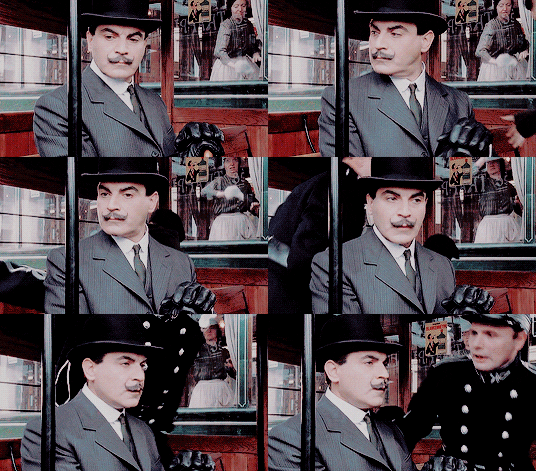
Hercule Poirot is about to tuck into a very traditional English supper with his old friend Bonnington when a lone diner sparks his interest. He's informed that, like clockwork, the man has eaten at the restaurant on Tuesdays and Thursdays for the last ten years, but no one on the staff knows his name. When “Old Father Time,” as they have fondly nicknamed him, suddenly stops coming, Poirot believes that he might have picked up the one essential clue that could shed light on this mysterious man. Could the meal the man ordered as his final meal at the restaurant provide the clue?
Librarian's note: this entry is for the story, "Four-and-Twenty Blackbirds." Collections of short stories by the author can be found elsewhere on Goodreads. Individual entries for all Poirot short stories can be found by searching Goodreads for: "a Hercule Poirot Short Story."
Dame Agatha Mary Clarissa Christie, Lady Mallowan, DBE (née Miller) was an English writer known for her 66 detective novels and 14 short story collections, particularly those revolving around fictional detectives Hercule Poirot and Miss Marple. She also wrote the world's longest-running play, the murder mystery The Mousetrap, which has been performed in the West End of London since 1952. A writer during the "Golden Age of Detective Fiction", Christie has been called the "Queen of Crime". She also wrote six novels under the pseudonym Mary Westmacott. In 1971, she was made a Dame (DBE) by Queen Elizabeth II for her contributions to literature. Guinness World Records lists Christie as the best-selling fiction writer of all time, her novels having sold more than two billion copies.
This best-selling author of all time wrote 66 crime novels and story collections, fourteen plays, and six novels under a pseudonym in romance. Her books sold more than a billion copies in the English language and a billion in translation. According to Index Translationum, people translated her works into 103 languages at least, the most for an individual author. Of the most enduring figures in crime literature, she created Hercule Poirot and Miss Jane Marple. She atuhored The Mousetrap, the longest-running play in the history of modern theater.
How important are white teeth? In the grand scheme of life, not very. However, if you're a Belgian detective, you may just be able to solve a murder based on the color of someone's chompers.
The gist of this one is that Poirot gets interested in the eating habits of a nameless man he and his friend see at a restaurant. After discovering that he eats the same meal each week and talking about habits, Poirot is concerned to discover, upon returning to the restaurant, that the man did not come back the next week. When he investigates the man's disappearance, he finds out that he died from a fall down his steps. ON THE SAME DAY HIS TWIN BROTHER DIED LEAVING HIM A SMALL FORTUNE.
Something about this doesn't seem right, and Poirot is going to find out exactly what it is.
Originally titled Poirot and the Regular Customer, some sources say it was first published in 1926 in an unnamed US magazine. But others say that it was initially published in the US Colliers the National Weekly in 1940, and in the UK in the Strand Magazine in 1941. It doesn't make a lot of sense that it would take so long between publishing it in the US and publishing it in the UK. Most of the short stories I've run across were only published a year apart between the two countries, so I tend to believe the story is most likely from the 40s.
The truth is this midnight library borrow took less time to read than I took watching its film; I suppose that was to be expected. It wasn't any great shakes as a mystery but it was just what I needed. Poirot being a tiny bit obtuse? Even by phone?!
It wasn't great but I wasn't expecting that it would be.
Agatha Christie's Poirot S01E04
Rating: 3* of five
The need to fill an entire (fifty-minute) hour with this simple story of greed and murder led the dramatizers Russell Murray and Clive Exton to spin a more elaborate web...adding an estrangement between twins, a strangely publicly known *absence* of testamentary dispositions, a muddled though believable plot to Do the Deed though lacking in the malice that usually activates the greedy perp's actions.
Still not top-drawer stuff but lovely. That is, if one simply tunes out the most stunningly tedious Hastings subplot ever. Cricket? Ew.
Quick read....eh, audio book. A short story from Agatha Christie. While I do love Poirot more than Miss Marple, I found it just OK. I think had it been longer it would have been better for me. I'm not good at whodunits and it all happened so fast I could barely get the facts before the reveal. Ha! The audio narrator is great and I've picked up a few more audios with the same person. Looking forward to the next Poirot!
3.75 stars. This is a quick, enjoyable read. As usual, Poirot delivers. Poirot and a friend are at a restaurant. Their waitress comments on the behavior of a customer who eats there every Tuesday and Thursday evening for the last ten years. Poirot finds this suspicious. It is amazing how Christie can create a whole mystery of a mundane activity such as ordering a different meal. Poirot is incisive and compassionate as always, but the short form lacks depth in comparison to other Christie's novels that I've read - which I chalk up to a length issue.
3 Stars. It's Poirot's turn. Agatha Christie has used this nursery rhyme more than once as the entrée to mystery. "Sing a song of sixpence / A pocket full of rye / Four and twenty blackbirds / Baked in a pie. / When the pie was opened / The birds began to sing; / Wasn't that a dainty dish, / To set before the king." It appears here and in the Miss Marple novel, "A Pocket Full of Rye." This story came out in "Collier's Magazine" in the US in 1940; my copy is from "Hercule Poirot The Complete Short Stories" of 1999. Our diminutive detective is having dinner at a restaurant in Chelsea with his old friend Henry Bonnington. Their waitress is Molly and she recently told Bonnington about the man eating in the corner, "Old Father Time." How he had been like a calendar coming in every Tuesday and Thursday for a decade. And then last week, out of the blue, he came in on Monday and ordered blackberry pie, something he didn't like! When they meet a few weeks later, his friend tells Poirot that the old man hasn't returned to the restaurant. Out of those clues, Poirot deduces - well that's up to the next reader to get into. Fair to say, for Poirot it was a piece of cake. (March 2021)
This short story was way too short - it consisted mainly of Poirot explaining how he solved the mystery, which resulted in little mystery or suspense for the reader (and not much of a plot either).
It is a double identity mystery. It is well structured and it has a nice flow. Poirot suspects something weird is happening when one of the customers in a restaurant seems to order meals that he doesn't usually eats.
This entire review has been hidden because of spoilers.
Four and Twenty Blackbirds is a short story by Agatha Christie which was first published in the U.K. in the Strand Magazine in 1941. Subsequently with the advent of ebooks and more economical processes, it was published as an individual book. My copy was found in a collection of twelve short stories by Agatha Christie, Autumn Chills and is one of four Poirot cases, the popular Belgian detective who is “just a man who has a liking for order and method.”
Ever observant and attentive for circumstances that appear out of character, Poirot is drawn to a fellow diner who deviates from his routine and then sadly dies some days later.
A perfect crime comes under his scrutiny and with meticulous method he exposes a murderer. A cautionary tale, to be careful what you eat, as this helps uncover the truth.
Christie uses a popular nursery rhyme again in this title which is a stretch and mere poetic license. It makes a good pub quiz question. Can you name the another 7 titles that were Nursery Rhyme inspired?
I always enjoy reading about Poirot especially when he sets out to solve a mystery like this one. Nobody else gets it: the reader is equally puzzled due to the weaving of clues and the author’s fine writing skills. I never tire of this character or such story telling.
The beauty of the shorter format being that you have all the fun and satisfaction without having to spend a few hours in a novel. Look out for them, they will delight and satisfy readers of all ages and make new fans every passing day.
I haven't been getting a lot of March Mystery Madness reading in, but I have been listening to the Hercule Poirot short stories while I do errands to get at least a little be in.
I think I am getting better at enjoying mysteries, picking up on what could be the threads to pull and not get mad if I pull at the wrong ones. I think there is also something to following a series and getting to know the sleuth's behavior, which can also provide a different set of clues to follow. Overall, I quite enjoyed this one. I think there will be more short story listening in my future!
Listened to the audiobook, narrated by Hugh Fraser.
I'm loving this series and the character Hercule Poirot. He has a keen eye to catch the small details and then solves the mystery with those facts that nobody else ever really notices.
Wanted to read this cuz I see the title referenced all the time (for example, it's also the title of a pie cookbook I've been coveting for years :P). Definitely a disappointment. I remember liking And Then There Were None when I read it years and years ago, so I'm not going to write off all future Agatha Christie reading opportunities, but yeah. Just seemed like we weren't clued in to any of the clues that much (like where was the indicator that the old man was actually his nephew in disguise? Seems like a waitress who had been serving him for years would have noticed that...) so it didn't make for a very fun reveal. Just felt like Sherlock Holmes without the wit.
Well, no more blackberries for me! Oh, who am I kidding? I'll be fine. Not like I plan to murder anyone.
This was a great little short story. I had seen the television adaptation, so I knew what was coming, but it was still a very enjoyable listen. Less theatrical than the adaptation, but I think that was for the better. Less complications. Just a good, straight-forward mystery.
Hercule Poirot is eating with a friend. While they are eating, a man arrives at the restaurant. He has been there every Tuesday and Thursday evening for the last ten years.
Later, he stops going to the restaurant, and is discovered to be dead. The police believe it to be an accidental death, but something just doesn't look right to Hercule Poirot.
I know I've read this before, but it's been years. Nice refresher. Very short and a quick read of an investigation Poirot did based on changes in a man's habits that made him suspect a murder had been committed.
Although this short story reminded me of the beginning of Unnatural Death by Dorothy Sayers, it is truly an original. It is amazing how Christie can create a whole mystery of a mundane activity such as ordering a different meal. Very clever read!
This was a fun little classic! I love a good food based mystery, and while it wasn’t the most well put together story I’ve read by Agatha Christie, it was a nice reminder of why I love her!
One of my favorite Poirot short stories. Poirot once again relies on the predictability of human behavior and both detects and solves a murder based on eating habits.