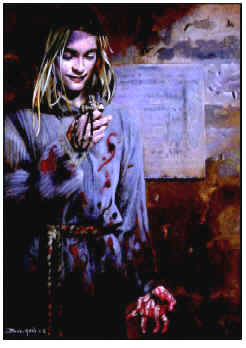
Anatole, holy madman among vampires, has come to Paris to preach the word of God to the Damned. But he is not alone--the fanatics of the Cainite Heresy have descended on the city and claim that Caine himself walks among them. A battle ensues for the hearts and souls of the vampires displaced from Constantinople earlier in the brink of religious warfare, Anatole faces not only his fellow vampires, but the fires of the Inquisition.
Malkavian prophet Anatole and his adopted childe Zoe, struggle against vampires of the Cainite Heresy sect in Paris, under a blood red night sky lighten by a doomsawyer scarlet comet, while Caine's sightings are everywhere. It was a real pleasure reading more about the saga of Anatole, Zoe and Malachite, but for some initial skirmish against werewolves and inquisition Red Brothers, you have to wait for almost 200 pages to read about some action... And all the vampiric theological arguments between Anatole and Lasombra Bishop St. Lys really needed to be cut a lot.
And from a Malkavian titled novel I was really waiting for a few madness more. Instead old good Anatole seems being the most sane character there.
Luckly the ending was very good and new interesting characters that are going to appear in following dark ages clan novels are introduced as usual. Not bad, but if you are looking for action and epic vampiric duels you are not going to find much of them in this chapter of the saga.
I am a huge fan of the VAMPIRE: THE MASQUERADE books but the Dark Ages books are just a better quality of fiction than the modern day Clan Novels.
DARK AGES: MALKAVIAN follows Anatole and his flock of Constantinople refugees. He is a preacher of God in a time when the undead are known to the public. He is currently trying to persuade people against the Cainite Heresy, which teaches that humans are nothing more than food and slaves to a "blessed" vampire race. Let into the city of Paris by the ruthless Prince Alexander, much of the book is about trying to fight the religion venerating caine from taking hold. Debate is not usually how an epic vampire story goes but it is here as well as intelligently written, witty, and concise. I really recommend this.
Being a direct sequel to "Ravnos", "Malkavian" picks up where the previous book ended and focuses on the same set of characters, to its detriment, because Anatole and Zoe and the book's whole plot are dull as dishwater. It starts well enough: in revenge for the death of brother Isidore, abbot Gervese organises a hunt for the vampires camping in the forest, only to be lured into a trap and clash with invading werewolves who nearly destroy them. Following this, both the red brothers and the werewolves are never mentioned again. Pity, because events connected with those two groups would have been much more interesting than what the author serves us.
What the reader is given instead is a series of unending verbal confrontations between Anatole and a preaching heretic Cainite bishop de Lys, and the latter's propositions and arguments are so moronic that anybody with two brain cells to rub together should just laugh him out of the hall. The expression "shining blood" that appeared in "Ravnos" for the first time is now used in every other sentence whenever de Lys speaks, and it becomes so overused that it becomes nauseating, cringeworthy and actually embarrassing to actually see it over and over again.
Eventually, through plot convenience and sudden incompetence, Anatole is unable to argue de Lys down and loses the debates, which results in a massive riot throughout Paris when de Lys's heretic preaching whips up the Cainite crowds, already agitated by the arrival of a comet, into a frenzy. Then comes the most unsatisfying resolution since Malachite's childe deciding to die of hematic allergy in the first book and everything ends while introducing a new threat.
The biggest flaw of this book, as has been the case with all books in this series but one so far, is that it shows us nothing specific about the titular clan of vampires, the clan that's supposed to be gifted with some sort of enlightened madness. To the contrary, Anatole feels like the only sane character in this novel. Zoe continues to be the most useless and pointless character and actually bring nothing to the plot. You could take her out of this book and nothing would be lost.
Consequently, I consider this instalment in the series to be worst so far. "Nosferatu" was bad, but at least something was happening in that book in addition to Malachite's moping. I don't know who thought it was - the author's or somebody at White Wolf - a good idea to structure a novel around the premise of a religious debate in which the side with the flawed and stupid ideas and arguments wins, but they need to never again engage in any sort of creative writing.
This entire review has been hidden because of spoilers.
I'm giving this a low 4; more like 3.5 stars. Good to finally have read a good DA:V novel after the blahness of the previous 2. This book should've been placed earlier in the series, simply because it explains what the Cainite Heresy is. I was foundering reading through Ravnos (book 6) with its oblique references to it and never really getting the sense of how anathemic to vampire society it was. But this book put the heresy front and centre, with Anatole, Zoe, and Malachite fronting up against our antagonist, Bishop St. Lys.
While this does have some more constraints in comparison to the clan novel set in 1999, there is a lot to like here. Some of the more mystical/psychic elements of the clan come more into play than the creative madness. The characters are interesting inviting you further into the main conflict. There are just some pacing issues that leave you wanting more content for the novel.