

What do you think?
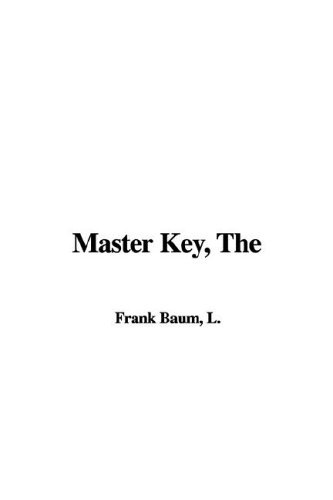
The Master Key
An electrical fairy tale founded upon the mysteries of electricity and the optimism of its devotees.
252 pages, Paperback
First published January 1, 1901
About the author
L. Frank Baum
3,490 books2,841 followersalso wrote under the names:
* Edith van Dyne,
* Floyd Akers,
* Schuyler Staunton,
* John Estes Cooke,
* Suzanne Metcalf,
* Laura Bancroft,
* Louis F. Baum,
* Captain Hugh Fitzgerald
Lyman Frank Baum was an American author best known for his children's fantasy books, particularly The Wonderful Wizard of Oz, part of a series. In addition to the 14 Oz books, Baum penned 41 other novels (not including four lost, unpublished novels), 83 short stories, over 200 poems, and at least 42 scripts. He made numerous attempts to bring his works to the stage and screen; the 1939 adaptation of the first Oz book became a landmark of 20th-century cinema.
Born and raised in Chittenango, New York, Baum moved west after an unsuccessful stint as a theater producer and playwright. He and his wife opened a store in South Dakota and he edited and published a newspaper. They then moved to Chicago, where he worked as a newspaper reporter and published children's literature, coming out with the first Oz book in 1900. While continuing his writing, among his final projects he sought to establish a film studio focused on children's films in Los Angeles, California.
His works anticipated such later commonplaces as television, augmented reality, laptop computers (The Master Key), wireless telephones (Tik-Tok of Oz), women in high-risk and action-heavy occupations (Mary Louise in the Country), and the ubiquity of advertising on clothing (Aunt Jane's Nieces at Work).
* Edith van Dyne,
* Floyd Akers,
* Schuyler Staunton,
* John Estes Cooke,
* Suzanne Metcalf,
* Laura Bancroft,
* Louis F. Baum,
* Captain Hugh Fitzgerald
Lyman Frank Baum was an American author best known for his children's fantasy books, particularly The Wonderful Wizard of Oz, part of a series. In addition to the 14 Oz books, Baum penned 41 other novels (not including four lost, unpublished novels), 83 short stories, over 200 poems, and at least 42 scripts. He made numerous attempts to bring his works to the stage and screen; the 1939 adaptation of the first Oz book became a landmark of 20th-century cinema.
Born and raised in Chittenango, New York, Baum moved west after an unsuccessful stint as a theater producer and playwright. He and his wife opened a store in South Dakota and he edited and published a newspaper. They then moved to Chicago, where he worked as a newspaper reporter and published children's literature, coming out with the first Oz book in 1900. While continuing his writing, among his final projects he sought to establish a film studio focused on children's films in Los Angeles, California.
His works anticipated such later commonplaces as television, augmented reality, laptop computers (The Master Key), wireless telephones (Tik-Tok of Oz), women in high-risk and action-heavy occupations (Mary Louise in the Country), and the ubiquity of advertising on clothing (Aunt Jane's Nieces at Work).
Ratings & Reviews
Friends & Following
Create a free account to discover what your friends think of this book!
Community Reviews
Displaying 1 - 30 of 32 reviews

November 28, 2012
This is not one of L. Frank Baum’s best known works, and it probably should not be compared to the Wizard of Oz. Yet it is well worth the read, even if it is just to see what a great thinker predicted, in 1901, would be the most important electrical inventions of the following century. If you’re wanting a book for purely entertainment purposes, you’ll probably tire of the boy protagonist and his exploits about 50 pages in. If you’re wanting a book about science, be warned: there’s no hard science here, just references and speculation. Yet all-in-all, it’s a delightful, thought-provoking read.
The full title of the book is The Master Key: An Electrical Fairy Tale, Founded Upon the Mysteries of Electricity and the Optimism of Its Devotees. It’s a classic, Faustian tale: the devil is the electrical demon, bringer of three amazing electrical gifts a week, and the protagonist a young boy who loves experimenting with electricity. .
What’s impressive is that all of the electrical demon’s devices are ones that we have in some form today. True, we don’t have watches that let us use electrical forces to fly, but we do have airplanes. Baum predicts Internet news, a device a bit more powerful than a lie detector (it could label people good or evil), bullet proof vests (his are electrical, but still cool), and other products. For example, the “Illimitable Communicator” predicts the cell phone: “a simple electrical device which will enable you, wherever you may be, to converse with people in any part of the world, without the use of such crude connections as wires.”
Throughout the book, there seems to be an underlying commentary that more advanced technology doesn’t necessarily make us better or happier; in fact, it can often add to our problems. I like the way this is learned by the main character through various circumstances. As a modern reader, I’m not so optimistic as Baum’s narrator in the idea of videos documenting the truth without human intervention—it would be fun to read a postcolonial critique of Baum’s work, which definitely incorporates the racism and colonialism of his time.
This book is public domain, so you can get it free on Kindle or read it as part of the Gutenberg Project online. It was a fast, fun, and worthwhile read.
The full title of the book is The Master Key: An Electrical Fairy Tale, Founded Upon the Mysteries of Electricity and the Optimism of Its Devotees. It’s a classic, Faustian tale: the devil is the electrical demon, bringer of three amazing electrical gifts a week, and the protagonist a young boy who loves experimenting with electricity. .
What’s impressive is that all of the electrical demon’s devices are ones that we have in some form today. True, we don’t have watches that let us use electrical forces to fly, but we do have airplanes. Baum predicts Internet news, a device a bit more powerful than a lie detector (it could label people good or evil), bullet proof vests (his are electrical, but still cool), and other products. For example, the “Illimitable Communicator” predicts the cell phone: “a simple electrical device which will enable you, wherever you may be, to converse with people in any part of the world, without the use of such crude connections as wires.”
Throughout the book, there seems to be an underlying commentary that more advanced technology doesn’t necessarily make us better or happier; in fact, it can often add to our problems. I like the way this is learned by the main character through various circumstances. As a modern reader, I’m not so optimistic as Baum’s narrator in the idea of videos documenting the truth without human intervention—it would be fun to read a postcolonial critique of Baum’s work, which definitely incorporates the racism and colonialism of his time.
This book is public domain, so you can get it free on Kindle or read it as part of the Gutenberg Project online. It was a fast, fun, and worthwhile read.

January 7, 2020
ENGLISH: Although the boy who is protagonist of this fantastic novel learns quite a lot during his adventures, and to a certain extent matures and makes the correct decision at the end of the book, I must admit that at no time I found him especially nice or felt identified with him.
The demon of electricity is a demon in the classical Greek sense, like the daimon of Socrates, or perhaps as the genius of Aladdin. He is not at all one of Satan's entourage demons.
ESPAÑOL: Aunque el chico protagonista de esta novela fantástica aprende bastante durante sus aventuras y hasta cierto punto madura, tomando la decisión correcta al final del libro, debo reconocer que en ningún momento me resultó simpático ni me sentí identificado con él.
El demonio de la electricidad es un demonio en el sentido griego clásico, como el Daimon de Sócrates, o quizá como el genio de Aladino. No es, en absoluto, uno de los demonios del séquito de Satanás.
The demon of electricity is a demon in the classical Greek sense, like the daimon of Socrates, or perhaps as the genius of Aladdin. He is not at all one of Satan's entourage demons.
ESPAÑOL: Aunque el chico protagonista de esta novela fantástica aprende bastante durante sus aventuras y hasta cierto punto madura, tomando la decisión correcta al final del libro, debo reconocer que en ningún momento me resultó simpático ni me sentí identificado con él.
El demonio de la electricidad es un demonio en el sentido griego clásico, como el Daimon de Sócrates, o quizá como el genio de Aladino. No es, en absoluto, uno de los demonios del séquito de Satanás.

October 22, 2021
eponymous sentence:
p11: "Because you have touched the Master Key of Electricity, and I must obey the laws of nature that compel me to respond to your summons."
grammar:
p80: The man seemed to understand, by he would not let the glittering instrument out of his possession.
p91: Thereupon he descended until, as the ocean's surface same nearer and nearer, he discovered a tiny island lying almost directly underneath him.
This would have been quite an eye-opener in its heyday. It's quite amusing to note that the Filipino General Emilio Aguinaldo was indeed captured by the American General Fighting Fred Funston at that time.
p11: "Because you have touched the Master Key of Electricity, and I must obey the laws of nature that compel me to respond to your summons."
grammar:
p80: The man seemed to understand, by he would not let the glittering instrument out of his possession.
p91: Thereupon he descended until, as the ocean's surface same nearer and nearer, he discovered a tiny island lying almost directly underneath him.
This would have been quite an eye-opener in its heyday. It's quite amusing to note that the Filipino General Emilio Aguinaldo was indeed captured by the American General Fighting Fred Funston at that time.

January 22, 2020
The little boy in this book takes the cake for one of the most selfish characters I've read. After he acquires electronic devices from an electric demon, who is more like a genii, he goes on a rampage around the world. There's a large sense of his self-importance, and I'm not sure if he's just a little jerk to everyone he meets, or if this is a result of white boys of this time era of fiction acting as if they're better than any other sort of nationality. But he treats his parents pretty dismal as well, so I think it's safe to assume he's just a jerk. He kills people with no further thought, knocks over guards and storms into the presence of the King of England and the President of France, acting as if even they are stupid children that he has to explain things to. Then he threatens to drop two castaways into the ocean if they end up being too heavy for his flying device to support with irritation that they're frightened of the aspect of flying.
Then at the very end when the demon is about to give him some more toys to play with, the boy suddenly grows a moral backbone and turns him down, after which giving him a lecture.
The most surprising aspect of this story is not any of the inventions that Baum dreamed up, but how his protagonist has gotten this far in life without having a worn out rear end!
Then at the very end when the demon is about to give him some more toys to play with, the boy suddenly grows a moral backbone and turns him down, after which giving him a lecture.
The most surprising aspect of this story is not any of the inventions that Baum dreamed up, but how his protagonist has gotten this far in life without having a worn out rear end!

October 30, 2007
This book was very imaginative. It was full of science and fantasy. This book seems to appeal to young boys just because of the content. It is made for a younger audience who is into science. Girls usually are not interested in trains and electricty. Despite the slight flaws, they are my opinion due to my genre preference. I believe it is still a book worth reading.
July 9, 2024
Never read anything like it. Super cool idea. Also kinda predicts the future
March 5, 2022
Three stars for the writing itself; one star for the pretty intense racism.
This is an interesting book from a historical perspective; I'll admit that even though I'd purchased it years ago in my "collect all Baum books" quest, I'd never actually tried to read it, because I'd sort of assumed I'd find it dull. "An Electrical Fairy Tale" isn't the most exciting title, and I've always been much more drawn to pure fantasy than to the sci-fi side of things.
The writing is actually very readable, though - Baum drops a lot of his usual style for a very simple, frank, boy's adventure story. A very typical American boy at the turn of the century (1900) has been playing with batteries and electricity and accidentally strikes some "Master Key" of electrical impulses that summons an all-power Demon of Electricity to do his bidding.
The Demon, who objects to the negative connotation of the term and functions more like a Jinn, provides Rob with three special electrical inventions each week, starting with what's essentially a taser, food tablets, and a watch that lets him travel easily through the air. Rob, being a brave and careless American boy, immediately sets off on world-traveling adventures that get him into bucketloads of trouble.
There's a sharp line drawn between "civilization" (Europe) and anywhere else that's not European, which includes a visit to an island off the coast of Africa, an encounter with Turks and Tatars in the Sahara Desert, and a quick flyover of China, Japan, and Korea. It's certainly not necessary to describe anything that happens in these chapters, and I definitely would not recommend this book for its intended audience, children.
Having a boy travel around the world and encounter other cultures would've been a great opportunity to actually experience other cultures, and to realize that interacting with people unlike yourself allows you to expand your worldview and increase your knowledge. That's what the Demon of Electricity wanted Rob to do, after all: to find other intelligent, scientific minds who could learn from the inventions and find ways to develop their own versions for wider use.
Baum simultaneously opened and slammed this door by making America the center of the universe, and having Rob only learn that...well, that "there's no place like home."
I guess Oz was really the same sort of story, and maybe that's why he resisted revisiting it for so many years...he never wanted his American youths to return to a world so unlike their own, where they'd have to learn from and adapt to unfamiliar cultures and lifestyles. (Maybe this is why I like the later Oz books more...because Dorothy and Trot and the others do become immersed in Oz's culture and grow more complex and interesting as a result.)
Baum does have a few sharply intelligent lines about the dangers of technology, seeming to predict the advent of things like cell phones and the internet, and the dangers of giving too much power and knowledge to people who simply aren't ready to handle it.
"Be very careful as to whom you permit to gaze upon these pictures of passing events, for knowledge may often cause great misery to the human race," the Demon tells Rob, as I read this book in between scrolling through frightening headlines and minute-by-minute news reports of events around the globe.
The conclusion is an interesting and thoughtful one, too; it's wrong to say that Rob only learned one lesson. He ultimately gave back all the electrical inventions because he recognized that it was too much responsibility for him, or for anyone in the present age.
He reminds the Demon that summoning him was purely an accident, and not the result of mankind reaching the kind of enlightenment that was supposed to spark that connection. If you give humans limitless access to information and to destructive weapons, you have to trust that they'll handle these with the proper amount of care and caution...which Rob simply doesn't see during his world tour (even in the European countries he and Baum prioritize as More Civilized). More than a century later, and I have to say I still agree with him.
Baum had his limitations, too, but in this way he was pretty wise and forward-thinking. I suppose that's why he so often returned to fantasy worlds and to the all-powerful, good fairies who took away magic from anyone who tried to use it to hurt others. And I guess that's why I'm always drawn to fantasy worlds, too, where things like that are possible.
The Master Key is, in some ways, a truer depiction of the world, and it's more disheartening for that - but it does provide some good lessons that Baum had probably wished more of his readers to take to heart.
This is an interesting book from a historical perspective; I'll admit that even though I'd purchased it years ago in my "collect all Baum books" quest, I'd never actually tried to read it, because I'd sort of assumed I'd find it dull. "An Electrical Fairy Tale" isn't the most exciting title, and I've always been much more drawn to pure fantasy than to the sci-fi side of things.
The writing is actually very readable, though - Baum drops a lot of his usual style for a very simple, frank, boy's adventure story. A very typical American boy at the turn of the century (1900) has been playing with batteries and electricity and accidentally strikes some "Master Key" of electrical impulses that summons an all-power Demon of Electricity to do his bidding.
The Demon, who objects to the negative connotation of the term and functions more like a Jinn, provides Rob with three special electrical inventions each week, starting with what's essentially a taser, food tablets, and a watch that lets him travel easily through the air. Rob, being a brave and careless American boy, immediately sets off on world-traveling adventures that get him into bucketloads of trouble.
There's a sharp line drawn between "civilization" (Europe) and anywhere else that's not European, which includes a visit to an island off the coast of Africa, an encounter with Turks and Tatars in the Sahara Desert, and a quick flyover of China, Japan, and Korea. It's certainly not necessary to describe anything that happens in these chapters, and I definitely would not recommend this book for its intended audience, children.
Having a boy travel around the world and encounter other cultures would've been a great opportunity to actually experience other cultures, and to realize that interacting with people unlike yourself allows you to expand your worldview and increase your knowledge. That's what the Demon of Electricity wanted Rob to do, after all: to find other intelligent, scientific minds who could learn from the inventions and find ways to develop their own versions for wider use.
Baum simultaneously opened and slammed this door by making America the center of the universe, and having Rob only learn that...well, that "there's no place like home."
I guess Oz was really the same sort of story, and maybe that's why he resisted revisiting it for so many years...he never wanted his American youths to return to a world so unlike their own, where they'd have to learn from and adapt to unfamiliar cultures and lifestyles. (Maybe this is why I like the later Oz books more...because Dorothy and Trot and the others do become immersed in Oz's culture and grow more complex and interesting as a result.)
Baum does have a few sharply intelligent lines about the dangers of technology, seeming to predict the advent of things like cell phones and the internet, and the dangers of giving too much power and knowledge to people who simply aren't ready to handle it.
"Be very careful as to whom you permit to gaze upon these pictures of passing events, for knowledge may often cause great misery to the human race," the Demon tells Rob, as I read this book in between scrolling through frightening headlines and minute-by-minute news reports of events around the globe.
The conclusion is an interesting and thoughtful one, too; it's wrong to say that Rob only learned one lesson. He ultimately gave back all the electrical inventions because he recognized that it was too much responsibility for him, or for anyone in the present age.
"That's just it," answered Rob. "I'm not wise enough. Nor is the majority of mankind wise enough to use such inventions as yours unselfishly and for the good of the world."
He reminds the Demon that summoning him was purely an accident, and not the result of mankind reaching the kind of enlightenment that was supposed to spark that connection. If you give humans limitless access to information and to destructive weapons, you have to trust that they'll handle these with the proper amount of care and caution...which Rob simply doesn't see during his world tour (even in the European countries he and Baum prioritize as More Civilized). More than a century later, and I have to say I still agree with him.
Baum had his limitations, too, but in this way he was pretty wise and forward-thinking. I suppose that's why he so often returned to fantasy worlds and to the all-powerful, good fairies who took away magic from anyone who tried to use it to hurt others. And I guess that's why I'm always drawn to fantasy worlds, too, where things like that are possible.
The Master Key is, in some ways, a truer depiction of the world, and it's more disheartening for that - but it does provide some good lessons that Baum had probably wished more of his readers to take to heart.
October 31, 2021
L. Frank Baum is most famous for "The Wizard of Oz" series. It made him the first successful American author of children books. He didn't stop there--he wrote over forty other novels. He wrote this on in 1901, which is one year after the first Oz book was published. A boy named Rob is fascinated with electricity and accidentally summons a Demon of Electricity, who gives him three marvelous electrical gifts per week. These let him travel anywhere, repel all attacks, defend himself, and feed himself. He ends up refusing the Demon's gifts, saying that humanity is not ready for such technology.
It's an interesting book. Not all that well-written, but interesting. It's a take on the Aladdin story: a boy gets three wishes (gifts) from a genie (demon). It's a warning against the rapid progress of technology and humanity's inability to be responsible for wide-sweeping power. It prefigures problems with TV and even social media--and with the atomic age. For a pre-WWI, pre-Wright brothers novel, written in a time of great enthusiasm for technology, it's an interesting take.
The imperialism hasn't aged well, and the main character isn't likeable (or sympathetic). The plot is random and moralistic, so two stars.
It's an interesting book. Not all that well-written, but interesting. It's a take on the Aladdin story: a boy gets three wishes (gifts) from a genie (demon). It's a warning against the rapid progress of technology and humanity's inability to be responsible for wide-sweeping power. It prefigures problems with TV and even social media--and with the atomic age. For a pre-WWI, pre-Wright brothers novel, written in a time of great enthusiasm for technology, it's an interesting take.
The imperialism hasn't aged well, and the main character isn't likeable (or sympathetic). The plot is random and moralistic, so two stars.

April 19, 2022
An interesting story by the author of the Oz books. Similar to the Oz books, this story features a child/youth protagonist, and much of the plot centers around him having various disconnected adventures while traveling. There's also a strong moral message at the end.
The most fascinating part of the story are the fantastical electrical devices which the "demon of electricity" gives to the young protagonist. Many of these inventions are commonplace in our world today, 100+ years after this book was written. It's classic science fiction in that regard, as the story predicts the future and suggests that even in an "advanced" civilization, humanity and human nature remain the same.
Many aspects of the story are quite dated by today's standards and might be considered culturally insensitive. However, Baum was a skilled and popular writer in his time, and this book weaves a thought-provoking yarn that can still be enjoyed today.
The most fascinating part of the story are the fantastical electrical devices which the "demon of electricity" gives to the young protagonist. Many of these inventions are commonplace in our world today, 100+ years after this book was written. It's classic science fiction in that regard, as the story predicts the future and suggests that even in an "advanced" civilization, humanity and human nature remain the same.
Many aspects of the story are quite dated by today's standards and might be considered culturally insensitive. However, Baum was a skilled and popular writer in his time, and this book weaves a thought-provoking yarn that can still be enjoyed today.
March 3, 2019
This was surprisingly good. Baum has the Oz books, but not all of his other works (or even some of the Oz books) are winners, so glad to find another of the good ones. The only unfortunate part of the book is that it reflects the stereotyping and colonialism of the time (the island of the cannibals). But at least the chief there doesn't necessarily believe everything he hears, insisting that "White men lie." Which historically (and even in the context of the book), he has every reason to assert.
Notwithstanding, the concept of the book is really fun, and the ending consistent with the story. The Record of Events, being a small rectangle that lets you know news from all over the world, seems to be his closest guess to something that actually developed!
Notwithstanding, the concept of the book is really fun, and the ending consistent with the story. The Record of Events, being a small rectangle that lets you know news from all over the world, seems to be his closest guess to something that actually developed!

August 29, 2022
A warning to the woke! Rob uses the alleged pejorative "Japs" instead of the ethnologically correct "Nips" (short for Nipponese).
Notable Quotables:
"The force of [gravitational] repulsion, which is little known, but just as powerful, is another that mankind may direct." C.3
"Common folks always think great men are crazy, but Edison and Tesla and I don't pay any attention to that." C.4
"Dead white man good. Live white man bad!" C.5
"White man lie. Lie all time." ibid
"They [people] try to appear good when they are not, and wise when in reality they are foolish. They tell you they are friendly when they positively hate you, and the try to make you believe they are kind when their natures are cruel." C.8
"Suppose we form a trust, and place them ["laptop computers"] upon the market. We'll capitalize it for a hundred millions, and you can have a quarter of the stock—twenty-five millions." C.18
Notable Quotables:
"The force of [gravitational] repulsion, which is little known, but just as powerful, is another that mankind may direct." C.3
"Common folks always think great men are crazy, but Edison and Tesla and I don't pay any attention to that." C.4
"Dead white man good. Live white man bad!" C.5
"White man lie. Lie all time." ibid
"They [people] try to appear good when they are not, and wise when in reality they are foolish. They tell you they are friendly when they positively hate you, and the try to make you believe they are kind when their natures are cruel." C.8
"Suppose we form a trust, and place them ["laptop computers"] upon the market. We'll capitalize it for a hundred millions, and you can have a quarter of the stock—twenty-five millions." C.18
June 23, 2025
Pushing towards a 2.5, but just didn’t quite get there for me. This tale blends fantasy and science fiction to create what strives to be a cautionary tale. Rob, the main character, lacks the charm and personality of other Baum protagonists like Trot or Dorothy. At times I found him hard to like, but he does show high levels of strong character by the end. Given that it was published in 1901, there is some racism and xenophobia that would have been commonplace at the time, but cringy now. A fun enough read, but I’ll take any of the Oz books any day compared to this one.

September 24, 2021
In Baum's only foray into Science Fiction, he predicts cell phones, tablets, wireless communication, and the 24 hour news aspect of the Internet encapsulated in an technology-driven twist on the genie in the bottle story. The writing is definitely geared toward preteen boys, is couched in the pervasive, casual racism of the turn of the 20th century, and ending is a bit of an abrupt disappointment. However, the narrative, the dialog, the plucky main character all have that touch of Baum magic.

October 21, 2017
Read from Project Gutenberg. Recommended for L. Frank Baum aficionados, early 20th-century boys' novels collectors, and early science fiction fans.

April 23, 2021
No wonder readers kept wanting him to go back to Oz.
This book was godawful, racist garbage.
This book was godawful, racist garbage.

Read
January 8, 2022Scary how in 1901 Baum foresaw cell phones, tasers, etc. Even more scary that he foresaw the awful uses to which they are put.


November 26, 2019
História entretida, mas algo pobre em imaginação inventiva, sobretudo se comparada com os livros de Oz. De resto, um bom bocado para público mais infantil, pouco interessante para o mais adulto.

April 2, 2014
This book was a series of surprises for me.
Some of them were positive, and some of them were not.
I couldn't help taking a sigh of relief when nowhere in the book scientific progress and new technologies were portrayed in a negative light. Maybe it's because of the period in which this was written, but it is so refreshing. I'm just tired of being told my field of interest is evil and will destroy the world by people who understand literally nothing of it.
On the other hand, as a girl who has wanted to get into STEM since middle school, the continuous iteration that this was "a tale for boys" because no girl ever would be interested in electricity obviously was unbearable at best. Especially considering the author's other works: I have read The Wonderful Wizard of Oz and recently started (and dropped) The Sea Fairies and they both feature very bright little girls. Why wouldn't bright little girls like Dorothy and Trot be interested in science? Especially when the main character of this book is portrayed as anything but bright! He's daft and only strikes the master key by chance.
Some of them were positive, and some of them were not.
I couldn't help taking a sigh of relief when nowhere in the book scientific progress and new technologies were portrayed in a negative light. Maybe it's because of the period in which this was written, but it is so refreshing. I'm just tired of being told my field of interest is evil and will destroy the world by people who understand literally nothing of it.
On the other hand, as a girl who has wanted to get into STEM since middle school, the continuous iteration that this was "a tale for boys" because no girl ever would be interested in electricity obviously was unbearable at best. Especially considering the author's other works: I have read The Wonderful Wizard of Oz and recently started (and dropped) The Sea Fairies and they both feature very bright little girls. Why wouldn't bright little girls like Dorothy and Trot be interested in science? Especially when the main character of this book is portrayed as anything but bright! He's daft and only strikes the master key by chance.
April 15, 2014
The Master Key by L. Frank Baum---a fairy tale where a boy is given magical electrical gifts by the Demon of Electricity. Augured the internet, google, stun guns, TV, computers, wireless telephones....ends with Rob's comment: "Some people might think I was a fool to give up those electrical inventions," he reflected; "but I'm one of those persons who know when they've had enough. It strikes me the fool is the fellow who can't learn a lesson. I've learned mine, all right. It's no fun being a century ahead of the times!" A century ahead, indeed!

September 10, 2014
Eh, it was okay. I guess the ultimate lesson Rob learned was interesting, but the characterization and "humor" in this book were so shallow that it read as almost sociopathic to me. The racism was way less problematic than Rob acting like participating in a battle and actually killing people is a minor adventure; something he wouldn't be doing if he hadn't happened across it. Even worse, he is absolutely unsympathetic towards a pair of sailors he rescues from an island.

September 14, 2013
Pretty interesting story. Hard to believe that Baum could see so many inventions that are basically around today. I think the story has an interesting moral as well. The only thing that is iffy for me is that it feels like there is no real path or destination for Rob. It's like Baum started a story he was unsure of how to stop. That's not always a bad thing, however.

June 18, 2014
A young boy with a big interest in electricity is visited by the Demon of electricity, receives a series of 'gifts', electrical gifts, and has a series of unusual travels. But are these gifts good or bad?

Want to Read
October 31, 2007I was told this had science in it.

December 3, 2011
Awesome little "Waterspider" novella by the author of the Oz stories.
July 11, 2012
A lack of description seems to detract from Vain's writings for me however the imagination to predict devices we take for granted now, I.e., internet, cell phones, sonic screwdrivers...is astounding.

November 4, 2012
Abysmal, even by the low Edisonade standard.
January 30, 2014
Interesting story on the uses (and misuses) of technology. Not at all like the Wizard of Oz series.
May 26, 2014
Interesting morals but didn't capture my attention.

September 14, 2017
A startling lack of imagination. Cannibals and pirates? Oh dear. This has none of the originality of the Oz books.
Displaying 1 - 30 of 32 reviews