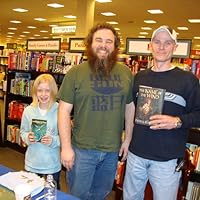
Robert Kirkman is an American comic book writer best known for his work on The Walking Dead, Invincible for Image Comics, as well as Ultimate X-Men and Marvel Zombies for Marvel Comics. He has also collaborated with Image Comics co-founder Todd McFarlane on the series Haunt. He is one of the five partners of Image Comics, and the only one of the five who was not one of the original co-founders of that publisher.
Robert Kirkman's first comic books were self-published under his own Funk-o-Tron label. Along with childhood friend Tony Moore, Kirkman created Battle Pope which was published in late 2001. Battle Pope ran for over 2 years along with other Funk-o-Tron published books such as InkPunks and Double Take.
In July of 2002, Robert's first work for another company began, with a 4-part SuperPatriot series for Image, along with Battle Pope backup story artist Cory Walker. Robert's creator-owned projects followed shortly thereafter, including Tech Jacket, Invincible and Walking Dead.
Not bye, Morgan? Bye, Morgan's arm, I guess. Abraham comes to help with his crew whilst Michonne and Rick drag (a pretty useless) Morgan back to Rick's place, where Denise will have to come to them. Glenn, Andrea, Heath and Spencer can only watch from a far, not being able to help as of yet. Glenn is starting to be a Debbie downer, like I don't think Andrea, Heath and Spencer need to hear that they're all going to die. He, specifically, thinks he's going to die soon ... well, I mean, he ain't wrong, he's real batting it out of the ball park with his premonition. Get it? Batting it? Because Negan? And his bat? Get it? I'm funny, please laugh. Abraham & his crew are still fighting back the zombies with his main chick on one side and his side chick on the other. How romantic. Morgan has been patching but Denise doesn't know if the arm has been taken off fast enough to stop the virus. Oop, more zombies have come through, Maggie comes with Sophia to hide in Rick's house whilst the zombies pour in. Morgan has come to and admits to Carl than he saw him shoot Ben (who I've completely forgot about), Carl being a little edge Lord is like 'I know you did'. Whimpy Gabriel grows some balls & lets (I think) Eugene in whilst he's crying. Very brave, Gab, very brave. Morgan has a fever and is convinced he's dying. He talks to Carl telling him he's a good kid and not to forget that but towards the end he mistakes Carl for his deceased son Duane. Spencer, the lil' shit, suggests instead of helping the group stuck in Alexandria, him and Andrea leave together, luckily she smacks him one, good. She's done with their relationship. And it ends with Rick suggesting that they leave. So basically what Spencer said. When Jessie says that we can't just leave other people's children behind, he's like 'but they're not OUR children' like bish, I'm cold hearted and I ain't here for it. x
Being a huge fan of the show, I wanted to see how the original writing started and how the show writers followed and deviated from the comics. My dislikes were that the comics are much more crude, crass, and unnecessarily violent. I did like the change in relationships and how people worked together differently, and the comics have a different creepiness feel than you get watching it on TV. Overall, I prefer the show, and probably will not finish out the comic book series.
Rick Grimes is a strong-willed deputy who missed the end of the world because he was in a coma for a month after getting shot in the line of duty. Shaken, starving and confused, Rick escapes the horror of the abandoned hospital only to be met with something far more terrible. Not only has the world ended, but the dead have learned to walk and to kill without mercy. After learning that his wife and son have fled to Atlanta from a single survivor and his son, Rick goes on a journey to reunite with his family and search for more survivors.
Rick quickly has to come to terms with the fact that the world has ended and only a select few survived. The dead have risen from their graves and they prey on the living. In a world where every minute feels like hours, where there's no such thing as law and order, where finding a small meal is a tremendous task, the walking dead are quite possibly the least threatening thing for the survivors to have on their breaking minds. Humanity is pushed to the brink of destruction, forcing them to embrace their cruel and primal nature in order to survive. Sometimes you have to be more concerned about who you let into your community so they don't kill you in your sleep and steal everything you once cared about. Rick has no choice but to abandon the ways of law and order that he's upheld as an officer for so long in order to protect the few loved ones he has left. He has to become a monster to protect his crew or risk being devoured by those who became more monstrous than him and even the walking dead.
Despite zombies running the world and having the series named after them, what really sets this series apart from the average zombie apocalypse tale is the focus on realism and the daily struggles, flaws and depth of the characters. There's plenty of badass zombie killing action, but the action often takes a back seat to give the characters plenty of times to share their extremely tragic yet endearing stories, grow through mutual suffering and learn to adapt to a world that has left them to die. Even after the world has ended, many people still can't see eye to eye. They turn on each other and kill each other when they should come together. Others form alliances in spite of their differences and try to rebuild over the corpse of everything that was lost. The daily human drama and conflict is more intense than any monster apocalypse could hope to be.
We watch Rick struggle to balance his old moral code with the many necessary evils he has to commit in order to survive and make the world a better place for the ones he holds close. We watch people like Glen, Dale and Maggie attempt to find love in spite of having every reason to be filled with fear, hate and self-loathing. Characters like Michonne have to learn how to forgive themselves and convince themselves they deserve to be loved despite all the blood on their hands. We watch the weak like Carl and Andrea become strong and sometimes the strong become evil like The Governor. Even monsters like the wicked yet oddly lovable Negan are given the chance to find new ways of redeeming themselves by struggling alongside the other survivors that have all been changed by the horrors of the fallen world.
The pacing is extremely slow and I can understand why that may be a turnoff for a lot of people, but I eventually learned to enjoy watching the characters grow, overcome their trauma, find meaning in life and learn to love again. The characters are forced to do many terrible things to survive and it haunts them every waking moment. The ways they overcome these regrets is very realistic, human and hopeful. The slow pacing really gives the feeling that we're living beside these people. The way every tiny detail of their lives and who they are is explored makes them feel very real and believable.
When I first started reading the series, I wasn't expecting it to have such an uplifting ending. It seemed so bleak and nihilistic for a long time and things would go horribly wrong even when they seemed to be going so well, but the finale channels all the pain, suffering and betrayal of the previous volumes and tops it off with a very touching and inspiring finish. This was never a story about hopelessness. It's about learning to appreciate the little things, learning to forgive yourself and learning to move on even when it's hard. When everything seems lost there's always more to be found, even when we believe otherwise because we convince ourselves that we don't deserve to be happy ever again. Instead of dwelling on what was lost, strive to try and make things better than they were before.
I've never been a huge fan of zombie apocalypse stories, but The Walking Dead had enough heart and strong social commentary to make me stick by the characters until the end and I enjoyed every moment of their long trial.
Have we been deceived? the show completely deviates and so far from the comics . it's another plot and no one can deny that . Grieving for loss Morgan , he was one of my favorite character . unfortunately i will start consider that are different story , to prevent my self from all that shocks .
Issue #82 plunges us deeper into the chaos as Alexandria teeters on the brink of collapse. Emotional tensions are at an all-time high, with the community facing both external threats and internal dilemmas. This issue explores themes of survival, moral compromise, and the cost of leadership, leaving no room for sentimentality in the brutal world they inhabit.
The issue opens with Morgan’s life hanging by a thread after being bitten. Rick, with grim determination, instructs Michonne to amputate Morgan’s arm, knowing it’s the only chance to save him. Michonne wastes no time, wielding her katana with clinical precision, slicing off Morgan’s arm before he can fully comprehend what’s happening. The rawness of this moment—blood spurting, Morgan's scream of agony, and the ruthless efficiency of Michonne—is both horrifying and gripping. The scene demonstrates the harshness of their reality: survival demands instant, brutal decisions.
Meanwhile, Glenn, Andrea, Spencer, and Heath remain stranded on the rooftop, trapped by the relentless horde below. Glenn’s growing despair is palpable as he contemplates the overwhelming odds. His quiet resignation, whispering that he doesn’t think they’ll make it, underscores the emotional toll of constant danger. Heath offers little solace, only sharing in the helplessness, while Spencer’s selfishness begins to unravel further.
Abraham leads a desperate defense, but the zombies continue to breach the perimeter. Rosita’s growing resentment toward Abraham, particularly regarding his apparent concern for Holly, adds an emotional undercurrent. The subtle implication of infidelity heightens the tension, and Rosita’s cold response to Abraham’s question about Holly shows the cracks in their relationship widening.
Back at Rick’s house, the threat looms larger as zombies flood the streets of Alexandria. Rick’s brutal pragmatism comes to the fore when he suggests abandoning the others to save his small group. Jessie's shock at his willingness to leave behind children and families highlights Rick’s growing moral ambiguity. His insistence that “they’re not our children” reveals the heavy toll leadership has taken on him, forcing him to prioritize survival over humanity. Yet, Rick’s decision feels cold, even for a hardened survivor, and it left me questioning how much of his humanity is still intact.
Carl’s interactions with Morgan showcase how much he has grown—or perhaps how much he has lost. The chilling conversation where Morgan confesses that Carl reminds him of Duane, his deceased son, adds layers of melancholy. Carl’s hardened demeanor, claiming he’s ready to shoot Morgan if necessary, reflects the loss of innocence. But Morgan’s sorrow, mistaking Carl for Duane in his fevered state, is devastating. It’s a reminder of what the apocalypse has stolen from everyone—their humanity, their children, and their hope.
Spencer’s cowardice hits its peak when he suggests to Andrea that they abandon the others and flee. Andrea’s response—punching him square in the face—is immensely satisfying. Spencer’s selfishness contrasts sharply with Andrea’s loyalty to the group, solidifying her as one of the few remaining characters who still believes in the value of community and selflessness.
This issue is a masterclass in emotional complexity. Michonne’s swift action to save Morgan shows how far they’ve come in accepting the harshness of their reality. Spencer’s selfishness and Rick’s cold pragmatism highlight the different ways people cope with the apocalypse.
Spencer’s cowardice was infuriating, and I was genuinely relieved when Andrea knocked him out. Rick, on the other hand, walks a razor-thin line between practicality and cruelty. His cold dismissal of the other children was unsettling, and while I understand his logic, it left a bitter taste.
Morgan’s fever-induced conversation with Carl was heartbreaking, especially when he mistook Carl for Duane. It was a stark reminder of the losses each character has endured. Carl’s unflinching demeanor, offering to shoot Morgan, was chilling, showing how much the apocalypse has shaped him into something unrecognizable from the innocent child he once was.
This issue adds a dark comedic twist to the tension as Carl and Ron dangle Morgan’s severed arm over the walkers like it’s some grotesque toy. The absurdity of the scene is both shocking and hilarious. Carl’s nonchalant attitude, particularly when he offers to kill Morgan because he misses the feeling of blood splatter, is so darkly humorous it borders on disturbing. Morgan’s horrified response—saying he’d rather turn into a walker and eat his son than let Carl kill him—added an unexpected, twisted humor. Rick’s deadpan response, “Not cool, Rick,” made the scene even funnier.
The sheer audacity of Carl’s dialogue had me laughing out loud. The balance of horror and humor is executed perfectly here, showing that even in the darkest times, there’s room for grim levity. It was one of the funniest moments in the series, and it added a refreshing break from the constant tension.
Holy shit! I kinda can't believe that Michonne ended up chopping Morgan's arm off to try and save him. But then again, drastic times call for drastic measures and all of that.
Whoo! I LOVE seeing Michonne kick ass and kill a shit ton of zombies. She's amazing with her sword and I never get tired of seeing her use it, especially when it comes to protecting herself or one of their group.
HELL YES! Go Abraham! I love seeing Michonne and Abraham tear those fucking zombies apart. They just go crazy on the zombies and I love it. They are NOT to be fucked with!
I feel bad that Glenn, Andrea, Heath and Spencer can't do anything to help the others that are still in Alexandria. Aww, my poor Glenn! Don't be so gloom and doom, honey!
Abraham, Holly, Eric and Aaron are doing an amazing job killing as many zombies as possible while waiting for a bunch of the others to join them. I hope they all survive this.
Well, I'm glad that Morgan's not dead yet, so that's something at least. We don't know if he's going to live but at least he's alive for right now, which is still something, in my opinion.
Oh shit! Just look at all of the zombies that have gotten inside of Alexandria. I hope that they all band together and are able to take all of those fuckers out. That's a lot of zombies.
Oh damn! Rosita and Abraham better hurry the hell up and get inside one of the houses as soon as possible. I hope that neither of them end up getting bitten by one of the nearby zombies.
I like that Rick and the rest of the group trust Carl enough to watch Morgan and take him out if need be. That means they trust him and rely on him, and for someone his age to have that, that's pretty amazing.
I liked the talk between Morgan and Carl. I'm glad that Morgan admitted that he knew Carl had killed Ben. I'm also glad that Morgan didn't try to make Carl feel bad for doing it.
Douglas's crying makes me want to punch him in the face. He's so fucking useless that it drives me crazy. Stop your crying you stupid old man and make yourself useful!
I'm glad that Gabriel let Eugene and the others into the church. For a moment there, I wasn't sure he was going to let them inside. Then I'd have wanted him dead for being a prick.
I feel like Rick and Jessie are just saying the same things over and over, about how they don't want Ron and Carl to find out about them, so they won't do anything. And then they go ahead and do stuff anyway. Yawn. Boring.
I liked Morgan and Carl's conversation, where Morgan told Carl that he was proud of him for doing what needed to be done where it concerned Ben. Too bad the effect was ruined when Morgan started hallucinating and ended up calling Carl, Duane.
I agree with Andrea that they shouldn't leave the other's behind, but her hitting him, was an overreaction and I don't like that she did it. I'm sure Spencer didn't mean to come off as a jerk.
Aww, I like that Carl tried to keep Sophia from getting scared of the zombies. That was nice of him, considering he's been a little shit head lately. So, I'm glad he's not a jerk to everyone.
I agree with Rick. My family comes first and once they're safe, then I'd go back for anyone and everyone else. But for Jessie to get upset at that, she needs to start using her head.