

What do you think?

Moneyball
Billy Beane, general manager of MLB's Oakland A's and protagonist of Michael Lewis's Moneyball, had a problem: how to win in the Major Leagues with a budget that's smaller than that of nearly every other team. Conventional wisdom long held that big name, highly athletic hitters and young pitchers with rocket arms were the ticket to success. But Beane and his staff, buoyed by massive amounts of carefully interpreted statistical data, believed that wins could be had by more affordable methods such as hitters with high on-base percentage and pitchers who get lots of ground outs. Given this information and a tight budget, Beane defied tradition and his own scouting department to build winning teams of young affordable players and inexpensive castoff veterans.
Lewis was in the room with the A's top management as they spent the summer of 2002 adding and subtracting players and he provides outstanding play-by-play. In the June player draft, Beane acquired nearly every prospect he coveted (few of whom were coveted by other teams) and at the July trading deadline he engaged in a tense battle of nerves to acquire a lefty reliever. Besides being one of the most insider accounts ever written about baseball, Moneyball is populated with fascinating characters. We meet Jeremy Brown, an overweight college catcher who most teams project to be a 15th round draft pick (Beane takes him in the first). Sidearm pitcher Chad Bradford is plucked from the White Sox triple-A club to be a key set-up man and catcher Scott Hatteberg is rebuilt as a first baseman. But the most interesting character is Beane himself. A speedy athletic can't-miss prospect who somehow missed, Beane reinvents himself as a front-office guru, relying on players completely unlike, say, Billy Beane. Lewis, one of the top nonfiction writers of his era (Liar's Poker, The New New Thing), offers highly accessible explanations of baseball stats and his roadmap of Beane's economic approach makes Moneyball an appealing reading experience for business people and sports fans alike. --John Moe
317 pages, Paperback
First published January 1, 2003
About the author
Michael Lewis
44 books15.7k followersMichael Monroe Lewis is an American author and financial journalist. He has also been a contributing editor to Vanity Fair since 2009, writing mostly on business, finance, and economics. He is known for his nonfiction work, particularly his coverage of financial crises and behavioral finance.
Lewis was born in New Orleans and attended Princeton University, from which he graduated with a degree in art history. After attending the London School of Economics, he began a career on Wall Street during the 1980s as a bond salesman at Salomon Brothers. The experience prompted him to write his first book, Liar's Poker (1989). Fourteen years later, Lewis wrote Moneyball: The Art of Winning an Unfair Game (2003), in which he investigated the success of Billy Beane and the Oakland Athletics. His 2006 book The Blind Side: Evolution of a Game was his first to be adapted into a film, The Blind Side (2009). In 2010, he released The Big Short: Inside the Doomsday Machine. The film adaptation of Moneyball was released in 2011, followed by The Big Short in 2015.
Lewis's books have won two Los Angeles Times Book Prizes and several have reached number one on the New York Times Bestsellers Lists, including his most recent book, Going Infinite (2023).
Lewis was born in New Orleans and attended Princeton University, from which he graduated with a degree in art history. After attending the London School of Economics, he began a career on Wall Street during the 1980s as a bond salesman at Salomon Brothers. The experience prompted him to write his first book, Liar's Poker (1989). Fourteen years later, Lewis wrote Moneyball: The Art of Winning an Unfair Game (2003), in which he investigated the success of Billy Beane and the Oakland Athletics. His 2006 book The Blind Side: Evolution of a Game was his first to be adapted into a film, The Blind Side (2009). In 2010, he released The Big Short: Inside the Doomsday Machine. The film adaptation of Moneyball was released in 2011, followed by The Big Short in 2015.
Lewis's books have won two Los Angeles Times Book Prizes and several have reached number one on the New York Times Bestsellers Lists, including his most recent book, Going Infinite (2023).
Ratings & Reviews
Friends & Following
Create a free account to discover what your friends think of this book!
Community Reviews
Displaying 1 - 30 of 7,050 reviews

October 26, 2008

Michael Lewis - image from Forbes
This is one of the best baseball books I have ever read, and that is saying something. Lewis’ focus is on Billy Bean, the GM of the Oakland Athletics. Because Oakland is a small-market team, Bean must use his brain to tease out the players who can help his team, at a reasonable cost. This makes him a sort of anti-Steinbrenner. Lewis goes into some detail on how Bean manages to field competitive teams almost every year under dire fiscal constraints. Must-read for any true baseball fan, and a source of hope for fans of small-market teams. The film version was a top-notch interpretation of the book, a lovely surprise.
Some other books that deal in baseball analytics in whole or part
-----The Inside Game by Keith Law
-----Smart Baseball by Keith Law
-----The Arm by Jeff Passan


4/13/18 - NY Times - How Do Athletes’ Brains Control Their Movements? - by Zach Schonbrun - Fascinating article. Maybe the next level in the expanding realm of the sort of baseball analysis someone like Billy Bean might employ to get an edge over wealthier franchises
It would seem to have almost nothing to do with their biceps muscles or fast-twitch fibers or even their vision, which, for most baseball players is largely the same. It would seem to have much more to do with the neural signals that impel our every movement. “It’s like saying people who can speak French very well have a very dexterous tongue,” John Krakauer, a neuroscientist at Johns Hopkins University, told me. “It would be the wrong place to assign the credit.”

February 24, 2016
“The pleasure of rooting for Goliath is that you can expect to win. The pleasure of rooting for David is that, while you don’t know what to expect, you stand at least a chance of being inspired.”

This book came out in 2003, and the movie version came out in 2011; yet, it is amazing to me that despite the success shown by the Oakland As under the guidance of Billy Beane, baseball, for the most part, is still focusing on the wrong things. Just recently the manager of the New York Mets, Terry Collins, who commands one of the best teams in the world, said in an interview after the World Series:
“I’m not sure how much an old-school guy can add to the game today,’’ Collins told USA Today. “It’s become a young man’s game, especially with all of the technology stuff you’ve got to be involved in. I’m not very good at it. I don’t enjoy it like other people do. I’m not going to sit there today and look at all of these (expletive) numbers and try to predict this guy is going to be a great player. OPS this. OPS that. GPS. LCSs. DSDs. You know who has good numbers? Good (expletive) players.”

Terry Collins said: “Shit Happens” at a press conference. Billy Beane must have rolled his eyes.
The MLB network show Hot Stove was incensed that Collins would make such a statement in this day and age, especially since they could track several “gut” decisions he made during the World Series that probably cost them a chance to win it. The most glaring error was when he decided to pull the pitcher, Matt Harvey, in the 9th inning of game five only to change his mind and send him back out there after Harvey complained. Collins looked into the player’s eyes and saw what he wanted to see. It was the third time through the order. Harvey had pitched brilliantly, but statistically, that bad word that Collins doesn’t like. When you look at the Royals, they get to pitchers late. The Royals got to Harvey and knocked him out of the game, which left a mess for Jeurys Familia to come into the game to try and save.
Royals Win!

Eric Hosmer going off the Billy Beane script for success, but man, was it dramatic. I about had a heartattack.
The Royals deviate from Billy Beane ball at many junctures. One being the most dramatic play of the series when Eric Hosmer steals home. Beane does not believe in stealing bases, too risky, and if you steal a base on a Billy Beane team, you better make sure you are safe. The Royals also occasionally bunt to move a runner, which doesn’t fit the Beane philosophy. He believes in managing outs and never giving up an out to advance a runner. The Royals have speedy wheels and frequently turn bunts into base hits, which would probably keep them from finding themselves subjugated to a Billy Beane lecture. You can go off script, but just be right.
The Royals are a homegrown team. Most of the players have come from the farm club system, although they are a bit too athletic and good looking for a Billy Beane ball club. One of the things that Beane talks about is getting away from players who could sell jeans. He should know; he was one of those players that looked like a Greek God in a uniform. He was drafted in 1980 along with another phenom that even those people who don’t follow baseball probably recognize his name...Darryl Strawberry. Beane was an interesting enough prospect that, for a while, the Mets were even considering taking him in the draft first instead of Strawberry. Both were amazing specimens of what we want athletes to look like. The Mets ended up taking Beane, too, but with the 23rd pick. Beane had all the physical gifts to be successful, but sports is not just about the body; it is about the mind. Billy had a lot of expectations for himself, and those expectations became insecurities that eventually evolved into a gifted player being unable to play the game.

Billy Beane on the verge of a stardom that somehow eluded him. He is exactly the player who Billy now tries to avoid.
He asked for a job in the As front office, and that began an odyssey in search of those players who were ”ballplayers”, not pretty head cases, not players that hit home runs and created RBIs, but players that could control the strike zone. As he tore apart the As organization, he got rid of the scouts who were still insisting on signing Apolloesque ballplayers and sold off overpriced talent. Ownership wasn’t giving him much money to work with anyway, so instead of buying expensive talent, he had to sell expensive talent and replace it with a motley group of players whom no one else wanted, but who had the one important element he wanted most, OPS (on base plus slugging), i.e. these guys knew how to get on base.
These players had a menagerie of interesting things wrong with them that had other clubs looking to get rid of them, which made them perfect for Billy Beane. One pitcher had club feet. They were below average fielders. They were overweight. They threw sidearm pitches. They were older players on their way out. They were players too green for any other team to consider playing them.
You can’t win with players like this!
Well, maybe you can. Exhibit A: The standings at the end of the season in the American League West in 2002.
Wins Losses Games Behind Payroll
Oakland 103 59 ---- $41,942,665
Anaheim 99 63 4 $62,757,041
Seattle 93 69 10 $86,084,710
Texas 72 90 31 $106,915,180
Now the interesting thing is notice the payroll compared to the wins. The more money a team spent the fewer games they won. If I had been the Texas Rangers owner, I’d be looking at these results and think to myself, What am I paying for?
Baseball is in love with RBIs and Home Runs. They think those are the things about baseball that put butts in seats. As the Royals made their way through the playoffs in the American league in 2015, they encountered two teams that depended on the home run to win ball games. The Royals hit 95 home runs in 2014, which placed them dead last at 30th among major league baseball teams. In 2015, they improved to 139 home runs, but were still 24th in the league. Their opponent in the playoffs in 2015, the Toronto Blue Jays, were 1st in all of major league baseball with 232 home runs. Their other opponent, the Houston Astros, hit 230 home runs and were second in the league for home runs.

Jose Bautista hit several dramatic home runs in the playoffs, including the famous bat flip home run, but despite those fence clearing bombs, they were unable to advance in the playoffs.
Jacking up home runs might equal playoffs, but it doesn’t seem to equal winning world championships.
Even the Mets hit 177 home runs for 9th in the league. They did win the pennant, but still fell short of winning a world championship. To my eye, they are a more complete offensive ballclub than Houston or Toronto and will be contenders again this year, but not because they hit a lot of home runs.
So why is major league baseball so reluctant to embrace the philosophy of Moneyball? ”Anti-intellectual resentment is common in all of American life and it has many diverse expressions.” For instance, preferring high school players in the draft over college players, even though statistically college players do better. College athletes have played against stiffer competition. They have honed their skills. They have more reliable stats to give a general manager a better clue to how they will perform at the next level.
I admire the Mets. They are a terrific team. I still have a lot of nostalgia for Gary Carter and the Miracle Mets of 1986, and if the Royals hadn’t been playing against them last year, I would have been rooting for them in the World Series. I have to say that Terry Collins’ comments about basically comparing statistics to voodoo was disappointing to me. I don’t mean to pick on Collins, but his comments came after he made several decisions in the face of a pile of data to the contrary that probably cost his team at least a better chance to win the World Series. He is not alone. Baseball is still filled with owners, GMs, and managers who believe that home runs and RBIs are the most important statistics and the best way to win championships.
The Royals, after all, are an anomaly, right?
It was the same things teams were saying about the As in the early 2000s.
I think of all those ballplayers who really know how to play the game, who are stuck in the minor leagues because they hit too many singles or walked too many times, and didn’t launch enough missiles over the back fence.
I loved this book because I’m a fan of baseball, but the book had a much bigger impact on me. I started thinking about and applying Billy Beane principles to my own business. We are a company mired in traditions and traditional thinking and long overdue for an overhaul in philosophy to meet new challenges. Like all companies, we need to become more efficient, more lean, more targeted to what wins ball games rather than what creates a big splash. I’m buying copies of this book for the rest of the management staff, and we are going to talk about singles and doubles and managing our outs. Maybe we, too, can get our Royal on.
If you wish to see more of my most recent book and movie reviews, visit http://www.jeffreykeeten.com
I also have a Facebook blogger page at:https://www.facebook.com/JeffreyKeeten

This book came out in 2003, and the movie version came out in 2011; yet, it is amazing to me that despite the success shown by the Oakland As under the guidance of Billy Beane, baseball, for the most part, is still focusing on the wrong things. Just recently the manager of the New York Mets, Terry Collins, who commands one of the best teams in the world, said in an interview after the World Series:
“I’m not sure how much an old-school guy can add to the game today,’’ Collins told USA Today. “It’s become a young man’s game, especially with all of the technology stuff you’ve got to be involved in. I’m not very good at it. I don’t enjoy it like other people do. I’m not going to sit there today and look at all of these (expletive) numbers and try to predict this guy is going to be a great player. OPS this. OPS that. GPS. LCSs. DSDs. You know who has good numbers? Good (expletive) players.”

Terry Collins said: “Shit Happens” at a press conference. Billy Beane must have rolled his eyes.
The MLB network show Hot Stove was incensed that Collins would make such a statement in this day and age, especially since they could track several “gut” decisions he made during the World Series that probably cost them a chance to win it. The most glaring error was when he decided to pull the pitcher, Matt Harvey, in the 9th inning of game five only to change his mind and send him back out there after Harvey complained. Collins looked into the player’s eyes and saw what he wanted to see. It was the third time through the order. Harvey had pitched brilliantly, but statistically, that bad word that Collins doesn’t like. When you look at the Royals, they get to pitchers late. The Royals got to Harvey and knocked him out of the game, which left a mess for Jeurys Familia to come into the game to try and save.
Royals Win!

Eric Hosmer going off the Billy Beane script for success, but man, was it dramatic. I about had a heartattack.
The Royals deviate from Billy Beane ball at many junctures. One being the most dramatic play of the series when Eric Hosmer steals home. Beane does not believe in stealing bases, too risky, and if you steal a base on a Billy Beane team, you better make sure you are safe. The Royals also occasionally bunt to move a runner, which doesn’t fit the Beane philosophy. He believes in managing outs and never giving up an out to advance a runner. The Royals have speedy wheels and frequently turn bunts into base hits, which would probably keep them from finding themselves subjugated to a Billy Beane lecture. You can go off script, but just be right.
The Royals are a homegrown team. Most of the players have come from the farm club system, although they are a bit too athletic and good looking for a Billy Beane ball club. One of the things that Beane talks about is getting away from players who could sell jeans. He should know; he was one of those players that looked like a Greek God in a uniform. He was drafted in 1980 along with another phenom that even those people who don’t follow baseball probably recognize his name...Darryl Strawberry. Beane was an interesting enough prospect that, for a while, the Mets were even considering taking him in the draft first instead of Strawberry. Both were amazing specimens of what we want athletes to look like. The Mets ended up taking Beane, too, but with the 23rd pick. Beane had all the physical gifts to be successful, but sports is not just about the body; it is about the mind. Billy had a lot of expectations for himself, and those expectations became insecurities that eventually evolved into a gifted player being unable to play the game.

Billy Beane on the verge of a stardom that somehow eluded him. He is exactly the player who Billy now tries to avoid.
He asked for a job in the As front office, and that began an odyssey in search of those players who were ”ballplayers”, not pretty head cases, not players that hit home runs and created RBIs, but players that could control the strike zone. As he tore apart the As organization, he got rid of the scouts who were still insisting on signing Apolloesque ballplayers and sold off overpriced talent. Ownership wasn’t giving him much money to work with anyway, so instead of buying expensive talent, he had to sell expensive talent and replace it with a motley group of players whom no one else wanted, but who had the one important element he wanted most, OPS (on base plus slugging), i.e. these guys knew how to get on base.
These players had a menagerie of interesting things wrong with them that had other clubs looking to get rid of them, which made them perfect for Billy Beane. One pitcher had club feet. They were below average fielders. They were overweight. They threw sidearm pitches. They were older players on their way out. They were players too green for any other team to consider playing them.
You can’t win with players like this!
Well, maybe you can. Exhibit A: The standings at the end of the season in the American League West in 2002.
Wins Losses Games Behind Payroll
Oakland 103 59 ---- $41,942,665
Anaheim 99 63 4 $62,757,041
Seattle 93 69 10 $86,084,710
Texas 72 90 31 $106,915,180
Now the interesting thing is notice the payroll compared to the wins. The more money a team spent the fewer games they won. If I had been the Texas Rangers owner, I’d be looking at these results and think to myself, What am I paying for?
Baseball is in love with RBIs and Home Runs. They think those are the things about baseball that put butts in seats. As the Royals made their way through the playoffs in the American league in 2015, they encountered two teams that depended on the home run to win ball games. The Royals hit 95 home runs in 2014, which placed them dead last at 30th among major league baseball teams. In 2015, they improved to 139 home runs, but were still 24th in the league. Their opponent in the playoffs in 2015, the Toronto Blue Jays, were 1st in all of major league baseball with 232 home runs. Their other opponent, the Houston Astros, hit 230 home runs and were second in the league for home runs.

Jose Bautista hit several dramatic home runs in the playoffs, including the famous bat flip home run, but despite those fence clearing bombs, they were unable to advance in the playoffs.
Jacking up home runs might equal playoffs, but it doesn’t seem to equal winning world championships.
Even the Mets hit 177 home runs for 9th in the league. They did win the pennant, but still fell short of winning a world championship. To my eye, they are a more complete offensive ballclub than Houston or Toronto and will be contenders again this year, but not because they hit a lot of home runs.
So why is major league baseball so reluctant to embrace the philosophy of Moneyball? ”Anti-intellectual resentment is common in all of American life and it has many diverse expressions.” For instance, preferring high school players in the draft over college players, even though statistically college players do better. College athletes have played against stiffer competition. They have honed their skills. They have more reliable stats to give a general manager a better clue to how they will perform at the next level.
I admire the Mets. They are a terrific team. I still have a lot of nostalgia for Gary Carter and the Miracle Mets of 1986, and if the Royals hadn’t been playing against them last year, I would have been rooting for them in the World Series. I have to say that Terry Collins’ comments about basically comparing statistics to voodoo was disappointing to me. I don’t mean to pick on Collins, but his comments came after he made several decisions in the face of a pile of data to the contrary that probably cost his team at least a better chance to win the World Series. He is not alone. Baseball is still filled with owners, GMs, and managers who believe that home runs and RBIs are the most important statistics and the best way to win championships.
The Royals, after all, are an anomaly, right?
It was the same things teams were saying about the As in the early 2000s.
I think of all those ballplayers who really know how to play the game, who are stuck in the minor leagues because they hit too many singles or walked too many times, and didn’t launch enough missiles over the back fence.
I loved this book because I’m a fan of baseball, but the book had a much bigger impact on me. I started thinking about and applying Billy Beane principles to my own business. We are a company mired in traditions and traditional thinking and long overdue for an overhaul in philosophy to meet new challenges. Like all companies, we need to become more efficient, more lean, more targeted to what wins ball games rather than what creates a big splash. I’m buying copies of this book for the rest of the management staff, and we are going to talk about singles and doubles and managing our outs. Maybe we, too, can get our Royal on.
If you wish to see more of my most recent book and movie reviews, visit http://www.jeffreykeeten.com
I also have a Facebook blogger page at:https://www.facebook.com/JeffreyKeeten

July 24, 2012
I read Moneyball at a time when I wasn't reading too much besides preschool kids books and reread it for the baseball book club I am a part of on good reads. Michael Lewis follows the story of general manager Billy Bean and his 2002 Oakland As, a low budget baseball team that managed to win their division going away. What is remarkable is that Bean built his team focusing on sabermetrics, not home runs and RBIs. He knew he did not have money to compete with the Yankees of the world and assembled a team of Harvard brainiacs to read stats in order to then assemble the best low cost baseball team his money could buy.
An amazing thing happened: the As team of damaged players won 20 games in a row on their way to a division title. The east coast establishment took notice and offered Bean a job at season's end. He declined and these years later his heart is still with the As determined to win in their crumbling ballpark with a lower budget team than before.
Postscript: teams are focusing on sabermetrics and big budget teams like the Yankees are floundering. The last World Series champion, the Royals. The best two up and coming teams with stocked farm systems who have entire teams of Harvard brainiacs at their disposal running stats: the Cubs and Astros. Even the Yankees are building their team around up and coming players. Sabermetrics is here to stay even if it isn't as fun to watch as a home run.
I have tried to read Lewis' other books but did not got get into them because they are about money, not baseball. Maybe I will try again because Lewis writes in a manner that makes his subject accessible to all readers. Highly recommended to all.
An amazing thing happened: the As team of damaged players won 20 games in a row on their way to a division title. The east coast establishment took notice and offered Bean a job at season's end. He declined and these years later his heart is still with the As determined to win in their crumbling ballpark with a lower budget team than before.
Postscript: teams are focusing on sabermetrics and big budget teams like the Yankees are floundering. The last World Series champion, the Royals. The best two up and coming teams with stocked farm systems who have entire teams of Harvard brainiacs at their disposal running stats: the Cubs and Astros. Even the Yankees are building their team around up and coming players. Sabermetrics is here to stay even if it isn't as fun to watch as a home run.
I have tried to read Lewis' other books but did not got get into them because they are about money, not baseball. Maybe I will try again because Lewis writes in a manner that makes his subject accessible to all readers. Highly recommended to all.

March 1, 2016
“[I]n professional baseball it still matters less how much money you have than how well you spend it. When I first stumbled into the Oakland front office, they were coming off a season in which they had spent $34 million and won an astonishing 102 games; the year before that, 2000, they’d spent $26 million and won 91 games, and their division. A leading independent authority on baseball finance, a Manhattan lawyer named Doug Pappas, pointed out a quantifiable distinction between Oakland and the rest of baseball. The least you could spend on a twenty-five man team was $5 million, plus another $2 million more for players on the [injured] list and the remainder of the forty-man roster. The huge role of luck in any baseball game, and the relatively small difference in ability between most major leaguers and the rookies who might work for the minimum wage, meant that the fewest games a minimum-wage baseball team would win during a 162-game season is something like 49. The Pappas measure of financial efficiency was: how many dollars over the minimum $7 million does each team pay for each win over its forty-ninth? How many marginal dollars does a team spend for each marginal win…?”
- Michael Lewis, Moneyball: The Art of Winning an Unfair Game
“It breaks your heart,” A. Bartlett Giamatti wrote of baseball in a piece called The Green Fields of the Mind. “It is designed to break your heart.”
And so it does, year after year.
Baseball is – as often noted – a game predicated on failure. The best hitters only succeed in roughly three out of ten at bats. The best pitchers might take a career-defining loss due to one bad pitch out of a hundred.
A 162-game season presents a tremendous sample size, which should iron out aberrations. Yet year after year, everything comes down to a single bad bounce or mistimed swing or hanging curve or blown call. You can spend an entire summer of lazy days drinking beer and cheering for your 100-win team, only to watch them sputter and die in a five-game series in October.
It hardly seems fair, sometimes.
Michael Lewis’s Moneyball is about a man who tried to crack the code, and unlock the secret of winning an “unfair” game.
***
The man in question is Billy Beane, the general manager of the small market Oakland Athletics. In 2002, the A’s lost three free agents from a tremendously successful team. To replicate that success – on the cheap – Beane had to find and exploit a market inefficiency.
Beane’s approach was to utilize undervalued players with a knack for getting on base. He believed that this metric – more than batting average or home runs – more closely correlated to wins than any other metric.
The baseball world largely doubted Beane’s sanity. Yet the 2002 Athletics ended up winning one more game than their star-heavy 2001 model.
Beane’s revolution didn’t result in a championship, but it helped change the game of baseball, a sport that is historically resistant to transformation. It’s a testament to the impact of Lewis’s book that the title has become shorthand for the entire sabermetric movement that has altered the way players are watched, judged, and paid.
***
Like all of Michael Lewis’s books, Moneyball is addictively readable.
I read this during a time when getting my two-year-old to sleep had become an epic battle of wills. Whenever I tried to leave the room, she’d hop up in her crib and unleash a sound akin to the war cry of the orcs on the Pelennor Fields. Even when she nodded off, she’d randomly wake up screaming as though her Daniel Tiger doll had caught fire. So, I’d sit with her and read with a headlamp, until unconsciousness arrived.
Moneyball proved to be perfect for this task. It is fast paced, perceptive, and filled with memorable character sketches. Lewis has an uncanny knack for making his readers feel smart. He can take complex subjects and boil them down with such ease that you start to feel like you can learn anything. Indeed, one of the knocks against Lewis is that he’s an over-simplifier, and there’s some truth to that. But that’s better than an over-confuser.
***
Simplifier or not, Lewis is a gifted storyteller. He’s good at finding the idiosyncratic characters that can shoulder a story. Beane – a former top-prospect who flamed out – proves to be a good choice. It is easy to see how his failures as a player made him eager to find a better rubric for evaluating talent. In Lewis’s hands, Beane is a passionate convert with a bucketful of neuroses, such as an inability to watch the A’s play live.
***
Moneyball is partly Beane’s biography. But he didn’t create the sabermetric movement. In this area, he stood on the shoulders ofgiants math nerds. The godfather of advanced statistics is Bill James, founder of the self-published statistical compilation Baseball Abstract. Lewis rightfully devotes an entire chapter to James and his acolytes, many of whom were hired by various Major League teams. They devised a new model; Beane implemented it.
***
Moneyball was originally published in 2003, and has since been made into a motion picture. It’s interesting to read it now, in light of all that has transpired. When the book first came out, it angered a lot of people in Major League Baseball. There are, it seems, a lot of “old school” guys who didn’t like the way Beane operated. Famed manager Dusty Baker, for example, once complained about walks because they “clog up the bases.”
This kind of wrongheaded institutionalized dogma makes it difficult for fresh views to gain traction. The popularity of Moneyball helped bring the stat geeks into the mainstream. Today, advanced statistics are the norm, and even casual baseball articles make reference to wins above replacement (WAR), weighted on-base average (wOBA), and fielding-independent pitching (FIP). Technological innovations have taken this even further since 2003, gauging exit velocities, launch angles, barrel rates, and route efficiencies for outfielders.
Everything now has a number attached to it.
***
Beane’s Athetics weren’t the only team using advanced stats. Beane just staked a lot more on it. He also had a great promoter in Michael Lewis. Looking back, though, some of Beane’s tactics were pretty rudimentary.
One of Moneyball’s centerpieces, for instance, is Scott Hatteberg’s transition from catcher to first base. Hatteberg was an on-base machine, so Beane put him on first without any experience. Today, with advanced defensive metrics, such a move would be even more suspect than it was at the time. Though Hatteberg fielded just fine, Beane’s deprecation of defense now seems rather shortsighted for a value-oriented GM. Likewise, his bullpen evaluations make him look like a dinosaur in the age of ace middle relievers and closers.
Many of the players mentioned in the book as Beane favorites never quite panned out, including catcher Jeremy Brown, who plays a large role. This isn’t to say that Beane was wrong in the premises, only that the game of baseball will always remain unfair.
***
The term “moneyball” has outrun its original meaning. Teams like the Red Sox and Cubs and Dodgers are known for using sabermetrics and also happen to have all the money in the world.
This has required small market teams to improvise. When I read this, the Kansas City Royals had just come off a two-year stretch in which they twice went to the World Series, winning once. Their manager, Ned Yost, was disparaged mightily for going with his gut, and believing in the hot-hand fallacy. Yet he also valued defense, refused to bunt or steal, and pioneered the six-inning game by stocking his bullpen with flamethrowers.
Innovation, it seems, comes in many forms.
***
Beane and the A’s have not won a World Series since the publication of Moneyball. Over the last couple years, they’ve gone so far downhill they’re going to end up in Las Vegas. As Beane himself admits, his tactics are great for the regular season, but can’t help in the crapshoot of the playoffs. That is the nature of baseball and life. You think you have all the time in the world to get things done, and then suddenly you don’t.
“The game begins in the spring, when everything else begins again,” A. Bartlett Giamatti wrote. “When you need it most, it stops.”
- Michael Lewis, Moneyball: The Art of Winning an Unfair Game
“It breaks your heart,” A. Bartlett Giamatti wrote of baseball in a piece called The Green Fields of the Mind. “It is designed to break your heart.”
And so it does, year after year.
Baseball is – as often noted – a game predicated on failure. The best hitters only succeed in roughly three out of ten at bats. The best pitchers might take a career-defining loss due to one bad pitch out of a hundred.
A 162-game season presents a tremendous sample size, which should iron out aberrations. Yet year after year, everything comes down to a single bad bounce or mistimed swing or hanging curve or blown call. You can spend an entire summer of lazy days drinking beer and cheering for your 100-win team, only to watch them sputter and die in a five-game series in October.
It hardly seems fair, sometimes.
Michael Lewis’s Moneyball is about a man who tried to crack the code, and unlock the secret of winning an “unfair” game.
***
The man in question is Billy Beane, the general manager of the small market Oakland Athletics. In 2002, the A’s lost three free agents from a tremendously successful team. To replicate that success – on the cheap – Beane had to find and exploit a market inefficiency.
Beane’s approach was to utilize undervalued players with a knack for getting on base. He believed that this metric – more than batting average or home runs – more closely correlated to wins than any other metric.
The baseball world largely doubted Beane’s sanity. Yet the 2002 Athletics ended up winning one more game than their star-heavy 2001 model.
Beane’s revolution didn’t result in a championship, but it helped change the game of baseball, a sport that is historically resistant to transformation. It’s a testament to the impact of Lewis’s book that the title has become shorthand for the entire sabermetric movement that has altered the way players are watched, judged, and paid.
***
Like all of Michael Lewis’s books, Moneyball is addictively readable.
I read this during a time when getting my two-year-old to sleep had become an epic battle of wills. Whenever I tried to leave the room, she’d hop up in her crib and unleash a sound akin to the war cry of the orcs on the Pelennor Fields. Even when she nodded off, she’d randomly wake up screaming as though her Daniel Tiger doll had caught fire. So, I’d sit with her and read with a headlamp, until unconsciousness arrived.
Moneyball proved to be perfect for this task. It is fast paced, perceptive, and filled with memorable character sketches. Lewis has an uncanny knack for making his readers feel smart. He can take complex subjects and boil them down with such ease that you start to feel like you can learn anything. Indeed, one of the knocks against Lewis is that he’s an over-simplifier, and there’s some truth to that. But that’s better than an over-confuser.
***
Simplifier or not, Lewis is a gifted storyteller. He’s good at finding the idiosyncratic characters that can shoulder a story. Beane – a former top-prospect who flamed out – proves to be a good choice. It is easy to see how his failures as a player made him eager to find a better rubric for evaluating talent. In Lewis’s hands, Beane is a passionate convert with a bucketful of neuroses, such as an inability to watch the A’s play live.
***
Moneyball is partly Beane’s biography. But he didn’t create the sabermetric movement. In this area, he stood on the shoulders of
***
Moneyball was originally published in 2003, and has since been made into a motion picture. It’s interesting to read it now, in light of all that has transpired. When the book first came out, it angered a lot of people in Major League Baseball. There are, it seems, a lot of “old school” guys who didn’t like the way Beane operated. Famed manager Dusty Baker, for example, once complained about walks because they “clog up the bases.”
This kind of wrongheaded institutionalized dogma makes it difficult for fresh views to gain traction. The popularity of Moneyball helped bring the stat geeks into the mainstream. Today, advanced statistics are the norm, and even casual baseball articles make reference to wins above replacement (WAR), weighted on-base average (wOBA), and fielding-independent pitching (FIP). Technological innovations have taken this even further since 2003, gauging exit velocities, launch angles, barrel rates, and route efficiencies for outfielders.
Everything now has a number attached to it.
***
Beane’s Athetics weren’t the only team using advanced stats. Beane just staked a lot more on it. He also had a great promoter in Michael Lewis. Looking back, though, some of Beane’s tactics were pretty rudimentary.
One of Moneyball’s centerpieces, for instance, is Scott Hatteberg’s transition from catcher to first base. Hatteberg was an on-base machine, so Beane put him on first without any experience. Today, with advanced defensive metrics, such a move would be even more suspect than it was at the time. Though Hatteberg fielded just fine, Beane’s deprecation of defense now seems rather shortsighted for a value-oriented GM. Likewise, his bullpen evaluations make him look like a dinosaur in the age of ace middle relievers and closers.
Many of the players mentioned in the book as Beane favorites never quite panned out, including catcher Jeremy Brown, who plays a large role. This isn’t to say that Beane was wrong in the premises, only that the game of baseball will always remain unfair.
***
The term “moneyball” has outrun its original meaning. Teams like the Red Sox and Cubs and Dodgers are known for using sabermetrics and also happen to have all the money in the world.
This has required small market teams to improvise. When I read this, the Kansas City Royals had just come off a two-year stretch in which they twice went to the World Series, winning once. Their manager, Ned Yost, was disparaged mightily for going with his gut, and believing in the hot-hand fallacy. Yet he also valued defense, refused to bunt or steal, and pioneered the six-inning game by stocking his bullpen with flamethrowers.
Innovation, it seems, comes in many forms.
***
Beane and the A’s have not won a World Series since the publication of Moneyball. Over the last couple years, they’ve gone so far downhill they’re going to end up in Las Vegas. As Beane himself admits, his tactics are great for the regular season, but can’t help in the crapshoot of the playoffs. That is the nature of baseball and life. You think you have all the time in the world to get things done, and then suddenly you don’t.
“The game begins in the spring, when everything else begins again,” A. Bartlett Giamatti wrote. “When you need it most, it stops.”

April 20, 2012
Having the misfortune of being a Kansas City Royals fan, I thought I’d had any interest in baseball beaten out of me by season after season of humiliation. Plus, the endless debate about the unfairness of large market vs. small market baseball had made my eyes glaze over years ago so I didn’t pay much attention to the Moneyball story until the movie came out last year and caught my interest enough to finally check this out.
Despite being a small market team and outspent by tens of millions of dollars by clubs like the Yankees, the Oakland A’s managed to be extremely competitive from 1999 through 2006. They did this when their general manager Billy Beane embraced a new type of baseball statistics called sabermetrics that had been championed by a stat head from Kansas named Bill James.
James had pored over box scores and started seriously questioning the traditional ways of measuring the performance of players with his initially self-published digests that eventually became must reads for hardcore baseball nerdlingers. As the digital age made mountains of baseball stats available on-line, fans with a mathematical frame of mind (And there are a lot of them.) started coming up with ways of looking at the data that called the old ways of evaluating players into question.
Beane had plenty of reason to distrust the old way of scouting since he had once been identified as a can’t-miss prospect who ended up quitting as a player to take a job in the front office after his career flamed out. By coming up with new ways to grade performance and ignoring things that other teams deemed flaws like being overweight or having a peculiar throwing motion, the A’s went after low dollar high-impact players who made them one of the winningest teams with the lowest payroll in baseball.
The sport has always had a weird intersection of nerd and jock, and this story illustrates that dynamic very well as Beane and his staff decided to trust the numbers rather than conventional wisdom. The conflict between the two worlds is a fascinating story, and the brash Beane makes a great focal point.
It’s a great book not just for sports fans, but for anyone who likes stories about people trying to shake up an established way of doing things. And if you’re a math geek or have a thing for hard nosed business deals, there’s a lot to like here. By framing the story in terms of the people involved, Lewis keeps it relatable in human terms and not just a dry recitation of on base percentages.
The movie is also extremely well done and entertaining (Hence the Oscar nomination for Best Picture.),but the Aaron Sorkin screenplay vastly simplifies the story and Hollywoodizes it to an extreme degree. Still, it’s a great flick for anyone who has a soft spot for stories about underdogs.
Despite being a small market team and outspent by tens of millions of dollars by clubs like the Yankees, the Oakland A’s managed to be extremely competitive from 1999 through 2006. They did this when their general manager Billy Beane embraced a new type of baseball statistics called sabermetrics that had been championed by a stat head from Kansas named Bill James.
James had pored over box scores and started seriously questioning the traditional ways of measuring the performance of players with his initially self-published digests that eventually became must reads for hardcore baseball nerdlingers. As the digital age made mountains of baseball stats available on-line, fans with a mathematical frame of mind (And there are a lot of them.) started coming up with ways of looking at the data that called the old ways of evaluating players into question.
Beane had plenty of reason to distrust the old way of scouting since he had once been identified as a can’t-miss prospect who ended up quitting as a player to take a job in the front office after his career flamed out. By coming up with new ways to grade performance and ignoring things that other teams deemed flaws like being overweight or having a peculiar throwing motion, the A’s went after low dollar high-impact players who made them one of the winningest teams with the lowest payroll in baseball.
The sport has always had a weird intersection of nerd and jock, and this story illustrates that dynamic very well as Beane and his staff decided to trust the numbers rather than conventional wisdom. The conflict between the two worlds is a fascinating story, and the brash Beane makes a great focal point.
It’s a great book not just for sports fans, but for anyone who likes stories about people trying to shake up an established way of doing things. And if you’re a math geek or have a thing for hard nosed business deals, there’s a lot to like here. By framing the story in terms of the people involved, Lewis keeps it relatable in human terms and not just a dry recitation of on base percentages.
The movie is also extremely well done and entertaining (Hence the Oscar nomination for Best Picture.),but the Aaron Sorkin screenplay vastly simplifies the story and Hollywoodizes it to an extreme degree. Still, it’s a great flick for anyone who has a soft spot for stories about underdogs.

June 8, 2014
In honor of the MLB postseason, I am resurrecting a book review that I wrote back in 2009 on another website.
I hardly know where to begin in attempting a review of Michael Lewis’ Moneyball: The Art of Winning an Unfair Game. It isn’t that I don’t think that the book is well written, because it is. It isn’t that I disagree with the conclusions that are reached in the book, because, for the most part, I don’t. What bothers me, as a recovering baseball fanatic, is that I don’t enjoy the game that utilizes the approaches that are proposed in this book.
Moneyball describes how the general manager of the Oakland A’s, Billy Beane, has been able to use sabermetrics (statistical analysis originated by Bill James and others) to more intelligently draft players and win games.
According to the proponents of this new approach:
1) offense is more important than pitching; 2) defense hardly matters at all; 3) the most important baseball statistic is on-base percentage, followed by slugging percentage; 4) stealing bases should not be attempted because it is not worth the risk; 5) the same goes for the hit-and-run; 6) never sacrifice because it is not worth giving up the out; 7) scouts are unnecessary; and 8) line-ups and game strategy are dictated to the manager by the general manager and his statistical analysts, making managers almost as unnecessary as scouts.
Beane and his statistical guru, and not the scouts, decide who should be drafted. According to Lewis, the most important statistic to Beane and his statistician in determining what position players to draft is the ability of players to draw walks. They look for players (only college players for they never draft high school players) who have exhibited the ability to work deep in the count and to draw walks.
I can’t speak for others, but I don’t watch baseball games in order to watch hitters work deep into the count, draw a walk, camp out on the bases until somebody gets an extra-base hit (or two) to drive them home. The strategy utilized by Beane and his proponents may produce a more efficient style of baseball, about that I am in no position to quibble. It may be the only way that a small market team like the Oakland A’s can compete with the deep pockets of the New York Yankees and other large market teams (the ‘unfair game’ mentioned in the book’s subtitle).
However, to repeat, I find the emphasis on this approach to result in a game that is much less fun to watch.
I hardly know where to begin in attempting a review of Michael Lewis’ Moneyball: The Art of Winning an Unfair Game. It isn’t that I don’t think that the book is well written, because it is. It isn’t that I disagree with the conclusions that are reached in the book, because, for the most part, I don’t. What bothers me, as a recovering baseball fanatic, is that I don’t enjoy the game that utilizes the approaches that are proposed in this book.
Moneyball describes how the general manager of the Oakland A’s, Billy Beane, has been able to use sabermetrics (statistical analysis originated by Bill James and others) to more intelligently draft players and win games.
According to the proponents of this new approach:
1) offense is more important than pitching; 2) defense hardly matters at all; 3) the most important baseball statistic is on-base percentage, followed by slugging percentage; 4) stealing bases should not be attempted because it is not worth the risk; 5) the same goes for the hit-and-run; 6) never sacrifice because it is not worth giving up the out; 7) scouts are unnecessary; and 8) line-ups and game strategy are dictated to the manager by the general manager and his statistical analysts, making managers almost as unnecessary as scouts.
Beane and his statistical guru, and not the scouts, decide who should be drafted. According to Lewis, the most important statistic to Beane and his statistician in determining what position players to draft is the ability of players to draw walks. They look for players (only college players for they never draft high school players) who have exhibited the ability to work deep in the count and to draw walks.
I can’t speak for others, but I don’t watch baseball games in order to watch hitters work deep into the count, draw a walk, camp out on the bases until somebody gets an extra-base hit (or two) to drive them home. The strategy utilized by Beane and his proponents may produce a more efficient style of baseball, about that I am in no position to quibble. It may be the only way that a small market team like the Oakland A’s can compete with the deep pockets of the New York Yankees and other large market teams (the ‘unfair game’ mentioned in the book’s subtitle).
However, to repeat, I find the emphasis on this approach to result in a game that is much less fun to watch.

January 20, 2026
A strong 4/5 stars with this one!
The Oakland Athletics general manager, Billy Beane, back a 2002 attempt to create a competitive team by working with half, or even a third, of the money as their follow rivals. With the help of his deputy, Paul DePodesta, they used further scouting techniques and data analysis of on base percentage and wins above replacement to collect players in the draft, free agency and trades to create a competitive team that most analysts and baseball professionals were skeptical about. As a result, they revolutionized an approach to the MLB that’s still being used to this day.
I really enjoyed the movie and a friend recommended this to me a while back so I decided to give the audiobook a listen. I enjoyed it quite as much as the movie. It’s amazing how this approach to creating a competitive baseball team was deemed “impossible” back then but is being adapted and implemented successfully how other teams since the 2002 season. Though some teams still haven’t figured out how to do it correctly/efficiently yet. I’m looking at you Pirates! Anyway, I would highly recommend this one!
Also I feel like author should narrate their books for audiobook versions of their works, as long as they’re good at it. They just know when to had a certain flare to their narrations, at least in my mind.
Happy reading everyone! 🫶
The Oakland Athletics general manager, Billy Beane, back a 2002 attempt to create a competitive team by working with half, or even a third, of the money as their follow rivals. With the help of his deputy, Paul DePodesta, they used further scouting techniques and data analysis of on base percentage and wins above replacement to collect players in the draft, free agency and trades to create a competitive team that most analysts and baseball professionals were skeptical about. As a result, they revolutionized an approach to the MLB that’s still being used to this day.
I really enjoyed the movie and a friend recommended this to me a while back so I decided to give the audiobook a listen. I enjoyed it quite as much as the movie. It’s amazing how this approach to creating a competitive baseball team was deemed “impossible” back then but is being adapted and implemented successfully how other teams since the 2002 season. Though some teams still haven’t figured out how to do it correctly/efficiently yet. I’m looking at you Pirates! Anyway, I would highly recommend this one!
Also I feel like author should narrate their books for audiobook versions of their works, as long as they’re good at it. They just know when to had a certain flare to their narrations, at least in my mind.
Happy reading everyone! 🫶

November 3, 2011
This is a good book, but not as good as I thought it was going to be. Sometimes I find technical writing to be a bit repetitive and this definitely leans more toward technical non-fiction than biography (I was hoping for more of a human interest story here)—because even though Billy Beane takes up a large chunk of the story, it isn’t really a story about Billy Bean per se.
Moneyball was published in 2003, only a year after John Henry bought the Boston Red Sox. Before that time, very few people in baseball had ever heard the term sabermetrics, never mind tried to implement it into a strategy for drafting and trading players—very few people, that is, besides Billy Beane. What’s fascinating about Beane is how much he had to struggle against the tide in order to apply the statistical approach of sabermetrics to his managing of the Oakland Athletics. Of course, given the payroll of the A’s in the early 2000s one might argue that he had no choice. But still, he was the first general manager in baseball to attempt it, so his story is unique.
But why the struggle? Any baseball fan could tell you how important it is to get on base, that patience at the plate is in fact doubly rewarding as it wears down opposing pitching and draws walks. And walks are huge! They extend an inning by avoiding an out, and they put a man on base which statistically leads to a greater probability of runs scored. The reverse is also true: base stealing attempts and sacrifice bunts are no-no’s in the world of sabermetrics precisely because they have the effect of potentially shortening an inning, leading to a lower probability of runs scored. It is simply not worth the calculated risk to try to advance a base runner. So why were these concepts so difficult for baseball operations managers (besides Beane) to understand? This is essentially what the author investigates here, and the easy answer lies somewhere in the fact that baseball managers are curmudgeons who are used to doing things a certain way and don’t want any smart alec college boy with his pocket protector changin’ the way things ‘er done.
Also, Joe Morgan is a buffoon.
I think this is basically old news, but I was still pleased to have my suspicions confirmed. So the story here is definitely interesting, but like I said, the argument in favor of a more objective approach to baseball decision-making is something that I already subscribe to (Yeah, Science!), so the argument itself does become rather repetitive.
Being a baseball fan, though, there are a few things I did enjoy, specifically Billy Beane trying to steal Kevin Youkilis out from under the noses of the Red Sox brass. At first, even though I obviously knew how things would turn out, I was almost rooting for Beane (who, by the way, was John Henry’s initial choice for managing his new organization), but I quickly checked myself and did a Jersey Shore–style fist pump when Theo Epstein refuses to let himself be outsmarted by that West Coast punk!
Moneyball was published in 2003, only a year after John Henry bought the Boston Red Sox. Before that time, very few people in baseball had ever heard the term sabermetrics, never mind tried to implement it into a strategy for drafting and trading players—very few people, that is, besides Billy Beane. What’s fascinating about Beane is how much he had to struggle against the tide in order to apply the statistical approach of sabermetrics to his managing of the Oakland Athletics. Of course, given the payroll of the A’s in the early 2000s one might argue that he had no choice. But still, he was the first general manager in baseball to attempt it, so his story is unique.
But why the struggle? Any baseball fan could tell you how important it is to get on base, that patience at the plate is in fact doubly rewarding as it wears down opposing pitching and draws walks. And walks are huge! They extend an inning by avoiding an out, and they put a man on base which statistically leads to a greater probability of runs scored. The reverse is also true: base stealing attempts and sacrifice bunts are no-no’s in the world of sabermetrics precisely because they have the effect of potentially shortening an inning, leading to a lower probability of runs scored. It is simply not worth the calculated risk to try to advance a base runner. So why were these concepts so difficult for baseball operations managers (besides Beane) to understand? This is essentially what the author investigates here, and the easy answer lies somewhere in the fact that baseball managers are curmudgeons who are used to doing things a certain way and don’t want any smart alec college boy with his pocket protector changin’ the way things ‘er done.
Also, Joe Morgan is a buffoon.
I think this is basically old news, but I was still pleased to have my suspicions confirmed. So the story here is definitely interesting, but like I said, the argument in favor of a more objective approach to baseball decision-making is something that I already subscribe to (Yeah, Science!), so the argument itself does become rather repetitive.
Being a baseball fan, though, there are a few things I did enjoy, specifically Billy Beane trying to steal Kevin Youkilis out from under the noses of the Red Sox brass. At first, even though I obviously knew how things would turn out, I was almost rooting for Beane (who, by the way, was John Henry’s initial choice for managing his new organization), but I quickly checked myself and did a Jersey Shore–style fist pump when Theo Epstein refuses to let himself be outsmarted by that West Coast punk!
And now that I’ve read this book, I think I’ll see the movie.


July 22, 2013
Michael Lewis hit this one out of the park. I love his writing style -- he is able to explain complex and insider ideas to a layperson, and he makes it interesting. That skill is as valuable to a reporter as a baseball player's on-base percentage was to the Oakland Athletics.
The story follows the Oakland A's during the 2002 baseball season, which was when their general manager, Billy Beane, was following a different set of principles for assembling a team than the majority of the league. Beane and his assistant, Paul DePodesta, were applying sabermetrics, which meant they were looking for players with certain qualities that the rest of the league had undervalued. This was critical because the Oakland A's had very little money -- back then their payroll was about $40 million, compared to the New York Yankees payroll of $126 million. The stats Beane and DePodesta were most interested in were a player's on-base percentage and slugging percentage.
The A's experiment worked and the team had a historical 20-game winning streak and made it to the playoffs. By now, the A's analytical tactics have widely been adopted by Major League Baseball, but back in 2002, the strategy was mocked by almost everyone inside the league.
In addition to explaining baseball stats, Lewis makes the story more compelling by bringing in sports psychology, game theory and sharing the stories of statistician Bill James, Beane, and a few key players. Beane had himself played in the major leagues, but he lacked the skills to be a consistent hitter. Beane was recruited out of high school and had to decide between a pro-baseball contract or going to Stanford. "I made one decision based on money in my life -- when I signed with the Mets rather than go to Stanford -- and I promised I'd never do it again." After several disappointing seasons as a player, Beane decided he would rather be a scout, and quit playing to work his way up in the A's front office.
Another interesting story was that of A's first baseman Scott Hatteberg. Hatte had been a catcher for the Boston Red Sox, but after suffering nerve damage in his elbow, he could never catch again. Beane and DePodesta saw in him the potential to be a good hitter and trained him to play first base. One of my favorite chapters in the book was about Hatte and how thoughtful he was about his hitting. In a great scene, he's in the team's video room watching footage of pitcher Jamie Moyer, who Hatte will be facing later that day. Moyer was a tough pitcher and Hatte was trying to figure out a strategy.
"Moyer was one of the few pitchers in baseball who would think about Scott Hatteberg as much as Hatteberg thought about him. Moyer would know that Hatteberg never swung at the first pitch -- except to keep a pitcher honest -- and so Moyer might just throw a first-pitch strike. But Moyer would also know that Hatteberg knew that Moyer knew. Which brought Hatteberg back to square one. He was knee-deep in game theory, and he had only an hour before he had to play the game."
I would highly recommend this book to baseball fans, even if they've seen the movie version, because the book is more in-depth and has great stories that didn't make it into the film. I think readers who like stories about underdogs would also enjoy it, because it shows how a poor team was able to change the institution of baseball.
The story follows the Oakland A's during the 2002 baseball season, which was when their general manager, Billy Beane, was following a different set of principles for assembling a team than the majority of the league. Beane and his assistant, Paul DePodesta, were applying sabermetrics, which meant they were looking for players with certain qualities that the rest of the league had undervalued. This was critical because the Oakland A's had very little money -- back then their payroll was about $40 million, compared to the New York Yankees payroll of $126 million. The stats Beane and DePodesta were most interested in were a player's on-base percentage and slugging percentage.
The A's experiment worked and the team had a historical 20-game winning streak and made it to the playoffs. By now, the A's analytical tactics have widely been adopted by Major League Baseball, but back in 2002, the strategy was mocked by almost everyone inside the league.
In addition to explaining baseball stats, Lewis makes the story more compelling by bringing in sports psychology, game theory and sharing the stories of statistician Bill James, Beane, and a few key players. Beane had himself played in the major leagues, but he lacked the skills to be a consistent hitter. Beane was recruited out of high school and had to decide between a pro-baseball contract or going to Stanford. "I made one decision based on money in my life -- when I signed with the Mets rather than go to Stanford -- and I promised I'd never do it again." After several disappointing seasons as a player, Beane decided he would rather be a scout, and quit playing to work his way up in the A's front office.
Another interesting story was that of A's first baseman Scott Hatteberg. Hatte had been a catcher for the Boston Red Sox, but after suffering nerve damage in his elbow, he could never catch again. Beane and DePodesta saw in him the potential to be a good hitter and trained him to play first base. One of my favorite chapters in the book was about Hatte and how thoughtful he was about his hitting. In a great scene, he's in the team's video room watching footage of pitcher Jamie Moyer, who Hatte will be facing later that day. Moyer was a tough pitcher and Hatte was trying to figure out a strategy.
"Moyer was one of the few pitchers in baseball who would think about Scott Hatteberg as much as Hatteberg thought about him. Moyer would know that Hatteberg never swung at the first pitch -- except to keep a pitcher honest -- and so Moyer might just throw a first-pitch strike. But Moyer would also know that Hatteberg knew that Moyer knew. Which brought Hatteberg back to square one. He was knee-deep in game theory, and he had only an hour before he had to play the game."
I would highly recommend this book to baseball fans, even if they've seen the movie version, because the book is more in-depth and has great stories that didn't make it into the film. I think readers who like stories about underdogs would also enjoy it, because it shows how a poor team was able to change the institution of baseball.

December 25, 2021
Michael Lewis and greatness finally intersect. They have orbited around each other for years before this book arrived.
The story is narrow in scope, discussing a baseball team. Or more narrowly, discussing the general manager (i.e., the person responsible for hiring and firing players and coaches) who doesn't have enough money to hire top-ranked talent. Zooming in even further, how this manager realized he could never win using the traditional tools of the trade, so he cobbled together a new toolset and changed the game forever.
The more narrowly the book is defined, the more universal the message, oddly enough. Hashing together a new toolset, for example, is exactly what Isaac Newton did back in the late 1600's when he invented Calculus to help him explain why falling apples and orbiting planets were actually two manifestations of the same force.
Innovators are rarely appreciated by the people they work with, and Billy Beane (the topic of this book) was no exception. Lewis, an author given to hagiography, here produces a much more complex portrait of an inspiring figure, and in so doing has written the best book about competition I've ever read.
(The movie was great, too -- quite a pleasant surprise. I have actually used the film as a teaching tool at work.)
The story is narrow in scope, discussing a baseball team. Or more narrowly, discussing the general manager (i.e., the person responsible for hiring and firing players and coaches) who doesn't have enough money to hire top-ranked talent. Zooming in even further, how this manager realized he could never win using the traditional tools of the trade, so he cobbled together a new toolset and changed the game forever.
The more narrowly the book is defined, the more universal the message, oddly enough. Hashing together a new toolset, for example, is exactly what Isaac Newton did back in the late 1600's when he invented Calculus to help him explain why falling apples and orbiting planets were actually two manifestations of the same force.
Innovators are rarely appreciated by the people they work with, and Billy Beane (the topic of this book) was no exception. Lewis, an author given to hagiography, here produces a much more complex portrait of an inspiring figure, and in so doing has written the best book about competition I've ever read.
(The movie was great, too -- quite a pleasant surprise. I have actually used the film as a teaching tool at work.)

April 9, 2024
I liked the first half better than the second but man, no one tells a story like Michael Lewis. I totally see why this became so successful - and the movie is great, too!
Click here to hear more of my thoughts on this book over on my Booktube channel, abookolive!

Click here to hear more of my thoughts on this book over on my Booktube channel, abookolive!

October 25, 2011
It was a better story before I knew the whole story.
Almost every book on randomness I have read had a reference to Moneyball and I had built up my own version about this story (I had even told a few people that version!) and it imagined everybody doing what Billy Beane was doing, and Billy Beane doing some sort of probability distribution among all players and randomly picking his team, winning emphatically, and thus proving that a truly random pick of players is the equivalent of a true-simulation of the market and just like how no considered selection of stock picks can ever outperform the market in the long run, a truly random representation of the baseball market cannot be outperformed by the interventionist methods of other teams over a long season. That is the story I wanted to hear. My apologies to anyone to whom I have spouted this story - it is not true. It is still probable though, when the next radical Billy Beane comes along in sports.

October 24, 2024
The sheer quantity of brain power that hurled itself voluntarily and quixotically into the search for new baseball knowledge was either exhilarating or depressing, depending on how you felt about baseball. The same intellectual resources might have cured the common cold, or put a man on Pluto; instead, it was used to divine the logic hidden inside a baseball game, and create whole new ways of second guessing the manager.
Moneyball by Michael Lewis (Page 81)
The premise of Moneyball is stated in the introduction. At the beginning of the 2002 baseball season the New York Yankees, the richest team in baseball, had a payroll of $126 million, while the poorest, the Oakland A’s, had a payroll of about $40 Million. At the end of the season Oakland would finish in first place in their division with the same number of wins as the Yankees. So how did this happen?
As the salaries of ballplayers became so expensive a need to better evaluate players became more important. Moneyball is the story of the Oakland A’s general manager, Billy Beane, and how he assembled a successful team. For several years Beane’s Oakland team working with the lowest payroll had won more games than any team except the Atlanta Braves. The story shows how it does not matter how much money you spend but how well you spend it. Oakland had a willingness to rethink how baseball is played. It began a scientific investigation of the sport.
Baseball is a sport ripe with statistics. One of the earliest people to utilize these numbers in a innovative way was Bill James. As a hobby he worked with box scores to search for answers to unusual questions. For instance, do some baserunners reach more bases because they capitalize on a fielders throwing accuracy? He began publishing abstracts on baseball statistics, which he named sabermetrics. These works found interested readers who then expanded the study. One of these people was Paul DePodesta, a Harvard graduate who became the assistant manager to Billy Beane. Together they were able to find undervalued players.
This book was fascinating both about baseball and the statistics. The story of the Oakland A’s is one of a team that set a major league record with 20 consecutive wins. It also has many interesting statistical analyses that Oakland used in evaluating players and the game of baseball. There are lessons here for an aspiring baseball player on how to become a better hitter. In addition, there are some interesting aspects in how the game is played and managed.
I was left with the question of what long-term impact these had on the game and how players are evaluated. The “Old Men” of baseball still believed in manufacturing runs; doing things like sacrifice bunts and stealing bases. Billy Beane saw these as squandering outs. The baseball world refused to acknowledge the possibility that the Oakland A’s might be on to something.
However, the Oakland A’s numbers were getting notice by more business-savvy baseball owners. The new owner of the Toronto Blue Jays made it clear that the team had to become self-sustaining, and he hired a protege of Beane and Podesta. The new owner of the Boston Red Sox, after a failed attempt to hire either Billy Beane or Paul Podesta away from Oakland, hired Bill James as a Senior Consultant. The Boston Red Sox would go on to win their first World Series in 86 years. However, when in 2024, 22 years later, the Los Angeles Dodgers would offer a $700 million contract to Shohei Ohtani, perhaps the lessons of Billy Beane have been lost.

June 18, 2024
If you are the type of person who loves to analyze the shit out of statistics, are inclined towards sports, and American, chances are you love some baseball. My brother and I would read baseball almanacs, which, if you are unfamiliar, are giant books of baseball statistics. We would quiz each other on obscure data like, "In 1981, of the top 10 base stealers, who had the highest batting average?" My brother would usually win. He had much more driving passion for the game than me. It's this obsessive love for baseball and baseball data Michael Lewis writes about in Moneyball.
Moneyball tells the story of how passionate fans dragged professional baseball into the modern era of data analytics. I loved the stories here about how fans questioned some of the most basic baseball statistics, proved the old statistics were almost meaningless by feeding their data and proofs through a crowd-sourced peer-review process, and presented new statistics which were simply better and useful. One fan on a baseball forum questioned conventional wisdom about pitching and defense, showed his data, said, "Prove me wrong", and changed the way people thought about pitchers forever. One can never underestimate the collective autism of the internet.
Intensely fascinating and entertaining, but if you don't know baseball, probably not so much. And if you know baseball, you probably easily knew the answer to my question above - Kirk Gibson.
Moneyball tells the story of how passionate fans dragged professional baseball into the modern era of data analytics. I loved the stories here about how fans questioned some of the most basic baseball statistics, proved the old statistics were almost meaningless by feeding their data and proofs through a crowd-sourced peer-review process, and presented new statistics which were simply better and useful. One fan on a baseball forum questioned conventional wisdom about pitching and defense, showed his data, said, "Prove me wrong", and changed the way people thought about pitchers forever. One can never underestimate the collective autism of the internet.
Intensely fascinating and entertaining, but if you don't know baseball, probably not so much. And if you know baseball, you probably easily knew the answer to my question above - Kirk Gibson.

March 23, 2016
As a writer, Michael Lewis has that amazing ability to write about one thing but actually be writing about something else entirely. Sometimes it’s meanings within meanings, and it often requires a deeper read between the lines.
“Moneyball: The Art of Winning an Unfair Game” is, ostensibly, about the economics of baseball, how baseball can be looked at as a financial microcosm of the real world: the wealth inequalities between major league teams and how rich teams tend to win many more games than poor teams and why that is.
Insofar as any book ever written about baseball is never actually about baseball, one can still enjoy “Moneyball” as a basic underdog story, and it has the distinction of being that rare literary beast of an underdog story: a true one.
But it’s even more than a metaphorical look at the unfairness of how our economic system works. Going deeper, it’s actually about our 21st-century disinterest in and---more worrisome---inexplicable discouragement of innovative “out-of-the-box” thinking, perhaps because true “out-of-the-box” thinking has the perception of being counterintuitive and diametrically opposed to everything we’ve been taught.

Billy Beane
In 2002, Billy Beane, the general manager of the Oakland A’s, decided to do something so radical as to have the appearance of utter insanity. Rather than listen to his talent scouts---seasoned veterans of the sport and guys who could recognize real talent---in regards to picking players for the upcoming season roster, Beane chose to listen to his assistant Paul DePodesta, an economics graduate from Harvard with a laptop always at the ready.
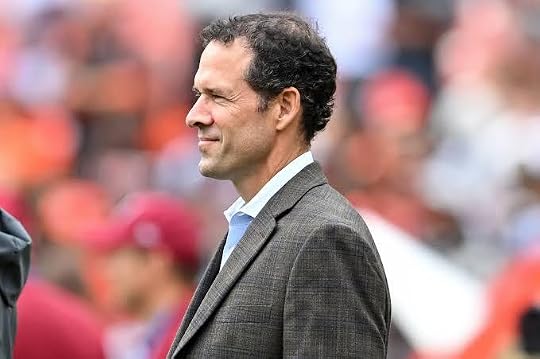
Paul DePodesta
Beane’s theory was this: picking players based on an outdated and somewhat mystifying and undefined je ne sais quoi of inherent talent was too subjective to be reliable, and, not only that, it simply didn’t work. How did he know this? Beane was living proof that it didn’t work.
By all rights, according to the talent scouts, Beane should have been one of the sport’s all-time best players ever. He hit all the markers: running, catching, hitting, throwing, looks. In 1980, fresh out of high school, he was signed by the New York Mets. Everyone knew, absolutely, that Beane was going to go places. Everyone, of course, except Beane.
The truth was, Beane’s heart wasn’t in it. If any of the myriad of scouts had asked him what he really wanted to do---go to college, for one---his life may have been drastically different. Unfortunately, Beane’s baseball career was a series of trades to teams who didn’t know what to do with a decent player who didn’t really want to be there.
As General Manager, Beane decided in 2002 that doing it the old-fashioned way just wasn’t cutting it. There had to be a better way.
Enter DePodesta. Like Beane, DePodesta loved baseball but saw that the sport was growing stagnant and major changes needed to be made, even changes that might initially seem destructive but would, in the long term, be better overall for the sport.
One of the changes was the way baseball statistics were being used. Basing their new philosophy on the writings of historian and statistician (and baseball lover) Bill James, Beane and DePodesta looked at the stats of the players in a way that most people didn’t. Most of the stats that scouts looked at were irrelevant, and scouts often overlooked more important stats. In a nutshell, Beane and DePodesta were looking for a player to do one thing: ensure a win.
The team that Beane/DePodesta picked looked, on the face of it, like a nightmare of rookies, has-beens, and never-wases. At one point, someone referred to the 2002 Oakland A’s roster as “the island of misfit toys”, and to most people it was an appropriate moniker. As the season opened, the Oakland A’s lost every single game they played for the first two weeks.
Then, something interesting started happening. They started winning games. It bumped their standing up from dead last in the league to, well, second to last. But it was something.
Then, something even more interesting started to happen. They started winning more games, until, at one point, they had a 19 game winning streak that didn’t appear to let up.
Sadly, the A’s lost in the postseason against the Minnesota Twins, and while their success to that point was something incredible, many of Beane’s naysayers pointed to the postseason loss as an “I told you so” moment, negating everything Beane was trying to do. Clearly, he was a failure, and his ideas were hokum.
Except, he wasn’t, and they weren’t.
Since 2002, more teams have begun adopting the same philosophy and methods that Beane used for his team, to great success. Indeed, the Boston Red Sox (a team that offered Beane a $12.5 million salary to be general manager, an offer that he turned down) won the 2004 World Series utilizing the same metrics and philosophies pioneered by Beane. Clearly, many people in baseball were changing their minds about Beane’s ideas: they weren’t hokum.
While Lewis’s book may seem like it might be a dry look at numbers that won’t interest anyone other than people who are die-hard baseball fans, it is anything but dry. Besides being beautifully written, Lewis never forgets the human element---the “romantic” side---of baseball in his characterizations of an ensemble cast of fascinating, flawed, and idiosyncratic people.
He also knows what makes for an exciting baseball underdog story, ending the book with the climactic tension-filled now-famous early-September game against the Kansas City Royals, where the A’s, starting off with an 11-0 lead, slowly began to lose the lead until the final inning, a score of 11-11. This was the game that would have either broken their 19-game winning streak or continued on to a 20-game streak. It was a nail-biter of a game, and Lewis captures it brilliantly on the page.
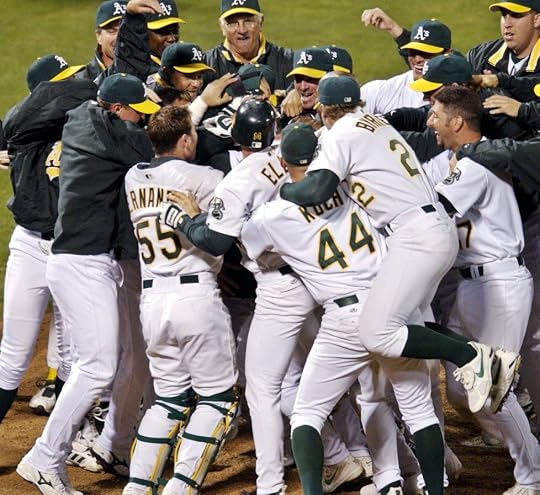
Beneath all the baseball and the economic theory, though, Lewis is telling another story about the American people, one that isn’t very pretty.
According to Lewis, people like Beane---idea people, outliers with highly innovative new ways of doing things---must fight their way past almost-unstoppable barriers of ignorance, anti-intellectalism, and traditionalism. Sometimes people like Beane never get heard. For every Beane, Steve Jobs, or Bernie Sanders, there are countless millions who may have had revolutionary ways of changing health care, education, the economy, the environment, etc. who simply gave up trying.
There is the secret tragedy that hides behind the upbeat and optimistic pages of “Moneyball”. It is a tragedy, I think, that Lewis hopes to avert in the future by telling Beane’s amazing story.
“Moneyball: The Art of Winning an Unfair Game” is, ostensibly, about the economics of baseball, how baseball can be looked at as a financial microcosm of the real world: the wealth inequalities between major league teams and how rich teams tend to win many more games than poor teams and why that is.
Insofar as any book ever written about baseball is never actually about baseball, one can still enjoy “Moneyball” as a basic underdog story, and it has the distinction of being that rare literary beast of an underdog story: a true one.
But it’s even more than a metaphorical look at the unfairness of how our economic system works. Going deeper, it’s actually about our 21st-century disinterest in and---more worrisome---inexplicable discouragement of innovative “out-of-the-box” thinking, perhaps because true “out-of-the-box” thinking has the perception of being counterintuitive and diametrically opposed to everything we’ve been taught.
Billy Beane
In 2002, Billy Beane, the general manager of the Oakland A’s, decided to do something so radical as to have the appearance of utter insanity. Rather than listen to his talent scouts---seasoned veterans of the sport and guys who could recognize real talent---in regards to picking players for the upcoming season roster, Beane chose to listen to his assistant Paul DePodesta, an economics graduate from Harvard with a laptop always at the ready.
Paul DePodesta
Beane’s theory was this: picking players based on an outdated and somewhat mystifying and undefined je ne sais quoi of inherent talent was too subjective to be reliable, and, not only that, it simply didn’t work. How did he know this? Beane was living proof that it didn’t work.
By all rights, according to the talent scouts, Beane should have been one of the sport’s all-time best players ever. He hit all the markers: running, catching, hitting, throwing, looks. In 1980, fresh out of high school, he was signed by the New York Mets. Everyone knew, absolutely, that Beane was going to go places. Everyone, of course, except Beane.
The truth was, Beane’s heart wasn’t in it. If any of the myriad of scouts had asked him what he really wanted to do---go to college, for one---his life may have been drastically different. Unfortunately, Beane’s baseball career was a series of trades to teams who didn’t know what to do with a decent player who didn’t really want to be there.
As General Manager, Beane decided in 2002 that doing it the old-fashioned way just wasn’t cutting it. There had to be a better way.
Enter DePodesta. Like Beane, DePodesta loved baseball but saw that the sport was growing stagnant and major changes needed to be made, even changes that might initially seem destructive but would, in the long term, be better overall for the sport.
One of the changes was the way baseball statistics were being used. Basing their new philosophy on the writings of historian and statistician (and baseball lover) Bill James, Beane and DePodesta looked at the stats of the players in a way that most people didn’t. Most of the stats that scouts looked at were irrelevant, and scouts often overlooked more important stats. In a nutshell, Beane and DePodesta were looking for a player to do one thing: ensure a win.
The team that Beane/DePodesta picked looked, on the face of it, like a nightmare of rookies, has-beens, and never-wases. At one point, someone referred to the 2002 Oakland A’s roster as “the island of misfit toys”, and to most people it was an appropriate moniker. As the season opened, the Oakland A’s lost every single game they played for the first two weeks.
Then, something interesting started happening. They started winning games. It bumped their standing up from dead last in the league to, well, second to last. But it was something.
Then, something even more interesting started to happen. They started winning more games, until, at one point, they had a 19 game winning streak that didn’t appear to let up.
Sadly, the A’s lost in the postseason against the Minnesota Twins, and while their success to that point was something incredible, many of Beane’s naysayers pointed to the postseason loss as an “I told you so” moment, negating everything Beane was trying to do. Clearly, he was a failure, and his ideas were hokum.
Except, he wasn’t, and they weren’t.
Since 2002, more teams have begun adopting the same philosophy and methods that Beane used for his team, to great success. Indeed, the Boston Red Sox (a team that offered Beane a $12.5 million salary to be general manager, an offer that he turned down) won the 2004 World Series utilizing the same metrics and philosophies pioneered by Beane. Clearly, many people in baseball were changing their minds about Beane’s ideas: they weren’t hokum.
While Lewis’s book may seem like it might be a dry look at numbers that won’t interest anyone other than people who are die-hard baseball fans, it is anything but dry. Besides being beautifully written, Lewis never forgets the human element---the “romantic” side---of baseball in his characterizations of an ensemble cast of fascinating, flawed, and idiosyncratic people.
He also knows what makes for an exciting baseball underdog story, ending the book with the climactic tension-filled now-famous early-September game against the Kansas City Royals, where the A’s, starting off with an 11-0 lead, slowly began to lose the lead until the final inning, a score of 11-11. This was the game that would have either broken their 19-game winning streak or continued on to a 20-game streak. It was a nail-biter of a game, and Lewis captures it brilliantly on the page.
Beneath all the baseball and the economic theory, though, Lewis is telling another story about the American people, one that isn’t very pretty.
According to Lewis, people like Beane---idea people, outliers with highly innovative new ways of doing things---must fight their way past almost-unstoppable barriers of ignorance, anti-intellectalism, and traditionalism. Sometimes people like Beane never get heard. For every Beane, Steve Jobs, or Bernie Sanders, there are countless millions who may have had revolutionary ways of changing health care, education, the economy, the environment, etc. who simply gave up trying.
There is the secret tragedy that hides behind the upbeat and optimistic pages of “Moneyball”. It is a tragedy, I think, that Lewis hopes to avert in the future by telling Beane’s amazing story.

March 30, 2017
For the most part, the is a fun book to read about the general manager of the Oakland Athletics baseball team. The first half of the book was very enjoyable. Toward the end, though, it became a bit repetitive. It's not that the author repeats himself--he does not. It's just that the stories about hiring and trading for good baseball players started to sound all the same after a while.
Billy Beane was the general manager during the late 1980's, early 1990's. His team was one of the poorest in the league, so he found it necessary to do things differently than other teams. He could not afford to pay top dollar for new recruits. So, when it came to recruiting and hiring new players, he decided not to strictly follow the advice of his died-in-the-wool scouts. He often ignored their advice, and listened to the advice of his assistant, Paul Depodesta. Paul was an economist, and used sabermetric principles in making up his recommendations. That is to say, he combined data with statistical approaches, and uncovered many correlations and relationships that gave Billy Beane a better idea of the relative values of players.
Whereas many general managers listened to their scouts' advice, they would often judge a player not by their playing ability, but by a set of factors; speed, hitting, fielding--and even by their body type, appearance and mannerisms. But, to Billy Beane and Paul Depodesta, one really counts is the data-based evidenced that a player could get himself on base, which is highly correlated with the number of runs scored. And, since the team was starved for cash, Billy Beane often resorted to wily negotiations with the general managers of other teams. He could not express his interest in another team's player too openly, because that would tip off others about the high value he placed on that player. So, this book is not only about the use of statistics in putting together a superior baseball team, it is also about the art of negotiation, and the wily craftiness involved in getting good deals.
The book describes some very interesting characters. And, it is also about the psychology behind coaching players, and hyping up their self-confidence.
I didn't read this book; I listened to the audiobook. It is narrated by Scott Brick. While I have listened to many thrillers narrated with great drama by Brick, this book is not a thriller. Brick's tendency to over-dramatize seems a bit over-the-top for a book of this sort. He should have toned it down some
Billy Beane was the general manager during the late 1980's, early 1990's. His team was one of the poorest in the league, so he found it necessary to do things differently than other teams. He could not afford to pay top dollar for new recruits. So, when it came to recruiting and hiring new players, he decided not to strictly follow the advice of his died-in-the-wool scouts. He often ignored their advice, and listened to the advice of his assistant, Paul Depodesta. Paul was an economist, and used sabermetric principles in making up his recommendations. That is to say, he combined data with statistical approaches, and uncovered many correlations and relationships that gave Billy Beane a better idea of the relative values of players.
Whereas many general managers listened to their scouts' advice, they would often judge a player not by their playing ability, but by a set of factors; speed, hitting, fielding--and even by their body type, appearance and mannerisms. But, to Billy Beane and Paul Depodesta, one really counts is the data-based evidenced that a player could get himself on base, which is highly correlated with the number of runs scored. And, since the team was starved for cash, Billy Beane often resorted to wily negotiations with the general managers of other teams. He could not express his interest in another team's player too openly, because that would tip off others about the high value he placed on that player. So, this book is not only about the use of statistics in putting together a superior baseball team, it is also about the art of negotiation, and the wily craftiness involved in getting good deals.
The book describes some very interesting characters. And, it is also about the psychology behind coaching players, and hyping up their self-confidence.
I didn't read this book; I listened to the audiobook. It is narrated by Scott Brick. While I have listened to many thrillers narrated with great drama by Brick, this book is not a thriller. Brick's tendency to over-dramatize seems a bit over-the-top for a book of this sort. He should have toned it down some

April 26, 2019
This just didn't wow me like I thought it would. I guess I just like the play on the field better than the behind-the-scenes action.

January 3, 2016
The story about the great former Seattle Mariner Jaimie Moyer is enough to justify the cover price of this book. Baseball just has better stories than any other sport. Period!
I read this back when it was first published and I was a Seattle Mariners fan at the mercy of the success of the Oakland franchise. I remember Oakland’s 20 game streak while our own position in the division evaporated into thin air. I learned a lot about baseball and so recommend this book to fans.
Now I live in Spain and I think the same process could translate to European football. I see so much of the game, so many different facets that seem to be played on pure tradition instead of deciding whether or not it is effective. I also see a lot of players who seem horribly over-priced and over-valued. I hope my home club of Valencia Club de Fútbol takes notice of Billy Beane and company.
Michael Lewis is such a skillful writer that he embarrasses most of the “literary” writers out there who plod along writing their little self-indulgent introspections while rarely leaving the confines of academia. The lesson they should learn is to get out and learn something new to write about.
I read this back when it was first published and I was a Seattle Mariners fan at the mercy of the success of the Oakland franchise. I remember Oakland’s 20 game streak while our own position in the division evaporated into thin air. I learned a lot about baseball and so recommend this book to fans.
Now I live in Spain and I think the same process could translate to European football. I see so much of the game, so many different facets that seem to be played on pure tradition instead of deciding whether or not it is effective. I also see a lot of players who seem horribly over-priced and over-valued. I hope my home club of Valencia Club de Fútbol takes notice of Billy Beane and company.
Michael Lewis is such a skillful writer that he embarrasses most of the “literary” writers out there who plod along writing their little self-indulgent introspections while rarely leaving the confines of academia. The lesson they should learn is to get out and learn something new to write about.

February 1, 2018
The major taxing of this book is not the baseball terms, but there are so many people appeared in the book, and the similarities in names are not helping. For example, the main protagonist is Billy Beane, and there is another important character whose name is Billy James. That's my only concern when reading this book. Some people maybe not comfortable with the writing style in this book, jumping from one subject to another without smooth main story.
I am not a professional baseball fan although I enjoy reading some Japanese high school baseball manga. Pardon my approach, I read this book as if I read a fantasy novel where I don't know the setting or magic system of the story. And there is magic in this story, called sabermetrics.
But as in any good fantasy story, the magic system is one aspect, but a good fantasy story still needs a good plot. The plot is: how the second lowest payroll team could become the team with the highest number of win in American League West in 2002. If the answer is simple "by using sabermetrics", there won't be necessary to write such a thick book. No worry, Billy Beane still had a lot of to do although he was supported by sabermetrics mages behind him.
I admit the author could delivery the story in interesting way, sometimes I forget this is a non fiction book. When I check other sources for cross reference, some things don't developed as in fairy tales that I imagine after reading this book.
I am not a professional baseball fan although I enjoy reading some Japanese high school baseball manga. Pardon my approach, I read this book as if I read a fantasy novel where I don't know the setting or magic system of the story. And there is magic in this story, called sabermetrics.
But as in any good fantasy story, the magic system is one aspect, but a good fantasy story still needs a good plot. The plot is: how the second lowest payroll team could become the team with the highest number of win in American League West in 2002. If the answer is simple "by using sabermetrics", there won't be necessary to write such a thick book. No worry, Billy Beane still had a lot of to do although he was supported by sabermetrics mages behind him.
I admit the author could delivery the story in interesting way, sometimes I forget this is a non fiction book. When I check other sources for cross reference, some things don't developed as in fairy tales that I imagine after reading this book.
April 22, 2008
Moneyball is a book that shook the world of professional baseball, but not necessarily in the way it should have. Let me explain...
Moneyball is framed around the story of Billy Beane, a hot prospect who never panned out in the majors, who became general manager of the Oakland A's in 1997. Since that time, the A's, while consistently having one of the lowest payrolls in baseball, have been one of the best teams in the game. How is this possible? The book details how Beane and a few trusted associates began looking at the game in a different way. Instead of trusting scouting intuition and traditional baseball thinking, the A's began focusing on particular assets of players that were being undervalued by other teams. In this way, they were able to build winning teams using players that were overlooked or discarded by wealthier or less skilled organizations.
While straightforward statistical analysis is interesting enough to me (see my review of Baseball Between The Numbers), where Moneyball shines is it's more detailed investigations into the development of statistical analysis in baseball, and some of the individual players who made up the A's successful 2002 squad. It is these investigations that give the Beane storyline depth and character, and add credence to the statistical analysis strategies the A's employed.
I also appreciated the way Lewis outlines the response FROM the baseball community to the release of Moneyball, which is included in the later paperback edition. This even more firmly establishes the view that most baseball organizations are wasteful and subjective in their approach to analyzing the game they spend hundreds of millions to play. However, Moneyball also explains how teams such as the Toronto Blue Jays and, more impressively due to their two World Series wins in 3 years, Boston Red Sox have hired statistically-minded and data-crunching GM's to run their organizations - showing that the future will perhaps indeed have on base and slugging percantage be our primary focus rather than batting average and RBIs.
Not if Joe Morgan has anything to do with it, though.
Moneyball is framed around the story of Billy Beane, a hot prospect who never panned out in the majors, who became general manager of the Oakland A's in 1997. Since that time, the A's, while consistently having one of the lowest payrolls in baseball, have been one of the best teams in the game. How is this possible? The book details how Beane and a few trusted associates began looking at the game in a different way. Instead of trusting scouting intuition and traditional baseball thinking, the A's began focusing on particular assets of players that were being undervalued by other teams. In this way, they were able to build winning teams using players that were overlooked or discarded by wealthier or less skilled organizations.
While straightforward statistical analysis is interesting enough to me (see my review of Baseball Between The Numbers), where Moneyball shines is it's more detailed investigations into the development of statistical analysis in baseball, and some of the individual players who made up the A's successful 2002 squad. It is these investigations that give the Beane storyline depth and character, and add credence to the statistical analysis strategies the A's employed.
I also appreciated the way Lewis outlines the response FROM the baseball community to the release of Moneyball, which is included in the later paperback edition. This even more firmly establishes the view that most baseball organizations are wasteful and subjective in their approach to analyzing the game they spend hundreds of millions to play. However, Moneyball also explains how teams such as the Toronto Blue Jays and, more impressively due to their two World Series wins in 3 years, Boston Red Sox have hired statistically-minded and data-crunching GM's to run their organizations - showing that the future will perhaps indeed have on base and slugging percantage be our primary focus rather than batting average and RBIs.
Not if Joe Morgan has anything to do with it, though.

June 1, 2019
Smart people who think outside the box are so much fun to read about.
I read this book really fast, and it was enjoyable to read the whole way through. I've never read a Michael Lewis book before, but I might consider reading more now. He has a simple, clean style that is really efficient at getting his story across, and he has an instinct for the best way to use his material. And he has some great underlying material here.
As he notes in the Afterword (which is really great, so if you're going to read this book, make sure you track down a newer copy that has it included), he didn't set out to write a book about the Oakland A's with GM Billy Beane at its center, that's just where the research took him. That's where the answer to his initial question was centered, which was all about how the monetary inequalities between baseball teams affected economic efficiency. How could a team like the Oakland A's, with a budget of only approximately $10M to spend on players salaries, hope to compete against say, the New York Yankees, who were shelling out closer to $130M? And yet they were!
What follows is a book that can basically be summed up, as the author puts it, "when reason collides with baseball". It boggles my mind how stubborn and shortsighted humans can be. This book only reinforces my view that people who are capable of adaptation and change, of admitting they are wrong instead of blindly adhering to something just because "that's the way it's always been", are extremely valuable in every aspect of life, not just running baseball teams.
Highly recommend this one.
[4.5 stars]
Read Harder Challenge: A business book.
I read this book really fast, and it was enjoyable to read the whole way through. I've never read a Michael Lewis book before, but I might consider reading more now. He has a simple, clean style that is really efficient at getting his story across, and he has an instinct for the best way to use his material. And he has some great underlying material here.
As he notes in the Afterword (which is really great, so if you're going to read this book, make sure you track down a newer copy that has it included), he didn't set out to write a book about the Oakland A's with GM Billy Beane at its center, that's just where the research took him. That's where the answer to his initial question was centered, which was all about how the monetary inequalities between baseball teams affected economic efficiency. How could a team like the Oakland A's, with a budget of only approximately $10M to spend on players salaries, hope to compete against say, the New York Yankees, who were shelling out closer to $130M? And yet they were!
What follows is a book that can basically be summed up, as the author puts it, "when reason collides with baseball". It boggles my mind how stubborn and shortsighted humans can be. This book only reinforces my view that people who are capable of adaptation and change, of admitting they are wrong instead of blindly adhering to something just because "that's the way it's always been", are extremely valuable in every aspect of life, not just running baseball teams.
Highly recommend this one.
[4.5 stars]
Read Harder Challenge: A business book.

September 10, 2021
In nearly everyone's mind, for any topic which they care about at all, there is a mental model. Not, generally, a probabilistic population of models, but rather, one model: The Way This Thing Is. It may be how the economy works, it may be how politics works, it may be how romance works (or fails to). Whatever it is that a person needs to have an opinion on, because it impacts their life and they must deal with it (which means they must have a strategy for dealing with it), people have a mental model of how that thing works that they use to decide what to do.
It is always, in every case and for every person, at best, incomplete. As the saying goes, "all models are false; some models are useful."
Small wonder, then, that from time to time people come across evidence that their model is wrong. Even in fields such as war which have been analyzed from time immemorial, by people whose life depended on it, new things are discovered. For most of us, whose professions are considerably newer than that of the warrior, not only do changes upend our profession, but the old models of how things worked may not ever have been that good in the first place. It takes time for a profession to discover what works and what does not; my own current profession of software development has certainly not sorted this out yet. But when this happens, when a new mental model of How This Works comes along, there are at least a generation of people who have deep investment in the old mental model, who will be deeply resistant to any attempt to change the consensus on How This Works. This is because it would render their years (or decades) of accumulated knowledge suddenly less valuable. In many fields, this resistance is enough to prevent any change to the orthodoxy, whereas in others, there is some objective method of determining whose mental model is most correct.
In no field, not science and not warfare and certainly not economics, is this testing more rigorous than in professional sports. Every other expert in the field may disagree with you, and yet your strategy and theirs, when matched against each other in full public view, may declare yours the winner.
This book, is the story of how one paradigm was overthrown, and a new one came to replace it. If you enjoy watching the sport of baseball, it will likely add an extra layer of interest to the story for you, but I am guessing that it is by no means necessary, because this is not at its most fundamental level a story about baseball, per se. It is the story of how an intellectual orthodoxy can resist change for years (decades), and then can be shaken and overthrown by events.
Billy Beane was, we are led to believe, able to see through the common orthodoxy about what makes a great baseball player, because he was not one, and yet everyone he met in his life for years thought that he would be. While possessed of great physical talent, and obviously a keen intellect (he had been accepted to Stanford University before choosing to play baseball instead), he was unable to perform well at the professional level. Not merely in spite of this failure, but perhaps because of it, he went on to become one of the most consequential managers in the history of baseball. His fundamental insight, the foundation for all of the rest, was that Looks Are Deceiving. He turned to a succession of ever-more-nerdy sources of statistical analysis to tell him what really mattered in a player. In many ways, he was looking for players who were the antithesis of his younger self. If they were a bit chubby, or slow, or old (by the standards of professional baseball), or otherwise failed to live up to the Olympian ideal of American baseball, but they nonetheless could get the job done, then Billy Beane wanted them on his team. If they got the job done, but not in the usual way (e.g. getting a walk rather than a hit, which nonetheless got you to first base), he wanted them on his team.
The principal motivation for this unorthodoxy, was that he was manager for a team, the Oakland A's, which had far less money than its competitors. Unlike many other professional sports leagues, professional baseball teams each were free to spend as much as they wanted on player salaries. This meant that, for example, the New York Yankees could spend several times the money that the Oakland A's could, on getting the best players. It was as if they were competing in a pole vault in which different players were able to use poles of different lengths, depending on how much pole length they could afford. Because he was never going to be able to outbid the richer teams for the players which those rich teams wanted, Billy Beane was forced to find ways to get players which the rich teams didn't want, that were nonetheless just as good at winning games. This meant, that he had to have a better mental model than they did, for what it is that makes a player good.
I don't watch much baseball anymore, but as a youth I did watch many St. Louis Cardinals games with my dad, and enjoyed it. The game has a pace slow enough to encourage discussion, debate, and even prediction. Do you think he's going to try to steal a base? Do you think he's going to pitch him inside? Do you think they'll do a hit-and-run? There is enough time for those watching the game to guess what is happening, or what should happen, and enough of a pause afterwards to discuss it before the next play begins. You don't just have time to say "Yay!" or "Oh no!"; you also have time to say "Why didn't he...?" It's not as if it is a purely intellectual exercise, but more than many sports it is tailored well for intellectual analysis. For over a century now, people have been recording what happened, analyzing it, and debating it. In this sense, baseball was uniquely prepared for someone such as Billy Beane to disrupt it, by mining the data of all that history instead of relying on whether a scout liked the young fellow's physique ("we're not selling blue jeans here," he liked to say).
But in a larger sense, Moneyball is a great symbol of what has happened to our entire world, with one exception: here, it is the little guy, without huge piles of money, who has the data. Because if it had been, say, the New York Yankees who had first tried to use the power of data and analysis to crush all resistance, they could have been the Facebook, Google, or Amazon. Or, to look at it another way, this is a world where those companies were kept forever small and hungry, knocking down the walls around privilege instead of erecting new ones around their own fortresses. It can also be seen as a story of what happened when science overthrew religion in the heart of Europe, or what happened when medical knowledge started to come from double-blind trials instead of the wisdom of the ancients. There are a lot of different ways to see the quixotic quest of a small-market team in a poor city, trying to compete with the teams of larger, wealthier cities.
And it can also, of course, be read as a story about baseball. Either way, it is a great read.
It is always, in every case and for every person, at best, incomplete. As the saying goes, "all models are false; some models are useful."
Small wonder, then, that from time to time people come across evidence that their model is wrong. Even in fields such as war which have been analyzed from time immemorial, by people whose life depended on it, new things are discovered. For most of us, whose professions are considerably newer than that of the warrior, not only do changes upend our profession, but the old models of how things worked may not ever have been that good in the first place. It takes time for a profession to discover what works and what does not; my own current profession of software development has certainly not sorted this out yet. But when this happens, when a new mental model of How This Works comes along, there are at least a generation of people who have deep investment in the old mental model, who will be deeply resistant to any attempt to change the consensus on How This Works. This is because it would render their years (or decades) of accumulated knowledge suddenly less valuable. In many fields, this resistance is enough to prevent any change to the orthodoxy, whereas in others, there is some objective method of determining whose mental model is most correct.
In no field, not science and not warfare and certainly not economics, is this testing more rigorous than in professional sports. Every other expert in the field may disagree with you, and yet your strategy and theirs, when matched against each other in full public view, may declare yours the winner.
This book, is the story of how one paradigm was overthrown, and a new one came to replace it. If you enjoy watching the sport of baseball, it will likely add an extra layer of interest to the story for you, but I am guessing that it is by no means necessary, because this is not at its most fundamental level a story about baseball, per se. It is the story of how an intellectual orthodoxy can resist change for years (decades), and then can be shaken and overthrown by events.
Billy Beane was, we are led to believe, able to see through the common orthodoxy about what makes a great baseball player, because he was not one, and yet everyone he met in his life for years thought that he would be. While possessed of great physical talent, and obviously a keen intellect (he had been accepted to Stanford University before choosing to play baseball instead), he was unable to perform well at the professional level. Not merely in spite of this failure, but perhaps because of it, he went on to become one of the most consequential managers in the history of baseball. His fundamental insight, the foundation for all of the rest, was that Looks Are Deceiving. He turned to a succession of ever-more-nerdy sources of statistical analysis to tell him what really mattered in a player. In many ways, he was looking for players who were the antithesis of his younger self. If they were a bit chubby, or slow, or old (by the standards of professional baseball), or otherwise failed to live up to the Olympian ideal of American baseball, but they nonetheless could get the job done, then Billy Beane wanted them on his team. If they got the job done, but not in the usual way (e.g. getting a walk rather than a hit, which nonetheless got you to first base), he wanted them on his team.
The principal motivation for this unorthodoxy, was that he was manager for a team, the Oakland A's, which had far less money than its competitors. Unlike many other professional sports leagues, professional baseball teams each were free to spend as much as they wanted on player salaries. This meant that, for example, the New York Yankees could spend several times the money that the Oakland A's could, on getting the best players. It was as if they were competing in a pole vault in which different players were able to use poles of different lengths, depending on how much pole length they could afford. Because he was never going to be able to outbid the richer teams for the players which those rich teams wanted, Billy Beane was forced to find ways to get players which the rich teams didn't want, that were nonetheless just as good at winning games. This meant, that he had to have a better mental model than they did, for what it is that makes a player good.
I don't watch much baseball anymore, but as a youth I did watch many St. Louis Cardinals games with my dad, and enjoyed it. The game has a pace slow enough to encourage discussion, debate, and even prediction. Do you think he's going to try to steal a base? Do you think he's going to pitch him inside? Do you think they'll do a hit-and-run? There is enough time for those watching the game to guess what is happening, or what should happen, and enough of a pause afterwards to discuss it before the next play begins. You don't just have time to say "Yay!" or "Oh no!"; you also have time to say "Why didn't he...?" It's not as if it is a purely intellectual exercise, but more than many sports it is tailored well for intellectual analysis. For over a century now, people have been recording what happened, analyzing it, and debating it. In this sense, baseball was uniquely prepared for someone such as Billy Beane to disrupt it, by mining the data of all that history instead of relying on whether a scout liked the young fellow's physique ("we're not selling blue jeans here," he liked to say).
But in a larger sense, Moneyball is a great symbol of what has happened to our entire world, with one exception: here, it is the little guy, without huge piles of money, who has the data. Because if it had been, say, the New York Yankees who had first tried to use the power of data and analysis to crush all resistance, they could have been the Facebook, Google, or Amazon. Or, to look at it another way, this is a world where those companies were kept forever small and hungry, knocking down the walls around privilege instead of erecting new ones around their own fortresses. It can also be seen as a story of what happened when science overthrew religion in the heart of Europe, or what happened when medical knowledge started to come from double-blind trials instead of the wisdom of the ancients. There are a lot of different ways to see the quixotic quest of a small-market team in a poor city, trying to compete with the teams of larger, wealthier cities.
And it can also, of course, be read as a story about baseball. Either way, it is a great read.

April 30, 2008
A couple cons:
The writing’s a little heavy-handed in places, which might just be a hazard of writing about baseball. Ex: “The batter’s box was a cage designed to crush his spirit.”
Plus, as a poet, I always feel guilty reading books like this when I could/should be reading Proust or Shakespeare…
But:
Overall, I really enjoyed Moneyball, and I’m glad I read it. Even though it’s focused on the emergence of new baseball-thinking, Moneyball seems much more comprehensive, and much more narrative than I expected. Essentially, Lewis tells the story of a new way of thinking about baseball. Bill James, this smartypants non-athletic geek, challenges the traditional way of thinking about baseball, subverting “the foolishness of many conventional baseball strategies.” With the most pitiful bank account in the AL West, Oakland A’s listen to James, apply his theories, and improve exponentially.
“Conventional baseball strategies” includes such nonsense as: discouraging plate discipline, encouraging recklessness, and pooh-poohing walks ( I’m still shocked to know that drawing walks used to be, and sometimes still is, considered a failed at-bat). Anyway, James, The A’s, and now the Red Sox, operate—thrive—by challenging conventional thinking and looking for ways to locate and manipulate inefficiencies in the baseball market. They rely on stuff like logic and math to evaluate performance, rather than the good-ole’ traditional scouting system (drafting/evaluation based on non-quantifiable qualities like hunches, scout observation, the player’s “presence”). Although there’s still some problems about what this actually means and how to implement or manipulate stats, it’s clear to me that math and logic beats out chutzpah.
Things about Moneyball I particularly enjoyed, and think you will too:
--Anytime Lewis discusses the language of baseball. (BTW, for an awesome book about baseball language and signs, read Dickson’s The Hidden Language of Baseball).
--Issues of the value of and tensions between emotional and intellectual intelligence, or lack thereof, in baseball—Lewis tell of scouts ranking a player with “personal problems,” such as psychological issues and jail records on the same plane as a player who’s “too smart”(!). Then he writes: “Physical gifts required to play pro ball were…less extraordinary than the mental ones. Only a psychological freak could approach a 100mph fastball aimed not all that far from his head without total confidence.” (I like thinking about this when I watch games now.)
--Even though Billy Beane’s sort of the *star* of the story, I found Bill James’s, Chad Bradford’s and Scott Hatteberg’s stories especially, surprisingly, endearing.
--Challenges to unchecked tradition, which basically run through the whole book. This includes questioning insider baseball journalists, talking heads, Bud Selig, Joe Morgan & co. What can I say?—-Selig & Morgan might not actually care about Lewis’s jabs at them...but reading them does kinda fill me with glee.
The writing’s a little heavy-handed in places, which might just be a hazard of writing about baseball. Ex: “The batter’s box was a cage designed to crush his spirit.”
Plus, as a poet, I always feel guilty reading books like this when I could/should be reading Proust or Shakespeare…
But:
Overall, I really enjoyed Moneyball, and I’m glad I read it. Even though it’s focused on the emergence of new baseball-thinking, Moneyball seems much more comprehensive, and much more narrative than I expected. Essentially, Lewis tells the story of a new way of thinking about baseball. Bill James, this smartypants non-athletic geek, challenges the traditional way of thinking about baseball, subverting “the foolishness of many conventional baseball strategies.” With the most pitiful bank account in the AL West, Oakland A’s listen to James, apply his theories, and improve exponentially.
“Conventional baseball strategies” includes such nonsense as: discouraging plate discipline, encouraging recklessness, and pooh-poohing walks ( I’m still shocked to know that drawing walks used to be, and sometimes still is, considered a failed at-bat). Anyway, James, The A’s, and now the Red Sox, operate—thrive—by challenging conventional thinking and looking for ways to locate and manipulate inefficiencies in the baseball market. They rely on stuff like logic and math to evaluate performance, rather than the good-ole’ traditional scouting system (drafting/evaluation based on non-quantifiable qualities like hunches, scout observation, the player’s “presence”). Although there’s still some problems about what this actually means and how to implement or manipulate stats, it’s clear to me that math and logic beats out chutzpah.
Things about Moneyball I particularly enjoyed, and think you will too:
--Anytime Lewis discusses the language of baseball. (BTW, for an awesome book about baseball language and signs, read Dickson’s The Hidden Language of Baseball).
--Issues of the value of and tensions between emotional and intellectual intelligence, or lack thereof, in baseball—Lewis tell of scouts ranking a player with “personal problems,” such as psychological issues and jail records on the same plane as a player who’s “too smart”(!). Then he writes: “Physical gifts required to play pro ball were…less extraordinary than the mental ones. Only a psychological freak could approach a 100mph fastball aimed not all that far from his head without total confidence.” (I like thinking about this when I watch games now.)
--Even though Billy Beane’s sort of the *star* of the story, I found Bill James’s, Chad Bradford’s and Scott Hatteberg’s stories especially, surprisingly, endearing.
--Challenges to unchecked tradition, which basically run through the whole book. This includes questioning insider baseball journalists, talking heads, Bud Selig, Joe Morgan & co. What can I say?—-Selig & Morgan might not actually care about Lewis’s jabs at them...but reading them does kinda fill me with glee.

March 3, 2020
Non-fiction about how Oakland A’s General Manager Billy Beane used sabermetrics to develop winning baseball team at less expense than the wealthier teams in the industry. Published in 2003, we can see much of Beane’s philosophy being practiced now throughout the game. There are fewer sacrifices, hit & runs, and steals, and more emphasis on walks and reliance on statistical probabilities in making decisions. On base percentage plus slugging has upstaged the traditional measurements of RBIs, runs scored, and batting average.
The book is part biography of Billy Beane, part homage to Bill James (the father of sabermetrics), part explanation of the (at the time) unorthodox strategies employed by the A’s, and part a case study in resistance to change. Personal stories of a few A’s players are also included. In 2002, the baseball season covered in this book, the A’s won 102 games and finished first in their division.
Lewis has strong opinions about the effectiveness of past methods, and makes no bones about criticizing scouts, managers, general managers, and pretty much anyone that disagrees with him. This can, at times, be grating, as the former regime has certainly had successes in developing star players. Of course, most of this work occurred prior to the computing age, so they did not have the same tools, and, therefore, it is not a level playing field (pun intended) by which to judge. I did not see the need to come down so hard on some individuals, who are hard-working baseball people with good intentions.
Moneyball is written such that a person does not need any in-depth knowledge of statistics, as the author explains the mathematics in a straight-forward manner, possibly over-simplifying to reach a wider audience. With the benefit of hindsight, it is obvious that baseball has adopted some of the concepts put forth in this book, such as drafting college players more frequently than those in high school and establishing an Analytics Department to evaluate the numbers.
This book will appeal to those interested in the history of baseball or the application of statistical methods to the game. It is a good example of “out of the box” thinking. It will be interesting to see what is next in the drive to gain a competitive advantage now that “analyzing the numbers” is more widely embraced.
The book is part biography of Billy Beane, part homage to Bill James (the father of sabermetrics), part explanation of the (at the time) unorthodox strategies employed by the A’s, and part a case study in resistance to change. Personal stories of a few A’s players are also included. In 2002, the baseball season covered in this book, the A’s won 102 games and finished first in their division.
Lewis has strong opinions about the effectiveness of past methods, and makes no bones about criticizing scouts, managers, general managers, and pretty much anyone that disagrees with him. This can, at times, be grating, as the former regime has certainly had successes in developing star players. Of course, most of this work occurred prior to the computing age, so they did not have the same tools, and, therefore, it is not a level playing field (pun intended) by which to judge. I did not see the need to come down so hard on some individuals, who are hard-working baseball people with good intentions.
Moneyball is written such that a person does not need any in-depth knowledge of statistics, as the author explains the mathematics in a straight-forward manner, possibly over-simplifying to reach a wider audience. With the benefit of hindsight, it is obvious that baseball has adopted some of the concepts put forth in this book, such as drafting college players more frequently than those in high school and establishing an Analytics Department to evaluate the numbers.
This book will appeal to those interested in the history of baseball or the application of statistical methods to the game. It is a good example of “out of the box” thinking. It will be interesting to see what is next in the drive to gain a competitive advantage now that “analyzing the numbers” is more widely embraced.

October 5, 2016
Really enjoyed this, partly because reading a baseball book in October when your team is in the playoffs gives you a great high and partly because I was surprisingly and honestly fascinated by the science of sabermetrics. Science and math have never been my strong points, but like Jurassic Park or The Martian, I was nevertheless intrigued. Coupled with the handful of recognizable players scattered through the book, I had a good time with this one. I also remember seeing the film a few years ago; gotta watch it again. It's not nearly as accurate to the book as it should be, but that's an adaptation for you.
October 2016 Baseball Book Club group read
October 2016 Baseball Book Club group read

June 27, 2024
Where has this book been all my life!? It’s a whopping 21 years old and somehow I managed to miss out on this gem.
I guess I never stumbled upon this classic because, I’ll be honest here, I REALLY hate baseball. But I found myself absolutely loving this book. It grabbed me from the very first page and didn’t let go. Who knew a book about baseball could be such a rollercoaster ride of intrigue?
What makes “Moneyball” so appealing is that it’s the super-ultimate underdog story: a gigantic, ragtag crew of misfits, banding together, flipping the script, and toppling the establishment. It’s like watching a real-life superhero team-up movie, where every underdog gets their moment to shine, and they all rise to glory together in one epic, triumphant smackdown.
What makes “Moneyball” even more special is its timing. With all the dismal news we've been exposed to lately, this book is a much-needed shot in the arm of a good old-fashioned feel-good story. And the best part? It’s non-fiction. These events actually happened, which makes the story even more compelling.
The story centers on the Oakland Athletics and their general manager, Billy Beane. Beane and his team of misfits challenge the traditional norms of baseball using sabermetrics, a method of statistical analysis. Instead of relying on the usual big-budget strategy, they focus on overlooked players with big flaws, but still with hidden potential.
Lewis does an amazing job of giving us a front-row seat to all the excitement as these renegades remake the world of baseball. His writing is sharp and engaging, making complex statistical concepts not only understandable but also fascinating.
One of the things I loved most about “Moneyball” is how it humanizes the players and staff. These aren’t just athletes; they’re individuals with dreams, flaws, and incredible resilience. These players were guys who had been chewed up and spit out by the traditional, man-of-steel, gifted athlete system. Lewis brings their stories to life with such vivid detail that you can’t help but get invested in their journey.
Take, for example, the section where Beane, drafts Chad Bradford, a pitcher with a quirky submarine style. Bradford was ridiculed by most teams because of his freakishly twisted style, but Beane saw his potential. The way Lewis describes Bradford’s rise from obscurity to a key player is truly inspiring. It’s classic underdog.
Another great section is when Beane and his team pick up Scott Hatteberg, a former catcher with a damaged elbow. Most teams would have written him off, but the A’s saw an opportunity. After a lifetime behind the plate, they had the audacity to transform Hatteberg into a first baseman, and he became a crucial part of their lineup.
Lewis balances the technical aspects of baseball with human stories, making the book accessible to both baseball enthusiasts and newcomers like myself. You don’t need to love the sport to appreciate the ingenuity and heart that went into the A’s revolutionary approach.
Reading “Moneyball” gave me a needed shot of hope for this troubled world. It’s about more than just baseball; it’s about challenging the status quo and believing in the potential of the overlooked and underestimated. This book is a celebration of the underdog, and it's just a darn inspiring read.
I guess I never stumbled upon this classic because, I’ll be honest here, I REALLY hate baseball. But I found myself absolutely loving this book. It grabbed me from the very first page and didn’t let go. Who knew a book about baseball could be such a rollercoaster ride of intrigue?
What makes “Moneyball” so appealing is that it’s the super-ultimate underdog story: a gigantic, ragtag crew of misfits, banding together, flipping the script, and toppling the establishment. It’s like watching a real-life superhero team-up movie, where every underdog gets their moment to shine, and they all rise to glory together in one epic, triumphant smackdown.
What makes “Moneyball” even more special is its timing. With all the dismal news we've been exposed to lately, this book is a much-needed shot in the arm of a good old-fashioned feel-good story. And the best part? It’s non-fiction. These events actually happened, which makes the story even more compelling.
The story centers on the Oakland Athletics and their general manager, Billy Beane. Beane and his team of misfits challenge the traditional norms of baseball using sabermetrics, a method of statistical analysis. Instead of relying on the usual big-budget strategy, they focus on overlooked players with big flaws, but still with hidden potential.
Lewis does an amazing job of giving us a front-row seat to all the excitement as these renegades remake the world of baseball. His writing is sharp and engaging, making complex statistical concepts not only understandable but also fascinating.
One of the things I loved most about “Moneyball” is how it humanizes the players and staff. These aren’t just athletes; they’re individuals with dreams, flaws, and incredible resilience. These players were guys who had been chewed up and spit out by the traditional, man-of-steel, gifted athlete system. Lewis brings their stories to life with such vivid detail that you can’t help but get invested in their journey.
Take, for example, the section where Beane, drafts Chad Bradford, a pitcher with a quirky submarine style. Bradford was ridiculed by most teams because of his freakishly twisted style, but Beane saw his potential. The way Lewis describes Bradford’s rise from obscurity to a key player is truly inspiring. It’s classic underdog.
Another great section is when Beane and his team pick up Scott Hatteberg, a former catcher with a damaged elbow. Most teams would have written him off, but the A’s saw an opportunity. After a lifetime behind the plate, they had the audacity to transform Hatteberg into a first baseman, and he became a crucial part of their lineup.
Lewis balances the technical aspects of baseball with human stories, making the book accessible to both baseball enthusiasts and newcomers like myself. You don’t need to love the sport to appreciate the ingenuity and heart that went into the A’s revolutionary approach.
Reading “Moneyball” gave me a needed shot of hope for this troubled world. It’s about more than just baseball; it’s about challenging the status quo and believing in the potential of the overlooked and underestimated. This book is a celebration of the underdog, and it's just a darn inspiring read.

February 25, 2023
What a terrific book! I expected the book to more or less correspond to the movie (which I also enjoyed), but there's a lot of depth to the story that really wasn't covered in the movie version (understandably).
I particularly enjoyed the in-depth stories of the various players that the Oakland A's recruited that literally no one else wanted. Their backstories were fascinating. They were told they would never make it in baseball for one reason or other, and they probably never would have if it wasn't for the A's relentless pursuit of a way to win within their budgetary constraints.
I am a baseball fan, and I do think it helps to have some knowledge of the game to truly appreciate this book. It probably would be dull for those who don't understand the basics of the game. But Lewis does his usual extraordinary job of making the story widely accessible even though it talks about business and mathematics.
One of my favorite (but also most disheartening) parts of the book was the afterward. Apparently, after Moneyball was published, the baseball insiders tore Billy Beane to pieces, accusing him of all sorts of things. He went against baseball orthodoxy, and then had the gall to allow the story of his team's achievements to be published in a book. The afterward basically rips apart the vultures. Good for Michael Lewis for defending Beane, his book, and those who cooperated with bringing us this fascinating story. He certainly has the last laugh because literally every baseball team uses analytics today and those insiders who jeered Beane should be embarrassed and ashamed.
Definitely a don't miss read for baseball fans. In fact, this book makes me wonder what other great baseball writing I may be missing.
I particularly enjoyed the in-depth stories of the various players that the Oakland A's recruited that literally no one else wanted. Their backstories were fascinating. They were told they would never make it in baseball for one reason or other, and they probably never would have if it wasn't for the A's relentless pursuit of a way to win within their budgetary constraints.
I am a baseball fan, and I do think it helps to have some knowledge of the game to truly appreciate this book. It probably would be dull for those who don't understand the basics of the game. But Lewis does his usual extraordinary job of making the story widely accessible even though it talks about business and mathematics.
One of my favorite (but also most disheartening) parts of the book was the afterward. Apparently, after Moneyball was published, the baseball insiders tore Billy Beane to pieces, accusing him of all sorts of things. He went against baseball orthodoxy, and then had the gall to allow the story of his team's achievements to be published in a book. The afterward basically rips apart the vultures. Good for Michael Lewis for defending Beane, his book, and those who cooperated with bringing us this fascinating story. He certainly has the last laugh because literally every baseball team uses analytics today and those insiders who jeered Beane should be embarrassed and ashamed.
Definitely a don't miss read for baseball fans. In fact, this book makes me wonder what other great baseball writing I may be missing.

April 2, 2020
"I was writing a book about the collision of reason and baseball." - Michael Lewis
Moneyball has become the modern-day shorthand term for a perceived over-reliance on statistical data by a given baseball manager, front office, or franchise. Critics point out that, since Billy Beane took over as General Manager and implemented many cutting-edge valuation models based on sabermetric data, the Oakland As have failed to win a World Series Championship. That criticism is accurate. It also misses the point. Moneyball is the story of one of the poorest teams in baseball, cursed with a stingy owner and an antiquated stadium, that nevertheless manages to be shockingly competitive during the tenure of its oft-, and wrongly-, maligned General Manager despite consistently fielding one of the lowest payrolls in the league. How do they do it? (Ironic spoiler alert) They find and acquire players whose production is inefficiently undervalued by the marketplace. Author Lewis turns his eye from the financial markets (Liar's Poker, The Big Short: Inside the Doomsday Machine) to baseball, and with wit and clarity, peers inside the age-old mystery of why baseball does the things it does. A working knowledge of the basic rules of the sport is probably a good idea but even casual readers and not just die-hard baseball fans will be both educated and entertained.
Moneyball has become the modern-day shorthand term for a perceived over-reliance on statistical data by a given baseball manager, front office, or franchise. Critics point out that, since Billy Beane took over as General Manager and implemented many cutting-edge valuation models based on sabermetric data, the Oakland As have failed to win a World Series Championship. That criticism is accurate. It also misses the point. Moneyball is the story of one of the poorest teams in baseball, cursed with a stingy owner and an antiquated stadium, that nevertheless manages to be shockingly competitive during the tenure of its oft-, and wrongly-, maligned General Manager despite consistently fielding one of the lowest payrolls in the league. How do they do it? (Ironic spoiler alert) They find and acquire players whose production is inefficiently undervalued by the marketplace. Author Lewis turns his eye from the financial markets (Liar's Poker, The Big Short: Inside the Doomsday Machine) to baseball, and with wit and clarity, peers inside the age-old mystery of why baseball does the things it does. A working knowledge of the basic rules of the sport is probably a good idea but even casual readers and not just die-hard baseball fans will be both educated and entertained.

June 23, 2026
3.5 stars. If I was a baseball fan, I would probably love this book. As it is, I am just a fan of statistics being used to dismantle intuitive expertise and traditional ways of doing things. The book definitely delivers on that front, especially when talking about Bill James's role in the sport, but it also hits it deep on baseball, which got a little boring.
“If gross miscalculations of a person’s value could occur on a baseball field, before a live audience of thirty thousand, and a television audience of millions more, what did that say about the measurement of performance in other lines of work? If professional baseball players could be over- or under-valued, who couldn’t?”
“One absolutely cannot tell, by watching, the difference between a .300 hitter and a .275 hitter. The difference is one hit every two weeks … The difference between a good hitter and an average hitter is simply not visible—it is a matter of record.” (Quoting Bill James)
“If gross miscalculations of a person’s value could occur on a baseball field, before a live audience of thirty thousand, and a television audience of millions more, what did that say about the measurement of performance in other lines of work? If professional baseball players could be over- or under-valued, who couldn’t?”
“One absolutely cannot tell, by watching, the difference between a .300 hitter and a .275 hitter. The difference is one hit every two weeks … The difference between a good hitter and an average hitter is simply not visible—it is a matter of record.” (Quoting Bill James)

September 6, 2008
I fucking hate watching sports.
Hate it.
Then how is it that this book, about applying pertinent statistical analyis to creating baseball teams and playing basesball, so captivated me? It's a testament to a) the skill of the author, Michael Lewis, but also b) the unequivocal appeal of the underlying story: how hard it is to change the status quo (and how one can succeed despite that) and the man Lewis profiles, Billy Beane.
A fantastic narrative for fans of spectator sports or folks like me who'd rather clean a toilet bowl with his tongue than watch a ball game.
Hate it.
Then how is it that this book, about applying pertinent statistical analyis to creating baseball teams and playing basesball, so captivated me? It's a testament to a) the skill of the author, Michael Lewis, but also b) the unequivocal appeal of the underlying story: how hard it is to change the status quo (and how one can succeed despite that) and the man Lewis profiles, Billy Beane.
A fantastic narrative for fans of spectator sports or folks like me who'd rather clean a toilet bowl with his tongue than watch a ball game.
Displaying 1 - 30 of 7,050 reviews