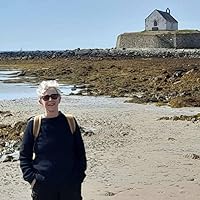
I was born in Wales in 1972, and grew up too fast in south west Scotland where I lived with my English parents and three brothers, watching the ferry boats going to and from Northern Ireland. I left home at 17, went over the border to England, and lived for a year in Carlisle, before moving to Devon. I gained a first class degree from Dartington College of Arts when I was 21, then after brief stints busking and carrying on in both Leeds and London, I moved to Brighton aged 23 where I grew up a bit slower, and have lived ever since.
I have always written, probably on just about every day of my life, and from 2008-10, I studied Creative Writing at Sussex University. I had a number of short stories published and more shortlisted and longlisted as a result of competitions I entered while on the course, and my first novel, Snake Ropes started as a short story which wouldn’t stop growing.
Snake Ropes was published by Sceptre in 2012, and was shortlisted for the Costa first book award 2012. My second novel, Cooking with Bones, was published in 2013.
Snake Ropes is Jess Richards' debut, and it's one of the most original, exciting first novels I've read in quite some time. Set entirely on an extremely remote island somewhere off the coast of Scotland (the exact location is hinted at but remains obscure, much like the time period in which the story takes place), it depicts a tiny community sustained by traditional trade with the 'tall men' who visit from the mainland. While one interpretation might see this as simply an old-fashioned and superstitious society, there are hints of real magic. Mysterious (and apparently dangerous) ropes are bundled up and left on the beach without explanation, ghosts are seen and the voices of the dead heard, an owl with a woman's face acts as a harbinger of doom, and above all there is the dominance of the Thrashing House, an ancient building where liars and criminals are sent to have the truth 'thrashed out' of them. The narrative switches between two teenage girls living in circumstances as different as one could find in a place like this. Mary, born and brought up on the island, lives in a cottage with her father and creates 'broideries' for a living: she is preoccupied with protecting her three-year-old brother, Barney. Morgan, part of the only family not native to the island, is kept under lock and key by her troubled mother in a house encircled by a giant pink fence: obsessed with fairytales, she dreams only of escape.
The island is a fascinating place, and not just because it seems to possess magical qualities. It appears to be an almost entirely female-dominated society, with women portrayed as the decision-makers, the political leaders, and the only ones able to enforce the island's 'law' by sending wrong-doers to the Thrashing House. Women are taught to read and write (and almost all of the island's own legends involve women only), but men are not, and indeed they are often implied to be virtually useless. (When Mary's father is sent to the Thrashing House, this is reinforced by his physical transformation - becoming a literal embodiment of uselessness.) At the beginning of the story, boys are vanishing from the island, but despite some instances of personal anguish, this issue is largely brushed under the carpet and treated as if it doesn't really matter - Mary is repeatedly told she should just forget about Barney.
Each girl speaks with a unique and distinctive voice. Mary's incorporates elements of dialect (although it is still easy to read) and is rich with the history and culture of the island. Morgan's is ostensibly more intelligent, but the way she interprets her surroundings highlights her lack of experience with real life. Both display sparks of humour, cleverly placed to diffuse the rather bleak atmosphere created by the island's isolation and the lack of opportunities for its inhabitants, and the girls' ignorance of the world at large makes for moments of both pathos and amusement. Discussing 'main land fashions', Mary observes that 'a few years back... the tall men wanted jumpers full of holes called the grunge, but now them want cable or ribbed'. Meanwhile, Morgan ruminates that (in fairytales) 'the arrival of the prince is at best suspicious, and at worst sinister'. Although she isn't without an ability to question the logic of happy endings, Morgan's whole world is seen through the prism of the tales she has spent her life reading, and she can only make sense of her experiences outside the family home by turning them into myth-like stories. Upon meeting Mary, she asks seriously of Barney's disappearance: 'Have you looked carefully at animals? He could have been transformed - into a mouse, or a rat, or a bat, even a small cow?'
The significance of myth is illuminated most powerfully in how each girl chooses to deal with her suffering. Morgan portrays herself, in both thoughts and words, as the central character of a fairytale, someone who must escape, who will be rescued. Mary hears Barney's voice whispering to her through a shell, and later sees her 'shadow self' appear as she struggles to deal with the aftermath of an attack. Ultimately, language proves crucial in the resolution of every thread of the plot. The women punish those held in the Thrashing House by 'stripping away' their name, chanting it until they have 'no words to hide behind'. Mary dispels her pain by writing of her experiences and refusing to let herself name what has happened to her, and therefore refusing to let herself be defined by damage. Morgan unravels the mystery of Mary's past, long banished from memory, by unlocking the secrets hidden inside a diary.
The real genius of Snake Ropes is that the author plunges you into a quite fantastical world yet always maintains a sense of realism strong enough to keep you anchored to the story. Full of fascinating layers of meaning, and blessed with two thoroughly sympathetic protagonists, this is an excellent debut. There is little wrong with it, and my only real complaint would be that the pacing sometimes doesn't seem quite right - although I found the story engrossing, I wouldn't say I was compelled enough to keep going back to it at every opportunity, or that I couldn't stop thinking about it. Maybe I felt this way because the narrative is sometimes a little too fragmented: alternate chapters are narrated by Mary and Morgan, the chapters are fairly short, and the two don't come into contact with one another for quite some time. Despite this minor flaw, this is a book that deserves to be hugely successful and widely read - and I really hope it is. It's accomplished, evocative and totally unique, and Jess Richards has been firmly added to my growing list of authors to watch closely in future.
I would never have picked this book up in the shop, never. It's far from what I'd usually read and I'm always a bit suspicious of books dubbed 'literary delight', 'evocatively beautiful' etc. So it was with a bit of a frown that this came out the review envelope. I thought I'd give it a few pages and if it was as boring as I suspected I'd leave it at that.
The first page threw me, I won't lie. The author has a very unique style and I thought, at first, that it was going to put me off. I was wrong. In no time it becomes par for the course. You anticipate the style and before long you just take it in. Oddly for me, because I'm not keen on books that insist on this, I actually enjoyed it. It gave a real richness to one of our heroines, Mary. I say one because this book is filled with heroines. Morgan who has the opposing POV fascinated me. There are parts in her inner narration where I was swept into this place with her and it took my breath away. How did the author find those combination of words, I found myself wondering. How?? I don't even need to tell you what I mean, because when you read it you will know instantly what bits I'm referring to. There are other characters, such as Morgan's mother who intrigued me, and Mary's grandmother--I adored her. The book is just chokablock with these strong female figures and they're all somehow so believable.
The men however do not fare as well. If there was any weakness in this story it is here. The male characters were simply there. They didn't add to anything or detract from it, they were just there...well all but one, but he was so loathsome I shan't waste my writing time on him.
The story itself? Well it was a strange blend of fairy tale and real life, all swept together and made utterly believable. Jess has created this little island, quite literally, filled with characters that automatically become so real. And the twist? Well I was filling up as I read that bit, my heart clenching and my fingers tightening on the page.
So how wrong was I? Boring? Far from it. And no doubt you're wondering what the heck I'm talking about? Style? Twist? Huh? Well I'm not going to tell you because if you read any book this year it has to be Snake Ropes. It simply has to be.
You'll be left wanting more, desperate to drop back in five years down the line to see how Mary and Morgan are faring. I can guarantee it.
Step inside this book and you will find yourself on, a wild island, far from the Scottish coast. It is a world apart, where people live as people in isolated communities have for many centuries. They farm, they fished, and they make things that they might trade with passing travellers.
Those travellers came often, `tall men in black coats' from the mainland, and yet the islanders never left. I wouldn't want to leave, even though I might be a little scared if I stayed. Jess Richards has created a wonderful world; real, alive, magical and strange.
It is the stories of two young women that bring it to life.
Mary was born into an island family, but her family is shrinking. First her mother was lost to her, and then Barney, her beloved infant brother. She knew he was still there, she heard his voice in the world around her, but she couldn't see him. What secrets was her father keeping from her? Had the tall men taken him? Or was he in the mysterious Thrashing House, a building every bit as sinister as its name suggests? She had to find out.
Morgan was born on the mainland, but her parents ran away from something, and they fled to the island. They built a fortress and they raised their children behind barricades. Morgan, and her younger twin sisters could see out, but they couldn't get out.What was her family doing on the island? What might there be outside the barricades? She had to find out.
And so two stories are told in two voices. They work together and balance each other beautifully. And, of course, they meet
I was wonderfully torn, by the writing and the storytelling. I wanted to linger. To luxuriate in beautiful prose, as light as air, rich with wonderful images, wrapped around so many intriguing ideas. But I also wanted to keep turning the pages, I wanted to keep hearing those two wonderful voices, and I wanted to uncover those secrets, answer those questions every bit as much as Mary and Morgan.
I was caught up, completely and utterly. The stories flowed perfectly. The twist, when it came, was devastating. And the book as whole is quite extraordinary.
There is magic - a child's toy speaks, an embroidered bird takes flight, a key has a mind of its own - and it illuminates serious themes - pain and healing, the roles women play, the consequences of keeping secrets - so very, very effectively.
You could just read a wonderful inventive story, or you could stop and ponder the many things it says so very eloquently as well.
I can see the influences - Angela Carter and Margaret Atwood are, quite rightly named - but I can also see that Jess Richards has absorbed them and then moved on to create something of her own that is quite unique.
It is an extraordinarily accomplished debut novel, and I am thrilled at the prospect of what she might go on to write in the future.
Snake Ropes tells the stories of two young women. Mary lives in a matriarchy where the hand goods made by the women are the main source of trade with the “Tall Men” who come from the mainland. Since the death of her mother, Mary has been the main caregiver of her baby brother, who she hides for his own safety when the Tall Men arrive. Morgan, is imprisoned in her family home, not allowed to wear shoes and forced to keep house for her narcissistic mother and her enabler father. Each chapter is presented alternatively from Mary then Morgan till their narratives converge and they discover how to battle the forces trying limit their power and potential.
I would recommend this book to fans of Helen Oyeyemi - to readers who enjoy the fantastical and books with dark fairy tale overtones. Unfortunately for me, this type of storytelling is not to my personal reading tastes.
This was a pick for The Readers Bookclub waaay back in 2013 which I am just now getting around to reading.
For a debut novel, this journey really was wondrous. Filled with strong women, secrets locked away, myths of sea and stone, and a mystery of a lost boy, the characters are glorious and the plot engaging. Whether trapped by locked doors or missing memories, both protagonists strive for freedom and illumination. Ultimately don’t we all? Highly recommended!
Snake Ropes really is an exceptional novel, both in its stylistic uniqueness, but also in managing to successfully combine narrative and myth - real or imagined - while at the same time dealing with some really intense issues.The fact that it ostensibly starts as a relatively "simple tale of simple folk", & then turns out to be anything but, makes the reveal of its brutal events have such an impact. I was really impressed how the author managed to subtly, but consistently, keep up the tension all the way through the second half, encompassing lots of fantastic plot twists towards the end. Truly a stunning debut novel!
This was an enjoyable read. The story was great, although I did have moments where I was having problems following. It was dark and a bit sinister at times, which was interesting. The characters were great. The two main characters, Mary and Morgan, have distinct voices that were interesting to follow. I enjoyed the characterization of both characters. Also, I thought the ending was really good. I can't wait to read more books from Jess Richards, who really knows how to make a great story. Overall, a great read.
How I Came To Read This Book: I think those folks over at Harper Collins talked about it on Facebook or something. It sounded intriguing so I got it from the library.
The Plot: The book is told from two alternating viewpoints, both of which are young women living on a mysterious island in a dystopian / fantasy near-future. Mary Jared is sixteen years old and afraid for the safety of her brother, Barney, when other young boys on the island go missing - purportedly traded to the men that come in from the mainland with goods to sell. When Mary finds herself quite alone, she tries to find answers using her special gift - the ability to hear memories embedded in metal. Morgan is eighteen and also living on the island, but in a locked-up 'safe house' with her family, the island's 'educated' undertakers that arrived from the mainland many moons ago. Morgan's head is constantly buried in books, her only escape from her very small and Cinderella-esque world, and all she wants to do is escape and see what's beyond the monumental fence surrounding her place. The two girls stories eventually collide, as they both seek freedom from whatever's been dragging them down. There's SO much more to it than that, a lot of folk tales and ghost story stuff, but that's a high-level overview.
The Good & The Bad: This is an interesting little book. I vacillated between being genuinely engrossed and at times, a little freaked out / terrified, and being kind of bored and feeling like the book was labour-intensive to get through. The opening chapter really dictates whether you'll enjoy the book - Jess Richards' has a very specific style, particularly with Mary's colloquial island dialect, and it's Mary that she cares about. While I generally found Morgan's story more engrossing to begin with (probably because it was easier to get through), by the time Morgan and Mary crossed paths I started to question why Richards had even included her. Morgan's chapters are almost always half or a third of the length of Mary's, and most of Morgan's activities - once she's aware of Mary - serve to advance Mary's plot. In fact, the end of Morgan's story is actually pretty ambivalent about what spells freedom to her, whereas Mary, despite her low-English, comes off as the intelligent, focused one.
That's a general theme to the book actually - feeling like a fish out of water and seeing some ugly truths you've been hiding from yourself as a result. There's also a huge theme of storytelling. Morgan fully believes in stories and anticipates the whole world is just a psychology case waiting to be shrunk, or a fairy tale waiting to be given a happy ending, and once she gets a chance to experience them firsthand, she comes off woefully naive (although vaguely kick-ass thanks to her ability to speak with ghosts). Mary's chapters are constantly peppered with two types of stories - memories and the legends that dictate the rule of the island, which is said to be haunted by some witchy sisters known as the Glimmeras, and has a creepy punishment chamber known as 'The Thrashing House' that only leaves 'the truth' of someone once they've disappeared.
Altogether I'd say I liked this book. I'd actually give it something closer to a 4 than a 3, but I felt like one too many things didn't contribute to the core of the book's plot, and it got a little literary and scattershot for me. There was an overall vibe created by the story, but there were also a lot of dangling threads that I would've liked to see sewn up. I still have plenty of questions...
The Bottom Line: An interesting if sometimes overwhelming story.
I spent of great part of this book loving the writing, setting and atmosphere but feeling like I had no grasp on the plot other that a vague sense that there were two girls telling their tales. But in the last third suddenly a momentum took over, I connected with what was happening and I was utterly captured. I think I now have a better understanding of how the novel worked, and as such, when I read another by Richards (which I intend to do) I might feel less lost.
4.5 stars. I have always enjoyed reading dystopian novels and psychology has never ceased to fascinate me, so naturally I’ve found this book extremely intriguing and the reading experience very satisfying. Through a nightmarish vision, the author explores narcissism, inner child and mystified love with uncanny and astounding brilliance.
I read this book because it was mentioned on The Readers podcast and was their next book club book. I tried to finish it yesterday so I could post a question for the author who is being interviewed for the podcast this evening. However I think I may have rushed through it. There is a lot to this book that I may have missed.
At school I took O level English Language, so I am good at spelling, grammar and where to put an apostrophe! However I didn't take English Literature (I went down the science route) and as a consequence I think my reading is a bit superficial. My favourite books are crime or thrillers or anything with a vampire in it. There's usually a murder at the beginning, and you either know who did it but have to see how the police find out who it was, or you don't know who did it so you try to work it out from the clues. And at the end you have a nicely wrapped up story. Job done!
This isn't one of those books. It is haunting and atmospheric and "literary". Set on a strange island which nothing from the modern world has reached, men come from the mainland to trade with the islanders. There is no electricity or mod cons, the women knit, or sew and the men fish to trade for food, and the island has it's own form of justice in a building called The Thrashing House. No-one comes out of the Thrashing House alive, and they are usually transformed into something that represents their crime or personality when they were alive.
When some of the young boys on the island go missing the women accuse their men of trading the boys with the men from the mainland, but Mary doesn't believe that this is what happened to her brother Barney. Another girl, Morgan, lives with her strange family and mentally unstable mother, in a house surrounded by a 13 foot high fence and is never allowed to leave the house as her mother fears something bad will happen to her. Morgan believes that real life is like a fairy tale and one day she will be rescued, but she still tries to escape.
I really wish I could describe what happens next in the book better, but I'm not really sure I understood it myself. There is a magical element, ghosts and the forgetting herb, and strange ropes that turn into snakes. At the end of the book I wanted a bit more explanation of what happened to some of the characters. And parts which I wondered why they were there at all like the character of Valmarie and her seal skin, very odd.
I look forward to listening to The Readers podcast and the chat with the author to see if she can shed any more light on it for me!
The blurb from my copy of Snake Ropes boldly claims "In the tradition of Angela Carter and Margaret Atwood, (Jess Richards) combines a page-turning narrative and a startlingly original voice with the creation and subversion of myths." It is brave indeed to compare any novel but particularly a first one to the work of these two. The bar was set very high and honestly, I never imagined that Richards would reach it.
She did. Richards' writing is rich and lyrical. She builds this fascinating culture which trades with "the Tall Men" - who I believe represent our own society. We have all these fantastical elements which nevertheless always feel completely credible. Snake Ropes has the power of layer upon layer of metaphor and the depth of folklore created over centuries in the telling.
*** SPOILERS AHEAD***
Richards' society is a matriarchy and it would be ever so interesting to study her work in regards to its portrayal of motherhood. The mother whose experience of labour is horrific. The mother who has to deal with the rape of her child. The child who becomes a mother far too young. The sister who raises her brother after the death of their mother. The mother with mental health issues who stifles her children in her need to shelter them from the world. The desperation of the mother(s) who lose(s) a child. All the mothers who do the best they can without really knowing how.
I can't possibly explain all of Snake Ropes's depths. There are likely ones I won't even be aware of 'till the third or fourth read. Just trust me that it is well worth a look.
I read this novel after Simon and Gavin of The Readers podcast announced it as their July book club pick. It sounded like something I wouldn't pick up on my own, but I was in the mood to step outside my comfort zone.
Although I'm usually put off by dialects, it didn't take long to get into the rhythm of Mary's and I was quickly drawn into the story, curious about the lives of both Mary and Morgan, the two main characters, whose stories are told in alternating chapters. Mary grew up on the isolated island that is visited regularly by the tall men who arrive in boats to trade products from the mainland for the embroideries that the island women make and the fish that the men catch. Morgan's family came to the island in an attempt to calm the mother's neurosis. Mary's younger brother disappears and Morgan yearns to escape the fortress that her parents have created to keep others out and their family in.
Snake Ropes is one of the most original stories I've read in a long time. The setting and sensory details are superb--I could feel the cold, hear the seashore, imagine character's voices. The plot and characters are unique, yet familiar in some ways due to the underpinning of mythology and fairytale woven throughout the story and its feminist critique.
Magical realism enhances this tale and doesn't seem gimmicky at all (as it often does to me). The community is matriarchal, but that doesn't mean its a paradise for Mary and Morgan. Both young women suffer due to parents' emotional problems, tradition, or the schemes of elders, but there's hope that together they'll find peace and healing, and create a safe home together.
I was lucky enough to get a proof copy of this beautifully written book. Jess Richards writes of an island that is 'off the map' - a world with its own language, myths and culture, and where the landscape is not just vivid but alive in the most alarming of ways. This is a wonderful dose of magical realism, rightly compared by the publishers with the work of Margaret Attwood and Angela Carter, about a strong matriarchal culture where the women make important decisions in the mysterious 'Weaving Rooms', while men aren't even taught to read. And the boys are disappearing. I wonder if women will enjoy this book much more than men! Richards powerfully imagines two very different families, each with poisonous secrets, and the daughters of each who must seek the truth (in one case) and the freedom (in the other) that they are denied. I found the distinctive language of the islanders so infectious I found myself speaking it. And the Thrashing House is unforgettable. A powerful, magical first novel from a writer who is very clearly 'one to watch'.
This book could use a trigger warning for — I probably wouldn't have read it had I known where the story was going to go, and especially not that . But that wasn't my only problem with it. I really enjoyed a lot of the ties to Scottish mythology/folklore, and would probably like a collection of these types of stories written by this author.
But the actual story was a bit hard to follow and took so long to really GO anywhere that I had pretty much lost interest by a quarter of the way through (I hate unfinished stories though, so I pressed on) and it felt like it didn't really start until probably halfway through. A good portion of things that happened in the book were never really explained in a way that felt satisfying to me, and the ending felt abrupt. Overall, I felt like the setup and characters were fairly interesting and some of the writing was poetic but it didn't really keep me engaged.
A wonderful debut, which weaves myth, magic and allegory into a beguiling tale. While I don't feel that it succeeds on all levels (a bit more realism in the relationships between characters would have helped to anchor the more poetic elements of the tale, for me), it is a daring first novel and I applaud Miss Richards for her efforts. I will certainly look forward to reading more by this author.
I did not finish this because the writing is so pretentiously gimmicky, it hurts. I would urge anyone considering to buy this to read the free sample on amazon first, making sure they can handle the narrators' artificially clobbered together 'voices'. Made up dialects really are only for master novelists. Richards isn't one of them.
Jess is a friend of mine *and* fellow Sceptre debut novelist (we swapped proofs), so anything I say will clearly be biased. Therefore, please read the *other* reviews and ratings, then do yourself a favour and read this amazing book!
Very weird. I had to get used to the writing because the island people speak differently, but halfway through I didn't even notice anymore. There's a lot of magic stuff and mysterious things happening but my take on it is that everyone just has a bunch of mental issues.
I definitely liked this more than Cooking with Bones. The imaging is great and it just sucks you in and refuses to let you go (just like the Thrashing House).
This was a surprisingly enjoyable book. I'd never heard of it or Jess Richards; the book had found its way to our house via a recommendation we can't remember. The book is set amongst a remote island population who live with their own customs and spiritual beliefs from way back when trapped in a time warp. It includes ghosts, shadow people and talking objects. It reminded me of The Wicker Man. However I couldn't put the book down. The two girls who are the main characters are really interesting and you want to know how they get on. This book is something very different and well worth a read.
I want to preface this by saying I’m sure there are people out there who will love this book. It’s not bad, it just wasn’t for me. Can’t even tell you why, but I felt so disconnected from everything that was happening and the writing made it hard to follow the story. I’d write more but it’s really late and I don’t think I have anything else to say anyway ¯\_(ツ)_/¯
I'm in a bit of a quandary about this book, the writing in places was beautiful, atmospheric and descriptive, but I could put it down quite happily without a desire to pick up and continue reading, in fact I read 2 other books whilst reading this. It all came together in the end but I felt it was a slog getting there sometimes.
Snake Ropes is a haunting work of fiction. Jess Richards delivers an original, page-turner, for her debut outing! Set on an isolated island off the coast of Scotland, the community has no desire to leave their little slice of the world. Their means of survival is self-sufficiency and the monthly trades they make with, “the men in black coats,” from the mainland.
“No-one here goes to the main land, and no-one wants to. Our boats aren’t strong enough, we dun know the way, them can’t understand us, we’re fine as we are. We have so many reasons; them stretch as wide as the distance to cross to take us there.”
Island men fish, but have little say otherwise. The women run things on the island. They all possess unique skills needed for everyday living. They are the keepers of island history, storytelling, and secrets. There is no shortage of secrets. The women are also the keepers of the Thrashing House key. It is their decision when punishment is to be handed down for crimes against the community. They decide who will be sent to the Thrashing House. While none of them knows what goes on inside, they all know that those who enter, never exit… many have entered.
Somewhere in the midst of myths, legends, and magic, two teenage girls upset the balance of the island. They are strangers; each is driven buy her own agenda. Mary: a native islander wants only to protect her little brother, since the sons of the island have started to disappear. Morgan: an import to the island. Her parents wanted to disappear from the mainland. So they built a fortress on the island, where Morgan has been imprisoned for most of her life. She wants to escape that prison.
When the girls unite, midway through their desperate missions. Secrets are unraveled and lives are forever changed.
I LOVED this book!
Special thanks to HarperCollins Canada and goodreads for an advance copy!
Thoughts crash around in my head, all fighting to be chosen... (p216)
My first thought as I review this book is that there was a hell of a lot going on. It was almost as if the author had a million and one concepts floating in her mind, threw them on the ground like a set of pick-up-sticks, and then picked them up and carefully placed them on the pages of her first novel. It's not the novel is incoherent - but it is perhaps a little too busy.
The book begins with two stories: (1) Mary lives on a remote island in a creepy village which is run by women. She makes embroideries for the tall men from the mainland who come every month to trade with the islanders. Her little brother becomes the latest in a string of young boys that go missing, and she tries to find him.... (2) Morgan lives in a house with a domineering mother who treats her like a slave. She does all the cooking, and she desperately wants to escape the house....
Mary steals keys and they can talk to her because they're made out of metal. She also has a moppet doll that is imbibed with the spirit of her brother and that can talk to her as well. One of the women on the island might be a silkie (half-woman, half-seal). There is a thrashing house on the island which is a living thing and calls people and kills them. The women make ropes that turn into snakes. Morgan sees ghosts.
OK, so the author has a very vivid imagination, and throws it around in abundance.
I was tempted to give this book 2 stars because it seemed to go everywhere all at once. But I've gone one star better because the reality is that it did kind of stick together. Story elements came and went, often without sufficient explanation or resolution, but it did somehow hold together as a whole. And although it hurt my brain occasionally, I did overall enjoy the experience.
Jess Richards has succeeded in writing a beguiling tale that straddles a strange modern world with one concocted from the remnants of myth, folklore, fairytale and Freud. The story emerges from the voices of two adolescent girls - Mary who is motherless and is searching for her lost brother; and Morgan who is locked within her house with her strange twin sisters and forced into doing all the housework (definite shades of Cinderella, Rapunzel etc.) while reading Freud and Jung.
Out of these two narratives a story materialises taking in lost boys, twisted mother-daughter relationships, absent fathers, mysterious Tall Men, and the sinister Thrashing House which looms over the island.
The influences of classical myth (Homer and Virgil for birds with women's faces; Ovid for extraordinary physical metamorphoses), folklore and fairy tales are everywhere and, to some extent, this reminded me of Angela Carter's The Bloody Chamber, Margaret Atwood's The Penelopiad, Jeanette Winterson's novels, Alan Garner's The Owl Service and Red Shift. Freud's The Interpretation of Dreams also seems to have a presence here as well as Jung and the idea of the collective unconsciousness and the reading of symbols. But Richards melds these beautifully and creates a voice and vision which is sometimes quite startling.
Yet for all its admirable qualities I couldn't stop a niggling doubt that this is a hugely imaginative and mesmeric telling of what is, ultimately, quite a familiar story. All the stylistic prose elements work wonderfully but served to keep me at arm's distance from the story that was being told, which is dark, distressing and should have felt more hard-hitting. So this is dazzling in lots of ways but there is an emotional black hole where its heart ought to be.
Mary Jasper lives on a remote island in a community run by women. Their survival is dependent on the tall men who come from the mainland to trade food and supplies for handmade goods. The tall men are taking more than handmade goods, however; boys from the island have gone missing, and when Mary's little brother disappears, she vows to find him. She enlists the help of Morgan, another girl on the island who has led a very sheltered life under the watchful eye of her disturbed and overprotective mother. Together, the two girls unlock secrets in the community and in themselves.
Snake Ropes is told through two narrators in alternating chapters. Mary, born and bred on the island, narrates in a low- English dialect that adds local color and authenticity, and Morgan, from elsewhere, is more educated in her speech but lacks life experience, and her immaturity and fanciful, fairy-tale-like thought shines through her narration. Within the storyline, it took a long time for these two characters to meet up, and during that slow progression, I found I much preferred Mary's story. It was complex enough to stand alone, with a twist that I certainly didn't see coming and an ending that is open to interpretation.
This is a dark and imaginative little book, and if you like magical realism, it will probably appeal to you. I am slowly learning that I much prefer realism to magical realism, especially in combination with unreliable narrators, where is it so easy to become confused about what is "real" and what is not. Still, I read this over a month ago, and I'm still thinking about it, so that is saying something. This might be a story that benefits from a second read.
The reason I rated this book with only three stars, was because it took almost a quarter of the book for me to really get into it. And yes, after a quarter things started to be more up-beat, a little interesting, but it still had it's dull moments.
That's really the only complaint I have about this very unique novel, although I did find the context a little hard to understand. Is it in the future, past? Where did these people come from, how did they get here? Maybe those questions aren't supposed to be answered, but I felt really in the dark, and by feeling that way, I couldn't really get the plot line as well as I would have liked.
What I loved about this book was the over bearing symbolism and morals! The stories and folk-lore that were expressed, the dark, twisted fairytale characters, and the surprises that I didn't see coming were thoroughly enjoyed! I found that I could connect to this novel because of these things, like the folk lore that spoke of everyday situations, but in magical context. I always love fantasy, and because of the very different Glimmeras and the Snake Ropes, I could really somewhat connect with the main characters. It's hard to explain. I already knew about Silkies, and so I was like "Yay! I know what's going down right now!".
In the end, I liked this book. Not loved, but liked. It will stay on my shelf of treasured books.
Wait, speaking of the end, did the end result tick everyone else off? It really made me a little angry. It was a bitter sweet cliffhanger which I usually love, but this one I just did not. I think they got out, but I don't know. What happened to Annie? Was it Morgan? WAHHHH.
You know you’ve read a good book when you come back to write something about it and find out it stayed with you so much you need to give it an extra star. In Snake Ropes, contemporary world, myths, magic and folklore blend perfectly to create an original and gripping novel.
We follow two narrators, Mary and Morgan, living on the same remote island off the coast of Scotland but in very different conditions: one as an orphan part of a community living off trading and fishing, the other secluded in a family home where her mother is obsessively keeping anything and anyone out of their house’s fence. Perhaps not surprising for a story set on a once Celtic island, women are in charge of the little community. We are never told when the events takes place, and we can assume it is a contemporary world, but at the same time the community life of the locals and the legends around the island makes you feel like it all takes place in a distant time or, at best, suspended in time. Fulcrum of the story is the Trashing House, a place where locals supposedly punish their criminals and that seems to come alive as much as any other character. The narration alternates Mary’s and Morgan’s voice, giving different perspective on what is happening on the island and unravelling small details a bit at the time. As a reader, I loved being left to put the pieces together slowly, almost subtly, and I was never frustrated or lost interest.
If you like original stories with a fairytale aura and interesting twists, this is a read I highly recommend.
Narrated by two teenage girls, from wildly different backgrounds, 'Snake Ropes' is a magical tale that weaves an intricate picture where myth and reality blend so much they can no longer be separated.
Set on a mysterious island, somewhere west of St. Kilda, in an unspecified though presumably contemporary time, where the locals have little contact with the outside world except through their trade with the Tall Men, Richards has created a matriarchal world with both echoes of life on Hirta and the mythology of many island folk. There are selkies, poisonous seaweed and magical keys which unlock secrets to a chosen few; ghosts demanding burial, relics of the dead – quite literally – and disappearing boys around which the novel revolves.
I've read some of the other reviews, and can't help but think some people missed the point. The novel is one of magical realism – if you don't like that genre, or can't accept that there's an island that few people know about, or even that the women hold the power, then this novel is not one for you. I enjoyed it, though I've only given it 4 stars as it's not without its faults. I would like to have seen more development in the stories of Valmarie, Annie and Kelmar, and felt by the end of the novel that certain key questions had been left unanswered – I'm not convinced that magical realism and post-modernism necessarily make good bedfellows.
However, if you're a fan of Margaret Atwood, Angela Carter or Isabelle Allende, then I would recommend this novel, and as a debut novel it's certainly pretty impressive.
This book read differently to anything else I have ever read, lacking the superficial gloss of commercial fiction. Instead, it offers the abstract sensation of paintings which work their way into your dreams and the old warmth of oral storytelling. Almost everything I have read lately seems to constantly remind me that, as the reader, I am part of some specific targeted market which it conforms to please - in other words, it was refreshingly uncliched and does not fit into a genre. Also refreshing was the dual narrative, with both narrators young women, although as characters I wasn't too sure how well defined they were. They both had a childish impulsiveness which seemed hard to understand at times, although this also merited the effect of a nightmare in which everything happens unquestioningly out of character. I've come to regard this book almost as an entity of its own - a comfortingly dark myth. However, I do hold the reservation that the aesthetic Richards creates seems discordant, with garish clashes between the modern world and the ancient backwardness of the island. Personally, I feel it would have been enriched by the allocation of some sort of period, as the aspects of the present day did not seem to sit well with the rest of the story and setting, skewing the sense of place somewhat. But if you want an intimately internalised storyline woven as if from the eclectic, clashing motifs of a charm bracelet, dangling against a harsh, bleak island landscape, then this book is something for you to delight in.