Jump to ratings and reviews
Rate this book

Happy Endings

Rate this book
Atwood's short story includes six different stories, labeled A to F, which each quickly summarize the lives of its characters, eventually culminating in death. The names of characters recur throughout the stories, and the stories reference each other (for example, "everything continues as in 'A'"), challenging narrative conventions. In addition, the story explores themes of domesticity, welfare, and success.

3 pages, ebook

First published January 1, 1983

12 people are currently reading
3977 people want to read

About the author

Margaret Atwood

669 books89.8k followers
Margaret Atwood was born in 1939 in Ottawa and grew up in northern Ontario, Quebec, and Toronto. She received her undergraduate degree from Victoria College at the University of Toronto and her master's degree from Radcliffe College.

Throughout her writing career, Margaret Atwood has received numerous awards and honourary degrees. She is the author of more than thirty-five volumes of poetry, children’s literature, fiction, and non-fiction and is perhaps best known for her novels, which include The Edible Woman (1970), The Handmaid's Tale (1983), The Robber Bride (1994), Alias Grace (1996), and The Blind Assassin, which won the prestigious Booker Prize in 2000. Atwood's dystopic novel, Oryx and Crake, was published in 2003. The Tent (mini-fictions) and Moral Disorder (short stories) both appeared in 2006. Her most recent volume of poetry, The Door, was published in 2007. Her non-fiction book, Payback: Debt and the Shadow Side of Wealth ­ in the Massey series, appeared in 2008, and her most recent novel, The Year of the Flood, in the autumn of 2009. Ms. Atwood's work has been published in more than forty languages, including Farsi, Japanese, Turkish, Finnish, Korean, Icelandic and Estonian. In 2004 she co-invented the Long Pen TM.

Margaret Atwood currently lives in Toronto with writer Graeme Gibson.

Associations: Margaret Atwood was President of the Writers' Union of Canada from May 1981 to May 1982, and was President of International P.E.N., Canadian Centre (English Speaking) from 1984-1986. She and Graeme Gibson are the Joint Honourary Presidents of the Rare Bird Society within BirdLife International. Ms. Atwood is also a current Vice-President of PEN International.


Ratings & Reviews

What do you think?
Rate this book

Friends & Following

Create a free account to discover what your friends think of this book!

Community Reviews

5 stars
898 (33%)
4 stars
1,018 (37%)
3 stars
609 (22%)
2 stars
139 (5%)
1 star
47 (1%)
Displaying 1 - 30 of 377 reviews
Profile Image for Adina ( back from Vacay…slowly recovering) .
1,297 reviews5,553 followers
June 9, 2023
Re-visited with the Short Story Club.

Initial thoughts:
I saw two of my GR friends (Petra Eggs and Jaidee) reading this recently and their reviews made me curios. Especially Jaidee's because I did not understand anything from it. I am also currently reading The Handmaid's Tale and I wanted to know how Atwood deals with short stories (Answer: not bad).

If you read Atwood you would know already that it was an optimistic, fluffy, joyous, man loving story. Only joking. It was none of these things.

Spoiler alert! Everybody dies. So it goes....
Profile Image for Gaurav Sagar.
203 reviews1,727 followers
June 8, 2023
I came across this outrageously innovative flash fiction tale(s) through The Short Story Club, the story immediately pulls you into the narrative to look for the meaning and motives behind it, if there are any. What we find here is the juxtapositions of a few characters to carve out various possibilities which may come across as different tales or, more aptly, different versions of the same tale. I am coming across the author for the very first time, but it convinces me well enough that it would not be the last time.


We have at our disposal six interlinked (or should I say integrated) tales fabricated upon riddles and jokes but not to be taken as banter at all since something serious goes on under the surface of the narrative. The author calls it ‘mutation’ because it is different than what we have been conditioned to expect from typical stories, the treatment is different, the impact is unique.


link: source

It may appear to an (in)attentive reader that the story is just about different tales wherein the end is same, but the middle parts of the tales are divergent, thereby giving rise to various possibilities and various (possible) tales, or various possible version of the same tale. The author surreptitiously builds a narrative around ingenious structure of tales, which shows the process of the writing itself- that how contrasting stories may be constructed with the same (similar) characters, by throwing them through various possibilities, thereby forcing them to take various decisions in their life. However, all the stories go back to one of the stories, which may be the end of all the stories. But these stories start again from that one story every time to come up with a different story, and the process goes on and on.


link: source

Human relationships are always conjured up in a vague manner, people come around, they exploit each other, thereby coming to a point from which they can form a strong association riding upon the traits of love, but the eventual fate of every relationship, or every life, or everything for matter, is same. The relationship may take different paths through their lives depending upon various circumstances the people come across in their life and thereby taking different decisions in their lives, but they can’t escape the ultimate fate.


The central theme of the short story is that no matter whatever happens in life, the end is always the same i.e. it has to be ended in one way only, however, only to spring up again, somewhere and somehow. Death is the only eventual fate of life but perhaps it is not the conclusive one since, we should appreciate, that death is only a phase in the continuum of the universe which goes on infinite cycles of life, non-life. The various choices in life give birth to various possibilities which may branch off as various universes from the perpetuity of space-time to the advent of multi verses wherein each one of them is a manifestation of various choices available in life.


link: source

The story invariably reminds me of Hopsctoch by Julio Cortázar, perhaps because of the structure but only to realize later that the both stories differ in their scopes and treatments. The childish instinct to compare various literary works does not leave my consciousness as it brings The Myth of Sisyphus by Albert Camus to my mind, since it is about keep going despite knowing the eventual fate- to accept the absurdity of life and thereby taking responsibility to exist authentically.


The story also drops light upon the unbounded potential and ability of the omnipotent author who is the god of her universe. The story brings forth an intriguing point that the author may use the characters as per her will by forcing them through various settings, different points of view- patriarch, feminist or romantic- tragic, just to convey her meaning or meaningless (since at times, the authors write just to exude their creative instinct and without the intention of conveying anything at all). These characters exist only in the brain of their god (the author) and their existence depends upon the fancy of their god who may pull back the string of life anytime to throw them in the purgatory of nothingness. It also draws one’s attention towards the process of reading too, for we may be reading to find meanings out of what we read, to assuage the probing questions of existence, the questions which keep us haunting but only to give rise more questions and perhaps that should be the only motive (if there is any) of any creative text for that matter.


link: source


The story is a unique blend of various forms of literature riding upon the metafictional elements, although the author will not be happy with such labels and rules. For she may be writing these stories out of sheer desire and obligation to write, by infusing elements of twists and surprises to pleasantly shock her readers, out of the sheer pleasure of being an author. As per her, it is a somewhat like a scribbling we do on the backside of our notebooks as it is gives us a sense of impunity that no one is watching us, perhaps only to know later that all of us behave in a similar way and essentially we humans are same-a realization which may rob us off the any misconception we may be having about ourselves being unique.

However, it is the case with us- the critics, who always undertake the roles of literary detectives, seeking for meanings and motives, endlessly out of the absurdity of the author’s universe; perhaps it is the curse of being a critic or of having the misconception that you are the one. All the possibilities and probabilities we have discussed here are just manifestations of the immodest scuffle of our brains since essentially every literary piece is perhaps written just out of absolute compulsion to write and perhaps (never mind) to be read.
Profile Image for Petra X.
2,460 reviews35.8k followers
March 29, 2017
The primal story is A. The stories B, C, D and E are kind of variations, but just like in singing a round, all will join together for the chorus, A. Then F is either a literary or existential summing up of these very strange little stories (or story) that can be read in five minutes but will leave you thinking for a long time.

Recommended for authors, those who are and those who would be. These stories show how brilliant writing can elevate almost nothing into a literary event. But also how trying to think up interesting plots is probably futile but don't give up anyway.

Read Happy Endings here.
Profile Image for Nika.
253 reviews316 followers
June 22, 2023
"Eventually they die. This is the end of the story."

This very short story can be compared to an equation with many variables. Every variable is unique and has its own weight. We have John and Mary, John and Madge, Fred and Madge, James and Mary.
The relationship between those variables can be convoluted, or bizarre, or even non-existent. Had something gone differently, the lives of the characters could have followed other trajectories.
At first glance, the author only touches on the outline of their life stories, but by doing this she highlights something essential to which we all can relate.

People can have very different intentions and aspirations. They can react differently in similar circumstances and show similar reactions in different situations.
That being said, most of us long for happiness and crave to be understood.
Margaret Atwood's story can be considered a philosophical fable.
Sometimes, we should allow ourselves to enjoy life and embrace the moment.
Other times, we have to struggle to adjust to what life imposes on us or change that.
Some people impress us. Others are impressed by us. We choose you and we are chosen by them.
We have to make choices and accept their consequences.

Life can be hilarious and tragic, challenging and smooth, boring and unpredictable. However, the end of it is the same for all. It is better not to believe those who tell otherwise.
But is an ending that important? It is what happens in between that truly matters. That stretch between endings and beginnings is eloquent.
Ultimately, this is the message that this story gets across. And the message is as fresh today as it must have been many centuries ago.

The story can be read here.
Profile Image for Jaidee (lost in Vegas for a few days).
772 reviews1,511 followers
December 9, 2020
3 "kind of clever, kind of not" stars !!!

4th Most Fun Review that I Wrote in 2017 Award

I read this on a little whim encouraged and inspired by my GR buddy Petra Eggs who is a very cool chick and a voracious reader. This took me eight minutes to read....longer than the five it took Ms. Petra Eggs....so be it !!

I was kind of charmed but kind of not. A fair bit of man-bashing I'd say but it was written in the 1980's and that was kind of a thing. Clever, yes it was, but kind of pretentious as well but oh so very Canadian which does not fit in with pretentiousness so it becomes clever again. I adore Ms. Atwood sometimes and sometimes she gets on my nerves. I sat next to her at a restaurant and she was very imperious with the waiter but perhaps she is with everybody. My partner thinks she is way over-rated and I disagree. In a pinch, this litte paragraph is similar to what Ms. Atwood wrote but I would need to write a B, a C, a, D. I do not want to do this because it would annoy myself as it would you. Also I do not want to man bash...not today anyways. Yes this is annoying but I am Canadian so I will put on a bland smile and ask you about the weather....The End !!

P.S. My favorite section was A and perhaps since I am Canadian but really of South Europe and North Africa so really nowhere at all should have gone on the letter V or perhaps Q.

Read the story and you may understand what the fuck I am talking about !!

P.S.S. It was really fun writing this little ditty. Thanks so much Petra Eggs but you might change your name to Petra X again or perhaps to Petra Atwood which would be a really nice treat :)
Profile Image for Rosh.
2,403 reviews5,039 followers
June 3, 2023
In a Nutshell: An interesting experimental short work, highlighting the disparate elements of life and story-writing. Quick and quirky.

I have yet to read any of Margaret Atwood’s full-length novels, but based on whatever short stories of hers I have read, this one is the simplest, the quickest, and yet, the most abstract.

Presented as a set of six stories—A, B, C, D, E & F, story A is the ultimate goal, and all the others lead to it through varied paths.

The start is clear: John and Mary meet.

The end is clear: Eventually, they die. (‘Eventually’ being the key word.)

What can happen in between? Six options are provided to you through the above six variants.
(I’d love to know what my Canadian friends think about Story F. 😁)

In a way, this little work, just three pages long, is also a story-within-a-story, with the main story being how a writer has the beginning and end pat down, but needs to fill in the middle, with the six mini-stories depicting alternative plots for the same beginning and end.

As is typical for Atwood, the stories have a strong feminist vibe, which is good, but with strong male-bashing as well, which is not good. There’s a somewhat snarky undertone to the writing, but on the whole, it is an entertaining parody of romances in fiction (and in real life.) I liked the parting thoughts talking about a writer’s challenges.

Recommended for the unusual structure and the jovial yet blunt ending. It’s a quick read as well; I took longer to review it than to read it!

3.75 stars.


This metafiction work was first published in a 1983 Canadian collection, ‘Murder in the Dark’. I read it as this week’s story in ‘The Short Story Club’, through the below link:
https://openlab.citytech.cuny.edu/bel...


———————————————
Connect with me through:
My Blog | The StoryGraph | Instagram | Facebook | Twitter
Profile Image for Cecily.
1,326 reviews5,376 followers
June 8, 2023
A short frippery written in 1983, a couple of years before the seismic dystopia, The Handmaid’s Tale (see my review HERE), and long before the hugely disappointing YA sequel, The Testaments, and the silly satire, The Heart Goes Last.

It’s postmodern meta-fiction, akin to the choose-your-own-adventures that were popular at the time, but although you can read it as a piece of fun (and it is fun), it’s Atwood, so there’s plenty more to it: feminism, gender roles, identity, fate, the illusion of choice, literary criticism, and ultimately - the nothingness of death.

I wanted to do a choose-your-own review. Maybe one day I will, but I don’t have the time or spoons at the moment. Anyway, I did something along those lines for Calvino’s If on a Winter’s Night a Traveler (see my review HERE), or maybe I’ll find a GR friend has already done one for Atwood’s piece.


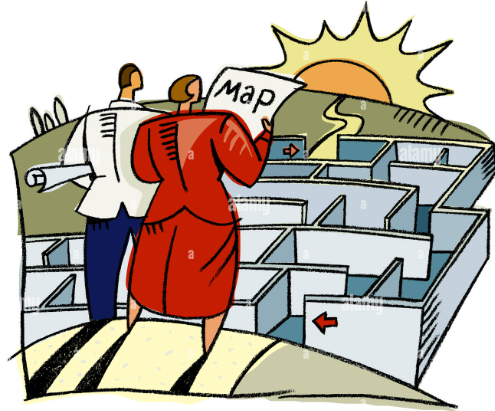
Image: A man and woman standing in front of a maze, with the sun setting on the horizon (Source)

Choices

John and Mary meet.
What happens next?
If you want a happy ending, try A.


Section A is a single paragraph where every adjective is positive and the story, such as it is, is very dull.

The five subsequent sections introduce variety, complications, other characters, humour, and tragedy. Each is an obvious satire of a different genre, but each shows the constraints of convention and patriarchy on relationships.

Finally, and somewhat unnecessarily, Atwood spells out her point:
So much for endings. Beginnings are always more fun. True connoisseurs, however, are known to favor the stretch in between… That’s about all that can be said for plots, which anyway are just one thing after another.
Shades of the famous, and variously attributed, maxim, “History is just one damned thing after another”.

More playfulness

See Atwood’s equally brief There Was Once. It’s in Paul Merton’s anthology, Funny Ha Ha, and you can read the story HERE. It opens:
There was once a poor girl, as beautiful as she was good, who lived with her wicked stepmother in a house in the forest.
An inoffensive, if unoriginal, start for a children’s story? Nope. That one sentence is rewritten, agonised over, and rewritten again to avoid causing any offence. Reductio ad absurdum. It's from 1992, when political correctness was much mocked, but it reads just as well in the age of wars on woke.

Short story club

I reread this as one of the stories in The Art of the Short Story, by Dana Gioia, from which I'm aiming to read one story a week with The Short Story Club, starting 2 May 2022.

You can read this story here.

You can join the group here.
Profile Image for Mahtab Safdari.
Author 53 books38 followers
September 7, 2025
The story breaks the fourth wall, with a narrator addressing the reader directly and commenting on the act of storytelling itself. It playfully acknowledges its own artificiality to challenge the reader's assumptions about narrative and character. The story's central argument is that all stories, like all human lives, end in death. The title "Happy Endings" is an ironic jab at conventional romance plots that promise neat, satisfying resolutions. In Atwood's story, a "happy ending" is the ultimate, dull inevitability of mortality, stripping happiness of its romantic meaning. The conclusion satirizes romance plots that end with a simplistic "happily ever after".
Atwood dissects the conventions of narrative, particularly the expectation of a dramatic plot. The narrator dismisses most traditional events as mere distractions, arguing that a story's real value is in the complex motivations and emotions behind the action_ the "how" and "why". The story questions the ability of art to fully capture the complexities of life. By showing how simplistic narratives fail to do justice to human experience, Atwood challenges readers to engage with the nuanced realities of their own lives.

Profile Image for Nataliya.
987 reviews16.2k followers
December 11, 2015
Fantastic. Brilliant. Or perhaps brilliantly fantastic.
"So much for endings. Beginnings are always more fun. True connoisseurs, however, are known to favor the stretch in between, since it's the hardest to do anything with.

That's about all that can be said for plots, which anyway are just one thing after another, a what and a what and a what.

Now try How and Why."
Profile Image for Heba.
1,247 reviews3,096 followers
February 24, 2022
النهايات السعيدة...عنوانٌ مغري جداً...ولكن ثمة شك غريزي بشأن حدوث مثل تلك النهايات في الواقع....أليس كذلك؟
ولكن دعنا نرى ما ينتظرنا...؟
" جون وماري تقابلا...
ماذا سيحدث بعد ذلك ؟...
إذا كنت ترغب في نهاية سعيدة...حاول "
في ثلاث صفحات فقط تستطيع الكاتبة المُبدعة " مارجريت أتوود" أن تختلق ستة سيناريوهات مختلفة لتجارب حياتية توقظ لدى قارئها حواسه الذهنية والعاطفية على نحو مُشوق ومثير...بالتفاصيل القليلة المكثفة النابضة تسلمك من نهاية إلى أخرى متورطة بحالة عاطفية ما قد تبدو خرقاء ..أو لامعقولة...ولكن كلها مراوغة تتحايل على نهاية وحيدة منطقية وحتمية وهى أن "جون وماري" يموتان.....أجل بالنهاية الموت...
"" تقول "مارجريت" بأن ذلك كل ما يمكن قوله عن الحبكات والتي ليست سوى شيء يتبع ماذا ثم ماذا...
والآن جرب كيف ولماذا ...""
يتراءى لي كقارئة بأنه لكي تكون قصة ما قابلة للتصديق وتدفعك لمواصلة قراءتها... لابد وأن لا تكتفي بماذا ثم ماذا....بل كيف ولماذا...
وهذا ما تفعلينه ببراعة سحرية يا سيدتي...
Profile Image for Lori.
308 reviews96 followers
December 17, 2017
And they died happily ever after. The End!
Profile Image for Thomas.
1,877 reviews12.1k followers
December 10, 2015
We all die. Margaret Atwood's cutting and sarcastic short story "Happy Endings" proves it. It contains six short stories all wrapped up in one, each ending in the deaths of its characters. Atwood's incisive piece of metafiction comments on several subjects: domesticity, the art of creative writing, romance, and more.

I love how Atwood makes every word count. In just three pages she deconstructs the premise of "happily ever after," the idealization of neat narratives, and the way we cling to the illusion of immortality. This piece reminded me right away of psychologist Irvin Yalom's four human existential concerns, one of which centers on our inevitable deaths, perhaps the one thing we all have in common.

Recommended to those who want a brief piece with punch. Atwood establishes her voice with ease and makes every scenario worth reading.
Profile Image for Olga.
458 reviews167 followers
December 7, 2024
The Short Story Club


What a philosophical and witty perspective into human life, relationships and success. The author could have written a novel about these five people but this sketchy draft is OK if you are willing to read between the lines. There isn't such thing as 'happy endings'. The end is always the same. What matters, however, what motivates you to make you choices in this short period of time called life.
Profile Image for Paula Mota.
1,681 reviews571 followers
October 4, 2023
#A story a day to chase the blues away #4

4,5*
“Happy Endings”, Margaret Atwood, Canadá, 1983

Este breve conto é um exercício de argúcia narrativa, uma lição de vida em que nem homens nem mulheres saem muito favorecidos…

Her friends tell her they’ve seen him a restaurant with another woman, whose name is Madge. It’s not even Madge that finally gets to Mary: it’s the restaurant. John has never taken Mary to a restaurant. Mary collects all the sleeping pills and aspirins she can find, and takes them and half a bottle of sherry. You can see what kind of a woman she is by the fact that it’s not even whiskey.

...e uma aula de escrita.

So much for endings. Begginings are always more fun. True connoisseurs, however, are known to favour the stretch in between, since it’s the hardest to do anything with. That’s all that can be said about plots, which anyway are just one thing after another, a what and a what and a what. Now try How and Why.

Impressionante, para umas meras três páginas.
Profile Image for Sarah.
186 reviews448 followers
July 1, 2018
“You'll have to face it, the endings are the same however you slice it. Don't be deluded by any other endings, they're all fake, either deliberately fake, with malicious intent to deceive, or just motivated by excessive optimism if not by downright sentimentality.

The only authentic ending is the one provided here:

John and Mary die. John and Mary die. John and Mary die.”
Profile Image for Connie  G.
2,153 reviews712 followers
May 31, 2023
Margaret Atwood wrote a story about the process of writing using a story about domesticity with six versions. She said that no matter what the plot of the story entailed, the stories ended up the the same - the characters died.

Atwood gives examples of six types of plots. Story A is a typical romance with no problems and a "happy ending." In stories B and C, there are variations of unrequited love and a woman with low self-esteem, typical of a soap opera. Story D has a natural disaster in the plot. In version E, the couple is challenged by illness. Version F attempts to make the characters more interesting by having them in the roles of a revolutionary and a counterespionage agent. But they all die at the end of the plot.

Atwood ended the story:

"That's about all that can be said for plots, which anyway are just one thing after another, a what and a what and a what."
"Now try How and Why."


I always find the "How", and especially the "Why," to be the most interesting parts of a story. Atwood has good advice for readers and writers of short stories. This work was included in The Art of the Short Story, a college-level anthology of 62 short stories, and it could be interesting to discuss in a classroom. The anthology is being read by the Short Story Club.
Profile Image for Mimi.
745 reviews228 followers
January 26, 2022
Short and seemingly simple. And brilliant.

I loved this story the first time I read it, but it's been years since and I haven't reread it until just now, until Petra's review (link to the story included). A rereading is long overdue. And what a different experience it is to read it now. Margaret Atwood will never not amaze me.

Parts B and C are still my favorite, and they still hit me as hard now as they did all those years ago.
Profile Image for mwana.
479 reviews279 followers
May 29, 2018
John and Mary meet
What happens next?
If you want a happy ending, try A.


This is a metafiction by Margaret Atwood where John and Mary's relationship goes through different stories labelled A-F. It's Atwood so I was intrigued. The following "reviews" are my reactions to the stories.

A

Well, that's nice.

B

The fucking fuck Mary????

C

description

D

description

E

This one is about Fred and Madge. I was shortchanged. Where are John and Mary?

F

????????


As Atwood herself stated, Beginnings are always more fun.
Profile Image for Greta G.
337 reviews320 followers
December 16, 2017
A short story in the metafiction genre that looks more like an outline for a novel the author wanted to write.
In my opinion, this is lazy writing.
You can read it online.
Profile Image for Shaghayegh.
183 reviews378 followers
June 28, 2023
سبک این اثر فسقلی سه صفحه‌ای برام جالب بود و از طرفی ماه‌ها پیش که خونده بودمش هم زیر لب می‌گفتم: همه‌مون از پس نوشتن چنین چیزی برمیایم، منتهی با چنین دیدگاهی می‌تونیم روایتش کنیم؟ (الان که فکر میکنم به این نتیجه رسیدم: البته که می‌تونیم!)
اول از همه باید تعریف خود نویسنده رو راجع به دسته‌بندی اثرش نقل قول کنم:
When I wrote "Happy Endings"—the year was, I think, 1982, and I was writing a number of short fictions then—I didn't know what sort of creature it was. It was not a poem, a short story, or a prose poem. It was not quite a condensation, a commentary, a questionnaire, and it missed being a parable, a proverb, a paradox. It was a mutation. Writing it gave me a sense of furtive glee, like scribbling anonymously on a wall with no one looking.
This summer I saw a white frog. It would not have been startling if I didn't know that this species of frog is normally green. This is the way such a mutant literary from unsettlles us. We know what is expected in a given arrangement of words; we know what is supposed to come next. And then it doesn't.
It was a little disappointing to learn that other people had a name for such aberrations [metafiction], and had already made up rules.

و با این اوصاف، بدون هیچ اسپویلی ماجرا رو خیلی مختصر تعریف می‌کنم.
نویسنده تو دل روابط مختلف میره و روایتشون می‌کنه. هر رابطه‌ای که با یه حرف انگلیسی متمایزش کرده به طرز خاصی پیش می‌ره. با انتخابات و تصمیماتی که هم می‌تونه به بهبود و التیامشون کمک کنه و هم میتونه ویرانگر باشه. اصلا خاصیت عشق مگه در همین نیست که هم موهبت هست و هم عذاب؟
و خب با دیدگاه منحصر به فرد هر شخصیت، میشه روند فروپاشی و ادامه دادن روابط رو دید. اینکه هر کس، بسته به احساسات، منطق و تصمیماتی که می‌گیره، چه خاکی به سرش می‌ریزه.
نویسنده در آخر، پیام نهاییش رو بیان می‌کنه که این کارش می‌تونه تو ذوق بزنه. چون مگه کار ما موشکافی و شخم زدن نیست؟ اینکه لقمه‌ی آماده رو تو دهنم بچپونن از نظرم باعث میشه که دیگه تلاشی در فهم ماجرا نکنم.
به هر حال اثر کوتاه، راحت‌خوان و ساده‌ای بود که ده دقیقه هم (البته با ارفاق) وقت نمی‌بره. منتهی فکر می‌کنم جا داشت که بیشتر بهش بپردازه. شاید نتونه برای خوندن آثار مهم نویسنده ترغیبتون کنه ولی اونقدرا هم بد نیست.
Profile Image for Franco  Santos.
482 reviews1,524 followers
June 16, 2016
"El único final auténtico es el que viene a continuación: John y Mary mueren. John y Mary mueren. John y Mary mueren".

Relato/ensayo de Margaret Atwood que trata el devenir de los personajes en las historias. Rompe la ilusión del "Y vivieron felices por siempre" para revelar la muerte que se oculta detrás como una verdad continuamente presente pero nunca expresada.

Por supuesto que las historias son como la vida, y de ese modo se debe leer este texto (al menos así lo entiendo yo). No importa que vayamos a morir, tampoco importa saber que estamos viviendo. El final es igual para todos. La muerte no discrimina, y Atwood no tiene problema en decirlo. Pero hay cosas por las que vale la pena vivir, y lo valioso reside en el cómo y en el porqué.

Lo pueden leer acá: "Finales felices".
Profile Image for Kathleen.
Author 1 book269 followers
June 3, 2023
Margaret Atwood is brilliant. From what I have seen, heard and read, every time she opens her mouth or sits down to write, this kind of stuff comes out.

In this piece, she gives writing advice--with panache. By demonstrating some basic story variations, she ponders the whole idea of happy endings, not just writing them.

My favorite writer. Always perceptive, always wise, always entertaining, always making a deeper point, even when she tells a joke.
Profile Image for Ruthi.
Author 3 books16 followers
August 7, 2014
It seems that most of the negative reviews miss the entire point of this short story essay and assume Atwood thinks too highly of herself and is negative without just cause.
Pick up a book by Nicholas Sparks. The plot is as described by Ms. Atwood, to a T. These are popular books that make it on NYTimes Best Sellers List all the time. Girl and boy meet (man and woman, if you are feeling generous based on how the characters act in most of his books). Connection! True love! Oh, no. Letter from an ex, so and so's family doesn't approve, so and so gets married to another person. Oh! Person realizes they made a huge mistake not marrying who they first met and fell for. They remedy it. They get married. The End. Of course, if the traditional novel dealt with what happens after a couple meets, rather than the meeting itself, it would be quite different. People, as a whole, enjoy bickering (I'm writing this because I ended up being upset at several reviews I felt missed the mark- people enjoy bickering, myself included) and picking apart those they are closest to. Divorce happens, constantly. True love turns into true hate. And then you die.

Or older married man meets unmarried girl who is in love with boy her age. She has an affair with the older man because he makes her feel safe, and anyway, he knows his way around the bedroom and her body more so than the boy does, so girl ignores the fact that she knows older married man has emotions and feelings invested in her more than just "fancying." She ruins it all by sleeping with the boy her age on a day she knew older married man would be coming over. Depression, crime of passion- the gun that was bought in the previous chapter for seemingly no reason all of a sudden becomes crystal clear in the plot and then! Everyone has died.

Or John & Mary are government workers. They find out that there is a plan to kill the president. They and they alone can stop it. There are many near misses, many near death experiences in this story but in the end, all is almost well; they didn't stop the assassination, but they were able to kill the group responsible. Too bad everyone views them as villains now and thinks that THEY were responsible for the assassination. But before they are both publicly executed, they realize they have fallen in love. Their public kiss after they declare innocence marks the beginning of a new era where no one trusts anyone and the government has a hand in everything. John and Mary are dead.

Or how about John is a King and Mary a lowly woodswitch. John hears screams while he is on a hunt and rides his horse to find out what the matter is. He finds Mary surrounded by bandits. Too many for her to take on all at once, magic or no. He rescues her. The bandits die. Well, all except one that had his hood on the entire time. That turns out to be King John's most trusted advisor. Mary was meant to die because she refused to help the advisor overthrow the King. Mary moves into the castle at King John's urging. She becomes a castle witch, helping with cures for illnesses and whatever else the gentry need. The advisor stays quiet. Neither John or Mary know what the advisor has in store for them, until it is almost too late. They are saved because Mary & John find out that they fight together perfectly in battle. They are married because they also realize they have fallen in love. Mary and the child dies in labor; John kills himself with no heir apparent to the throne. The family line ends there.

The only true ending is John and Mary both die. Not right away, of course, but they do die and thus their story ends.

As Ms. Atwood states in this short story, "True connoisseurs, however, are known
to favor the stretch in between, since it's the hardest to do anything with," plot is the most important part of a story. It's also the part most writers hate the most as it's very difficult to keep going at when writing. It becomes exhausting. You want it to end. You want to cheat your readers (and yourself) and wrap it up half way through the second major battle with, "And Mary and John both get a sword to the chest and die. The End," but you don't. You keep going because you have to. Plot is the only thing that makes reading and writing worth it, after all, but those who love writing plot heavy stories are few & far in between. Look at how many trilogies are put out instead of longer series.

No matter what choices any of us make, in the end, the only thing we have guaranteed in life is that we will all die. We do not get to have a picture perfect life all the time. If you're lucky, you get moments ("Life is made of moments, many worth exploring"- Yes, Into the Woods quote, had to) that are picture perfect and that is illustrated in this short story. Every novel that has become popular follows a formula no matter the genre. As writers, we can try to not follow formulas, but as time goes on, it becomes more and more impossible and unlikely that you shall find a unique narrative. It is neither bad nor good; it just is. Ms. Atwood comes across as a writer that was frustrated & annoyed with literature all being, basically, the same. It's a realization most readers and writers eventually have and, eventually, most of us at least, get over it. We realize we still love anything to do with word craft despite there maybe not being anything new because a story can still grasp us and teach us something new about ourselves.


What did this short story teach me? That every single writer (and most readers) go through the being jaded with everything to do with it phase. It's almost become a right of passage, it seems, to hate everything about a particular craft that you do truly love. Eventually, you grow out of it. Whether it hits you as a teenager or as a young adult or as someone older than that, eventually, you realize that everything in life ends with death and that is neither bad nor good; it just is.

We all die, in the end, after all.
Profile Image for ~:The N:~.
851 reviews55 followers
October 27, 2022
You’ll have to face it, the endings are the same however you slice it. Don’t be deluded by any other endings, they’re all fake, either deliberately fake, with malicious intent to deceive, or just motivated by excessive optimism if not by downright sentimentality.
The only authentic ending is the one provided here:
Profile Image for Sara Alaee.
208 reviews201 followers
September 10, 2015
Comment on the story taken from enotes :

“Happy Endings” by Margaret Atwood is an example of metafiction. This is a fiction story that refers to or takes as its subject fictional writing and its conventions. The author at the same time displays her feelings about creative writing, and then she uses her scenes to comment on living life to its fullest.

Atwood presents six scenarios all with the same characters. Each of the scenes provides the same conclusion. The characters die in the end. The author cleverly presents different plots for the stories. Her characters are flat and only caricatures of reality, and her tone is somewhat satirical and sarcastic.

Profile Image for droogie.
53 reviews17 followers
August 6, 2021
This 3 page story is very creatively written!
John and Mary meet…what happens next?
I wish all the books were written like this - plots expedited and cut to the chase cause beginnings are always more fun right?
This is A. I could write a B, C, D, E, F of this review, though it all leads to A regardless!
But B - why Mary, why?!
Read it here : Margaret Atwood's Happy Endings
Profile Image for Dee.
7 reviews144 followers
September 15, 2017
The novel is a meta fiction on which the author is relating to the craft. All the novels are similar, where the only difference is the plot which what really matters. it's the quest, the moments, the tiny little details and the fact that you're alive are what really matters in life & fiction.
Displaying 1 - 30 of 377 reviews

Join the discussion

Can't find what you're looking for?

Get help and learn more about the design.