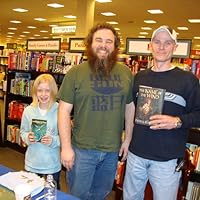
Robert Kirkman is an American comic book writer best known for his work on The Walking Dead, Invincible for Image Comics, as well as Ultimate X-Men and Marvel Zombies for Marvel Comics. He has also collaborated with Image Comics co-founder Todd McFarlane on the series Haunt. He is one of the five partners of Image Comics, and the only one of the five who was not one of the original co-founders of that publisher.
Robert Kirkman's first comic books were self-published under his own Funk-o-Tron label. Along with childhood friend Tony Moore, Kirkman created Battle Pope which was published in late 2001. Battle Pope ran for over 2 years along with other Funk-o-Tron published books such as InkPunks and Double Take.
In July of 2002, Robert's first work for another company began, with a 4-part SuperPatriot series for Image, along with Battle Pope backup story artist Cory Walker. Robert's creator-owned projects followed shortly thereafter, including Tech Jacket, Invincible and Walking Dead.
Being a huge fan of the show, I wanted to see how the original writing started and how the show writers followed and deviated from the comics. My dislikes were that the comics are much more crude, crass, and unnecessarily violent. I did like the change in relationships and how people worked together differently, and the comics have a different creepiness feel than you get watching it on TV. Overall, I prefer the show, and probably will not finish out the comic book series.
This is one of those breather issues that could stand alone. In television, it would probably be a filler episode that was cheaply made, since there's very little action, dialogue, or setting. But this is one of those stand out, stand alone issues, since it's really from Carl's point of view. So far, it's one of the saddest, introspective issues, where you know your character has permanently changed. Some readers (in later "Letters" sections) have complained about the lack of dialogue, which I guess is understandable if you're breaking off a few dollars, just to read 2 minutes of dialogue, and have to wait another month for the next issue. But this issue could later be important in understanding Carl's character development, assuming he doesn't get killed off before that happens.
Rick Grimes is a strong-willed deputy who missed the end of the world because he was in a coma for a month after getting shot in the line of duty. Shaken, starving and confused, Rick escapes the horror of the abandoned hospital only to be met with something far more terrible. Not only has the world ended, but the dead have learned to walk and to kill without mercy. After learning that his wife and son have fled to Atlanta from a single survivor and his son, Rick goes on a journey to reunite with his family and search for more survivors.
Rick quickly has to come to terms with the fact that the world has ended and only a select few survived. The dead have risen from their graves and they prey on the living. In a world where every minute feels like hours, where there's no such thing as law and order, where finding a small meal is a tremendous task, the walking dead are quite possibly the least threatening thing for the survivors to have on their breaking minds. Humanity is pushed to the brink of destruction, forcing them to embrace their cruel and primal nature in order to survive. Sometimes you have to be more concerned about who you let into your community so they don't kill you in your sleep and steal everything you once cared about. Rick has no choice but to abandon the ways of law and order that he's upheld as an officer for so long in order to protect the few loved ones he has left. He has to become a monster to protect his crew or risk being devoured by those who became more monstrous than him and even the walking dead.
Despite zombies running the world and having the series named after them, what really sets this series apart from the average zombie apocalypse tale is the focus on realism and the daily struggles, flaws and depth of the characters. There's plenty of badass zombie killing action, but the action often takes a back seat to give the characters plenty of times to share their extremely tragic yet endearing stories, grow through mutual suffering and learn to adapt to a world that has left them to die. Even after the world has ended, many people still can't see eye to eye. They turn on each other and kill each other when they should come together. Others form alliances in spite of their differences and try to rebuild over the corpse of everything that was lost. The daily human drama and conflict is more intense than any monster apocalypse could hope to be.
We watch Rick struggle to balance his old moral code with the many necessary evils he has to commit in order to survive and make the world a better place for the ones he holds close. We watch people like Glen, Dale and Maggie attempt to find love in spite of having every reason to be filled with fear, hate and self-loathing. Characters like Michonne have to learn how to forgive themselves and convince themselves they deserve to be loved despite all the blood on their hands. We watch the weak like Carl and Andrea become strong and sometimes the strong become evil like The Governor. Even monsters like the wicked yet oddly lovable Negan are given the chance to find new ways of redeeming themselves by struggling alongside the other survivors that have all been changed by the horrors of the fallen world.
The pacing is extremely slow and I can understand why that may be a turnoff for a lot of people, but I eventually learned to enjoy watching the characters grow, overcome their trauma, find meaning in life and learn to love again. The characters are forced to do many terrible things to survive and it haunts them every waking moment. The ways they overcome these regrets is very realistic, human and hopeful. The slow pacing really gives the feeling that we're living beside these people. The way every tiny detail of their lives and who they are is explored makes them feel very real and believable.
When I first started reading the series, I wasn't expecting it to have such an uplifting ending. It seemed so bleak and nihilistic for a long time and things would go horribly wrong even when they seemed to be going so well, but the finale channels all the pain, suffering and betrayal of the previous volumes and tops it off with a very touching and inspiring finish. This was never a story about hopelessness. It's about learning to appreciate the little things, learning to forgive yourself and learning to move on even when it's hard. When everything seems lost there's always more to be found, even when we believe otherwise because we convince ourselves that we don't deserve to be happy ever again. Instead of dwelling on what was lost, strive to try and make things better than they were before.
I've never been a huge fan of zombie apocalypse stories, but The Walking Dead had enough heart and strong social commentary to make me stick by the characters until the end and I enjoyed every moment of their long trial.
After the haunting conclusion of Issue #49, I approached Issue #50 with both anticipation and dread. The silence surrounding Rick and Carl, and the isolation they face, underscores a growing sense of vulnerability. With Rick’s declining health and Carl being forced to face the world alone, I wondered how this young boy would handle the crushing weight of responsibility thrust upon him.
The issue opens with Rick lying unconscious on the floor, feverish and unresponsive. Carl desperately shakes him, pleading for him to wake up. But then, Rick begins to mumble and shift, his movements slow and disoriented. This moment is harrowing as Carl, fearing the worst, draws his gun, ready to shoot. It’s a painful scene, as Carl’s eyes betray his inner turmoil, torn between his love for his father and the harsh necessity of survival. When he finally realizes Rick is still alive, the relief is overwhelming, and Carl collapses in tears, voicing his uncertainty and helplessness as he eventually drifts into an uneasy sleep beside his father.
By morning, Carl faces a horrifying reality: Rick is burning with fever, slipping further from consciousness. In a brave yet heartbreaking moment, Carl tries to cool Rick’s forehead with a damp towel, pleading for his father to wake up. As he shouts, though, their shelter attracts the attention of nearby zombies who begin pounding at the door, their relentless moans an eerie soundtrack to Carl’s desperation. Understanding the danger, Carl devises a risky plan, dragging Rick in front of the door to buy himself enough time to sneak out the back. It’s a moment that emphasizes both Carl’s ingenuity and his growth in these dire circumstances. But just as he lures the zombies away, a third one appears behind him, catching Carl off guard. In a heart-stopping moment, he narrowly avoids a bite and manages to take down all three walkers with his gun, though the intensity leaves him shaken to the core.
After this exhausting encounter, Carl returns to the house and begins to grapple with complex, bitter emotions. In a vulnerable monologue, he voices thoughts he’s likely suppressed for a long time, blaming Rick for everything that’s happened—the deaths of Lori, Judith, and even the loss of their previous group members. Carl’s anger reflects a child forced to grow up too soon, carrying an unbearable weight of trauma and responsibility. His outburst of resentment is deeply human, a release of pent-up pain and helplessness. Yet, despite his declarations that he doesn’t need Rick to survive, his words betray the hollow ache of loss and confusion within him. His outburst is more than anger—it’s grief, raw and unfiltered.
That night, in a powerful moment, Rick regains brief consciousness, reaching weakly for Carl, who stands over him, gun in hand. Carl hesitates, overwhelmed by fear and relief. Rick’s frail voice, barely a whisper, tells Carl that he’s sick and urges him to stay indoors and safe. Carl finally lets his walls fall, acknowledging his fear, and gently cradles Rick’s head as they share a vulnerable, tender moment. He tearfully takes back his previous declaration of independence, confessing that he’s scared, that he still needs his father. It’s a poignant reminder of Carl’s youth, the innocence that’s been eroded by loss but hasn’t entirely disappeared. As they drift to sleep, their bond is reaffirmed—a small but vital spark of hope in their bleak world.
Carl’s journey in this issue is both triumphant and heartbreaking. I felt a deep sense of pride in watching Carl fend for himself, yet there was also an unsettling sadness seeing such a young soul bear the weight of survival alone. The rawness of his emotions, his anger toward Rick, and his fragile moments of vulnerability all underscore the toll this world is taking on him.
The scene with Carl facing the zombies alone was nerve-wracking; he was so close to being bitten, and the very thought of him facing that alone was gut-wrenching. It’s as if every step he takes is a balancing act between survival and surrender, and it’s terrifying to witness a child walking that fine line. Carl’s survival instincts are honed, but the toll on his heart and mind is beginning to show. His declaration that he can live without his father is both a testament to his strength and a signal of his breaking point—a defense mechanism to push down the unbearable weight of fear and grief.
The emotional resonance of Carl’s monologue really struck me. Here is a child who should be preoccupied with school, friends, and fun, yet he’s thinking about death, loss, and the horrifying reality of this new world. The sadness in this issue is so heavy, and seeing Carl try to convince himself he doesn’t need Rick only to realize the emptiness of those words left me feeling hollow. It’s a reminder that, even as he grows into this world, he’s still a child at heart, terrified and desperate for reassurance.
This issue paints a stark portrait of survival—not through adrenaline-pumping action but through the quiet, painful moments of self-reflection. It’s a powerful exploration of Carl’s emotional journey, and while the physical threat of zombies is ever-present, the true struggle is within Carl as he battles fear, anger, and his need for connection.
This matched up to the tv series quite well. Rick is sleeping through the entire episodde and Carl is showing signs of growing up. Not much action, but at least Rick is able to heal.
I feel sorry for Carl that he's basically by himself in an unknown place for the time being. His Dad's sick and unconscious and can't calm him or do anything else for him.
I don't think it's a good idea for him to be yelling at his Dad. I'm pretty sure the noise will end up attracting a zombie or more than one zombie. Oh, there we go. I wonder what Carl's going to do to get rid of the zombie.
I hope that Carl doesn't leave the house and go and do something stupid. Rick would be so pissed off if he gets better and wakes up, and finds Carl dead. Well, he'd be sad, too, but also angry.
I KNEW that Carl wasn't going to stay inside and figure some way to move his Dad so they could be safe. I just didn't think he'd go right after those three zombies, which could've easily turned into a dozen or more.
He was lucky that he was able to shoot them and that more didn't show up and surround him. I'm glad that Carl went back inside as soon as possible, as staying there, might have alerted more zombies to where he was.
It's too bad that Rick's unconscious, or he'd be both scared and proud of Carl for looking after him and taking out all of those zombies.
All the stuff that Carl was saying was teen or pre-teen angst. He's been through a lot, and losing as many people as they have lost, surely doesn't help. His teenage years are going to be all fucked up.
I'm glad that Carl didn't shoot Rick, or he'd be in deep shit. Carl still has a lot to learn, about using a gun. About defending himself and about the things that go on out in the open with other people, and with zombies.
I'm also glad that Rick's still alive and didn't turn into a zombie. I'm glad that he was able to tell Carl not to go outside and that he's just sick. Hopefully it makes Carl feel a bit better, being able to hear his Dad talk.
Too bad Rick passed right back out because of being sick. Hopefully he won't be sick for too long, as I don't think Carl would know what to do or where to search for food or water.
Carl goes through quite the emotions in this issue, his dad is basically unconscious, looking like he's about to kick the bucket. Zombies come a-knockin' at the door so Carl lures them away to keep his dad safe, ends up shooting all 3, comes back bragging that he doesn't need his dad any more, he handled/protected himself, only to later on recant what he said, knowing full well that he's just a child that very much needs an adult to protect him. I'm not a fan of Carl but this issue made me feel for him a little more. This was more of a breather issue, with the events of the prison still lingering, you need a little down time from all the chaos. x
Carl es demasiado adorable para mi, estando indefenso y valiéndose por si mismo mientras Rick se recupera me agrada. Me agrada como Carl se esta desenvolviendo.
Justo en el cora. Tanto en la serie como ahora en el cómic, el discurso de Carl me llega al cora. Si mal no recuerdo, ya estaría en lo que es la cuarta temporada de la serie..