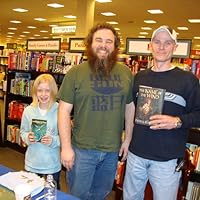
Robert Kirkman is an American comic book writer best known for his work on The Walking Dead, Invincible for Image Comics, as well as Ultimate X-Men and Marvel Zombies for Marvel Comics. He has also collaborated with Image Comics co-founder Todd McFarlane on the series Haunt. He is one of the five partners of Image Comics, and the only one of the five who was not one of the original co-founders of that publisher.
Robert Kirkman's first comic books were self-published under his own Funk-o-Tron label. Along with childhood friend Tony Moore, Kirkman created Battle Pope which was published in late 2001. Battle Pope ran for over 2 years along with other Funk-o-Tron published books such as InkPunks and Double Take.
In July of 2002, Robert's first work for another company began, with a 4-part SuperPatriot series for Image, along with Battle Pope backup story artist Cory Walker. Robert's creator-owned projects followed shortly thereafter, including Tech Jacket, Invincible and Walking Dead.
After the sheer intensity of the last issue, it’s impossible not to feel both anticipation and dread. Abraham's past has cracked open in pieces, and I was left wondering what else lies beneath his hardened exterior. And seeing Rick struggle with his own painful memories and decisions only strengthens the dark reality of their world. This issue feels primed to dig even deeper, giving us not just horror but the raw humanity underneath their survival.
Issue #58 picks up immediately with Abraham sharing the haunting story of his family’s tragic end. In a raw moment of vulnerability, Abraham tells Rick that they were surviving in a grocery store with other neighbors and friends. Abraham, determined to protect his loved ones, had gone on a weapons run with a small group, only to come back and find that those he thought were allies had turned on his family. His wife and daughter had been assaulted, forced upon by the very people they trusted, while his son had been forced to watch helplessly. Rage took over as Abraham killed the culprits with his bare hands. But in the brutal aftermath, his own family became afraid of him, seeing him no longer as their protector but as something monstrous. That night, his wife and children fled, only to be found dead by Abraham later on. His family’s tragic fate and his sense of guilt cut through him to this day.
Listening to Abraham’s story, Rick opens up about his own dark actions, confessing that he killed Dexter and Martínez in a fit of survival instinct, taking lives in a new world where such choices were both necessary and morally devastating. Rick muses that those who can’t kill in this world end up as the undead, wandering and dangerous. Carl, overhearing this exchange, joins in, confessing his own darkness: he killed Shane, and he’s wished death upon whoever took his mother and baby sister from him. He wonders if these thoughts make him unlovable, something that breaks Rick's heart. Father and son embrace, their pain and love spilling out in a rare moment of honesty and shared trauma, while Abraham watches silently, realizing he’s not alone in his struggles.
Meanwhile, back with the rest of the survivors, Dale voices his concerns over the safety of staying out in the open and, in his uncertainty, considers taking his family and splitting off to find a safer place. Andrea, however, isn’t ready to leave the group. Dale, trying to sway her, even hints at taking the truck to scout a location, driven by a mix of fear and love. There’s a tension here that shows just how deeply this life has chipped away at everyone’s resolve. Eugene, practical as ever, mentions the group’s food supply and suggests they might need to start rationing.
The story takes a turn when Rick, Abraham, and Carl finally make it to Rick's old neighborhood. Carl, haunted by the memories and pain of his old life, hesitates to enter. Rick assures him it’ll be just a minute and heads off to check in on Morgan and Duane, old friends who once gave him shelter when he first awoke in this new world. As he steps into Morgan’s home, he’s suddenly attacked, struck in the back of the head by a shovel, just like Duane had done when Rick first showed up at their door. Calling out to Duane, he’s taken aback when he realizes it’s Morgan who’s wielding the shovel, and this time, Morgan is a broken shell of the man Rick once knew.
The reunion is a heart-wrenching one. Morgan, overwhelmed with shock, takes Rick inside and shows him Duane, who has been turned and is now chained up in the house. The look in Morgan’s eyes is almost haunting—he’s still holding onto his son, needing Duane to remember who he once was, a child, not the soulless creature he’s become. In a shattering revelation, Morgan admits he’s killed looters, even fed them to his zombie son, trying to keep the remnants of his boy alive in the only way he knows. Rick, devastated yet understanding, gently hands Morgan his gun, offering him the chance to give Duane the peace he deserves.
Rick steps outside, where Abraham and Carl await him, and he tells them that Morgan will be joining their group. Abraham, wary, questions the decision, but Rick, who sees something of himself in Morgan, responds with a haunting statement: "He's no different from us. We do terrible things to protect the ones we love." Just then, a gunshot echoes from inside the house. Morgan appears moments later, somber and shattered, and announces, “It’s done.” As the trio leaves the home, a chilling image of Duane, now broken from his chains, dragging his way into a soulless oblivion, lingers in the reader’s mind.
This issue unravels the humanity of each character in such a painfully vivid way. Abraham’s confession shows the painful transformation he's undergone—from a loving father to a man haunted by the dual burden of his family's betrayal and his own violent retribution. That single act has torn him apart, yet he moves forward, perhaps in an attempt to redeem himself, or simply because he has no other choice. His bond with Rick deepens here, and it feels as though they're connecting over shared ghosts, finding solace in each other’s trauma.
Carl’s openness in this issue, too, speaks volumes about his growth. This child, forced to mature faster than anyone should, is grappling with emotions that are far beyond his years. It’s both heart-wrenching and haunting to see Carl burdened with such darkness, yearning for Rick’s love despite his own self-doubt.
Morgan’s breakdown at seeing Rick, and his inability to let go of Duane, was perhaps the hardest part to read. For Rick, this journey was about retrieving an old friend, but what he finds is a man broken by the very thing he tried to protect. That Morgan chose to stay with Duane, feeding him and hoping for a flicker of recognition, paints a tragic picture of someone who’s lost all sense of purpose beyond the memories he clings to. When he finally pulls the trigger, it’s as though he's putting not just his son but a part of himself to rest.
As they leave, that final panel with Duane’s reanimated form dragging his broken chain is a haunting symbol. It’s a reminder that, in this world, some chains aren’t physical, but they keep pulling you back all the same. For Morgan, that chain has finally broken, but not without scarring him beyond repair.
This issue peels back the layers of each character, revealing the fractured pieces they’ve tried to hold together. It's more than just survival; it’s a look at how much of themselves they’re willing to lose to keep going, and how every choice and every confession brings them closer to becoming something unrecognizable—both to themselves and to each other.
I feel so bad for Abraham with what happened to his ex-wife, daughter, and son. That had to be horrifying and sad. I feel so bad for everything that Abraham and his family have been through.
I'm glad that Rick and Abraham are talking about all of this and getting it out in the open. They both needed to talk and I don't think it would've been good for them to talk about this stuff with anyone else.
Aww, Carl. I'm glad that he spoke up and is telling his Dad about his thoughts. I'm glad that Rick hugged Carl, which was his way of saying that it was okay, without using words.
I think Dale needs to get some sense knocked into his head. Andrea's right for not wanting to leave Rick and the group again. Sure, Rick's dangerous, but you need to be dangerous to live in this world.
I feel like they should've been rationing food from the start, that by doing so from the beginning, it would make the food last longer. Sometimes, I wish they would use their brains.
AWESOME, they found Morgan! Now they can take Morgan and Duane with them! Oh shit! Aww, Duane's dead and turned into a zombie. That's so fucking sad! I actually cried when Morgan had to put Duane down.
Being a huge fan of the show, I wanted to see how the original writing started and how the show writers followed and deviated from the comics. My dislikes were that the comics are much more crude, crass, and unnecessarily violent. I did like the change in relationships and how people worked together differently, and the comics have a different creepiness feel than you get watching it on TV. Overall, I prefer the show, and probably will not finish out the comic book series.
Rick Grimes is a strong-willed deputy who missed the end of the world because he was in a coma for a month after getting shot in the line of duty. Shaken, starving and confused, Rick escapes the horror of the abandoned hospital only to be met with something far more terrible. Not only has the world ended, but the dead have learned to walk and to kill without mercy. After learning that his wife and son have fled to Atlanta from a single survivor and his son, Rick goes on a journey to reunite with his family and search for more survivors.
Rick quickly has to come to terms with the fact that the world has ended and only a select few survived. The dead have risen from their graves and they prey on the living. In a world where every minute feels like hours, where there's no such thing as law and order, where finding a small meal is a tremendous task, the walking dead are quite possibly the least threatening thing for the survivors to have on their breaking minds. Humanity is pushed to the brink of destruction, forcing them to embrace their cruel and primal nature in order to survive. Sometimes you have to be more concerned about who you let into your community so they don't kill you in your sleep and steal everything you once cared about. Rick has no choice but to abandon the ways of law and order that he's upheld as an officer for so long in order to protect the few loved ones he has left. He has to become a monster to protect his crew or risk being devoured by those who became more monstrous than him and even the walking dead.
Despite zombies running the world and having the series named after them, what really sets this series apart from the average zombie apocalypse tale is the focus on realism and the daily struggles, flaws and depth of the characters. There's plenty of badass zombie killing action, but the action often takes a back seat to give the characters plenty of times to share their extremely tragic yet endearing stories, grow through mutual suffering and learn to adapt to a world that has left them to die. Even after the world has ended, many people still can't see eye to eye. They turn on each other and kill each other when they should come together. Others form alliances in spite of their differences and try to rebuild over the corpse of everything that was lost. The daily human drama and conflict is more intense than any monster apocalypse could hope to be.
We watch Rick struggle to balance his old moral code with the many necessary evils he has to commit in order to survive and make the world a better place for the ones he holds close. We watch people like Glen, Dale and Maggie attempt to find love in spite of having every reason to be filled with fear, hate and self-loathing. Characters like Michonne have to learn how to forgive themselves and convince themselves they deserve to be loved despite all the blood on their hands. We watch the weak like Carl and Andrea become strong and sometimes the strong become evil like The Governor. Even monsters like the wicked yet oddly lovable Negan are given the chance to find new ways of redeeming themselves by struggling alongside the other survivors that have all been changed by the horrors of the fallen world.
The pacing is extremely slow and I can understand why that may be a turnoff for a lot of people, but I eventually learned to enjoy watching the characters grow, overcome their trauma, find meaning in life and learn to love again. The characters are forced to do many terrible things to survive and it haunts them every waking moment. The ways they overcome these regrets is very realistic, human and hopeful. The slow pacing really gives the feeling that we're living beside these people. The way every tiny detail of their lives and who they are is explored makes them feel very real and believable.
When I first started reading the series, I wasn't expecting it to have such an uplifting ending. It seemed so bleak and nihilistic for a long time and things would go horribly wrong even when they seemed to be going so well, but the finale channels all the pain, suffering and betrayal of the previous volumes and tops it off with a very touching and inspiring finish. This was never a story about hopelessness. It's about learning to appreciate the little things, learning to forgive yourself and learning to move on even when it's hard. When everything seems lost there's always more to be found, even when we believe otherwise because we convince ourselves that we don't deserve to be happy ever again. Instead of dwelling on what was lost, strive to try and make things better than they were before.
I've never been a huge fan of zombie apocalypse stories, but The Walking Dead had enough heart and strong social commentary to make me stick by the characters until the end and I enjoyed every moment of their long trial.
I liked this issue, we got to hear Abraham's awful story of what happened to his ex-wife, daughter and son, you can kinda get where he's coming from and feel his pain. It gives his character more volume to be honest. We then go back to the whiny camp, Dale bitching about staying in a tent and wanting to find somewhere safe and secure for Andrea and the twins (not going to lie, I completely forgot all about the twins, they've hardly been seen or mentioned over the past few issues, I don't even remember their names!), and we get the story about Eugene and his fabulous mullet. We then go back to Rick, Carl and Abraham, going back to Rick's old place and lo-and-behold it's Morgan. Not as completely crazy as in the show but he's in a bad place, his son turned and is now a zombie chained up because Morgan can't shoot him. Rick decides to take Morgan with them, we think Morgan goes to shoot his son but turns out he just shot the chain holding him, his son is now free to roam about and probably kill a few folks in the process. Good job Morgan. x
Yay, backstories and reintroducing a loose thread! But, as usual, rape has a place in it. (Cue my eyes rolling). Aside from that, this was a great issue, which shows how much pain and anguish one can feel with the death of a child, and how easily one can snap under extreme stress, kids included.
One of the good things about introducing someone with a scientific mind, is that you can bring up real world logistical problems, that readers are probably thinking about, such as food rationing, and the possibility of running out of food. Just how much this scientist knows about the actual "plague," vs the use of deductive reasoning, remains to be seen.
Great! I am really enjoying TWD comics. All the comics in this series are really good but I think they have gotten so much better since issue 50. I also love seeing the differences between the comic and the TV show.
La historia de Abraham es más trágica de lo que pensé. Reaparece Morgan. Espero que sea más llevadero su personaje, porque en la serie realmente no me lo fumo