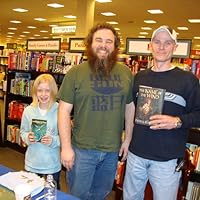
Robert Kirkman is an American comic book writer best known for his work on The Walking Dead, Invincible for Image Comics, as well as Ultimate X-Men and Marvel Zombies for Marvel Comics. He has also collaborated with Image Comics co-founder Todd McFarlane on the series Haunt. He is one of the five partners of Image Comics, and the only one of the five who was not one of the original co-founders of that publisher.
Robert Kirkman's first comic books were self-published under his own Funk-o-Tron label. Along with childhood friend Tony Moore, Kirkman created Battle Pope which was published in late 2001. Battle Pope ran for over 2 years along with other Funk-o-Tron published books such as InkPunks and Double Take.
In July of 2002, Robert's first work for another company began, with a 4-part SuperPatriot series for Image, along with Battle Pope backup story artist Cory Walker. Robert's creator-owned projects followed shortly thereafter, including Tech Jacket, Invincible and Walking Dead.
Being a huge fan of the show, I wanted to see how the original writing started and how the show writers followed and deviated from the comics. My dislikes were that the comics are much more crude, crass, and unnecessarily violent. I did like the change in relationships and how people worked together differently, and the comics have a different creepiness feel than you get watching it on TV. Overall, I prefer the show, and probably will not finish out the comic book series.
Rick Grimes is a strong-willed deputy who missed the end of the world because he was in a coma for a month after getting shot in the line of duty. Shaken, starving and confused, Rick escapes the horror of the abandoned hospital only to be met with something far more terrible. Not only has the world ended, but the dead have learned to walk and to kill without mercy. After learning that his wife and son have fled to Atlanta from a single survivor and his son, Rick goes on a journey to reunite with his family and search for more survivors.
Rick quickly has to come to terms with the fact that the world has ended and only a select few survived. The dead have risen from their graves and they prey on the living. In a world where every minute feels like hours, where there's no such thing as law and order, where finding a small meal is a tremendous task, the walking dead are quite possibly the least threatening thing for the survivors to have on their breaking minds. Humanity is pushed to the brink of destruction, forcing them to embrace their cruel and primal nature in order to survive. Sometimes you have to be more concerned about who you let into your community so they don't kill you in your sleep and steal everything you once cared about. Rick has no choice but to abandon the ways of law and order that he's upheld as an officer for so long in order to protect the few loved ones he has left. He has to become a monster to protect his crew or risk being devoured by those who became more monstrous than him and even the walking dead.
Despite zombies running the world and having the series named after them, what really sets this series apart from the average zombie apocalypse tale is the focus on realism and the daily struggles, flaws and depth of the characters. There's plenty of badass zombie killing action, but the action often takes a back seat to give the characters plenty of times to share their extremely tragic yet endearing stories, grow through mutual suffering and learn to adapt to a world that has left them to die. Even after the world has ended, many people still can't see eye to eye. They turn on each other and kill each other when they should come together. Others form alliances in spite of their differences and try to rebuild over the corpse of everything that was lost. The daily human drama and conflict is more intense than any monster apocalypse could hope to be.
We watch Rick struggle to balance his old moral code with the many necessary evils he has to commit in order to survive and make the world a better place for the ones he holds close. We watch people like Glen, Dale and Maggie attempt to find love in spite of having every reason to be filled with fear, hate and self-loathing. Characters like Michonne have to learn how to forgive themselves and convince themselves they deserve to be loved despite all the blood on their hands. We watch the weak like Carl and Andrea become strong and sometimes the strong become evil like The Governor. Even monsters like the wicked yet oddly lovable Negan are given the chance to find new ways of redeeming themselves by struggling alongside the other survivors that have all been changed by the horrors of the fallen world.
The pacing is extremely slow and I can understand why that may be a turnoff for a lot of people, but I eventually learned to enjoy watching the characters grow, overcome their trauma, find meaning in life and learn to love again. The characters are forced to do many terrible things to survive and it haunts them every waking moment. The ways they overcome these regrets is very realistic, human and hopeful. The slow pacing really gives the feeling that we're living beside these people. The way every tiny detail of their lives and who they are is explored makes them feel very real and believable.
When I first started reading the series, I wasn't expecting it to have such an uplifting ending. It seemed so bleak and nihilistic for a long time and things would go horribly wrong even when they seemed to be going so well, but the finale channels all the pain, suffering and betrayal of the previous volumes and tops it off with a very touching and inspiring finish. This was never a story about hopelessness. It's about learning to appreciate the little things, learning to forgive yourself and learning to move on even when it's hard. When everything seems lost there's always more to be found, even when we believe otherwise because we convince ourselves that we don't deserve to be happy ever again. Instead of dwelling on what was lost, strive to try and make things better than they were before.
I've never been a huge fan of zombie apocalypse stories, but The Walking Dead had enough heart and strong social commentary to make me stick by the characters until the end and I enjoyed every moment of their long trial.
Following the events of last issue, I’m intrigued by how the enigmatic figure Davidson is woven into Alexandria’s backstory and why his name holds such a weight in the community. While his influence seems like it may foreshadow trouble, there’s so much more to discover about Alexandria itself. It’s strange to see the group in such a “normal” place, where the familiar world of neighborhood life and community rules exists within the boundaries of an apocalypse.
The issue opens with an intense moment, as Douglas apologizes to Heath for his outburst after the name Davidson came up in Issue #70. The mention of Davidson clearly hit a nerve, hinting at some dark history between Douglas and this man. Regina, Douglas’ wife, still holds deep suspicion toward Rick and his group. Her unease introduces a tension that’s palpable even as the community tries to put on a warm front.
Meanwhile, Rick encounters another problem with Carl’s interactions in Alexandria. Carl and another boy, Mikey, end up in a scuffle after Mikey asks to see Carl's gun, and Carl refuses. Mikey shoves Carl, and Carl retaliates, knocking Mikey down. Rick intervenes just as Mikey storms off to complain to his father, Nicholas. Rick, recognizing his son's instinct for self-defense, advises Carl to try and restrain himself with the other kids. Carl’s apology falls flat with Mikey, who is quick to run to his dad with complaints—a reminder of how different this community’s normalcy is from Carl’s reality.
Douglas approaches Rick and seems impressed at how quickly he’s acclimating. He organizes a tour of Alexandria but insists that Rick’s group surrender their weapons to the armory while they stay. This demand for disarmament is a cautious move from Douglas, yet Rick and his group recognize it as a sign they’re not yet fully trusted. Nicholas, still furious over the situation with Mikey, confronts Rick over Carl carrying a gun. Rick maintains a diplomatic approach, calming Nicholas and subtly asserting his place without further confrontation—a surprisingly calm move for a man as seasoned as Rick, whose patience is hard-earned.
The tour stops at the community armory, where Douglas explains that all weapons will be locked and stored safely, though each member retains personal ownership of their arms. Michonne, however, wants to keep her katana. Douglas resists at first but, with Olivia's help, eventually concedes, allowing Michonne to keep it within her home as a keepsake. This exception feels like a small victory for Michonne and the group, a reminder of the familiar world they came from.
The infirmary introduces us to Denise Cloyd, Alexandria’s medic, and we get a glimpse of Heath’s relationship with a bedridden friend named Scott, who is cautious about the newcomers. It’s clear that even the seemingly quiet parts of Alexandria have their own stories and uncertainties.
The tour ends with Douglas showing Rick’s group three houses they’re to occupy. Rick takes the lead on room assignments, grouping people by family or closeness and noting that Abraham and Eugene will share space despite their rough past. Abraham’s acceptance shows growth, and the group seems cautiously hopeful for this new setup. However, a shared skepticism lingers, especially for Rick and Abraham. They suspect the houses may be part of a divide-and-conquer tactic, so they make a secret plan to all sleep in one house the first few nights, prioritizing safety in numbers. Douglas, ever sharp, notices their caution and casually extends an invitation for Halloween festivities the next day, adding a layer of humor to his awareness.
Halloween day brings an unusual sight: Alexandria’s children trick-or-treating in broad daylight. Douglas explains that the event takes place during the day to ease any residual fear among the kids, and he even admits they aren’t sure of the exact date—though no one seems to mind. Carl initially tries to enjoy the celebration but soon grows uncomfortable, disliking the sense of lowered guard and yearning for the constant vigilance he’s grown accustomed to. Rick eventually takes Carl home, sharing his unease.
Douglas then assigns roles to each member of Rick’s group, a move that seems to reinforce their value to Alexandria while subtly testing their willingness to adapt. When he suggests a different role for Andrea, Rick steps in to recommend her as the community’s lookout, a position that respects her sharpshooting skills and aligns with her strengths.
Later, as night falls, the group relaxes together in the house, caught between disbelief and joy at this strange new safety. Andrea confides in Rick about her reservations, feeling that Alexandria’s sense of peace is fragile, with defenses she doubts could withstand a real threat. Rick’s response, however, reveals his darker, tactical side: if the community ever turned on them, he’s confident his group could take it over. The implication is chilling, showing Rick’s strategic mind and the ruthlessness he’s adopted to survive.
In this issue, I feel the group’s mixture of relief and skepticism. Alexandria is a paradise, but it’s also too perfect—a place that seems to ignore the brutal reality outside its walls. Carl’s disinterest in Halloween hits hard; he’s lost a chunk of his childhood, and in his eyes, everyone is merely playing pretend. He’s a child who’s been forced to grow up too fast, and it’s bittersweet seeing him alienated even as he should be reveling in the happiness of other children.
Rick’s mindset, especially in his final thoughts, is fascinating and unsettling. He respects Alexandria but also sees its weaknesses. His talk of potentially taking over Alexandria feels sinister, as if the survivalist side of Rick is willing to do anything to protect his group, even if it means turning on this safe haven. The lines between hero and anti-hero blur, and his willingness to consider domination over integration hints at the psychological toll of life on the road.
After the 71th Issue the comics offers a lighthearted two-pager that is a welcome break from the intensity of the main storyline, showing Carl’s sharp humor and wit. Despite the grim world, it’s refreshing to see the kids bring a bit of comedic banter.
In this brief strip, Carl is invited by John to join his “badass” club. John tries to impress Carl by bragging about his own “badass” feats, but Carl seems unimpressed. Pushed to share his own story, Carl casually drops that he shot a man (Shane) in the neck—a fact that silences the other boys. John’s attempt to prove his toughness fails miserably against Carl’s chillingly real survival experiences, making this interaction both humorous and dark.
The humor here is dark but hilarious, capturing Carl’s hardened perspective and how out of place he feels among these boys who have never seen the worst of the apocalypse. John’s bravado crumbles hilariously, and Carl’s bluntness highlights just how different his reality is from theirs. It's a reminder that while Alexandria’s children worry about childish disputes, Carl has been dealing with life-or-death decisions, a tragic yet comedic contrast that shines in this strip.
We get to see more of Alexandria. Carl's being a little shit. A little cowboy shit. I forgot Glenn and Maggie were even in this. Michonne is told to give up her sword but they're like 'nah, it's not a weapon' ... it is. It literally is. Rick and Andrea doing some major foreshadowing. Rick sounding like a dictator at the end, 'we'll make it ours?' Rick, I really don't like you. x
The group begins to settle down in Alexandria but still remain on guard. Nice to see them be able to live a somewhat normal life. Halloween is attempted but meant not to be scary and Carl gets bored quickly.
I'm glad that Douglas shut Regina up. She was only in a handful of scenes and she already annoys the shit out of me. So glad that Douglas got her to calm the hell down.
Ah, hell no. I wouldn't let anyone take my weapon, sorry. I wouldn't trust these people not to slaughter me in my sleep. Maybe after some time had passed and nothing happened, but not until then.
Sounds like both Nicholas and his son are assholes. If I were Rick, I'd have let Carl kick that other little boy's ass. Teach him not to be such a little prick from now on. And the father's just as bad.
Okay, I don't agree with Douglas at all. I'm sure he's taking their weapons so that they can't use them on anyone in Alexandria, but I wouldn't give up my weapon. hell now. You never know if someone from Alexandria's gonna try some crazy shit or not.
I'm glad that Abraham came up with a plan in case some crazy shit ended up going down. I like the idea of them all bunking together at least for the first few nights. Sounds like a wise move, to me.
On the one hand, I think them having a Halloween for the kids is a good idea. But on the other hand, I really don't. They're trying too hard to be normal, when the situation they're in is anything BUT normal.
I agree with Carl. It DOES feel like everyone is pretending that nothing's going on. I wouldn't want to be there either, if they keep going on like that. It's dangerous for them to forget about the zombies and how dangerous they are.
Yeah, I know what it's like to have to wait for a free bathroom, and I hate it, too. Andrea should have taken Glenn up on his offer to move the dishes out of the way, and brush her teeth in the sink. I would have.
I like Rick saying that if the Alexandrians tried to kick them out, that they'd take over the place. I just hope that it doesn't come to that. I hope they can all keep getting along.