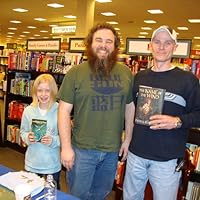
Robert Kirkman is an American comic book writer best known for his work on The Walking Dead, Invincible for Image Comics, as well as Ultimate X-Men and Marvel Zombies for Marvel Comics. He has also collaborated with Image Comics co-founder Todd McFarlane on the series Haunt. He is one of the five partners of Image Comics, and the only one of the five who was not one of the original co-founders of that publisher.
Robert Kirkman's first comic books were self-published under his own Funk-o-Tron label. Along with childhood friend Tony Moore, Kirkman created Battle Pope which was published in late 2001. Battle Pope ran for over 2 years along with other Funk-o-Tron published books such as InkPunks and Double Take.
In July of 2002, Robert's first work for another company began, with a 4-part SuperPatriot series for Image, along with Battle Pope backup story artist Cory Walker. Robert's creator-owned projects followed shortly thereafter, including Tech Jacket, Invincible and Walking Dead.
Being a huge fan of the show, I wanted to see how the original writing started and how the show writers followed and deviated from the comics. My dislikes were that the comics are much more crude, crass, and unnecessarily violent. I did like the change in relationships and how people worked together differently, and the comics have a different creepiness feel than you get watching it on TV. Overall, I prefer the show, and probably will not finish out the comic book series.
Rick Grimes is a strong-willed deputy who missed the end of the world because he was in a coma for a month after getting shot in the line of duty. Shaken, starving and confused, Rick escapes the horror of the abandoned hospital only to be met with something far more terrible. Not only has the world ended, but the dead have learned to walk and to kill without mercy. After learning that his wife and son have fled to Atlanta from a single survivor and his son, Rick goes on a journey to reunite with his family and search for more survivors.
Rick quickly has to come to terms with the fact that the world has ended and only a select few survived. The dead have risen from their graves and they prey on the living. In a world where every minute feels like hours, where there's no such thing as law and order, where finding a small meal is a tremendous task, the walking dead are quite possibly the least threatening thing for the survivors to have on their breaking minds. Humanity is pushed to the brink of destruction, forcing them to embrace their cruel and primal nature in order to survive. Sometimes you have to be more concerned about who you let into your community so they don't kill you in your sleep and steal everything you once cared about. Rick has no choice but to abandon the ways of law and order that he's upheld as an officer for so long in order to protect the few loved ones he has left. He has to become a monster to protect his crew or risk being devoured by those who became more monstrous than him and even the walking dead.
Despite zombies running the world and having the series named after them, what really sets this series apart from the average zombie apocalypse tale is the focus on realism and the daily struggles, flaws and depth of the characters. There's plenty of badass zombie killing action, but the action often takes a back seat to give the characters plenty of times to share their extremely tragic yet endearing stories, grow through mutual suffering and learn to adapt to a world that has left them to die. Even after the world has ended, many people still can't see eye to eye. They turn on each other and kill each other when they should come together. Others form alliances in spite of their differences and try to rebuild over the corpse of everything that was lost. The daily human drama and conflict is more intense than any monster apocalypse could hope to be.
We watch Rick struggle to balance his old moral code with the many necessary evils he has to commit in order to survive and make the world a better place for the ones he holds close. We watch people like Glen, Dale and Maggie attempt to find love in spite of having every reason to be filled with fear, hate and self-loathing. Characters like Michonne have to learn how to forgive themselves and convince themselves they deserve to be loved despite all the blood on their hands. We watch the weak like Carl and Andrea become strong and sometimes the strong become evil like The Governor. Even monsters like the wicked yet oddly lovable Negan are given the chance to find new ways of redeeming themselves by struggling alongside the other survivors that have all been changed by the horrors of the fallen world.
The pacing is extremely slow and I can understand why that may be a turnoff for a lot of people, but I eventually learned to enjoy watching the characters grow, overcome their trauma, find meaning in life and learn to love again. The characters are forced to do many terrible things to survive and it haunts them every waking moment. The ways they overcome these regrets is very realistic, human and hopeful. The slow pacing really gives the feeling that we're living beside these people. The way every tiny detail of their lives and who they are is explored makes them feel very real and believable.
When I first started reading the series, I wasn't expecting it to have such an uplifting ending. It seemed so bleak and nihilistic for a long time and things would go horribly wrong even when they seemed to be going so well, but the finale channels all the pain, suffering and betrayal of the previous volumes and tops it off with a very touching and inspiring finish. This was never a story about hopelessness. It's about learning to appreciate the little things, learning to forgive yourself and learning to move on even when it's hard. When everything seems lost there's always more to be found, even when we believe otherwise because we convince ourselves that we don't deserve to be happy ever again. Instead of dwelling on what was lost, strive to try and make things better than they were before.
I've never been a huge fan of zombie apocalypse stories, but The Walking Dead had enough heart and strong social commentary to make me stick by the characters until the end and I enjoyed every moment of their long trial.
Yeah right, Douglas. I'm sure you DO make it a habit of sneaking around at night, making sure that any new people you bring into Alexandria don't try to take over the place.
So basically, the way Douglas sees his marriage is that it's okay to be a lying cheater. Andrea needs to be smart and realize he'd be the same way with her, even though they wouldn't be married.
I get that Maggie's worried about something happening to Glenn, but she still shouldn't stop him from doing what he wants or feels he needs to do. I hope they can patch things up soon.
Andrea just called Douglas a creepy old bastard who hit on her. So why is she smiling? Is she really so jaded thinking that no man her own age would want her, that she just sticks to sleeping with old men? Yuck.
I liked Rick and Andrea's conversation. Rick and Andrea get along so well and I really like their friendship. They kind of seem like best friends to me, which I think they both need.
I liked that they talked about the expansion and touring the place. It was one of those moments where things almost felt normal and that doesn't happen often in this series.
I really don't like how obsessed Douglas seems to be with Andrea. I feel like he's going to end up being a big problem, one that Andrea or someone else from Rick's group has to put down so he'll leave her alone.
I like Abraham and Rosita's conversation. I like that he's always honest with her about what he's thinking and feeling and I hope Abraham continues to stay that way with her.
Wow, Michonne is losing her damn mind. I mean, I get where she's coming from, implying that there are more serious things to worry about, but I also feel like she overreacted a bit.
I like that they had Glenn pretend to be sick, so that he could go and check out the building that holds their weapons. I'm also glad that they're planning to break into that building and get them back.
I'd feel a lot better about Rick and his group staying in Alexandria if they could have their weapons close at hand just in case anything happened. I want them able to protect themselves.
Douglas really be out here hitting on Andrea ... like I seriously hope she doesn't end up with him because that's the second person in a row she's been with that could be old enough to be her grandfather. Anyhoo, the people of Alexandria hold a little meet and greet for the newbies. Michonne isn't buying it, Carl still being a whiny bitch, Andrea starts flirting with Spencer ... Douglas's son, interesting, Abraham is a lil' nervous about being out doing construction work because he's kinda become used to not dealing with zombies in Alexandria and Glenn fakes being blind drunk so he can see where the weapons are being stashed for Rick. Rick is actually starting to annoy me more than usual, it's like guys like him who feel the need to control everything, it's their way or no way at all, are just a dictator in the making. Also without a beard he looks like a little weedy bitch. It's getting real hard to like any of these folks just now. x
michonne !! hahaha that was awesome. But yeah if you've been out that long and people are worrying about what should they cook instead of their safety, who wouldn't snap ?