An English-language translation of the original German work that has been nominated for the 1998 Hans Christian Andersen Award follows the life of pug puppy Flix, who is born to bewildered cat parents and who is ostracized by kitten peers for his differences.
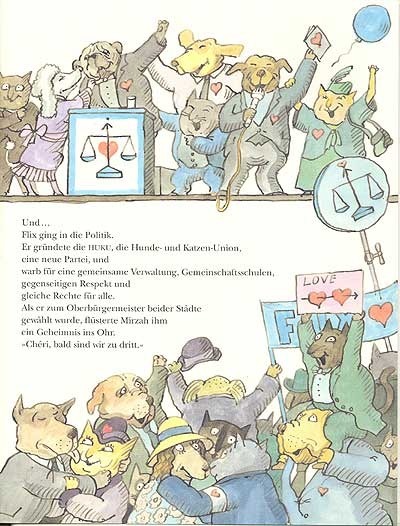
When Mr. and Mrs. Krall discover that they are going to have a baby, the feline couple is overjoyed. Then delivery day arrives, and Mrs. Krall has a puppy! Naming this unusual offspring Flix, the Kralls bring their son home to Cattown and raise him with love. Aware from the first of Flix's special needs, they arrange for him to spend lots of time with his canine godfather, Dr. Medor Klops, a basset hound from nearby Dog City. When it is time for Flix to attend high school, and then college, he does so in Dog City, while living with Uncle Medor. Whilst at university, Flix meets, saves, and falls in love with a poodle named Mirzah de la Forrière. After their marriage, Flix founds the CDU - "Cats and Dogs United" - an organization dedicated to fostering mutual respect and tolerance between canines and felines, and eventually goes on to become the first mayor of the now joined Cattown and Dog City. When he and Mirzah have a baby, it turns out to be a kitten - the ultimate affirmation of Flix's life spent between the dog and cat world.
Leaving aside issues of biological confusion - Flix is not technically a bi-racial child, as he is not the offspring of a union between a cat and a dog, just as his own child is not the product of a biracial (or cross-species) union - Flix is an engaging and humorous look at the experiences any child who feels caught between two worlds might have. I appreciated the fact that Flix's parents are so loving, and accept him for who he is. They don't simply include him in the feline world, they ensure that the canine part of him is acknowledged and nurtured, even when that takes him away from them, and from Cattown. The illustrations here, as is always the case with Tomi Ungerer, are humorous and engaging, with plenty of amusing visual details, from the canine-feline fight being shown on television in the very first scene, to the fact that the hospital where Flix and Mirzah have their child is staffed by an integrated dog/cat staff, unlike the solely feline staff of the hospital in which Flix himself was born. Subtle details like this reinforce the larger message of the story, about different communities coming together and not just learning to tolerate one another, but growing to consider one another friends and comrades. Recommended to Tomi Ungerer fans, and to anyone looking for children's stories addressing themes of difference, tolerance, acceptance, and cross-community friendship.
I loved this unusual tale of a dog born into a cat family. Despite its rather melancholy feel, there's a wonderful message of tolerance and understanding. Plus, lots of cats and dogs - what's not to love?
Flix è un racconto illustrato per bambini nato dal genio di Tomi Ungerer, già amato in tutto il mondo, e riportato in Italia da Camelozampa. Una storia ancora attuale che parla di diversità, con l’umorismo che contraddistingue questo autore, detentore di innumerevoli battaglie politiche e sociali. https://ilmondodichri.com/flix/
Charming, upbeat story about a dog who is unexpectedly born into a cat family - would be suitable for kids over the age of about 5. As usual with Ungerer, there are plenty of clever jokes for the grown-ups hidden in the pictures. I particularly liked the scene where Flix is celebrating his engagement to the cute poodle in "the best restaurant in Cat-town", and there is a sign on the wall saying "No Dogs". Also the wedding in the cathedral, with a statue of St. Bernard near the altar. But good as this book is, not even close to his masterpiece, "No Kiss for Mother". ___________________________________
Update: four-year-old Samuel visited today, and I tried reading him this one. Possibly my impromptu translation wasn't so good - I find it much easier with Swedish books - but I'm more inclined to suspect that he was bored by the political message. When we reached the bit near the end where Flix founds the UDC (Union of Dogs and Cats) and starts militating for equal rights, he lost interest altogether and went to look at David's Lego set instead. So, probably not a winner for very young kids.
Die Geschichte von Flix, dem ungewöhnlichen Sohn einer Katze und eines Hundes, beginnt mit den Worten: „Liebling, bald sind wir zu dritt!“ – „Kriegen wir Besuch?“ – „Wir kriegen ein Kind!“ und endet mit einem versöhnlichen Echo: „Chéri, bald sind wir zu dritt… Es ist ein Mädchen!“ Dazwischen entfaltet sich eine kluge Parabel über Anderssein, Mut und den schwierigen, aber lohnenden Weg zu gegenseitigem Respekt. Mein Sohn wunderte sich damals sehr über das Resultat eines Techtelmechtels zwischen Hund und Katze – und genau dort begann unser Gespräch über Respekt, Vorurteile und Grenzen. Vielleicht sollten Schulen Respekt tatsächlich als eigenes Fach einführen, im Rahmen einer breit angelegten Übung im Verhandeln und Zuhören. Es ist eine Selbsttäuschung zu glauben, Respekt sei in allen Fächern selbstverständlich präsent. Auch im Kollegium müsste mehr dafür geworben werden – dann wären Äußerungen wie „Mathe ist nichts für dich“ oder gar „Sogar ein Ausländer kennt die Antwort“ undenkbar. Manche Kampfsportarten zeigen, wie respektvoller Umgang konkret geübt werden kann: Wer die Kontrolle über den anderen verliert, spürt die Folgen sofort. Und schließlich: Es bleibt absurd, seinen Hund zärtlich zu streicheln und zugleich seinem Kind eine Ohrfeige zu geben.
Wonderfully clever, with all manner of little sight gags and in jokes hidden throughout the pages. Pet lovers will especially appreciate this story of a pug puppy born to a cat family.
Parents of especially young or sensitive kids will want to be aware that a few of the jokes, particularly those involving the cats' dietary habits, may be a bit too gruesome for some. (A butcher shop with dead rats hanging, the bottom half of rats on a plate, a car tire squashing a rat, etc.) However, the illustrations are very cartoon-y.
Ce que j’ai adoré dans Flix de Tomi Ungerer, c’est la manière dont l’auteur mêle tendresse, humour et émotion pour raconter une histoire profondément touchante. Deux chats amoureux voient naître un chiot, Flix, qui devra toute sa vie chercher sa place entre deux mondes que tout oppose : celui des chats et celui des chiens. À travers cette fable pleine de douceur, Tomi Ungerer aborde avec finesse la différence, l’acceptation et la tolérance. On rit, on s’émeut, et on ressort de cette lecture avec le cœur réchauffé et l’envie de croire qu’aimer, c’est aussi apprendre à comprendre l’autre.
Flix a su me charmer ! Les chats font des chiens, ici, et on les aime quand même. Un peu utopique, peut-être même un peu daté avec cette construction très classique du "on s'aime et on fait des bébés" mais franchement, la morale est jolie. Evidemment que dans la vraie vie, être gentil et héroïque ne suffit pas. Mais si on essayait tous, le monde s'en porterait mieux ! Mon avis complet ici : https://sorbetkiwi.fr/index.php/flix-...
No me gusta que sea tan... pro "viva la democracia" a tal punto que Flix se hace político y se lanza en campaña. Sí se siente como un libro muuuuy de los 90.
Pero bueno ya eso es personal y de mi contexto (México)
I hadn't encountered this story of Ungerer's before seeing it in Tomi Ungerer: A Treasury of 8 Books and I loved it. Much like Moon Man, Ungerer chooses to explore race and relations taking the story of Flix, a puppy born to two cats, and following him throughout his entire life. Although his odd birth hits the headlines as one of shock and potential horror, his mother and father love him needlessly and invite a bassett hound to be the godfather. Together the three of them meet and raise Flix to be a compassionate, kind of thoughtful creature who sees beyond the barriers of racial inequality.
One of his later picturebooks, Ungerer's story is one whose message is about how we should all get along no matter our colour or cultural beliefs. Much of it, Ungerer tells us is autobiographical in its nature having been born in Alsace (claimed by the French and Germans alike) yet it is, as always, the humour and incidentals in his work which I always find so appealing. From the humorous rats, to the pool-playing cats, there is such delight in finding Ungerer's playful little stories.