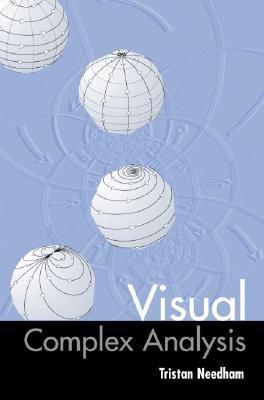
i bought this book for like $76 at borders and i think the clerk thought i was insane (i suspected i was insane.) (clerk: "woah, that's an expensive book. what's it for?" "umm... for fun? i guess...???") buying shit is weird. i know i could get it on half.com for like 18.99 or whatever, but sometimes it just seems too fucked up to do that. i want someone, somewhere, to know that someone found this book browsing in a borders and immediately forked over the cash and walked out with it. things like this have value. affirming that value is at least as important as eating lunch at Togo's every day for five days. i feel the same way about buying music and crap, so whatever.
anyway, i got it because it instantly struck me as exactly what i needed right then. what better reason? the book is just what it says, which is more radical than it maybe seems at first glance: it is a course in complex analysis that is presented exclusively, doggedly even, from the standpoint of geometry. it kindof blew my mind. it's interesting to imagine (as the author does, in his introduction) that there was a time, before our modern concepts of mathematical "rigor" were really formulated, when enormous mathematical insights often arose from physical, spatial analogy, or equally "informal" means. what's fascinating is the idea of trying to recapture that kind of direct, intuitively guided reasoning. it is certainly not a very rigorous book; most of the "proofs" are informal geometric demonstrations; but i think it does its job: it convinces the reader of the intuitive "rightness" of mathematical truths that are very, very hard for most people to grasp at all; this is a very hard thing and i am duly impressed. dr needham makes no bones about his adherence to a philosophy that sez mathematical truths are TRUTHs in an absolute sense, "capturing aspects of a robust Platonic world that is not of our making," in stark contrast to the somewhat popularized Gödelian vision of mathematics as a rickety, self-referential structure of Relative Truths, which dovetails so nicely with the pseudo-postmodern philosophical and aesthetic pablum so lovingy spewed by art students and other priveledged twentysomethings desperately trying to forget their own consequences as a part of material reality... er, oops, i'm derailing...
um, i really like this. i could never imagine that such an approach to complex analysis would make so much sense, nor proceed with such clear logic. there are LOTS of exercises, which are quite varied, often difficult, and implicitly test one's (my) powers of computation to the utmost (in case you were worried by all the pretty pictures.)
it's hard for me to summarize this stuff much better. maybe a couple sample problems:
[ch. 1]
"by considering [geometrically?] the product (2+i)(3+i), show that (pi/4) = (arctan(1/2) + arctan(1/3))."
[ch. 2]
"the mapping z->(z^3) acts on an infinitesimal shape and the image is examined. it is found that the shape has been rotated by pi, and its linear dimensions expanded by 12. where was the shape originally located? (there are 2 possibilities.)"
[ch. 10]
"show both algebraically and geometrically that the streamlines of the vector field z^2 are circles that are tangent to the real axis at the origin. explain why the same must be true of the vector field 1/(bar(z)^2)."
fun!
and of course, the illustrations are AWESOME.