Jump to ratings and reviews
Rate this book

On Being Blue

Rate this book
In a philosophical approach to color, William Gass explores man's perception of the color blue as well as its common erotic, symbolic, and emotional associations.

91 pages, Paperback

First published January 1, 1975

197 people are currently reading
8588 people want to read

About the author

William H. Gass

64 books705 followers
William Howard Gass was an American novelist, short story writer, essayist, critic, and former philosophy professor.

Gass was born in Fargo, North Dakota. Soon after his birth, his family moved to Warren, Ohio, where he attended local schools. He has described his childhood as an unhappy one, with an abusive, racist father and a passive, alcoholic mother; critics would later cite his characters as having these same qualities.

He attended Wesleyan University, then served as an Ensign in the Navy during World War II, a period he describes as perhaps the worst of his life. He earned his A.B. in philosophy from Kenyon College in 1947, then his Ph.D. in philosophy from Cornell University in 1954, where he studied under Max Black. His dissertation, "A Philosophical Investigation of Metaphor", was based on his training as a philosopher of language. In graduate school Gass read the work of Gertrude Stein, who influenced his writing experiments.

Gass taught at The College of Wooster, Purdue University, and Washington University in St. Louis, where he was a professor of philosophy (1969 - 1978) and the David May Distinguished University Professor in the Humanities (1979 - 1999). His colleagues there have included the writers Stanley Elkin, Howard Nemerov (1988 Poet Laureate of the United States), and Mona Van Duyn (1992 Poet Laureate). Since 2000, Gass has been the David May Distinguished University Professor Emeritus in the Humanities.

Earning a living for himself and his family from university teaching, Gass began to publish stories that were selected for inclusion in The Best American Short Stories of 1959, 1961, 1962, 1968 and 1980, as well as Two Hundred Years of Great American Short Stories. His first novel, Omensetter's Luck, about life in a small town in Ohio in the 1890s, was published in 1966. Critics praised his linguistic virtuosity, establishing him as an important writer of fiction. In 1968 he published In the Heart of the Heart of the Country, five stories dramatizing the theme of human isolation and the difficulty of love. Three years later Gass wrote Willie Masters' Lonesome Wife, an experimental novella illustrated with photographs and typographical constructs intended to help readers free themselves from the linear conventions of narrative. He has also published several collections of essays, including On Being Blue (1976) and Finding a Form (1996). His latest work of fiction, Cartesian Sonata and Other Novellas, was published in 1998. His work has also appeared in The Best American Essays collections of 1986, 1992, and 2000.
Gass has cited the anger he felt during his childhood as a major influence on his work, even stating that he writes "to get even." Despite his prolific output, he has said that writing is difficult for him. In fact, his epic novel The Tunnel, published in 1995, took Gass 26 years to compose. An unabridged audio version of The Tunnel was released in 2006, with Gass reading the novel himself.

When writing, Gass typically devotes enormous attention to the construction of sentences, arguing their importance as the basis of his work. His prose has been described as flashy, difficult, edgy, masterful, inventive, and musical. Steven Moore, writing in The Washington Post has called Gass "the finest prose stylist in America." Much of Gass' work is metafictional.

Gass has received many awards and honors, including grants from the Rockefeller Foundation in 1965, the Solomon R. Guggenheim Foundation in 1970. He won the Pushcart Prize awards in 1976, 1983, 1987, and 1992, and in 1994 he received the Mark Twain Award for Distinguished Contribution to the Literature of the Midwest. He has teaching awards from Purdue University and Washington University; in 1968 the Chicago Tribune Award as One of the Ten Best Teachers in the Big Ten. He was a Getty Foundation Fellow in 1991-1992. He received the Lannan Lifetime Achievement Award in 1997; and the American Book Award for The

Ratings & Reviews

What do you think?
Rate this book

Friends & Following

Create a free account to discover what your friends think of this book!

Community Reviews

5 stars
626 (30%)
4 stars
720 (35%)
3 stars
497 (24%)
2 stars
150 (7%)
1 star
51 (2%)
Displaying 1 - 30 of 317 reviews
Profile Image for Lucy Dacus.
111 reviews49k followers
March 11, 2023
This guy is absolute perv for the color blue.
Profile Image for Gregsamsa.
73 reviews412 followers
July 24, 2018
This sort of filth has no place on a book review site which could be viewed by children. The explicit obscenities that bloat this seemingly innocuous pamphlet could have no purpose other than to corrode the virtue of readers by attempting to elevate their most base and craven lusts to the sphere of fine aesthetics.

William H. Gass is an unctuous smut-peddler whose greasy grammar all but slithers across the page and up the skirts of innocent texts in his attempt to befoul all that is right and pure.

The coarsening of our culture continues unabated but Mr. Gass is unsatisfied with confining this pernicious infection to television, music, movies, magazines, and 90% of the internet; no, he must also besmirch poetry, history, a whole color, and the once-glorious rhetorical figure antanaclasis:
Contrary to those romantic myths which glorify the speech of mountain men and working people, Irish elves and Phoenician sailors, the words which in our language are worst off are the ones which the worst-off use.
On top of its casual slander of people without his sophisticated appetite for crassness, this lump of corrupted wisdom is used as an excuse to propose we expand our litany of expletives! Mr. Gass actually expresses his disappointment at there being only one , implying that our terms for sexual acts should outnumber even all Creation's avian wonders: "After all, how many kinds of birds do we distinguish?" Not content to drag Creation to his gutter, he goes for the Creator:
We have a name for the Second Coming but none for a second coming.
Apparently spattering The Deity with x-rated excreta is what passes for philosophical musings these days; thank you liberal media!

But like any Onanist with a tattered ideal in (the other) hand, Gass remains disappointed by the slack power of his beloved four-lettered friends, and makes the most perverse claim on their behalf: it is because we don't love them enough!
No, they are not well-enough loved, and the wise writer watches himself, for with so much hate inside them--in 'bang,' in 'screw,' in 'prick,' in 'piece,' in 'hump'--how can he be sure he has not been infected--by 'slit,' by 'gash'--and his skills, supreme while he's discreet, will not fail him?
How, indeed.

In this book Gass elsewhere extrudes bulkier paragraphs that make it easier to imagine the soured sweat accumulating in crescents of shine on his fevered forehead and fingers with the labor spent on pushing his perversities into the splashy packaging of effortful prose, but I abstain from quoting them for the potential impact they could have upon more impressionable readers.

I could only recommend this book to those for whom wholesomeness is a despised thing and nothing is complete until it is tarnished by the carnal. Even as he nears the end with a curiously precise and penetrating examination of the mechanics of visual perception, his penis must make an appearance (on page sixty nine no less), revealing it as the locus for the source of all his fine thought, and later as the stylus from which issues his own same fiction.

Profile Image for Kalliope.
738 reviews22 followers
February 16, 2016

When I arrived on my first year at University, we were given a copy of The Blue Book sometime during our first week. It seemed that the academic authorities did not think that this group of young men and women, in spite of having been selected for a supposedly brilliant intellectual future, really knew what they had in their bodies, nor could they read their own instincts. But it had graphics. We all kept this Blue Book half hidden amongst all the other books although we had the reassuring knowledge that everyone else had a copy as well.

When a few years later I arrived for my graduate studies to another University on another continent, for those of us who wanted to tick off from our graduation requirements our knowledge of some foreign languages, we had to then take during the first weeks our tests in translation. For those tests we were told that we had to use Blue Books.

Whaaat..?¿!¡?

This anecdote came back to my mind in reading Gass’s mental walk through Blue.

Blue Book had not translated well into Blue Book

The same term, the same language, for both a sex manual and for a booklet with lined paper to be used for university exams. Both blue and both books and the latter one for, ironically, examining abilities in transferring meaning from one language and conventions to another.

Gass’s is another Blue Book. Very much another.

Colors and languages; projections and conventions; words and correspondences; utterances and literary repertoire.

On Desires and Love: love of a person, love of sex, love of learning, chromatic love, love of language.

On perception and sensations: consciousness in colors, sounds in colors, sounds in words, on being and consciousness in words, or in colors.

What is Blue anyway? I don’t sense it as a color.

Is it a word?
Profile Image for Praj.
314 reviews899 followers
July 29, 2016

Blue lips
Blue veins
Blue, the color of the planet from far, far away..

( verse from the single- Blue Lips)

At the risk of sounding corny to the extent of being doltish; the moment I boarded on Gass’s cerulean expedition, a mystifying songstress, a certain Ms. Regina Spektor was awaiting for my arrival. In the course of her repeatedly looped melodious rendition, what Ms. Spektor was trying to elucidate to my conflicted mind was the enchantment of the colour:- Blue. The symbolic “blue lips” signifying the onset of death gazing into the contrasting pulse of “blue veins” through which the throbbing life flows. The antique colour magnifies as it covers the entire Earth, the planet that harbors the origins of life and the invisibility of death. Earth is blue, the planet on which all life-form exists. In an interview to 'The Paris Review' (July 1976), Gass had famously said:- “A word is like a schoolgirl’s room—a complete mess—so the great thing is to make out a way of seeing it all as ordered, as right, as inferred and following.” Thus, all I needed was the brilliancy of Gass, the melodies of Ms. Spektor and the grandeur of the word: - Blue; to find some order in the riotous clutter of a schoolgirl’s room.

The words sing to the miraculous transformations of the blue pigment, its magnificence illuminating through the monochromatic arrays of feelings, shape, form and art. The beauty of “blue pencils, blue noses, blue movie......” embedded in the idiosyncrasies of the allegorical blue and its blueness. “A random set of meanings has softly gathered around the word the way lint collects. The mind does that. A single word a single thought, a single thing,” , just as Plato taught ; condensing the virtue of the blue pigment into a psychosomatic and philosophical idiom, forming an artistic chorus between the domains of “seeing blue” and “being blue”.


“An author is responsible for everything that appears in his books......... claims that reality requires his depiction of the sexual, in addition to having a misguided aesthetic, he is a liar, since we shall surely see how few of his precious passages are devoted to chewing cabbage, hand-washing, sneezing, sitting on the stool, or, if you prefer, filling out forms, washing floors, cheering teams.....”

Gass emphasizes on the magnitude of language and the responsibilities yet to be paid by the readers and the authors. What is the exact notion of sexuality and where does the sex in literature assume its place? Humans are a bunch of prudes who prefer to read an erotica veiled under an umbrella of elitist ignorance and outright denigration because of the hypocritical values society places on sex, the sexual taboos and the lawful sanctimonious label that sex carries restricting the varied sexual fantasies to seek fulfillment through rogue imaginations or erotic “dirty” fictions. Fiction gives the desired autonomy to the reader what reality hampers, thus it becomes crucial on the part of the author to have substantial acumen of the sparse sexual vocabulary and desist from going overboard in augmenting the sexuality and not “continue to drain through the cunt till we reach a metaphor”. When nuances of love and fornication are written, it should be penned to induce seduction, the love of language in a lover’s amorous acts. The reader is an inquisitive creature who likes to peek through the narrowed corners of literary sentences with a pinch of suspense and so the language of a lover should not be embellished by varied metaphorical christening of animal parts for an act of penile erection. A kiss is much more seductive when laced with unparalleled sensuality than when accompanied by “weak knees” or other agonizing bodily joints. The seduction of indecency comes through the rawness of decency and unruffled compassion. Gass draws comparisons through the works of Beckett, Flaubert, Henry Miller, Rilke, Colette, De Sade, et.al; to assert the need of true sexuality as more of a literary aesthetic than some perky pornographic ordeal of horse-like wild insertion coming before an erection. And as they say, “Boys have dick and men have cock or penis”. Writing is an art and like the luminosity of the “blueness” from the various shades of the pigment, renders an unearthly experience to art; writers should not subject their words to humdrum commonality; words have their own language and solicitous properties that mirror through idiosyncratic sentences which underlines literary wisdom. Sentences that would make the reader croon as it carries the dormant imagination to the finest places and shield the virtue of fictional characters defending its stance in meticulously carved wistful paragraphs. Sentences those written by of Henry James where the artist and the language interlock into a dreamy luster. Sex in literature ought to be liberated from the opaqueness of ludicrous vocabulary that interrupts the sensuality of sex and restore the events of coitus to proper artistic proportions rather than a lousy corollary to masturbation.


“I might have said “fuck a fox”, however, the modulation of “uck” into “ox” is too sophisticated for swearing and a fox has in every way, the nobler entry. “ Fuck a trucker” is equally sound (though it tails off doggily), but the command calls for courage and so scarcely carries the same disdain.”

In order to enrich the “impoverished vocabulary and for the blueness in books to thrive at its best, Gass approaches the subject of ‘literary consciousness’. According to Gass words are “one-way mirrors” and thus if used haphazardly can induce “textual privacy” constraining the reins of a language and depriving the reader of noninterventionist console Gass thinks that words transform through meditative etymology and ontological process to form their own set of language.. Gass illustrates this panorama by enlightening a paradigm of ‘Rice Grain’. When one thinks of the word ‘rice', one perceives a meagre seed/grain which is cooked for supper. However, on occasions when the grains are symbolically used as a fertility blessing in marriages, a pious offering to God and for good luck during harvest season; the economical and plenteous rice metamorphosed into a multidimensional word that has a language of its own through its diversified usage. The prose section which I immensely enjoyed was Gass’s elucidation on “swearing” and its dramatic utterance as a part of speech. Gass’s clarifications on shouting “fuck you” equating to the frequency of ‘Ave Maria’ recitations hit too close to home. I unequivocally agree with the genius of Gass when he further elaborates that the terminology “fuck you” said during speckled temperamental episodes does not literally mean to indulge in intercourse. The word “fuck” is emancipated from its commonality expression of coitus as it alters through various phases of human dispositions. Similar transmutation properties are bestowed on the word ‘penis’ as it began its infancy journey from being a “pee pee” to an adult penile terminology. The language of words allows us to differentiate between what is said and what is actually implemented. The expression “feeling blue” is far away thought from the probability of physicality of the tinted pigment. “Fiction becomes visual by becoming verbal”; Gass supports this assertion by the magic of movies. Comparing the exaggerated acting exhibits of a silent film to the audible script filming, Gass elucidated the fundamental nature of ‘words’ and magnificence of language that along with banishing the quintessential muteness in a silent film has opened up a window exposing the residing vulnerabilities of feeble scripts and “hamming” gestures of the actors. The ‘blue’ of an emotion is no longer hidden underneath the black-white muteness, but has been precipitately uncovered by the consciousness of voyeuristic language.


“Blue as you enter it disappears. Red never does that. Every article of air might look like cobalt if we got outside ourselves to see it. The country of the blue is clear.”

When one speaks about having a “blue personality”, it veers towards a range of emotions from gloomy, friendly to honourable. Blue is an emotional colour that lives in close quarters of the heart. It finds a prominent place in literature for the very same reasons. Blue is ubiquitous; from the cell of a protoplasm to the blueprint of rigor mortis. The refraction of the blue pigments finds a eminence in the cerulean shades of the sky, the indigo of the oceanic icy waters, the passionate pages of a book, the honour badge of a soldier, the patriotic titular significance for the soluble dye, the sapphire shines through the Christ’s mantles, radiates through the surreal skin of Lord Vishnu, the blueness of a whore illuminates the lonely nights, the morbidity of disease and starvation , the sonnets from a poet’s heart rolled-down in deception and hope and shielding the burning candle flame. Being green dissipates quickly in terrains of envy, red gets scorched in its brutality, but blue penetrates through the darkest of blacks and resonates through the wholesomeness of the whites. Being blue is what the world has always known.

As impressed as I stand here, dazzled by Gass’s outstanding ability of transcending the world of language and vocabulary though the magical celebration of one solitary colour: - Blue ; I reckon it would be rather appropriate if I let Ms. Regina Spektor have the last words on this obscured renowned gem.

Blue, the most human color
(Blue Lips..)


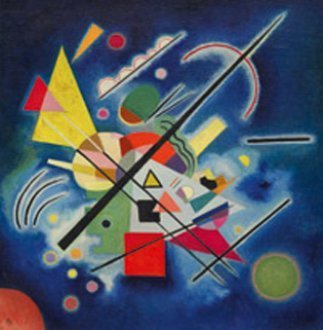
**A Kandinsky – “Blue Painting” where the equanimity of emblematic blue approaches the spirituality of art by moving itself into a personification of infinite shades.

Profile Image for elle.
372 reviews18.4k followers
June 5, 2025
a fantastic short little essay collection on the color blue. it quite literally just answers the question, what is blue? in a hundred different ways. a great companion read with maggie nelson's bluets. i love blue.
Profile Image for Chris Via.
483 reviews2,038 followers
Read
April 8, 2023
Video: https://www.youtube.com/watch?v=p105k...

========================================================
Reading note from first reading (11 December 2016):

Philosophy, philology, criticism, prosody, a mere thematic essay? All of these? None of these? What, exactly, is this book? As best I can judge, it is simply a panegyric to the splendor of language. Beyond the voluble figure-eights of the sentences, what strikes me most here, as with all of Gass's work, is his acuity for metaphor. There are tropes in here that render your mind numb with impact. Yet, at the same time, these linguistic gymnastics seem inevitable. One thinks of Yeats's poem "Adam's Curse":

I said, ‘A line will take us hours maybe;
Yet if it does not seem a moment’s thought,
Our stitching and unstitching has been naught.
Better go down upon your marrow-bones
And scrub a kitchen pavement, or break stones
Like an old pauper, in all kinds of weather;
For to articulate sweet sounds together
Is to work harder than all these, and yet
Be thought an idler by the noisy set
Of bankers, schoolmasters, and clergymen
The martyrs call the world.’
Profile Image for Rowena.
501 reviews2,771 followers
April 1, 2013
“Yellow cannot readily ingest gray. It clamors for white. But blue will swallow black like a bell swallows silence ‘to echo a grief that is hardly human.’ Because blue contracts, retreats, it is the colour of transcendence, leading us away in pursuit of the infinite.”

On second thoughts, I think this book deserves 5 stars.It consists of an amazing few chapters that examines the colour blue in everyday life, literature etc. It's quite amazing how thorough Gass is in talking about this colour, tracing back the origins of "blue" idiomatic expressions, referencing "blue" passages from famous writers such as Joyce, Rabelais and De Sade and so on.

I haven't read anything else by him but I do like his writing style a lot; it's obvious he's a fan of the English language, and his use of the language is stunning and frank at the same time.
Profile Image for Garima.
113 reviews1,984 followers
May 6, 2013

So it's true: Being without Being is blue.

First time rated a book before finishing it and that too with 5 stars. Gass is Good.
Profile Image for Nathan "N.R." Gaddis.
1,342 reviews1,654 followers
Read
August 21, 2016
On Being Blue has been composed by Michael & Winifred Bixler. The typeface is Monotype Dante, designed by the arch-typographer Giovanni Mardersteig, cut in its original version by the skilled punchcutter Charles Malin and first used in 1954. The mechanical recutting by the Monotype Corporation of this strong and elegant Renaissance design preserves the liveliness, personality, and dignity of the original. The second printing has been printed offset by Mercantile Printing Company on Ticonderoga Text Laid Finish and has been bound by Stanhope Bindery.


William Gass’ On Being Blue: A Philosophical Inquiry is a beautifully produced book, published by David R. Godine, 306 Dartmouth Street, Boston, Mass. 02116. Its boards are wrapped with an ancient blue cloth with gold lettering (author, title, publisher) on the spine, the front and back remaining blank. The dust jacket is a brown, textured paperbag with black-appearing-blue lettering and blue graphics, the title and author’s name being boxed with a narrow line inside a heavier line (both blue); an escutcheon (blue) printed between title and author; the spine of the jacket as on the cloth, black-appearing-blue ink replacing the gold; the reverse of the jacket containing an excerpt of the text, the DRG escutcheon (not the squiggle escutcheon on the front), and publisher’s name and address on Dartmouth Street in Boston. The front dust jacket flap contains text (black-appearing-blue ink) by an unidentified publicist describing Gass’ essay contained herein, whilst the rear flap announces four additional titles in the publisher’s catalogue (black-appearing-blue again). The text of the book is printed on an exquisitely textured heavy bond; sunlight shining through the pages creates a shroud-yellow luminescence, the pages on the right curling slightly upward at the exterior corners during its reading. The binding is classic craftsmanship, the signatures well sewn (Smyth) and glued with a blue and yellow-stripped headband. The signatures have been cut flush on three sides, the age of the binding, however, providing a shadow of a deckle. Inexplicably, the endsheets are brown, darker than the dust-jacket, yet lovingly textured; an indecipherable squibble on the front fly leaf may read “Gumball.” The title page presents the title of the book, sans subtitle, in blue ink, the remainder of the page and indeed the entire text is in a beautiful black ink that almost tempts the seeing of it as blue. My exemplar is of the second printing and possesses an ugly anti-theft device on the rear pastedown; a cellophane wrap provided by the antiquarian protects and grants confidence to the dust jacket. A beautiful book, this.

On page sixty two we find a possible misprint, “. . .and with the greed which rushes through them like like rain down gulleys. . .”; the repetition of “like” seems difficult to salvage. More intriguing are the possible mis-settings of type to be found on pages thirty eight and fifty seven. The initial letter of the initial word on line fifteen, page thirty eight, is raised slightly above its line, making the “i” in “it’s” jump just a bit above the right hand swerve on the lower part of the “t”. The leap of “n” on page fifty seven is a bit more interesting to the close reader. Here we read, “--there! climbing down clauses and passing through ‘and’ as it opens--there--there--we’re here! . . .” In “and” we find the “n” floating between the “a” and the “d” as if a child holding a hand each of mom and dad picks up her feet and swings between the two; the “n” with its feet rising half its height above its line. Intentional on the part of Herr Gass or the Mercantile Printing Company, it is an astonishing bit of typesetting.


“. . . the use of language like a lover . . . not the language of love, but the love of language, not matter, but meaning, not what the tongue touches, but what it forms, not lips and nipples, but nouns and verbs.”

“The worship of the word must be pagan and polytheistic.”

“It’s not the word made flesh we want in writing, in poetry and fiction, but the flesh made word.”

“The blue we bathe in is the blue we breathe. The blue we breathe, I fear, is what we want from life and only find in fiction. For the voyeur, fiction is what’s called going all the way.

“A fictional text enters consciousness so discreetly it is never seen outdoors . . . from house to house it travels like a whore . . . so even on a common carrier I can quite safely fill my thoughts with obscene adjectives and dirty verbs although the place I occupy is thigh-sided by a parson.”

“It is not simple, not a matter for amateurs, making sentences sexual; it is not easy to structure the consciousness of the reader with the real thing, to use one wonder to speak of another, until in the place of the voyeur who reads we have fashioned the reader who sings.”
Profile Image for George.
Author 20 books337 followers
October 21, 2020
“A gull's
gobbled the center,

leaving this chamber
—size of a demitasse—
open to reveal

a shocking, Giotto blue.” – Mark Doty’s “A Green Crab’s Shell”

This little blue book is described as “a philosophical approach to color” but if anything it’s a colored approach to philosophy with impeccable prose but meandering theses, not feces, though I’m told that poop can turn Prussian blue after consuming the medication Radiogardase for radioactivity, or even just an excess blunch of blueberries. And but so this book doesn’t really have much to do with blue other than an uncertain tint to the lens that hovers over ideas relating to obscenities, sex in literature, and other topics wrought obscure in part yet amusing, writing of language similar to “the deity who broke the silence of the void with speech so perfect the word ‘tree’ grew leaves and the syllables of ‘sealion’ swallowed fish.”

“Nothing moves but the intimate landscape of Patinir, a self-contained silent process which demands no attention, for the prevailing color there is blue.” – The Recognitions

Especially considering the sometimes vaguely licentious nature of Gass’ musings, he missed mentioning the blue veins in big breasts. And I don’t think he mentioned the blue-hued sky goddess Nut either, if I recall correctly. Who knew there was too much blue, did you? Though he delightfully did not forget one of the greatest blue books: “...or the emblematic blues, the color in which Joyce bound Ulysses, its title like a chain of white islands, petals shaken on a Greek sea, he thought...”

“The following things in the room were blue. The blue checks in the blue-and-black-checked shag carpet. Two of the room's six institutional-plush chairs […] two of the unsettlingly attached lamps that kept its magazines unread and neatly fanned were blue, although the two blue lamps were not the lamps attached to the two blue chairs. […] The premie violets in an asymmetrical sprig in a tennis-ball-shaped vase on the coffee-table were arguably in the blue family. And also the overenhanced blue of the wallpaper's sky, which the wallpaper scheme was fluffy cumuli arrayed patternlessly against an overenhancedly blue sky…. The sills and crosspieces of the waiting room's two windows have always been dark blue. There was a nautical-blue border of braid around the bill of Michael Pemulis's jaunty yachting cap. […] Also blue: the upper-border slices of sky in the framed informal photos of E.T.A. students that hung on the walls; the chassis of Alice Moore's Intel 972 word processor w/ modem but no cartridge-capability…” – Infinite Jest

And but so this little book has tucked into it some passion if not advice for the scrivener who would be literary king: “So to the wretched writer I should like to say that there’s one body only whose request for your caresses is not vulgar, is not unchaste, untoward, or impolite; the body of your work itself; for you must remember that your attentions will not merely celebrate a beauty but create one; that yours is a love that brings its own birth with it….” So what are you waiting for, wombless men and wombful women? Go give birth, pick up your pen and pullulate!

“Only the foolish, blinded by language’s conventions, think of fire as red or gold. Fire is blue at its melancholy rim, green in its envious heart. It may burn white, or even, in its greatest rages, black.” — Salman Rushdie’s “The Firebird’s Nest”

Allow this excerpt of a nebula-gaseous sentence of Gass’ to chloroform your inhibitions and galactify your imagination: "…blue is the color of the mind in borrow of the body; it is the color consciousness becomes when caressed; it is the dark inside of sentences, sentences which follow their own turnings inward out of sight like the whorls of a shell, and which we follow warily, as Alice after that rabbit, nervous and white, till suddenly—there! climbing down clauses and passing through ‘and’ as it opens—there—there—we’re here!…in time for tea and tantrums; such are the sentences we should like to love—the ones which love us and themselves as well—incestuous sentences—sentences which make an imaginary speaker speak the imagination loudly to the reading eye; that have a kind of orality transmogrified: not the tongue touching the genital tip, but the idea of the tongue, the thought of the tongue, word-wet to part-wet, public mouth to private, seed to speech, and speech…ah! after exclamations, groans, with order gone, disorder on the way, we subside through sentences like these, the risk of senselessness like this, to float like leaves on the restful surface of that world of words to come, and there, in peace, patiently to dream of the sensuous, imagined, and mindful Sublime."
Profile Image for Nick.
134 reviews235 followers
September 13, 2014
Gass's love of words so sincerely, beautifully and artfully expressed here in his philosophical approach to colour, language and literature. These essays he writes... these layers of thought expressed in the most conscious expanding articulation are profoundly moving and awe inspiring in style and prose. Another Gass essay to elevate my future reading experiences through altered and enhanced perception.
Profile Image for Steve.
441 reviews581 followers
Read
March 16, 2014
Under no set of circumstances would I agree to write an introduction for this essay-panegyric to the color blue and, let's admit it, to the thought/act sex ; under no set of circumstances would I want my prose to be set directly next to that of William Gass. Michael Gorra was a fool.

From the initial page-long sentence, followed by two short, percussive sentences, and then, the rhythmic cramp easing, by a more expansive sentence, and then another yet more expansive, On Being Blue announces itself to be not "A Philosophical Inquiry", but a revelling in the English language by a prose wizard. Associative, digressive, from obscure periodicals to the phrase "fuck a duck", Gass' text follows its whims and whimsies wherever they lead. And then takes us out in a two-page-long sentence of encouragement to all writers.

Encouragement to be heeded by said writers - just don't let your prose stand directly next to his. You'll be sorrrrryyyyyyyy...
Profile Image for Mala.
158 reviews197 followers
March 13, 2016

"...blue is our talisman, the center of our thought."

In real life were someone to ask you an innocuous question like: "So what's your favourite colour?", could you launch into a virtuoso performance of extracting every nuance, every flavour, every fragrance out of that colour & in the celebratory process fill it with more of these?
Forget it, cause you are not William H. Gass – you can never be him.

I'm glad that's out of the way 'cause Blue is one of my favourite colours & Gass just made me appreciate it all over again. In fact, I've never come across anyone who doesn't love this colour or at least not like it.
I'll be stumped though if you asked me my favourite shade of blue - hmm, Peacock blue, the romantic Firozi for which Aqua is such a poor substitute, French Ultramarine, Teal blue, Cornflower blue, Prussian blue, Periwinkle blue, Powder blue – they all holler for supremacy, & I love the blue on this book's cover- is that Cerulean/Tufts/Steel blue?

So, after the famous breathless opening paragraph, Gass quotes Beckett's equally famous stone sucking passage from Molloy & then metaphorically sucks on different concepts of Blue, digressing & coming back for more but unlike Molloy's sixteen stones, all of which "tasted exactly the same," Gass' bleu meditations vary considerably in content.

The opening words "blue pencils, blue noses, blue movies" soon bring his attention to the treatment of sex in literature & lead to this observation:

"An author is responsible for everything that appears in his books. If he claims that reality requires his depiction of the sexual, in addition to having a misguided aesthetic, he is a liar, since we shall surely see how few of his precious passages are devoted to chewing cabbage, hand-washing, sneezing, sitting on the stool, or, if you prefer, filling out forms, washing floors, cheering teams.Furthermore, the sexual, in most works, disrupts the form." Hmm.

But then in an obsessive way, Gass keeps returning to matters sexual ( don't get excited by the thought though cause he makes love with* words not bodies!):
"It’s not the word made flesh we want in writing, in poetry and fiction, but the flesh made word.”
And :
“It is not simple, not a matter for amateurs, making sentences sexual; it is not easy to structure the consciousness of the reader with the real thing, to use one wonder to speak of another, until in the place of the voyeur who reads we have fashioned the reader who sings.”

In other words, through the alchemy of language, the sexual act transcends both the intent and execution of titilation/ cheap gratification. There is something Proustian to that. Gass shares choice excerpts from Barth, Hawkes, and Henry James to prove his points.

As the press release from Godine's for the first hardcover edition states: "William Gass subjects the traditions of pornography and Plato to the same pen, and so reveals blue in close-packed layers: color, word, and concept. "Blue", then, becomes the state of being**."

I wish Gass had focussed more on the bluesy, existential side of this discourse: "Being without Being is blue", more of the iris and the pansy blue of melancholy, but at least, we got this:the still intenser blue of the imagination:

"blue is the color of the mind in borrow of the body; it is the color consciousness becomes when caressed; it is the dark inside of sentences, sentences which follow their own turnings inward out of sight like the whorls of a shell, and which we follow warily, as Alice after that rabbit, nervous and white, till suddenly—there! climbing down clauses and passing through 'and' as it opens—there—there—we're h e r e ! . . . in time for tea and tantrums; such are the sentences we should like to love—the ones which love us and themselves as well—incestuous sentence."

Finally, Gass takes the discourse into proper philosophical*** realm dealing with the nature of perception. I especially loved his elucidation with his blue copy of Bishop Berkeley's New Theory of Vision . In Gass, one finds a perfect combination of the writer-philosopher, something that one experiences with DFW as well but not to this extent.

Blue to me is the colour of infinity - vast, endless sky, deepest ocean. Gass told me more than I needed to know really - Blue the celestial colour is also the colour of "servitude"! No way!
We all have our emotional associations with colours - there is Joyce's famous request that "wherever Ulysses is published it have a blue cover." Whenever I close my eyes & think of blue, I see a blue peacock with its widespread gorgeous plumage dancing in the rain; I see Krishna playing his flute; his colour described as Ghanashyäm i.e. the hue of a dark cloud, I see myself as a 10-year old sneakily trying on my mom's deep blue Benarasi sari & tripping over in her high heels!, my first frosted blue eyeliner, I remember the robin's egg blue handbag that was hard to match with just any dress & sat as good as new in the cupboard- that's how these shades became an essential part of my blue colour palette.

Do read this book & see what colour-related memories it evokes for you.
Now if only Herr Gass had done a series on colours!– but at eighty plus years, the man has earned his blues.
Ps. You'll notice that I haven't praised Gass' prose even once & that is 'cause you don't state the obvious!
Gass has composed a rhapsody on blue, its etymology – blue as colour, blue as word, and blue as being; and he didn't mention even once that he loves the colour!
As I said, you don't state the obvious. Period.
* * *
* I've preferred using the less correct "make love with" 'cause it implies reciprocity as in keeping with Gass' expression: "such are the sentences we should like to love—the ones which love us and themselves as well."

**Digital Gateway Image Collections & Exhibitions | William H. Gass: The Soul Inside the Sentence : On Being Blue

http://omeka.wustl.edu/omeka/exhibits...

*** Edit: 13/3/16
Schenkenberg How has its reception seemed to you, when you hear about these people teaching it or assigning it?

Gass: Well, it’s odd. I think it’s because it was regarded, for a while, as scandalous. It was also the very thing that annoyed me about Godine that after we got this thing and saw it in print, subtitled “A Philosophical Inquiry”—I had never said that. I don’t regard it as “A Philosophical Inquiry” at all. I couldn’t stop it, really. But then people tried to make it out to be one. And there were a bunch of people who said, “That’s the way philosophy should be done!” They liked it for reasons like that. But then it had bad words in it, you know… People are funny, because in my work there’s no sex to speak of. But there are words—the words are there but the sex isn’t there. And here was a case of the words were there. But to have this called ‘a philosophical inquiry’ — I had to inform my colleagues of my problem there. But there were some who said, “Yeah, it’s about time that philosophy became.. not this cold thing, and so forth, … Gooey is what we want!” So it’s had a kind of underground life. And it’s sold more copies than any book of mine. That’s not a great lot—25,000 to 30,000 over the years.

https://medium.com/the-william-h-gass...
* *
Some gems:
Profile Image for Sanjana.
115 reviews61 followers
March 23, 2017
How did I get here?
All I wanted to do was read The Tunnel. But the ebook is unavailable and I did not want to spend 5000 12,000 bucks on a book that I am pretty sure I won't understand.

That's how I ended up picking up this little one by Gass instead.

Hadrian's review pretty much sums it up.

Absolutely loved it. The author's thoughts are scattered and I'm sure I missed a lot of the references, but I highlighted the shit out of every page. I want to read everything written by him.

someone please gift me The Tunnel
Profile Image for Liam Mulvaney.
224 reviews25 followers
March 6, 2025
William H. Gass meets the kindergarten assignment, which turns into a philosophical inquiry about the colour and being blue. Such a naughty essay! But "On Being Blue" is a masterpiece! Gass is fast becoming one of my favourite authors. His writing is distinct and complex, yet outstanding. I was engrossed in his arguments about sex in literature—just one thing. I wouldn't recommend you start reading Gass from here. I can only recommend Omensetter's Luck as it is the other book I've read by this American author. Then, after you finish the said book, read this essay. Fans of William H. Gass should give this a try. I'll read it again soon after I sit down and read Cheri by Collette.
Profile Image for Ian "Marvin" Graye.
948 reviews2,782 followers
August 17, 2016
Beware of Hagiography

When an author is regarded as a master of the sentence, it's tempting to approach all of their works with the expectation that every single sentence will be equally masterful.

In Gass' own words, we're prone to "plait flowers in [our] hero's pubic hair."

However, while a poem might strive to achieve this demanding standard, it's much more difficult for prose, whether fiction or not, to maintain it.

"On Being Blue” is divided into four parts. In the first half of part III, I started to question its merit, even to respond "so what?" It had ceased to please me.

In retrospect, this was probably when Gass’ subject matter was most familiar, his exposition most methodical and potentially least impressionistic and imaginative.

By the second half and in part IV, he pulled his inquiry together, and his prose continued to amaze.

Beware of Preconceptions

It might help to avoid some of the preconceptions that I had.

While it occasionally touches on it, "On Being Blue" is not primarily about melancholy, sadness, depression or tristesse.

It is not so much about the suffering of the Self. It is more about the relationship of the Self with its Object, with an Other, and the extent that this might be sexual.

It’s the blue in blue movies, blue stockings, the aspects of life that are described in terms of birds and bees and flowers, that are too often censored or blue-pencilled out of the blue-print for humanity or propriety.

In a sense, “On Being Blue” is a rebellion against the tendency of straight-laced white conservatism and convention to expel the blue from their midst.

Gass set himself the task of understanding how this occurs from a social, literary and philosophical point of view.

This doesn’t mean that Gass wanted to promote the writing of pornography. He is the first to acknowledge how difficult it is to write convincingly and authentically about something that is so familiar to us all.

He simply wants to win back the freedom to engage with all aspects of life in person and in literature, to return colour to what has been bleached out of life.

He urges us, "don’t find yourself clergy’d out of choir and chorus…[we must win back the freedom to] sing and say," if we’re to avoid a world where "everything is grey."

The Methodology of Blue

Gass describes five ways by which sex enters literature:

1. the direct depiction of sexual material.

2. the use of sexual words.

3. the displacement of sex from life (e.g., by indirection, symbolism, metaphor or euphemism).

4. the analogy of the “skyblue eye” that for prudes signifies insinuation, innuendo and indecency.

5. the use of language like a lover, "… not the language of love, but the love of language, not matter, but meaning, not what the tongue touches, but what it forms, not lips and nipples, but nouns and verbs."

To this discussion, Gass adds two methodological or strategic concerns:

1. three functions (or what he says a Marxist might describe as "modes of production") for blue words, which he explains in terms of the verbs use, mention and utter.

2. three motives for using blue words or material in literature from the point of view of the reader, the writer and the work itself. (In summary, they allow a reader to spy, they allow a writer to fashion a voyeur into a reader who sings, and they constitute the work itself as a body of some beauty that can be celebrated in its own right (this is a "love that brings its own birth with it" and which might effectively replace blue things with blue words).

I won't go into any detail on these seven issues, except to say that he works through them methodically, giving examples from literature, from the likes of Rabelais and personal favourite contemporaries, like John Barth, Stanley Elkin and John Hawkes.

At times, it's difficult to follow the thread or sequence of his arguments. However, the following statement is a good example of what Gass seemed to be saying:

"...sentences are copied, constructed, or created; they are uttered, mentioned or used; each says, means, implies, reveals, connects; each titillates, invites, conceals, suggests; and each is eventually either consumed or conserved…"

The Philosophy of Blue

Gass argues that the rejection of colour in general and blue in particular is a product of the philosophical opposition of an object’s essence and its qualities.

The essence is detected by reason, while qualities appeal to our senses (which are irrational):

"Reason is so swift to slander the senses that even Hume did not escape, replacing shadow, mood and music, iris and jay, with a scatter of sense impressions artificial as buttons: each distinct, inert, each intense, each in self-absorbed sufficiency and narrowly circumscribed disorder like a fistful of jelly beans tossed among orphans or an army of ants in frightened retreat."

Gass advocates ”blue for blue’s sake…praise is due blue, the preference of the bee.”

Blue contrasts domesticity with intimacy: "Let her wash her greens, I go where it’s blue." He even quotes the similarly euphonious James Joyce in "Ulysses":

"Light sob of breath Bloom sighed on the silent bluehued flowers."

Living in the Country of the Blue

As writers, Gass and Joyce allow us to get blue beneath the fictitious sheets of literature.

The blue celebrates life, and blue writing is intrinsically celebratory, if well executed:

"It is not simple, not a matter for amateurs, making sentences sexual; it is not easy to structure the consciousness of the reader with the real thing, to use one wonder to speak of another, until in the place of the voyeur who reads we have fashioned the reader who sings; but the secret lies in seeing sentences as containers of consciousness, as constructions whose purpose it is to create conceptual perceptions – blue in every area and range: emotion moving through the space of the imagination, the mind at gleeful hop and scotch, qualities, through the arrangement of relations, which seem alive within the limits they pale and redden like spanked cheeks, and thus the bodies, objects, happenings, they essentially define."

Gass ends by entrusting his book to his wife, Mary, for safekeeping, on behalf of ”all those who live in the country of the blue.”


The Preference of the Bee
[Assembled from the Words of William H. Gass]


I remember best the weed which grew between the steps...the mind at gleeful hop and scotch...she is still preparing salad at the sink...leaves like hanging lanterns...foliage like mascara'd eyes in midwink...the snicker and giggle of ink...what good is my peek at her pubic hair...martini on the tongue...cleavage for the eye... a deep blue crack as wide as any in a Roquefort...split like paper tearing...the self that in the midst of pitch and toss has slipped away...like a lucky penny fallen from a dresser...a cool flute blue tastes like deep well water drunk from a cup...a muff, a glove, a stocking, the glass a lover's lips have touched...praise is due blue, the preference of the bee…


SOUNDTRACK:

Miles Davis - "So What" [from the album "A Kind of Blue"]

https://www.youtube.com/watch?v=DEC8n...

Miles Davis & John Coltrane - "So What" [Live in 1959]

https://www.youtube.com/watch?v=x9A2b...

Lou Reed - "Pale Blue Eyes" [Live in 1998]

https://www.youtube.com/watch?v=TWFgG...

Orange Juice - "Blue Boy"

https://www.youtube.com/watch?v=0qz9U...

The Sound of Young Scotland channelling the Velvets!

Elvis Costello - "Almost Blue" [Live]

https://www.youtube.com/watch?v=Zju3l...

Joni Mitchell - "Blue"

https://www.youtube.com/watch?v=w5782...

Buffalo Springfield - "Bluebird" [Rare Long Version]

https://www.youtube.com/watch?v=55q2r...
Profile Image for Jr Bacdayan.
221 reviews2,020 followers
April 12, 2013
On Being Blue: A Philosophical Inquiry by William H. Gass is, well, a very innovative and enlightening piece of work. Mr. Gass redefines Philosophical Inquiry and in the process shames his equivalents. Actually, it is not a mere Philosophical Inquiry, it's also with a touch of Linguistic Analysis, a smear of Satirical Extravaganza, and a fine dose of the grandest prose. One can clearly see the genius that he is, based alone on his sentence construction. This book is worth reading just for the words alone, even without all the ideas. That's how good his writing is. The concept is that he examines "Blue" as a color, as a word, as a Platonic idea, and as a feeling. As a Communication student, I guess I've encountered some of his other notions, especially those concerning with Linguistics, Semantics, and Pragmatics. Yet, I'm quite amazed at how interesting he presents it. Cause my text-books contain mostly the same things yet can't hold my undivided attention. It may be partly due to him making use of very scandalous topics such as sexual material in literature and swearing or the good ole' cussing or whatever you want to call it. Partly, too, because of his mastery over the medium. But there's a fine distinction between him and the linguistic scholars that write my university text books. I utterly believe that Mr. Gass is in love with language, while the others merely study it. And that makes all the difference. There's no equivalent of a man so in-love with language, not even the best of scholars. Don't misquote me. I'm not saying that all writers are in love with language. As Gass himself states, a lot of writers write for matter, for fame, for money. But only a chosen few write for the language. And one can clearly see his passion, not only based on what he says but it is also reflected by his prose-style. So, my admiration for that man is really profound. This work is the true embodiment of what literature should be: harnessed to every bit of its potential. Language written to inform while maintaining all of its poetic beauty.
Profile Image for Rayroy.
213 reviews84 followers
August 17, 2014
Consider my mind well fucked and blown. William H. Gass understands language and literature like someone who’s immortal, who’s been studying literature since Plato was around, Gass takes words strings them together creates something grand, that is beyond what you think words can be and should do, I fear I’m too dumb to understand what “On Being Blue” means or rather it’s impossible for me to put into words what this book is about.

Blue as, the cover of Infinte Jest, or gym shorts that are colbolt, are snug along her cunt, blue laws, Orgy's cover of Blue Monday, (Beckett was blue and Gass brings up John Barth's The Sot-Weed Factor many times),Royal to Navy, Aqua to Robbins Egg, Well look my examples of blue suck read Gass's examples of Blue instead.
Profile Image for ritareadthat.
254 reviews57 followers
September 22, 2025
I have read two books recently on the color blue. The first was 𝘉𝘭𝘶𝘦𝘵𝘴 by Maggie Nelson, in which she heavily referenced 𝘖𝘯 𝘉𝘦𝘪𝘯𝘨 𝘉𝘭𝘶𝘦, which led me to pick it up. Blue has always been my favorite color; it is one that I connect with deeply. I have decided this will be a little ongoing research project for me, to read more books based on the color blue, to try to understand how different people and cultures view this color, what it means to each—how it resonates.

𝘛𝘩𝘦𝘳𝘦 𝘈𝘳𝘦 𝘙𝘪𝘷𝘦𝘳𝘴 𝘪𝘯 𝘵𝘩𝘦 𝘚𝘬𝘺, by Elif Shafak, is a historical fiction book I also read recently, which includes multiple references to lapis lazuli, a deep blue gemstone. It was revered across ancient Mesopotamia and Egypt as a symbol of royalty, power, and divinity. The lapis lazuli mines in Afghanistan are some of the oldest known, having been in operation for over 6,500 years. I reference this to corroborate blue's place in history—its reverence and sacredness are documented.

This is the first book I have read by William H. Gass; I do own 𝘐𝘯 𝘵𝘩𝘦 𝘏𝘦𝘢𝘳𝘵 𝘰𝘧 𝘵𝘩𝘦 𝘏𝘦𝘢𝘳𝘵 𝘰𝘧 𝘵𝘩𝘦 𝘊𝘰𝘶𝘯𝘵𝘳𝘺, which I would like to get to soon. 𝘖𝘯 𝘉𝘦𝘪𝘯𝘨 𝘉𝘭𝘶𝘦 was first published in 1976 to mixed reviews; some championed its uniqueness in its exploration of language and color, others found it challenging and a slog to get through.

I feel I fall somewhere in the middle of where these initial reviewers first landed. I would be amiss if I were to say that I fully understood everything I read in "On Being Blue." Gass is making connections between the color blue and many topics that may not be at the forefront of your mind. Thoughts are mostly unique and varied from person to person, yet they can bind us together into a singular collective. Gass illustrates that there are an abundance of ways that we can relate to the color blue. It is woven through history, through our moods and feelings, and through our sexuality. Understanding sexuality and attempting to put words to that which is mostly instinct and feeling are a large part of this essay. To illustrate certain points, he turns an eye on works by the authors Samuel Beckett, Virginia Woolf, Collette, John Barth, James Joyce, and Henry James, as well as paintings by Jackson Pollack and Pablo Picasso. He weaves blue through all of it. Snippets of meaning are extricated here and there.

He is sussing out intricacies of language, with a topic of interest to him—sexuality—which he feels harbors a misspoken, or easily misunderstood, place in language. I felt like some of this was a stretch, but I do agree with many of the concepts and musings he presented. Sexual undertones were present in many of Gass' works.

Gass lists and lists. There are whole paragraphs and pages dedicated to them. He opens the book with a list—which was, I believe, an excellent attention grab—of everyday things that are blue (see carousel slide). On pages 59-60 he lists almost every conceivable shade of the color blue. I enjoyed these and feel that the listing showed the depth of blue's connection in the world around us. On pages 75-76 he lists blue's emotional range in comparison to other colors and why he feels it is the obvious choice compared to the others.

Clocking in at around 90 pages, there is a lot to chew on. I did enjoy reading this; if you aren't one to appreciate philosophy, then maybe rethink this as a choice for you. I believe that this is a book that will age like fine wine—becoming more appealing the more times that it is read. Just going back over my notes to write this review, I was reprocessing things that I didn't quite understand fully the first time I read them. Word of caution, lol, don't read this when you are sleepy or don't have time to process. It definitely needs your full attentiveness. - 9/22/25


7/31/25
4.25 stars
Loved. So many thoughts. Let's talk about the color blue, and sex, and language and art and philosophy. I'll be back around to do that soon.
Profile Image for Maru Kun.
223 reviews573 followers
August 16, 2018
Is it about blue? Is it about philosophy? Is it about meaning? Is it about sex? Is it about all of these things or none of them or something else entirely? I'm still not sure. The first sentence was great; the rest, not so. I know there is a lot to say about the colour blue and now I'm blue that this book said so little.

I will console myself with this brilliant BBC documentary: A History of Art in Three Colors, Episode 2: Blue which I would recommend to anyone with even a passing interest in art or history or the colour blue, it's that good.
Profile Image for Andrew.
2,258 reviews928 followers
Read
February 23, 2015
I can't be the only one who thought of Tobias Funke when I read the first few pages.
OK, got that out of the way.

Gass has written a dense and allusive little thing that reminds me, if it reminds me of anything, of the finest aesthetic essays of Susan Sontag, Junichiro Tanizaki, Juhani Pallasmaa, and Elaine Scarry. Only with more fucks. Way more fucks. And I don't mean "fucks given," as the kids are saying these days, but actual penises and vaginas. I'd thought that when he was considering all things blue, his focus would be on melancholy, but nope, he went for the fucks. Not what I was expecting, but entertaining as all hell, even if I felt like covering up the page when I was reading on the subway.
Profile Image for Kyle Fulford.
18 reviews38 followers
September 3, 2024
Extremely poetic study on sex, emotion, symbolism, and semantics — Gass obsesses over the ways in which language can evoke all of the above with a heavy emphasis on color and its abstract (but universally recognized) implications. A love letter to lyricism and the conscious artist.
Profile Image for Tony Vacation.
423 reviews341 followers
September 9, 2014
As always, Billie G. writes next to nothing but five-star sentences, and On Being Blue has plenty of syntactical heartthrobbers ornamentally arranged throughout its slender page count. Gass seeks to do as he always does in his works, and that is to champion the melodious possibilities of the sentence. This book is at its best when Gass poetically ponders on the usage and intended/unintended meanings of dirty words, and how dirty words need to be more loved by readers and writers so that they can deliver a full-scale of fleshy resonance on the page. As unendingly pretty as the prose is, Billie G. lost me a bit in the latter pages with his obfuscated meanderings on philosophical meaning (the purple turn of phrases here don't exactly engender clarity). But nonetheless, a Gass is always a gas worth having, and this book certainly is as alluring as the blue lady on the cover.
Profile Image for Speranza.
141 reviews132 followers
October 10, 2015
Please excuse my French, but reading this book felt like watching Gass trying to impotently force himself onto something he couldn’t see. In the dead of night, in the dead of all colour.

So his victim happened to be the blue of this world. He tried to perform on it all obscene acts one can think of - he tried to rape and then to caress it; he tried to kill and dissect it; he tried to revive and glorify it. I think he just tried to prove to himself how great of a mind he is and blue just happened to accidentally stumble upon his path.

Now, I suspect it might be me being not clever, not literate and not sophisticated enough to understand the genius of Gass. But one thing I am for sure (and I have been it all my life) – blue - and just having been violated by this man's handsome mind, I feel like blue is definitely not his colour.
Profile Image for Roxane.
Author 130 books168k followers
September 16, 2012
An excellent meditation on writing sex. Very, very smart.
Profile Image for Jenna.
Author 12 books365 followers
July 4, 2015
There's no question that Gass has a first-class writing style, equal parts goofy and lyrical. Like Shakespeare, Gass takes boyish pleasure in filling a page with an effervescent mixture of bawdiness and wordplay, gilding it all with a sophistication of style that completely shields him from any potential accusations of being (gasp!) "lowbrow." He has a profound learnedness, a deep and intimate familiarity with English literature, that is rather reminiscent of James Wood. Like Wood, Gass strews his prose with rather obscure quotations from literary texts -- the B-sides of literature, so to speak -- in a way that makes his readers hungry to dash to the nearest library and devour those texts that he references so lovingly. Gass effuses. He cavorts. He ejaculates all over the page. In short, I should have enjoyed this book more than I did. It was the logical-scientific part of my mind that hindered me: I ultimately wanted Gass's arguments to be clearer, easier to follow, and more substantial than just "Writing about sex is hard to do."
Profile Image for Crito.
315 reviews93 followers
February 23, 2018
The attraction is the acute and near constant faculty of observation which Gass exercises. While you can summarize the main interest of the essay, it isn't thesis driven. This throws out the "philosophical inquiry" charge its subtitle touts, since it falls far more strongly on the side of literary criticism which is Gass' actual bread and butter. It's in the critical side where Gass can indulge in observation, and he's well aware that his strengths lie in his indulgences. The section on sexuality in particular is itself an indulgent digression — I am not yet convinced of the "blueness" of sex — but not only is he remarkably attuned to the textures of the text, he also makes both cogent and entertaining the literary struggle of closing the gap between reality's commonplaces and contradictions, and the ways we're even supposed to represent it on the page. This may not be the first place to go if you want to get into his critical work given its seeming amorphousness (he's like this in his shorter essays too even though the length keeps him more leashed), but it's still a good sample of his raw critical faculties at work.
191 reviews11 followers
March 8, 2015
An inquiry into color in general and blue specifically, with regard to how it relates to perception, emotion, sexuality. Very interesting. It also highlights in part strengths of writing, how subtle good writing can be versus the blunt laziness that characterizes poor writing.
Displaying 1 - 30 of 317 reviews

Can't find what you're looking for?

Get help and learn more about the design.