A sweeping, romantic saga of two noble families and their intertwined destiny, and a panoramic portrait of Russian society at the time of the Napoleonic Wars, Tolstoy's unforgettable masterpiece has inspired love and devotion in its readers for generations.
Now read the original version of Russia's most famous novel, which never made it to publication in Tolstoy's lifetime. Undiscovered for more than a century, this edition—with its subtly different characters, dialogue, and ending—is essential reading for devotees of Tolstoy and new readers alike: it is world-class fiction in its most vivid and vital form.
Lev Nikolayevich Tolstoy (Russian: Лев Николаевич Толстой; most appropriately used Liev Tolstoy; commonly Leo Tolstoy in Anglophone countries) was a Russian writer who primarily wrote novels and short stories. Later in life, he also wrote plays and essays. His two most famous works, the novels War and Peace and Anna Karenina, are acknowledged as two of the greatest novels of all time and a pinnacle of realist fiction. Many consider Tolstoy to have been one of the world's greatest novelists. Tolstoy is equally known for his complicated and paradoxical persona and for his extreme moralistic and ascetic views, which he adopted after a moral crisis and spiritual awakening in the 1870s, after which he also became noted as a moral thinker and social reformer.
His literal interpretation of the ethical teachings of Jesus, centering on the Sermon on the Mount, caused him in later life to become a fervent Christian anarchist and anarcho-pacifist. His ideas on nonviolent resistance, expressed in such works as The Kingdom of God Is Within You, were to have a profound impact on such pivotal twentieth-century figures as Mohandas Gandhi and Martin Luther King, Jr.
The 1st part is much better & more comprehensive characterizations than the last part. The 1st section caused me to question whether Tolstoy was going to take Dostoevsky’s 1st place as my favorite author. The 2nd 1/2 resolved that dilemma for me. I think Dostoevsky still holds the crown. But I know Tolstoy has the capability. Maybe after I read the actual W&P novel, I’ll change my mind?
I finally finished it! Wahoo! And actually, it was much much much more enjoyable than I ever imagined it could be. I really love the way Tolstoy sees life lessons and bits of human nature in all the world around him. His analogies and comparisons, that often began a chapter, while very verbose, were also poignantly memorable. Particularly the one about the beehive without it's queen. That one really stuck with me. And it's fascinating how human nature remains so consistent through time. Though on a completely different continent, in a completely different era, his insights still rang true.
I really liked the way the characters stretched and grew and changed. You followed them for so long, you didn't just see them grow linearly, but more like the way a plant grows, with different branches sprouting off in different directions, changing, dying, and then new growth appearing elsewhere, but always reaching towards the sky.
My one hang-up was the last 20-30 pages. It seems like perhaps he ran out of story to go with his philosophy, so just decided to throw the rest in at the end anyway. I had to read it out loud to get through it (my husband insisted that I couldn't quit the 1450 page book, 20 pages from the end). But once I was reading it out loud, I was able to pick out the meaning and the points he was trying to make and did enjoy it somewhat. But perhaps, he needed a better editor :)
All in all, I surprise myself by saying, I do want to read it again someday. Next time I will get my own copy and read it with a pencil in hand to mark my favorite passages and insights into this strange thing we call life.
Soooo, it turns out that if you’re reading War and Peace because you love the musical Natasha and Pierre and the Great Comet of 1812, this is totally NOT the version of War and Peace you want to read. I really should have done more research before buying. I’d picked up the book on a whim a few months ago, but didn’t notice until I started reading it recently that the cover said Original Version. Turns out that Tolstoy added and changed a fair bit of content when he revised War and Peace, so the section that coincides with The Great Comet musical is very different than later versions.
Abandoning this...found myself a translation of a later version of War and Peace. I will finish this book...just not this particular version.
Set more than 200 years ago in the early 1800’s, War and Peace is a novel about two Russian families whose lives are interspersed with war (the Napoleonic wars and Russia’s military response) and peace (mostly about love & marriage among Russian high society). As a novel the book is written exceptionally well, with the characters brought to life and their inner hopes and fears revealed. Beyond that, we get to learn about military and family life as it was for the Russian nobility in that historical period. Despite their great wealth, 19C Russian aristocrats could not avail themselves of 20C technologies such as the telephone or motorcar. If they wanted to get in touch with anyone they had to pen a letter, send it out, and wait a long time for a reply. The book contains many such letters and they are wonderful to read both as literary works and as a reminder of how things were not so long ago. Letters are a lot more thoughtful and reflective than the writing one encounters today over email and social media. And medicine, despite the means to pay for the best doctors in Europe, did not include penicillin or vaccinations. Childbirth, an infected wound, or typhoid often meant death. The wartime hospitals full of wounded soldiers were appalling places, with death mercifully brought on by outbreaks of typhoid fever. Marriage was a big deal for Russian high society and its prospect and orchestration consumed a lot of energy for Tolstoy’s characters. Young women didn’t date; they simply had “admirers” who visited their homes and spent time with their family. The women were forced to wait nervously as their fate and future hung on whether their hand was formally requested by their chosen suitor. Thus, the society was influenced, much more than ours is today, by a sense of propriety. Duty, honour and virtue had primacy in governing life and relationships, as the following passage about Prince Andrei makes clear: “What else could he do? Flee from the army like a coward to try to help his loved ones but avoiding danger and deserting his duty, or seek death in the obscure ranks of the army, doing his duty and defending the fatherland. Yes, he had to choose the latter. Duty and death.” Or this passage in which another character, Pierre, considers his situation after marrying the stunning but shallow Helene: “I hate and despise this woman. And I am bound to her for ever, like a convict bound by a chain with the ball of honour and reputation attached to it, and I bind her too”. For all the differences of life in 19C Russia – technological, economic, cultural – the struggles of Tolstoy’s characters, brought to life so beautifully by his writing, highlight the aspects of human nature that have persisted throughout the ages. The desire to lead a good life, to overcome our worst impulses and desires, to find love. These are the universals that transcend culture and milieu. One of the major themes of the novel is free will and the extent to which our actions are freely chosen as they seem to be, or are the inexorable result of so many pre-determined forces and laws. Tolstoy is fascinated by the role of Napoleon and other leaders and is convinced that history overplays them. Tolstoy's central insights about war include these: - Despite the best laid plans of military or regiment commanders, battles unfold on the front lines as no one could have predicted or choreographed - Heroism and military honours are mostly undeserved; the truth of a battle is nowhere to be found in the retelling's which are after-the-fact stories we make up - Despite the exalted role ascribed to commanders the truth is that they could not have acted otherwise
“we see this event as an inevitable phenomenon that could not have been produced by the wills of the individuals Kutuzov and Napoleon, and in which their wills played no more part than the will of each soldier, an event that these generals not only did not create, they did not foresee it, they did not control it and they did not understand it. As is always the case in war, their actions – the actions of these geniuses – were as meaningless as the actions of that soldier who fired point-blank at another foreign, soldier he did not know”.
- The higher one is in the human hierarchy the less free will is exercised and the more one is trapped in the ‘treadmill of human history’. - Tolstoy takes a dim view of war. He points out the great irony of decorating and honouring the military when war is a euphemism for mass murder - Tolstoy understands that humans are story-tellers and that our minds create rational sounding explanations in the way that a mad man can perfectly explain any event; nothing surprises him because his theories are adaptable enough to accommodate whatever transpires - We cherry pick from history the points that, though hardly salient for the actors at that moment, connect the dots in the story we are telling to explain the outcome
Consider that identifying and testing for human cognitive biases has only recently resulted in the burgeoning field of behavioral economics with accompanying Nobel prizes. In this context, it is humbling to consider how deeply Tolstoy understood these phenomena, and more generally human nature, over 150 years ago.
I did it! I've finally read “War and Peace”! I thought I’d do something different on my recent beach vacation, and tackle a thick classic instead of the usual light thriller or chicklit. I’ve been meaning to read it forever, and we ended up spending two full weeks together, on buses, trains, planes and the beach, even my lunch break back at work!
I grew attached to the characters, and it was interesting to see them evolve. The rich psychological descriptions make them very real. It was hard to keep track of all of them, though, as there were so many! But I used the same tactic as I use when reading George R.R. Martin’s “Song of Ice and Fire” books – I picked those that interested me most and focussed on them, and skimmed through the parts about the others. I also skimmed through the tedious parts about the actual war. I know, I know, the book is all about how the war affects the characters’ lives, but frankly, you don’t need to know the minute details of what happens on the battlefield to understand how it affects them. So overall I’d say it was an average read – some parts I really, really enjoyed, while some others bored me. From this author, I preferred “Anna Karenina”.
Also, I realized halfway through that this version of the book is an early version, and not the most common one, so that there are slight differences in the characters and ending, but still. I’ve read it all!!! Yay me!
god!! this book was such a rollercoaster...everything that's vaguely gay in the canon version is 10x gayer in here (nikolai is straight up in love with dolokhov and andrei and pierre get compared to orestes and pylades). it's definitely a first draft and the pacing goes off the rails towards the end but my god! andrei survives his wound at borodino and it's left very ambiguous who marries natasha (him or pierre) which is like. The andrierretasha good ending i suppose. i LOVED reading this and it's given me a new perspective on the canon version
This entire review has been hidden because of spoilers.
Heroes and Heroines or Failures and Fools… or both?
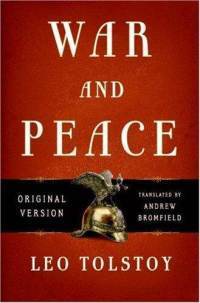
I guess the first responsibility one has in writing a review of War and Peace is to be clear about what version is being reviewed. My review concerns, War and Peace: Original Version, translated by Andrew Bromfield, Paperback, 912 pages, Published September 1st 2008 by Harper Perennial. The 912 pages is short by most standards (Goodreads.com shows 383 editions and the lengths of some of these editions can run into several thousands of pages, divided into multiple books). The most common versions read by English readers run something less than 1500 pages, I believe.
Whew, I'm glad that part's over! It's all quite relevant, I'm sure, on the one hand, which edition/version we're talking about and yet on the other, perhaps not so much so. There are the issues of a "happy ending" or not, philosophical "fill" or not, etc. Leave it to the Tolstoy geeks, I'm sorry. It's not the only good story in the world and, great as he was/is, he's not the only great writer in the world. I don't personally see how saying that detracts anything from his greatness or the novel's greatness.
So let me begin by saying, It's a great novel. I felt a strong sense of loss when I finished it. It had become a friend over the nearly five months that I was reading it (I'm a slow reader and I have a very busy life and I was reading other books simultaneously).
I must say that if I hadn't been coming into it with the expectation of it being a great novel, I may have abandoned it early on. Those glamorous society parlor soirees, full of gossip and all manner of arrogant types of conversation would have done me in. The fact that the author was obviously critically mocking the characters didn't help much. I think that when it was written, such authorial mockery may have served an important purpose and been quite entertaining, as well, but we've had such a diet of it over the years of my life that I now find it quite boring and repugnant—the stuff of soap operas. Still, I cannot deny, Tolstoy was a master of minute observation and when the stuff of his writing is sincere, I was in constant admiration of that ability.
My other problem with the novel was the fact that it was written from the point of view of privileged society in the first place. My Australian Goodreads friend Laurel sent me her thoughts: "With Tolstoy's two great books, Anna Karina and War and Peace, he very much writes about family life. You feel as if you know the families concerned. For me, it is his greatest achievement." I could not help but agree with her about the contribution regarding family, but it's just a personal thing with me: I'm not often fascinated by the family doings of the rich and famous. So when I remarked that I was likely to remain a bigger Dostoevsky fan, that was perhaps the reason. Personally, I am a product of middle class America. From that starting point, in the board game of life, I have occasionally travelled through the slums and the low places of those without "opportunity" as it is usually called, and I have, in turn, traversed, on other occasions, the high roads and visited the lofty nests of the well-to-do. There are good and bad people in all walks, and I'm not comfortable anywhere, but certainly not in the lap of luxury.
I think the greatest delight in reading War and Peace is that the reader is always kept guessing as to the quality of a character's character, so to speak. My favorite one, Pierre is a perfect case in point. For some time I thought that he was the only character with character. Later, I became convinced that the same was true of Prince Andrei. Up and down I was thrown and plunged through my identification with individual personalities. Whether it was in terms of family relations, or those of friends and peers, or those uniquely military or nationalistic, the story always had me going, pulling for this character or that, despairing in his or her shortcomings and reveling in that same one's transcendence.
The war scenes, though relatively brief, are very powerful. Ultimately, War and Peace is an anti-war novel. I think it's also a pro-Russia novel; I mean to say a work that revels in the character of the pre-socialist Russia. But it seems so ironic that Tolstoy freely expresses this love of country while he relentlessly mocks every one of his own characters and the entire Russian mentality. He openly portrays the Russian military organism, from the beloved sovereign to the generals to the foot soldiers, as absolutely clueless. He places no value whatsoever on the genius of anyone in command (not even Napolean, the enemy's great emperor hero who is widely acclaimed, even today as a military genius). The business of war, the author sees as baseless murder, yet the business of peace he seems to see as ridiculous comedy.
There is really one primary question that I have, and I think the reader must decide for her/himself: are there any heroines/heroes in this great sprawling and endearing epic? I believe there are only three characters who genuinely concern themselves with any higher, spiritual questions or pursuits in their lives; how those questions or pursuits are resolved is, to me, part of the same primary question.
I do highly recommend War and Peace. I think it will be a joy to discuss it with others—a joy one won't be able to relate to unless one reads it.
[previously, in a progress report]
I said before that it starts slow and gets better and better. That's still true, but I'm not sure what my final analysis is going to be. It will be good, but I'm pretty sure I'll still be more of a Dostoevsky fan.
I waver between a 3- & 4-star rating. Regardless, this should be on your TBR list.
Since I can't find the version from Sterling Publishing released by Barnes & Noble, this has the closest page count. There's no doubt this is a classic piece of work. However, if you're not inclined or in the mood for a socio-philosophical perspective of what ails the thinking of humans, particularly in the context of why we go to war, then you may not enjoy this work of historical fiction. I couldn't get through the 2nd epilogue. Some of his philosophy is scattered about in the main body of work. Here, again, I may have found it more interesting or compelling at another point in my life.
Tolstoy spares no stone unturned in his characterizations of his many complex and Volo characters. This is a book that will not only fancy your imagination with the most Volo narrative but in the same token offsets a profound as deep as the deepest ocean analysis of that is it that makes countries and its citizenry wage wars with one another. If you need a lesson on war this is the definitive book. The near novel I ever read. - Raymond Espedido from Manila Philippines 🇵🇭
I purchased War and Peace-Original Version by Leo Tolstoy at a Books-a-Million in St. Louis for $7 and started reading it back in August. It has been a hard read but there is much of it that I have enjoyed. Sitting at just below 900 pages though I would hardly call it a summer read! Oddly enough by purchasing the original version I may have been in error as I discovered it differs slightly from the "normal" version in several ways possibly even in the ending so for those who have read the original I would love to hear if you find any glaring differences as I review it. I shocked several people by choosing this book to read, but I am a huge fan of Dostoyevsky and I wanted to know whether this meant I was a fan of Russian literature. I decided to tackle War and Peace despite a few misgivings, because honestly, I just was not interested in Anna Karenina.
First and formost the main thing that stuck out to me as I read was that I enjoyed the "Peace" parts far more than the "War". This may be the main difference between a female reader and a male reader...or it might just be me who despises war.
The other thing I noted as I read this book is that Tolstoy seems to be very fatalistic. In writing about war he states several times that individuals do not shape history but the collective conscience does. He also talks about how things happen as they should and that they unfold regardless of people's intentions. Here is a quote near the end of the book:
"everything that happens in a matter in which many people act together does not happen according to these people's will, but according to various zoological laws. and it is not given to man to foresee their outcome."
And earlier in the book:
"Fatalism is as rational in history as it is irrational in the individual. It is no accident that Solomon's saying- ' the kings heart is in God's hand' - became proverbial"
Tolstoy appears to believe that individuals have freedom of choice, but that freedom diminishes when you gather together large groups or people. It also decreases in direct proportion to the level of power and authority that you have. In this way, Tolstoy believe that Napolean was only acting on behalf of the people and not the monster that some people of his time made him out to be.
In comparison to Dostoyevsky I would say that I find Tolstoy's writing more contrived. Dostoyevsky writes of life amidst the poor class of society and deals with the root causes of dark human issues murder, jealousy, guilt etc. Tolstoy on the other hand focuses more on upper class society and attempting to find the meaning of life amidst all of the chaos and confusion in the world. Although Tolstoy's topic is lofty and he points to God in several passages of his book I find that his philosophizing does not feel as genuine as some of Dostoyevsky's writings. That being said, I do enjoy much of what he has to say about God and the meaning of life.
"Love, compassion for one's brothers, for those who love and hate us, yes, the love that was taught by God on earth, that Princess Marya tried to teach me-that is waht would remain to me if I were to live" ~Prince Andrei
"But for me, even now when I am dying, there is nothing certain in all this except for the pettiness of all that I understand and the greatness of something else, something incomprehensible but supremely important"
And Pierre, a passionate, but bumbling man who doesn't understand a lot (but lives passionately much like Peter of the bible) says, "Yes, my friend...there is a God in heaven and good on earth"
I did fall in love with characters who came to life and leapt off the page, but I had a hard time keeping track of a few of them, because there are many people throughout the book (much like in Dickens' novels). Some of my favorites include Princess Marya a young single girl who lives with her father and longs to get married, Prince Andrei, her brother who loses his young wife in child birth and struggles with the meaning of life and Pierre the passionate bumbling idiot who society laughs at but finds amusing.
Although this book is long, and parts of it are hard to read I would recommend it to others. I would, however, recommend reading another lighter book at the same time though to balance the heaviness of this one.
War and Peace is one of those books you read just to say you've read it. I listened to the audiobook version of this. It definitely could have dealt with being shorter and the eight 'book' is definitely the strongest. The second conclusion is a little too 'preachy' and definitely skipable if you want to end on a stronger conclusion. It's definitely readable and the language isn't too difficult compared to other 'classics' I've read.
It probably lost another star because I wasn't a fan of some of the narrators of the audiobook but that's definitely a 'me' issue.
I attempted to read it, oh how I tried! I got to page 100 or so and that was it. I didn't care for any of the characters, got lost as to who was who. Screw it! I have no time for tomes of this type. It's beyond me why it's considered a classic. From what I've read it doesn't get any better. Thanks Tolstoy, but no thanks! My time on earth is limited and have no time or the patience to wait 600 pages until something 'interesting' happens.
My edition was in five small blue-covered volumes, which I think may have been my mother's. And I remember the paper was rather thin, so the long story would fit in five volumes convenient for holding and reading. This was just after the World War II experience, so I may have been prompted to read this long story as I returned home from serving in the Army. Because of its length and grand complexity, I'd not recommend it to others unless they with to read a classic of Russian writing.
Seemed to be 95% development and 5% resolution which was too quick for me. I would have preferred ~ 80%/20%. With so many characters (each seemed to have three names and to be called by slightly different names at times) it was difficult to keep track of everyone. This was the Bromfield translation of the original unpublished version which doesn't kill off as many characters as more common versions.
Antes de mais nada, esse livro não existe na mesma escala de mtos outros. Ele recebe um quatro na escala dele
O livro é excelente e todo mundo deveria ler, e viver esses personagens. me convence muito da ideia de que livros, ficção complexa, são uma tecnologia em si. Viver o que o Pierre, o Andrei, a Natasha, a Hélène, a Maria e tanto outros vivem enriquece minha vida e me permite Mais Os epilogos são um acidente infeliz. Sem eles, seria um 5/5 fácil
Woohoo! I finally finished the mega novel! Here are a few thoughts: 1) Tolstoy's epic shows the need/justification for the Russian revolution- even though it is anti-war; 2) Tolstoy is amazing at capturing the subtleties if human nature; 3) what happens to Sonya?!?!?!
I have always been intimidated by War & Peace. What I found was that it feels like light reading. Tolstoy is such a graceful story teller that all his ideas just seem to come naturally and with no stress for the reader. You should read it just to say you did.