Murder of Quality John le Carré's classic novels deftly navigate readers through the intricate shadow worlds of international esionage with unsurpassed skill and knowledge, and have earned him -- and his hero, British secret Service Agent George Smiley -- unprecedented worldwide acclaim. George Smiley was simply doing a favor for Miss Ailsa Brimley, and old friend and editor of a small newspaper. Miss Brimley had received a letter from a worried "I'm not mad. And I know my husbad is trying to kill me." But the letter had arrived too it's scribe, the wife of an assistant master at the distinguished Carne School, was already dead. So George Smiley went to Carne to listen, ask questions, and think. And to uncover, layer by layer, the complex network of skeletons and hatreds that comprised that little English institution. Call for the Dead It was less an interview than an amiable conversation over a walk in the park. George Smiley had been sent to speak to a high-ranking civil servant after an anonymous tip-off that he was a security risk. It was a formality -- and the two men liked each other. Why then, did it apparently drive the poor man to despair? And why was he found dead the next day, the victim of an unnecessary suicide? Call for the Dead launched John le Carré's unparalleled career as a novelist, and introduces one of fiction's most famous spies -- George Smiley, who is both brilliant and unremarkable.
John le Carré, the pseudonym of David John Moore Cornwell (born 19 October 1931 in Poole, Dorset, England), was an English author of espionage novels. Le Carré had resided in St Buryan, Cornwall, Great Britain, for more than 40 years, where he owned a mile of cliff close to Land's End.
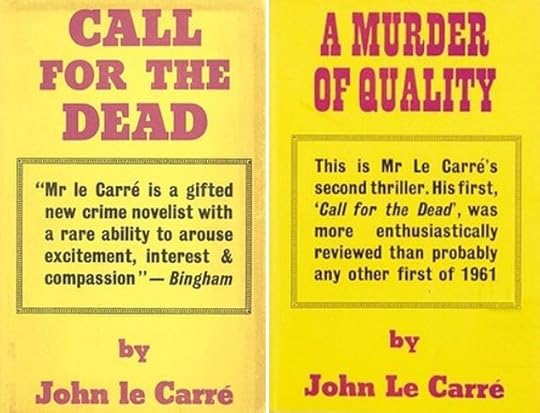
The front covers of the first two George Smiley novels as published by Gollancz in 1961 and 1962. Images sourced from Wikipedia.
This was an oddity which I noticed as a Kindle Deal of the Day back in January 2025 and picked up out of curiosity. It was a reprint of an edition first released to cash in on the breakthrough success of The Spy Who Came in from the Cold (1963) by bundling the lesser known first two John Le Carré - George Smiley novels (which separately were really more novella length).
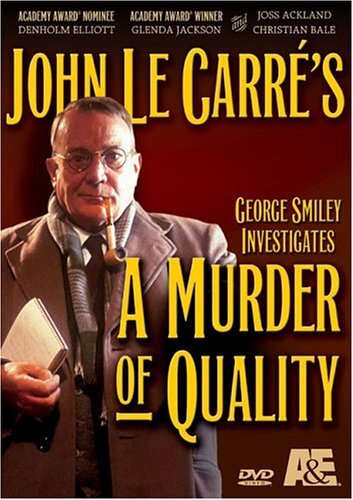
Denholm Elliott as George Smiley in the TV movie adaptation of A Murder of Quality (1991). Image sourced from Double O Section Blogspot.
I've read both of these several times over the years and reviewed them as Smiley Begins and Smiley on the Case shortly after Carré's passing in 2000.
The oddity about this omnibus is that it prints the second book A Murder of Quality first and then follows it with the first book Call for the Dead. It makes sense in that #2 is more of a murder mystery and #1 is more of a spy novel (although it begins with a mysterious death). So the path progresses gradually into the espionage which is in the forefront of the books that followed.
Both of these were still a pleasure to re-read, especially for the character portrait of George Smiley and for the introduction of characters such as Peter Guillam and Inspector Mendel who would play further roles in the later Smiley novels.
Trivia and Link It was recently announced that the next major film adaptation by the production company The Ink Factory (run by the Carré/Cornwell family) would be a TV-series based on the John Le Carré novel A Legacy of Spies (2017), which admittedly I didn't enjoy when I read it due to its revisionist version of past events. A further Smiley on screen is still to be welcomed, although Matthew MacFadyen doesn't immediately strike me as the Smiley type. As that book looks back on past events and characters, it is possible that events from Call for the Dead will be mentioned in the TV-adaptation.
I was one of the lucky ones - not reading a Biggles book until quite recently. Biggles was the xenophobic, misogynistic hero of numerous books by someone called Capt. W. E. Johns and he was forever crouched over an ops table or fighting savages in some far -flung part of the British Empire between the wars. Reading this early Le Carre ( the author was 30 when it was published) evokes memories of Biggles. Spies George Smiley and Peter Guillam join forces with an Inspector Mendel in an awkward little whodunnit involving the death of a spy. and not a desirable woman in sight. Smiley's fat and brilliant and the other two are what they are. The writing shows promise of what is to come but the long ending is like reading this (still short) novel all over again.
Le Carre's work is such a comfort. Cleanly written and intelligent, he makes the world seem orderly, comprehensible. I liked the spy novel in this collection better than the murder mystery but wasn't sad I read either.
The first novel, Call for the Dead, was interesting, if only to see the origins of the George Smiley character, and a brief introduction to the Circus. His second novel, A Murder of Quality, seemed ready to launch Smiley, recently retired from spydom, as a casual investigator. It makes you very grateful that le Carré abandoned this line of thinking. It's not a very satisfying novel.
Narrated by Ralph Coshan Call for the dead A younger middle aged George Smiley investigates the apparent suicide of a colleague. The first chapter is an introduction to George giving a brief history of his past and his beginning workings of service, including his meeting and marriage to Lady Ann. Then the novel moves into a case of a dead agent, desk doesn’t care and George resigns. Shenanigans ensue, Smiley gets sucked into an international mess, we meet Mounts- for I think first time chronologically- but read out of order so not. Smiley enlists the help of newly retired policeman and that was fun to see the different approaches to crime solving. This one is sad from human interest pov. Sloppy spies, smart wives, cross double cross. Really quite good. 5 stars.
And A Murder if Quality narrated by Jayston Smiley gets called from a war acquaintance , Elsa Brimley, the editor of a small paper, regarding a patron who is a feared for her life. A teachers wife at fictional Karn school where George has a contact. He contacts his friend and finding that the woman has been murdered he hustles up to help. Brim stays home helping from the side lines. A police inspector working for an incompetent buffoon, snide under the guise of propriety and competitive instructors George soon integrates himself into the schools culture . The book really revels the ugly petty side of school masters, but other wise is kind of a fun romp for Smiley away from his usual immersions. I enjoyed it listened sometimes intently sometimes just as background.4 stars.
According to the introductory comments in the edition I read, these are the first two books that Mr. Le Carre published. The first book, Call for the Dead, is a 5-star read. Intriguing with good pacing, Mr. Le Carre advances the story with believable characters and spot-on dialogue. The second book, A Murder of Quality, is a 3-star story. The ending is really good, nearly enough to deserve increasing my rating to four stars, but most of the book drags along with meandering dialogue and vignettes that stretch on far too long. But the ending, wow! It is a fine ending, to be sure.
Mr. Le Carre created a marvelous character when he introduced George Smiley. He isn't sleek or svelte or good looking or cultured - in short, he's an average Geo, and very likable to boot.
This book, The Incongruous Spy, two books in one, is a good introduction to Mr. Le Carre's writing. Both stories are worth reading and are very enjoyable in the process.
Technically two novels: "Call for the Dead" and "A Murder of Quality." The first two in the loosely connected series about George Smiley.
Smiley is a bit of an anti-hero. He's no Jason Bourne or James Bond. He's bookish and intellectual, solves his mysteries without guns and tools, and his odd appearance is frequently referenced.
Also interesting is the fact that in both novels he is out doing this on his own--while he's still technically an active member of the Circus in the first book, he quits during that investigation, and is pseudo-retired in the second.
These are pretty light books - I can't really remember that well but I expect the Tinker Tailor trilogy to be a bit more plot-heavy. (I read some of those in the long-ago past but not these two.)
First two novels by John Le Carré featuring the Grey Don of the British secret service, George Smiley. War hero, disappointed husband, perpetually retired, something keeps pulling him back to the life he continually fails to escape. Here, it's both the prototype for all his later dour spy adventures in Call For The Dead, and a rather atypical murder mystery set in that peculiarly British institution, a posh public school in A Murder Of Quality. Great introduction to a character whom Le Carré memorably describes as having the cunning of a demon and the conscience of a child, although pales in comparison to his masterful presentation which culminated in the Karla Trilogy between Tinker, Tailor, Soldier, Spy and Smiley's People.
The first two George Smiley novels in one vol. Basically murder mysteries, especially "A Murder of Quality", but then again I believe spy novels (of which "Call For The Dead" is one such novel, with murders) are a sub-genre of murder mysteries. I'd forgotten, thru the decades, just how good le Carre was as a novelist. And while he was writing his spy novels in his own time period, to me reading them over fifty years after they were first published, they appear to be historical thrillers rather than spy novels (with murders).
Just started reading this series, and it's quite different than I'd expected. Not that much action, protagonist is pretty boring (in these two anyway) and lots of ruminating on the morality of politics.
Also the author tends to overexplain, as if his readers weren't quite bright enough to get it the first time through. May try a few more and see if they grow on me.
Call for the Dead is a great story subtle spy story and establishment of the character of Smiley. A Murder of Quality is a nicely convoluted mystery without the spy intrigue, which makes it a little less interesting for me.
Le Carre writes an excellent spy novel, or two, as is the case here, but I just wish I had a better grasp of…(how do I say this?)…Britishness?! The British idioms and places and customs, etc. throw me a bit, but not enough to not enjoy the stories.