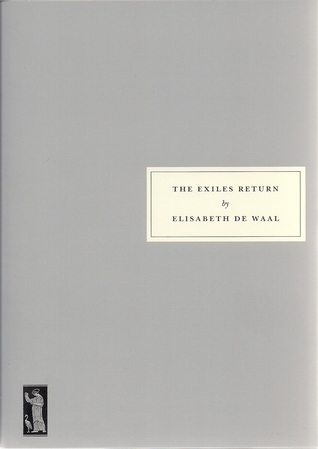
The Exiles Return is set in Occupied Vienna in 1954-5. It describes five people who grew up there before the war and have come back to see if they can re-establish the life they have lost.
The novel begins with Professor Kuno Adler, who is Jewish and fled Vienna after the Anschluss (the events of March 1938 when Hitler’s troops marched into Austria). He is returning from New York to try and take up his old life as a research scientist. We realise through his confrontation with officialdom and with the changed fabric of the city (the lime trees are there no longer, it is hard to know who behaved well during the war and who was a Nazi sympathiser) that a refugee who goes back has a very difficult time.
Next we are introduced to a wealthy Greek named Kanakis. Before the war his family had lived in great style with a coach and horses and many servants, and now the 40 year-old Kanakis has come back to try and buy an eighteenth-century hotel particulier, a little palais, in which to live a life of eighteenth-century pleasure. He meets Prince Lorenzo Grein-Lauterbach (who owes more than a little to Tadzio in Death in Venice). Bimbo, as he is known – and the nickname is an accurate one – is a 24 year-old who, because his aristocratic, anti- Nazi parents were murdered by the Germans, was spirited away to the country during the war years and afterwards. He is penniless yet retains an overweening sense of entitlement. Kanakis and he develop a homosexual relationship (a brave thing to write about in the 1950s) and he is kept by his older lover. But he has a sister, Princess Nina, who works in a laboratory, the same one to which Adler returns. She lives modestly in the attic of her family’s former palais, is a devout Catholic, loyal to her brother and the memory of her parents, intelligent and hard-working, but, as she perceives it, is stocky and unattractive. Lastly, there is 18 year-old Marie-Theres, whose parents went to America just before the war; they, and her siblings, have become completely American, but Resi (as she is known, possibly with a deliberate echo of Henry James’s What Maisie Knew) has never fitted in and is déplacée. So she goes back to her Austrian aunt and uncle to see if she can make a life in the home country (from her parents point of view to see if she can be married off) yet here too she is an innocent abroad, unable, to put down roots. Her tragedy is at the core of this moving and evocative book, which explores a very complex and interesting question: if an exile returns, how should he or she behave morally? Some have moral fastidiousness (Adler, Nina), some are ruthlessly on the make (Kanakis, Bimbo), some have no moral code because they have never been educated to acquire one (Resi).
Each of the exiles describes an aspect of the author herself. Elisabeth de Waal was brought up in the Palais Ephrussi, so wonderfully evoked by her grandson Edmund de Waal in his bestselling The Hare with Amber Eyes. Her mother’s life was the one for which the ‘startlingly beautiful’, fictional Resi was bred and should have grown into. Elisabeth herself was much more like Princess Nina, ‘a serious young girl who was, as Edmund de Waal said recently in an interview with Mark Lawson on BBC Radio 4’s Front Row, ‘desperate to get from one side of the Ringstrasse in this crazily marble and gilt edifice to the other side where there was this fantastically exciting university full of philosophers and economists, and she did it through sheer dogged will power.’ Yet, although there are aspects of Resi and of Nina in Elisabeth, we can imagine that Professor Adler was the character with whom she identified most. And, although she obviously would have shrunk from identifying with Kanakis and Bimbo, she knew that they were in her family background and that even those two, the wealthy Greek playboy and the dissolute young aristocrat, had elements of what she might have been.
Elisabeth arrived in England in 1939 and became a wartime and post-war housewife, like so many of the women in Persephone books. We can imagine her struggling with How to Run your home without Help and Plats du Jour. She coached children in Latin, maintained a large correspondence, and wrote a few reviews for the TLS – but mostly what she did was write novels, two in German and three in English. The Exiles Return is the first to be published.
Elisabeth de Waal was born in Vienna in 1899, the eldest child of Viktor von Ephrussi, of the banking family, and Baroness Emmy Schey von Koromla. She was educated at home and at a leading boys' school, studied philosophy, law and economics at the University of Vienna, and when only 19 gave a paper at the first of Ludwig von Mises's legendary Private Seminars on economics. She completed her doctorate in 1923 and also wrote poems (exchanging letters about poetry with Rilke). She was a Rockefeller Foundation fellow at Columbia. In 1928 she married Hendrik de Waal, a Dutchman; they had two sons, Viktor and Constant (later Henry), lived first in Paris and then in Switzerland, and in 1939 settled in Tunbridge Wells, England. She wrote five unpublished novels, two in German and three in English, including 'The Exiles Return' which was published posthumously. She died in 1991.
A book that suits its dove-grey covers very well ...
I was intrigued by The Exiles Return as soon a I saw it written about, as a forthcoming Persephone Book last autumn. The authors name was familiar, because it was her grandson who wrote The Hare With Amber Eyes, a book that I think everyone in the world but me had read. But this was a book that hadn’t been read, though the author made every effort to get it into print.
And yet it holds a stories that have been little told. Stories of exiles returning to Austria after the war, when the country regained its independence. Fascinating stories, that are quietly compelling because they are much more than stories. They are testimonies created from the authors own experiences.
There are three main strands. There is a Jewish professor who had taken his family to America when he saw danger at home; they thrived in their new life but he did not, and has returned alone. There is an entrepreneur, of Greek descent, who is returning to a city where he believes he will find business and social openings. And there is an American girl, the daughter of immigrants, who has been sent to stay with relations in the hope that it would pull her out of what seemed to be apathy with her life.
And in consequence there are three very different stories, told in different styles. I questioned the shifting narrative at first, but as I read I came to realise that it was very, very effective. It emphasised that so many lives were affected, in so many ways, and that there would be countless consequences.
There are so many moments that I could pull out.
Professor Adler’s realisation that he really had come home. His later realisation that home had changed, in ways he had not anticipated. Most of all his realisation that there were people who had supported what he saw as an evil regime among his friends, neighbours and collegues.
For me Professor Adler was the emotional centre of the story. He was an intelligent and sensitive man, and he saw that the years he spent in exile could not be made up, that her would always be a little out of step with those who had stayed. The telling of his story was pitch perfect and utterly moving.
His experiences may have mirrored those of a German gentlemen who lived here on the promenade until he died a few years ago. He and his wife came to England during the war to try to raise awareness of what was happening in Germany, and they went home after the war but eventually they retired back to Cornwall. I am so pleased that this book has finally come into print, to shine a light on stories like his.
Resi’s story touched me too. She blossomed as she met her Austrian family, as she learned new things about her family background, and it was lovely to watch her living happily, in the country, with her cousins. It was the family’s move to the city that took the desperately pretty Resi out of her depth, and kicked off the plot that would bring the different strands of the story together.
That plot didn’t quite work, it felt a little over dramatic after the subtle and thought-provoking writing that has come before. And I was unconvinced that Resi would have acted as she did at the very end. But that by no means spoiled things, and I am more than ready to believe that a dramatic plot might have been necessary to sell a book about the consequences of war when it was written, years ago.
The Exiles Return is not the best written or the best structured novel on Persephone’s list. But it is as heartfelt, as honest, and as profound, as any of the one hundred and one titles it joins.
Persephone generally publishes books that have often enjoyed great success in the past, but have been out of print for a number of years. This is not the case with The Exiles Return. The author Elisabeth De Waal was the grandmother of Edmund De Waal who wrote the hugely successful The Hare with Amber Eyes – which I have not read – I think I might though now. It is solely through his efforts that Elisabeth’s book is now available. The manuscript of what became The Exiles Return Elisabeth De Waal kept with her on her travels across Europe for years, the story was important to her although it seems she had little hope of it ever being read by anyone, much less that it would be published. Before I go any further I must say I really enjoyed this book, which I hadn’t intended to read this month until I saw a lovely review of it from Claire at word by word. I loved the sense of time and place, the feeling of returning to place once loved is strong, and the idea of things being put back together again – of families reconnecting is one I really enjoyed. However I don’t think this is a faultless novel; there were moments when I felt oddly disconnected from it. “Kuno Adler handed over his passport, his American passport, with a sense of defiance, as if challenging him to question its authenticity. The man leafed through it, looked at the photograph and at Adler himself for what seemed an intolerably long time, probably twenty seconds, cocking his head to look at him from all angles. All right, all right! Adler thought, of course he can see that I am a Jew, a refugee. What of it? ‘Coming back?’ the man asked, closing the passport and handing it back to him. Adler had meant to answer the question in English. But somehow he couldn’t. ‘Ja’ he replied, and in the same soft German, ‘I’m coming back.’” The Exiles Return is set in Austria in 1954/55 during the occupation following World War Two. As the title suggests it concerns the return home of people living in Exile. There are three story strands – which are linked slightly – but which at times felt oddly disjointed. Having thought about the novel some more since I finished it – I think that this is a strangely powerful way to portray that feeling of exile that Elisabeth De Waal herself experienced. Professor Adler a Jewish scientist returns to Vienna from America where he has been living with his wife and daughters. However Adler returns alone, his relationship with his wife is difficult. Adler finds a place familiar and yet altered. The Professor finds he needs to work with people who had worked within the regime that saw him having to flee his homeland fifteen years earlier. Entrepreneur Kanakis , an Austrian of Greek descent returns, intending to find his dream home, and make money out of the new opportunities that he hopes will be opening up. Resi – is an American the nineteen year old daughter of immigrants, she is sent by her mother to her Austrian relations in the Austrian countryside. Resi enjoys her time in the country; she becomes happier in these idyllic surroundings, finding herself drawn to her aunt, and happy in the company of her older cousin Hanni. However a move to the city that allows Resi to attend university and socialise with friends of Hanni’s, sets in motion events that will lead to tragedy. (This is not a spoiler- the tragedy is revealed in the novel’s prelude). I loved the story of Professor Adler – and rather wished I had rather more of him in the novel. His sad disillusion is touching, his delight in meeting up with an old man who he knew years earlier, and an unexpected romance are wonderfully poignant. Resi’s story is different – more dramatic, and for me, a little strange, especially at the end. I didn’t connect with the character of Resi – I was unconvinced by some of her actions and was a little confused by her attitude toward some of the characters – there were a few things for me which didn’t entirely hold together. All in all although I did enjoy this novel – and I am glad that I have read it, I do feel it is not as strong as other Persephone novels.
Loden--people really wore it back then. This book has some beautiful descriptions, of characters and of places, that kept me going through its slow development and awkward dialogue.
For example, there is an electrifying scene of one Austrian scientist named Krieger telling the (Jewish) scientist returned from exile about Krieger's wartime experiments on prisoners. Krieger points out that they were Roma, not Jews (he seems to think his audience will approve). He goes on about how these experiments advanced science, and, most chillingly, how he regrets that there probably would not be similar opportunities in the future to experiment on live people.
On a lighter note, there is a kind princess-aunt telling her young American niece to always have fresh flowers in the house because it's nice to get dressed in front of flowers. The aristocrats' mindset is fascinating throughout the book.
Unfortunately, the last 40 or so pages are a rushed, breathless, melodramatic plot. Part bad telenovela, part cheap romance novel, with a little seasoning of homophobia. It's especially disappointing because it revolves around the American niece, the least interesting character in the bunch.
My recommendation: read the first 80% or so, especially if (like me) all you know about Austria is from "The Sound of Music" and "The Grand Budapest Hotel" and you don't mind that nothing really happens. Skip the end.
The Exiles Return was written by Elisabeth de Waal, grandmother to Edmund de Waal - and not published until 2013, by Persephone Books, a full two decades after the author’s death. Presumably, interest in the book was kindled by the huge success of Edmund’s The Hare with Amber Eyes, but the book had (and has) every right to be published and read on its own merits. I’ve wondered quite a bit what kept it from being published: perhaps the subject matter was considered too controversial, or perhaps editors assumed that their reading audience were tired of books dealing with the Jewish experience during World War II. There are several potentially controversial subjects in the book - a homosexual relationship, although it is merely hinted at and not the least graphic, and a suicide - but considering what the world witnessed during the years of 1938-45, I cannot imagine, even in the staid 1950s, that these events would have the power to shock or offend most adults. Perhaps the book just disturbed too much the collective desire for amnesia. Perhaps the book touched on a spot still too sore.
Set in Vienna during the 1950s, the title gives a good hint of the novel’s subject matter. The three ‘exiles’ in the book are: Professor Kuno Adler, a research scientist who is returning to the University after 15 years in New York City; Theophil Kanakis, a rich Greek tycoon whose family had helped turn Vienna into the jewel of the Austro-Hungarian Empire; and Marie-Theres ‘Resi’, the American daughter of an exiled Austrian princess and her Danish husband. All three characters have their own storylines and secondary characters, but the author also connects them together in a storyline as tragic as an opera plot. (The importance of the opera in Vienna is alluded to in more than one scene in the novel.)
The novel begins with a direct reference to an exact moment in Vienna’s history: ”it was in the middle fifties, a short while before the conclusion of the so-called State Treaty which led to the withdrawal of the Allied Occupation forces and finally restored Austria’s independence.” Vienna is still rebuilding, a full decade after the war. A long season of hunger is finally coming to an end. A partial restitution is being made to the Jewish population, from whom so much was stolen. The author, whose own family had been prominent citizens of Vienna for several generations, does not just make her book about the Jewish experience, though. Impoverished aristocrats and the ambitious sons of former servants also play a role, as do former Nazis. What the book does so well is describe a diverse society, totally ruptured, which is attempting to knit itself back together.
Elisabeth de Waal was a linguist in the highborn, well-educated European style: I know that she spoke fluent German, French, Dutch and English at the very least. During the war, she and her Dutch husband settled in Tunbridge Wells, Kent, and presumably it was there that she perfected her English. I mention this only because her writing never gives even a hint that she is not a native speaker. She has a graceful, flowing style - truly a pleasure to read - and it completely mystifies me that this book was not published in her lifetime.
Los exiliados a los que alude el título no son solo los retornados, los que se marcharon de su país por razones étnicas, económicas o diferencias políticas, son también los que se quedaron y fueron desposeídos de su estatus social, sus posesiones materiales y se vieron degradados y fuera del orden establecido tras el Anschluss.
La novela nos lleva a través de varios personajes, los que se fueron y los que se quedaron y los vamos conociendo por su trayectoria vital, todos ellos y sin conocerse confluyen en Viena a mediados de los años 50 del siglo pasado, la ciudad se está recuperando de los estragos de la II Guerra Mundial y de su anexión a la Alemania nazi, una ciudad donde confluye la miseria, la reconstrucción, la burocracia, la desidia, el egoísmo y la dulzura.
Es una historia corta pero muy bien narrada, todos los personajes arrastran un pasado y de una forma natural y sin conocerse entre ellos terminaran siendo un grupo unido, aunque a veces de forma marginal o no deseada.
I love a meandering classic that treats its characters well, shows each snippet of their lives proper respect, and manages to make me love them enough to do the same.
The Exiles Return promises a lot but then fails to deliver on some fronts. The setting is Vienna in the early 1950s in the aftermath of World-War II - a disheveled, occupied city keen to recapture its illustrious past. The characters are a potent mix of those who fled from the Nazis, those who stayed and fought them and those who remained and co-operated with them. The publisher’s cover blurb talks the book up a storm, and the Foreword by the author’s grandson, Edmund de Waal, (author of the beautifully written, ‘The Hare with Amber Eyes’)certainly adds weight. The book’s strength comes in patches when the author very ably manages to capture the atmosphere of post-war Vienna, the privations that its citizens had to face, and the politics of the time. She also has crafted characters with interesting histories that seem bound to lead to conflict. However, the book really fails in its execution. The characters behave in unbelievable, precipitous ways and say preposterous things to each other. Also, the writing at many times is clumsy. I was very disappointed that the story - which initially promised to focus on two of the eponymous exiles, a rich business man and a scientist – instead revolves around the love life of the beautiful and vacuous daughter of another couple of Viennese exiles. This is a book written by an intelligent person who knows and empathizes with her subject matter. However, the writing is not compelling. Despite this, I feel it is a book worth reading, if only for its insights into life in Vienna in the early 1950s.
I listened to this in German and the language draws you into the story, time and setting. Not sure if it would work so well in translation. It reminded me of some of Stefan Zweig's novels.
This is the 102nd book on the Persephone list. As with Emma Smith's The Far Cry, I did not know much about this novel before I began to read it, apart from the fact that it was set in Austria. The Exiles Return was written in the late 1950s, and was not published in de Waal’s lifetime. The preface to the Persephone edition is written by the Viennese author’s grandson, Edmund de Waal. He states that his grandmother ‘wanted… to create novels of ideas’, and his introduction is truly fascinating.
The novel takes place over a relatively short period, beginning in 1954 and ending the following year, just after Austria recovered her independence following Hitler’s Anschluss. Whilst there are several characters who are introduced and focused upon in detail, the two protagonists of the piece are Professor Kuno Adler, ‘the academic whose need to return to Vienna is at the heart of the book’, and a ‘beautiful girl’ named Marie-Theres, the American-raised daughter of an Austrian princess, who comes to be known as Resi. Adler is barely on speaking terms with his wife, and has returned from New York alone, leaving his daughters in her care. Resi is sent to stay with her uncle and aunt, a Count and Countess, because it is believed that a change of scenery will be ‘good’ for her.
The characters whom de Waal focuses upon come from different walks of life – a prince who has lost most of his family to the Gestapo, a rich Greek man, and the children of the Count and Countess, for example. Pre- and post-war differences within Vienna are set out well, as are the ways in which the place impacts upon those who live within it. Lots of history has been bound alongside the story, and the novel consequently has such depths; it becomes richer as each new character or scene is introduced. The whole is rendered almost luscious in this respect. The Exiles Return is a fabulous addition to the Persephone list, and I can only hope that the rest of de Waal’s books are – or will soon be, at any rate – readily available in English.
I knew going into this that it was about several different people. But once I started reading and I totally got into Professor Adler's story, I forgot about that. When it switched to another character, I didn't want to leave Professor Adler. But after about a day of sulking, I picked up the book again and went back into it.
The style of writing may not suit today's taste for all action all the time, but I really enjoyed it. I felt like I got to know the characters inside and out, and I liked the feel or atmosphere that the narrator created. Marie-Theres/Resi's absorption in the natural world, her innate slow-moving-ness, and her lack of connection with the whole US suburban culture definitely resonated with me. Those moments she has with Frans were really evocative, and I was sorry she didn't connect up with him again.
It did seem as if some threads of the story were beginning to be woven and were not picked up again later in the story. But I did get sucked into the drama between Kanakis, Bembo, and Resi, to the point that I gasped out loud at one point. Not like, Oh, these events are so shocking! in a prudish 1950s way (which might have kept this book from being published at the time) but more in an I-can't-believe-she-did-that kind of way.
Besides being portraits of people, this novel is also portrait of a city at a certain time in its history -- Vienna, immediately post-WWII. That's a place and a time that we don't hear much about, and I was glad to be given a picture of it. Thanks, Elisabeth, for writing down a portrait of your time, and thanks, Edmund, for seeing that it got published.
From the outset, a straight-forward story of the return of émigrés to Austia shortly after WW2. There's an underlying note of discomfort as those involved try to deal with displacement, loss, social readjustment and the inevitable hangover from a recent Nazi regime. And the usual drama of families, generational realignment and the societal conventions that have been fractured by war. But then, De Wall surprises us with a deliciously contrived denouement. I will not drop any spoilers here, except to note that she very neatly, cleverly and beautifully draws inspiration from Tchaikovsky's "Eugene Onegin". Masterfully done! I find it astonishing that no one saw fit to publish this exquisite novel during De Waal's lifetime. Another forgotten treasure brought to light by the folks at Persephone.
She wrote 5 novels and long after her own death, thanks to the success of her grandson's award winning book Edmund De Waal'sThe Hare With Amber Eyes, we now get to read that most personal of all the stories she wrote, Elisabeth De Waal'sThe Exiles Return inspired by her own return from exile to Vienna after the war.
The return is never really the return, it might be another beginning, if one is fortunate, for other's it represents the end.
Im Vorwort zum Roman erwähnt Edmund de Waal, der Enkel der inzwischen verstorbenen Autorin, die Liebe seiner Großmutter zu Marcel Prousts Büchern. Als ich die ersten Kapiteln las, konnte ich in der Tat spüren, sie wären von jemandem verfasst, wer sich mit Erinnerungen und vor allem mit der Sprache umzugehen weiß. Ich war bereit, Professor Adlers Schicksal zu verfolgen, seine Persönlichkeit gewann langsam an individuellen Zügen, doch kaum angefangen, war es schon vorbei mit der guten Lektüre. Die zweite Geschichte nämlich, die von einer jungen Erbin eines alten adeligen Clans handelt, hat mit der ersten nichts zu tun, weder inhaltlich noch sprachlich. Die Kapiteln über Marie-Theres, die (leider) die meisten Seiten des kleinen Romans füllen, wirken sehr skizzenhaft und roh: es gibt viele Wiederholungen, das heißt, wenn de Waal auf eine gelungene Metapher kommt, dann reitet sie auch weiterhin herum, ohne sich was neues einfallen zu lassen. Weiterhin, sind die endlosen sich wiederholenden Anspielungen auf den gesellschaftlichen Status a la "sein Vater war doch ein Graf und meiner nur sein Förster" ebenso lästig: man fühlt sich wie ein kleines Kind zig mal an dasselbe erinnert, obwohl man eigentlich imstande ist, sich die wenigen biographischen Details der Protagonisten gleich bei der ersten Bekanntschaft zu merken. Insgesamt fand ich den Einblick in die Wiener hohen Kreise der Nachkriegszeit schon interessant, auch wenn dieser Blick nicht gerade tief war. Andererseits war es für mich sprachlich gesehen ein ziemlich anspruchsloses Buch und ich habe mich am Ende enttäuscht gefühlt und war über die vergeudete Zeit verärgert.
This is a perfectly enjoyable look at a handful of returnees to Vienna following the end of the Second World War. You get a fabulous sense of post war decay and neglect as well as an interesting (if maybe too fleeting) insight in to the reality of government promises to resettle those who had been displaced by the Nazis. However there is some naivity to some of the writing (in particular dialogue) and plot lines (that can be a bit more dramatic than they need to be) although for me these are forgivable given that this wasn’t professionally edited or published during the author’s lifetime. A good if flawed contemporaneous account of an aspect of the Second World War that I have had little understanding of.
I really liked the concept behind the novel (exiled Austrians returning to the homeland post-WWII), but it wasn't an especially polished book (unsurprisingly, given it is an unpublished manuscript).
This makes me feel a bit too critical with my rating, but I can't just rate it on the concept when the plot and characters weren't very engaging, and the dialogue in particular seemed incredibly artificial.
I actually found the beginning of the book introducing Kuno Adler's return to Austria really good. Sadly then five more main characters were introduced alongside god-awful romance plots.
The book contains fictional stories about people who come back to Vienna after the war. It's not a very positive book as nobody is trully happy and most of the people are disappointed as they've lost their assets in the bombing, also the position and status. It's hard to adjust to the new reality, especially when they still apply old-fashioned standards in their lives. I'm glad that nowadays we are more flexible and we can choose our own standards.
this was a lovely surprise, just picked it up from the little free libraries and found it an excellent story about returning Austrians in the early 50's.
Beautifully written and some wonderful moments and characters that served as microcosms into post-war Vienna. This being said, I have many bones to pick with this book. The narrative was engulfed into the upper-class and their post-war plight. Knowing Waal's background I can see why she told their (the upper-class) story but there was not even the slightest mention of anyone but those whom had wealth, at least not by name. There were some rich and vibrant characters but I felt that they were more the sideline characters rather than the protagonists. Despite the great moments in the book, which mostly came after page 165, much of the story seems quite plainly unnecessary. What I mean is that if you are telling such an important story - as an 'exiles return' - why not devote the story to a plight of true struggle. I feel that only Adler had a hard time 'returning' to Vienna, but even he was swiftly returned to his former post. Resi had no interest in politics or the regions history so ignorance allowed her to transition all too happily. And every man (besides one)seemed happy to accept her into society. I was a bit disappointed with this novel but maybe it is because I expected too much from it.
When I began this novel, I didn't read the author bio on the back flap. After a few pages, I was delighted to find a new author whose style actually evoked/matched the period that they were writing about. Then I discovered that de Waal was writing in the 1950s. Oh well!
This was a delightful read. The three threads of the plot are woven effortlessly together. I especially enjoyed following Professor Adler's journey home to Austria after fleeing the country to avoid Nazi persecution and the death camps. His developing relationship with the Princess Nina Grien was quite romantic. I felt sorry for hapless Marie-Teres - she was pretty much destined for trouble. de Waal's writing reminds me of Irene Nemirosky's, which I also like very much. The bio said that de Waal had four unpublished novels. I hope some of the three are in publication now
as this is a recovered manuscript it holds up well. The subtleties of her writing was what I liked. Now the endings can seem trite but at the time in the 50's each character's end would have been unexpected. I really liked the beginning of the book. This was what I was expecting in reading Trieste but didn't get. It puts into intimate descriptive fiction so much of the 50's history as she experienced I believe.
I felt there could have been more depth or substance to the characters. The one character I would have thought to be bland and boring, was, but in a comforting manner. He knew what he was seeking and was content with his choice.