Alan Moore is an English writer most famous for his influential work in comics, including the acclaimed graphic novels Watchmen, V for Vendetta and From Hell. He has also written a novel, Voice of the Fire, and performs "workings" (one-off performance art/spoken word pieces) with The Moon and Serpent Grand Egyptian Theatre of Marvels, some of which have been released on CD.
As a comics writer, Moore is notable for being one of the first writers to apply literary and formalist sensibilities to the mainstream of the medium. As well as including challenging subject matter and adult themes, he brings a wide range of influences to his work, from the literary–authors such as William S. Burroughs, Thomas Pynchon, Robert Anton Wilson and Iain Sinclair; New Wave science fiction writers such as Michael Moorcock; horror writers such as Clive Barker; to the cinematic–filmmakers such as Nicolas Roeg. Influences within comics include Will Eisner, Harvey Kurtzman, Jack Kirby and Bryan Talbot.
... and then, there I was when I realized that this part of the story is pure, sensational, earth-moving F-U-N. The wrap-up was a little corny, yes. But I can't argue that I didn't all-out enjoy Dr. Manhattan and Silk Spectre II and, and, well it was super-fun!
On another note, I think it's safe to say that these different "books" wouldn't have read well as stand-alone publications for me. The story is complex with a lot of characters and a whole lotta stuff and nonsense between different characters resulting in or alluding to different crazy societal problems - serious stuff, too, like World War III, government subversion, corporate corruption, LGBT rights, possible rape, vigilantes with conspiracy theories, super-friends gone cray-cray and drawing pictures on the face of FREAKING MARS...
Осим једног плот твиста који овде нећу спојловати, скоро читава епизода прошла је у натезању др Менхетна са његовом бившом женском око тога треба или он или не треба да се ангажује око спашавања Земље од нуклеарне апокалипсе. Водећи се резоном да живот на Земљи није ништа битнији од неких тамо пјешчаних структура на Марсу, детерминистички и атеистички настројен др Менхетн успјешно је одолијевао емотивним нападима женске и онда се на крају напрасно предомислио понудивши за то објашњење које је крајње неувјерљиво. Поред тога, иако иначе наводно види и прошлост и будућност и све (јербо је, је ли, све предетерминисано, а он из неког разлога има на телефонској вези све законе физике), сад одједном не може да види нешто у будућности, понудивши за то објашњење које је крајње неувјерљиво, што нам јасно показује да је са оваквим супермоћним скоро па полубожанским ликовима врло тешко конзистентно манипулисати у фабули.
Watchmen #9 profundiza en la complejidad de la existencia humana a través de la interacción entre Dr. Manhattan y Laurie Juspeczyk. Laurie expresa su frustración con la aparente falta de conexión emocional de Dr. Manhattan, quien ve el tiempo como un "joyero tridimensional", revelando su percepción fatalista de la vida.
Los recuerdos de Laurie, que culminan en la revelación de que The Comediant es su padre, simbolizan el dolor del pasado y su búsqueda de identidad. La ruptura de la botella de Nostalgia representa el rompimiento con ese pasado y lleva a Dr. Manhattan a reconocer el valor intrínseco de la vida humana, a pesar de su desapego.
La cita de Carl Jung al final encapsula el mensaje central: encontrar significado en la existencia, incluso en la oscuridad. Este capítulo es un punto crucial en la narrativa, invitando a los lectores a reflexionar sobre el valor de la vida y la conexión humana.
After only stellar reviews sadly I have to admit that this issue was a bit of a drag. Luckily the ending was amazing and therefore helped recovered a little dignity. Most of the issue went by soooo slow it completely disenchanted me from Watchmen, to the point that I actually put it aside for almost two whole weeks!! I never felt the need to pick up again, even though the volume was sitting on my bedside table the whole time. So, getting back to the issue, for the most part nothing happens and it's pretty boring but the huge plottwist and final close-up on Dr. Manhattan almost make up for it.
By far the most visually stunning issue. In this installment, Dr. Manhatan teleports Laurie to his newly built castle on Mars, for a conversation that will define Earth's future. Dave Gibbons and John Higgins's art takes the breath away, and appropriately since this is the start of the climax of Watchmen's story.
Watchmen was a very interesting read and I’m glad to have finally gotten around to it. While I really appreciated some aspected such as the gritty world and symbolic, satirical plot line, there were times when it really didn’t live up to the hype surrounding it, at least not in my opinion. When compared to V For Vendetta, one of Moore’s best in my opinion, it just didn’t cut it for me, nor strike me with anything really meaningful afterwards. This is going to be a really hard one to rate and review for me— but here it goes.
P.s. If haters wanna hate, please go hate elsewhere. ;)
"This Hugo Award-winning graphic novel chronicles the fall from grace of a group of super-heroes plagued by all-too-human failings. Along the way, the concept of the super-hero is dissected as the heroes are stalked by an unknown assassin.
One of the most influential graphic novels of all time and a perennial best-seller, Watchmen has been studied on college campuses across the nation and is considered a gateway title, leading readers to other graphic novels such as V for Vendetta, Batman: The Dark Knight Returns and The Sandman series." -Book Blurb
Because I’m reviewing the entire series, and want to avoid an overly long review as well as story spoilers, in this review I’m just going to cover a few things, some things that stood out, things I liked, things I didn’t etc.
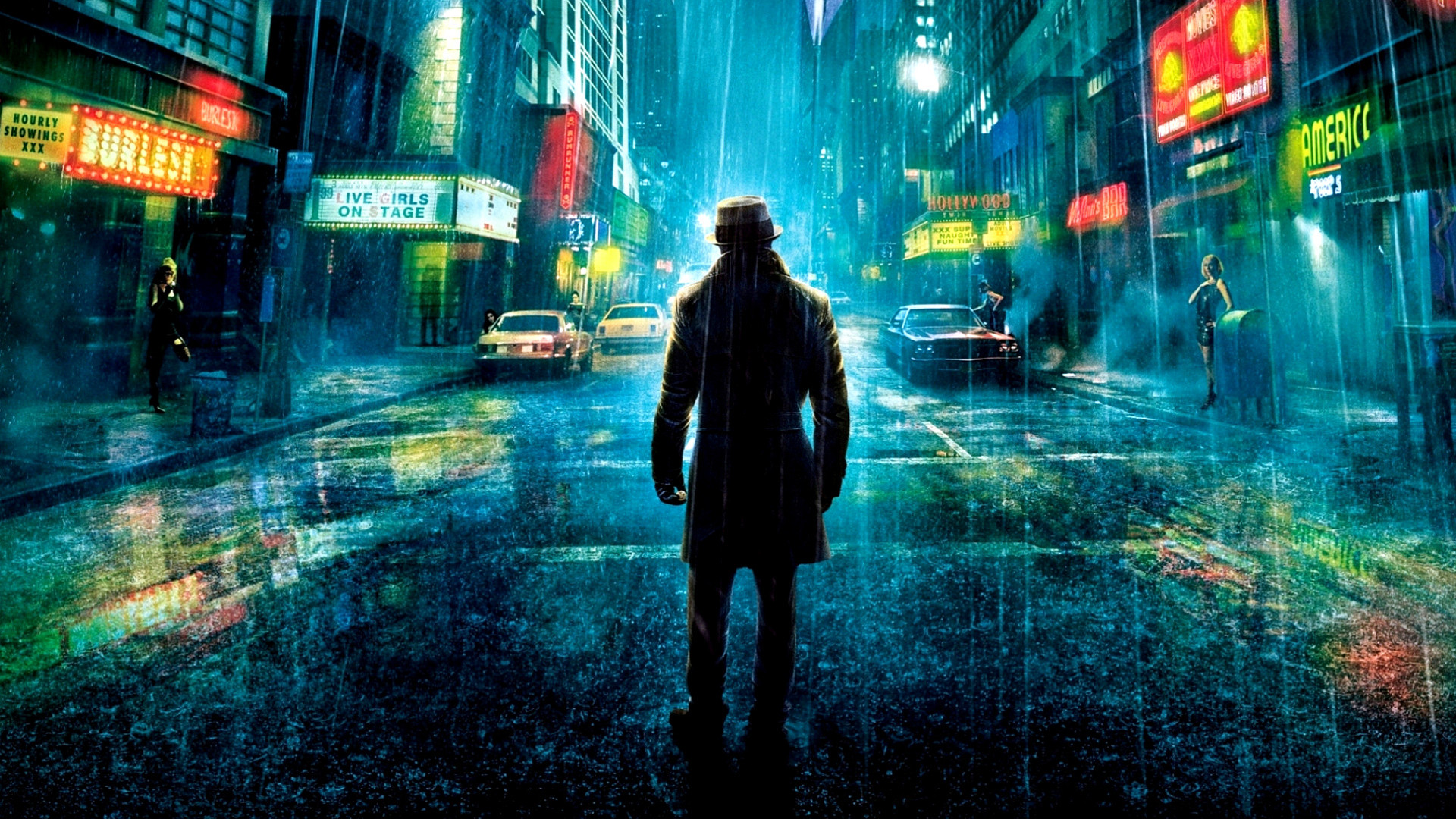
In the beginning of Watchmen the readers are introduced to this dark world, an alternate history, and are initiated into the story through the mysterious and grim character of Rorschach, whom I instantly liked albeit his strange attitude and growingly apparent fact that he was lacking some amount of sanity. He operates outside the law, as superhero’s are outlawed by the government. The mystery was compelling enough, the world is very dark and interesting.
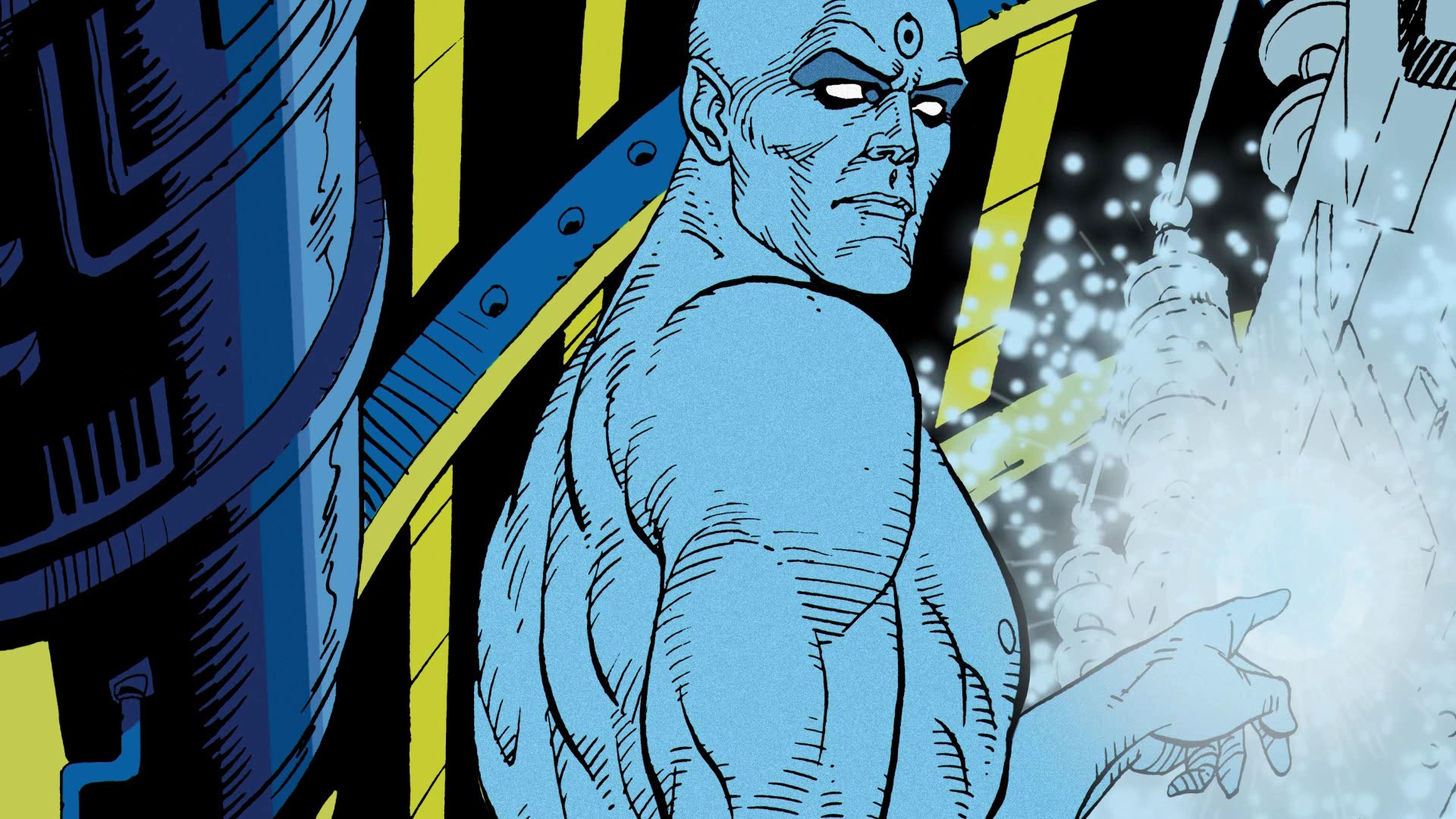
As the story goes on we are introduced to other ex-heroes like Nite Owl II, (who seemed ironically a parody of Batman), and Ozymandias, as well as heroes contracted by the government such as Doctor Manhattan (the only actually superhuman in the series), The Comedian and Silk Spectre II. While the characters were interesting at times, most notably Doctor Manhhattan and Rorschack, many of the others felt dull to me, like bland caricatures.
One aspect I disliked was the weird, and seemingly pointless romance between Silk Spectre II and Nite Owl II. It felt creepy and out of place, boring me and ultimately jarring me from the otherwise interesting plot. Why was it necessary to bog the plot down with their awkward affair, (including facts about his erectile dysfunction)? What was perhaps meant to flesh out the side characters, just ended up feeling like a lot of filler material. Bleh. It slowed the overall momentum for me.
Another irritant was the issue concerning the backstory of Silk Spectre I and The Comedian, and the flippant way her sexual assault/rape was dealt with. It felt only a cheap tactic used to give the readers a twist later on, which was obvious to me miles away, and ultimately felt an easy way to manipulate the reader and story. It did not have that effect on me. The matter was not handled very tastefully, in my opinion. Silk Spectre I’s response— or lack thereof—to the crime against her made the writing and overall story have a very misogynistic undertone, which continuously reared its head throughout the following issues.
That continuous feeling was highlighted and accentuated by the apparent uselessness of most of the female characters, who rarely if ever, contribute to the story in any meaningful way. Not to mention the fact that so few women were present at all, the story tiresome by their lack of contribution. One obvious exception being Silk Spectre II’s pleading with Doctor Manhattan on Earth’s behalf later on, even then he probably would have come to the decision on his own, given how his mind worked. So perhaps I’m reading between the lines here, but that’s how it struck me. It didn’t sit well, and I’m overly used to comics using women in the usual ways, to titillate as eye candy and fan service, serving no real purpose. I guess I expected more, too much, from something hailed as an innovative masterpiece.
Moving on.
There were things I did really like, though the story was bogged down with politics, propaganda and misogyny. I really like the satirical take of the golden age superhero story, the way the story makes you think about things in a different light, albeit a very pessimistic—dare I say—nihilistic light. I like the jaded hero perspective. The art was very fitting and did a good job setting the overall tone, even though it wasn’t as pleasing on the eye. It conveyed the general vibe of the plot really well.
I loved the fact that the series read more like a mystery noir novel that a traditional action comic book. I really enjoyed the characterizations of Rorschach and Doctor Manhattan the most. I LOVED Doctor Manhattan’s backstory. It was so epic and philosophical; those chapters really made me think. While Rorschach’s background was very sad, it was also a bit underwhelming, considering how much I loved his character. He made an excellent anti-hero.
Overall, I really enjoyed it, but could not say I loved it by any means. I appreciate what it means to the world and legacy of comic books and graphic novels, I think it changed the industry in many ways, not all for the better, but in many ways it was good. I liked how original it was. I like the philosophical mindset it gets you in. Some of the characters were so memorable, but the bad somewhat equals the good for me. There was a lot of filler material that felt tedious to read through, dragging the story out. As much as I enjoyed it, I also felt annoyed by it. I felt it was lacking in some pivotal areas, where it could have done more. Many of the characters were so unlikeable and dull, like cardboard cutouts. Seeing how much depth Rorschach and Doctor Manhattan had, I think all of the characters had that potential as well.
So I guess I’m in a love-hate thing with Watchmen, no matter which way I slice it, I can’t seem to pick a definite stance. I was pretty disappointed with the ending. I would recommend reading it, to appreciate the leaps Watchmen gave the genre of graphic novels, and for the interesting plot and setting, but in my opinion V for Vendetta was better in most regards.
[VOLUMN RATING: 4 STARS]
[OFFICIAL RATING: 3.5 STARS]
This entire review has been hidden because of spoilers.
This number was boring and predictable in some ways..
It was always going to be difficult to tackle the whole rape issue. I think they managed it mostly well.
The whole parent reveal was absolutely transparent since the first moment we saw the Comedian's hair. Laurie's doesn't resemble her mother's, Larry's or Hooded Justice's - who was, on top of it all, gay - so of course she had to be his daughter. It gave me a whole other layer of sympathy for Sally Jupiter.
I really like Laurie, and if anything, this chapter solidifies that position. I also enjoy the dinamic with Dr Manhattan.
For the most part I empathize with Dr Manhattan, but I also think his whole existential dilema is not actually that deep and it seems dull and dragging, utterly different from Watchmaker, where I really enjoyed his character and found him very interesting. His solution to his struggle is also utterly unoriginal and it doesn't feel revealing or new in any way, but then again, I might just be a bit jaded, and this is not, after all, 1988 anymore.
Overall, I'm still enjoying these comics series very much.
until the next to last page of this issue i was like "come on. you, dr manhattan you lost it, big time" but then laurie lost it too and dr manhattan pulled himself together and boom, my love for dr manhattan is back.
the issue is kind of a drag cause it focuses around Laurie's character, that in my opinion, is useless and with no characters at all... but moreover, it was boring mostly because nothing really happens... i even stopped reading at some point and gave it another chance after a couple of days...
i really hope the next issues will be better than this and will reach a certain closure cause i can't see where this is going and i still have no idea who the instigator of the anti heroes "conspiracy" is
Watchmen 9 of 12, Collector's Edition pág. 0: créditos #9 pág. 1: THE DARKNESS OF MERE BEING Pág. 29: scrapbook for Sally Jupiter Pág. 33: créditos editoriales
The reveal was wild and the build up looking through flashbacks and Laurie’s and Dr. Manhattens conversation back and forth was great. This story is just insane …
Set in an alternate history where costumed heroes have helped shape society since the beginning of time, the controversial yet prolific costumed hero Edward Blake (more commonly known by his alias The Comedian) is found dead and the perpetrator is nowhere to be found. Unable to solve such a bizarre murder by conventional means, the masked vigilante Rorschach who once served as a costumed hero alongside Comedian and four others takes matters into his own bloodstained hands to track down a mysterious assassin that's taking out costumed heroes one by one. Conspiracies abound, political tensions are through the roof, the threat of WWIII is lurking just around the corner and the gritty and depressive atmosphere of a rotting New York City during the 1980's sets the scene for a grim dissection and criticism of classic superhero archetypes.
Watchmen redefines the term superhero. With the exception of Dr. Manhattan, none of them have any notable powers. The Comedian is merely a grotesque reflection of American society and all its shameless faults, as well as how misguided patriotism can be used to justify mindless violence and prejudice. Rorschach is a vigilante who throws around the words good and evil to justify his brute force and questionable methods of solving problems. Silk Spectre is a normal woman struggling between following her own path in life and forever remaining trapped in the shadow of her mother's legacy. Nite Owl almost feels like a comedic parody of Batman, poking fun at the fact that he's an awkward old nerd that loves owl-themed gadgets and dressing up in what is essentially a big Halloween costume. Dr. Manhattan is the embodiment of how power, knowledge, wealth and limitless freedom to do anything imaginable can alienate and dehumanize a person from the rest of the world. All of the superheroes are extremely flawed everyday people with everyday issues and imperfections who hide behind masked personas to cope with the questionable acts they're performing and the faulty morals behind them.
The heroes of this tale defy the image of flawless paragons of justice that can do no wrong. They are just as capable of being selfish, abusing their powers and doing evil things out of spite and unchecked negative emotions as everyone else. This critiques the very idea of putting idols on a pedestal in the first place. This can be compared to the famous actors, pop stars and politicians of today. It's easy for people to treat the words and actions of their idols like the words of God himself, forgetting that they're ordinary people with many imperfections just like everyone else. Again, most of the Watchmen have selfish reasons for hiding behind their costumed personas, because they feel powerless, guilty and ordinary without them. What does it say about who you are when you can't even show yourself in public without hiding behind a carefully crafted disguise? Why wear a mask if you're in the right and have nothing to hide?
All of this deception and abuse of authority is where the popular slogan (Who watches the Watchmen?) comes from. The people in power are constantly watching and judging the actions of the average person, but who are watching and judging the actions of the people in power? The people in power punish us for our wrongdoings but who punishes the people in power for theirs? Dismantling the infallible images that figures of authority try to maintain, dissecting issues of confused morals and identities hiding behind literal and figurative masks, tearing the veil from the one-dimensional definition of superheroes, all of these things are masterfully challenged in the shape of a dark psychological crime-thriller with many timeless themes that go harsh on politics and society.
Our heroes and leaders are never the flawless, perfect beings we romanticize them to be.
The Darkness of Mere Being is the ninth issue in the twelve-issue series Watchmen, written by Alan Moore and drawn by Dave Gibbons.
Continuing the story from the cliffhanger ending of the last issue, this one focuses on Dr. Manhattan and Laurie’s time spent on Mars. There, they discuss existential issues, particularly focusing on whether or not humanity is worth saving. This issue proved once again that the Watchmen series is much better at these one-location, introspective character studies than the usual progressing the main story issues.
The Darkness of Mere Being is, in fact, one of the best issues from the second half of the series’ run as it really builds on the relationship between these two characters and it deals with some important themes. Admittedly, how Dr. Manhattan changed his mind felt almost abrupt and unbelievable, but this had to have happened, so I don’t blame that conventional ending too much.
But everything that came before it was phenomenal. Dr. Manhattan grappling with the ideas of the importance of life and humanity’s many messy, but also deep facets was excellent and the dialogue was continually superb in those sections. Laurie herself got an intriguing backstory and the twist that The Comedian is actually her biological father was unexpected and it made for a complex study in human nature and how complicated male-female relationships can be.
The illustrations are also stunning here. This is one of the most visually impactful issues in the series as the Martian landscapes are jaw-droppingly breathtaking to see and those moments where they observed its terrain were quite epic. Another strength of this issue lies in that final supplement that focused on the original Silk Spectre and her complicated life through magazines, newspapers and interviews. It again showcased how she is a much more interesting character than her daughter.
Overall, The Darkness of Mere Being has an abrupt, unbelievable ending, but everything that came before it was stellar. Beautifully illustrated and wonderfully written in dialogue and existentialist themes, this is one of the deepest and most effective issues in the Watchmen series.
Como siempre, el guión durante este número no solo fue revelador, tambien fue un deleite conocer la perspectiva de un ente que para fines prácticos es un Dios y el de un ser humano mientras debatian sobre la importancia de la vida y el porque tambien es algo insignificante para el universo.
El ilustrador se superó así mismo con los hermosos paisajes y ahora que estoy cerca del final estoy ansioso por ver que pasa.
Hay demasiados misterios y conflictos ocurriendo al mismo tiempo y es hora de traer a la artillería pesada...
el destino de la humanidad se discute en el planeta marte y así creo que lo será en el futuro
las opiniones de manhattan sobre el tiempo, la vida y la humanidad me parecieron interesantes, así como la visión de laurie y su madre, que no vivieron una vida plena. espero las cosas mejoren para ambas. se ve prometedor lo que resta de la historia
¿por qué valdría la pena salvarnos de la catástrofe si al final del día el universo no se enterará si desaparecemos?
Oh, man... solo diré: cómo adoro todo el rollo existencialista. Mi número favorito hasta ahora.
“Ven... seca tus ojos, porque eres vida, más rara que un quark e impredecible más allá de los sueños de Heisenberg; la arcilla en la cual las fuerzas que forman todas las cosas dejan sus huellas más claramente. Seca tus ojos... y vámonos a casa.”
A bit deeper than the last few instalments, this one dives into Silk Spectre 2's back story - the good, the bad and the ugly. Yes, there are a couple of twists that non-eagle eyed readers would not have seen coming. But the whole "what really is good and evil" discourse between her and Dr. Manhattan deserves credit. Things are picking up, and I have high hopes!
I don't really know how to feel. Two of my least favorite characters in the book get all the spotlight. Dr. Manhattan, for being as all seeing as possible, doesn't see how humans are a miracle, which is pretty obvious. Laurie whines some more and then gets her way after a shocking 😳 revelation. This was fine but this second half of the Watchmen story has not done anything for me.
But the world is so full of people, so crowded with these miracles that they become commonplace and we forget. I forget. We gaze continually at the world and it grows dull in our perception. Yet seen from another's vantage point, as if new, it may still take the breath away.