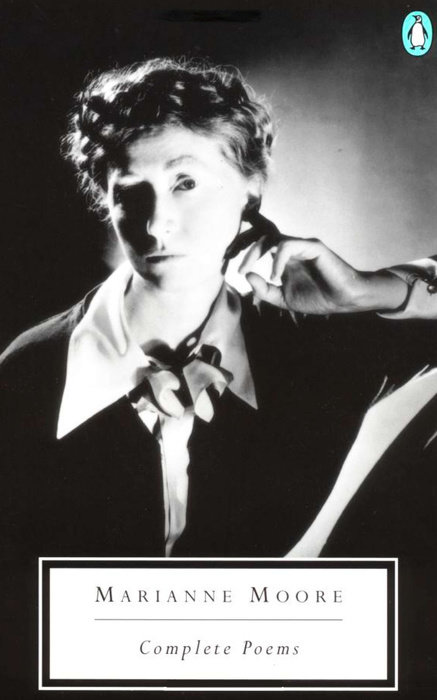
This definitive edition contains sixty years of Marianne Moore's poems, incorporating her text revisions and her own entertaining notes that reveal the inspiration for complete poems and individual lines.
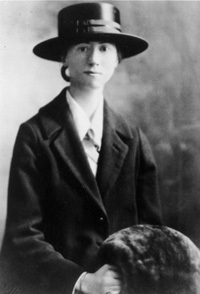
Marianne Craig Moore (November 15, 1887 – February 5, 1972) was an American Modernist poet, critic, translator, and editor. Her poetry is noted for formal innovation, precise diction, irony, and wit.
How many of you have even heard of Marianne Moore?
I'm genuinely curious on this point because I hadn't until last week. Her relative obscurity (at least here in the UK) is a bit of a shame because she has an important voice in the world of poetry.
Her poetry is unusual and it’s very hard to understand because of the multiple voices she uses and constant quotation that runs through the work. It’s very difficult to discern an overall direction of her poems because more often than not, the longer pieces, present opposing opinions. It’s almost like the poetry is in conversation with itself, demonstrating different point of views on a particular topic without giving any of them any particular weight or prominence. So it feels circular at times and contradictory and its unlike anything I have ever read before.
“... we do not admire what we cannot understand.”
There is no “I” within her poems. There is no poet who has a powerful opinion or is subjecting the world to their all-consuming emotions. There is simply observation, detached and levelled. Moore reports what she sees but offers no comment.
Marriage
"This institution, perhaps one should say enterprise out of respect for which one says one need not change one's mind about a thing one has believed in, requiring public promises of one's intention to fulfill a private obligation"
On reading this it would seem the poem is a feminist statement against the patriarchy and the trappings of marriage, though the poem concludes very differently. It’s like she has fixed on one singular theme, marriage, and has done all she can to show everything marriage can be from the good to the bad, from the warmth to the life sentence. It’s almost like Imagist poetry but with conversational elements. And it’s quite unique.
I think what hampered her development was her isolation. Whereas Pound, T.S Eliot and Williams were in conversation with each other, Moore wrote alone. She didn’t have the same strong literary circle to help hone her ideas. She wrote alone and spent her life living with her mother (rumour has it that they even shared a bed into adulthood and until her mother’s death.) Moore never married and remained a solitary figure throughout her entire life, though she was fiercely independent and functional in her loneliness. Though the real hampering was her confidence: she never new how clever she was. And she didn’t really consider herself worthy of being called a poet.
Well she is worthy. Her peers recognised it and tried to get her published long before she was brave enough to actually put her work out there. Her voice is worth hearing.
with verses of ermine and a three-cornered hat you promenade down the avenues of poetry head held high twixt halos of street-lamps and attitudes of humankind— no animal escapes your sidewalk gaze
your own gait like an egret’s and your macaw fingers clutching at stars and your luna moth mind flitting from dream to dream in the emaciated Brooklyn night—these are part and parcel of what you are
you love baseball and boxing and bric-a-brac and words that glimmer like gewgaws in the windows of antique tears
sunday afternoons in Central Park arm in arm with mother dear you rhapsodize over jockeys and prize fighters poking at dead leaves with your stick never failing to particularize —by bringing everything back to the strangeness of our having bodies— every shape and every size
everything is strange come to think of it you are strange and I am strange and stars are strange and trees are strange and streets are strange and the pangolin is very strange why the whole wide gamut of the world is strange
nor do you wish to unstrange the strange you keep it as it is Marianne eccentric beautiful colourful gay mysterious and mind-numbingly bizarre and you count syllables on the knuckles of your left hand as if writing verse were a game made up by the strangest of child- ren
and we the ape-like reader in our jungle of books scratch our heads and backsides and go to sleep in the lush foliage of your strange poems
Marianne Moore is delightful, and one of the few poets I know that I'd actually enjoy hanging out with. It'd be great - we'd sit around drinking tea and talking about art, and then she'd be like, "Hey, do you want to hear about squids?" And then she would tell me all about squids and then share the poem she wrote about them, and it would be lovely.
Marianne Moore studied biology, so she really does write about stuff like that - nautiluses and fish and pelicans and buffalo, and it's all really good. She wrote a six-page poem just about an octopus!
"An Octopus
of ice. Deceptively reserved and flat, it lies "in grandeur and in mass" beneath a sea of shifting snow-dunes; dots of cyclamen-red and maroon on its clearly defined pseudo-podia made of glass that will bend - a much needed invention - comprising twenty-eight ice-fields from fifty to five hundred feet thick, of unimagined delicacy."
That is so cool. And then she wrote this one, which I also love:
"I May, I Might, I Must
If you will tell me why the fen appears impassable, I then will tell you why I think that I can get across it if I try."
They fought the enemy, we fight fat living and self-pity.
I loved more than a few but many escaped me. Kenner’s distinctions between Moore and Wallace Stevens appear valid as far as parsing characteristics but I still find it suspicious to regard one as Modern and the other as Post Romantic. Moore does possess a beguiling humor which I appreciated. She also appears to shudder at the notion that someone will take her excessively serious.
In a world in which science is by and large alien to the general public, nature by and large segregated off in little-visited and increasingly encroached-upon designated zones, and the very concept of poetry almost laughable by nature, Marianne Moore is a refreshing anecdote. Her work is scientific in its analysis, but not science, makes so much of its subject the natural world, without being the godawful "nature writing" you might have been unfortunate enough to encounter, and self-consciously poetic without sounding like something a smart 15 year old would write.
I might add that I like her earlier, icier work better -- when she becomes a bit more playful with rhyme and prosody, it starts to feel weirdly like Eminem's flow, with real frogs in imaginary gardens instead of Shady being locked in Mariah Carey's basement (I can't be the only one who thinks that). Which is fine if there's a beat, less fine on paper.
Her devices of near-rhymes and syllabic (as opposed to metric) verse structures are well known but the result she gets from them is underrated - as the best blankverse/alexandrine writers have made use of subsitutions, Moore's verse becomes something like a strainer where a variety of rhythmic and prosodic pulses can slowly shift through a regular structure; her device of opening&closing on self-contained stanzas but proceeding irregularly&overflowing sentence structure in the middle verses resembles a sonata like this. It produces a very lively and intricate verse that realizes Pound's looser re-conception of form&music in a way that Ezra never achieved. Her dictum, meanwhile, achieves (and earlier) the same distant distortion of the natural voice that Auden and Bishop would do in her wake and, coupled with the musicality and Moore's unique voice, surpasses both in my opinion. Her choice of content is also exciting, being primarily versifications of newspaper&magazine articles that she found interesting, and uses her musicality&voice in conjunct with the objects/phenomena in question to produce elegant&intricate treatments of subjects that remind me of Donne/Marvell and the sonneteers of the 16th century ... This book is not 'the complete poems' as its title suggests, being a highly edited and redacted version of her ouevre made in old age; but it seems that this allowed for her to produce an essentially flawless volume (only a few scattered poems, and the La Fontaine translations, fall short for me). Became perhaps my favorite poet within 20 pages.
Marianne Moore is a modern force of nature. I was first attracted to her writing by the precise strength of 'An Octopus', where cold observation and quotation somehow form a remarkable synthesis with a fierce love for the outdoors and for words.
She tends to frustrate when writing about more (to my mind) quotidian subjects, especially when her aim seems to be straightforward appreciation or praise. Many of the baseball poems as well as 'Tom Fool at Jamaica' fall into this category. She can also come across as writing with too stiff an upper lip, as it were. 'Only wood weasels shall associate with me', she declares at one point, and many of her poems take on a morally didactic tone.
Despite these traits, she seems to me less a Puritan propagandist than an eccentric aunt, gently nagging the nephew-reader to do the right thing. Her poetry-prose is never self-aggrandizing ('Poetry / I, too, dislike it') but her words are chosen with such care that she seems less a poet and more a sculptor with words ('Twisted torcs and gold new-moon-shaped / lunulae aren't jewelry / like the purple-coral fuchsia-tree's.').
This isn't really a Collected Marianne Moore. True to my sense of her impeccable propriety, she removed poems and prefixed the collection with 'Omissions are not accidents'. It would be instructive to discover what she left out and why, if only to get a glimpse of those parts of her mind that she felt less inclined to display.
Just adding this book today. I have it wrapped carefully and stored even more carefully in a place of honor but somehow forgot that I had this book in my collection when I initially included my book inventory. I bought this treasure at the library in Kent, CT. The book was sold to me containing a handwritten personal letter from the author, folded inside the jacket. I don't know this to be true but I'm assuming the person that received this charming letter from Miss Moore placed the letter inside the jacket for safe keeping. Her handwriting is an art form itself. Marianne Moore is considered a major influential American poet. It is very important to buy the book version of her poems because she uses the power of indentation in versing her poems and if you are using a form that does not allow for the indentations, you are missing out on the tone and brilliance of her poem as she intended it to be read. It is impossible to see the true beauty of her work by not reading only one poem but savoring the entire collection. Marianne Moore is an American treasure.
The poem as an Object over diary-entry, her kenning-filled idiolect built as optical syntax unique to her music’s form, her hybrid method of composition, where phrases ripped are riffed, her adjectival density where lies the left-branchingly compound, “compression is the first grace,” compression she contains in spade (& so recedes by will like snail), of lighter lilt to Pound, but with as grand a stature, no wonder Zukofsky dedicates the Objectivist Anthology to Pound yet lets Moore lead the case, “relentless accuracy is the nature of this [x] with its capacity for fact.” Where Pound fathers the ideogram (colliding elements sparking meaning) & the Vortex (which is “not the water but a patterned integrity made visible by the water”, metahistorical rhyme) so Moore mothers the syllabic grid (“ecstasy affords the occasion and expediency determines the form”) & the armature, or bestiary of the armored, animals that defend, the mechanics of defense. Her contractility of heart, warmth of her dance, her cabinet of fossils as flies in amber, her rectitude, her surgical courtesy, her meditated stealth.
I read this collection back in 2004, and liked it at the time; I was also engaged enough and challenged enough by the poems to take 12 pages of handwritten notes on them, analyzing meanings (actually more than 12 pages --the last one breaks off in mid-sentence and a 13th page is missing, misplaced somehow.) I consider Moore a talented poetess. But when I purposed to write a retrospective review of it last night, I realized that, even with my notes and the book in front of me, I couldn't recall any of the poems; the impression they made didn't last. That's not necessarily any fault of Moore's as a writer; it's more likely my own deficiency as a poetry reader. But I realized that I'll have to reread this book sometime before I attempt to review it. So I'm writing this (relatively) short note to stand in the meantime, in lieu of a review.
Marianne Moore si legge a 20 anni e si può rileggere anche a 120. Resta l'incanto. Scrive di pangolini catafratti che hanno le scaglie della regolarità di una pigna e questi quasi-carciofi sanno camminare sotto la luce della luna anzi, sul raggio stesso della luna. Scrive che fu la pazienza a proteggere l'anima come i panni il corpo contro il freddo E di Peter che è un gatto con la faccia di prugna secca che sa parlare ma nella sua insolenza resta zitto. E poi che importa ? quando uno è franco, la sua stessa presenza è un complimento. Scrive di non amare i diamanti ma il bagliore di lampada nell'erba Che non c'è mai stata una guerra che non fosse dentro di noi; e io devo combattere finché non avrò vinto entro me stessa ciò che è causa di guerra e non credevo.
This is great, these poems are great. Moore was simultaneously ahead of her time, completely of her time, and rooted in the most classic sensibilities of poetry. She has a beautiful and massive vocabulary and she left me in the dust with it many times (in a very pleasant way).
I want to say that her poems are basically like children's poems for adults, they are generally very simple in theme or topic, very playful in their language, and remarkably imaginative.
Many of them are about animals, and have lots of taxonomic details. She mentions double rainbows in one. They all made me feel good to read.
"Hate-hardened heart, O heart of iron, iron is iron till it is rust. There never was a war that was not inward; I must fight till I have conquered in myself what causes war, but I would not believe it. I inwardly did nothing. O Iscariot-like crime! Beauty is everlasting and dust is for a time."
Excerpt from "In distrust of merits" by Marianne Moore
Independent, unique, solo, chaotic full of gripe and surrender.. These are words and phrases I would use to describe some of Marianne's work. Most famous poets have an ensemble of poems that create a euphuism for who they are..Marianne however writes in a delicate yet intrusive way...One that creates a laissez faire relationship with the reader and poem. The euphuism in Marianne's poems isn't drawn out or vagrant. It's magically scattered in a rudimental way that provides no efficacy of thought. This to ME specifically is genius! Perhaps, because I also write in this style poetically, I find it so appealing :). My poems, sometimes have the same unnatural gilding that streams like a grapevine throughout. However so, Marianne has perfected this technique and I do bravo the assortment of poems she has created. Toward the end we find some rather uninteresting poems but non the less decently written. Overall a wonderful collection of fine poetry by the lone-poet herself.
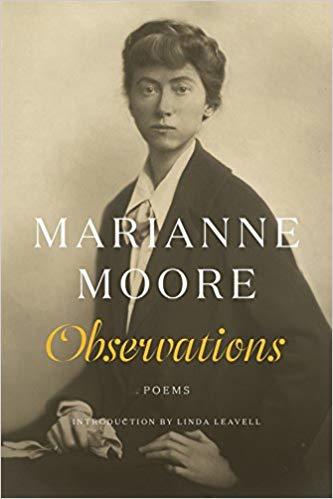
Leavell makes clear that Marianne Moore achieved great critical skill long before she found her voice as a mature poet. Some of her best writing was in the form of reviews. Similarly, Moore became an advocate of the younger poet, Elizabeth Bishop, and recommended her to influential critics and a publisher, at a time when Bishop had yet to put pen to paper and actually write poems. The idea that I am about to enter the lists with a critical review of Moore's work is therefore more than amusing; a bit like a novice challenging a grandmaster to a game of chess.
With the help of Leavell's biography, I have now penetrated far beyond the stage at which it seems a difficult thing to read Moore's poems. I admit that is where I had to start from. The key is to set aside some decent quiet reading time for them. Beyond that, I don't feel any special responsibility to respond to every one of the poems; it would be odd to go through that many different moods in a single week of reading. It is sufficient, and far more than most poets achieve for me, to have emerged with a number of poems that have made a strong impression on me. I will certainly return to this volume on many future occasions.
Utterly unique and, how often do you hear this to describe a poet, funny. With some of the more abstruse poets I find I move on. Not with Moore, rather I want to know what is going on and keep going back to unlock these mischievous mechanisms of language and meaning. As far as I am familiar with the poetry she's also the rare first generation modern who is clearly enraptured by the natural world. Yet this is not the work of a romantic, there is no transcendence or melding with the world evident, instead highly detailed almost incandescent description and metaphor. Ultimately it is the delight of witnessing the world. She's a modernist that can instill in the reader joy. That is a rare thing indeed. Yet her language is clear and precise. There is also a tight internal logic to the poetry as it is based on a syllables. This is not free verse but neither does it follow traditional meter and measure. How she can fuse such a craft like approach to language with such beauty is what makes her so fascinating. She makes me happy.
3.5 stars! Okay so I read this book for school and let me tell you Marianne Moore is tough!!! I've called her a biddy many times over the past month! In fact when you first read her you absolutely LOATHE her. Many many times you stop and think, 'What in the hell is she even talking about?!' But then you start digging and her poems become something really really cool. She believed that it was honorable to search and study for meaning and in a way you kinda feel like a knight finally finding the Holy Grail when you finally dissect her poems! If you feel like you would really like a read that will cause your brain to explode then I would gladly suggest picking up a copy of The Complete Poems of Marianne Moore. :)
One must read Marianne. Especially just before sleep. You will have vivid dreams--part in your world and part in hers. A sort of haunting stillness. One avoids reading her like you might have done and like I did with Walt Whitman, both of whom changed my perceptions.
Of the Modernist poets I find Moore the most approachable (which in a way makes her a terribly unconventional Modernist). Her later work is more sparse, but still full of the allusions and wit (and nature) and cadence that are her hallmarks. Thoroughly enjoyable.
What does it mean to read poetry today? Who is our most consequential living poet? The question is ridiculous: the truth is poetry doesn't matter in today's world. But if not now, how could it ever? Before TV, before silent films even, one had to resort to whatever was available for "entertainment"& "escapism", so perhaps poetry meant more at certain times in history, for those meagre aims. On the other extreme religious verse probably serves the same purpose it always has: a few misunderstood phrases memorized out of context to some, and modes of thought and spirit to be contemplated deeply by less. Someone in the middle, a secular poet writing perplexing verse to convey "(something)" however, what has ever been the point of that?
Setting the greater question aside for a moment, my personal criteria for a poet tends to play out like this: I'll read the entire volume like I would a reg'lar book (but faster cuz there's less words >:). If I can get to the end of it it prolly means I found something interesting within, a certain turn of phrase, an atmosphere or texture, and ideally I'd have some semblance of an idea as to what the poet is getting at, what their poetic "thesis" might be. It's all very foggy, obscure, even if when ingested the images appear in moments of hightened crystaline brilliance. Once read through (ideally out loud even if whispered to myself) then it's a matter of digging deeper, seeing what respected readers have to say about it (or "critics" you could call them), absorbing pertinent tidbits of biography, having someone else explain it to me and seeing if it resembles my initial impressions in any way. Then, if there's still enough motivation (and it's bound to come out of nowhere), Re-reading begins, and in those subsequent experiences an actual idea begins to form of the poet.
I did this first with Wallace Stevens. Funny then that after the first few poems of Ms Moore I was muttering to myself that she reminded me of the stoic insurance man from Hartford, Connecticut. In The Necessary Angel Stevens says his favorite poem of his own is "The Emperor of Ice Cream" (It's old Stevey King's fav too :P). His reason for liking it is purely the way it sounds. I got the impression throughout that Ms Moore was choosing her words for the way they sounded in a similarly Stevensian way. Funnier still that I should find in the same slim volume of essays by Stevens, an essay on Marianne Moore!
"Miss Moore's reality is significant. An aesthetic integration is a reality." "About one of Marianne Moore's Poems" (ibid, 95)
I'd have to agree with old Wally there, even if, for me at the moment the judgment can only be called a generalization. I'm only through part A on the journey of decoding Marianne Moore. My initial impressions are that she has an interesting and intentional turn of phrase, the atmosphere is very rich at times, with some amazing textures (mineral, vegetable, animal), and for an overall thesis, or what Stevens calls a "reality", there is for her a necessity for a certain perception that does away with every superfluous element. A pure poetic experience visioned through the poet is in danger always of being appreciated for the wrong things, which for Ms Moore seems almost worse than missing it altogether. It is ironic then that she seems to speak around the experience, in multisyllabes; forced into figurative language as all poets are, she must demonstrate her thesis in an act — call it ritual if you must, homage is probably more accurate. She says it better in "The Past is the Present":
"Ecstasy affords / the occassion and expediency determines the form."
When it hits, one sees through her eyes, a glowing orb spinning softly, off which all figurative description slides.
So why read poetry? If a poet or poem finds you it is capable of making you aware of something. When that may come into play in your real life (IYRL), and if it will be an advantage, only time can say. It's like asking for something now in order to get something unknown later. Like religion, poetry today requires faith.
BY DISPOSITION OF ANGELS Messengers much like ourselves? Explain it. Steadfastness the darkness makes explicit? Something heard most clearly when not near it? Above particularities, these unparticularities praise cannot violate. One has seen, in such steadiness never deflected, how by darkness a star is perfected. Star that does not ask me if I see it? Fir that would not wish me to uproot it? Speech that does not ask me if I hear it? Mysteries expound mysteries. Steadier than steady, star dazzling me, live and elate, no need to say, how like some we have known; too like her, too like him, and a-quiver forever.
As I read these poems, I felt the time they were written, I felt the simple subjects made complex, I felt a thrill at a mastery of language that was different than a lot of the poets I love. They come alive, aloud; on paper, they aren't as powerful. There was a lightness and humor to some that just was so lovely, and made me so interested in this poet. I imagine she was lovely to speak with, lovely to pass time with, and maybe one of those zen like poets that exude calm and warmth.
Excerpts
The barnacles which encrust the side of the wave, cannot hide there for the submerged shafts of the sun, split like spun glass, move themselves with spotlight swiftness into the crevices— in and out, illuminating the turquoise sea of bodies.
In the days of Prismatic Color not in the days of Adam and Eve, but when Adam was alone; when there was no smoke and color was fine, not with the refinement of early civilization art, but because of its originality; with nothing to modify it but the mist that went up, obliqueness was a variation of the perpendicular, plain to see and to account for: it is no longer that; nor did the blue-red-yellow band of incandescence that was color keep its stripe...
ROSEMARY Beauty and Beauty’s son and rosemary— Venus and Love, her son, to speak plainly— born of the sea supposedly, at Christmas each, in company, braids a garland of festivity. Not always rosemary— since the flight to Egypt, blooming differently. With lancelike leaf, green but silver underneath, its flowers—white originally— turned blue. The herb of memory, imitating the blue robe of Mary, is not too legendary to flower both as symbol and as pungency. Springing from stones beside the sea, the height of Christ when thirty-three— it feeds on dew and to the bee “hath a dumb language”; is in reality a kind of Christmas-tree.
What is love and shall I ever have it?’” The truth is simple. Banish sloth, fetter-feigning uncouth fraud. Trapper Love with noble noise, the magic sleuth, as bird-notes prove— first telecolor-trove— illogically wove what logic can’t unweave: one need not shoulder, need not shove
THE ARCTIC OX (OR GOAT) To wear the arctic fox you have to kill it. Wear qiviut—the underwool of the arctic ox— pulled off it like a sweater; your coat is warm; your conscience, better. I would like a suit of qiviut, so light I did not know I had it on; and in the course of time, another since I had not had to murder the “goat” that grew the fleece that made the first. The musk ox has no musk and it is not an ox— illiterate epithet. Bury your nose in one when wet. It smells of water, nothing else, and browses goatlike on hind legs. Its great distinction is not egocentric scent but that it is intelligent. Chinchillas, otters, water-rats, and beavers, keep us warm but think! a “musk ox” grows six pounds of qiviut; the cashmere, ram, three ounces—that is all—of pashm. Lying in an exposed spot, basking in the blizzard, these ponderosos could dominate the rare-hairs market in Kashan and yet you could not have a choicer pet. They join you as you work; love jumping in and out of holes, play in water with the children, learn fast, know their names, will open gates and invent games. While not incapable of courtship, they may find its servitude and flutter, too much like Procrustes’ bed; so some decide to stay unwed. Camels are snobbish and sheep, unintelligent; water buffaloes, neurasthenic— even murderous. Reindeer seem over-serious, whereas these scarce qivies, with golden fleece and winning ways, outstripping every fur-bearer— there in Vermont quiet— could demand Bold Ruler’s diet: Mountain Valley water, dandelions, carrots, oats— encouraged as well by bed made fresh three times a day— to roll and revel in the hay. Insatiable for willow leaves alone, our goatlike qivi-curvi-capricornus sheds down ideal for a nest. Song-birds find qiviut best. Suppose you had a bag of it; you could spin a pound into a twenty-four-or-five- mile thread—one, forty-ply— that will not shrink in any dye. If you fear that you are reading an advertisement, you are. If we can’t be cordial to these creatures’ fleece, I think that we deserve to freeze.
O imagnifico, wizard in words—poet, was it, as Alfredo Panzini defined you? Weren’t you refracting just now on my eye’s half-closed triptych the image, enhanced, of a glen— “the foxgrape festoon as sere leaves fell” on the sand-pale dark byroad...
TO A GIRAFFE If it is unpermissible, in fact fatal to be personal and undesirable to be literal—detrimental as well if the eye is not innocent-does it mean that one can live only on top leaves that are small reachable only by a beast that is tall?— of which the giraffe is the best example— the unconversational animal. When plagued by the psychological, a creature can be unbearable that could have been irresistible; or to be exact, exceptional since less conversational than some emotionally-tied-in-knots animal. After all consolations of the metaphysical can be profound. In Homer, existence is flawed; transcendence, conditional; “the journey from sin to redemption, perpetual.”
TO VICTOR HUGO OF MY CROW PLUTO “Even when the bird is walking we know that it has wings.”—VICTOR HUGO Of: my crow Pluto, the true Plato, azzurronegro green-blue rainbow — Victor Hugo, it is true we know that the crow “has wings,” however pigeon-toe- inturned on grass. We do. (adagio) Vivorosso “corvo,” although con dizionario io parlo Italiano— this pseudo Esperanto which, savio ucello you speak too — my vow and motto (botto e totto) io giuro è questo credo: lucro è peso morto. And so dear crow— gioièllo mio— I have to let you go; a bel bosco generoso, tuttuto vagabondo, s erafino uvaceo Sunto, oltremarino verecondo Plato, addio.
(((((Impromptu equivalents for esperanto madinusa (made in U.S.A.) for those who might not resent them. azzurro-negro: blue-black vivorosso: lively con dizionario: with dictionary savio ucello: knowing bird botto e totto: vow and motto io giuro: I swear è questo credo: is this credo lucro è peso morto: profit is a dead weight gioièllo mio: my jewel a bel bosco: to lovely woods tuttuto vagabondo: complete gypsy serafino uvaceo: grape-black seraph sunto: in short verecondo: modest))))
“Poetry is an unintelligible unmistakable vernacular like the language of the animals…” (Ideas of Order, 1936). American poet Marianne Moore was born in 1887 in Kirkwood, Missouri. This was just one year earlier than another famous poet, T.S. Eliot, also born in Missouri. Both poets were considered modernists who pioneered new poetic structures in their work. T.S. Eliot’s poetry was characterized by fragmented structures with dark tones conveying the angst of the human condition. In contrast, Marianne Moore’s poetry was characterized by syllabic verse i.e. patterns of syllables. She incorporated a plethora of non-poetic sources (magazine clips, travel brochures, book excerpts, etc.) with an oft repeated focus on animal life and the sea. This was similar in approach to Joseph Cornell’s assemblage art that incorporated everyday objects and fragments into his famous “shadow boxes.” Marianne Moore lived in New York City most of her adult life where she edited a literary magazine called “The Dial” which showcased modern art and literature during the 1920s. Moore never married and remained extremely close to her mother and brother throughout her life. Her marital status (or lack thereof) led to the creation of one of her landmark poems, “Marriage” - - “This institution, perhaps one should say enterprise out of respect for which one says one need not change one’s mind about a thing one has believed in, requiring public promises of one’s intention to fulfil a private obligation,” and later, “I should like to be alone; why not be alone together?” Regarding Marianne Moore’s poetry, perhaps I can best summarize my thoughts by quoting the 1967 edition of her poem entitled “Poetry”: “I, too, dislike it. Reading it, however, with a perfect con- tempt for it, one discovers in it, after all, a place for the genuine.”
Things—obdurate, prickly, overly available to the eye—and words—endlessly sensuous, sticky, seductive—change places, maybe change ontological categories, in a PERSONA/MULHOLLAND DRIVE/3 WOMEN kinda way. They become coterminous, they co-be. Yet Marianne’s poems attain no more transcendental quality than an elderly Yankee woman’s laundry list. Which, of course, they are.
Lo mejor que he leído en bastante. Marianne es sublime, demasiado elegante para cualquiera. Indigna quien la siga, indigno quien procure precederla, Marianne es única: un faro de huesos en la poesía gringa del siglo xx y ,por qué no, de todo el mundo.
Those various scalpels, those various sounds consistently indistinct, like intermingled echoes struck from thin glasses successively at random -- the inflection disguised: your hair, the tails of two fighting-cocks head to head in stone -- like sculptured scimitars repeating the curve of your ears in reverse order...
What does this mean? Does this mean something? This doesn't mean anything... Does it?
Majority was lost on me, if i’m honest! mostly very dense nature based poetry that calls for deep dissection! but she is undeniably talented and poised
Black in blazonry means prudence; and niger, unpropitious. Might hematite— black, compactly incurved horns on bison have significance? The soot-brown tail-tuft on a kind of lion ... -Marianne Moore
Moore's poems delight the ear with precise diction, opaline perfection, wit, and cheerful insights of an Earth...alive! Marianne Moore wove a vast verbal tapestry of science, nature, and art.
China's current Corona virus culprit, (The Pangolin) reminded me of Marianne Moore's poem of the same name. The calibre of Marianne Moore's Complete Poems sustains a resplendent quality throughout. Highly recommended!
The Pangolin
Another armored animal–scale lapping scale with spruce-cone regularity until they form the uninterrupted central tail row! This near artichoke with head and legs and grit-equipped gizzard, the night miniature artist engineer is, yes, Leonardo da Vinci’s replica– impressive animal and toiler of whom we seldom hear. Armor seems extra. But for him, the closing ear-ridge– or bare ear licking even this small eminence and similarly safe contracting nose and eye apertures impenetrably closable, are not;–a true ant-eater, not cockroach-eater, who endures exhausting solitary trips through unfamiliar ground at night, returning before sunrise; stepping in the moonlight, on the moonlight peculiarly, that the outside edges of his hands may bear the weight and save the claws for digging. Serpentined about the tree, he draws away from danger unpugnaciously, with no sound but a harmless hiss; keeping the fragile grace of the Thomas- of-Leighton Buzzard Westminster Abbey wrought-iron vine, or rolls himself into a ball that has power to defy all effort to unroll it; strongly intailed, neat head for core, on neck not breaking off, with curled-in feet. Nevertheless he has sting-proof scales; and nest of rocks closed with earth from inside, which he can thus darken. Sun and moon and day and night and man and beast each with a splendor which man in all his vileness cannot set aside; each with an excellence! "Fearful yet to be feared," the armored ant-eater met by the driver-ant does not turn back, but engulfs what he can, the flattered sword- edged leafpoints on the tail and artichoke set leg-and body-plates quivering violently when it retaliates and swarms on him. Compact like the furled fringed frill on the hat-brim of Gargallo’s hollow iron head of a matador, he will drop and will then walk away unhurt, although if unintruded on, he cautiously works down the tree, helped by his tail. The giant-pangolin- tail, graceful tool, as prop or hand or broom or ax, tipped like an elephant’s trunk with special skin, is not lost on this ant-and stone-swallowing uninjurable artichoke which simpletons thought a living fable whom the stones had nourished, whereas ants had done so. Pangolins are not aggressive animals; between dusk and day they have the not unchain-like machine-like form and frictionless creep of a thing made graceful by adversities, con- versities. To explain grace requires a curious hand. If that which is at all were not forever, why would those who graced the spires with animals and gathered there to rest, on cold luxurious low stone seats–a monk and monk and monk–between the thus ingenious roof-supports, have slaved to confuse grace with a kindly manner, time in which to pay a debt, the cure for sins, a graceful use of what are yet approved stone mullions branching out across the perpendiculars? A sailboat was the first machine. Pangolins, made for moving quietly also, are models of exactness, on four legs; on hind feet plantigrade, with certain postures of a man. Beneath sun and moon, man slaving to make his life more sweet, leaves half the flowers worth having, needing to choose wisely how to use his strength; a paper-maker like the wasp; a tractor of foodstuffs, like the ant; spidering a length of web from bluffs above a stream; in fighting, mechanicked like to pangolin; capsizing in disheartenment. Bedizened or stark naked, man, the self, the being we call human, writing- master to this world, griffons a dark "Like does not like like that is obnoxious"; and writes error with four r’s. Among animals, one has a sense of humor. Humor saves a few steps, it saves years. Uningnorant, modest and unemotional, and all emotion, he has everlasting vigor, power to grow, though there are few creatures who can make one breathe faster and make one erecter. Not afraid of anything is he, and then goes cowering forth, tread paced to meet an obstacle at every step. Consistent with the formula–warm blood, no gills, two pairs of hands and a few hairs–that is a mammal; there he sits in his own habitat, serge-clad, strong-shod. The prey of fear, he, always curtailed, extinguished, thwarted by the dusk, work partly done, says to the alternating blaze, "Again the sun! anew each day; and new and new and new, that comes into and steadies my soul."
It took me 10 years (!!!!!) to get through this collection (ha!). Ms Moore def warrants praise for her nature poetry. It was refreshing to read poetry centered in/on one ordinary "thing" blown up & getting a metaphysical glow up. I also learned like what a pagolin is & her one poem about a tiger was ghastly good & I also know more about bisons versus muskoxen (& quiviut). I do not think I have EVER encountered a poet who uses consonance so much! To understand some of her poems, I needed to read them aloud, and many lines & stanzas felt like a combo-tongue-twister-meets-Getman. Her intellect is evident, and her humor is dry. She uses language of the time, so many of my students would throw the towel in on her quickly; however, she is never crass and her philosophy clearly honors equality & respect for life. She has little time for hypocrisies. It is almost jarring to read Modernist poetry after reading mostly contemporary poetry. Overall, I feel accomplished I finally finished! 🤣