Jump to ratings and reviews
Rate this book

Flee

Rate this book
Evan Dara's first two novels - The Lost Scrapbook (1995) and The Easy Chain (2008) - were dazzling tapestries. Flee is half the length but no less ambitious - an excellent addition to his already impressive oeuvre. --The Times Literary Supplement

Maybe the best novel to aesthetically and philosophically address the economic collapse of '08... Incredibly rewarding...a strong, strong book. --Biblioklept

239 pages, Paperback

First published July 31, 2013

8 people are currently reading
883 people want to read

About the author

Evan Dara

6 books112 followers
Evan Dara is an American postmodern novelist. In 1995, his first novel The Lost Scrapbook won the 12th Annual FC/2 Illinois State University National Fiction Competition judged by William T. Vollmann. Evan Dara currently lives in Paris.

Dara's second novel, The Easy Chain, was published by Aurora Publishers in 2008.

A third novel, Flee, was published by Aurora, Inc. in late summer 2013.

Ratings & Reviews

What do you think?
Rate this book

Friends & Following

Create a free account to discover what your friends think of this book!

Community Reviews

5 stars
52 (37%)
4 stars
49 (35%)
3 stars
29 (20%)
2 stars
7 (5%)
1 star
3 (2%)
Displaying 1 - 29 of 29 reviews
Profile Image for karen.
4,012 reviews172k followers
August 31, 2018
this book takes place in vermont.


that should be the whole review, really, because it is so difficult to know where to even begin to review an evan dara book. i have made two attempts before, for his previous two novels, and both of them were just me gushing without anything substantive to say.

and then i remember who i am, and that that's what i do. so here we are.

and i'm about to gush. stand back.

evan freaking dara. light of my life, fire of my loins. why does no one else write like he writes? he will just pitch the reader into a situation with no omniscient narrator or pesky physical descriptions, and no characters really, not in any traditional sense. just… dialogue. monologues. a tornado of humanity stripped to its barest essence. and you are just caught up in his words in the most delightful updraft as you slowly find your footing and follow the story in a picture-puzzle way where he is deliberately holding onto several middle-pieces. but it's not frustrating. it's not "look at me, i am the author and i control you!" it is just… fun. it is an experience. it is an offering. it is a gut-punch of discovery that makes you remember why you love to read in the first place. so many books will just lead you. dara reminds you that you are an integral part of the experience.

but, now, in this one, surprise! there are characters to follow, and there are great narrative chunks in the middle of the splintered collage of voices with recurring and recognizable "faces," and their plot progresses in a linear fashion, but always always in the background, in the underneath, this chorus of frustration and confusion and want and need and fear and unease as the town's inhabitants disappear, are taken, or flee.

it's just gorgeous, all of it. a big fat bowl of word-soup with all the flow and finesse that i have come to crave, since reading him for the first time.

i wish more people had read him. i wish his books hadn't been so hard to get for so long. i wish that more people had read The Sea Came in at Midnight, which is the one of the only other books that has ever made me feel this way, so i could say "it is like that; it made me feel like that," and more of you would know what i meant. infinite jest is close, in its shape, but dara does something earthier, something more universal. something difficult to pin down.

here's a good chunk, and one that is a really good example of the pervasive dread and spookiness that underscores the whole book:

So, on my own, I scanned around. And what I saw was, yes, there were still customers in the store, by no means a sure thing. In fact, they had quite a few, looking at maps, trying on sunhats, browsing, a good number of them. But.

But this young lady flicking through a rack of jerseys was making those hanger-tops click over and over again, all up and down the rack, way across size lines. But this guy checking pool cues for straightness placed their thick ends by his nose and looked down those things for a hell of a long time. He picked up and put down the same two, three cues over and over again. And this other guy was just like standing in the corner looking at sunscreen, without actually taking any of the bottles or tubes from the shelves. And other such, just like that. Movement without movement, or progression. And all of them new faces to me.

Were they buying? Or were they what, just passing the time? Weird. I got my water cooler and got out of there.


god, i love him.

even just the little isolated lines that pop up in the chorus of voices - they are simple and brief, but staggering:

-Is there enough room in the world for all the things that have been taken away from me-- ?

-Only absence lasts forever.

and the whole scene of the town hall meeting over the solar panels had me laugh-snorting like a fool.

it's just a triumph, there's nothing else i can say about it.

here, jeff has written a review of this one

and also the biggest dara fanboy ever, steve, has done some remarkable annotating.

here, you can buy all his books here: http://aurora148.com/flee.php

do it.
because sometimes, just sometimes, i get things right.

come to my blog!
Profile Image for Greg.
1,128 reviews2,148 followers
August 13, 2013
But enough. The spiral swells. The more I say, the more I see I have more to say. If I do not go now, I will be submerged in useless meanings, I will never be able to outrun the words...

Other people will probably say smart things about this book.

This is Evan Dara's third novel, he wrote two others that fluctuate between being available and then commanding fairly steep prices in the used book world.

They are all available right now from www.aurora148.com, you may want to get your hands on them.

Dara is possibly the epitome of the cult novelist. People in the know generally love him, like really really love him, but he's generally completely unknown to most people.

How do I know about him? Because of Karen who discovered his first novel before I met her, and then when the first novel was going out of print she forced me to buy one of the remaining copies we had of the book in the store.

When she forced me to buy the book I thought she was a little off her rocker. The book looked kind of interesting, but it also looked like a self-published nightmare. If you are around books enough you might know what I mean, certain self-published books just scream self-published.

William vollmann's name was on the cover though, he had chosen the novel for the National Fiction Competition. That helped with selling me on the book but I was still a little eh about the whole thing.

But I do trust Karen, maybe not so much Vollmann, who I really have no barometer of knowing what his recommendations are like (and by this point I'd been burned/bored by more than one DFW blurbed book, so...). But I bought it, read it and wrote a review for it that is shorter than I think the opening paragraph of this review.

That was back in the day when I wasn't reviewing for anyone at all on goodreads, I was just saying things to myself and I guess to Karen. Not like these stellar performances I put on now to entertain and delight the masses.

So continuing on my trend this summer, I have once again read a new book by an author I really like, while still having not read the author's previous novel that I have owned and could have read for years but just haven't.

Compared to Dara's other novels this is a short one. It's 239 pages, and it's about a small city dying. The city is called Anderburg, it's in Vermont and has many streets and parks in common with the not-fictional city of Burlington. I haven't been in Burlington in let's say 15 years, so I don't know what it's like there these days, but the dying city of the book didn't feel like the fairly vibrant city of the 90's.

The mass Fleeing of the residents didn't feel quite right to me either. The Vermont I knew were people who seemed to just want to build a wall around their state and be totally self-sufficient, the people who said fuck you to the federal government and their money when the government tried to tell them to lower their speed limits and get rid of some of the damn boulders all along their highways. The city did feel like it's sister 'city' across Lake Champlain, the depressing home of my alma mater, Plattsburgh, NY. Which also shares some of the street names, is sometimes referred to as P'burgh, like the city in the novel is called A'burg and which is a city that could conceivably completely die if the college ever went belly up.

In my six on and off years of living in Plattsburgh I lived in a city of bleak depression (economically, not to be confused with my state of mind at times). Right before I started attending the school the Air Force base had been decommissioned. Soon after I started attending the school the relative value of the US Dollar lost it's strength to the Canadian Dollar; delivering a one-two punch to two of the three major economic forces in town, the military people and the Canadians who would come to the malls to get good deals because of the voodoo of currency rates. What was left when I was there were a couple of malls, tons of liquor stores and a downtown stricken with a blight of empty store front, unoccupancy or else bars that opened at night.

Plattsburgh also had the phenomena noted in this book. Obscene traffic. Traffic that got worse as jobs decreased and there seemed to really be no where to go. Where all these people were going? I have no idea, but they were going, or more like mostly sitting traffic.

I don't think that Dara means for the novel to be Plattsburgh, but it does feel an awful lot like Plattsburgh, it feels like something that could conceivably happen there, that's if the school shut down (which is one of the high points of the book, the fairly absurd and very DFW like manner that the the school shuts down and precipitates the majority of the town packing up and leaving for better places.)

The book is written mainly in a chorus of voices of the people in Anderburg. Sometimes they are snippets of conversations, sometimes they are just staccato shots of standalone dialogue followed by other voices of everyday life saying the sorts of things that people say to one another. Sometimes the book does break into a more traditional narrative, mostly following two characters and their idealistic attempts to make their city a better place.

At a surface level the book reads like a more accessible version of JR by Gaddis, only more accessible though because it's fairly obvious that you don't generally need to know who is saying what in this book, you aren't trying to piece together a story from unattributed dialogue, here the story just unfolds through the voices, and the characters who matter you are quite aware that you are now watching and listening to them.

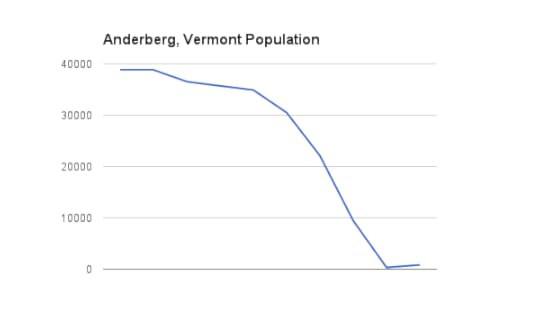
The book is kind of depressing, it's about a town dying. A home for forty something thousand people shriveling up, become unable to support and sustain the people who relied on it for their existence. It's the worst case scenario of towns eaten up by big stores, downtowns that couldn't compete with the internet, with dehumanized logics dictating company policies and then calling it the will of the marketplace. It hits home, living in a basically dead town for much of the 90's, seeing my hometown turned into a superficial facade of prosperity and overtaken by big stores, by policies in the company I work for devaluing employees and debasing quality in the name of words that don't even make any sense.

It's an articulate portrait of a lot things that depress the shit out of me if I think about. It's pretty fucking great.


He stands, brushes crumbs from his pants, pulls a fist of things from his pockets. From this jumble he pulls four dollars and forty cents--quarter, dime, nickel--and places same on the table. He turns to leave. But then he hitches, turns back, looks down takes the fort cents up again--levering each coin one by one--before pivoting, again, to go. He starts to walk away, slopes his head, stops, turns back to the table, puts the dime and nickel once again down.

The quarter remains within his fist, pinched between second and third fingers. Outside, he puts the coin back into his left front pocket, walks away.
Profile Image for Jeff Falzone.
15 reviews15 followers
August 9, 2013
My friend Karen introduced me to Goodreads. I still don't fully know Goodreads, only that I really love it. I just click and click and read interesting takes on all sorts of books I've read and never will read and constantly impressed by the huge brains and senses of humor that live here. So I'm big time grateful for the Goodreads intro by Karen.

And before Goodreads, Karen introduced me to Evan Dara's first novel, THE LOST SCRAPBOOK. It's hard to imagine anybody is reading this review who hasn't already read (or is at least aware of) TLS. I asked her to send me a great book and she mailed me that. Jesus.

I started and stopped the first twenty pages a few times. It was tweaking me and I wasn't snagged. Randomly, a few weeks later, I picked it up again and from page one it began to kill me. And then I just kept reading until I was finished. It was the right time in my life and all that, but even beyond all the me stuff, THE LOST SCRAPBOOK, page after page, produced sentences and stories and structures that delighted, absorbed and destroyed me. It opened me up. And ultimately it moved me immensely. It changed the way I understand "community", and, like all great writing, I couldn't believe the writing was so effortless and brilliant.

After SCRAPBOOK Dara wrote another masterpiece (even it's shortcomings, for me, can't touch the way it flames) called THE EASY CHAIN.

And now he brings us FLEE.

I simply don't know how to put in words what makes me love this g/uy's writing.* And I've hung around Goodreads enough to know that there will be at least 4 other reviews of this book within a year, each of which will find great ways of describing technically what Dara does with language that I find so awe inspiring.

I can say this:

Dara's writing is electrically visceral: Like when I read David Foster Wallace, I devour each sentence and can't wait for the next. And no matter how smart they are being with their vocabulary, their need to be smart never (for me) exceeds the tone they set for the telling. I get annoyed easily when reading "smart" books by writers who can use science metaphors to talk about anything and everything. But with DFW and Evan Dara, even when I know they are desperate to impress me, I also can feel/see how they are unyielding in carrying the characters forward. Every inch of each syllable gives a shit about who these people are and what they are experiencing.

Dara makes up words at an ee cummings pace. (if my Goodreading skills improve, i bet i can revisit this review and give examples eventually)

Okay but like I said, others can much better explain what I love about his writing on that level.

What I want to say about his stories- and FLEE is a great example- is how much Dara cares. That is what kills me.

To be perfectly honest, I don't know the degree to which THE LOST SCRAPBOOK is functioning in my reading of FLEE. I read Flee and from the beginning can see how much the town and the people mattered to Dara, but it's hard to know how much this comes from everything he reveals in his two other books.

I guess I'll find out because FLEE is an easier book to hand off, in terms of introducing people to Dara. It's shorter, he's more careful with his risks, which I don't think comes out of fear but, rather, out of a clean understanding of what this slimmer book needs to accomplish. Anyway, I'll be interested if readers who start with Flee experience it as caring as I do.

Because FLEE is also cold and unflinching. Dara evokes the picture of a town running away from itself and he only gives us little gusts of warmth along the way. But there is something in those warm gusts that makes all the difference for me.

Some of it is that I feel more human when I'm reading Dara. There is so much loss and sadness in his writing... I don't understand how it also give me actual hope. Maybe because he's not hiding. At all. That could be it. I feel more human but that means feeling more sadness and joy. He doesn't hide from all of the possibilities of who we are.

He doesn't hide. He's a brilliant writer. And he's found a new way- for me, at least- to voice something that's essential.

FLEE is like each of his books in the way he tells the story through a scattering of randomesque voices. Most of the talking is done in first person by people whom he doesn't name. And you begin in the middle of their comments and they are very quickly interrupted by other strangers. Sometimes the interrupter continues the story from her perspective and often they quickly jut it in a new direction.

This is Dara's way of giving a large and disparate and complex group of people a voice. One voice. All three of his books do it. And I've never experienced it before as a reader. It's like you are walking down a street full of divergent groups of people excitedly talking about the same thing. You catch wisps of conversation and slowly build a picture of who this place is. And that's uniquely Dara, I think: places are whos.

In FLEE the town is is called Anderberg but is clearly Burlington, VT. It is such a common cliche to say that in a movie or a book the setting is a main character. Dara isn't interested in the setting-as-main-character cliche because he obviously believes very deeply that locations/places/communities are active and actual presences. And more; the only constant theme in all three books is that meaning only happens via a complicated placement of opposites. He makes this theme fun and exciting and dramatic but his images are constantly those of the way "a" meaning is inherently composed of the way in which it is also intrinsically meaningful as its supposed opposite. (Again, in the future, I'll include some of his phenomenal sentences that do this so breezily)

I think that like any other writer who is doing something very unconventional, it mostly comes down to extremely arbitrary factors as to how much the writing transfixes you. If somebody is not excited by Evan Dara, I certainly don't think it is because they are missing something. No way. That's part of what I find so gripping; why does FLEE never let go of ME. Why do I suddenly cry and laugh reading sentences that aren't obviously sad or funny. There is something about me in this guy's writing and vica versa.

Needless to say, I couldn't be happier that Evan Dara refuses to be known. But, equally, I wish his books were.


*Since the writer chose a masculine first name, I'll just stay with 'he' as I refer to h/er in this review.

Profile Image for Kansas.
821 reviews488 followers
April 5, 2023

https://kansasbooks.blogspot.com/2023...

“- ¿Y si yo me fuera? ¿Quién lo advertiría, a quién le importaría?
¿Se notaría?
Por eso debo irme. Por eso debo dejar esta ciudad, librarme de ella. Dejar un lugar donde mi ausencia no se note. No seguir donde no importe que me marche, donde no importa que me vaya.”


Adoro esta cita que en un momento inesperado durante la novela me dio en la cara, como una bofetada porque... ¿se puede expresar mejor en qué nos hemos convertido en este mundo desangelado de prisas y huidas?? A priori el argumento sobre el cual Evan Dara construye esta novela es apasionante porque refleja los tiempos que vivimos, tiempos casi sostenidos en una visibilidad que si profundizas no es tal, una especie de castillo de naipes económico y social, tan frágil, que en cualquier momento puede producirse el derrumbe de todo un sistema y dejarnos desamparados. La seguridad es ficticia, una mentira. En algún momento tuve la impresión de estar sumergida en una especie de distopía, en un lugar de gente corriendo vaciando una ciudad agónica; una narración continuamente envuelta de una especie de atmósfera de ruidos, voces y pánico generalizado, de seres anónimos de los que no sabremos ni siquiera los nombres, y esto lo consigue Dara a través de una técnica narrativa que engancha tal como me enganchó La Cadena Fácil. Es un autor con un talento de superdotado para las palabras, para encadenar frases que tocan la esencia, que van al grano y que reconocemos como algo muy tangible de ahora mismo. A mi es un autor que me intriga muchísimo por cómo construye su texto, aparentemente puede dar la impresión de que no nos toca, de que está narrando con distancia, y de repente y zasss, en pleno texto, abandona lo colectivo y ahonda en el individuo, en lo más íntimo del ser humano "O sea, yo ni sé qué darle a un hijo, cuando todo es como arena que se escurre por un reloj. O sea, ya ni sé qué queda de mí."

"¿Que se hace con un error? Se arregla, se descarta, se elimina sin miramientos. Se corta por lo sano y a tomar por saco..."

Se podría decir que Huir comienza con un estudiante, que profundizando más allá de lo que se esperaba de él (un dato con mucha enjundia, porque, ¿quién espera a estas alturas que se profundice en algo hoy en día?), elige matricularse en un curso de sociología y de paso especializarse, y buscando aquí y allá, pronto descubre que ni el departamento que lleva estos cursos existe ni los cursos que aparecen en el programa aparecen por ninguna parte, solo existen en papel pero no son reales, son visibles pero son pura pompa de jabón. Una visibilidad por tanto engañosa ("La visibilidad está sobrevalorada."), una mentira que sin embargo sostiene económicamente a todo este pueblo de Anderburg, creando una especie de red que los mantiene unidos en todos los aspectos, pero sobre todo en el económico. A partir de ahí la universidad echa el cierre, y como en el dominó, todo lo que tocaba la universidad, va a su vez difuminándose, tanto que llegado un punto, Anderburg se convierte en una especie de espectro de lo que fue.

"¿Mi círculo? Lo delimito con una pregunta: ¿quién piensa en mí? ¿Quién vela por mis intereses?"

Aunque haya empezado hablando del argumento realmente en las novelas de Evan Dara este argumento no es tan importante o directamente no existe un hilo argumental como tal, o por lo menos, se puede decir que lo de verdad importante ocurre fuera de este foco. La mayor parte de la novela está construida en la técnica de la explosión de voces continuas que se pisan, se interrumpen, ni siquiera se escuchan, pero son un reguero incesante exponiendo un pánico creciente. Las conversaciones nerviosas, fragmentadas de personajes en ningún momento identificados, nos harán ir vislumbrando que aunque estas voces parezcan un gallinero sin ton ni son, realmente lo que están haciendo es precisamente mostrar una desorientación que los lleva a un estado de pánico en el que primer reflejo es la huida hacia adelante, dejando la ciudad completamente hueca, vacía... Esta cacofonía de voces me la encontré por primera vez en Los Reconocimientos de Gaddis pero aquí en Evan Dara, me suena mucho más creible, más natural, pero por otra parte es lógico ya que es una novela de ahora y de estos tiempos " -Reducir, recortar, ser más austeros, más mezquinos, más rigurosos, esa es la manera de avanzar, así es como funciona el mundo.” En medio de esta explosión de ruido, de frases sin terminar, de conversaciones de gente desesperada buscando una salida, hay tres personajes, Carol, Rick y Marcus, que de alguna forma podrían dar una apariencia de narración más tradicional, y es es cierto que son tres personajes con un objetivo marcado, el de no abandonar la ciudad, y así y todo, en mi caso concreto, ya no pude volver a desconectar de ese comienzo de novela de gente desesperada, desorientada y en pánico.

"-Y en el pueblo, ¿qué veo? ¿Por todas partes? Gente corriendo-"

Y por otra parte, el titulo elegido por Dara para esta novela Flee/Huir refleja como ninguno, no solo la agonía de estos tiempos nuestros, sino que a su vez define perfectamente el estado del individuo que al menor obstáculo en su vida, huye hacia adelante, prácticamente sin detenerse a analizar lo que está ocurriendo a su alrededor. Quizás sean unos síntomas de una enfermedad nunca reconocida, el individuo apoyado en una colectividad más frágil que nunca, cuya engañosa seguridad en sí misma no es otra cosa que pura apariencia, pura fachada. Evan Dara es sin duda uno de los autores más interesantes ahora mismo, el más guerrero, el que nos enfrenta al mundo que tenemos sin chaleco antibalas: "Hemos regado desesperación con tiempo y lo hemos llamado idealismo."

"Márchate. Corre. Los compromisos, las concesiones, el eterno bocado en el pecho nunca han valido la pena, jamás, siempre lo has sabido en lo más profundo de tus temblorosas células, tan adentro que no podías susurrártelo al oído hambriento, por temor a lo que pasaría."
Profile Image for Ian Scuffling.
178 reviews90 followers
September 7, 2013
Undoubtedly Dara's most accessible work--though, maybe slightly to its detriment. While it rides some lulls, the metanarrative on fragmentation of culture and expansion of capital gives this book weight beyond its pages. That isn't to say there aren't moments where Dara's classic touch with prose shines--particularly, the late chapter focused on Marcus, whose humble life alludes to some deeper tragedy he's working past, and numerous passages throughout are full of striking language. In Flee (as in his other books) Dara is masterful at making strong political insights without being topical or flimsy, and for that, this book is worth every iota of attention.

It's good to see that Dara can work outside of overtly experimental forms, but I hope that he (or she?) heads back to something more innovative next time.
Profile Image for Simon Robs.
512 reviews101 followers
February 23, 2018
I click on finished but am I? Is anyone ever finished w/a book like this, like did I even start? Further cacophonous jump-cut schizoid dialogo-humph jibber-jabber and like, where does that leave you but a small burg in Vermont where the gettin' seems good but why, why and how to, but no, no two ways about it just glean the hip bits, carry water chop wood. ED you're anything but limp biscuit 'specially when it cums to Laura Linney and fair trade dreams. Your stories are your stories but are they? And then you leave off....
Profile Image for Nathan "N.R." Gaddis.
1,342 reviews1,656 followers
Read
July 30, 2015
I’ve been very much enjoying my review=slump of recent reading. But I want to duck back into it just for a moment to declaim the greatness of Evan Dara. There’s really just one other contemporary author I compare him with, Jeff Bursey. Both authors do that kind of political fiction which, to my best understanding, is mostly pressed to the side by family stuff (Franzen et al) and/or individualist first=person=pov stuff. But here, in Dara and Bursey, we get a political fiction of a community (television does it with SoA and Deadwood and The Wire). And in both, quite coincidentally, but with form following content, we get a thoroughly orally-oriented language, a technic grounded in Gaddis. But maybe too, this community oriented politics, even as it’s perhaps so uncommon in today’s north american fiction, traces back to pre-WWII american fictions, those perhaps of Lewis’s Main Street and the like. Incidentally, I go to India for something similar, Rao’s Kanthapura. But whatever the aboutness here, do not miss Dara ; he’s doing a fiction kind of thing that we need more of. Criminally under=read.
Profile Image for Steve.
166 reviews39 followers
September 6, 2013
06AUG13. First reading in progress. So far so good! The melange of voices (and the skill with which Dara deploys them) is very Lost Scrapbook. Unlike its two predecessors, Flee is relatively short (239 pages) and has chapters. They're numbered not with integers but with five-digit figures that appear to be a countdown of sorts: sequential censuses of a dying town. (Like what Detroit's numbers might look like in a decade or two if things don't turn around.)

I posted some notes and miscellany and will continue to do so as the read progresses.

09AUG13. Done and WHEW. So many questions! Went right back and re-read several early chapters that mentioned characters who were figurants then but became much more later on.

Definitely more to come here and on my own page.

12AUG13. Happy Aug. 12, a.k.a. "That Crafty Kid From Rutland" Day (pp16-17)
Profile Image for Christopher Robinson.
175 reviews121 followers
September 14, 2020
A wonderful novel about the slow unraveling of a small town and the drifting apart and away of its inhabitants, and about the proud few who elect to stick around and attempt to bring the increasingly ghostly town back to life.

Chapter X, in particular (the Marcus section) was my favorite. Truly beautiful writing, and ironically among the very simplest Dara has put to paper to date.

Alternately hilarious and deeply sad, Flee is another terrific work from Evan Dara, who has now officially become one of my very favorite living authors.

Highly recommended. Would be a good intro to Dara for readers wanting to see what he’s about without committing to one of his larger works. (Personally though, I think he’s best read in order.)
Profile Image for alex.
37 reviews52 followers
September 4, 2013
Another treat from the mind of Evan Dara that seemed to come out of nowhere (Aurora/Dara appears to do zero PR for his books beyond an email blast to previous customers), Flee finds the author in breezy, digestible form. While it doesn't reach the peaks of The Lost Scrapbook or The Easy Chain, I can't help but highly recommend it.

Anyone familiar with Dara's style will find much to love here (the chorus of many, many voices that diligently work through accretion to create the hilarious or sad depictions of the everyday that typify his works, the breakneck speed of his prose, the sheer readability of the text...). My preference goes to TLS and TEC simply because in those books Dara is able to cut loose by virtue of what he sets out to achieve. Flee, with its constrained length and relatively narrow narrative conceit, feels a bit stifled to me comparatively.

I'm not sure Dara necessarily NEEDS to write tomes, but at least so far he has impressed me most when he allows himself to stretch out.
8 reviews1 follower
March 26, 2023
Un libro desconcertante que pone al lector al límite. Haba de un pueblo donde los habitantes desaparecen debido a una fuerza/enfermedad/sea lo que sea que nunca se menciona. Un cruce de Kafka y Winesburg Ohio pasado por el tamiz posmoderno de Evan Dara
Profile Image for Phil.
142 reviews20 followers
August 4, 2014
Dystopia fiction is adored but played out. We know its landmarks and trajectories. We ride the well worn ruts of its trails.

While not dystopian fiction per se, Flee parallels the genre and ups the ante by making it refreshing, compelling, and once again disquieting. Flee revolves around the unexplained collapse of a community, Anderberg, Vermont. The inertia that holds it and its peoples' lives together has been suspended. Little things once taken for granted--the touchstones of the everyday--wither, whether stable schools, predictable stores, and neighbors, acquaintances, and friends, etc. One calls a coworker only to get no answer (they fled). One goes to a store to find it closed (owner fled; employees followed). One tries to go to class (school's shut down). City hall becomes a hollow fortress. In short, characters learn that they have no reason to expect the predictable parameters of their pasts to continue in their presents and futures. Anderberg becomes a zombie town (complete with lonely holdouts and "zombies" (the shims)).

By bringing the scope to this quotidian level, Dara makes a new, chilling dystopia. For the residents who remain while other flee, it's like they're watching their solipsistic visions of the world rapidly decompose, implode. All that remains are the shadows of memories, and the dissonance and doubt. Existential questions underscore it all, like, what constitutes a community? What constitutes an identity? How does someone derive purpose?

The voices Dara summons from this world add dimension and gravity. We feel their engagement and panic, their denial, conspiracy theories, acceptance, and attempts at progress forward (vs. surrender to stagnation).

Progress forward appears to be a "moral of the story." While systems are robust in the grand scheme of things--they adjust to equilibrium eventually--they do not guarantee the protection of the individual in a crisis or its wake. All one can do is flee or stand firm. If one stands firm, he can only continue forward by accepting everything in gratitude and without attachment (hence the penultimate chapter where Marcus goes part Messiah, part I am Legend).

As a bit of trivia/exhibition, note that Dara begins each chapter with a population count. If every chapter is treated the same (i.e., no compensation is made for their heterogeneous time periods), Anderberg's population looks like the following:


All of the above might sound a bit glowing, but a number of things do not work well in Flee.
* Sometimes the literary device-ness of characters is too transparent (e.g., Ian, JFK, et. al.)
* The Marcus chapter, though pleasant and interesting, ultimately falls short. It feels half fleshed out. I wonder if Dara realized that the cost of making it whole was prohibitive.
* The town itself never felt like a community. Granted, we start at the beginning of the exodus, but by not establishing the stakes, I didn't really feel the characters' senses of loss. Well, I did, but only after suspending my disbelief.
* Sometimes language and plot points were rough.

These demerits didn't earn Flee its three-star rating. It earns its rating because it lacks that sort of ineffable x-factor that makes a book feel agonizingly alive. Ultimately, my standards are more capricious and inscrutable than I otherwise pretend.

And for a bit of Dara speculation, I wouldn't be surprised if he had some sort of background in economics (my training and occupation)--not an advanced degree or anything, but perhaps an undergraduate minor. He casually yet sensibly employs its concepts, e.g., pareto efficiency, supply and demand, regression analysis, etc. Compare this to the likes of, say, DFW, who despite his attempts to portray the contrary, only had a basic understanding of economics (see, e.g., his not infrequent invoking of elasticity). Dara does not come across as a tourist to this world.
Profile Image for Guillermo.
299 reviews169 followers
March 24, 2023
«El altruismo se acaba a la hora de repartir beneficios»
.
.

Un estilo inconfundible para narrar la irracionalidad del neoliberalismo.
Profile Image for Brent Hayward.
Author 6 books72 followers
October 11, 2020
Competent, and clever, but reads more like a carefully groomed experiment in fiction than experimental fiction, and remains chillier for it. The population of a town in Vermont diminishes, told through dialogue; a couple of losers make plans. Apparently, the mysterious Dara claims never to have read Gaddis?
Profile Image for Zack.
138 reviews9 followers
January 20, 2024
Of two minds regarding Evan Dara’s Flee. The author is clearly an intelligent, astute commentator on contemporary American culture. This book captures some of what I feel are the central national ideologies of the 21st century - that the dream ain’t big enough for all of us, that we have a fundamental inability to prioritize the good of the “we” (as in “we the people”) and thus the “I” in favor of fear of the “other”. He also conveys these ideas in a very striking style:

“–Oh, my. I mean, I look around and…and what is my context? What can I do — can I mean — what can I possibly do that would–

–Am I just a receptacle? Am I not supposed to have some bearing on things? I look and see and look and see. But one thing I do not see. Where am I in–“

And the manifestation of this conflict is the American small town. These places are romanticized as harmonized “communities” when in fact they are microcosms of this we/other conflict - and also subject to the whims of economic and political systems that are seemingly divorced from their personal lives. I think the novel is very smart in its characterization of the home. In light of the 08 crisis, the home is really just a tiny division of the “housing market” - a single unit of potential profit in a empathetic-less system, not a source of continuity and family as we’d like to believe. And the book also captures this sense that in the time following the 08, “too big to fail”, crisis things could have been built back differently, that there was a moment where we could have radically rethought our way of living, but we didn’t.

All that said, I didn’t really enjoy reading the book. The first half is very straightforward despite its experimental structure, to the point where it was hard to stay interested. And then the second half becomes very philosophical and abstract, to the point where I was pretty lost - weirdly less so with the thematic direction of the novel, but more of the basic plot progression. So it’s a book I have immense admiration for, but I don’t really like it. Weird.

“But of course. We’re joining the future. Everything everywhere turning into bits, into dust, to data, to imperishable prickles, and now we are too…It must happen here, when here is transvestite everywhere. And so we vanish. Do you get this?: Fear of vanishing begets vanishing. For by vanishing we become stronger – we become eternal. Dematerializing we find diamond-solidity. Anti-dimension can only expand. Non-being is the best defense. Only absence lasts forever.”
Profile Image for Jeffrey Paris [was Infinite Tasks].
64 reviews17 followers
November 23, 2013
I love that there is such a person in the world as Evan Dara - or at least someone pretending to be Evan Dara - for the sake of challenging what we believe to be literature. I love the ideas in Flee, at least the ones I could pick up, better than the execution, which is somewhat different from The Lost Scrapbook, in which the execution was absolutely mesmerizing. But then again, why bother having an actual opinion of an Evan Dara novel after reading it only once? Until or perhaps upon the event of such a re-read, I would be embarrassed to have given this less than perfect adoration. Meanwhile, -- what is the population of your town? -- are you paying attention?
1,272 reviews24 followers
June 13, 2017
evan dara goes apocalyptic via william gaddis. i mean, not really. flee is a mostly unattributed dialogue account of the residents of a town in vermont leaving it. this dialogue is the gaddis: the speech is interruptive and full of its own idiosyncratic rythmns , like walking down a sidewalk and picking up the pieces of a hundred conversations all feeding the town's narrative. you get a sense of place. each chapter notes , as its title, the dwindling population. interrupting the unattributed dialogue is the story of two people trying to start a business that brings jobs and people back to the town. it's a novel about the moral decay of capitalism and the failures of collectivism, bizarrely compelling considering how tied up it is in the minutiae of red tape and bureaucracy. it's almost all form, with no emotion until it diverges in the penultimate chapter to tell the story of yet another person trying to start a business in the failing town, and then a sort of narrative's worth of emotional reckoning emerges in a very short period.

dara is immensely talented and is ever evolving; he represents on of only a few people that seem to be pushing the form forward aesthetically.
Profile Image for Yonina.
171 reviews
January 17, 2022
I am still figuring this one out. Hell, I’m still figuring out Permanent Earthquake and The Lost Scrapbook. TLS is still my favorite for its euphoria and the blatant genius of its transitions, its richness of feeling. PE stumped me: as much as Dara’s talent with voices blows me away, I don’t thrill to the characters he narrates from without. This was in between. The interest in PE in a highly regulatory world built on enforcing some inexplicable power structure becomes clearer. So does the antirealism, the invented scenarios that drive instability. Those scenarios in Flee are not even consistent; they’re a shifting target, starting with a very Gaddisian financial collapse (felt like JR narrated from a victim’s perspective), momentarily suggested to be a pandemic or plague or communal poisoning, then earthquakes,…. ultimately only impossible hopes, or pathological gratitude, can combat A-Berg’s failure.

The least I can say is that Dara wants to see what happens when a world collapses but something keeps us stuck in the spot: financial, emotional, geographical. Those in Flee who Flee are gone. Those who remain, in this book, have a strange, empty self, a thematic pathos but their (presumed) hidden anguish is not permitted to surface.

Echoes: Gaddis; Gass; Philip K Dick
Profile Image for j2c6.
78 reviews15 followers
April 18, 2023
Leer a Evan Dara, uno de los grandes escritores contemporáneos escondidos tras un pseudónimo, se parece a sintonizar una radio de conversaciones humanas. En este caso, en 'Huir', nos encontramos ante el declive de Anderburg, una ciudad de la parece que se está huyendo y nunca llegamos a conocer el motivo. Y se diría que la propia ciudad, es un ente, un protagonista en forma de personajes, especialmente Carol, Rick y Marcus, pero también otras decenas de voces anónimas. Acostumbrándote a sintonizar esa radio sin entender muy bien el contexto, esta novela pasaría por novela de intuición, y esa sensación de estar perdido parece que es el mismo shock que rodea a los personajes, pero que al igual que el lector pasa las páginas, no les impide intentar seguir avanzando. Es anterior al COVID, inevitablemente me lleva a esa etapa, donde en cualquier caso, es la experiencia en sí, la obligación de reinventarse y sobrevivir en un mundo caótico y cambiante como esta novela especulativa.
Profile Image for Pete.
760 reviews1 follower
January 30, 2014
Five stars for being legitimately inventive and challenging but also funny and humane. The first 2/3rds are the story of a Burlington VT manqué town that's rapidly losing population, told in a sort of chorale bouquet of dialogues, played in equal parts for laughs and depth. This first chunk is cut through with scenes of these two Anderburgians, Carol and Rick, as they feebly try to start a job placement agency in their dying town. The last chunk doesn't quite cohere in the end--it's the story of Marcus, one of the last people in town, getting stoned and being sustained by mysterious grocery deliveries and dreaming up a religion based on gratitude. There's not much of a plot but it doesn't matter. I am really glad I read this and will be checking out Dara's other novels, although I am going to take a lengthy break to read slightly less heady stuff before tackling those.
980 reviews16 followers
September 28, 2013
a tangling of voices and fragments of conversation gradual reveal a small Vermont town in steady bubble-burst.
Profile Image for Logan Suzanne.
73 reviews
January 15, 2024
The idea of writing a town's descent into economic instability using snippets of conversation from the town's citizens is a good one. Unfortunately, the characters themselves do not hold this narrative up for me. I found each of the main characters to fit somewhere on a spectrum from "boring" to "unlikeable," which is particularly daunting when the story itself is bleak. If the worldbuilding had been on par with that of "1984" (which suffers from a similar character issue in my eyes), I don't think I would take such issue with the protagonists. But aside from some fittingly bleak, concise descriptions, I did not find myself pulled into the town of Anderburg.

My copy of the book killed itself in my hands as I read. The pages came loose from the binding, leaving me with a stack of papers nestled between covers. This actually made the reading process more pressing, because I had no choice but to plan out reading for times when I would be within proximity of a flat surface. Other than that, my main compulsion to finish the book lies in its central story of how big companies like RiteAid and Amazon destroy local businesses, rendering local culture unstable.

Overall, I think this story is one worth telling, but I definitely wanted more out of the characters. Their lack of presence for me, as a reader, left me unsatisfied. And Marcus was definitely not the protagonist I wanted to see this book end with... His ego made his segment a test of endurance. I do not enjoy being philosophized to by a character who is self-involved to such a degree that he considers other citizens "shims."

From page 80:
"I must run so as not to be run from."
Profile Image for javor.
169 reviews1 follower
May 29, 2025
Imagine quickly switching radio stations, only catching brief glimpses of each one, but the fragments of sentences seem to form something when heard sequentially: “The first thing—” “—of notice—” “—is the all new Match—” “—making services available—” etc. Reading this book feels something like that, where the story they form is that of a town silently collapsing as its residents flee. Turning the postmodern hellscape of the 2008 crash into literary form, Dara seems to capture the kind of televisual chaos found in rushed side effect warnings in prescription drug ads or the idle chatter of a 90s sitcom. All in one, the flight of the town seems to engender and/or be engendered by the dissolution of the community, of the social bond, of general societal cohesion, of the economy, of the subject, of the plot, of the narrative. The book felt at times like it was delving into some postmodern-y narrative nihilism, often feeling like it was so experimental it was just wasting your time. But still an interesting approach to the 2008 crash that is worth reading.
Profile Image for Will.
150 reviews
April 11, 2024
A few words from other reviews: chilly, ambivalent, not quite experimental. A technique that worked for me - alternating fonts between the story of Carol and Rick, and the overall narrative stream. A technique that didn't - referring to Burlington as "Anderberg" despite swimming in clear references to neighboring towns, local businesses, and even streets.

Dara deftly captures the voice of Vermonters such I felt listening in on actual conversations. However, I remained unclear on the intent throughout - the effect is of a literary exercise.
Profile Image for Stewart Mitchell.
549 reviews28 followers
March 15, 2025
Hate to say it, but this was a bit of miss from Dara. It retains the sociological voice of The Lost Scrapbook and The Easy Chain, but the writing feels noticeably weaker than it did in those books, and almost everything that’s happening thematically in Flee seems like a rehash of his past work. I do still enjoy his perspective, and there are some cool structural decisions here, but even at half the length of his last 2 novels, this one was a chore to get through.
Profile Image for Ezra James.
10 reviews2 followers
December 1, 2024
If there’s any modern writer that deserves more recognition for his originality and depth it is most certainly Evan Dara. Despite his lack of mainstream literary recognition it’s almost impossible not to be amazed by his body of work once it’s read. He belongs to be mentioned in the same breath as Pynchon, Cormac, Gaddis, and David Foster Wallace.

Flee is Dara’s third novel and a deviation from his previous ones. While he retains the same succinct style similar to Gaddis’ in JR, this book incorporates a linear side story right in between the thoughts and dialogues of anonymous and known sources. Like before, the intrigue lies in how the reader slowly pieces together what’s going on, and marvels at the mastery of subject and tone, with Dara never deviating from the two as and smoothly drives the story forward. This combination is the reason why it’s probably my favorite of Dara’s novels (with The Lost Scrapbook a close second) and my pick for the book to read if you want get better acquainted with his style before delving into the heavy hitters.

PS: I can’t help myself in that I’m already speculating what Dara’s next novel is going to be, and since he doesn’t have a big enough following to start a discussion I was wondering if people who have read his work have any thoughts about what his next book will be. Regardless of the plot a part of me really wants (in a masochistic sort of way lol) for a big 700 page epic going back to the style of The Lost Scrapbook. I yearn for a Dara maximalist novel.
Profile Image for Sam.
Author 3 books8 followers
Read
March 31, 2016
Hoooo boy. I did not know what I was getting into here. I will read this book again. Hopefully sometime soonish. I suspect the second reading will be more enjoyable (not to say I didn't enjoy it this time), however I'm not convinced I'll end up with any clearer of an idea about what actually happened. I'm going to hold off on giving Flee a star-rating for now.
Profile Image for Geoffrey.
654 reviews17 followers
September 28, 2015
A little ambivalent about this one. Maybe I'm just prejudiced towards thicker books. Maybe it was a bad idea to read all of Dara back-to-back-to-back. Or...maybe this really IS a bit lightweight compared to its predecessors. In any case still worth reading, though.
Displaying 1 - 29 of 29 reviews

Join the discussion

Can't find what you're looking for?

Get help and learn more about the design.