

What do you think?

Doctor Who Target Books (Numerical Order) #65
Doctor Who and the Time Warrior
His spaceship crippled in an interstellar battle, the Sontaran warrior Linx is forced to crash-land on Earth. He arrives in the Middle Ages, a time too primitive to provide the technology he needs to repair his ship. Allaying himself with the local robber chief, Linx uses his powers to "borrow" scientists and equipment from twentieth-century Earth. The Doctor tracks down the missing scientists and journeys into the past to save them. But can he defeat the ruthless Linx and his savage human allies before the course of human history is changed forever? Doctor Who and the Time Warrior is based on a 1973 TV serial starring John Pertwee.
144 pages, Paperback
First published January 1, 1978
About the author
Terrance Dicks
344 books225 followersTerrance Dicks was an English author, screenwriter, script editor, and producer best known for his extensive contributions to Doctor Who. Serving as the show's script editor from 1968 to 1974, he helped shape many core elements of the series, including the concept of regeneration, the development of the Time Lords, and the naming of the Doctor’s home planet, Gallifrey. His tenure coincided with major thematic expansions, and he worked closely with producer Barry Letts to bring a socially aware tone to the show. Dicks later wrote several Doctor Who serials, including Robot, Horror of Fang Rock, and The Five Doctors, the 20th-anniversary special.
In parallel with his television work, Dicks became one of the most prolific writers of Doctor Who novelisations for Target Books, authoring over 60 titles and serving as the de facto editor of the range. These adaptations introduced a generation of young readers to the franchise. Beyond Doctor Who, he also wrote original novels, including children’s horror and adventure series such as The Baker Street Irregulars, Star Quest, and The Adventures of Goliath.
Dicks also worked on other television programmes including The Avengers, Moonbase 3, and various BBC literary adaptations. His later work included audio dramas and novels tied to Doctor Who. Widely respected for his clarity, imagination, and dedication to storytelling, he remained a central figure in Doctor Who fandom until his death in 2019, leaving behind a vast legacy in television and children's literature.
In parallel with his television work, Dicks became one of the most prolific writers of Doctor Who novelisations for Target Books, authoring over 60 titles and serving as the de facto editor of the range. These adaptations introduced a generation of young readers to the franchise. Beyond Doctor Who, he also wrote original novels, including children’s horror and adventure series such as The Baker Street Irregulars, Star Quest, and The Adventures of Goliath.
Dicks also worked on other television programmes including The Avengers, Moonbase 3, and various BBC literary adaptations. His later work included audio dramas and novels tied to Doctor Who. Widely respected for his clarity, imagination, and dedication to storytelling, he remained a central figure in Doctor Who fandom until his death in 2019, leaving behind a vast legacy in television and children's literature.
Ratings & Reviews
Friends & Following
Create a free account to discover what your friends think of this book!
Community Reviews
Displaying 1 - 30 of 32 reviews

June 24, 2019
One of the nice quirks of these Target novelisations is the slight randomised publication order.
With The Sontaran’s having just appeared on screen for the third time, it’s quite fitting that their introduction made it to print a few months later.
This allows for a wonderful prologue by the original story writer Robert Holmes to include all the established backstory of the war with the Rutans.
Holmes asked Script Editor Dicks to complete this novel, which he achieves seamlessly.
I’ve got a real fondness for this serial, it really is a story of firsts as new companion Sarah Jane Smith is introduced. The journalists plucky quest for the truth has made her one of the shows most popular characters.
It’s also the first and only (televised) historical story featuring the Third Doctor.
Plus he’s home planet of Gallifrey is named for the first time...
An alien race arriving in medieval England is what Doctor Who does best.
The supporting characters reactions to the unknown are practically great. The cry’s of the sky is falling when Link’s ship arrives and Irongron’s constantly calling him Toadface are practically memorable.
With The Sontaran’s having just appeared on screen for the third time, it’s quite fitting that their introduction made it to print a few months later.
This allows for a wonderful prologue by the original story writer Robert Holmes to include all the established backstory of the war with the Rutans.
Holmes asked Script Editor Dicks to complete this novel, which he achieves seamlessly.
I’ve got a real fondness for this serial, it really is a story of firsts as new companion Sarah Jane Smith is introduced. The journalists plucky quest for the truth has made her one of the shows most popular characters.
It’s also the first and only (televised) historical story featuring the Third Doctor.
Plus he’s home planet of Gallifrey is named for the first time...
An alien race arriving in medieval England is what Doctor Who does best.
The supporting characters reactions to the unknown are practically great. The cry’s of the sky is falling when Link’s ship arrives and Irongron’s constantly calling him Toadface are practically memorable.

December 6, 2021
This is a novelization of the first adventure of the eleventh season of Doctor Who, which was broadcast in December of 1973 into January of 1974. Robert Holmes wrote the teleplay and the first section of this adaptation of it but for some reason did not continue and passed it along to Terrance Dicks to complete. His contribution to the novelization was uncredited. The story features the third regeneration of The Doctor and introduces journalist Sarah Jane Smith as his plucky new companion. The story also introduces Sontarans, who would return many times in years to come. Linx is a Sontaran commander whose ship crashes in medieval England; he travels to contemporary England and kidnaps scientists to force them to make repairs to it, and Brigadier Lethbridge-Stewart and The Doctor investigate their disappearance. Sarah Jane stows away aboard the TARDIS and the rest is (literally) history.... It's a fast-paced, fun story, very cleverly plotted with a good character mix.

September 15, 2014

This serial was first shown in 1973-4, and features the Third Doctor and Sarah Jane Smith in her first adventure. It is also the first appearance of the Sontarans, the potato headed war obsessed aliens who are now a bit of a joke in Nu Who (though I love Strax), but here come across as pretty nasty and scary. The Doctor also mentions Gallifrey for the first time in this story. I remember this one a little bit and seem to recall enjoying it. At only 4 episodes it was pretty zippy for a classic Who story.
The book does a very good adaptation here. From the first, you have an exciting space battle between Lynx, the Sontaran commander, and his enemies the Rutans. From there, you get the mystery of the disappearing scientists in the 20th Century quickly laid out, the Doctor is tasked to finding them by the Brigadier, and then Sarah Jane stows away in the Tardis. The rest of the story is set in Medieval times, and is a thrilling clash between the Doctor, Lynx, and two groups of knights (one good and one bad of course). Lots of daring escapes, sword fights and liberal uses of arrows here.
The style of the book shows an admirable economy and terseness of style, a necessity given its short length (144 pages, which is still longer than a lot of these books), but one which serves to hurry the action along well. Sarah Jane Smith is well served in this story, showing in her first outing why she was to become such a favourite companion. She is plucky, smart and outspoken here, and there's certainly no screaming on her part. The Doctor also comes across well, using his cunning and intelligence to outsmart the primitive people around him, though also fighting when he needs to (the sword fight in armour is a highlight here). His concern for the well-being of everyone, even his enemies, is also shown. Lynx comes across as pretty bad-ass, using any means necessary to get himself back into his battle, including kidnapping and brainwashing scientists from the modern era to help him repair his ship, but also showing cunning and ruthlessness with bad knight Irongron and his band of less-than-merry men.
The Medieval setting is a lot of fun too, though I had to laugh when they had Sarah Jane peeling potatoes in the castle's kitchen a good few centuries before they came to Britain from South America (the potatoes that is, not Sarah Jane). There's lots of costume changes, no doubt aided by the BBC's extensive costume department (one of the main reason why Doctor Who spent so much time in the past no doubt, so not forgetting the series original educational purpose).
If I had a quibble about this story, it was in wondering why the Doctor didn't just take the kidnapped scientists home in the Tardis. He could have easily left them hypnotised until he got them back if he was worried about them talking, then deprogrammed them later. For that matter, why did the Sontarans have the ability, no matter how crudely, to travel through time? If they could time travel this easily why didn't they use this ability to destroy their hated enemies the Rutans, and I don't recall them ever mentioning this ability again. It's a bit of a wibbly wobbly timey wimey problem in an otherwise great story though, and its one I recommend.
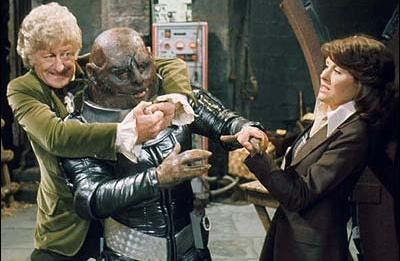
Edit: I've just watched Robots of Sherwood, and it's basically the same story. If you're going to pinch a storyline from classic Who, at least they picked a decent one.
May 15, 2022
Slightly above average read. Some fun characters but nothing amazing etc

October 29, 2014
The best of both worlds: this is actually a collaboration. Original screenplay writer Robert Holmes writes the evocative and absorbing prologue of the book, and Terrance Dicks seamlessly follows up with his own inimitable style. The end result is two contributors to the greatness of the televised Jon Pertwee era combining to extend that greatness to the Pertwee era novelizations. We should all be thankful that Robert Holmes finally overcame his writer's block for prose and eventualy contributed "The Two Doctors" to the Target range; the opening pages of "The Time Warrior" are a pointer to that later greatness.
December 23, 2024
The story behind how this book was written is one of my favourites because it perfectly highlights the difference between speed over quality when it comes to writing.
There are writers out there who are quick at what they do because they work hard and fast; writers like Stephen King who keep to 6,000 words a day, or Jeffrey Archer who write 27 hand-written drafts of a novel before they're satisfied with it, or Anthony Burgess who wrote 'A Clockwork Orange' in the space of just three weeks.
But then you get writers like Susanna Clarke who take 15 years to write a novel, whether it be the mammoth-sized 'Jonathan Strange & Mr. Norrell' or the slick-sized 'Piranesi', and averages a short story once every 18 months. But my God, what novels and stories she produces.
Apply this logic then to Terrance Dicks and the Target Books. By this point in time their Doctor Who range was practically a cottage industry with Dicks right at the centre of it. Between 1977 and 1980 the number of novelisations Dicks would publish with Target would reach a peak of 27 books, roughly half of the total 65 he would write for the firm by the time it was closed down in 1994.
Throughout this time Dicks was also serving as the unofficial editor of the range, a responsibility which entailed contacting the original authors to see if they were interested in novelising their own work, or whether they would prefer the Dicks method: "I do all the work and you get half the money."
Unsurprisingly due to the low royalty rates most authors chose the latter and kept Dicks busy with work throughout the duration. But one writer who did take up the request was Robert Holmes, a friend of Dicks and his successor as script editor for Doctor Who who wrote many of the classic serials from this period.
Including this story, 'The Time Warrior', which not only opened Pertwee's final season but also included the first appearances of Sarah Jane Smith (as played by the wonderful Elisabeth Sladen) and the Sontarans. Although it was a story that Holmes was not initially fond of due to its historical setting, he agreed to write a novelisation of the script for Dicks and the Target Books range.
The books were supposed to be completed at a high-rate of turnover and after several months with no word Dicks suddenly received a bundle from Holmes in the post. It consisted of just eight pages of manuscript along with a note from Holmes saying: "Tried my best, now you do the rest." The pages were for the opening prologue a common feature of many of these books employed to lend them a more novel-like feel as they often used material not present in the original script.
Of these pages Dicks said this: "They were the best pages I'd ever read... I'd have given my right arm to be able to write pages like that... But not at the price of doing them at Bob's speed." The pages were kept in the book and Dicks finished off the rest of the book. He did a pretty standard job, lovingly reprinting some of the best lines of Holmes' dialogue from the original script, including my all-time favourite line about Jon Pertwee's nose from Irongron: "Is this 'Doctor' you seek a long-shanks knave with a mighty nose?" It's the kind of line only someone very familiar with the cast could have written and gotten away with.
What stands out to me now though about 'The Time Warrior' is just how much agency the secondary characters are given in this story. Usually in most Doctor Who serials the story only picks up once the Doctor turns up on the scene and from there it goes at the pace of a roller coaster until we get to the finale (the best example of this being in 'Doctor Who and the Sunmakers' also by Robert Holmes and also novelised by Terrance Dicks).
But here the Doctor doesn't really become involved with the action until the end of the first part of the story. It's Linx, the Sontaran warrior stranded in medieval England, that propels the story forward at the beginning, and then after that it's Irongron, the robber baron, and Sarah Jane, the new companion and reluctant time traveller, that propel the story forward in those moment where Pertwee's Doctor is busy trying to play catch-up with everyone else.
This adds an extra element of excitement to the story, a sense that you can rely on the extra characters to do something exciting when the time comes instead of just sitting about waiting for stuff to happen. It's almost a shame when the story comes to an end and a lot of these characters are very quickly bumped off in the space of the last five minutes. Makes it all feel very rushed, it was a shame to see Irongron wasted as well who, if he survived, might very well have become some figure of legend, rather like General Woundwort in Watership Down, a fiercesome figure out of myth who still prowls the woodlands in search of a new castle to serve as his seat.
There are writers out there who are quick at what they do because they work hard and fast; writers like Stephen King who keep to 6,000 words a day, or Jeffrey Archer who write 27 hand-written drafts of a novel before they're satisfied with it, or Anthony Burgess who wrote 'A Clockwork Orange' in the space of just three weeks.
But then you get writers like Susanna Clarke who take 15 years to write a novel, whether it be the mammoth-sized 'Jonathan Strange & Mr. Norrell' or the slick-sized 'Piranesi', and averages a short story once every 18 months. But my God, what novels and stories she produces.
Apply this logic then to Terrance Dicks and the Target Books. By this point in time their Doctor Who range was practically a cottage industry with Dicks right at the centre of it. Between 1977 and 1980 the number of novelisations Dicks would publish with Target would reach a peak of 27 books, roughly half of the total 65 he would write for the firm by the time it was closed down in 1994.
Throughout this time Dicks was also serving as the unofficial editor of the range, a responsibility which entailed contacting the original authors to see if they were interested in novelising their own work, or whether they would prefer the Dicks method: "I do all the work and you get half the money."
Unsurprisingly due to the low royalty rates most authors chose the latter and kept Dicks busy with work throughout the duration. But one writer who did take up the request was Robert Holmes, a friend of Dicks and his successor as script editor for Doctor Who who wrote many of the classic serials from this period.
Including this story, 'The Time Warrior', which not only opened Pertwee's final season but also included the first appearances of Sarah Jane Smith (as played by the wonderful Elisabeth Sladen) and the Sontarans. Although it was a story that Holmes was not initially fond of due to its historical setting, he agreed to write a novelisation of the script for Dicks and the Target Books range.
The books were supposed to be completed at a high-rate of turnover and after several months with no word Dicks suddenly received a bundle from Holmes in the post. It consisted of just eight pages of manuscript along with a note from Holmes saying: "Tried my best, now you do the rest." The pages were for the opening prologue a common feature of many of these books employed to lend them a more novel-like feel as they often used material not present in the original script.
Of these pages Dicks said this: "They were the best pages I'd ever read... I'd have given my right arm to be able to write pages like that... But not at the price of doing them at Bob's speed." The pages were kept in the book and Dicks finished off the rest of the book. He did a pretty standard job, lovingly reprinting some of the best lines of Holmes' dialogue from the original script, including my all-time favourite line about Jon Pertwee's nose from Irongron: "Is this 'Doctor' you seek a long-shanks knave with a mighty nose?" It's the kind of line only someone very familiar with the cast could have written and gotten away with.
What stands out to me now though about 'The Time Warrior' is just how much agency the secondary characters are given in this story. Usually in most Doctor Who serials the story only picks up once the Doctor turns up on the scene and from there it goes at the pace of a roller coaster until we get to the finale (the best example of this being in 'Doctor Who and the Sunmakers' also by Robert Holmes and also novelised by Terrance Dicks).
But here the Doctor doesn't really become involved with the action until the end of the first part of the story. It's Linx, the Sontaran warrior stranded in medieval England, that propels the story forward at the beginning, and then after that it's Irongron, the robber baron, and Sarah Jane, the new companion and reluctant time traveller, that propel the story forward in those moment where Pertwee's Doctor is busy trying to play catch-up with everyone else.
This adds an extra element of excitement to the story, a sense that you can rely on the extra characters to do something exciting when the time comes instead of just sitting about waiting for stuff to happen. It's almost a shame when the story comes to an end and a lot of these characters are very quickly bumped off in the space of the last five minutes. Makes it all feel very rushed, it was a shame to see Irongron wasted as well who, if he survived, might very well have become some figure of legend, rather like General Woundwort in Watership Down, a fiercesome figure out of myth who still prowls the woodlands in search of a new castle to serve as his seat.

August 25, 2021
It’s sometimes a shame when a Terrance Dicks book doesn’t add much new to the original story and that’s essentially what happens with Doctor Who and the Time Warrior, adapting The Time Warrior. While the book, and indeed the audiobook narrated by Jeremy Bulloch, does have all the charm of a Terrance Dicks book, this one seems almost like it was rushed. With Dicks’ other works you can get a sense that care is taken to see what can be done to translate from screen to page and enrich some of the text with that usual charm. For instance, Doctor Who and the Auton Invasion and Doctor Who and the Terror of the Autons both introduce new companions from their television stories and give them their own internal monologues and lives, as well as giving the villains of those stories some more depth.
Here, this is just a one to one translation of the television story onto the page except for the prologue. The prologue is the only thing that deviates, showing Linx crashing into the Milky Way and eventually the Earth which does give the reader something about the Sontarans and Rutans which is great, but this was actually from the mind of Robert Holmes. Holmes originally wished to write this book himself, but apparently only submitted three pages before Dicks was brought in to actually write the book. There isn’t any indication that he was rushed, but outside of some very minor character notes, with the Doctor and the Brigadier having more interactions at the beginning, it feels like Dicks may have been rushed.
Overall, Doctor Who and the Time Warrior is simply inferior to its television counterpart, with the major issues coming from the fact that it doesn’t change enough to actually feel like a novelization. All of the dialogue feels reproduced from the television story, which is very possible as it was released only four years from the initial broadcast so the tapes were there to watch. It’s still decent, The Time Warrior is a great story even if this isn’t a great adaptation. 7/10.
Here, this is just a one to one translation of the television story onto the page except for the prologue. The prologue is the only thing that deviates, showing Linx crashing into the Milky Way and eventually the Earth which does give the reader something about the Sontarans and Rutans which is great, but this was actually from the mind of Robert Holmes. Holmes originally wished to write this book himself, but apparently only submitted three pages before Dicks was brought in to actually write the book. There isn’t any indication that he was rushed, but outside of some very minor character notes, with the Doctor and the Brigadier having more interactions at the beginning, it feels like Dicks may have been rushed.
Overall, Doctor Who and the Time Warrior is simply inferior to its television counterpart, with the major issues coming from the fact that it doesn’t change enough to actually feel like a novelization. All of the dialogue feels reproduced from the television story, which is very possible as it was released only four years from the initial broadcast so the tapes were there to watch. It’s still decent, The Time Warrior is a great story even if this isn’t a great adaptation. 7/10.
September 7, 2019
Once upon a time, a 7 year-old purchased this book from the school book-club, presumably after 7 weeks of 20p deposits. It started an obsession with Doctor Who books that continues to this day - I now own all of the target novelisations and am reading them one a month (I expect to finish in about 10 years!).
I decided to skip ahead a couple of books to this one, following the death a few days ago of Terrance Dicks who wrote so many of these. Are the Target novelisations high literature - no! Do they add anything much beyond a quick canter through the script of the TV series - rarely. This is an exception where there is some background added and there are a number of firsts here. Sentimental or not, I think this one of the best of them (though not my favourite serial - that goes to the Caves of Androzani).
RIP Terrance Dicks - I for one shall be continuing to read your works for years to come!
I decided to skip ahead a couple of books to this one, following the death a few days ago of Terrance Dicks who wrote so many of these. Are the Target novelisations high literature - no! Do they add anything much beyond a quick canter through the script of the TV series - rarely. This is an exception where there is some background added and there are a number of firsts here. Sentimental or not, I think this one of the best of them (though not my favourite serial - that goes to the Caves of Androzani).
RIP Terrance Dicks - I for one shall be continuing to read your works for years to come!

August 23, 2025
Doctor Who and The Time Warrior opens on cool Sontaran-Rutan space action - partly written by Robert Holmes himself before handing it off to Terrance Dicks - a prologue to Linx landing in Medieval England. Dicks follows up by getting us into Irongron's mind (such as it is), and cracking on with Sarah Jane Smith's first story. She's great. IT's great. What more do you want? The first mention of Gallifrey by name? Okay! (Although I don't think that holds true in the novelisations.) A fun turn from Professor Reubish? That too! Dialog changes that don't eliminate the general wit of the story as broadcast? After The Green Death doing just that, yes please! The only thing I'm missing - and this has to do with when they published the adaptation - is some accompanying illustrations. With two key introductions and a vivacious setting, it would have been a cool inclusion. They just weren't doing that by 1978.
April 4, 2021
Enter Sarah Jane Smith :) A good start too for Sarah here, with quite a different approach it feels, with her suspecting the Third Doctor of being in league with the enemy, leading to some interesting scenes. The nature of her initial trip also mean that she didn't have the sort of grounding most companions have had to prepare, leading to amusing scenes as well as she believes she is still in the 20th century.
First time we see the a Sontaran too, and in the book at least mention of the Rutans, though nicely adds to the Doctor's mystique as such in that he already knew of the Sontarans.
Nice to have the Brigadier at the beginning of the story, and a varied cast of one off characters here, that are well fleshed out and nicely add to the story.
All round a good read, and good start for Sarah.
First time we see the a Sontaran too, and in the book at least mention of the Rutans, though nicely adds to the Doctor's mystique as such in that he already knew of the Sontarans.
Nice to have the Brigadier at the beginning of the story, and a varied cast of one off characters here, that are well fleshed out and nicely add to the story.
All round a good read, and good start for Sarah.
This entire review has been hidden because of spoilers.

June 9, 2023
Doctor Who and the Time Warrior (1978) by Terrance Dicks is the novelisation of the first serial of the eleventh serial of Doctor Who and the 70th serial overall.
The Doctor and Unit are contacted as scientists are disappearing from a top secret lab. The Doctor and UNIT are called on to investigate. Also there is a journalist pretending to be a scientist. The Doctor traces the disappearances to the scientists being kidnapped in time and follow in the TARDIS. The journalist also sneaks along. They arrive in the middle ages.
The serial is notable for having the debut of Sarah Jane Smith and also of the Sontarans.
It’s quite cool. The way the way loving Sontarans are compared to warlords is well done. The Sontarans are good villains too. Not all powerful and with a code of conduct.
Doctor Who and the Time Warrior is a good Doctor Who Serial.
The Doctor and Unit are contacted as scientists are disappearing from a top secret lab. The Doctor and UNIT are called on to investigate. Also there is a journalist pretending to be a scientist. The Doctor traces the disappearances to the scientists being kidnapped in time and follow in the TARDIS. The journalist also sneaks along. They arrive in the middle ages.
The serial is notable for having the debut of Sarah Jane Smith and also of the Sontarans.
It’s quite cool. The way the way loving Sontarans are compared to warlords is well done. The Sontarans are good villains too. Not all powerful and with a code of conduct.
Doctor Who and the Time Warrior is a good Doctor Who Serial.

January 18, 2025
This story introduced us to arguably the best companion ever to the Doctor--Sarah Jane Smith.
My understanding is that Robert Holmes, who wrote the original teleplay, started the novelization, but had to hand it off to Terrance Dicks for reasons lost to time. But Dicks nearly always did a bang-up job with novelizations, telling the stories in a clear and very exciting manner.
An alien has crashed in medieval England. Teaming up with a gang of outlaws and hiding his damaged spaceship in a castle, he uses his technology to kidnap scientists from the 2oth Century to repair his ship.
The Doctor investigates and traces the trouble backwards in time, using his TARDIS to travel back to the Middle Ages. He doesn't realize that an intrepid reporter--Sarah Jane--has stowed away.
Soon, he's dealing not just with a warlike alien and bloodthirsty outlaws, but also with Sarah Jane, who mistakenly believes the Doctor is working WITH the alien.
Sarah is a great companion. Despite her initial mistaken impression of the Doctor, she is smart, brave and proactive. It's soon pretty obvious that she'll be a top-notch companion to the Doctor.
My understanding is that Robert Holmes, who wrote the original teleplay, started the novelization, but had to hand it off to Terrance Dicks for reasons lost to time. But Dicks nearly always did a bang-up job with novelizations, telling the stories in a clear and very exciting manner.
An alien has crashed in medieval England. Teaming up with a gang of outlaws and hiding his damaged spaceship in a castle, he uses his technology to kidnap scientists from the 2oth Century to repair his ship.
The Doctor investigates and traces the trouble backwards in time, using his TARDIS to travel back to the Middle Ages. He doesn't realize that an intrepid reporter--Sarah Jane--has stowed away.
Soon, he's dealing not just with a warlike alien and bloodthirsty outlaws, but also with Sarah Jane, who mistakenly believes the Doctor is working WITH the alien.
Sarah is a great companion. Despite her initial mistaken impression of the Doctor, she is smart, brave and proactive. It's soon pretty obvious that she'll be a top-notch companion to the Doctor.

June 3, 2025
Based on a script by Robert Holmes this is number 65 in the Target catalogue. The first cover is by Roy Knipe and the second by Alister Pearson.
This is another high quality novelisation by Dicks. It’s a fairly simple adventure storyline over 4 episodes which seems to be the ideal length for Target. All the elements from the TV version are present and there’s enough space for decent detailing of the scenery
This is also a book of firsts being the first Sontaran story and the first Sarah Jane story.
There isn’t much extra character motivation or even extra dialogue. But with the simplicity of the plot it isn’t really required. This is simply an unpretentious straight forward adaptation of the broadcast episodes. My favourite sort of Target.
This is another high quality novelisation by Dicks. It’s a fairly simple adventure storyline over 4 episodes which seems to be the ideal length for Target. All the elements from the TV version are present and there’s enough space for decent detailing of the scenery
This is also a book of firsts being the first Sontaran story and the first Sarah Jane story.
There isn’t much extra character motivation or even extra dialogue. But with the simplicity of the plot it isn’t really required. This is simply an unpretentious straight forward adaptation of the broadcast episodes. My favourite sort of Target.
February 24, 2026
This was a very un-Terrence Dicks novel and, trust me, that's a compliment. I usually find his writing quite wooden. Very "and this happened then that occurred and then they did this". This wasn't the case with The Time Warrior. I greatly enjoyed reading this one. And who can complain about Sarah Jane Smith, the icon herself? A great introduction to the Sontarans, as well. I'm not a fan of how modern Who turned them into a bit of a joke, and it's nice to experience them back as they should be: cold, unfeeling, and obsessed with war.
Doctor Who and The Time Warrior was the last of the episode novelisations I got at the charity shop. Took me some time to work through the stash, but I did it! Now onto the two new adventures novels I also got with them :-)
Doctor Who and The Time Warrior was the last of the episode novelisations I got at the charity shop. Took me some time to work through the stash, but I did it! Now onto the two new adventures novels I also got with them :-)
December 19, 2021
This was an ok, normal historical adventure. It is an interesting snip of alternate history with the medieval rogues getting rifles. The Sontaran has the bulky, dim, aggressive attitude that continues to be used. He started the adventure a little brighter than he finished in my opinion. Maybe the bandit lord's nickname of Toad got to me.

August 12, 2020
My feelings on this book are swayed as it was one of the first videos that I got, great first appearance of the Sontarans and Sarah Jane.
Cracking story from start to finish really enjoyed re reading it.
Cracking story from start to finish really enjoyed re reading it.

June 30, 2024
A great start to a new season and a new companion. On the page this is a riproaring and witty adventure in the Middle Ages (despite the appearance of potatoes). The introduction of Sarah Jane Smith is handled terrifically and she proves her worth very quickly. A hoot.

November 19, 2025
I have always enjoyed this series just because it introduces one of my favorite companions, Sarah Jane Smith. The premise is interesting with a Sontaran crash landing in 13th-century England. Overall a great action-adventure story.
April 21, 2026
The novelisation of an absolutely classic Dr Who story set in medieval England. Like many other of Dicks' renditions this provided more insight into the backstory and motivations of the Doctor's foe, which presumably didn't make the TV show for time/cost reasons.

Read
June 19, 2025Finally finished! So awesome to read the novelisation of Sarah Jane’s first adventure, my feminist queen

September 13, 2025
3.5/5
The emphasis on Sarah's perspective (as it's her first adventure) at several points really enhances this one for me, as does the prologue fleshing out Linx's crash to Earth.
The emphasis on Sarah's perspective (as it's her first adventure) at several points really enhances this one for me, as does the prologue fleshing out Linx's crash to Earth.

February 12, 2026
Linx you ugly mf, and Sarah is here!

April 8, 2009
http://nhw.livejournal.com/1038662.html#cutid1
Somehow despite the apparently favourable conjunction of DW's most prolific TV script writer (Robert Holmes) and the most prolific novelisation writer (Dicks), it rarely seems to gel, and this is a typical example: an unexceptional Dicks novelisation of a decent Holmes script. The Sontaran commander Linx (rather than Lynx) and the myopic Professor Rubeish both get a little more characterisation, but it's otherwise standard stuff.
It is interesting that both this and the next story are about the bad guys shunting people between the present and the past.
https://fromtheheartofeurope.eu/the-time-warrior-by-matthew-kilburn-and-terrance-dicks/
this was unfair of me. There are a lot of nice little moments in the novelisation that were missed from the TV show, including Mary, Hal the archer’s girlfriend, whose lines were completely cut from the screen. After a marathon of Pertwee novelisations in 2008, I think I may have been getting a bit fed up with Dicks’ prose, but in isolation it reads much better.
Somehow despite the apparently favourable conjunction of DW's most prolific TV script writer (Robert Holmes) and the most prolific novelisation writer (Dicks), it rarely seems to gel, and this is a typical example: an unexceptional Dicks novelisation of a decent Holmes script. The Sontaran commander Linx (rather than Lynx) and the myopic Professor Rubeish both get a little more characterisation, but it's otherwise standard stuff.
It is interesting that both this and the next story are about the bad guys shunting people between the present and the past.
https://fromtheheartofeurope.eu/the-time-warrior-by-matthew-kilburn-and-terrance-dicks/
this was unfair of me. There are a lot of nice little moments in the novelisation that were missed from the TV show, including Mary, Hal the archer’s girlfriend, whose lines were completely cut from the screen. After a marathon of Pertwee novelisations in 2008, I think I may have been getting a bit fed up with Dicks’ prose, but in isolation it reads much better.

January 16, 2013
Loved the Target Doctor Who novelizations as a kid. Quick, fun reads, and the only alternative to waiting through the PBS rerun cycle for revisiting stories in the days before the VHS and DVD releases. And in the cases of the stories that no longer existed in BBC archives, for many years these books were the only way to experience them (though now there are thankfully soundtracks and reconstructions available).
As for this particular entry in the series, it's typical Terrence Dicks in that it's a pretty straightforward recounting of the televised story. Some series authors would occasionally add flourishes that would expand the narrative and give things a bit more depth. Not so much with Dicks. But it's a decent Third Doctor story to begin with, so it doesn't need as much help anyway. The Doctor, some castles, evil knights given anachronistic weapons, the debut of the Sontarans... Shakespeare it isn't, but it's a pleasantly diverting read.
As for this particular entry in the series, it's typical Terrence Dicks in that it's a pretty straightforward recounting of the televised story. Some series authors would occasionally add flourishes that would expand the narrative and give things a bit more depth. Not so much with Dicks. But it's a decent Third Doctor story to begin with, so it doesn't need as much help anyway. The Doctor, some castles, evil knights given anachronistic weapons, the debut of the Sontarans... Shakespeare it isn't, but it's a pleasantly diverting read.
December 19, 2016
Three stars because I did enjoy it, however, it didnt make me want to hear it again. Then again, I wouldn't mind hearing it again.
For being a solid story, the highlights for me are the introduction to my favorite companion Sara Jane Smith. Chutzpah from the start, and ready to point out inequality of the situation. Also, for the trivia-minded, this is the first time the home planet of the Doctor is named; Gallifrey, and the first episode with Sontarans.
A portion the book has that is not in the televised episode, is a prologue with the Sontaran fighting their eternal enemies, the Rutans.
The deeper peeks into the characters is one of the strong reasons I enjoy the novelizations. I appreciate the audiobooks because they are ready by an actor associated to the episode being read. In this case Jeremy Bulloch who played Hal the archer.
For being a solid story, the highlights for me are the introduction to my favorite companion Sara Jane Smith. Chutzpah from the start, and ready to point out inequality of the situation. Also, for the trivia-minded, this is the first time the home planet of the Doctor is named; Gallifrey, and the first episode with Sontarans.
A portion the book has that is not in the televised episode, is a prologue with the Sontaran fighting their eternal enemies, the Rutans.
The deeper peeks into the characters is one of the strong reasons I enjoy the novelizations. I appreciate the audiobooks because they are ready by an actor associated to the episode being read. In this case Jeremy Bulloch who played Hal the archer.
November 4, 2008
The very first Sontarion story is a great piece of science fiction about an alien stranded on medevil earth, who creates a time bridge between medevil times and modern, in order to kidnap scientists to repair his space ship.
The missing scientists get the attention of UNIT and the Doctor. The Doctor and new companion, Sarah Jane Smith, girl reporter are then stranded in medevil England, caught between a fierce alien warrior and unscrupulous and greedy local knights.
The missing scientists get the attention of UNIT and the Doctor. The Doctor and new companion, Sarah Jane Smith, girl reporter are then stranded in medevil England, caught between a fierce alien warrior and unscrupulous and greedy local knights.

April 7, 2011
Classic Doctor Who. I am reliably informed that this was the first appearance of the Sontaran race, and also the introduction of perhaps the most enduring companions in Sarah-Jane Smith.
We enjoyed discussing whether the anachronism of potatoes in the Middle Ages stew was consistent with the time travelling story or a mistake.
I did miss having the classic theme tunes!
We enjoyed discussing whether the anachronism of potatoes in the Middle Ages stew was consistent with the time travelling story or a mistake.
I did miss having the classic theme tunes!

April 12, 2008
The Doctor and Sarah Jane Smith meet for the first time and, after some manuevering, work together to solve the puzzle of scientists disappearing into the Medieval Ages.
Read
August 23, 2008isbn,original
Read
June 16, 2009The introduction of Sarah Jane Smith. Wish I could get a copy of the episode, but I keep missing it. I'd thought Sarah impersonated her great-aunt, but it turned out just to be her aunt.
Displaying 1 - 30 of 32 reviews