

What do you think?

Tetralogy of Elements #2
Entering Fire
This startling and brilliantly comic novel tells the stories of two a father and his estranged son. Lamprias de Bergerac is a gentle mystic and amateur botanist who spends his middle-aged years in an erotic utopia deep in the Amazonian jungle, collecting specimens of rare orchids and ultimately finding Cucla, the young and free-spirited native woman who has become the love of his life. Meanwhile, his demented son Septimus is raised by his mother in prewar Europe, seething with hatred of the father who abandoned him. He rises to power in Nazi-occupied France, where he goes mad in an obsessive pursuit of racial purity. Rikki Ducornet has a gift for combining the horrific with the hilarious, the realistic with the fantastic. Through a wildly inventive narrative, Entering Fire scrutinizes the sources of fascist mentality in nations and, potentially, in all humans.
159 pages, Hardcover
First published January 1, 1986
About the author
Rikki Ducornet
64 books268 followersRikki Ducornet (born Erika DeGre, April 19, 1943 in Canton, New York) is an American postmodernist, writer, poet, and artist.
Ducornet's father was a professor of sociology, and her mother hosted community-interest programs on radio and television. Ducornet grew up on the campus of Bard College in New York, earning a B.A. in Fine Arts from the same institution in 1964. While at Bard she met Robert Coover and Robert Kelly, two authors who shared Ducornet's fascination with metamorphosis and provided early models of how fiction might express this interest. In 1972 she moved to the Loire Valley in France with her then husband, Guy Ducornet. In 1988 she won a Bunting Institute fellowship at Radcliffe. In 1989 she moved back to North America after accepting a teaching position in the English Department at The University of Denver. In 2007, she replaced retired Dr. Ernest Gaines as Writer in Residence at the The University of Louisiana. In 2008, The American Academy of Arts and Letters conferred upon her one of the eight annual Academy Awards presented to writers.
Ducornet's father was a professor of sociology, and her mother hosted community-interest programs on radio and television. Ducornet grew up on the campus of Bard College in New York, earning a B.A. in Fine Arts from the same institution in 1964. While at Bard she met Robert Coover and Robert Kelly, two authors who shared Ducornet's fascination with metamorphosis and provided early models of how fiction might express this interest. In 1972 she moved to the Loire Valley in France with her then husband, Guy Ducornet. In 1988 she won a Bunting Institute fellowship at Radcliffe. In 1989 she moved back to North America after accepting a teaching position in the English Department at The University of Denver. In 2007, she replaced retired Dr. Ernest Gaines as Writer in Residence at the The University of Louisiana. In 2008, The American Academy of Arts and Letters conferred upon her one of the eight annual Academy Awards presented to writers.
Ratings & Reviews
Friends & Following
Create a free account to discover what your friends think of this book!
Community Reviews
Displaying 1 - 27 of 27 reviews

November 23, 2024
Their family life isn’t à la Anna Karenina…
And the father is an intrepid explorer both of the globe and of the female nature… His spiritual beliefs are an extravagant mixture of darwinism and shamanism…
Entering Fire is a black burlesque and dark extravaganza rolled into one… The father – a bon vivan, philanthropist and womanizer – and his son – a hater, misanthrope and misogynist – are at the same time antagonistic and complementary… And the son is a raving retrograde…
Fanaticism of any kind always turns into madness.
P’pa, although a de Bergerac, a Frenchman and married to my mother, had a Chinese concubine. He brought her back from a voyage to Peking in the spring of 1881. M’man took one look at the woman’s tiny, cloven hooves and swollen belly and before fainting shouted, ‘Kremlin and Vatican!’, the only curse she knew. The infidel’s name was Dust.
M’man, a valiant Frenchwoman and an honour to her race, accepted the situation. To question P’pa’s decisions was beyond her wildest imaginings. Indeed, M’man was an exemplarily virtuous woman and had no imagination.
And the father is an intrepid explorer both of the globe and of the female nature… His spiritual beliefs are an extravagant mixture of darwinism and shamanism…
‘In the Amazon, every fish is the spirit of a penis in search of an orchid. And every orchid is the spirit of a woman’s vagina.’
Entering Fire is a black burlesque and dark extravaganza rolled into one… The father – a bon vivan, philanthropist and womanizer – and his son – a hater, misanthrope and misogynist – are at the same time antagonistic and complementary… And the son is a raving retrograde…
To hell with bigamists, communists, Jew tycoons, journalists with elliptical heads, agitators, homosexual spies, writers of subversive books, Italian anarchists, astronomers, arsonists …Ladies and Gentlemen, the Occident has a cancer, a cancer named Democracy.
Fanaticism of any kind always turns into madness.

September 17, 2013
Water has never been my element. Give me a hot wind. Give me fire.
The second in Rikki Ducornet's loose quartet of elemental novels, Entering Fire is a fantastic blend of high-level botany, extreme racism, tropical fevers and alchemy, all infused with the author's characteristically deep understanding of sexual instincts and behaviour.
Her first book was set in the Loire Valley; this one begins in the same place, but then rapidly expands to take in Occupied Paris, the Brazilian rainforest during the rubber boom, and the paranoia of McCarthyite America. Ducornet is showing off her range, and I liked it very much; there is something almost Pynchonesque in this sexy, dilettantish but deeply thoughtful approach to historical incident.
There are two narrators, father and son: two poles of humanity, two opposed visions of the male experience. The father, Lamprias de Bergerac – a descendant of Cyrano – loves women almost to excess (a trait to which we can note that Ducornet is always very sympathetic). Lamprias is world-renowned as ‘the Einstein of botany’, whose life, when he's not dallying in various exotic brothels, has been dedicated to the study of orchids – those plants known for their ‘impudent display of tiger-striped, peachvelvety, sticky and incandescent genitalia’. Yum!
The son, Septimus, is a nightmarish Céline caricature. A violent antisemite and misogynist, he welcomes the Nazis to France with open arms and contributes gleefully to the ensuing suppressions. Females, with the single exception of his mother, terrify and disgust him: ‘I like to imagine a brothel where the women – and each and every one of them has her feet bound – are infibulated when not in use and tied to their beds. That's my idea of Paradise.’
Septimus's voice is terrifying: he is a continuation of the Exorcist from The Stain, now fully gone over to the dark side. It is instructive, if uncomfortable, to read about the Nazi occupation from the point of view of a character so enthusiastic about it.
His father's narration, by contrast, is lush, verdant, polyphiloprogenitive – full of beautifully pullulating descriptions, such as this sketch of turn-of-the-century Rio:
Etched into my brain are visions of young, green Spanish girls sipping sherbet and preening like grebes on balconies, bouncy French whores nibbling pineapple and dealing out cards, English lasses floating past on imported bicycles and everywhere a European bustle of full skirts. Beneath the tropical sun the women sweated like mares – the odour of their overheated flesh was everywhere – their breasts pressed beneath the lace of their bodices like flowers in a book of verse. And now suddenly I remember the laundresses hanging out the city's wash to dry in the blazing sun. And camisoles and shifts and bloomers and petticoats. There were men in Rio, too, but I took little notice of them….
I mean come on. When Ducornet is in flow like this you feel that you can positively bathe in her prose. She has a tendency of coming out with things that I don't think would ever even occur to me and that I'd be scared to write down if they did: ‘Whores, like orchids, are the female archetype par excellence: painted, scented, seductive,’ she has her most sympathetic character say – but then immediately develops the maxim into something more nuanced:
Beneath their masks, the women of the Palace were fragile, luscious and unique. But the men who visited them were so blinded by lust they never saw what was there, only what was painted there.
Her style, as well as her scope, has developed since the first book: she is slightly more restrained here and more in control. Occasionally this can make her sound a little sententious – that sense of sheer fun has been toned down – but generally speaking, it feels more mature. And I was surprised to see the narrative enlivened by several excellent jokes (not something I'd previously imagined would be her forte):
You will understand why later, when Senator McCarthy asked me if my companion was a Marxist, I answered without hesitation, Yes. Of course, I was thinking of Groucho.
And don't even get me started on the insults – ‘Your mother has a cunt like a hippopotamus yawning’, anyone?
With its two oscillating narrators, the book will whisper to you on a symbolic level too, even if you're not always sure exactly what point is being made. And though Ducornet still sometimes takes herself just a smidgen too seriously for my taste, her sentences are a delight, a wonder, a pure pleasure. Rikki's world is stark and often frightening, but it's also full of sensual delights. I closed the book already craving the chance to spend more time there.
----------------------------------
Original non-review:
Prepare to be jealous. Not only do I have a first edition of Rikki Ducornet's Entering Fire, but I have Angela Carter's old copy.
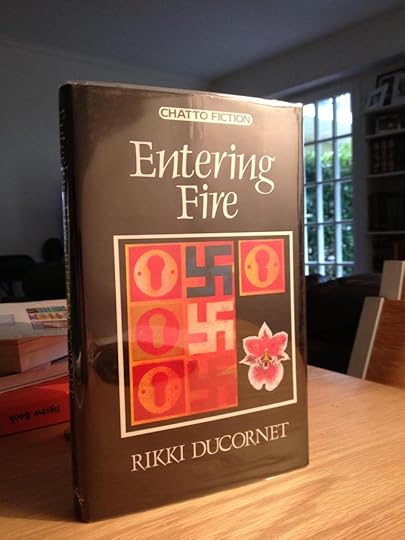

:-D

January 11, 2015
I love Rikki Ducornet. I love the way she writes. I love the way her mind works. I love that half of this svelte and unpredictable novel is narrated by a kindhearted libertine who falls in lifelong love with a fiery nymph while searching for sexy flowers in the Amazon. I love that the other half of this novel is narrated by his bitter and syphilitic son who finds meaning in his existence once he becomes a Nazi and helps torment his fellow Frenchmen during the country's occupation by German forces. I love that this novel has Nazis, a giantess, a psychotic railroad baron, Senator McCarthy, a mad Chinese concubine, J. Edgar Hoover, a G-man named Corky, a limber prostitute with the handle "Tarantula Jane", vegetable cloning, bilious rants about bigotry and zesty orations about sex. I love that this book gets off so much on bawdy, acrobatic wordplay. I love that Ducornet is willing to plunge into the reptilian side of human nature with one breath and, with the next, bungee over to the joys of the humane and of intimate physicality. I loved this book. I love Rikki Ducornet.

September 25, 2016
You Can Lead a Whore to Culture But You Can’t Meet Her Shrink
This slender novel is no less rewarding for its size or lack of it: indeed, it's ample proof that a novel doesn't have to be a thousand or 1,500 pages to stimulate our imaginations or thrill us verbally.
The chapters more or less alternate between father and son, Lamprias de Bergerac and Septimus de Bergerac. Lamprias is a horticulturist and whoremonger. Septimus is a polemicist and fascist sympathiser/collaborator. The one is metaphorically light, the other dark. Lamprias is promiscuous and profligate. Septimus is puritanical and paternalistic. Septimus resents his father for abandoning and humiliating him and his mother, Virginie, who seems to be the only woman for whom Septimus has any respect. He speaks of other women in the most misogynistic terms.

Georgia O'Keeffe - "Black Iris III" (an iris, not an orchid)
Lamprias is obsessive about orchids and, despite not being scientifically trained, embarks on a project to discover, conserve and breed them, his specialty being the creation of exotic hybrid forms. While on an expedition in Brazil, he meets a 12 year old native Amazonian girl, Cucla, with whom he forms a long-term relationship, despite their lack of a common language. They have other ways to communicate.
Septimus, though he never meets Cucla, regards her as an "animal". He has always been envious and scornful of a younger half-brother, True Man, the illegitimate son of a relationship with a Chinese woman named Dust. Septimus sublimates his feelings in a preoccupation with aesthetic and racial purity, as if racial diversity has undermined the integrity of his own family and community. He craves a leader in the absence of his father, and his chapters are riddled with anti-Semitic rants and Nazi propaganda.

Robert Mapplethorpe - "Orchid" (1977)
"Blue is the Colour of Copulation"
Superficially, we're tempted to sympathise with Lamprias and his libertinism and abhor Septimus' self-righteous pomposity. However, especially towards the end of the novel, Septimus' cosmical struggle with his father becomes increasingly comical, and Ducornet's use of language frequently hysterical.
This is a highly refined concoction of Nabokov, Marquez, Pynchon, Coover and Theroux that packs a mighty punch for what passes itself off as a tropical fruit cocktail. Ducornet makes a fine alchemist and bartender.
This slender novel is no less rewarding for its size or lack of it: indeed, it's ample proof that a novel doesn't have to be a thousand or 1,500 pages to stimulate our imaginations or thrill us verbally.
The chapters more or less alternate between father and son, Lamprias de Bergerac and Septimus de Bergerac. Lamprias is a horticulturist and whoremonger. Septimus is a polemicist and fascist sympathiser/collaborator. The one is metaphorically light, the other dark. Lamprias is promiscuous and profligate. Septimus is puritanical and paternalistic. Septimus resents his father for abandoning and humiliating him and his mother, Virginie, who seems to be the only woman for whom Septimus has any respect. He speaks of other women in the most misogynistic terms.
Georgia O'Keeffe - "Black Iris III" (an iris, not an orchid)
Lamprias is obsessive about orchids and, despite not being scientifically trained, embarks on a project to discover, conserve and breed them, his specialty being the creation of exotic hybrid forms. While on an expedition in Brazil, he meets a 12 year old native Amazonian girl, Cucla, with whom he forms a long-term relationship, despite their lack of a common language. They have other ways to communicate.
Septimus, though he never meets Cucla, regards her as an "animal". He has always been envious and scornful of a younger half-brother, True Man, the illegitimate son of a relationship with a Chinese woman named Dust. Septimus sublimates his feelings in a preoccupation with aesthetic and racial purity, as if racial diversity has undermined the integrity of his own family and community. He craves a leader in the absence of his father, and his chapters are riddled with anti-Semitic rants and Nazi propaganda.
Robert Mapplethorpe - "Orchid" (1977)
"Blue is the Colour of Copulation"
Superficially, we're tempted to sympathise with Lamprias and his libertinism and abhor Septimus' self-righteous pomposity. However, especially towards the end of the novel, Septimus' cosmical struggle with his father becomes increasingly comical, and Ducornet's use of language frequently hysterical.
This is a highly refined concoction of Nabokov, Marquez, Pynchon, Coover and Theroux that packs a mighty punch for what passes itself off as a tropical fruit cocktail. Ducornet makes a fine alchemist and bartender.

July 8, 2016
Between the years 1984 and 1986, I grew approximately a couple-three inches. Contemporaneously, overachiever extraordinaire Rikki Ducornet, a writer of great promise in her debut, transformed from a smallish woman into the goddamn Empire State Building. Growth between first and second novels isn’t uncommon. Growth of this caliber? Hen’s teeth.
I absolutely adored this novel. It may be one of the most viscerally exhilarating books I’ve ever read, with more charm per square inch than Burt Reynolds’ prodigiously haired chest. The framing is perfect—the alternating, first-person chapters between libertine, pistil-licking father, Lamprias, and his Nazi-blowing, syphilitic son, Septimus, provide studies in contrast so stark that their relative greatness is made only more lasertight as a result. By the time that RD has nubile Cucla of the Jungle speaking like Jimmy Cagney, it’s all too much. I honestly high-fived a ghost, for want of a living hand to slap in celebration.
I urge you to read friend Anthony’s review (https://www.goodreads.com/review/show...) for a significantly more creative and infinitely richer review than mine. I have a backlog like a sumbitch, and these graves ain’t gonna dig themselves. That said, I proudly light my neighbor's candle and solemnly intone: "I am a Rikki Ducornet lover." I have no shame, bear no mark. Now where are the goddamn donuts?
I absolutely adored this novel. It may be one of the most viscerally exhilarating books I’ve ever read, with more charm per square inch than Burt Reynolds’ prodigiously haired chest. The framing is perfect—the alternating, first-person chapters between libertine, pistil-licking father, Lamprias, and his Nazi-blowing, syphilitic son, Septimus, provide studies in contrast so stark that their relative greatness is made only more lasertight as a result. By the time that RD has nubile Cucla of the Jungle speaking like Jimmy Cagney, it’s all too much. I honestly high-fived a ghost, for want of a living hand to slap in celebration.
I urge you to read friend Anthony’s review (https://www.goodreads.com/review/show...) for a significantly more creative and infinitely richer review than mine. I have a backlog like a sumbitch, and these graves ain’t gonna dig themselves. That said, I proudly light my neighbor's candle and solemnly intone: "I am a Rikki Ducornet lover." I have no shame, bear no mark. Now where are the goddamn donuts?

May 22, 2020
Reading Rikki Duconet is to inhabit for a time a Twin Earth, a place deceptively like the world we know, comforted by many familiar people, places, yet shadowy at its fringe, unsettling, of dreams and nightmares, a wisp of unease in a fragrance, familiar yet forgotten, an intimation of stirring at the borderland of vision, a world of fantasy made real, the prosaic made fanciful, the lost found, transmuted by the alchemy of her words, lush and fecund as an exotic garden, always prodding the ineffable.
Imagine silences as beneath a bell of glass shattered by the clatter, chatter, twitter, croak and screech, tin drum rattle and lilting zither of insects swarming like galaxies. [23]
ENTERING FIRE is built on first-person narrative set pieces, some by Lamprias de Bergerac, abandoning wife, son and mistress to explore the mystery and multiplicity of nature in the jungles of the world, especially the discovery and hybridization of rare orchids; alternating with the story of Septimus, his son, warped, hateful, banal and evil, finding the fertile soil of rising Nazism in pre-war France to grow and foster his descent into xenophobia, brutality and madness.
It's a beautifully written tale, full of insight, obsession, humor and cruelty.
Imagine silences as beneath a bell of glass shattered by the clatter, chatter, twitter, croak and screech, tin drum rattle and lilting zither of insects swarming like galaxies. [23]
ENTERING FIRE is built on first-person narrative set pieces, some by Lamprias de Bergerac, abandoning wife, son and mistress to explore the mystery and multiplicity of nature in the jungles of the world, especially the discovery and hybridization of rare orchids; alternating with the story of Septimus, his son, warped, hateful, banal and evil, finding the fertile soil of rising Nazism in pre-war France to grow and foster his descent into xenophobia, brutality and madness.
It's a beautifully written tale, full of insight, obsession, humor and cruelty.

May 13, 2014
The second of Ducornet's cycle of elemental novels, Entering Fire follows the narrower village-and-countryside view of the supurb, earthy The Stain with a much wider scope, both globally and historically, to thread gymnastically through fin-de-siecle hothouse orchids, equatorial swelter, the heat of passion, and the infernos of 20th-century atrocity. She attempts her usual balancing act of finely-wrought vocabulary, pathos, and briskly humorous touch, leading to some rather abrupt mood swings, but on the whole, this succeeds in surging with life, then receding into the sorrow of irreversible history. Some of the third act capers make a risky bid to undercut the force of the prime content where it's needed most, but it's a temporary lapse, and somehow I was able to connect more closely with the characters here than usual in Ducornet's juggling acts. Cucla is especially memorable, and bereft of her people and leaping across the globe, she seems closest to the heart of the book. Arranged about her, Lampiras remains sympathetic as well, despite his terminally poor parenting begetting the worst of monsters. Still, he's the pulse of life (nearly eternally) to Septimus' fascist fixation on death and black loathings (his racism and misogyny rule his experience to such a degree that he is reduced to a pretty blunt tool as far as political critique goes, though). And how does life give us death? The two are inextricable in biology, but in history? This is perhaps at the heart of the tragedy of Entering Fire, and it is, I think much more tragedy than comedy, whatever Ducornet's tendencies to arrange a bright and playful veneer for her darker contemplations.
Also, a note on reading styles. At the outset, I found myself leaping forward, grabbing at strands of plot, which is very much not the way to read Ducornet. Her words, instead, are a sensorium, her scenes contained terrariums for savor and wonder, through which ideas may creep and caper in the shadowed undergrowth. But the gloss surface is not to be neglected in search of plot and purpose, instead it guides everything that underlies. As soon as I appreciated this, I apprehended its motions much more directly.
Also, a note on reading styles. At the outset, I found myself leaping forward, grabbing at strands of plot, which is very much not the way to read Ducornet. Her words, instead, are a sensorium, her scenes contained terrariums for savor and wonder, through which ideas may creep and caper in the shadowed undergrowth. But the gloss surface is not to be neglected in search of plot and purpose, instead it guides everything that underlies. As soon as I appreciated this, I apprehended its motions much more directly.

January 7, 2014
The second novel in Ducornet’s tetralogy of elements is a chaotic historical narrative about two Bergeracs—the father a long-gone philanderer, the son a long-gone fascist (among other qualities). As in other Ducornet’s novels, Entering Fire has no overt plot and moves between set-pieces wherein her extravagant and exotic imagery, vocabulary, and surreal imagination is allowed free rein to bemuse and amuse. The son Septimus begins to adopt a form of sick raging narrative style that echoes Céline (who is poked at on the epigraph page) and introduces a witty layer of pastiche that Ducornet deploys in other books that often goes overlooked. For more, Warwick made the effort.

July 25, 2014
Feels so good to sink into a Rikki Ducornet novel. What joy in language, what a marvelous, lush, strange imagination--such engaging, bizarre characters! Ducornet is the fiction equivalent of a small, intensely rich dessert from some foreign land, full of strange flavors, continually surprising. Having read 'The Word Desire', 'Phosphor In Dreamland', and 'The Fan Maker's Inquisition' long ago, I understandably pounced on 'Entering Fire' when I found it tucked away in a small bookstore, along with a copy of 'The Butcher's Tales.'
This tale of father and son, told in alternating chapters, begins with the son Septimus de Bergerac, one of Ducornet's monsters, a boy who hates his absent father, adores his unspeakable M'man, a hideously priggish woman who has shaped her son into a viper. How he loathes his father's Chinese mistress and his son by her, True Man, who both lodge with the mother and the misshapen Septimus, who grows into a virulent anti-Semite and experiences his glory days in Occupied France.
Meanwhile, the father chapters are the most divine. Lamprias de Bergerac is a whimsical sensual adventurer who has abandoned his family to venture into strange worlds upriver in the Amazon and discover orchids and outrageous women, a dreamer and lover of life as much as his son is a plotter and a poisonous little fascist. Fascinating to watch their destinies grow and cross.
I ate this short (150pp) novel up in two sittings and and it never failed to charm and amaze me with its baroque intricacies.
This tale of father and son, told in alternating chapters, begins with the son Septimus de Bergerac, one of Ducornet's monsters, a boy who hates his absent father, adores his unspeakable M'man, a hideously priggish woman who has shaped her son into a viper. How he loathes his father's Chinese mistress and his son by her, True Man, who both lodge with the mother and the misshapen Septimus, who grows into a virulent anti-Semite and experiences his glory days in Occupied France.
Meanwhile, the father chapters are the most divine. Lamprias de Bergerac is a whimsical sensual adventurer who has abandoned his family to venture into strange worlds upriver in the Amazon and discover orchids and outrageous women, a dreamer and lover of life as much as his son is a plotter and a poisonous little fascist. Fascinating to watch their destinies grow and cross.
I ate this short (150pp) novel up in two sittings and and it never failed to charm and amaze me with its baroque intricacies.

July 25, 2007
Entering Fire finds Ducornet writing like a cross between Fuentes and Angela Carter, and I suspect a send up of Celine (several quotes from his anti-semetic pamphlets are used as an epigraph) and his world disgust, bitter black humor, and world hopping. Moving from Vichy France, the Brazilian republic, and to red-scare America, oppression and violence are themes, but so is an exalting of every permutation of the human imagination. Every forbidden urge and obsession brought on parade. A poetic and funny racist and a nymphomaniac professor in sympathetically presented pedophilic relationship (an inverse Lolita). The human mind carves out its own country in a world of horror.

February 20, 2021
This short gem was more to my tastes these days, an exotic phantasmagoria of a novel with little plot or and claim to realism at all. Here we have juxtaposed characters, themes, even forces. Nature, in the form of a father, adventure, botany, exploration, intoxication, love, and mucho sex squares off against an Oedipal son, jealous of his half brother, who, consequently sinks into sickness, racism, fascism, and the eternally evil search for order, dominance, and the torture of others to fill the hole in his heart. Poor thing. The twentieth century in a nutshell. Also an explosion of language I found delicious. I ate this one raw.

June 21, 2021
"And so we are prodded, ashen, naked, and creaking, into the maw of Death. I still clutch a bit of perfumed linen and, oddly enough, it's last message - faint now, above all of iris, yet masked by the smell of nightmare - is of Lamprias De Bergerac who, innocent of his son's future crimes, seduced me with stories of the sexual lives of the flowers on a night dizzy with crickets and blazing, blazing with fireflies."
It's a shame this book is out of print. I snagged one of the last few copies on Amazon. Rikki Ducornet is a flagrant, beautiful writer. Entering Fire tells the story of how a romantic who chases women in the rainforest turns out to create a Nazi that terrorizes France. It's a wonderful story about the banality of evil, and how thoughtlessness creates horrors.
It's a shame this book is out of print. I snagged one of the last few copies on Amazon. Rikki Ducornet is a flagrant, beautiful writer. Entering Fire tells the story of how a romantic who chases women in the rainforest turns out to create a Nazi that terrorizes France. It's a wonderful story about the banality of evil, and how thoughtlessness creates horrors.

September 8, 2011
It was impossible for me to concentrate on my work. My head was swimming with visions of this doll-like creature, her legs like sharpened pencils in the air, her jewelled mouth a ripe fig seeded with teeth. As I fell into her bed I imagined for a fleeting, foolish instant my ancestor's dark, sprawling house transformed by two women living as sisters together, surrounded by an affectionate brood of children. And so, from foggy thinking fired by lust, I created a madhouse.

November 8, 2013
This entire review has been hidden because of spoilers.

April 2, 2022
Extraordinary. Ducornet spares no quarter in depicting the sheer force behind human passion and repression, be it malevolent or benevolent. Lamprias and Septimus, like father, like son, deliver a purely ideological battle of the senses. Ducornet shows how people in the first decades of the 20th century struggled against social norms and the rapid political change that buffeted the European continent, its effects transported into Latin America, Africa and the rest of the colonized world. While Lamprias is an erotic escapist who leaves his family and society behind to rot, Septimus automatically chooses to remain behind and assume the opposite role to his father, climbing through the rot of society to the high echelons of Nazi sympathizers in France, with all that entails regarding his spiritual and mental stability. Both main characters seek to escape from what they experience in their everyday lives, Lamprias does it by running to amorous arms, embracing other civilizations and people, while Septimus does it by spewing hatred towards the Jews, the gypsies, and ultimately, his father. Ducornet beautifully entangles comedy with tragedy and has something to say for each character, leaving none outside the scope of her social criticism.

November 11, 2023
very cool meditation on the politics and ontology of carnal desire (the fire element). Lamprias and Septimus respond in opposite ways to the raw animality they recognize raging within -- the one toward hedonistic naturalism and the other toward hardcore ideological fascism. which Ducornet presents as actually kind of co-arising and in conversation with each other.
like Adam in the garden we assign names to the processes and phenomena of the world around us -- but does reality precede these names? or does the naming create reality? if the latter is true, then language really is a kind of divinity, partaking of that same primordial eros which is the engine of all creation.
and so Ducornet asks: what kind of world is generated by the florid jargon of the biologist? the symbology of the alchemist? the racial taxonomies of the fascist?
lots of Freudian stuff here too. Ducornet presents fascism as basically daddy issues on the macro-political scale. i can get down with that.
3.9 stars
like Adam in the garden we assign names to the processes and phenomena of the world around us -- but does reality precede these names? or does the naming create reality? if the latter is true, then language really is a kind of divinity, partaking of that same primordial eros which is the engine of all creation.
and so Ducornet asks: what kind of world is generated by the florid jargon of the biologist? the symbology of the alchemist? the racial taxonomies of the fascist?
lots of Freudian stuff here too. Ducornet presents fascism as basically daddy issues on the macro-political scale. i can get down with that.
3.9 stars

April 9, 2016
Love and hate, love of life and death-in-life are exemplified by a father and son, and by a wife and mother, and several mistresses. The father is voracious for pleasure and adventure, after discovering that his wife is warped by repression; he finds freedom with other women, many of them whores. One of his sons, Septimus, cannot overcome the hatred he feels by being abandoned, and makes hatred his life's purpose by becoming a racist and Nazi collaborator. The novel contrasts the two lives with alternating chapters: the early 20th century for the father and mainly the 1940s for the son. The writing is poetic, elaborate, often brutal and always exhilarating and hard-hitting. This short novel has great range: from light comedy, and charm to the most brutal tragedy. I put her at the top with any of the more recognized supremos of literature. A great, important and perfect masterpiece.

Read
October 29, 2017There is nothing quite like Ducornet. One feels that she has a whole library and the entirety of the English and French languages at her disposal. Her voice seems nowhere to be found—rather, a spirit diffused into times and characters. I often feel that I cannot place the time in which her books were written, they so effortlessly dip from the evolutions of language and metaphor. A rich, robust vocabulary and knack for juxtaposing the vile and the comedic, Ducornet is a sui generis experience.

June 2, 2023
The first book I read by her and I'm now a fan. Lush language, surreal plot. So excited to read The Stain and Phosphor in Dreamland next. I hope Ducornet gets more recognition soon, she reminds me a bit of a surrealist and experimental Ottessa Moshfegh.
The plot was so original and thought-provoking yet so easy to read. This is what all novels should aspire to be! One could tell the writer had FUN while writing this and felt free and unburdened by market-driven interests!
The son's grotesque racism and misogyny are a creative risk that few writers apart from right-wing creeps like Houellebecq would take. But Ducornet isn't a right-wing provocateur, she's a satirist. With her it feels like she's satirising the Western world and the son's fascism, as a reader, I was fully in on the joke.
The plot was so original and thought-provoking yet so easy to read. This is what all novels should aspire to be! One could tell the writer had FUN while writing this and felt free and unburdened by market-driven interests!
The son's grotesque racism and misogyny are a creative risk that few writers apart from right-wing creeps like Houellebecq would take. But Ducornet isn't a right-wing provocateur, she's a satirist. With her it feels like she's satirising the Western world and the son's fascism, as a reader, I was fully in on the joke.

July 13, 2025
This one was Vonnegutesque! I love her and can’t wait to read all her books. Wild, fun, funny, sexy, great characters, delicious and delirious prose, humanist, and touching without a hint of treacle.

Read
February 16, 2021A surrealist study of anti-Semitism.

October 31, 2025
This book really grew on me by its last page. A slapstick tragedy? A morose comedy? I think such categories are for you to decide, dear reader. All I will add is Ducornet's concise, poetic text is full of the muddy and rippled waters of life. But on the other hand:
Water has never been my element. Give me a hot wind. Give me fire.

March 9, 2017
... I am stuck like a sugarplum in a cabin the size of a gnome's pocket with a pastry cook from Marseille who abstains from soap and a Picard who makes a point of never brushing his teeth.

February 8, 2024
The second installment in the Tetralogy of Elements by Rikki Ducornet. Entering Fire is alternatively narrated by a father and his son, Lamprias and Septimus de Bergerac. Not satisfied with the option of inoculating every single woman with his sperm (which he does), Lamprias is a turn of the century French alchemist seeking to create life from cultures of single cells, for which he travels around the world. As a result of the abandonment of the familiar house, his son grows increasingly hateful, bigoted and mother-centered and, quite obviously, develops an inclination towards national socialism, actively collaborating with the nazi forces during the Occupation. Rikki develops these two parallel stories with the characteristic black comedy, grotesque and occultism. If something prevents this novel from being a five star, it’s the fact that, sometimes, the balance between the plotting and the absurd breaks and Rikki favors the second over the first. There are some specific chapters in which the plot develops based on wordplay or free improvisation. However, I love this novel and it is maybe my second favorite.
October 5, 2008
Entering Fire packed quite a whollop. The small yet potent volume represents fire in Rikki Ducornet's tetralogy of elements. It's a slow burn of a read which, when completed, leaves its reader almost numb. Ducornet writes beautifully and with humor (although the humor felt a bit forced at times), but tragedy gets the starring role in Entering Fire.

December 30, 2024
A very interesting story of an estranged son and his father. The son’s chapters are mere letters to his father in Brazil. His father’s chapters are the recap of his entire life/reactions to his son’s letters. Lots of botanical verbiage hurts the rhythm of the book, but the story’s characters impede that verbiage from ruining the book.

Read
July 18, 2018like a cup of good drink that needs to be savour as slowly as possible.
My first Ducornet book; looking forward to read the others.
My first Ducornet book; looking forward to read the others.
Displaying 1 - 27 of 27 reviews