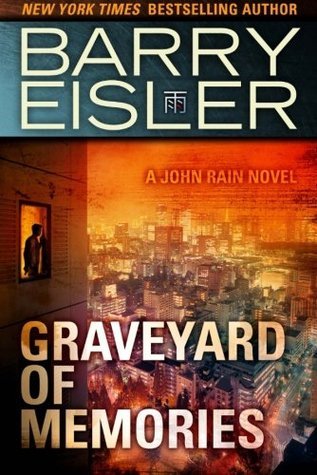
In Graveyard of Memories, author Barry Eisler returns to the John Rain saga in the only way possible—by writing a prequel. After all, Rain would now be in his mid-60s or older; even Hollywood might balk at casting him as an action hero. The novel begins with a fairly simple, straightforward set-up: to save his own life, Rain must execute a series of strategic ‘hits’. As he carries these out, we watch him evolve, getting a better handle on both his tradecraft and his temper. His many lapses in judgment would be inexcusable to the John Rain of the earlier books (that take place later), but Eisler handles this skillfully by making the older Rain the narrator (as if writing his memoirs), and therefore able to comment on his younger self’s naïveté and lack of experience. Somewhere around the midpoint of the book, Rain begins to grasp the deeper implications of his plight—that all might not be as it first appeared, that certain helpful coincidences were perhaps a bit too convenient—and from then on, the story takes off, following plot twists that are not only credible, but in retrospect make perfect sense. As we’d expect, there are also a number of great action set-pieces, all of which come off with adrenaline-rush verisimilitude.
Against the backdrop of the action, Rain also courts Sanaya, a young woman a few years his senior, who happens to be a paraplegic. Here we get to see Rain’s tender qualities and the upside of all that youth and naïveté, including a crazy, loving gesture designed to placate Sanaya’s shame that I’m fairly confident has never been done before. (Eisler also gives us perhaps one of the most unique erotic scenes in fiction—even more compelling than the wonderful sexual encounter in London Twist.) The romantic subplot helps cut the bitter taste (bordering on disgust) left by the grisly murders; indeed, without it, Rain’s character would become anathema to us. (The Japanese bath with its overtones of purification and cleanliness figures prominently in both the love and death elements of the story, as does the graveyard of the book’s title—a very nice thematic touch.)
Other than the yakuza, Eisler’s characters are never stereotypes, as is too often the case in this genre. Tatsu (whom we come to know and love in the earlier/later Rain books) is clever, understated and restrained. McGraw feels very real. Even though Rain dislikes him, as a reader I found him interesting and even (for a while) likable for his smarts and savvy, as compared to Rain’s clumsy immaturity.
My only real complaint with the story was the frequent use of italicized Japanese terms and place names. The names I just skimmed past, not knowing Tokyo from Mars. If you did know Tokyo, no doubt the story would be the richer for it. But I was curious about many of the Japanese terms (the Kindle translator was no help), and Eisler could have easily made these translations available to us through the narrator’s voice. But I have the same beef with Cormac McCarthy, who’s far guiltier of it, so at least Eisler’s in good company.
I consider this a most worthwhile read in all respects: a clever, entirely believable plotline; real characters with strengths and faults; a portrait of a foreign culture with its prejudices; a protagonist who’s not all-good, who grows in both skill and maturity through the course of the story, and who must figure his way out of a complex dilemma; well-crafted thematic elements like the bath and graveyard; and a bittersweet ending that played with just the right soft touch. I highly recommend this book to anyone who appreciates good spy literature and isn’t queasy about contract killing. I look forward to more.