

What do you think?

Fragrant Harbour
Libro usado en buenas condiciones, por su antiguedad podria contener señales normales de uso
324 pages, Kindle Edition
First published January 1, 2002
About the author
John Lanchester
29 books683 followersJohn Lanchester is the author of five novels, including the best-selling The Debt to Pleasure and Capital. His books have won the Hawthornden Prize, the Whitbread First Novel Award, and the E. M. Forster Award, have been longlisted for the Booker Prize, and have been translated into more than twenty-five languages. He is a regular contributor to The New Yorker and The New York Review of Books. He lives in London.
Ratings & Reviews
Friends & Following
Create a free account to discover what your friends think of this book!
Community Reviews
Displaying 1 - 30 of 223 reviews

July 2, 2017
"That Unique Hong Kong Style"
First impressions of "Fragrant Harbour" (John Lanchester’s third novel) are that it's a well-written family epic about Hong Kong from 1935 to 2000 told from the perspective of four different narrators.
How (well) the juxtaposed stories gel together at the end is hidden in "that unique Hong Kong style in which the most significant information is present in the gaps, omissions and implications."
It's this concern with the detection of presence (despite and through its apparent absence) that differentiates this novel from more traditional realism, and makes for a sophisticated, rewarding and poignant tale, come its ending.
"A Precise and Intricate Hierarchy"
This absence is most apparent in the account of the expatriate Englishman, Tom Stewart, who manages the Empire Hotel on behalf of another expatriate Englishman, Alan Masterson. His story supplies the most detail (it reads like a blend of Somerset Maugham, J.G. Ballard, Lawrence Durrell, Evelyn Waugh and Graham Greene - W.H. Auden and Christopher Isherwood make thinly disguised, but entertaining, appearances as well), and takes up over one-half of the novel, yet it's clear that there are things that he's not telling us. We have to wait for the other narrators to learn exactly what's missing.
It’s not that he's trying to deceive us, his audience, the readers, it’s just that his coyness and sense of etiquette lead him to think he shouldn’t tell us. To some extent, he's like his father, "a bookish and private man." He's not normally one for gossip, which is one of the chief preoccupations of the expatriate community in Hong Kong. He's better known for his discretion, which endears him to expatriates, refugees, locals and Chinese alike. On the boat out, he recognises that "there was something regal about my isolation." It wasn’t just the fact that he was an expatriate:
"The whole idea of coming East was to loosen the shackles England imposed, it seemed to me - that was self-evident. If you so liked the way things were in England, why would you leave? But the sense of respectability, the need to conform and to fit, was crushing. There were codes, visible and invisible, everywhere. Each of the big concerns - the Government, the rival Hongs, the Bank - had a precise and intricate hierarchy, each with its own set of customs, mores, patterns of social life, do’s and don’ts, musts and mustn’ts, rules about where one went and what one wore and whom one talked to and what one said."
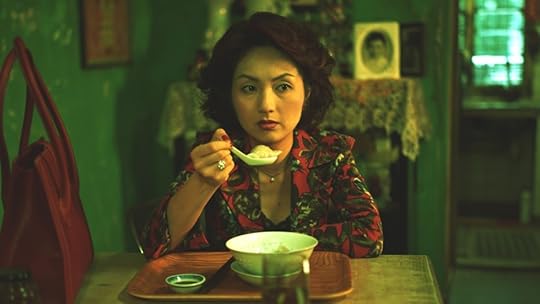
Miriam Yeung in a scene from Fruit Chan's movie "Dumplings" (shot by Chris Doyle)
More Than This
Tom was conscious of the trouble his own curiosity could get him into. When asked to play a role in the wartime resistance against the Japanese, he asks, "‘Isn’t it better if I know a bit more?’ It would be untrue to say I blush at the memory of asking that question. But it was one of the stupidest things I ever said."
When he surrenders to the Japanese, he reveals only that "the soldiers subjected me to certain indignities." We don’t need to know a bit more. Of his beatings, he says, "I will not describe what happened in detail, other than to say we were subjected to three sessions each, over about three days". When he breaks off an engagement to an English woman, he says "it is a conversation I prefer not to recall." When he parts company with Sister Maria, he reveals, "There might have been something more to say, but if there was, I couldn’t think of it."
Instead, Maria asks (a la "Casablanca"), "Do you remember Fanling?" To which he replies, "Of course I do. I think of it all the time."
When the hotel is agreed to be sold and he learns that he will be given a loyalty bonus, he asks Masterson’s executor how much. He discloses only that "He told me":
"The most significant information is present in the gaps, omissions and implications."
More than this, I cannot say…John Lanchester knows exactly how much to say, and how much to leave unsaid... and so he leaves much for us to imagine.
SOUNDTRACK:
July 1, 2017
First impressions of "Fragrant Harbour" (John Lanchester’s third novel) are that it's a well-written family epic about Hong Kong from 1935 to 2000 told from the perspective of four different narrators.
How (well) the juxtaposed stories gel together at the end is hidden in "that unique Hong Kong style in which the most significant information is present in the gaps, omissions and implications."
It's this concern with the detection of presence (despite and through its apparent absence) that differentiates this novel from more traditional realism, and makes for a sophisticated, rewarding and poignant tale, come its ending.
"A Precise and Intricate Hierarchy"
This absence is most apparent in the account of the expatriate Englishman, Tom Stewart, who manages the Empire Hotel on behalf of another expatriate Englishman, Alan Masterson. His story supplies the most detail (it reads like a blend of Somerset Maugham, J.G. Ballard, Lawrence Durrell, Evelyn Waugh and Graham Greene - W.H. Auden and Christopher Isherwood make thinly disguised, but entertaining, appearances as well), and takes up over one-half of the novel, yet it's clear that there are things that he's not telling us. We have to wait for the other narrators to learn exactly what's missing.
It’s not that he's trying to deceive us, his audience, the readers, it’s just that his coyness and sense of etiquette lead him to think he shouldn’t tell us. To some extent, he's like his father, "a bookish and private man." He's not normally one for gossip, which is one of the chief preoccupations of the expatriate community in Hong Kong. He's better known for his discretion, which endears him to expatriates, refugees, locals and Chinese alike. On the boat out, he recognises that "there was something regal about my isolation." It wasn’t just the fact that he was an expatriate:
"The whole idea of coming East was to loosen the shackles England imposed, it seemed to me - that was self-evident. If you so liked the way things were in England, why would you leave? But the sense of respectability, the need to conform and to fit, was crushing. There were codes, visible and invisible, everywhere. Each of the big concerns - the Government, the rival Hongs, the Bank - had a precise and intricate hierarchy, each with its own set of customs, mores, patterns of social life, do’s and don’ts, musts and mustn’ts, rules about where one went and what one wore and whom one talked to and what one said."
Miriam Yeung in a scene from Fruit Chan's movie "Dumplings" (shot by Chris Doyle)
More Than This
Tom was conscious of the trouble his own curiosity could get him into. When asked to play a role in the wartime resistance against the Japanese, he asks, "‘Isn’t it better if I know a bit more?’ It would be untrue to say I blush at the memory of asking that question. But it was one of the stupidest things I ever said."
When he surrenders to the Japanese, he reveals only that "the soldiers subjected me to certain indignities." We don’t need to know a bit more. Of his beatings, he says, "I will not describe what happened in detail, other than to say we were subjected to three sessions each, over about three days". When he breaks off an engagement to an English woman, he says "it is a conversation I prefer not to recall." When he parts company with Sister Maria, he reveals, "There might have been something more to say, but if there was, I couldn’t think of it."
Instead, Maria asks (a la "Casablanca"), "Do you remember Fanling?" To which he replies, "Of course I do. I think of it all the time."
When the hotel is agreed to be sold and he learns that he will be given a loyalty bonus, he asks Masterson’s executor how much. He discloses only that "He told me":
"The most significant information is present in the gaps, omissions and implications."
More than this, I cannot say…John Lanchester knows exactly how much to say, and how much to leave unsaid... and so he leaves much for us to imagine.
SOUNDTRACK:
July 1, 2017

December 22, 2014
I enjoyed this book hugely - a sort of history of Hong Kong since the 1930s told through the interlinked stories of 4 very different protagonists, full of rich descriptions and colourful characters, who reflect the changing nature of the society there. Lanchester also has a feel for language (not just English, since there is quite a lot on the nature of Cantonese). Parts of it also reminded me of J.G. Farrell's epic The Singapore Grip, but Lanchester is a more sympathetic and less caustic narrator. Having read all four of John Lanchester's novels in the last few months, this one is probably the best, though The Debt to Pleasure is well worth reading too.

February 23, 2019
A Hong Kong family history covering a time frame of 70 years that involves both Chinese and expats that is ideal for those that want an interesting but easy to read story.
One small error was the author calling the Jacaranda Tree flame red when it is purple. I think he meant Flamboyant Flame Trees as they are known in Hong Kong.
One small error was the author calling the Jacaranda Tree flame red when it is purple. I think he meant Flamboyant Flame Trees as they are known in Hong Kong.

January 12, 2009
I bought this when I was in Hong Kong this summer because I was looking for a novel that would give me an overview of the city's history and tell a compelling story as well. I did learn a great deal about Hong Kong from the 1930s through the 1990's, but the story was certainly not compelling though much of it was interesting. The tale is told through the voices of four different characters- a young woman from England who's climbing hand over fist up the career ladder, a Chinese businessman on the brink of failure, a nun, and a man from England who manages and then owns his own hotel. Their stories all intertwine, and the choices they ultimately make raise questions about integrity, responsibility and compromise. Some of the characters are more well-developed than others, but Lanchester seems to shy away from digging deeply into the psyche of any of them, which left me feeling unsatisfied and made me wonder what I was missing since novel was included on the New York Times Notable Books list for 2002.

January 4, 2019
As a self-confessed Hong Kong fangirl I'm always on the lookout for novels set in the city. John Lanchester's novel set in the city of the title ("fragrant harbour" is the literal translation of the Chinese for Hong Kong) spans the 20th century - from the 1930s to the 90s - and was just the novel I was looking for.
Lanchester's novel follows four characters, but the central character is Tom Stewart, a Brit who moves to Hong Kong as a young man in search of a new life. The other central characters include a Chinese nun, Maria; a young British journalist, Dawn; and a Chinese refugee turned struggling businessman, Matthew.
As others have mentioned, this is an ambitious but highly readable novel, and Lanchester's writing really brings Hong Kong to life. As a bonus I also learnt a lot about the Japanese occupation (through the book itself and subsequent Googling), something I only knew very little about before. Recommended!
Lanchester's novel follows four characters, but the central character is Tom Stewart, a Brit who moves to Hong Kong as a young man in search of a new life. The other central characters include a Chinese nun, Maria; a young British journalist, Dawn; and a Chinese refugee turned struggling businessman, Matthew.
As others have mentioned, this is an ambitious but highly readable novel, and Lanchester's writing really brings Hong Kong to life. As a bonus I also learnt a lot about the Japanese occupation (through the book itself and subsequent Googling), something I only knew very little about before. Recommended!

May 15, 2026
I’m a John Lanchester fan and I enjoyed this novel, but with some reservations.
Through the eyes of a small group of linked characters (British and Chinese) we meander through the complex and often bloody history of Hong Kong, from the thirties up to the late nineties. Through wars, revolution and the growth of global trade, the buildings get taller and the world (with the boom in international travel) gets smaller.
There’s much of interest and I learned a lot about the uneasy relationship between Britain, China and Hong Kong but the narrative stalled in places, becoming slow, before shooting off to more involving sections. It all felt a bit uneven.
There is some poignancy in understatement but the characters’ lack of outward emotion and the fact that they aren’t always reliable narrators, made it hard to feel too deeply about their stories, or to be too wowed when there’s a twist or two later in the book.
It’s a good read but not my favourite by this author. 3.5 Stars.
Through the eyes of a small group of linked characters (British and Chinese) we meander through the complex and often bloody history of Hong Kong, from the thirties up to the late nineties. Through wars, revolution and the growth of global trade, the buildings get taller and the world (with the boom in international travel) gets smaller.
There’s much of interest and I learned a lot about the uneasy relationship between Britain, China and Hong Kong but the narrative stalled in places, becoming slow, before shooting off to more involving sections. It all felt a bit uneven.
There is some poignancy in understatement but the characters’ lack of outward emotion and the fact that they aren’t always reliable narrators, made it hard to feel too deeply about their stories, or to be too wowed when there’s a twist or two later in the book.
It’s a good read but not my favourite by this author. 3.5 Stars.

June 13, 2014
I loved this unusual book written through the eyes of 4 protagonists each with a different but entwined story and recount of life in HongKong from the 1930s to the 90s. I learnt so much about the time of war in Hong Kong and had no idea how people here had been so affected. I have lived in Hong Kong for almost eleven years and so many of the names and places are familiar to me. It was interesting to see how things have changed. A great read!

October 22, 2012
Interesting book, capturing Hong Kong from the 1930,s until just before 1997.

May 4, 2013
This is, in some ways, a really difficult book to review. Having lived in Hong Kong for four years, I got a frission of recognition and excitement when - particularly in the first section - the book seems to have been a carbon copy of the time I went through. This makes it difficult to separate the book from my own personal memories of my time in Hong Kong. However, the second section is almost like a history lesson of Hong Kong and again, was interesting just to see how the city had come together to be the place I knew.
It begins to unravel by the third section, however. The plot twist involving two of the major characters contains two main issues - firstly, it doesn't really ring true for the characters and secondly, it's an example of the author keeping information from the reader just to create a twist. The final section is probably the weakest and drags the book down - it just reads like a slightly stilted telling of a business deal and the most interesting section. The most interesting part would be how the grandfather reacts to the new business deal, but this is not included within the book. Also, the book has the problem that it is not really about the Chinese experience of Hong Kong but how the Western world viewed it.
I would recommend it to anyone who has lived in Hong Kong, but not as a book, more as an aide-memoire for the time they lived in the city.
It begins to unravel by the third section, however. The plot twist involving two of the major characters contains two main issues - firstly, it doesn't really ring true for the characters and secondly, it's an example of the author keeping information from the reader just to create a twist. The final section is probably the weakest and drags the book down - it just reads like a slightly stilted telling of a business deal and the most interesting section. The most interesting part would be how the grandfather reacts to the new business deal, but this is not included within the book. Also, the book has the problem that it is not really about the Chinese experience of Hong Kong but how the Western world viewed it.
I would recommend it to anyone who has lived in Hong Kong, but not as a book, more as an aide-memoire for the time they lived in the city.

November 7, 2022
Чудесен роман. Пресъздава, и то добре, историята на Хонг Конг от миналия век през три гледни точки. И трите – убедителни. Интересен сюжет, завладяваща атмосфера, потъваш в историята и се забравяш. Това, което очаквам от всеки добър роман.

July 20, 2013
A big, ambitious novel that doesn’t read like one. There are no pretensions here. Lanchester’s prose is so clean and his style seems so effortless that one begins to underestimate the real achievement: In four personal narratives from four engaging characters, Lanchester chronicles the history of Hong Kong in the 20th century. Wow. He makes it look so easy.
You will meet Dawn Stone, the hilariously self-deprecating and man-weary writer for the Thatcher-era British tabloids who stumbles her way to the top of a Hong Kong media empire. There is Tom Stewart, the son of a British pub owner who goes to Hong Kong in 1938 to seek his fortune, and finds it with the aid of a quickie course in Chinese on the boat from England. There is Sister Maria, the Chinese nun who was Tom’s teacher and who, somewhat expectedly, falls in love with him. I won’t reveal Narrator #4, but it’s a nice surprise when the time comes.
Lanchester was brought up in Hong Kong; his knowledge of the place is impressive. And what better setting to explore his fascination with money and its effect, good and bad, on those who pursue it? Ms. Stone describes Hong Kong as the "purest free-market economy in the world;" another character, more descriptively, call it a "money typhoon." (The image of plate-glass-window-as-urinal in the men's room of the swank club atop a harbor high-rise, where gentlemen can imagine the thrill of peeing on the peons below, is a perfect emblem of Lanchester's wry view of capitalist economy.) Money and the human response to it also appear to be key to Lanchester’s latest book, Capital, which I am eager to start as soon as I finish this review!
I would have been satisfied if the novel had focused on the affable Tom Stewart and his relationship with Sister Maria. The secondary characters surrounding them during the WWII period in Hong Kong are fascinating, and the description of the Japanese invasion of the island—from Tom’s point of view—deserves special mention. I love Stewart’s understatement when he says simply on the day of British surrender: “Then I made a white flag out of a towel and went out to find a Japanese officer. The soldiers subjected me to certain indignities.” End of chapter.
Nonetheless, Lanchester’s canvas is bigger than a mere love story between a capitalist and a nun. The main character here is the island of Hong Kong, the color, corruption, beauty and stink that characterize it. My one quibble is the packaging of the novel; the cover looks as if it encloses a story of war-torn romance, and the book is so much more than that. The title itself conveys Lanchester’s sly humor. Hong Kong translates to “fragrant harbor,” but as the author points out, the harbor hasn’t been fragrant since at least 1938, when modern industrialization began to take its inevitable hold.
I hope I get to the island sometime in this lifetime, but if not, Lanchester's novel has left me with a pretty solid impression of what a visit there would be like.
You will meet Dawn Stone, the hilariously self-deprecating and man-weary writer for the Thatcher-era British tabloids who stumbles her way to the top of a Hong Kong media empire. There is Tom Stewart, the son of a British pub owner who goes to Hong Kong in 1938 to seek his fortune, and finds it with the aid of a quickie course in Chinese on the boat from England. There is Sister Maria, the Chinese nun who was Tom’s teacher and who, somewhat expectedly, falls in love with him. I won’t reveal Narrator #4, but it’s a nice surprise when the time comes.
Lanchester was brought up in Hong Kong; his knowledge of the place is impressive. And what better setting to explore his fascination with money and its effect, good and bad, on those who pursue it? Ms. Stone describes Hong Kong as the "purest free-market economy in the world;" another character, more descriptively, call it a "money typhoon." (The image of plate-glass-window-as-urinal in the men's room of the swank club atop a harbor high-rise, where gentlemen can imagine the thrill of peeing on the peons below, is a perfect emblem of Lanchester's wry view of capitalist economy.) Money and the human response to it also appear to be key to Lanchester’s latest book, Capital, which I am eager to start as soon as I finish this review!
I would have been satisfied if the novel had focused on the affable Tom Stewart and his relationship with Sister Maria. The secondary characters surrounding them during the WWII period in Hong Kong are fascinating, and the description of the Japanese invasion of the island—from Tom’s point of view—deserves special mention. I love Stewart’s understatement when he says simply on the day of British surrender: “Then I made a white flag out of a towel and went out to find a Japanese officer. The soldiers subjected me to certain indignities.” End of chapter.
Nonetheless, Lanchester’s canvas is bigger than a mere love story between a capitalist and a nun. The main character here is the island of Hong Kong, the color, corruption, beauty and stink that characterize it. My one quibble is the packaging of the novel; the cover looks as if it encloses a story of war-torn romance, and the book is so much more than that. The title itself conveys Lanchester’s sly humor. Hong Kong translates to “fragrant harbor,” but as the author points out, the harbor hasn’t been fragrant since at least 1938, when modern industrialization began to take its inevitable hold.
I hope I get to the island sometime in this lifetime, but if not, Lanchester's novel has left me with a pretty solid impression of what a visit there would be like.

May 14, 2021
This book has everything: It's very suspenseful and moving, beautifully written and I loved the structure: Four parts, each with a different narrator and different length. All interconnected, but to various degrees. When the first part finished and I realised that the next part was starting with a new character in a different period, I felt regret as I didn't want to leave the previous part. But after only a few lines I was roped in to the new story.
Hong Kong and its fascinating history provides a great backdrop, but the novel is mainly about those four people, how and why they came to Hong Kong and what happens to them.
I was amazed how different this book is compared to the previous novels by Lanchester ('The Debt To Pleasure' & 'Mr Phillips'). In my opinion he's getting better and better. Looking forward to his fourth.
PS: I also enjoyed James Clavell's novel 'Tai-Pan' very much. If you're interested in a novel about how Hong Kong started, read that.
(originally posted as Amazon review, 05 Jan 2004)
Hong Kong and its fascinating history provides a great backdrop, but the novel is mainly about those four people, how and why they came to Hong Kong and what happens to them.
I was amazed how different this book is compared to the previous novels by Lanchester ('The Debt To Pleasure' & 'Mr Phillips'). In my opinion he's getting better and better. Looking forward to his fourth.
PS: I also enjoyed James Clavell's novel 'Tai-Pan' very much. If you're interested in a novel about how Hong Kong started, read that.
(originally posted as Amazon review, 05 Jan 2004)

June 13, 2015
I loved the four stories featured in Fragrant Harbour. Such an interesting view of an unfamiliar time and place. The connections among them were surprising yet never forced. I love it when I end each section both wanting more and eager for what is next

November 14, 2014
This is the second book I've read about Hong Kong in recent weeks, "Gweilo" (Golden Boy) by Martin Booth being the other. (Highly recommended)
Like Booth, Lanchester grew up in HK and imparts the history, people and description of the area with feeling and insight. Unfortunately, the harbor has long since been fragrant and the current protests decry a vibrant metropolis. I'm wondering what the future holds? A quote from the book: "Things are always about to get worse in China. That's China's version of staying the same."
I wish my history professors, long ago, were as interesting as Lanchester, who adds a touch of humor to a serious subject. Perhaps I wouldn't have slept through their classes. Lanchester, a gifted storyteller, has quickly become a favorite author.
Like Booth, Lanchester grew up in HK and imparts the history, people and description of the area with feeling and insight. Unfortunately, the harbor has long since been fragrant and the current protests decry a vibrant metropolis. I'm wondering what the future holds? A quote from the book: "Things are always about to get worse in China. That's China's version of staying the same."
I wish my history professors, long ago, were as interesting as Lanchester, who adds a touch of humor to a serious subject. Perhaps I wouldn't have slept through their classes. Lanchester, a gifted storyteller, has quickly become a favorite author.

October 5, 2013
Historical fiction without trying to be historical fiction, without shoving facts and figures and culture down readers' throats, without pretension - such is Lanchester's accomplishment via engaging, believable characters telling their own fascinating, fictional stories. The book features:
Tom Stewart- British expat living in Hong Kong for nearly 70 years since the 1930s, P.O.W. during the Japanese occupation, successful hotelier.
Dawn Stone- the 1990s British transplant to Hong Kong, a journalist turned big money Hong Kong corporate PR executive by the year 2000.
Sister Maria- activist nun and friend of Tom Stewart since his journey to Hong Kong, when they were shipmates.
Matthew Ho- Chinese refugee to Hong Kong as a boy, struggling young entrepreneur with a young family at the turn of the millennium.
The way these four primary characters' lives intertwine, told by each of them in first person during different sections of the novel, captivates and details a unique social, economic, and political Hong Kong societal landscape.
As someone very interested in portrayals of capitalism and capitalists in literary fiction, a lot of my favorite lines came during Matthew Ho's commentary:
-"People are full of fantasies about how to do business in China. The key is that you must find people with power and deal directly with them and be clear about everything and be prepared to pay." (p. 269)
-"'You know the Americans have these stories. "What do you call a nine-hundred-pound gorilla with a machine gun?" "Sir." ... How do you get the attention of a nine-hundred-pound gorilla? You turn up with a twelve-hundred-pound one.'" (Tommy Cheung on p. 286)
-Ho's entire pitch to Wo at end of the book.
In addition to these and other parts during Ho's segment, I loved nearly everything Tom Stewart had to say. The way Stewart handles himself - always with dignity, loyalty, honesty, stubbornness - makes his character one of my favorite protagonists in recent memory. A man of unwavering principal he is.
Lanchester writes each character's voice so distinctly, so fitting to each of their personal histories, each section can stand alone as a compelling story, but their interconnectedness is just brilliant. This is the second book of his I've read (The Debt to Pleasure is the other, and it's a wholly different, equally intelligent, excellent read), and I'll surely read more of his work.
Tom Stewart- British expat living in Hong Kong for nearly 70 years since the 1930s, P.O.W. during the Japanese occupation, successful hotelier.
Dawn Stone- the 1990s British transplant to Hong Kong, a journalist turned big money Hong Kong corporate PR executive by the year 2000.
Sister Maria- activist nun and friend of Tom Stewart since his journey to Hong Kong, when they were shipmates.
Matthew Ho- Chinese refugee to Hong Kong as a boy, struggling young entrepreneur with a young family at the turn of the millennium.
The way these four primary characters' lives intertwine, told by each of them in first person during different sections of the novel, captivates and details a unique social, economic, and political Hong Kong societal landscape.
As someone very interested in portrayals of capitalism and capitalists in literary fiction, a lot of my favorite lines came during Matthew Ho's commentary:
-"People are full of fantasies about how to do business in China. The key is that you must find people with power and deal directly with them and be clear about everything and be prepared to pay." (p. 269)
-"'You know the Americans have these stories. "What do you call a nine-hundred-pound gorilla with a machine gun?" "Sir." ... How do you get the attention of a nine-hundred-pound gorilla? You turn up with a twelve-hundred-pound one.'" (Tommy Cheung on p. 286)
-Ho's entire pitch to Wo at end of the book.
In addition to these and other parts during Ho's segment, I loved nearly everything Tom Stewart had to say. The way Stewart handles himself - always with dignity, loyalty, honesty, stubbornness - makes his character one of my favorite protagonists in recent memory. A man of unwavering principal he is.
Lanchester writes each character's voice so distinctly, so fitting to each of their personal histories, each section can stand alone as a compelling story, but their interconnectedness is just brilliant. This is the second book of his I've read (The Debt to Pleasure is the other, and it's a wholly different, equally intelligent, excellent read), and I'll surely read more of his work.

January 15, 2017
The book is very different to Lanchester's other books - multi-narrator (which should have dealt with the over longer feel of the other books) but also multi-dimensional. However each of the 3 narrators lacks any real depth or character, so much of the action or their feelings take place ""off stage" and the whole seems to lack engagement. The book has much more of the restraint of an Kazuo Ishiguro than the otherness and exoticism of David Mitchell (it also lacks Mitchell's knack with inter-connected stories; the Stone piece for instance may as well be excised from the book which is very strange as it forms the opening third). Further the style doesn't really appear to fit what is clearly meant to be a multi-generational portrait of Hong Kong over a turbulent century.

July 24, 2008
I'm not sure exactly why I enjoyed this book so much. Was it because it takes place in Hong Kong, my home for the last 16 years? Was it the description of pre-war colonial Hong Kong? Was it the insightful comments about the nature of both Hong Kong people and mainland Chinese? Was it the interesting juxtaposition of four separate stories? Was it the ending which left me creating my own version of "what happened next"? I guess it was all of those things.
The plot is not that well drawn. It's more of a narrative than a plotted novel. The characters are somewhat stereotypical but not overly so. Yet, I was somehow carried along and finished the story in a short time.
If you wish to learn about Hong Kong - the way it is and the way it was plus avoid the usual travel guide drivel, I highly recommend this book.
The plot is not that well drawn. It's more of a narrative than a plotted novel. The characters are somewhat stereotypical but not overly so. Yet, I was somehow carried along and finished the story in a short time.
If you wish to learn about Hong Kong - the way it is and the way it was plus avoid the usual travel guide drivel, I highly recommend this book.

July 23, 2007
I don’t understand how this book won a “Best Fiction” award. It read like a bad action adventure novel. Filled with insignificant details and a unsatisfying storyline, it was a pain to read. In fact towards the end I found myself skimming chapters just to get to the conclusion of the story. I felt cheated at the end of this story. In retrospect, however, I feel I learned a bit about the history of Hong Kong and how it was impacted by the turmoil occurring in China.
June 27, 2022
Empecé a leerlo hace un tiempo y lo dejé, no me enganchó en ese momento. Ahora lo he retomado y me ha sorprendido gratamente.

September 30, 2020
Fragrant Harbour by John Lanchester is a novel that is hard to praise too highly. Set in Hong Kong, it presents the stories of four main characters, each of which is an immigrant to this city. Behind them at all times is a culture that rules their lives, sets the limits of what might be possible, but is always hard for outsiders to penetrate.
That the culture affects all aspects of their lives, however, is a given. Each character pursues self-interest, the different eras they inhabit defining and characterising the different stages of the city’s development. Thus we see its pre-war emergence from a dirty nineteenth century right through to its contemporary role as a driving force of free market globalisation.
When Tom Stewart, on his way to Honk Kong in the 1930s, accepts the challenge of a wager, he changes the direction of lives, not just is own. A random, trivial suggestion suggests he might learn Cantonese in the thirty days of a shared voyage to new lives. His tutor is Sister Maria, a Chinese nun who proves to be an enlightened, motivating teacher.
Tom Stewart learns the language, wins the bet and begins a relationship with things Chinese that will sustain him through war, peace, economic growth, professional life, clandestine activity and property speculation. Dawn Stone, previously Doris, hails from Blackpool, but she makes it to Hong Kong. She has a career in the media, having gone through the once well trodden paths of learning her trade on provincial newspapers and then graduating to London. She makes it good and proper in the public relations business that booms out east. She seems to have few scruples and is ruled by pragmatism.
She is not alone. Michael Ho is a young businessman. He has a vision of an air conditioned future that is on a knife edge between success and failure. He is sub-contracted from Germans who operate north of London to avail themselves of the country’s more flexible approach to labour. He has a rip-off sub-contracting factory in Ho Chi Minh City. He is Hong Kong based, but from Fujian, and thus also an immigrant. He has recently relocated his family to Sydney. Interests in Guangzhou will determine his fate. Mountains are high and the emperor is far away, his contacts tell him, so practices are mainly local. He must learn. He must raise capital.
It is perhaps true everywhere in this global economy, where Hertfordshire taxi drivers remonstrate in Urdu and curse in English. And it is pragmatism that rules the place. As globalisation becomes an issue, the place is the world, not just Hong Kong. In this new world which appears to be built on the professedly liberal economic ideas that have underpinned the colony’s free-for-all, these immigrants to the place make their lives, make their fortunes in their own ways.
But still there is a constant in that they can only succeed within the protective umbrella shade of bigger interests than their own. In a city state that grew out of an illicit and illegal trade in opium as British merchants and adventurers became international drug dealers to vulnerable China, people with wealth beyond measure push people around the chessboards of their interests, occasionally enthroning a pawn they might even have previously sacrificed.
As in A Debt To Pleasure, John Lanchester has us enter the world of an anti-hero. The character that drives events in Fragrant Harbour is but a name for most of the book. He is cold, calculating, driven by raw, undiluted self-interest. In this he is perhaps no different from anyone else. It’s just that he is more successful at it, and thus less willing to risk that success. And he prevails. The emperor is far away. The mountains are high. In his case, he is the emperor and he owns the mountains. Power lives in pockets and, in a globalised economy, we are all immigrants, even in our homes. What a superb book!
That the culture affects all aspects of their lives, however, is a given. Each character pursues self-interest, the different eras they inhabit defining and characterising the different stages of the city’s development. Thus we see its pre-war emergence from a dirty nineteenth century right through to its contemporary role as a driving force of free market globalisation.
When Tom Stewart, on his way to Honk Kong in the 1930s, accepts the challenge of a wager, he changes the direction of lives, not just is own. A random, trivial suggestion suggests he might learn Cantonese in the thirty days of a shared voyage to new lives. His tutor is Sister Maria, a Chinese nun who proves to be an enlightened, motivating teacher.
Tom Stewart learns the language, wins the bet and begins a relationship with things Chinese that will sustain him through war, peace, economic growth, professional life, clandestine activity and property speculation. Dawn Stone, previously Doris, hails from Blackpool, but she makes it to Hong Kong. She has a career in the media, having gone through the once well trodden paths of learning her trade on provincial newspapers and then graduating to London. She makes it good and proper in the public relations business that booms out east. She seems to have few scruples and is ruled by pragmatism.
She is not alone. Michael Ho is a young businessman. He has a vision of an air conditioned future that is on a knife edge between success and failure. He is sub-contracted from Germans who operate north of London to avail themselves of the country’s more flexible approach to labour. He has a rip-off sub-contracting factory in Ho Chi Minh City. He is Hong Kong based, but from Fujian, and thus also an immigrant. He has recently relocated his family to Sydney. Interests in Guangzhou will determine his fate. Mountains are high and the emperor is far away, his contacts tell him, so practices are mainly local. He must learn. He must raise capital.
It is perhaps true everywhere in this global economy, where Hertfordshire taxi drivers remonstrate in Urdu and curse in English. And it is pragmatism that rules the place. As globalisation becomes an issue, the place is the world, not just Hong Kong. In this new world which appears to be built on the professedly liberal economic ideas that have underpinned the colony’s free-for-all, these immigrants to the place make their lives, make their fortunes in their own ways.
But still there is a constant in that they can only succeed within the protective umbrella shade of bigger interests than their own. In a city state that grew out of an illicit and illegal trade in opium as British merchants and adventurers became international drug dealers to vulnerable China, people with wealth beyond measure push people around the chessboards of their interests, occasionally enthroning a pawn they might even have previously sacrificed.
As in A Debt To Pleasure, John Lanchester has us enter the world of an anti-hero. The character that drives events in Fragrant Harbour is but a name for most of the book. He is cold, calculating, driven by raw, undiluted self-interest. In this he is perhaps no different from anyone else. It’s just that he is more successful at it, and thus less willing to risk that success. And he prevails. The emperor is far away. The mountains are high. In his case, he is the emperor and he owns the mountains. Power lives in pockets and, in a globalised economy, we are all immigrants, even in our homes. What a superb book!
February 15, 2013
"Fragrant Harbour" is a very interesting and moving story of Hong Kong from the 1930s to the new millennium. Through the intertwining tales of four different narrators, the reader is taken on a journey through Hong Kong's history. It is fascinating because the novel spans all Hong Kong's major events of the 20th century so one can learn about its past--and on a different, more personal level than one could from a work of nonfiction. That is probably what I liked best about "Fragrant Harbour" and is the biggest takeaway for me. The story is great and each of the four narrators brings a new dimension of meaning and significance. I would recommend this book, especially to people with an interest in Hong Kong because this is one of my favorite books about Hong Kong that I have read. I think it is great and that John Lanchester is a very good writer.

August 19, 2015
In a departure from his Euro-centric novels, Lanchester writes of Hong Kong before World War II, during the Japanese occupation, and through to the hand-off of the British colony to the Chinese. But, in his remarkable way, he finds a point of view that is perfect. Tom Stewart has no prospects in England so sets out by tramp steamer for far-away Hong Kong. He is joined by a bank employee, a devoted couple, and two nuns, one of whom teaches him Chinese as the ship makes its way to the Orient. He finds work in a bank, which makes him useful to the Japanese when they take over, but also puts him in between the suddenly-captured English and the Chinese underclass of the island, and … one of the nuns. I’ll not say more. - See more at: http://jwlbooks.com/jack-london-revie...
July 18, 2026
Acabo de tancar la novel·la i encara em sento atrapat pel magnetisme d'Hong Kong. Ha estat una lectura absolutament captivadora que he gaudit de principi a fi.
El que més m'ha fascinat és com l'autor retrata l'evolució de la ciutat a través de visions i perspectives molt diferents, des dels anys 30 fins als 90. Més enllà del context històric, la trama principal té una força brutal: té la capacitat de fer-te sentir part de la història, com si visquessis en la pròpia pell el destí dels personatges. En aquest sentit, el gran triomf de la novel·la és que no utilitza la història com un simple decorat, sinó que converteix la ciutat en el personatge principal, obligant-te a patir i gaudir el cost emocional de la seva transformació.
En definitiva, una crònica viva, immersiva i humana d'un territori fascinant. Absolutament recomanable si busques un viatge literari que et commogui de veritat.
El que més m'ha fascinat és com l'autor retrata l'evolució de la ciutat a través de visions i perspectives molt diferents, des dels anys 30 fins als 90. Més enllà del context històric, la trama principal té una força brutal: té la capacitat de fer-te sentir part de la història, com si visquessis en la pròpia pell el destí dels personatges. En aquest sentit, el gran triomf de la novel·la és que no utilitza la història com un simple decorat, sinó que converteix la ciutat en el personatge principal, obligant-te a patir i gaudir el cost emocional de la seva transformació.
En definitiva, una crònica viva, immersiva i humana d'un territori fascinant. Absolutament recomanable si busques un viatge literari que et commogui de veritat.

January 6, 2013
This book was not that easy to begin, but it's getting more exciting if you can endure the first few chapters (and the first character).
I have to salute the author to give me quite a surprise towards the end of the book (there was a hint in the beginning but I totally missed it), and I found myself getting more eager to finish the book - to find about the ending.
The ending is not a fairy-tale-like ending. But it made me reflect about... that is how life goes.
This is a good book, good story, but perhaps not for everyone.
I have to salute the author to give me quite a surprise towards the end of the book (there was a hint in the beginning but I totally missed it), and I found myself getting more eager to finish the book - to find about the ending.
The ending is not a fairy-tale-like ending. But it made me reflect about... that is how life goes.
This is a good book, good story, but perhaps not for everyone.

January 18, 2017
Typical Lanchester really; busy, hectic and engaging portrayal of city life. Four separate but cleverly linked narrators tell of their experiences in Hong Kong between 1930-1990s. Didn't realise 'Hong Kong' translates as 'Fragrant Harbour'. We do get lots of smells, but also sounds, sights and the worlds of cut throat businesses, Triads and of course, the Japanese occupation. Tom Stewart is the real protagonist; affable, loyal and quietly brave. Masses of information and some lovely surprises too.

July 3, 2017
I was a little apprehensive about this book before I began it, but I ended up liking it hugely. It's an excellent story of generations of Hong Kong residents (I thought the middle section was by far the best - but of course I'm biased towards anything set in the 1930s) that, as always, made me understand historical events so much more fully. Wry, thoughtful and with real emotional impact. 14+
*Please note: this review is meant as a recommendation only. Please do not use it in any marketing material, online or in print, without asking permission from me first. Thank you!*
*Please note: this review is meant as a recommendation only. Please do not use it in any marketing material, online or in print, without asking permission from me first. Thank you!*
April 2, 2017
What I love about Johnny Lanch is that, aside from his first book which is a total evisceration of a certain type of man, his other fiction is so patient and forgiving of what it is to be an adult. Clear but not judgemental, moral but not moralising. Feels like a sibling a decade or so older than you who you weren't close with growing up but in adulthood sets you straight on one or two things without giving you any shit at all.

December 28, 2024
loved it! might just be me starstruck by an idealised representation of what i hope to experience but lanchester was so eloquent in expressing a city and culture that is so complex and in helping me to imagine it and the place it is set in better than i could before. continuing my reading now, looking forward even more, can't wait.

May 25, 2020
En este momento solo quiero ser un inglés en los años 30 que emigra buscando su sueño, o una monja cantonesa llamada María, o una periodista en los 80 que destapa casos de corrupción.
En fin, joyita. Todo ambientado en un maravilloso Hong Kong que cambia con el tiempo, pero mantiene su esencia.
En fin, joyita. Todo ambientado en un maravilloso Hong Kong que cambia con el tiempo, pero mantiene su esencia.

September 18, 2011
An excellent telling of the story of Hong Kong in the 70 years coming up to its passing back to China. Written from the viewpoint of 4 people whose lives intertwine. Difficult to put down.
Displaying 1 - 30 of 223 reviews