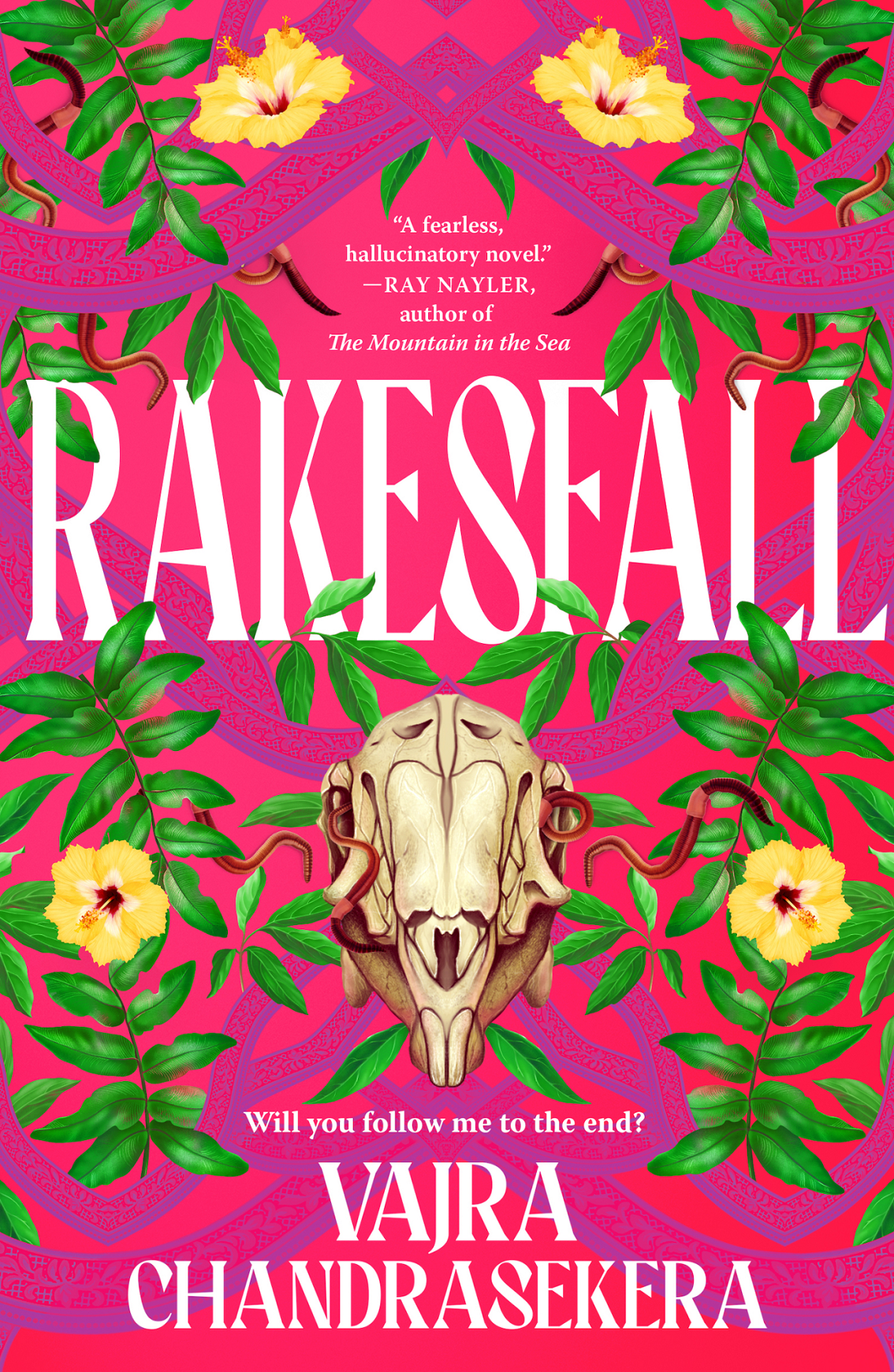
Unbound from temporal or physical constraints, Rakesfall defiantly confronts the reader to question not just what they know about the world they live in but about how they exist. “What do you think is the border of you?” is asked, late into this story, but Chandrasekara doesn’t even pretend that he is interested in giving answers.
The writing in this book is dense and layered and incredibly lyrical. It is wonderfully beautiful to hear, either via the audiobook or via just reading the book aloud to yourself. Mythic language and technobabble play across the page in English as well as Pali, Sinhalese, and more, never holding the reader’s hand but insisting on itself as fundamental throughout. This extravagant style of writing combines with millennia spending landscapes to create poignant atmosphere and settings, moving from meta-fictional classrooms to civil war-ravaged jungles to contemporary concrete jungles to planets that have been destroyed and re-greened and destroyed again as they wait the kiss of emerging supernovas, to the non-physical space where gods, demons, and artificial intelligences are indistinguishable. All of these spaces feel encompassing and vivid, but by the very nature of the story they are like artistic renditions more than deep knowings. We move too quickly across space and time for more than conceptual backdrops for contemplative psychonautics, and as such the world building is effective and the atmosphere consistent and dreamy even if no one place has significant depth.
There isn’t much of a plot, instead there is a recognition that all that has been, is, and will be, whether real or imagined, is recorded simultaneously in a mythic record that eschews earthy linearity and corporality for something intangible and infinite. In this way we follow a handful of characters across countless permutations, reincarnations, hauntings, possessions, folk tales, prophecies, and remembrances. The characters are fun to spend time with, but they are necessarily cryptic, in constant flux. Nothing here has any hard boundary, and that includes characters traits and personalities, and especially character histories and backstories. This works for the surreality of the story but if you are incredibly invested in specific character depth, growth and journey this may feel frustrating, because there is definite character journeys but trying to plot them out is like trying to preserve a cupped palmful of sand by tightening your fist.
In everything, from plot to world building to characters to writing it feels like we are at the intersection between the surreal and the hyperreal, a slipstream narrative that literally leaves the reader without any actual grounding. All of this I enjoyed quite a lot. What I finished the story asking, though, was, to what end? There are certainly ideas he wants us to think about, the nature of self, the nature of relationship and family, stewardship of our planet and worlds both tangible and social, the intersections of poetry and nation-building, possession and possessions, the inevitable consequences of greed and the undeniability of the mythic, what nonduality and positive renunciation might look like in real life, and more. So many ideas. But they all feel as if presented behind a shimmer, a divide between our experiences and any resemblance of wisdom, expansive to the point where it became too dispersed to hold on to. I don’t want a book like this to give me answers but it often didn’t feel it was even asking questions but instead just brainstorming ideas that would be fun to ask questions about, if that makes sense. I would have liked just a little more direction, ironically enough, some firmer ground that let me know there was a definite collection of intentionalities behind this text instead of just fever-dream vibes and intangible wisps of gnosis riding interstellar temporal winds. All the words sound so nice, but the level of abstraction was a bit more than I really enjoy. I appreciated the language and the writing and the overall experience, and I always like being challenged and forced to sit with disquieting questions, and this novel did deliver that. I imagine reading it in any sort of discussion group would be remarkably rewarding, because it really seems like a catalyzing locus of transformative thought. It is impressive and confusing and poetic; take from that what you will.
(Rounded from 3.5)