

What do you think?

Undue Influence
Enigmatic Claire is 30 and lives alone in Marylebone. She is content with her life, although she recognises she has become more reserved and independent since her wilder student days. Her life changes when she embarks on an affair with a widower.
220 pages, Paperback
First published July 29, 1999
About the author
Anita Brookner
66 books714 followersAnita Brookner published her first novel, A Start In Life in 1981. Her most notable novel, her fourth, Hotel du Lac won the Man Booker Prize in 1984. Her novel, The Next Big Thing was longlisted (alongside John Banville's, Shroud) in 2002 for the Man Booker Prize. She published more than 25 works of fiction, notably: Strangers (2009) shortlisted for the James Tait Black Memorial Prize, Fraud (1992) and, The Rules of Engagement (2003). She was also the first female to hold a Slade Professorship of Fine Arts at Cambridge University.
Ratings & Reviews
Friends & Following
Create a free account to discover what your friends think of this book!
Community Reviews
Displaying 1 - 30 of 123 reviews

October 20, 2013
Edited and pictures added 10/3/2021
I really enjoy Brookner’s novels – I must, lol, since I’ve reviewed six and I’ve read a couple more. I find her novels an intriguing, slow, calming read. She’s not Henry James but she’s like him in her psychological focus and in her analysis of manners, mannerisms, gestures. Maybe Henry James ‘lite.’
In Undue Influence we have the stereotypical lonely female book store clerk surrounded by old ladies – her widowed mother and the two elderly spinsters she works for. Her only girlfriend has a married lover but they do not confide in each other about the most important things in their lives.
If there is a single theme to this work, it is loneliness. Our lonely heroine eventually gets involved with a recent widower with a predictable outcome.
The rap on Brookner is that she writes the same book over and over. That’s generally true, but it’s an excellent ‘book’ and well-worth reading the author’s works for the variations on a theme.
Not all her novels are about women. Two I read were focused on men - Altered States and A Private View, but those two had the same themes of loneliness and disappointment in love. (In her obituary, the NY Times called her fiction ‘bleak.’)

As a novelist, Brookner (1928-2016) was an amazing late-bloomer, publishing her first novel when she was 53! She was a professor of art history at various British universities including Cambridge. She’s probably best-known for Hotel du Lac, the 1984 Booker prize winner.
I’ve enjoyed many other novels by Anita Brookner and below are links to my reviews of them. The two I enjoyed most were Hotel du Lac and Making Things Better. (I gave those two novels a rating of 5; all the others, 4.)
The Bay of Angels
A Friend from England
Look at Me
Hotel du Lac
Making Things Better
Altered States
A Private View
The Debut
Visitors
Dolly
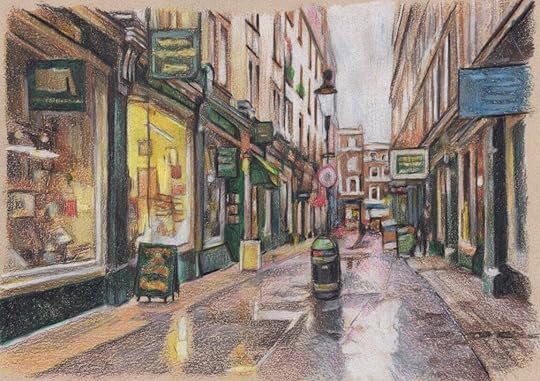
London street colored pencil sketch by Chriss Travell on etsy.com
The author from nytimes.com
I really enjoy Brookner’s novels – I must, lol, since I’ve reviewed six and I’ve read a couple more. I find her novels an intriguing, slow, calming read. She’s not Henry James but she’s like him in her psychological focus and in her analysis of manners, mannerisms, gestures. Maybe Henry James ‘lite.’
In Undue Influence we have the stereotypical lonely female book store clerk surrounded by old ladies – her widowed mother and the two elderly spinsters she works for. Her only girlfriend has a married lover but they do not confide in each other about the most important things in their lives.
If there is a single theme to this work, it is loneliness. Our lonely heroine eventually gets involved with a recent widower with a predictable outcome.
The rap on Brookner is that she writes the same book over and over. That’s generally true, but it’s an excellent ‘book’ and well-worth reading the author’s works for the variations on a theme.
Not all her novels are about women. Two I read were focused on men - Altered States and A Private View, but those two had the same themes of loneliness and disappointment in love. (In her obituary, the NY Times called her fiction ‘bleak.’)
As a novelist, Brookner (1928-2016) was an amazing late-bloomer, publishing her first novel when she was 53! She was a professor of art history at various British universities including Cambridge. She’s probably best-known for Hotel du Lac, the 1984 Booker prize winner.
I’ve enjoyed many other novels by Anita Brookner and below are links to my reviews of them. The two I enjoyed most were Hotel du Lac and Making Things Better. (I gave those two novels a rating of 5; all the others, 4.)
The Bay of Angels
A Friend from England
Look at Me
Hotel du Lac
Making Things Better
Altered States
A Private View
The Debut
Visitors
Dolly
London street colored pencil sketch by Chriss Travell on etsy.com
The author from nytimes.com

March 22, 2020
About 10 or more years ago I used to read a lot of Brookner. And then I stopped, having come to the firm conclusion that she depressed me. So I picked this up with some hesitation - trepidation.
I was right - I should have left well alone. This story is sad and depressing. Multiple times I found myself flicking forward to see how much was left in each chapter - this should have been a clear sign to me to PUT IT DOWN - stop reading. But I didn't I persisted to the very end. Yes Brookner has a finesse of style - similar in some ways to Henry James - although James is heavier, and far more entertaining.
The problem with this - Undue Influence - is that it is a dishearteningly accurate portrayal of how (probably) many women, myself included, have participated in a relationship. Brookner's portrait of the female desire to have a man by our side, to make us feel "whole, complete and socially acceptable" is disturbingly accurate. Our narrator, Claire Pitts, aged 29 would like to have a relationship with a man who is a companion, a friend, a lover - and a lover who will commit to her exclusively and on a long term basis. What most of us would identify - as normal.
Unfortunately Claire chooses someone - Martin Gibson - who is wrong for her - he does not share the same set of values. Claire's friend Wiggy points this out early on in the story but, Claire is driven by her need to find A MAN. Claire's background is described in lengthy detail. Her invalid older father; her close attachment to her mother, who has just died; Claire's romantic adventures whilst on holiday in France - flings, of a sexual nature, which satisfied her on a purely temporary basis. I suppose we are to understand that these casual encounters are all that Claire can allow herself because she cannot upset the closeness of her life with her mother.
All the background figures around Claire are SPINSTERs - the two old ladies, Hetty and Muriel, who own the bookshop, where Claire works; her mother - essentially a spinster - she was married to a much older man, cripped with a stroke when Claire is 15 - classifies the mother as yet another female - with no sex life. Brookner's point - unless you grab your man you will end up like poor old Muriel and Hetty Collier. On a personal note, I remember my own mother threatening me with - spinsterhood - if I didn't learn some nicer manners!
Even Claire's best friend Wiggy - has no committed and dependent relationship with a man - she 'only has' the affections of a married man. A situation which Claire thinks is not worthy of her. There is no suggestion that perhaps this is exactly how Wiggy likes things to be.
So - onward with the plot. Early on in her pursuit of Martin, Claire realises that 'there are problems,' which can BE FIXED. Sorry, but again, this is depressingly and unnervingly true. Brookner could easily be classed as Feminist along with Erica Jong or Simone de Beauvoir, because this is like a thesis - an extremely careful analysis of how in desperation, women (of a certain era) are prepared to do everything possible to conduct/carry on a relationship with someone who is unsuitable for them - and refuse to see it, despite the miserable torture they end up embroiling themselves in. They are convinced they can handle, iron out all those little differences of opinion.
How many women are brought up to believe that the onus of the relationship is on them - they are responsible for, they have to fix the problems?
I think a lot of reviewers stated how much they disliked Claire - this is NOT the point of Brookner's novel. Instead we are to understand how such a person as Claire could arrive in such an unpleasant situation. It is a social analysis - an analysis of cultural values and conditioning. This is a very carefully structured novel - it has been extremely well planned and executed. The only problem was I felt as if I had Miss Brookner's leather-bound ankle boot firmly pressed against my neck as I tried to nod agreement with each and every one of her tightly argued structures, on the fate of women.
No - I don't want to agree with her theories. I want to believe that we can escape our upbringing, our parental values embedded into us, our DNA, the values into which we are formed. I want to believe that as rational beings we can look around, question what we do and change our behaviour - or try to.
I suggest that - if you are a liberated 21st century female, then read this as social history - not how we are but how we were.
Two stars - because I was involved but also massively uncomfortable - walking in Claire's shoes.
I was right - I should have left well alone. This story is sad and depressing. Multiple times I found myself flicking forward to see how much was left in each chapter - this should have been a clear sign to me to PUT IT DOWN - stop reading. But I didn't I persisted to the very end. Yes Brookner has a finesse of style - similar in some ways to Henry James - although James is heavier, and far more entertaining.
The problem with this - Undue Influence - is that it is a dishearteningly accurate portrayal of how (probably) many women, myself included, have participated in a relationship. Brookner's portrait of the female desire to have a man by our side, to make us feel "whole, complete and socially acceptable" is disturbingly accurate. Our narrator, Claire Pitts, aged 29 would like to have a relationship with a man who is a companion, a friend, a lover - and a lover who will commit to her exclusively and on a long term basis. What most of us would identify - as normal.
Unfortunately Claire chooses someone - Martin Gibson - who is wrong for her - he does not share the same set of values. Claire's friend Wiggy points this out early on in the story but, Claire is driven by her need to find A MAN. Claire's background is described in lengthy detail. Her invalid older father; her close attachment to her mother, who has just died; Claire's romantic adventures whilst on holiday in France - flings, of a sexual nature, which satisfied her on a purely temporary basis. I suppose we are to understand that these casual encounters are all that Claire can allow herself because she cannot upset the closeness of her life with her mother.
All the background figures around Claire are SPINSTERs - the two old ladies, Hetty and Muriel, who own the bookshop, where Claire works; her mother - essentially a spinster - she was married to a much older man, cripped with a stroke when Claire is 15 - classifies the mother as yet another female - with no sex life. Brookner's point - unless you grab your man you will end up like poor old Muriel and Hetty Collier. On a personal note, I remember my own mother threatening me with - spinsterhood - if I didn't learn some nicer manners!
Even Claire's best friend Wiggy - has no committed and dependent relationship with a man - she 'only has' the affections of a married man. A situation which Claire thinks is not worthy of her. There is no suggestion that perhaps this is exactly how Wiggy likes things to be.
So - onward with the plot. Early on in her pursuit of Martin, Claire realises that 'there are problems,' which can BE FIXED. Sorry, but again, this is depressingly and unnervingly true. Brookner could easily be classed as Feminist along with Erica Jong or Simone de Beauvoir, because this is like a thesis - an extremely careful analysis of how in desperation, women (of a certain era) are prepared to do everything possible to conduct/carry on a relationship with someone who is unsuitable for them - and refuse to see it, despite the miserable torture they end up embroiling themselves in. They are convinced they can handle, iron out all those little differences of opinion.
How many women are brought up to believe that the onus of the relationship is on them - they are responsible for, they have to fix the problems?
I think a lot of reviewers stated how much they disliked Claire - this is NOT the point of Brookner's novel. Instead we are to understand how such a person as Claire could arrive in such an unpleasant situation. It is a social analysis - an analysis of cultural values and conditioning. This is a very carefully structured novel - it has been extremely well planned and executed. The only problem was I felt as if I had Miss Brookner's leather-bound ankle boot firmly pressed against my neck as I tried to nod agreement with each and every one of her tightly argued structures, on the fate of women.
No - I don't want to agree with her theories. I want to believe that we can escape our upbringing, our parental values embedded into us, our DNA, the values into which we are formed. I want to believe that as rational beings we can look around, question what we do and change our behaviour - or try to.
I suggest that - if you are a liberated 21st century female, then read this as social history - not how we are but how we were.
Two stars - because I was involved but also massively uncomfortable - walking in Claire's shoes.

August 21, 2019
The premise of Undue Influence makes it sound like archetypal Anita Brookner. Claire Pitt is 29, single, and works in a bookshop run by two elderly spinsters. She has one good friend – Caroline, known by her nickname Wiggy – whose main preoccupation is a long-running affair with a married man. One day, Claire gets talking to a customer, Martin Gibson, whose combination of 'attractiveness and hesitation' she finds irresistible. 'I feel a desire to take him over, as if his weakness excited me.' When she insists on delivering a book to Martin's house, she makes the acquaintance of his invalid wife, Cynthia, and is drawn into their world.
With that said, Claire is not quite a typical Brookner heroine. From the very beginning, I sensed something devious and cruel in her voice. She is rather manipulative – though one senses she would like to be more successful at it than she actually is. She would no doubt regard Frances (Look At Me) or Kitty (Providence) with derision.
Claire lives in her imagination. She reminded me a lot of the narrator of Katie Kitamura's A Separation, who invents all sorts of stories about those around her, and makes leaps of judgement based on these fantasies. Similarly, Claire speculates endlessly about the intimate lives of her acquaintances: Martin and Cynthia; her bosses, the 'Misses Collier', and their father; and her own parents.
It's her wild imaginings that prove to be her downfall: despite fantasising about Martin's life almost constantly, she's unable to spot an obvious truth. The ending struck me with a strange mixture of pathos and gratification. In other Brookner novels, I have felt desperately sorry for the tragic protagonists. With Undue Influence my feelings were a bit more complicated: Claire isn't particularly likeable, especially her intolerable smugness about her 'minor adventures' abroad, and her protestations of experience and sophistication make her inability to grasp reality less forgiveable.
Undue Influence is a later Brookner, published in 1999. The milieu her characters inhabit seems dated even in her early novels, and it's a bit of a problem here: I struggled to believe in Claire as a young woman in the era of Bridget Jones and the ladette, and found it helpful to picture the story taking place 30 or 40 years earlier.
As always, I noted down lots of quotes and dog-eared about 20 pages. Brookner's novels may be rather similar to one another, but I'm not tired of them yet, though I liked this less than the others I've read. (Especially Look At Me, which I suspect will remain the ur-Brookner in my personal canon.)
TinyLetter | Twitter | Instagram | Tumblr
With that said, Claire is not quite a typical Brookner heroine. From the very beginning, I sensed something devious and cruel in her voice. She is rather manipulative – though one senses she would like to be more successful at it than she actually is. She would no doubt regard Frances (Look At Me) or Kitty (Providence) with derision.
One thing was certain: I was not destined for the happiness of a settled life, whether or not I longed for it: I was not one of the elect.
Claire lives in her imagination. She reminded me a lot of the narrator of Katie Kitamura's A Separation, who invents all sorts of stories about those around her, and makes leaps of judgement based on these fantasies. Similarly, Claire speculates endlessly about the intimate lives of her acquaintances: Martin and Cynthia; her bosses, the 'Misses Collier', and their father; and her own parents.
I know remarkably few people in what I am tempted to call real life, and yet I seem to get closer to them when I construct their lives for myself.
It's her wild imaginings that prove to be her downfall: despite fantasising about Martin's life almost constantly, she's unable to spot an obvious truth. The ending struck me with a strange mixture of pathos and gratification. In other Brookner novels, I have felt desperately sorry for the tragic protagonists. With Undue Influence my feelings were a bit more complicated: Claire isn't particularly likeable, especially her intolerable smugness about her 'minor adventures' abroad, and her protestations of experience and sophistication make her inability to grasp reality less forgiveable.
Undue Influence is a later Brookner, published in 1999. The milieu her characters inhabit seems dated even in her early novels, and it's a bit of a problem here: I struggled to believe in Claire as a young woman in the era of Bridget Jones and the ladette, and found it helpful to picture the story taking place 30 or 40 years earlier.
As always, I noted down lots of quotes and dog-eared about 20 pages. Brookner's novels may be rather similar to one another, but I'm not tired of them yet, though I liked this less than the others I've read. (Especially Look At Me, which I suspect will remain the ur-Brookner in my personal canon.)
TinyLetter | Twitter | Instagram | Tumblr

May 21, 2012
Novels can be plot-driven, character-driven or idea-driven: it is generally accepted that serious "literary" fiction is mostly of the last two categories. In character-driven stories, rather than events, it is the development and analysis of human nature that takes front stage. The events are just a backdrop. Skillfully executed, they are sometimes more exciting than the wildest adventure story; however, when the execution falls flat (as in Undue Influence by Anita Brookner), the result is a disaster.
Claire Pitt is a lonely young woman, living with her widowed mother. Her crippled father has passed away some time back. Claire is suffering from some kind of existential angst (at least, that is what her first person narrative indicates): she cannot form any lasting relationship with a member of the opposite sex, even though she hints that she has had adventures aplenty. Claire's only friend is Wiggy, an artist, who is happily in relationship with a married man - though even with her, Claire finds it difficult to unburden herself. She continuously fantasises about the lives of the people she meets, providing them with imaginary pasts, presents and futures. She is also adept at analysing the emotions of other people (according to her own yardstick, of course).
As the novel opens, we find Claire reeling under the death of her mother, the only human being who she could claim to be attached to. She suddenly realises that her sinecure job at a bookstore run by two old ladies is her only tenuous hold to life. As Claire desperately casts about for some kind of foothold on society, she meets attractive, middle-aged Martin Gibson who is married to an invalid. She is immediately attracted to him, and believes she has a chance at a life when Martin's wife passes away: all the more important to her, as the store is sold off and her job disappears. However, in this also, Claire is disappointed - making her realise that it is time to stop grasping at shadows and take charge of herself.
This could have been a great novel of manners. The characters are all well-drawn (even the dead St Collier, the father of Claire's employers, whose articles she is editing), the relationships complex and the language, superior. However, all the effort is wasted because of the meandering pace and the endless self-reflections of the singularly unlikeable protagonist. The author may have made Claire flawed to make her all the more human, but she ended up being such a whimpering, self-pitying dishrag that I wanted to poke her one on the nose! The excruciatingly slow pace of the novel also did not help. In the end, when the big "revelation" comes, it is something which would be clear to any discerning reader about halfway through the novel - still, Claire says, "this was one connection I failed to make". Shows what a jackass she is, IMO.
Avoid this one at all costs.
Claire Pitt is a lonely young woman, living with her widowed mother. Her crippled father has passed away some time back. Claire is suffering from some kind of existential angst (at least, that is what her first person narrative indicates): she cannot form any lasting relationship with a member of the opposite sex, even though she hints that she has had adventures aplenty. Claire's only friend is Wiggy, an artist, who is happily in relationship with a married man - though even with her, Claire finds it difficult to unburden herself. She continuously fantasises about the lives of the people she meets, providing them with imaginary pasts, presents and futures. She is also adept at analysing the emotions of other people (according to her own yardstick, of course).
As the novel opens, we find Claire reeling under the death of her mother, the only human being who she could claim to be attached to. She suddenly realises that her sinecure job at a bookstore run by two old ladies is her only tenuous hold to life. As Claire desperately casts about for some kind of foothold on society, she meets attractive, middle-aged Martin Gibson who is married to an invalid. She is immediately attracted to him, and believes she has a chance at a life when Martin's wife passes away: all the more important to her, as the store is sold off and her job disappears. However, in this also, Claire is disappointed - making her realise that it is time to stop grasping at shadows and take charge of herself.
This could have been a great novel of manners. The characters are all well-drawn (even the dead St Collier, the father of Claire's employers, whose articles she is editing), the relationships complex and the language, superior. However, all the effort is wasted because of the meandering pace and the endless self-reflections of the singularly unlikeable protagonist. The author may have made Claire flawed to make her all the more human, but she ended up being such a whimpering, self-pitying dishrag that I wanted to poke her one on the nose! The excruciatingly slow pace of the novel also did not help. In the end, when the big "revelation" comes, it is something which would be clear to any discerning reader about halfway through the novel - still, Claire says, "this was one connection I failed to make". Shows what a jackass she is, IMO.
Avoid this one at all costs.

September 25, 2022
I will confess I found this novel a bit unsettling at times and increasingly bleak as it progressed. That said, the writing here is raw, precise, and unsentimental and this stylistic approach helped to capture the essence of the main character, Claire Pitt. Claire is young, attractive, and a bit of an introvert given to speculating about the lives of those she encounters. Thanks to Ms. Brookner's brilliant prose, we as readers, spend a lot of time inside that busy mind. It is in these fanciful ruminations that she eventually comes across as a bit cruel and manipulative. This is a very interior novel even by Brookner standards. Still, once engaged, I found it difficult to put down and, in the end, really enjoyed it. Full disclosure: I am a Brookner fanboy so please take my humble observations with a grain. Cheers!

January 6, 2023
I myself had only a shadow existence in ... dreams, whereas those of whom I was dreaming were endowed with an alarming distinction, as if enjoying another life of which I knew nothing but on which I had somehow gained an unnerving insight. Thus the characters who people one’s dreams are revealed as strangers, and strangers, moreover, who have no interest in oneself, even though one is the agent behind all their movements. In the act of dreaming it is impossible to consider oneself the prime mover. More often one is the victim of circumstance, unsuitably dressed, missing the train, enrolled in the wrong examination, vainly requesting help that is not forthcoming, whereas those who made a random appearance seem to enjoy a more substantial existence.

February 24, 2008
Why even bother? Anita Brookner just keeps writing the same goddamned book. Over and over and over. Surprise, surprise - the main protagonist is another one of those sensitive, bookish, brooding, pathetic, lonely unmarried women. Who pines for TRUE LUV.
And keeps on pining. And pining. And pining. And whining.
As with the other two Brookner novels I've read, somewhere around the 100-page mark, the urge becomes almost irresistible to reach into the book, smack the main character smartly around the head and scream "Snap out of it already! Have you even once, for a second, thought about interrupting your lifelong wallow in self-pity? About maybe doing some volunteer work? Just GET OVER YOURSELF ALREADY!!!!"
Same goes for you, Anita. Obviously you're a smart woman. Well able to string pretty sentences together. But, even more obviously, you need to get out more. Writing the same book over a dozen times really speaks to some unresolved issues, wouldn't you say?
Can you spell 'one-trick pony'? Nobody likes a whiny, self-pitying nag.
And keeps on pining. And pining. And pining. And whining.
As with the other two Brookner novels I've read, somewhere around the 100-page mark, the urge becomes almost irresistible to reach into the book, smack the main character smartly around the head and scream "Snap out of it already! Have you even once, for a second, thought about interrupting your lifelong wallow in self-pity? About maybe doing some volunteer work? Just GET OVER YOURSELF ALREADY!!!!"
Same goes for you, Anita. Obviously you're a smart woman. Well able to string pretty sentences together. But, even more obviously, you need to get out more. Writing the same book over a dozen times really speaks to some unresolved issues, wouldn't you say?
Can you spell 'one-trick pony'? Nobody likes a whiny, self-pitying nag.

June 29, 2013
The first of my Brookner in July reads – I hope to do one or two more this month of Brookner reading.
Claire Pitt is an attractive young woman, living alone in the mansion flat where her mother died. Although not really in need of money, Claire has taken a job in a book shop owned by octogenarian sisters Muriel and Hester. Claire works in the dusty basement on the sister’s father’s papers. She enjoys the work, becomes fascinated by the man whose articles she is painstakingly transcribing from piles of rotting newspapers. It is while working in the basement that Claire meets Martin Gibson, and is immediately curious about him, soon finding herself attracted to him.
Martin is married to a manipulative invalid Cynthia – and Claire and her friend Wiggy are drawn into Martin’s world after they pay a courtesy visit to Cynthia.
“She was wearing some kind of peignoir, coral pink, with a certain amount of lace, and she smelt of the kind of scent which should be reserved for decisive women executives looking forward to a career in the boardroom. I imagined, though I could hardly turn round and look, a whole armoury of such scents, indulgences brought to the sickroom by the devoted husband who would naturally be at a loss in such a situation and who would seek the advice of the sales assistants behind the beauty counters. My mother had never used more than a simple cologne. But this was no time to think of my mother.”
When Cynthia dies suddenly, Claire begins to imagine a possible future for herself with Martin. Yet as Claire comes to see she doesn’t fully understand Martin, he is not all that she would want him to be.
It is the detail of Brookner’s character’s lives that is so very good. The small suffocating lives of Murial and Hester having lived with their father, they have continued to live for him, carrying on what he had started until they are too old to go on with it. Wiggy’s upstairs neighbour Eileen whose unexpected death so shatters Wiggy, as it serves to highlight the loneliness of a woman who had presented to the world a rather different face. I find the portrayals of these lives to be so beautifully rendered that they somehow take away from the bleakness – oh there is bleakness I admit that. Claire probably spends far too much time, ruminating on her life, remembering her mother and how she had lived her life. Claire is a young woman, she sounds far older than she is, she needs to just get on with living her life.
I know many people find Anita Brookner “depressing” – a word I often see applied to Anita Brookner in online reviews. It is true, that Brookner’s characters are not always very likeable – they live small disappointed lives, falling for unsuitable or disinterested men. On the surface it might seem that Anita Brookner writes about lives far removed from our own – upper middle class women, with inherited money, living in mansion flats in North London. However there is a truth about Brookner’s world – that is maybe a little unpalatable. Strip away the privilege and the London setting and Brookner’s characters could be anyone – anywhere. There are many small disappointed lives being led out there – people isolated and alone – they may not indulge in the kind of introspection that Brookner’s characters do, but the result is the same. Anita Brookner may be a bit like marmite, now I don’t like marmite – I do like Brookner – but I understand why other readers are less keen.
Claire Pitt is an attractive young woman, living alone in the mansion flat where her mother died. Although not really in need of money, Claire has taken a job in a book shop owned by octogenarian sisters Muriel and Hester. Claire works in the dusty basement on the sister’s father’s papers. She enjoys the work, becomes fascinated by the man whose articles she is painstakingly transcribing from piles of rotting newspapers. It is while working in the basement that Claire meets Martin Gibson, and is immediately curious about him, soon finding herself attracted to him.
Martin is married to a manipulative invalid Cynthia – and Claire and her friend Wiggy are drawn into Martin’s world after they pay a courtesy visit to Cynthia.
“She was wearing some kind of peignoir, coral pink, with a certain amount of lace, and she smelt of the kind of scent which should be reserved for decisive women executives looking forward to a career in the boardroom. I imagined, though I could hardly turn round and look, a whole armoury of such scents, indulgences brought to the sickroom by the devoted husband who would naturally be at a loss in such a situation and who would seek the advice of the sales assistants behind the beauty counters. My mother had never used more than a simple cologne. But this was no time to think of my mother.”
When Cynthia dies suddenly, Claire begins to imagine a possible future for herself with Martin. Yet as Claire comes to see she doesn’t fully understand Martin, he is not all that she would want him to be.
It is the detail of Brookner’s character’s lives that is so very good. The small suffocating lives of Murial and Hester having lived with their father, they have continued to live for him, carrying on what he had started until they are too old to go on with it. Wiggy’s upstairs neighbour Eileen whose unexpected death so shatters Wiggy, as it serves to highlight the loneliness of a woman who had presented to the world a rather different face. I find the portrayals of these lives to be so beautifully rendered that they somehow take away from the bleakness – oh there is bleakness I admit that. Claire probably spends far too much time, ruminating on her life, remembering her mother and how she had lived her life. Claire is a young woman, she sounds far older than she is, she needs to just get on with living her life.
I know many people find Anita Brookner “depressing” – a word I often see applied to Anita Brookner in online reviews. It is true, that Brookner’s characters are not always very likeable – they live small disappointed lives, falling for unsuitable or disinterested men. On the surface it might seem that Anita Brookner writes about lives far removed from our own – upper middle class women, with inherited money, living in mansion flats in North London. However there is a truth about Brookner’s world – that is maybe a little unpalatable. Strip away the privilege and the London setting and Brookner’s characters could be anyone – anywhere. There are many small disappointed lives being led out there – people isolated and alone – they may not indulge in the kind of introspection that Brookner’s characters do, but the result is the same. Anita Brookner may be a bit like marmite, now I don’t like marmite – I do like Brookner – but I understand why other readers are less keen.

April 25, 2017
Four and a half.
Brookner's writing is reflective, elegant and absorbing. Solitary, inhibited lives and loneliness are a significant thread binding her novels. The prose in this slim book is wonderfully light, singularly engaging, quietly skilled and most profound.
Thank you so much Mary for sending me this novel! I found it an immersing read.
Brookner's writing is reflective, elegant and absorbing. Solitary, inhibited lives and loneliness are a significant thread binding her novels. The prose in this slim book is wonderfully light, singularly engaging, quietly skilled and most profound.
Thank you so much Mary for sending me this novel! I found it an immersing read.

November 22, 2020
An odd, interior book that's pulsing with wit and intelligence but in service of the most slender and aimless of plots.

Read
December 27, 2022Martin Gibson? Martin Gibson? You’re joking, right? That pusillanimous, washed-out, stuck-up guy who acts thirty years older than he is. That Martin Gibson? Claire, why him?
Anita Brookner created a few unappealing male characters in her approximately two dozen novels, and Martin Gibson may be the least appealing of them all. But then again, Undue Influence’s Claire Pitt rivals Undue Influence’s Martin Gibson as possessing an essentially unappealing and unappealing personality.
Anita Brookner’s novels sometimes feature a principal character’s epiphanies about herself, and especially about her failures to understand herself or other people. Undue Influence contains just such an epiphany but here Claire regards it as a purely intellectual failing: ”The burning blush that crept all over me was for my own stupidity, not emotional this time so much as intellectual. This was one connection I had failed to make. It was the greatest failure of my life and no future success could ever obliterate it.”>
Did Anita Brookner ever write a novel about two less appealing people? It takes true authorial courage and skill to write an interesting novel about uninteresting characters. In Undue Influence, Dame Brookner reveals that courage, creating an often fascinating and compelling novel about two grey and uninteresting characters.
Anita Brookner created a few unappealing male characters in her approximately two dozen novels, and Martin Gibson may be the least appealing of them all. But then again, Undue Influence’s Claire Pitt rivals Undue Influence’s Martin Gibson as possessing an essentially unappealing and unappealing personality.
Anita Brookner’s novels sometimes feature a principal character’s epiphanies about herself, and especially about her failures to understand herself or other people. Undue Influence contains just such an epiphany but here Claire regards it as a purely intellectual failing: ”The burning blush that crept all over me was for my own stupidity, not emotional this time so much as intellectual. This was one connection I had failed to make. It was the greatest failure of my life and no future success could ever obliterate it.”>
Did Anita Brookner ever write a novel about two less appealing people? It takes true authorial courage and skill to write an interesting novel about uninteresting characters. In Undue Influence, Dame Brookner reveals that courage, creating an often fascinating and compelling novel about two grey and uninteresting characters.
February 4, 2018
I have spoken already of the sexism inherent in most attitudes to Brookner's work. Even reviewers who recognise her virtuosity seem to go one of two routes: minimize her as a niche writer--she writes often about women and about women and men, so how important could she be--or dam her, and, indeed, all female writers, with faint praise. For instance, her publisher chooses to promote this volume by citing the Evening Standard, which deems Brookner "One of the few living female British novelists of real genius," as if even when nationality and mortality have narrowed the field, being a woman reduces considerably one's chances of making the grade. In any event, this is another Brookner novel about loneliness and misinterpretation, this one from her later output, and it's as sharply drawn, as painful, and as searching about time, expectation, and self-understanding as her others. The first chapter is particularly masterful. Brookner's clearest literary ancestor is Henry James, and so I say to the Evening Standard reviewer, take out the "female," and you're almost there.

May 16, 2025
3.5
There are endearing attempts at self-parody here but I feel they fall flat because they don't involve cold vegetable terrines.
It's also one of the few novels from her where she tries to do A Plot Twist™ and I'm sorry I love Anita Brookner but that's one thing she's just terrible at. That and dialogue, of course.
There are endearing attempts at self-parody here but I feel they fall flat because they don't involve cold vegetable terrines.
It's also one of the few novels from her where she tries to do A Plot Twist™ and I'm sorry I love Anita Brookner but that's one thing she's just terrible at. That and dialogue, of course.

August 24, 2026
It is many, many years since I read a Brookner novel. I cannot remember what I found so irksome about her writing ,other than repetition of similar stories told in different locations.
I am always keen to bury my own hatchet and try anew but I am still struggling to find any mastery or indeed any enjoyment. I found this novel a struggle to complete almost suffocating within this small world. The narrative is overwhelmingly interior with next to no dialogue and the unfortunate Claire, the protagonist seemed to have the manners and attitudes of the early rather than the late twentieth century. This is a young woman living in her own flat (after her mother's death) who has made little effort in her work choice, seems to have no head for managing people, money or friends. I found myself enclosed in a very long adult sulk.
For my part, this was a novel that just shuffled along. Huge sections of thinking about herself, her past and future, general speculation with a level of fiction within the fiction. A selection of characters/voices off who, anyone in their right mind would be brushing off rather than encouraging.
Brookner obviously not my bag
I am always keen to bury my own hatchet and try anew but I am still struggling to find any mastery or indeed any enjoyment. I found this novel a struggle to complete almost suffocating within this small world. The narrative is overwhelmingly interior with next to no dialogue and the unfortunate Claire, the protagonist seemed to have the manners and attitudes of the early rather than the late twentieth century. This is a young woman living in her own flat (after her mother's death) who has made little effort in her work choice, seems to have no head for managing people, money or friends. I found myself enclosed in a very long adult sulk.
For my part, this was a novel that just shuffled along. Huge sections of thinking about herself, her past and future, general speculation with a level of fiction within the fiction. A selection of characters/voices off who, anyone in their right mind would be brushing off rather than encouraging.
Brookner obviously not my bag

June 30, 2011
Don't read an Anita Brookner novel if liking the main character, wanting to sit down with her over a cup of coffee and chat, matters to you. Her characters are hard to like and impossible to feel any warmth for. They don't feel any particular warmth for anyone else, either, although they often know that their lack of genuine warmth and connectedness is a problem; they just have no idea what to do about it. Like most Brookner heroines, Claire is restrained and self-controlled to the point of being emotionally stunted. She spins elaborate stories about the people she encounters, imagining exquisitely subtle Jamesian motives and emotional nuances for them. Knowing too much about them as real people, as opposed to knowing them as characters in her private imagined Jamesian novel, would require a degree of personal vulnerability and messiness that she flinches from. Her only other emotional outlet seems to be occasional holidays abroad when she picks up men for sex (we have to infer from her hints the strings-free sex bit, but it seems pretty obvious), but those are in the past as this novel begins. Her father, whom she didn't like much, died some years ago after years as a cranky invalid; her mother, almost as restrained and isolated as Claire (although she at least managed to marry and have a child before retreating from life), has recently died. She does pointless work in the basement of a second-hand bookstore, compiling the writings of the dead father of her aged employers, octogenarian spinster sisters, and appreciating the image of tasteful middle-class life conveyed in the pages of the old magazines in which his nice little essays appeared. She seems to float in a timeless mid-century sensory deprivation tank, touching on the modern world only when necessary and with fastidious distaste. Now, all of this is difficult to like and impossible to admire, but it is sort of compelling. If you believe that everyone has a story worth hearing, then you have to believe that emotionally stunted but intelligent women who float unconnected through life have stories worth hearing, too. And in beautiful, and sometimes quite funny, prose, as well.

October 13, 2013
Anita Brookner won the Booker Prize for Fiction for her fourth book, Hotel du Lac, in 1984. Undue Influence, her 19th book, was published in 1999.
Brookner’s lyrical and engaging prose draws us skilfully into the unreliable world of Claire Pitt, a single 29 year old living alone following the recent death of her mother. We experience this world wholly through the eyes and rich imaginings of Claire, who has lived a fairly ordinary and structured life caring for an aging mother and working for two elderly spinsters crafting a compendium of their dead father’s writings. As she pulls these writings together, she envisions his day-to-day life, just as she devises the motives and lives of those people around her.
Brookner has Claire tell us on page one that ‘everyone is profoundly eccentric’ and ‘most people are entirely inconsistent’; a warning she would do well to heed.
Claire constantly strives to make sense of her lonely world. She has no real friends, but observes the people around her closely and populates her world by exploring the emotions and experiences that cause these people to act the way they do. In this, she is often forgiving and compassionate. We care about these characters, just as she does. And we are as surprised as she is to find out all is not how she has conceived it.
Brookner has fashioned a richly engaging cast of characters seen from Claire Pitt’s perspective, complete with her elaborations. As we follow Claire’s cautious progress, we witness her carefully orchestrated and rationalised life unravel into unknowing bewilderment.
Brookner’s lyrical and engaging prose draws us skilfully into the unreliable world of Claire Pitt, a single 29 year old living alone following the recent death of her mother. We experience this world wholly through the eyes and rich imaginings of Claire, who has lived a fairly ordinary and structured life caring for an aging mother and working for two elderly spinsters crafting a compendium of their dead father’s writings. As she pulls these writings together, she envisions his day-to-day life, just as she devises the motives and lives of those people around her.
Brookner has Claire tell us on page one that ‘everyone is profoundly eccentric’ and ‘most people are entirely inconsistent’; a warning she would do well to heed.
Claire constantly strives to make sense of her lonely world. She has no real friends, but observes the people around her closely and populates her world by exploring the emotions and experiences that cause these people to act the way they do. In this, she is often forgiving and compassionate. We care about these characters, just as she does. And we are as surprised as she is to find out all is not how she has conceived it.
Brookner has fashioned a richly engaging cast of characters seen from Claire Pitt’s perspective, complete with her elaborations. As we follow Claire’s cautious progress, we witness her carefully orchestrated and rationalised life unravel into unknowing bewilderment.

January 22, 2017
I am always ambivalent about Anita Brookner's novels. As a stylist and observer I would give her five stars, as an enjoyable read with narrative drive, one. Hence my mean rating (in both senses). The relentlessly introspective protagonist is beautifully observed; the tragedy of this psychologically trapped, socially impoverished young woman is almost unbearable. She rationalises her life choices to help her survive her unmet need but despite her long and detailed analyses of others' inner worlds, she finally realises that she lacks empathy and her deliberate rejection of compassion for herself and others leaves her stranded and empty. Of course she misreads the situation utterly. Very sad. As a wonderfully wrought book full of subtle insights, wit and ideas it will appeal to introverts more than those seeking an emotionally engaging narrative with a likeable protagonist.

February 16, 2013
I have a strange relationship with Anita Brookner's novels and this one was no exception. Although they ultimately leave me feeling dissatisfied and I often want to shake some sense in her heroines and tell them to get some backbone, I find that when I start reading one of her books I can't put it down till I'm finished.

December 29, 2010
With what a cool eye Brookner views women! A perfect illustration is this passage from "Undue Influence:"
In speaking of her mother, just widowed, she writes, "She had always struck me as a contented woman. She belonged to the era before women complained."
In speaking of her mother, just widowed, she writes, "She had always struck me as a contented woman. She belonged to the era before women complained."

April 13, 2012
Ugh! I kept thinking this book would get better. I was wrong! It took me a long time to get through it, reading several other books in between trying to finish this. It wasn't worth it; I shouldn't have wasted my time.

August 22, 2012
If by page 50, I just don't care what is going to happen, it's time to stop. Life is too short. Claire is not a character to whom I was drawn and I would not look forward to dinner with her any more than her friend did.

January 24, 2008
Pretentious twaddle - my first and last by this author!!

September 9, 2022
I chose this particular Brookner novel because it is uncommon for her (not because I don’t like her other work, but I wanted to see what she did when she did something different). It’s the first-person narrative of an odd youngish woman who has, in many ways, given up on life and love, and goes back and forth on being honest with herself and trying to fool herself. It’s a sad novel, and gets sadder as it goes along. The narrator becomes increasingly trying, but the writing is good and the novel is short. A success, but not a raging success because this is the furthest thing from a raging novel (in that way like Brookner’s more common work).
June 12, 2026
Anita Brookner books are for those of us, especially women, who have been writing essentially the same entry in their journal for the past 10 years, who are afraid of change but simultaneously desperately need it, who like things as they are but often imagine what it would be like if everything was different, who know the things they are supposed to want but not what they actually do…

July 9, 2015
[rating = B+]
"I had already reached that point in which the other's opinion of one seals one fate, so that imperceptibly one agrees with the other's reaction" Anita Brookner, who died recently in March is an author that has inspired my own writing. This novel is on par with her "Fraud" and "Hotel du Lac". You must be in a certain mood to read her careful, pristine, full and rich prose. She reminds me of a combination of Alice Munro, Virginia Woolf, Jane Austen, and Anne Tyler. She is sensitive and thoughtful, and in this particular novel very witty. This novel is narrated by Claire Pitt who is young woman searching for something or someone to bring meaning into her daily routine. Plagued by the memory of an ill father and loving but busy mother (both of whom are not gone), Claire wanders about her job and sole friend (Wiggy), and meets a Martin Gibbons. And this is where Brookner's (or rather Claire's) observations and fantasizing come into play. A woman who does not wholly live in her world, Claire is prone to make-up lives of others and introspect, perhaps hastily, her own. This story is about the idea of not influencing others, but one's self by being the company of others, and by continual fantasy of other's lives. A wonderful story that starts off a bit slow and dry, but really hits the hard in a common though unthought of way. It is a text of considerations and ideals of what men and woman are, to each other and to themselves.
"I had already reached that point in which the other's opinion of one seals one fate, so that imperceptibly one agrees with the other's reaction" Anita Brookner, who died recently in March is an author that has inspired my own writing. This novel is on par with her "Fraud" and "Hotel du Lac". You must be in a certain mood to read her careful, pristine, full and rich prose. She reminds me of a combination of Alice Munro, Virginia Woolf, Jane Austen, and Anne Tyler. She is sensitive and thoughtful, and in this particular novel very witty. This novel is narrated by Claire Pitt who is young woman searching for something or someone to bring meaning into her daily routine. Plagued by the memory of an ill father and loving but busy mother (both of whom are not gone), Claire wanders about her job and sole friend (Wiggy), and meets a Martin Gibbons. And this is where Brookner's (or rather Claire's) observations and fantasizing come into play. A woman who does not wholly live in her world, Claire is prone to make-up lives of others and introspect, perhaps hastily, her own. This story is about the idea of not influencing others, but one's self by being the company of others, and by continual fantasy of other's lives. A wonderful story that starts off a bit slow and dry, but really hits the hard in a common though unthought of way. It is a text of considerations and ideals of what men and woman are, to each other and to themselves.

May 21, 2012
This is a very introspective story of main character Claire Pitt's looking at past and present to find her place in life. So much is going on in this story, with the overriding events being those of loss through death, being displaced from a job, and developing relationships unexpectedly. It is far more a psychological study than it is chick lit. I am not familiar with Anita Brookner, but I expect reading her own commentary of this novel would be fascinating. With only the book to go by, I feel that she has thrown at lot at me to decipher: love, parental relationships, marriage relationships, the detachment mentality of people, aging, loneliness, our place in family, our place in community, etc. I honestly think there is enough material here for two books, which might have allowed for a slower, more emotional treatment within each.
December 13, 2011
3 1/2 I love Anita Brookner and don't know how I missed this when it was first published. I was reading a book of essays and reviews of books by Joyce Carol Oates, and this was one of the few books she liked. I was actually a tad disappointed. Claire Pitt is a youngish woman who works in the basement of a second hand bookstore compiling articles about Joseph Collier- father of the the current bookstore owners. A man visits the store, whom Claire ends up becoming involved with- Martin- who asks Claire to visit his sick wife. The wife then dies, you can guess what happens, but I was left unsatisfied. This is one of the only Brookners that seemed to drag. Still better than most books one reads, but I was glad for it to be over.

December 16, 2015
My favorite lines, pages 194-196: “You are not a whole human being. You lack empathy. . .You offer a great deal and you withhold a great deal. You offer your attributes, your looks, your grace, even your social position. Women succumb eagerly, and are in turn baffled by your withdrawal into a sort of solitude. . .A woman wants more. . . an unmasking, so that it will become possible to meet on every level. . . If I were to love you I would be utterly defeated.”

July 27, 2011
I am a big fan of Brookner, but found this much less rewarding than anything else I've read by her. The word that comes to mind is "unrelieved." The character lives in a solitude that is entirely unrelieved (in spite of a "friend" or two); and the reader, closing the book, feels herself equally unrelieved.
May 3, 2012
I couldn't get past page 75. I even tried taking a break and coming back to it. No luck. The writing did not draw me in at all. My mind kept wandering instead of being drawn into the story. I just didn't care. It is very rare for me to not finish a book, but this did not engage me at any level.
Displaying 1 - 30 of 123 reviews