Love, War and Peace
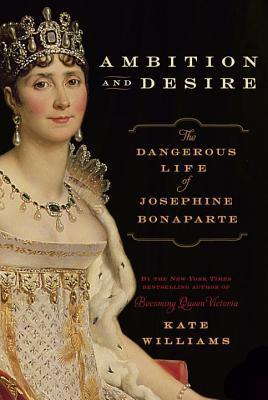
Kate Williams is an up and coming historian who has written some decent books in recent years on figure such as HM Queen Elizabeth II and Lady Hamilton, the mistress of Viscount Horatio Nelson. Here she turns to that most famous of women, Josephine de Beauharnais who captured the mind and soul of Napoleon Bonaparte. History has focused heavily on Napoleon and for good reason, he changed the world and defined an age. However, Josephine’s life in my opinion is extremely interesting and deserves its own story.
There are many myths to dispel. She was not a feminine fatale, not did she love Napoleon. This is not the story of a great romance, but one of betrayal, lies, enemies more than friends and a climb to the top. Stepping over everyone in the way. Williams describes her subject as ‘flawed, vulnerable, engaging and powerful’. This is an accurate summary. She was also no great beauty, but as Williams shows, she had a sexual and sensual nature and with ‘one twitch of her skirt’ could entice any man to fall head over heels for her and die to get her into bed.
Both six years before Napoleon in 1763 to a poor but slave owning family in French Martinique Marie-Josèphe de Tascher de La Pagerie had an easy childhood. However, for all ladies of her class and time she had to be married and in 1779 she was sent to Paris to wed the Viscomte de Beauharnais, a difficult and aggressive man, with whom she had her two children Eugene and Hortense. Following this the revolution broke out and as she was a member of the aristocracy she was imprisoned with her husband. He was executed even though he supported the revolution. She survived as Maxilliem Robespierre and the Reign of Terror was overthrown and the less bloodthirsty Directory was installed. She became the mistress of the powerful Paul de Barras and as a result in 1795 was introduced to a young Corsican called Napoleon Bonaparte. For him it was love at first site, for her it was social security.
What followed was a life of lies, deceit and war. Napoleon was obsessed, she knew that sex and romance meant that Napoleon would find her insanely excessive lifestyle. She once bought 38 hats in a month and 90 dresses in a year. She was always in debt and caused Napoleon no end of headaches. He was the first and only to call her Josephine, as we have seen above this was not her name. As she was six years old than him and had more experience on the bedroom, Napoleon was captivated by her. She more likely tolerated him, for as soon as he went to Italy on campaign in 1796 she cheated on him. However, it was Egypt in 1798 where Napoleon really learnt of her affairs and decided to take a mistress of his own. Here the balance of power really changed. He grew more powerful and she came utterly reliant on him. She also had to deal with the Bonaparte clan, bullies and backwards. They hated Josephine, but much to their own detriment in the end, convinced him to get a divorce so he could have children. This was an own goal on their part, as this meant he would produce his own heir and not name one of them or their children.
In 1804 Napoleon crowned himself emperor and as a good gesture also crowned Josephine empress. However, the urgent desire for an heir led him to divorce her and in 1809 marry the Austrian princess Marie-Louise, daughter of Joseph II. A young girl who was taught to hate the French as she grew up. But she brought legitimacy to Napoleon’s thrown in a way Josephine could not. Of course he looked after her and even continued to correspond. Even writing to her on the birth of his son, the King of Rome. Josephine died in 1814, after pneumonia. Napoleon never forgot and wrote about her in exile in St Helena. Josephine’s life was difficult and certainly had its ups and downs. Hanging on the Napoleon as much as possible, Hortense was sacrificed to marry the ill matched Louis. She also had to contend with Napoleon himself taking a liking to her. Josephine: Desire, Ambition, Napoleon is decent book, which fills in the gaps and doesn’t stray from the subject matter.


 come to my blog!