Jump to ratings and reviews
Rate this book

The Soul is Not a Smithy

Rate this book
“'[The Soul is Not a Smithy]' has a special place in my editor’s heart, I won’t deny it," writes Sven Birkerts, editor of AGNI (where this story originally appeared), in his introduction to this issue of Recommended Reading. "[David Foster] Wallace sent it to us as a way of wishing Godspeed—it was an act of kindness, one that we have since done everything we could to try to deserve. There is no flash summary possible, no shortcut I can offer through the bramble of it. I can only testify, as so many others have, that it is vintage Wallace, breaking expectation, compelling devoted attention, repaying in the way that the best art by letting us feel at the end that something has been rearranged and at a deep level."

About the
David Foster Wallace was born in Ithaca, New York, in 1962 and raised in Illinois, where he was a regionally ranked junior tennis player. He received bachelor of arts degrees in philosophy and English from Amherst College and wrote what would become his first novel, The Broom of the System, as his senior English thesis. He received a masters of fine arts from University of Arizona in 1987 and briefly pursued graduate work in philosophy at Harvard University. His second novel, Infinite Jest, was published in 1996. Wallace taught creative writing at Emerson College, Illinois State University, and Pomona College, and published the story collections Girl with Curious Hair, Brief Interviews with Hideous Men, Oblivion, the essay collections A Supposedly Fun Thing I'll Never Do Again, and Consider the Lobster. He was awarded the MacArthur Fellowship, a Lannan Literary Award, and a Whiting Writers' Award, and was appointed to the Usage Panel for The American Heritage Dictionary of the English Language. He died in 2008. His last novel, The Pale King, was published in 2011.

About the Guest
Like so many other ventures that first saw light in the counter-culture era, AGNI (founded in 1972 by Askold Melnyczuk) set itself up as an alternative to the status quo, a fly in whatever was the going ointment. Though much has changed and evolved, and though captains and crews have grown a bit older, we like to think that the founding spirit survives. Not so much as a politics, more as a feisty eclecticism, a welcoming of spirits from all parts of the world (we prize fine translation), and as an insistent celebration of the literature that represents the thorny complexity, the complex thorniness, of making a self in a world become “hyper” in so many respects. We look for language that gets our moment, that achieves excellence through the integration of perspectives, that strikes the note of the new. Our avatar is the Vedic god of fire, our goal is literary combustion.

About the
Electric Literature is an independent publisher working to ensure that literature remains a vibrant presence in popular culture. Electric Literature’s weekly fiction magazine, Recommended Reading, invites established authors, indie presses, and literary magazines to recommended great fiction. Once a month we feature our own recommendation of original, previously unpublished fiction, accompanied by a Single Sentence Animation. Single Sentence Animations are creative the author chooses a favorite sentence and we commission an artist to interpret it. Stay connected with us through email, Facebook, and Twitter, and find previous Electric Literature picks in the Recommended Reading archives.

39 pages, Kindle Edition

First published February 9, 2014

20 people are currently reading
422 people want to read

About the author

David Foster Wallace

130 books13.5k followers
David Foster Wallace was an acclaimed American writer known for his fiction, nonfiction, and critical essays that explored the complexities of consciousness, irony, and the human condition. Widely regarded as one of the most innovative literary voices of his generation, Wallace is perhaps best known for his 1996 novel Infinite Jest, which was listed by Time magazine as one of the 100 best English-language novels published between 1923 and 2005. His unfinished final novel, The Pale King, was published posthumously in 2011 and was a finalist for the Pulitzer Prize.
Born in Ithaca, New York, Wallace was raised in Illinois, where he excelled as both a student and a junior tennis player—a sport he later wrote about with sharp insight and humor. He earned degrees in English and philosophy from Amherst College, then completed an MFA in creative writing at the University of Arizona. His early academic work in logic and philosophy informed much of his writing, particularly in his blending of analytical depth with emotional complexity.
Wallace’s first novel, The Broom of the System (1987), established his reputation as a fresh literary talent. Over the next two decades, he published widely in prestigious journals and magazines, producing short stories, essays, and book reviews that earned him critical acclaim. His work was characterized by linguistic virtuosity, inventive structure, and a deep concern for moral and existential questions. In addition to fiction, he tackled topics ranging from tennis and state fairs to cruise ships, politics, and the ethics of food consumption.
Beyond his literary achievements, Wallace had a significant academic career, teaching literature and writing at Emerson College, Illinois State University, and Pomona College. He was known for his intense engagement with students and commitment to teaching.
Wallace struggled with depression and addiction for much of his adult life, and he was hospitalized multiple times. He died by suicide in 2008 at the age of 46. In the years since his death, his influence has continued to grow, inspiring scholars, conferences, and a dedicated readership. However, his legacy is complicated by posthumous revelations of abusive behavior, particularly during his relationship with writer Mary Karr, which has led to ongoing debate within literary and academic communities.
His distinctive voice—by turns cerebral, comic, and compassionate—remains a defining force in contemporary literature. Wallace once described fiction as a way of making readers feel "less alone inside," and it is that emotional resonance, alongside his formal daring, that continues to define his place in American letters.

Ratings & Reviews

What do you think?
Rate this book

Friends & Following

Create a free account to discover what your friends think of this book!

Community Reviews

5 stars
130 (42%)
4 stars
111 (36%)
3 stars
48 (15%)
2 stars
11 (3%)
1 star
4 (1%)
Displaying 1 - 30 of 41 reviews
Profile Image for Fionnuala.
898 reviews
Read
November 20, 2024
What we have here is a frame story inside of which nestle several substories, the frame story itself concerning an unexpected and sensational event in a 4th grade civics classroom in the United States in the 1960s with the kids all sitting quietly in rows, and the substories giving glimpses of the kids’ backstories plus the backstories of their parents, some of whom sit in offices, at desks in rows not dissimilar to the classroom, while the narrator, who is recalling the frame story, the sensational event in the civics classroom, and also meditating on the substories, goes on to reveal another story within the story, another frame story in fact, itself divided into smaller stories, and the word frame is particularly apt because what he describes when he’s not describing the original frame story complete with its substories, is what he remembers seeing through the classroom window frame, the glass of which is divided into rows of mesh squares which are like a story board allowing him to create a series of scenarios about what he sees through the window fleshed out with imaginary happenings not unrelated to the substories of the main frame story, all of which is told in one smooth flow of language, but with subtle shifts according to story theme..


Have I succeeded in confusing you? Unlike me, Wallace never slips up, successfully connecting the narrative of his many stories into a unified whole. The reader is never confused. It has to be the most cleverly constructed piece of writing I’ve ever read.
And the sensational event in the civics classroom around which everything seems to revolve turns out to be not what the story is about at all.

You can read The Soul is not a Smithy here - and yes, the title is a reference from Joyce:
http://recommendedreading.tumblr.com/...
Profile Image for Angela.
63 reviews18 followers
November 18, 2025
The Anti-Smithy

The title is the story's thesis: the soul is not a smithy. This is a direct, vital allusion to James Joyce’s-Portrait of a Young Artist- lines “Welcome, O life! I go to encounter for the millionth time the reality of experience and to forge in the smithy of my soul the uncreated conscience of my race.” Wallace issues a fierce rebuttal to this heroic, individualistic myth. Thanks to the discussions within the Short Story Club, -specifically, a vital clue shared by my fellow reader, Cecily-. Without her contribution, the essential allusion to Joyce, a piece of information sine qua non, would have entirely escaped my grasp, leaving my understanding of the story incomplete. Link to her review

The story is the narrator's lifelong psychological autopsy of the 4th Grade Civics class incident, where he and three classmates were labelled the "4 Unwitting Hostages." In a system that fails to accommodate or nurture atypical intelligence, instead grouping the narrator based on deficits, not potential. The incident's lasting effect stems from the media's cruel narrative: classifying the narrator and his classmates as intellectually compromised, provided the necessary justification for the police's lethal response. The story’s true purpose is to deconstruct this initial institutional lie, meticulously archiving every memory to prove that the problem laid not in the children's minds, but in the violent, unforgiving system they were trapped in.

"This is the story of how Frank Caldwell, Chris DeMatteis, Mandy Blemm, and I became, in the city newspaper’s words, the 4 Unwitting Hostages, and of how our strange and special alliance and the trauma surrounding its origin bore on our subsequent lives and careers as adults later on. The repeated thrust of the Dispatch articles was that it was we four, all classified as slow or problem pupils, who had not had the presence of mind to flee the Civics classroom along with the other children, thereby creating the hostage circumstance that justified the taking of life.

The site of the original trauma was 4th grade Civics class, second period, at R. B. Hayes Primary School here in Columbus. A very long time ago now. The class had a required seating chart, and all of us had assigned desks, which were bolted to the floor in orderly rows. It was 1960, a time of fervent and somewhat unreflective patriotism. It was a time that is now often referred to as a somewhat more innocent time. Civics was a state-mandated class on the Constitution, the U.S. presidents, and the branches of government."
The Soul is not a Smithy

The narrator contends that in the late 20th-century USA system, the soul is given no materials for genuine self-creation, only cheap, mass-produced moulds that shatter under the pressure of complex human experience. The narrator’s soul cannot be a smithy; it is an archive of trauma. The emotional damage stems from the failure of every "mould" that promises order or safety -be it physical, bureaucratic, or institutional.

The story's core argument, that violence is a pervasive system of life across all social layers, has a strong thematic parallel to Elena Ferrante’s magnificent novels. Yet, their methods diverge completely. While Ferrante delivers brutal truth with the chisel-sharp stroke of short, decisive sentences, Wallace demands an immense, exhausting investment. He narrates using mile-long, labyrinthine sentences full of technical details and disjointed subordinate clauses.

Wallace’s cleverness is undeniable, but reading The Soul is Not a Smithy felt like running a marathon in a hall of mirrors. The constant, clunky, scattered narration -his "infinite Matryoshka of violence"- feels like solving a complex calculus equation. If you forgot one variable, you were forced back to find the missing component, relentlessly pursuing a solution that never came. Perhaps the most striking element is the narrator’s detached, almost lobotomised perspective when recounting abominable things with the mind of a child. It's a deliberate choice to tax the reader with the need for closure, mentally, emotionally. It’s a clever but exhausting way to show that the soul fails to 'forge' anything when it’s too busy just analysing and surviving violence at all levels, familial, institutional, and systemic.

It remains, nevertheless, an indelible masterpiece of disruptive reading.


P.S. You may be wondering why I gave this story such a high mark. Did I like it? Not at all.
Not because of the writing's quality or beauty of the narrative, but because Wallace excels at trapping the reader in an emotional contract for closure.
I felt like a rabbit compelled to keep moving by the narrator dangling the carrot of synthesis and catharsis around a labyrinthine maze. Wallace relies on our deep human instinct to finish the puzzle.
Every time you think you have reached the carrot, you only find the next false turn. The chilling result is that you end the story exhausted, lost, and carrot-less. You realise the whole point was the process of being lost, which is the exact emotional state of the narrator: endlessly analysing, never concluding, and trapped in the labyrinth of his own mind.


Read with the Short Story Club
You can join the group here. Short Story Club
Profile Image for Cecily.
1,342 reviews5,474 followers
November 15, 2025
The incident at the chalkboard in Civics was likely to be the most dramatic and exciting event I would ever be involved in in my life… I think that I am ultimately grateful not to have been aware of this at the time.
The unnamed narrator is recalling “the day of the trauma”, when he was nine. The local press dubbed him and three others “the 4 Unwitting Hostages”, and dim, because they didn't flee as quickly as the rest of the class.

Wandering

The window mesh’s calibration divided into discrete squares that appeared to look quite like the rows of panels comprising cartoon strips, filmic storyboards... it led my attention not merely to wander idly, but to actively construct whole linear, discretely organized narrative fantasies, many of which unfolded in considerable detail.

He's a creative daydreamer who at that time, could barely read. He remembers peripheral details vividly (the odd shape of a psychologist's nostrils, the precise layout of 1960s classrooms, his dreams, and the lives of classmates' parents), but he is oblivious to more significant things (it's another pupil throwing up that brings his attention to the substitute teacher’s mental health episode), so his memories are mingled with what he learned from others afterwards.
The most obvious flaw in my memory of the incident as a whole is that much of the trauma’s inception unfolded outside my awareness, so intently was I concentrating on the window’s mesh squares, which in the narrative I was filling the next row of with panels.

He tells the stories of the protagonists' lives before and after, blending fact (within the reality of the story) with flights of fancy, and frequent swapping between characters and time periods. Visualising the threads of the narratives is a challenge, and I found my mind wandering a bit, mainly when the narrator's was. That's apt, but frustrating too.

There are many stories in this, but the specifics of the key event for “the 4 Unwitting Hostages” are barely mentioned, just the lead-up to it, and what happened to them in adulthood.


Image: Children in a 1960s elementary class, taking the Pledge of Allegiance (Source)


Education

The title is possibly a nod to a line near the end of James Joyce’s A Portrait of the Artist as a Young Man:
“Welcome, O life! I go to encounter for the millionth time the reality of experience and to forge in the smithy of my soul the uncreated conscience of my race.”
DFW’s title contradicts that, though what he’s written, seems to support it.

The message that sticks with me is the importance of providing suitable education for children with learning differences and disabilities (despite his period stereotypes of those who are blind and deaf). Just a couple of examples:

• “What teachers and the administration in that era never appeared to see was that the mental work of what they called daydreaming often required more effort and concentration than it would have taken simply to listen in class.

• “Many schoolchildren labeled as hyperactive or deficient in attention are observed to be not so much unable to pay attention as to have difficulty exercising control or choice over what it is they pay attention to… And yet much the same thing happens in adult life; as we age, many people notice a shift in the objects of their memories. We often can remember the details and subjective associations far more vividly than the event itself.

Trans-Atlantic differences

I know US children are schooled in the Constitution, but didn't know it was so detailed, so young. However, what struck me more, is that the undoubted trauma in the story is far less than many pupils experience nowadays, when even kindergarteners in the US do lockdown drills in case there is ever a mass shooter.

DFW

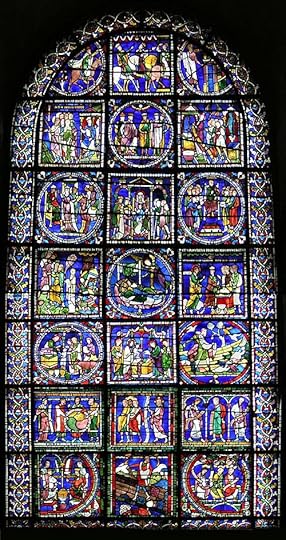
This was my first encounter with David Foster Wallace. I knew he was widely-admired and startlingly original, but possibly ‘difficult’. This was certainly a challenging read, but it’s brilliant, too, especially the almost magical window squares, whose images both unite and separate the narrative strands - like a.


Image: “The Poor Man’s Bible” - stories in stained glass in Canterbury Cathedral (Source)

Quotes

• “Cuffie was just a dog and didn’t have thought-bubbles as you or I do.”

• “The most vivid and enduring occurrences in our lives are often those that occur at the periphery of our awareness.”


Short story club

I read this with The Short Story Club, which you can join here.

You can read this story HERE, but note that the story itself starts a couple of screenfuls down.
Profile Image for Mark André .
230 reviews344 followers
January 4, 2026
Phew!! That was something.
Really good writing. Strange
intense story. Buyer beware!
Update: 12.11.25
From the safety of an interval of a few days time,
and with the added benefit of reading the author’s
article ‘Consider the Lobster’ I’m going to advance
my rating to a full 🌟🌟🌟🌟🌟 stars. Still beware!
Profile Image for Debi Cates.
516 reviews38 followers
November 17, 2025
This is the first short story read with The Short Story Club upon its change from a published anthology to a roster of selections by members. If the engagement with this story is any indication, the new method will be a big success.

Of course, I have heard of the genius of David Foster Wallace, but that reputation had put me off--was I smart enough?

Well, turns out, I'm probably not smart enough. BUT I enjoyed the heck out of it. It's an almost impossible story to describe correctly, but the gist is it starts off with revealing that something awful happened in the adults narrator's life. Back when he was in 4th grade, a substitute teacher in a Civics class lost his mind.

The story is about minds not being properly stimulated, mostly that of the on-the-spectrum narrator and his later adult suppositions about the mind of his father who's work life seemed a drudge (much like the Civics class). That makes the story sound boring. Although substandard intellectual education and engagement is one of the themes (my assessment after a few days thinking about it), the story is anything but boring.

It is fascinating, inventive, and often a little frustrating. One of the group members (hello Mark!) commented that Wallace "goes his own way just for his own private fun." That changed my perspective on the story. Instead of struggling to understand everything (inconsistencies, unexplained interjections in capital letters, etc.), once I took Mark's stance, I could sit back and allow the story to just be. It was quite a reading adventure.

I'm not now ready for Infinite Jest, but I am very willing to read more Wallace. Indeed, I've just checked out the short story collection Girl With Curious Hair from Hoopla through my local library and plan to read it (and other works I've neglected) over the Thanksgiving vacation week. My own work stress the last couple of months has been messing with my reading mojo and that's impacting fulfillment in my life. It's time to turn that back around.

Feel free to join us at The Short Story Club. It's a great group! https://www.goodreads.com/group/show/...
Profile Image for Lemar.
728 reviews80 followers
February 25, 2017
David Foster Wallace brings back elementary school in vivid sensory detail in the Soul is not a Smithy. It made me realize that those memories are still extant and complete in me and that thank God they don't boil near the surface of my brain as they did for him.
The soul of a child is like a pure flowing molten metal and when it is doused with the icy water of cruelty and deprivation the result is a screaming deformation that is painful to witness and experience.
DFW and I were born in the same year and his work has always struck me as scarily accurate and it's ability to evoke time periods I lived through, like college dorm life in the Broom of the System or any number of scenes in Infinite Jest. My hesitancy to fully embrace this short story as I did those novels, which are among my favorite all-time reads, probably has more to do with my discomfort. And yet, like a sad blues, I needed this story, it helps.
The story made me think about childhood and war and breaking points and the fantastic ability it is that this great author can transmit states of mind , time and place in a package my brain can unlock like a scent. DFW, a man who I perceive as having a huge heart it was not easy, or possible or desirable to defend.
Profile Image for Anni.
558 reviews91 followers
August 10, 2018
I am emotionally wrung out to dry after reading this - yet another masterclass of short story writing from the literary genius DFW. Is 'genius' too generous a description you may ask? The answer is no.
Profile Image for Jonfaith.
2,183 reviews1,773 followers
November 11, 2025
Read this twice for the Short Story Club, after an initial reading almost twenty years ago, found receipts and concert paraphernalia in the back jacket of my copy of Oblivion.

I can relate to so many aspects of this story and am likewise tortured by these themes. I suppose as an aging human and recurring reader I enjoy the dislocation if only as an acknowledgment.
Profile Image for Connie  G.
2,176 reviews721 followers
November 17, 2025
"The Soul is Not a Smithy" is an unusual short story with overlapping story lines. David Foster Wallace's writing seems interesting and experimental, and the reader will notice different events on a second reading. The narrator is looking back on a day in 1960 in fourth grade when a substitute teacher with a mental illness began writing KILL, KILL on the blackboard as he was teaching the Constitution. But the narrator missed it because he was looking out the window and daydreaming.

The windows at the school had glass with a wire grid through the panes. In his mind, the narrator created comic book-type stories in the squares of glass. The narrator, who probably is on the autistic spectrum, was adding past and future events to what he was actually viewing through the window to make up a story. His imagination and other people's accounts of what was happening in his world are added to what he is seeing through the window. While the narrator is missing the start of a traumatic event for the children in the classroom, his daydreaming is also becoming very dark and violent in nature.

There are themes involving memory, time, childhood, unfulfilled adults, and violence. I'm not sure what it all means, but it was quite the trip!
Profile Image for E.W. Harrington.
Author 1 book2 followers
April 2, 2014

I wanted to read The Soul is Not a Smithy having worked Joyce's Lit 101 line into my own writing. David Foster Wallace, a modern, stream of consciousness writer questioning the Irish master's premise, who perfected the technique.

The quote, you may recall, is from Joyce’s A Portrait of the Artist as a Young Man:

'Welcome, O life, I go to encounter for the millionth time the reality of experience and to forge in the smithy of my soul the uncreated conscience of my race.'

How then, is the soul not a smithy?

Joyce's creative domain may be seen as a place of promise and demiurgic fecundity, even though it sounds like a lot of work. Wallace's workshop, however, may have been a hellish place--think open flames and dropped anvils.

Or, perhaps being a Writer should only temporarily stress out a person.

On the other hand, is it about the uncontrollable, ultimately chaotic nature of Experience that Joyce (falsely) believes he has the power to master with Art?

(Forgive me...Wallace studied philosophy in college, as did I. He was a graduate student of philosophy at Harvard, but did not complete that degree).

There's mastery enough in Wallace's prose, here, an exploration of the inescapable effect of image. The slow learner learns this lesson, whose normal means of escape from the boredom of 4th grade Civics class had been to composite a new, framed reality, from outdoor images in the wire mesh of a nearby window, 'which divided the window into 86 small squares with an additional row of 12 slender rectangles...’

The imaginative child has learned how to make his own movie out of the window's individual frames. On the day in question, Civics class was not boring. The traumatic things seen that day in class are matched, if not exceeded, by the horrors the child witnesses outside, scenes of savage brutality, or meaningless violence. Curiously, everything bad that happens outside, is happening to a single family. It’s the Universe having a joke, I guess, since God is nowhere present.

It was the early sixties, when normal life strove unquestioningly to escape chaos, ordered into the unrelieved matrices of Levittown, not unlike the window's wire mesh: "The Civics classroom at R. B. Hayes consisted of six rows of five desks each. The desks and chairs were bolted securely to each other and to the floor and had hinged, liftable desktops..."

Reading this short book is at times difficult, painful. There are sentences here I may never choose to finish reading; I had to look away. Yet the writing itself is great. The challenge seems to have been to evoke deeply sad or horrific images, and strive to achieve redemption through mastery of technique, the precision, and beauty of art. Content should not matter.

I expect there are volumes in aesthetics on this last point.

If Wallace's furnace was fueled by indignation, it is that in our life, we learn that we will have no choice but to see, and remember. By the time we've left the movie theatre, we have already been subjected to the frightening, indelible image:

‘Later, when I was in my 20’ s and courting my wife, the traumatic film The Exorcist came out, a controversial film that both of us found disturbing— and not disturbing in an artistic or thought-provoking way, but simply offensive— and walked out of together at just the point that...

...the response was both disturbing and unforgettable. Suffice to say we have not seen it since. And yet the lone moment of The Exorcist that has stayed so emphatically with me over the years consisted only of a few frames, and had precisely this rapid, peripheral quality, and has obtruded at odd moments into my mind’s eye ever since.’

The other matter Wallace wants to be indignant about is the horror of adulthood. (A result of horrible images we can’t expunge?) There’s the meltdown of the substitute teacher writing KILL THEM ALL over and over on the blackboard. He tries to erase the words, then rewrites them.

And, there's the horror of his father’s work. The character's father is an insurance actuary, and the boy experiences repeated nightmares with images of a gray, interminable job, sitting at a desk in rows similar to those of his classroom, only there are more of them.

‘…the actual specifics of his job were always vague.’

There’s a youtube video of Wallace discussing the work. The interviewer says it reminded him of Kafka (he did not say Kafkaesque). Wallace said yes, but inverted Kafka; the final horrors are not surreal, but described in banal detail.

Wallace's formatting style, one I've seen in his other work, is of a tall block of text the eye can easily lose its foothold on, if one isn't careful, like free climbing a sheer rock face. Reading with a device, there's always the option to increase font size, which I did. I wondered what it was like on paper. And then there are these

PARAGRAPH SEPARATED BLOCKS OF ALL CAPITALS, WHICH MIMIC SCREAMING HEADLINES, OBSERVATIONS EX CATHEDRA, OR THAT RECALL SOME SORT OF CHORAL EMPHASES.

I usually enjoyed these, even though the eye's reflex is to duck.


Profile Image for Hester.
698 reviews
November 10, 2025
A wild card pick for the GR Short Story Club . I picked it as I have never read anything by DFW and because I value the thoughtful in-depth discussions we have every week . So I reckoned if I couldn't grasp what was going on someone else would help me out .

So here goes, with my initial thoughts .

First. The title . The Soul is not a Smithy . Here is foreshadowing right from the get go . The story is about how the soul is not shaped by education and obedience but by trauma and violence . And that this has profoundly affected the two protagonists : the teacher and the pupil .

We are inside the head of an adult who survived a classroom incident in a primary school . He is reflecting on his thoughts as the incident unfolds . It is 1960 and we are in suburban America .The teacher of the civics class , a supply , is a single man who has been observed buying TV dinners for one by others in the supermarket. One of the children who escaped subsequently becomes a war hero in Indo-China All this is revealed early on , We also know the life of the narrator has been publicly defined by this incident . He is one of four children, all of whom have " learning difficulties" , who remained in the classroom when the rest fled . This information is given by the narrator and by some snappy newspaper sub headlines that pepper the narrative.

The narrator appears to be on the autism spectrum . His description of the day is elliptical and discursive as he details the layout of the room in great detail and the particular reasons why he is normally placed away from the window given he is prone to " daydreaming" . In this lesson this routine is fractured as the supply teacher accepts the subversive reordering by the pupils of the normal seating arrangements . Our narrator ends up by the window which is cat nip to his imagination , to his soul .

The windows of the classroom , through which the narrator gazes , are threaded with a steel wire grid to. make them shatter proof . This grid enables the child to create an story , as it reflects the pattern of the comic books he adores . His increasingly dark and violent story constantly references the graphic style and layout of comics . This is how he sees the world in his imagination . What is going on in the room, although increasingly disturbing, is distant and is dismissed .

Without revealing any spoilers what DFW is juxtapositioning here is the attempt by the state to forge young citizens by deliberate instruction in Civics while all the time the imagination of the child is fueled by his home life and by his desperate need to escape the emotions this life brings up . The child , having little comprehension of his parents , who are unexpressive and hardworking , can sense something terrifying about their existence and mutates this into a story of dark violence.

The genius is that we hardly learn anything about how the incident plays out past the moment of violence. That's just how it was back then . The adult narrator is able to remember his imagined world at the time of the lesson but is unable to give a clear account of the finale . His soul is still shaped by his imagination and the terrifying emotion of his experience is absent .

I'm English so I'm interested to learn how ubiquitous Civics lessons are and at what age they start . I can remember having Religious Education , which allowed me much daydreaming , but was intrigued by the dedicated room and all it's props depicted in this story . Is that commonplace?

I'm also looking to understand the significance of the particular part of the constitution the teacher was focusing on and the relevance to what he was involuntarily writing on the chalkboard .
33 reviews
May 17, 2020
My first piece of DFW fiction. Very interesting technically: the narrator is at once a child and his adult self looking back on his recollections around the time of a traumatic event. The narrator's imagination and "good peripheral vision" give him a tendency to distract himself, a trait which his school had once tried to curtail by forbidding him to sit next to windows. This tendency is perhaps the dominant narrative feature of the story, with Foster Wallace employing a stream of segues, divergences and dalliances which keeps the main drama – the traumatic event unfolding in the classroom – always at arm's length, out of reach.

Because of this, what could have been a straight reporting of an incident in a classroom instead becomes a piece of imaginative comic book writing, an essay on a dream sequence from the Exorcist, and a rumination on the futility of work and the depression that surrounds jobs "dictated by the administration".

While these sub-plots do in some ways contain certain levels of Foster Wallace's analysis, particularly in the case of, one might imagine, the Exorcist and workplace sequences, what I found notable about the style of The Soul Is Not A Smithy is that the child's narration is devoid of analysis for the most part. Instead, we are presented with characters, symbols, actions and stories, juxtaposed against one another, the reader left to interpret their significance for themselves. There is thus clear irony to be found in the hostage situation unfolding in the Civics classroom, for example. Or in the narrator and his wife bonding over a mutual offence taken at the masturbation scene in the Exorcist. Or the motif of stray dogs humping.

For me, the main thrust of the story was the concept within the title. Civics classes, newspaper reports, cultural production, police and military institutions, the monotony of work, even language (as in the example of "breadwinner") – these all function to impose a certain dominating ideology upon us that restricts and condemns our imagination. Manufacturing consent, if you might indulge me the comparison. The narrator is seen as troublesome, a failure, slow, unwitting, delinquent for his imagination and inability to pay attention. Whereas the quality of his narration and his numerical aptitude would suggest to the reader that such characterisations are grossly unfair.
Profile Image for Alex Linschoten.
Author 13 books150 followers
November 10, 2015
This is a short story, originally published in AGNI, about a boy who witnesses a teacher having some sort of breakdown while in class. The plot isn't really the point of this story. Rather, Wallace writes a series of stories in stories that function a little like a medieval-era triptych; Wallace uses a different way to describe what these stories-in-stories are like. The story culminates at almost 20,000 words in a vision of the modern workplace - a nightmare - that adds perspective to the breakdown and to the sense of dread facing the students who don't manage to escape out of the classroom along with some others. I just finished reading it, so it's still a bit fresh, but I think I'll be returning to this one to figure out just how Wallace puts it all together.
This entire review has been hidden because of spoilers.
225 reviews
January 16, 2025
A masterpiece on the sorry horror of becoming an adult and having to drudge for evil foreigners you hate, day after day after day, with no reprieve, instead of conquering distant lands astral and terrestrial in the name of God. This is the potential of DFW completely realised.

{It's here also we see his first interest in accounting, the subject of his unfinished work 'The Pale King'. I would rather become a criminal than allow the fate below to befall me, as it probably will.}

"Looking back, I suspect that there was something of a cover-your-eyes and stop-your-ears quality to my lack of curiosity about just what my father had to do all day. I can remember certain exciting narrative tableaux based around the competitive, almost primitive connotations of the word breadwinner, which had been Mrs. Claymore's blanket term for our fathers' occupations. But I do not believe I knew or could even imagine, as a child, that for almost 30 years of 51 weeks a year my father sat all day at a metal desk in a silent, fluorescent lit room, reading forms and making calculations and filling out further forms on the results of those calculations, breaking only occasionally to answer his telephone or to meet with other insurance men in other bright, quiet rooms. With only a small and sunless north window that looked out on other small office windows in other tall grey buildings. The nightmares were vivid and powerful, but they were not the kind from which you wake up crying out and then have to try to explain to your mother when she comes what the dream was about so that she could reassure you that there was nothing like what you just dreamed in the real world. I knew that he liked to have music or a lively radio program on and audible all of the time at home, or to hear my brother practicing while he read the Dispatch before dinner, but I am certain I did not then connect this with the silence he sat in all day. I did not know that our mother's making his lunch was one of the keystones of their marriage contract, or that in mild weather he took his lunch down in the elevator and ate it sitting on a backless stone bench that faced a small square of grass with two trees and an abstract public sculpture, or that on many mornings he steered by these 30 minutes outside the way mariners out of sight of land use stars."
Profile Image for MF  GLOOM.
31 reviews
May 5, 2022
Like a lot of DFW's writing, it feels like he's pushing you to start day dreaming among the spaces of the page much like the narrator does on the sections of his classroom window at times, but it all culminates into absolutely beautiful reflections on adult life and boredom. The sections in the classroom are whatever, but the reflections he makes stemming from them about the narrator's father, his work life, adult life in general, boredom, and the way the narrator reflects and connects with it all is incredibly poignant and impactful.
Profile Image for Vishal.
35 reviews7 followers
January 24, 2018
The story is supposedly, a "short story" , but encompasses themes and ideas and scenarios which are more varied, deep and insightful than best of novellas. The whole story has a hallucinative quality where the most unspoken horrors of life, real life, are presented from viewpoint of a kid. There are layers to the story where it is presented as a recollection of transformation of a naive daydream of a kid, sitting in an unremarkable substitution class in junior section at school, into a nightmare as his teacher starts to have a breakdown and how it has a kind of psychic affect on all those who are around him including the boy who seems to be recounting his experience.

And the story, instead of leaving it at that, tries to, no matter how superficial it may read, find the underlying reasons for the banal evil that exist in the world. Apart from all this layered and deep meanings, or rather than reading, of the material, there is the unique style of DFW which never lets you rest and take the story for granted, and always keep you engaged in a way that, despite the horrid premise of the story, keeps you not only hooked, but entertained, as you read through the syntactically tough and twisted stuff that he has constructed.
Profile Image for Sam Emery.
54 reviews
December 25, 2025
I really do understand DFW now and I want SO badly to read infinite jest or pale king, but god, reading his work is so… unfun. Like it’s a lot of work. It’s not hard, it’s just tedious. Reading a DFW novel (and reading him in general) is on par with, I imagine, riding a 300 mile ultra gravel bike race with a weighted vest on. Could I do it, yeah sure, why not. Would I be glad I did? Maybe. Would it be THAT much more rewarding and worth it over, say, a 100 mile ultra gravel race? It’s hard to imagine it would be.
Profile Image for Liz Simmons.
3 reviews10 followers
August 14, 2015
What is trauma?

This incisive glimpse into an obsessive and sensitive kid who is held hostage in his 3rd grade Civics class was my first introduction to the writing of David Foster Wallace. If his own mind was as nearly obsessive and in touch with the pain of the world, it's no wonder he had to exit early.
Profile Image for Graciele Marim.
12 reviews2 followers
Read
January 13, 2015
Very good. The narrative is substantial and interesting. I do recommend this book to everyone.
Profile Image for Lynn.
64 reviews20 followers
August 28, 2015
Not my favorite of his, but there are those moments of sheer brilliance that shine through :)
Profile Image for Lannie.
472 reviews12 followers
January 27, 2025
Another incredible DFW work, rich with detail that makes you feel like you remember things you never experienced.

The heart of this story, to me, is DFW's generation's rebellion against the curtailing of the imaginative mind. There's a fear of adulthood and conformity. The young blind girl makes a mutated dog out of clay, which turns out to have actually been a person—a warning, perhaps, of people being modeled by a sightless machine into, not humans, but deformed, subservient animals to be kicked around.

This is a very Gen X story if ever I've read one, and I loved every word, every thoughtful deviation, every microscopic view into the lives framed within the frames within the frames. DFW inverts the final lines of Joyce's A Portrait of the Artist as a Young Man to say that, look, "young man," your art will be stifled, your soul compromised by the checks and balances of the adult world, the education system, the workplace, etc., and your soul will not be the smithy through which art and creative impulse influence the world, but rather your soul will become a coldened, deadened, servile thing. Perhaps, then, Mr. Johnson's "possession" at the chalkboard was a warning to all of the children to fight back against those who would close them up—to kill the oppressors of their imagination.

Ruth Simmons was at the weeping center of a laughing, mocking, hooting, cane-waving circle of deaf and blind children, one of whom was tossing Ruth’s figurine up into the air and swinging his cane at it like an American Legion coach hitting fungoes for outfield practice [...]

[...] it was revealed in mid-air, during the ridicule, in a close up, stop-action view as it rose end over end in the air and the wicked boy prepared to swing his cane, that the true subject of the clay statuette Ruth Simmons had fashioned was, in reality, a human being, who in her distraught distraction she had given four legs instead of two, despite the crude human features, creating a somewhat monstrous or unnatural image as in Greek myth or The Isle of Dr. Moreau.
Profile Image for Ry Book Suraski.
51 reviews1 follower
July 29, 2021
Much more "enjoyable" than Mister Squishy but still brutally bleak. Examines what trauma really is, and paints a very realistic picture of dread, the kind in nightmares, right before a "traumatic experience", and, in late childhood, when you realize what terribleness (adulthood) lies ahead.

A very, very immersive account of what it's like to be a child, told with extremely precise language.

An exploration of many simultaneous plots, achieved fluidly and clearly. I especially liked the way we learned about the narrator's personality via the awful story about Ruth and her dog, the matter-of-fact way he told the story of "the trauma", and details about his adult life and taste. Seeing the colorful imagination of a child put so technically and plainly was really unique and interesting, since thoughts are so disconnected and disorganized at that stage of life, and those parts of life are usually left unspoken about until they are forgotten.

As usual, a lot of very funny details, and a tiny bit of that shiny pulp (KILL THEM ALL!) that makes the reading experience much more fun.
This entire review has been hidden because of spoilers.
3 reviews
March 18, 2021
The short story about 4 Unwitting Hostages is a pretext to unfold a few sub-stories in front of the reader. As the stories inside the story, we have comics created in the narrator's mind, which breaks my heart with its unstoppable brutality. The protagonist contemplates the profundity of events happening on the peripheries of human's perception. As a foundation for his thesis, he uses supposedly not a very important bit from the Exorcist that stuck in his mind. DFW also reflect on working in a corporation and how draining and toxic it can be. Additionally, we have short background stories of infamous hostages, which work as a description of American peripheral families of the '60s. I have to admit that Wallace tremendously builds up the setup on a relatively short space. The discursive sub-stories make Wallace's story a bit clunky. The author's thesis, though interesting, seem to be upheld by imprecise examples that weaken them.
Profile Image for Petergiaquinta.
701 reviews133 followers
December 26, 2025
Still not sure, after a couple of reads and a month to think things over, whether I love this experimental quasi-stream of consciousness by DFW which is in part a rather painful satire about childhood in Amerikkka and in part a tip of the hat to James Joyce, among many others things, or whether I really really hate it, so here's three stars and I'm washing my hands of it.

On our GR short stories reading group thread, I posted,
Welp, my initial reaction is, "At least it didn’t have footnotes." 🤷‍♂️

One day, and I hope I live long enough to see that day, I'll be smart enough and patient enough to take on Wallace's Infinite Jest.

Here's the story, if you'd like to give it a try:

https://electricliterature.com/the-so...
Profile Image for Dee.
638 reviews5 followers
March 29, 2025
I recently read James Joyce, Portrait of an Artist as a Young Man, so it led me to read this short story with the title taken from Joyce's ending.

Ok, I don't think I am ready for experimental writing. In general, I appreciated the three stories contained within one story, that seemed to seamlessly flow between the stories. As opposed to Joyce who feels that he is taking control of becoming a man and going to be the smithy of his creative life, Wallace is much grimmer, feeling that he is the product of his world.

A tough but valuable read, this is better if you can discuss it with others.
Profile Image for Larrry G .
164 reviews15 followers
November 12, 2025
not particularly calling out the particulars here, but not everything adds up in the narrative, taking for example the window grid squares - of course it's always possible that one or more potential grid squares got subjugated by, say a handle attachment or the like.
Well that's approximately 70 or so pages of wallowing through Wallace, including and always meaning to return someday to Infinite Jest, but another 1000 or so pages like this will keep that on the periphery of my bucket list for now. In brevity, I sense the gist of it, whereas lingering levity languishes longitudinally.
Profile Image for Alex.
7 reviews
April 20, 2025
In a way the perfect horror story, "existential dread" is a way to describe it. Feels relatable and significant. "The tableau was so traumatic that this narrative line was immediately stopped and replaced"
Displaying 1 - 30 of 41 reviews