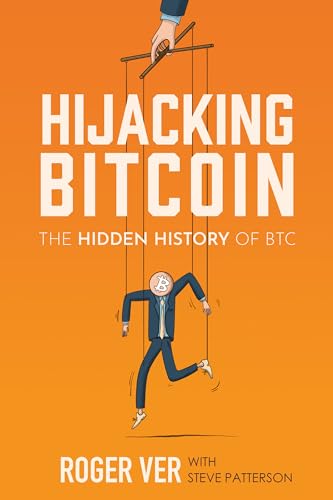
2025-05-04 Last year, my brother read this and thought it important, so he gave me a copy. I could not get to it for a few months, but finally did a couple months ago.
It was very well written. The author is a gifted author, with clear thoughts and enlightening descriptions and ideas.
The history of bitcoin was told in a very helpful way. I had become aware of bitcoin fairly early on (maybe only 2-3 years after it began in 2009) and tried to understand the technology, in addition to the implications both financial, social and ideological. I never became totally comfortable with the technical aspects of bitcoin and hence missed out on investing, which was a huge mistake. That kept me from being a true supporter of it financially, socially and ideologically, even though I had no beef with either of the two latter aspects, and rather liked it as a great potential alternative to the fiat currency standard, and perhaps as a friendly competitor to gold.
So, the book helped me understand more of the technical hang-ups I had with bitcoin.
It answered one very big issue - how could the technology scale on a worldwide and billions or trillions of transactions level. And most interesting, but difficult of all, was the governance of bitcoin - who controlled it, and what they did and its implications.
The key point the author made is that Bitcoin was/is controlled by the developers and they kept the block size too small to accommodate transactional growth from becoming a true world currency (with cheap and fast, ubiquitous transactions).
They got sucked in and remunerated by the “store of value” purpose of Bitcoin as money, as opposed to the “medium of exchange” true purpose, as Satoshi and so many of the original developers, evangelists, entrepreneurs, etc. envisioned and worked for.
The implications because the block size was not allowed to grow adequately, were that the time delay and actual monetary cost of transactions skyrocketed, so the ability of bitcoin to move to the next level of actually competing with fiat currencies as actual transaction media was crippled. Bitcoin no longer is thought of as being able to be used for non-significant sized transactions because of the costs, both monetary and in time delays. Very sad.
An alternative to the commonly known "bitcoin," with the same genealogy until the big "fork" is Bitcoin Cash, is discussed quite well, but not as comprehensively, or possibly as objectively. Perhaps the reason is that Bitcoin Cash took off in value early on, but then crashed and never recovered it's cache, so has not appreciated in value &/or use the way the developers/backers hoped.
So that leaves us with a Bitcoin that has appreciated in value from virtually no value at creation in 2009, to just under $80,000 t0 over $100,000 in trading value since Nov. 2024 (I am writing on 4 May 2025).
So, what to do about it?
This book has helped me understand, and I really appreciate it.
But I am still feeling a need for more good info/analysis.