

What do you think?

Delicious Hunger
Deep in the Malaysian rainforest, two comrades pine for each other but don't know how to declare their love; a fastidious man with perfect hearing keeps his comrades safe time after time, a woman viewed as a burden nonetheless manages to delight her comrades the day she finds a mythical mouse deer. In the forest, you forage and kill but also love, desire, and grieve.
Thread together, Delicious Hunger is a collection of moments; the time in and between warfare, when the act of hunger is something to taste and the rainforest becomes an extension of the body. Deftly translated by Jeremy Tiang, Hai Fan's stories are about the people who chose to fight for a particular world and in the process, built their own.
Thread together, Delicious Hunger is a collection of moments; the time in and between warfare, when the act of hunger is something to taste and the rainforest becomes an extension of the body. Deftly translated by Jeremy Tiang, Hai Fan's stories are about the people who chose to fight for a particular world and in the process, built their own.
272 pages, Kindle Edition
Published September 12, 2024
Ratings & Reviews
Friends & Following
Create a free account to discover what your friends think of this book!
Community Reviews
Displaying 1 - 30 of 31 reviews

May 13, 2025
‘The night before we joined up, I thought we should do something different, and tried to drag him to Kentucky Fried Chicken (which these days, seems to only be branded with its initials). He batted away my suggestion. ‘That ang moh food doesn’t sound tasty. It’s only chicken, after all.’ I’d seen many billboard ads promising it would be ‘finger-lickin’ good’, and insisted that we try it at least once. After we went into the rainforest, who knew when we’d ever emerge again?’
Not surprising, this, but I can’t imagine anyone other than Jeremy Tiang to make such a fucking wonderful and spectacular translation of this immensely interesting text. As he’s clarified in the prologue of the text, he’s a proponent of a ‘vibes-based’ translator. And I like that very much. Anyway, rounded this one off to a five (stars) without hesitation.
‘I’ve always thought that linguistic consistency is a virtue more prized by people from monolingual societies, which I very much am not. Life in Singapore and Malaysia takes place in a patchwork of many languages and cultures, a multitude reflected in Hai Fan’s writing—with its fragments of many Chineses, transliterated Malay, English, and Thai words—and also in this translation.’ (Translator’s Note)
Surely this is a ‘common’ or rather inevitable pattern — but any reader who fancies a bit of literature in translation is bound to (eventually) let a (preferred) translator (or two/more) one likes (a bit more than the rest) to curate their future reading ways. I think Jeremy Tiang is one of my favorite translators for sure (without a breath of doubt, that). Don’t think it was a ‘love’ (note: my first impressions on his translation of Yan Ge’s Strange Beasts of China — fully fantastic (even more so in hindsight) at first read, but a slow and/but gradual progression — leading to a pretty constant appreciation/admiration of his work.
‘In the farming villages, the Minyun volunteers were on the move, arriving almost every day with supplies for the festive meal. Basket after basket of nine-pound chickens passed by the sentry post, the fowl clucking away on the backs of comrades who couldn’t stop grinning—All year round, the comrades subsisted on mixed grains with every meal, but at this festive time, they would have a few days to enjoy white rice served with delicious dishes: white-poached chicken, Guangxi stewed pork, kelah merah fish from the croplands, all kinds of fresh fruit and vegetables… As the ingredients were carried past everyone’s eyes, their tongues danced with memories of delicious flavours, heightening anticipation for the holiday.’
In short, this was what I wanted Elephant Herd to be (but for whatever reasons then/now, Zhang’s writing did not move me enough to ‘finish’ (frankly I don’t remember getting very far with it — probably just before the halfway point)). To be clear, I would not consider them ‘similar’ — Zhang’s narrative was a bit of a mess and somehow self-indulgent (not sure why, but definitely it kind of felt like someone talking at me/the reader without pause — and it became a rather exhausting read quite quickly). I compared the both because of a similar choice of ‘setting’ — rainforests, jungles, etc. — and both are set in ‘Malaysia’. Being ‘familiar’ enough with ‘Malaysia’ (in the most general sense, etc.), Tan Twan Eng’s ‘historical fiction’ (I just cannot with) feels very ‘cringe’ to read (and I’ve never managed to finish one either). But I find Hai Fan’s work to be spectacular, and so well-written, interesting enough without clinging onto weak/overused stereotypes. Hai Fan delves into (or rather reveals) histories/narratives that feel entirely necessary to ‘explore’ and/or expose. Tan’s writing (to me) kind of feels like they’re written to appease/accommodate a ‘white’ audience/readers (sorry but (excuse me but) I just can’t be arsed/ can’t give a fuck about ‘Somerset Maugham’ views on Malaysia — and on top of that the book is written in the perspective of ‘colonisers’ — (excuse me but) get me the fuck out, please). I didn’t ‘feel’ this ‘vibe’ with Hai Fan’s work at all (needless to say). Not to say that Tan’s writing is terrible, but different ‘stories’ for different readers I suppose.
‘As he handed her his road-sweeping stick, he detected the dull reek of blood, mixed with the muddy stench of the river. The tea-coloured water swirling around Lianyi’s trouser legs was momentarily stained with red-brown liquid that quickly dispersed. Right away, he understood why Lianyi had insisted on crossing alone. Lianyi limped away from him, shaking as she reached the other bank.’
‘Between the rain, the river, and this sodden uniform, there was no way to keep it hidden—she could smell the odour on herself. Her only choice was to hang back from the rest of the group. She tried to work out from Yejin’s face what he was thinking. Surely he could tell. But he sincerely wanted to help, and was stronger than her. Should she let him carry some of her load in his rucksack? Or just swap her cargo with his?’
The ‘names’ of the characters are a bit difficult for me to ‘keep up’ with — it does get a bit confusing but not enough to disrupt one’s reading experience. In any case, I prefer this bit of ‘disturbance’ rather than an over-translated text. Admittedly I was probably also reading it a bit too fast — not because I was skimming, but because the narrative was extremely engaging. For some strange reason, it happily reminded me of another brilliant text I read a while back : Treasure of the Spanish Civil War by Serge Pey.
‘The synergy between Hai Fan and translator Jeremy Tiang is palpable when you read the text. The experiments that the translation into English presented was in stretching the form of the work into zig zags and poetic enjambment to feel at one with the rainforest, while retaining Hai Fan’s deliberateness with his matter-of-fact tone and emphasis on the ridge of a combat knife or the headiness of someone’s sweat in close quarters. Something that has been on my mind while working on this text has been the thought of coping networks during condensed periods of violence and grief—Without a coping network, without his home in the rainforest (he) becomes a ‘stray cat’. We are invited into a collection where coping continually changes shape.’ (Editor’s Note)
‘Names are unstable, arbitrary things. As noted in the book, the comrades all took on new names upon entering the rainforest, partly to symbolise a new beginning, partly to shield their previous identities so no one could implicate anyone else. These names often had a significance of their own, with comrades who joined up at the same time adopting names with one character in common. While there was little consistency in the romanisation of names at the time—’ (Translator’s Note)
The ‘tone’ and heart of the narrative slightly reminds me of Tash Aw’s most recent novel, The South (which isn’t a work of translation). The characters — the way they ‘speak’ to one another, the way their thoughts are composed/put together — felt like nothing was lost in translation, and if anything — the ‘text’ felt very much ‘elevated’ by the elegant intervention (referring to Tiang’s brilliant translation here, to be clear). I particularly enjoyed the ‘structure’ of the text (or rather how it was not ‘fucked with’/made to sound like ‘English’ that is too proper/not slightly bastardised (or rather, it was simply left bastardised for the best effect/result)). It may feel a little strange to ‘read’ but I rather this than a ‘forced translation’ (and by that I meant a translation that fucks with the character’s ‘lines’ so much that the ‘voice’ and ‘vibe’ feels thoroughly ‘anglicised’ (or other) and overdone). It brings me joy to recommend : Tash Aw (most recent : The South ) . Have not let my thoughts on ‘The South’ properly ‘sunk in’ / digested, but that is probably the best one I’ve ever read (in terms of books/novels set in Malaysia). I can’t surely say that Tash Aw’s and Hai Fan’s writing are very similar (in any particular ways), but if it helps, they’re both set in Peninsular Malaysia (unlike Zhang’s) — with characters trying to ‘survive’ — one way or another (in rainforests/jungle).
‘‘Bulldozing forests just so that rich people can go on vacation is not nothing. We have the most ancient jungles in the world, older than the Amazon, older than anywhere else on the planet, and we cut them down to build, what, Tivoli Villas? The fuck.’
Chuan sighed. ‘What’s the point of fighting if the fight is already over? No one cares about us. We’re a small country, we’re not Brazil. The world wants brand-name causes. The Amazon is a brand. We’re not sexy. We’re invisible.’
‘But we exist,’ Yin said, quickening her step to walk abreast of Lina.’ — from The South by Tash Aw
The last time I was in Singapore (the ‘setting’ for the stories towards to the end), I had (more so than not) spontaneously ‘visited’ one of the ‘Goddess of Mercy’ temples (just because (at that very moment) when a friend was asking ‘where’ I was, and while I was relaying the information/my location, I realised I was right next to the temple) — and it also so happened to be one that a mutual acquaintance of sorts (who I was to meet after) frequented (uncanny coincidence, or not? Overthinking it, surely). I wonder which precisely is the one mentioned in Hai Fan’s novel (even though I would be sort of thrilled if it was the same one I went to, I feel it’s very unlikely).
‘She was having a tough time searching for the little temple. Back in the day, this Goddess of Mercy temple had been in Marsiling kampong. She remembered an old banyan tree by the entrance gate, shady leaves rustling and long tendrils swaying. Now, though, she couldn’t quite remember how to get there. In the last few years, she’d set foot in virtually all the temples she knew of on this small island, and even offered incense more than once at the Old Temple in Johor Bahru, at the other end of the Causeway.’
‘Clasping her hands, she’d allowed her eyes to drift upward. The Goddess of Mercy, cross-legged on her lotus throne, looked down at humanity with her usual benevolence. Just one glance, then she shut her eyes to pray. That one look was enough to take in the purple haze that enveloped the Goddess. In the many years since, that purple glow had often drifted into her dreams. If she hadn’t believed, she wouldn’t be here today.’
Although I didn't ‘say’ much about the narrative/plot — I don’t think it’s necessary to over-explain here. I have only admiration and ‘good’ feelings regarding all of it. Highly recommend this to anyone, really.
‘Life is a single-lane road, and each of us walks through different landscapes. Even if you’re travelling alone, you’ll have different identities on different stretches of this road. Could there be a magical pathway that would allow us to meet with our past selves? To pick up these memories and rip them to shreds, mix them together, sculpt them again… Could this not be a process of getting to know ourselves? And so I am publishing this book at this time, not just to obey the urgings of my heart but also to hear the responses from readers and the life around me. The stories beyond the stories.’ (Author’s Note)
And to conclude, I just thought this line was so fucking lovely (a bit strange taken out of ‘context’ (worlds better with it), of course — so best get involved(?) — devour it all in one sitting (or savour it slowly, whichever), etc).
‘I’ll write you a letter,’ he said, ‘if you give me your burden.’

September 10, 2024
We all thought the same way back then: when we go into the rain forest and become guerrillas, we’ll be fuelled by revolutionary fervour. Who cares what we’ll eat or how we’ll get food? How is that even a problem?
Truly.
Looking back now, I realise how many questions actually revolved around eating.
Delicious Hunger is the translation by Jeremy Tiang of a 2017 collection 可口的饥饿 by Hai Fan, and is published by Tilted Axis Press (see below).
The 11 stories are all set in the jungle on the Malayan-Thai border region during the insurgents of the Malayan Communist Party. The insurgency lasted from 1968 to 1989, although its origins lay before that in the guerrilla army that fought for Malayan independence from the British Empire (1948-1960) and even the Malayan Peoples' Anti-Japanese Army from WW2.
The author himself, originally from Singapore (which, from references in the story he may have fled after the 1963 anti-communist security Operation Coldstore) was one such guerrila, rooting these stories in the authentic details of life in the jungle, and there is a wonderful illustrated glossary at the novel's end which explains, verbally and visually, some of the items which were key to their survival and are featured in the stories.
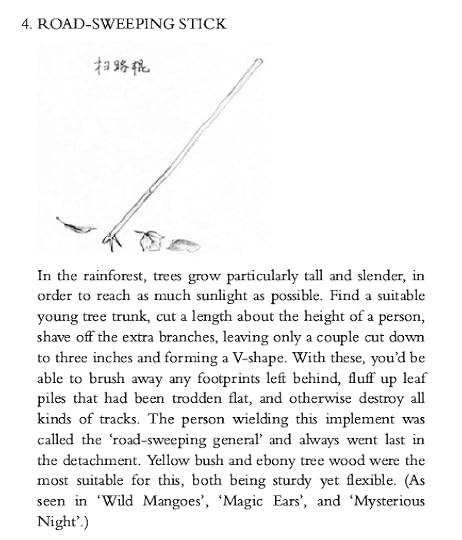
For a novel with the protagonists are idealists, the stories are refreshingly undidactic. The emphasis is on the sacrifices that the guerrilas undergo - the army use mines designed to cripple rather than kill so as to slow down the comrades of the large numbers left with the loss of limbs - the strong sense of comradery, the challenges of survival but also the pleasures of the terrain and nature - which are beautifully described - and yes the search for but pleasure taken in food (who knew how tasty food is when fried in elephant fat?).
Wind blew from the hills, carrying tiny rain drops like stars, brushing across her face, playing with her hair, steeped in the invigorating fragrance of wild mint and worm wood. The crops, bathed by this storm, brimmed with irrepressible life. Banana leaves spread themselves wide, vibrant and green, shedding crystalline droplets with each jolt of wind. Shouldering her hoe, Donghua walked over to where she’d been working earlier, stepping on soil she’d just loosened, feeling a sort of skin-close tenderness. Her eyes, dull for so long, were regaining a faint glimmer of delight at the labour.
The campaign ended in 1989 with the signing of the Peace Agreement of Hat Yai with both the Thai and Malay government, as Wikipedia notes rather drily: "When the Communist bloc in Europe collapsed in the late 1980s, the MCP had accepted the fact that they did not have any chance to form a communist government in Malaya. Malaysia by that time was one of the newly developed nations in Asia. Malaysia's economy was strong and the majority of Malaysia's citizens refused to accept communist ideology."
And several of the later stories, perhaps the most poignant, concern the aftermath of peace, with the guerrilas setting into specially eatablished communities and also re-establishing contact with their families and indeed the families of comrades lost in battle.
Just a few months ago, they’d still been guerrillas in grass-green, a single entity blending into the rain forest. You were issued the uniform as soon as you joined up, and the colour hadn’t changed for more than ten years—for decades, in fact. Be cause it was compulsory, no one had ever questioned it, and every one was used to it. Now they still wore uniform trousers as they built the vil lage, but their top halves were a rain bow of colours. As soon as they met their families, they changed to civvies.
And fittingly given the collection's overall theme, one celebration revolves around the disinterring of hidden food supplies for one last feast together.
Rather straightforward in purely literary terms - hence the 3.5* rating - but a fascinating new voice and setting and very much in line with the mission of the press.
The publisher
Tilted Axis Press is an independent publisher of contemporary literature by the Global Majority, translated into or written in a variety of Englishes.
Founded in 2015, our practice is an ongoing exploration into alternatives - to the hierarchisation of certain languages and forms of translation, and the monoculture of globalisation.
EDITORIAL VISION: TRANSLATING WATERS
Tilted Axis Press publishes six to nine books a year. We focus on contemporary translated fiction and also publish poetry and non-fiction.
Translating Waters is an editorial vision shaped by the migration of people, language, and ideas. From 2024, conceptual and literal bodies of water will be the framework of our titles. Beginning with the Pacific Seas, our list also covers the Indian Ocean as well as the Black Atlantic and the Black Pacific.
Our publishing practice foregrounds the complex movement of language, stories, and imaginations. Often fugitive and always trailblazing, our authors and translators challenge how we read, what we think, and how we view the world.
COMMUNITY: AFRO-ASIA / SOUTH-SOUTH SOLIDARITIES
Building and nourishing community is part of our publishing practice. Inspired by the Afro-Asia Writers’ Association, literary collectives, and grassroots organisations, we seek collaborative and interdisciplinary projects that expand what constitutes the literary and build on existing solidarities across the globe.
Truly.
Looking back now, I realise how many questions actually revolved around eating.
Delicious Hunger is the translation by Jeremy Tiang of a 2017 collection 可口的饥饿 by Hai Fan, and is published by Tilted Axis Press (see below).
The 11 stories are all set in the jungle on the Malayan-Thai border region during the insurgents of the Malayan Communist Party. The insurgency lasted from 1968 to 1989, although its origins lay before that in the guerrilla army that fought for Malayan independence from the British Empire (1948-1960) and even the Malayan Peoples' Anti-Japanese Army from WW2.
The author himself, originally from Singapore (which, from references in the story he may have fled after the 1963 anti-communist security Operation Coldstore) was one such guerrila, rooting these stories in the authentic details of life in the jungle, and there is a wonderful illustrated glossary at the novel's end which explains, verbally and visually, some of the items which were key to their survival and are featured in the stories.
For a novel with the protagonists are idealists, the stories are refreshingly undidactic. The emphasis is on the sacrifices that the guerrilas undergo - the army use mines designed to cripple rather than kill so as to slow down the comrades of the large numbers left with the loss of limbs - the strong sense of comradery, the challenges of survival but also the pleasures of the terrain and nature - which are beautifully described - and yes the search for but pleasure taken in food (who knew how tasty food is when fried in elephant fat?).
Wind blew from the hills, carrying tiny rain drops like stars, brushing across her face, playing with her hair, steeped in the invigorating fragrance of wild mint and worm wood. The crops, bathed by this storm, brimmed with irrepressible life. Banana leaves spread themselves wide, vibrant and green, shedding crystalline droplets with each jolt of wind. Shouldering her hoe, Donghua walked over to where she’d been working earlier, stepping on soil she’d just loosened, feeling a sort of skin-close tenderness. Her eyes, dull for so long, were regaining a faint glimmer of delight at the labour.
The campaign ended in 1989 with the signing of the Peace Agreement of Hat Yai with both the Thai and Malay government, as Wikipedia notes rather drily: "When the Communist bloc in Europe collapsed in the late 1980s, the MCP had accepted the fact that they did not have any chance to form a communist government in Malaya. Malaysia by that time was one of the newly developed nations in Asia. Malaysia's economy was strong and the majority of Malaysia's citizens refused to accept communist ideology."
And several of the later stories, perhaps the most poignant, concern the aftermath of peace, with the guerrilas setting into specially eatablished communities and also re-establishing contact with their families and indeed the families of comrades lost in battle.
Just a few months ago, they’d still been guerrillas in grass-green, a single entity blending into the rain forest. You were issued the uniform as soon as you joined up, and the colour hadn’t changed for more than ten years—for decades, in fact. Be cause it was compulsory, no one had ever questioned it, and every one was used to it. Now they still wore uniform trousers as they built the vil lage, but their top halves were a rain bow of colours. As soon as they met their families, they changed to civvies.
And fittingly given the collection's overall theme, one celebration revolves around the disinterring of hidden food supplies for one last feast together.
Rather straightforward in purely literary terms - hence the 3.5* rating - but a fascinating new voice and setting and very much in line with the mission of the press.
The publisher
Tilted Axis Press is an independent publisher of contemporary literature by the Global Majority, translated into or written in a variety of Englishes.
Founded in 2015, our practice is an ongoing exploration into alternatives - to the hierarchisation of certain languages and forms of translation, and the monoculture of globalisation.
EDITORIAL VISION: TRANSLATING WATERS
Tilted Axis Press publishes six to nine books a year. We focus on contemporary translated fiction and also publish poetry and non-fiction.
Translating Waters is an editorial vision shaped by the migration of people, language, and ideas. From 2024, conceptual and literal bodies of water will be the framework of our titles. Beginning with the Pacific Seas, our list also covers the Indian Ocean as well as the Black Atlantic and the Black Pacific.
Our publishing practice foregrounds the complex movement of language, stories, and imaginations. Often fugitive and always trailblazing, our authors and translators challenge how we read, what we think, and how we view the world.
COMMUNITY: AFRO-ASIA / SOUTH-SOUTH SOLIDARITIES
Building and nourishing community is part of our publishing practice. Inspired by the Afro-Asia Writers’ Association, literary collectives, and grassroots organisations, we seek collaborative and interdisciplinary projects that expand what constitutes the literary and build on existing solidarities across the globe.
November 19, 2024
And now for a completely new (for me) perspective. Fascinating collection of stories about the everyday lives of communist guerrillas fighting on the Malaysian/Thai border. These however are not on the whole stories of heroism or derring-do but of the daily grind of existing day to day. There is an emphasis on food and supplies (most notably in the title story Delicious Hunger) but also relationships, grief and the aftermath of land mine injuries. It was the minutiae that particularly captivated me - for example the importance of the stick used for rubbing away track marks (and the importance of the person using it) and the appearance of the kind of characters that you don’t normally hear about like the guerrillas who are actually just a little bit useless….
Despite the premise this isn’t a particularly political book and if you don’t know a lot about this era it doesn’t really give you much background but I don’t think that that matters as what it is actually doing is showing us the reality of this kind of life and maybe it’s a bit more obviously universal for that fact.
Despite the premise this isn’t a particularly political book and if you don’t know a lot about this era it doesn’t really give you much background but I don’t think that that matters as what it is actually doing is showing us the reality of this kind of life and maybe it’s a bit more obviously universal for that fact.

July 13, 2026
The battle of the Malayan Communist Party in Peninsular Malaysia and southern Thailand up to the late 1980s had its roots in the WW2 resistance against the Japanese and after, then the colonial British.
As modern Malaysia and Singapore emerged in the late 1950s,the movement floundered but then revived in that second, post-independence phase, when race relations struggled, the Chinese language was economically sidelined, and communism flourished in China and Indochina and the non-communist governments battened down the hatches against the Cold War red challenge.
It was that second phase that drew Hai Fan into the rainforest and join a struggle of survival in the forest, as much as against the Malaysian and Thai armies in those borderlands. These were remote and isolated from the urban struggles and race to new prosperity afforded by capitalism in the larger towns and cities. So many urban folk were largely unaware or indifferent to the jungle war which lasted some four decades in all.
These fictional short stories drawn draw on a decade of recollected experience to provide an invaluable and humanistic peek into that world. It’s a unique contribution to hearing about the ideologies, events and actions which shaped the region.
The communists emerged after peace treaties into residence into villages at Betong, southern Thailand, courtesy of the Thai government. And time has allowed calm examination of that time.
I am very glad Jeremy Tiang translated this offering. See also his own fiction book, “State of Emergency” (2017). Like “A Good True Thai” by Sunisa Manning, and “The Unrepentant: Short Stories” by Sharmini Aphrodite (2025), these works of historical fiction help to visualise aspects of regional history, which were largely sidelined but which never lost their relevance and shaped identity here.
Ebook from NLB on Libby.
As modern Malaysia and Singapore emerged in the late 1950s,the movement floundered but then revived in that second, post-independence phase, when race relations struggled, the Chinese language was economically sidelined, and communism flourished in China and Indochina and the non-communist governments battened down the hatches against the Cold War red challenge.
It was that second phase that drew Hai Fan into the rainforest and join a struggle of survival in the forest, as much as against the Malaysian and Thai armies in those borderlands. These were remote and isolated from the urban struggles and race to new prosperity afforded by capitalism in the larger towns and cities. So many urban folk were largely unaware or indifferent to the jungle war which lasted some four decades in all.
These fictional short stories drawn draw on a decade of recollected experience to provide an invaluable and humanistic peek into that world. It’s a unique contribution to hearing about the ideologies, events and actions which shaped the region.
The communists emerged after peace treaties into residence into villages at Betong, southern Thailand, courtesy of the Thai government. And time has allowed calm examination of that time.
I am very glad Jeremy Tiang translated this offering. See also his own fiction book, “State of Emergency” (2017). Like “A Good True Thai” by Sunisa Manning, and “The Unrepentant: Short Stories” by Sharmini Aphrodite (2025), these works of historical fiction help to visualise aspects of regional history, which were largely sidelined but which never lost their relevance and shaped identity here.
Ebook from NLB on Libby.
December 10, 2025
The stories here are fascinating and eye-opening, detailing the way a group of marginalised people strove to survive in the rainforest in a surprisingly neutral way that highlights their lived experiences. Reading them is like entering a time capsule or doing a deep dive into a topic that's usually relegated to the footnotes. I don't know about you, but the kind of history presented to my adolescent schooling self was very much pared down and simplified, so much of this is new to me. It is likely because history is written by the victors, but I'm also guessing that people trying not to starve in a tropical rainforest do not have the means to acquire, transport, and maintain reams of paper for record-keeping, making this collection necessary reading for anyone who wishes to learn more about unspoken local histories.
I was struck by how well-written the characters are. In each story, they are people first—human beings with complex emotions and desires—and guerrillas of the Malayan Communist Party second. They may share the same principles and experiences, but they have different motivations for joining and/or staying in the party. Not every comrade is there because they fervently believe in the party, and more often than not, the comrades carry on in their missions because their relationships sustain them. My favourite story has to be 'Wild Mangoes,' a love story between two comrades who believe their affections one-sided.
I mentioned that this collection is surprising because I expected it to be more overtly 'political,' and it is, but not in the typical Heroes VS Villains way, opting instead for subtlety and reading between the lines. Even their opponents are simply "the Enemy." The focus is on how they made a living as best they could, farming, washing, hunting, fishing, foraging, healing, defending themselves, protecting each other, eating the wrong thing, and always, being in the moment of their own choosing.
I was struck by how well-written the characters are. In each story, they are people first—human beings with complex emotions and desires—and guerrillas of the Malayan Communist Party second. They may share the same principles and experiences, but they have different motivations for joining and/or staying in the party. Not every comrade is there because they fervently believe in the party, and more often than not, the comrades carry on in their missions because their relationships sustain them. My favourite story has to be 'Wild Mangoes,' a love story between two comrades who believe their affections one-sided.
I mentioned that this collection is surprising because I expected it to be more overtly 'political,' and it is, but not in the typical Heroes VS Villains way, opting instead for subtlety and reading between the lines. Even their opponents are simply "the Enemy." The focus is on how they made a living as best they could, farming, washing, hunting, fishing, foraging, healing, defending themselves, protecting each other, eating the wrong thing, and always, being in the moment of their own choosing.

Did Not Finish
March 1, 2025This book is not pulling me in right now. Interesting stories on the lives of communist Guerilla fighters. As someone who has read literature on insurgents and their lives in the North East Indian states, it’s not necessarily a very new narrative and hence maybe I will pick this up at a later time.
January 24, 2026
“We did it for the Revolution. Never mind losing a foot, even losing an eye or an arm would have been fine, as long as we’d stayed alive to go back…someday.” Yuanshan bowed his head. “But some people…will never return.”
—page 188, Cherry Red Ivory
I consider Delicious Hunger one of the crown jewels of my bookshelf. One wouldn’t expect that from a short story collection presented rather simply. But I admire how Hai Fan’s understated storytelling opens into a multitude of textual essences: as a quasi-historical account, as a record of lived political theory, as a well-crafted and deeply compelling work of literature. Most of all, and due to how all those layers compound, I resonate with it personally, for being the artifact that most truthfully witnesses a bygone, pivotal, strange, stressful time of my life.
That might come off strange considering how many works there are, Filipino or otherwise, that talk about lives of communists and left-wing offshoots. But a Marxist subject matter alone does not make a work so. Nor should we be belittling the theory by equating it to a dogmatic artistic method, one that requires certain phrases said and morals learned to qualify as part of its worldview. I may have retired my activist days, but I still find beauty in Marxism. Real study, real appreciation of it, should instill the realization that it is not a lens that boxes in.
Hai Fan uses it as a lens through which we explore the world. This makes Delicious Hunger feel dynamic and lively. It is a work that proves the beauty opened up by Marxism, showing how its principles can be used to craft philosophically compelling, emotionally resonant, and just straight up entertaining fiction.
To examine one way Delicious Hunger achieves great fiction with Marxist thinking, we should look to its depiction of the guerrillas’ relationship to nature. Hai Fan shows how something that starts as a tactical decision (the need to operate invisibly beneath the safety of the forest canopy) becomes a material condition, that then expands into an entire way of life.
Living within nature’s ambivalence gives positional security, but demands great effort, great caution, great sacrifice. Most inciting incidents are not about military activity or ideological debate, but the plain struggle for food in the wilderness. Farming is a laborious activity worsened by getting caught in demoralizing storms (‘Hillside Rain’) or the peril of surprise enemy fire (‘Swansong in That Faraway Place’). Hunting animals for better rations can be a great success (‘Prey’), but just as easily fail (‘Spell’).
“None of them had forgotten their old comrade Li Jian, whose right hand was missing below the wrist where a wild boar crunched through the bones and swallowed it whole.”
—page 117, Spell
Amidst showing the operational, practical struggle, it asks us to consider, too, the romantic way of looking at it. Which is that living a guerillas’ life means attunement to nature.
In times of reprieve, experiencing nature during tranquility is reward enough for the unit. These book moments almost feel pastoral, for its embrace of nature and its fruits (except communists are ostensibly anti-fuedal).
“Long, balmy arms of morning sun roused the slumbering rainforest. A million glittering rays broke through the wasteland of sky, pushing aside the thick foliage. Through the ink-dark crowns of trees came a dazzling spill of light, countless rays as radiant as tiny golden needles, impossible to ignore.”
—page 38, Mysterious Night
“In the cool shade of the wild mango trees, the air around him was faintly sour sweet, everything washed clean by the hilltop’s dawn mist, intoxicating as the quiet buzz of alcohol. Like being in a fairy tale. On the ground, fruit lay amid the fallen leaves, overripe flesh split open and attracting swarms of flies. The thick canopies were dark green, dense as smoke, dangling clusters of fruit the color of jade. He clambered up the trunk, and as he brushed past the mango they rubbed together, rustling like the golden song of summer.”
—page 126, Wild Mangoes
Delicious Hunger arrives at the most truthful, authentic depiction of comrades because it invites Marxism, over and over, into the story.
The boldest artistic decision Hai Fan makes is related to the relationship between the comrades and the military. As with guerilla stories, we expect these two to come to blows. These scenes where the comrades must survive a skirmish gives the stories stakes, tension, and even action. But the warfare itself is not the challenging element. If anything, those give Delicious Hunger conventionally entertaining moments.
It is actually in preserving the detail that the internal jargon among comrades when referring to the military is simply “the Enemy.” It chooses here not to scaffold the uninitiated. Rather, it chooses to uphold the universality of contradiction. It chooses to remember this sociolect, as how communists verbalize everyday the ideological contradiction between themselves and the military.
The Marxist acceptance of reality goes further into the text with how it accepts that people—no matter how rigorously trained as soldiers—are fundamentally subjective beings. Accordingly, the stories envelop us with admiration of the comrades’ battle strength and lived wisdom, as well as the tension of their disagreements, the unsavoriness of their sexism.
Comrades can feel annoyed with another, because comrades don't have the same level of patience. Yet they will still hesitate to flippantly voice judgement of others, because of how the Party discourages fomenting subjectivity (‘Hillside Rain’). Here we see that, yes, a unit is the political structure that shaped the overall collective’s culture, in values, behaviors, and thought. But so too is it the idiosyncrasies of each comrade, thriving within those tucked corners, occasionally bucking up against its limits.
The material reality is that sometimes, the Party is helpful for the comrades. In (), a particularly eccentric comrade struggles with being socially awkward in her new unit. The Party steps in and advises the others to consciously take steps to strengthen their bond. Here, they are the guide over her reintegration, a good force for cohesion.
The material reality is that sometimes, the Party is awful and vindictive. In one striking episode, a comrade openly challenges the Party’s political analysis during a study session. From that moment on, his promotion is indefinitely postponed—reasons never explicitly stated, yet fully understood within the group.
What ultimately sustains the book is its close attention to the comrades’ characterizations. The personalities, insecurities, loyalties, and contradictions of each comrade drive the narrative more powerfully than the movements of the Enemy itself.
Having communist literature with this amount of depth is thanks largely to the author Li Zi Shu, who encouraged Hai Fan to write his stories. She correctly clocked Hai Fan’s work as a diamond in the rough once she got hold of it, because she knows how plain and stilted most other Communist writings are:
“Whether we’re reading Jin Zhimang’s Hunger or He Jin’s The Mighty Wave, we understand that these tomes are of more historical than literary value…Due to the urgency with which these works serve ideological needs, they have the strong reek of propaganda about them, and the writing is often somewhat unsophisticated, full of hackneyed cliches, lacking in aesthetic sensibility, and would surely be judged to have fallen far short of the exact standards of literature.”
—page 262, Afterword: Dead Pigs, Buried Rations, Yesterday’s People
Me and Li Zi Shu only diverge on what we think of Swansong in That Faraway Place. She considers it the weakest entry in Delicious Hunger. But I think it's the best.
A male comrade (Ah Xiang) becomes disabled when he accidentally tripped a landmine. The close call with death makes him revisit himself as an individual. Amidst his thoroughly collectivist training and education, a spring of existentialism bursts forth and can’t be stopped. Wanting more, wanting something of himself, he decides to impregnate his wife (Chunxi) and create a child.
Chunxi, a fully operational combatant for their unit, supported her husband in managing life in the unit with his disability. When they first joined the war, she encouraged him to bring his flute, in spite of strongly voiced discouragement from their comrades. She negotiates what of themselves is possible within this new life.
However, Ah Xiang pushed his human desires farther than ever this time, and finally went too far. Chunxi found herself an unprepared and unwilling participant in his plan for a child. Unlike her husband, whose thoughts of children are abstract, Chunxi thinks of the logistical weight on herself, on the unit, and on the child, of trying to make a family in the midst of war. Hoping against hope, she tries to carry the baby to term.
The pregnancy starts changing Chunxi’s body. Unfortunately, the reality of class war doesn’t take kindly to sentimentality, nor have pregnancy friendly accommodations. One day, her group was caught in a surprise attack from the state military, spurring the camp to mobilize. The rest of the collective moves forward, Ah Xiang included, away from Chunxi’s team, to the safety of a new base. Eventually, news of Chunxi and her unit arrives: killed in action. Ah Xiang, for trying to create a family in the midst of war, is left more alone than he ever was before.
While the entirety of Delicious Hunger is steeped in the demands of class war, Swansong in That Faraway Place is borderline suffocating in how it traps its characters within the stark demarcation between the comrade as a human being and the comrade as a member of the Revolution, and the deadly consequences of asking for too much while straddling that line. It is a realistic story, one that allows the world and its characters enough nuance that it renders a tragic weight that’s akin to that of Orpheus and Eurydice.
And this is why I like this story the most. It is the pinnacle of how I want to read these experiences from back then. They were never one-dimensional; I reject the rigid McCarthyist caricatures, which would cast me as a victim or villain. In this vein, I too reject the overly censored overtures of in-house NatDem propaganda, that throws aside like waste all the stories of people I’ve loved in this struggle when their truth became inconvenient.
They were full-bodied experiences, where revolutionary fervor unfolded across the constellation of my human soul. A grand ideal, first physically manifest as the heavy weight slumping a person’s shoulders, before enacted into the wider world. It was as much the blazing forge of danger and stakes that looked good on screens as it was the private, infinitely large moments that stretched in between. The ideology we followed made it a life that’s unlike any other. And yet, it is still so much like any other life, lived in all its beauty and cost. With Delicious Hunger, I can read stories that can shore up to almost exactly how it really was.
Final Thoughts
Inside Delicious Hunger is a political reality of great attrition. Hai Fan’s 12 stories are about communist guerillas, trying to win a class war and survive the beautiful, ambivalent mountain terrain while bearing the indelible heartbeat of the human condition. This simply narrated book succeeds as literature, as historical witness, precisely because of how wholly it lets Marxism attend to its narrative. For that reason, I consider Delicious Hunger the most wondrous literary tribute to the struggle.

October 1, 2024
Loved this collection of short stories! Normally, I avoid topics around war because it’s not-the-vibe, but it’s good to reality check from time to time. Although it was sometimes hard to read, aka the story ‘Prey’, these stories are about the moments between warfare for guerrillas of the MCP, and I’m so grateful they’ve been told. So poetically written, and even more beautifully translated! An amazing work for both Hai Fan and Jeremy Tiang. Each story was moving and thought-provoking, and I loved how pulled into each story I felt. And again, such great writing! I’ve never seen the jungles of Malaysia but I feeeel like I have. A truly delicious novel!

August 24, 2025
Short stories from the guerrilla war fought by Malayan communists (mostly ethnic Chinese) in northern peninsular Malaya near the Thai border from the 1960s to the late 1980s. Less about actual warfare (there is actually very little of this in the stories) -- more about living and surviving in the jungle. Outstanding settings and characters and character relationships; excellent writing.
July 22, 2026
I am fascinated by the Malayan Emergency and have read quite a number of books, mainly non-fiction in the course of researching and discovering about the subject. The accounts in this book happened during the late 1970s and early 1980s, well after the Emergency was officially declared over in 1960. There is far less literature about this 'Part 2' of the communist movement in what is now Malaysia, and I gather almost all of it published in Chinese. This English translation then, is one of those rare ones, possibly the only one? In any case, this period is less well known by the general public, an almost forgotten occurrence only relevant to those who participated.
Hai Fan's short stories collected in this book come across as whimsical, even when detailing the grueling conditions and harsh realities of living in the jungles, enduring deprivation of all sorts while being in constant danger of physical injury and death. Jeremy Tiang, the translator, wrote an interesting introductory section about his own journey researching these events and writing fiction about it. I have not read the original Chinese text, but I felt that the writing does not translate well. Whether it is due to the nature of Chinese language or the skill of the translator I cannot say, but the end effect is that the stories had a child like quality, with frequent strange sound effects (bullets, bombs, leaves stirring etc.) I found not really fitting, and the dialog frequently sounding awkward. Some of the information about wildlife is plain incorrect, like how black bears are described as the Asian black bear when they are far more likely to be Malayan sun bears.
There is also a tendency to romanticize the exploits of the guerillas and empathize with their hardships and personal sacrifices. While I am not against their political ideals, still I cannot fathom the point of retreating into the wilderness as a strategy to force changes to society. It seems like just a form of escapism and utopian fantasy to live in an artificial world, with similarities to the hippy communes that sprouted during the 1960s in the West. Well, minus the firearms and violence of course.
Hai Fan's short stories collected in this book come across as whimsical, even when detailing the grueling conditions and harsh realities of living in the jungles, enduring deprivation of all sorts while being in constant danger of physical injury and death. Jeremy Tiang, the translator, wrote an interesting introductory section about his own journey researching these events and writing fiction about it. I have not read the original Chinese text, but I felt that the writing does not translate well. Whether it is due to the nature of Chinese language or the skill of the translator I cannot say, but the end effect is that the stories had a child like quality, with frequent strange sound effects (bullets, bombs, leaves stirring etc.) I found not really fitting, and the dialog frequently sounding awkward. Some of the information about wildlife is plain incorrect, like how black bears are described as the Asian black bear when they are far more likely to be Malayan sun bears.
There is also a tendency to romanticize the exploits of the guerillas and empathize with their hardships and personal sacrifices. While I am not against their political ideals, still I cannot fathom the point of retreating into the wilderness as a strategy to force changes to society. It seems like just a form of escapism and utopian fantasy to live in an artificial world, with similarities to the hippy communes that sprouted during the 1960s in the West. Well, minus the firearms and violence of course.

Read
January 14, 2026This collection of short stories are based on Hai Fan’s time as a guerilla for the Malayan Communist Party (Ma Gong) near the Thai-Malaysian border. This is undoubtedly such a precious piece of history but also literature. Translated by Jeremy Tiang.
One gets the sense that while they were fighting colonisers in the forest, the first and more hour-to-hour battle they were fighting was their hunger and survival needs. Many passages were about food, what they missed eating, how they hunted, rationed, buried, salted and dried, what they endured to ensure they could eat enough. Interesting to read about how they learned from the orang asli in the forest about how to forage and catch animals, and this helps them to survive. So innovative too! I loved the glossary of items invented at the end of the book.
While these guerillas are communist, these stories don’t actually touch about politics very explicitly, having instead a very human angle. Their anxieties as they fall in love, their sadness as they are far away from home, their grief as comrades die. What strikes me is how they were very common, very young, and often rural idealistic youths. The Ma Gong had an institution and structure where they could direct their idealism to in a very material way. They gave their life and body to a cause, but it’s also distressing to see how disposable they could be. Not just to colonisers who would kill them in a second, but higher ranking communist leaders as they order executions during purges of “collaborators”. Ordinary people die under the boots of ideology, and that’s the saddest thing, because their desire was so pure.
There are beautiful, almost adoring sentences about the forest, and in those times you get the sense that while it is a place where so much violence and grief happens, the forest endures, beautiful and serene. The purity of the human spirit of those who fight for a better life is like that..
One gets the sense that while they were fighting colonisers in the forest, the first and more hour-to-hour battle they were fighting was their hunger and survival needs. Many passages were about food, what they missed eating, how they hunted, rationed, buried, salted and dried, what they endured to ensure they could eat enough. Interesting to read about how they learned from the orang asli in the forest about how to forage and catch animals, and this helps them to survive. So innovative too! I loved the glossary of items invented at the end of the book.
While these guerillas are communist, these stories don’t actually touch about politics very explicitly, having instead a very human angle. Their anxieties as they fall in love, their sadness as they are far away from home, their grief as comrades die. What strikes me is how they were very common, very young, and often rural idealistic youths. The Ma Gong had an institution and structure where they could direct their idealism to in a very material way. They gave their life and body to a cause, but it’s also distressing to see how disposable they could be. Not just to colonisers who would kill them in a second, but higher ranking communist leaders as they order executions during purges of “collaborators”. Ordinary people die under the boots of ideology, and that’s the saddest thing, because their desire was so pure.
There are beautiful, almost adoring sentences about the forest, and in those times you get the sense that while it is a place where so much violence and grief happens, the forest endures, beautiful and serene. The purity of the human spirit of those who fight for a better life is like that..
March 19, 2026
Singapore is perhaps the last place in the world that you’d associate with a revolutionary movement, but three years ago, when I read Jeremy Tiang’s novel State of Emergency, it radically altered my perception of that country, and its mid-20th revolutionary and radical history.
After that, I’ve always been on the lookout for Tiang’s work (along with Viet Thanh Nguyen, he’s also one of the prominent SE Asian writers that have been very strong on Palestine); the latest I found was this translation of a book called Delicious Hunger, which takes us right back to that same revolutionary movement - and this one has been written by one of those revolutionaries. Delicious Hunger is a collection of interwoven short stories that recount the lives of the revolutionaries who spent years fighting from the forests.
These short stories are written almost as journalistic vignettes: centred around a single event (a battle, a disappearance, a death), and then unfolding outwards in a portrayal of the revolutionaries’ time in the forest, crafting a life - and lives together - both in hiding, and under fire. It is almost as if the immense strain sharpens and clarifies the true nature of the range of human emotions - from love to parting to heartbreak to solitude: the veils that we weave are stripped away, leaving nothing but the essence. These are, in a sense, simple stories - but it is a simplicity forged in the most adverse of circumstances, circumstances where superfluity could itself have mortal consequences.
It is rare, these days, to find stories of revolution written by a revolutionary (the last such book I came across, I think, was Hiwot Teffeira’s Tower in the Sky); these days, literature that makes such claims is far more about revolutionary aesthetics. It is that what makes Delicious Hunger not just a window into a time and an era that has been allowed to be forgotten, but also the most unique and irreplaceable of authorial voices.
After that, I’ve always been on the lookout for Tiang’s work (along with Viet Thanh Nguyen, he’s also one of the prominent SE Asian writers that have been very strong on Palestine); the latest I found was this translation of a book called Delicious Hunger, which takes us right back to that same revolutionary movement - and this one has been written by one of those revolutionaries. Delicious Hunger is a collection of interwoven short stories that recount the lives of the revolutionaries who spent years fighting from the forests.
These short stories are written almost as journalistic vignettes: centred around a single event (a battle, a disappearance, a death), and then unfolding outwards in a portrayal of the revolutionaries’ time in the forest, crafting a life - and lives together - both in hiding, and under fire. It is almost as if the immense strain sharpens and clarifies the true nature of the range of human emotions - from love to parting to heartbreak to solitude: the veils that we weave are stripped away, leaving nothing but the essence. These are, in a sense, simple stories - but it is a simplicity forged in the most adverse of circumstances, circumstances where superfluity could itself have mortal consequences.
It is rare, these days, to find stories of revolution written by a revolutionary (the last such book I came across, I think, was Hiwot Teffeira’s Tower in the Sky); these days, literature that makes such claims is far more about revolutionary aesthetics. It is that what makes Delicious Hunger not just a window into a time and an era that has been allowed to be forgotten, but also the most unique and irreplaceable of authorial voices.

May 12, 2026
Writers with specific political affiliations often have a habit of producing stories that read more like propaganda than prose. That was my initial assumption here, but Hai Fan surprised me with the sheer mundaneness of his stories.
Centred on MCP combatants and members during and after the Communist movement in Malaysia, these tales are beautifully human. The ideologies that served as the party’s North Star are not the spirit of the stories; the people are. We are given narratives of survival, grief, and the profound alienness that followed the conclusion of their fight. Rather than inserting ideology like a dry textbook, Hai Fan lets it breathe through the customs and behaviours of his characters.
It is, quite often, much easier to understand what people believe through their actions than through their rhetoric.
What struck me most was the vividness of the setting: the rich forests used for combat, the villages and campsites serving as refuge, and a homeland that felt simultaneously dear and alien.
The book also offered unexpected historical threads that sparked a new interest in my own country’s past. Hai Fan mentions that MCP members were often smuggled into neighbouring countries as refugees, one of them being Indonesia. I’m now keen to learn how their presence might have impacted the movement within Indonesia itself.
In all its simplicity, this book opens several new doors of curiosity. I’m quite thankful for it.
Centred on MCP combatants and members during and after the Communist movement in Malaysia, these tales are beautifully human. The ideologies that served as the party’s North Star are not the spirit of the stories; the people are. We are given narratives of survival, grief, and the profound alienness that followed the conclusion of their fight. Rather than inserting ideology like a dry textbook, Hai Fan lets it breathe through the customs and behaviours of his characters.
It is, quite often, much easier to understand what people believe through their actions than through their rhetoric.
Everything began from when he took that name, Yejin. It was the same with everyone. He only knew about his comrades’ lives after they’d acquired their new names.
No matter what, now that they’d chosen to be part of the collective, protecting the interests of the group had to be their highest responsibility.
What struck me most was the vividness of the setting: the rich forests used for combat, the villages and campsites serving as refuge, and a homeland that felt simultaneously dear and alien.
The book also offered unexpected historical threads that sparked a new interest in my own country’s past. Hai Fan mentions that MCP members were often smuggled into neighbouring countries as refugees, one of them being Indonesia. I’m now keen to learn how their presence might have impacted the movement within Indonesia itself.
In all its simplicity, this book opens several new doors of curiosity. I’m quite thankful for it.
January 25, 2026
What an incredible perspective. Hai Fan draws you into the life of the members of the Ma Gong. As an avid reader of Ha Jin’s works, you can see the similarities in their writing (no doubt the poetic emphasis on food).
Growing up in Singapore in the 2000s, I never imagined or understood the MCP. I thought they collapsed after the Emergency in 1960. I’m surprised to find out that they continued after that in the Malaysia-Thai border. And I’m even more surprised to see literature coming from that context.
My favourite story is Buried Rations. Particularly the interactions between Hong Ying’s grandmother and the temple attendant. Such beautiful writing, “A plum branch in winter, leaves fallen and withered, but no destroyed; when the sun appears in the Spring, blossoms come again”. The author Hai Fan admits that he never regretted his time in the MCP.
Growing up in Singapore in the 2000s, I never imagined or understood the MCP. I thought they collapsed after the Emergency in 1960. I’m surprised to find out that they continued after that in the Malaysia-Thai border. And I’m even more surprised to see literature coming from that context.
My favourite story is Buried Rations. Particularly the interactions between Hong Ying’s grandmother and the temple attendant. Such beautiful writing, “A plum branch in winter, leaves fallen and withered, but no destroyed; when the sun appears in the Spring, blossoms come again”. The author Hai Fan admits that he never regretted his time in the MCP.
October 24, 2025
An eye opener..
'The Enemy can only defeat you if you’ve already defeated yourself. There’ll be many battles, but we have to stand strong and stay upright!’
victory and despair
laugh and that’s a lifetime, cry and that’s a lifetime too
We all thought the same way back then: when we go into the rainforest and become guerrillas, we’ll be fuelled by revolutionary fervour. Who cares what we’ll eat or how we’ll get food? How is that even a problem? Truly. Looking back now, I realise how many questions actually revolved around eating.
'Without hunger, nothing tastes as good,’
'The Enemy can only defeat you if you’ve already defeated yourself. There’ll be many battles, but we have to stand strong and stay upright!’
victory and despair
laugh and that’s a lifetime, cry and that’s a lifetime too
We all thought the same way back then: when we go into the rainforest and become guerrillas, we’ll be fuelled by revolutionary fervour. Who cares what we’ll eat or how we’ll get food? How is that even a problem? Truly. Looking back now, I realise how many questions actually revolved around eating.
'Without hunger, nothing tastes as good,’
This entire review has been hidden because of spoilers.

February 3, 2026
Talk about ignorance. I never knew there was such a thing as Malayan Communist literature. But talk also about the nationalist propaganda that has erased the lived experiences & freedom fighting struggle of the leftists & communists.
This book is such a precious treasure trove of the lives of the guerillas in the Malayan jungles, complete with vivid, colourful details that could only be told by someone who had spent their prime years in such camps. It’s eye opening, captivating, & overall just excellently written.
This book is such a precious treasure trove of the lives of the guerillas in the Malayan jungles, complete with vivid, colourful details that could only be told by someone who had spent their prime years in such camps. It’s eye opening, captivating, & overall just excellently written.
September 14, 2026
Poignant collection of stories about the rainforest guerillas in the Malayan Communist Party of an era of Singapore and Malaysian history often distorted if not buried, who were mostly vilified despite their sacrifices and contributions to defeating colonialism. Much praise for the translator Jeremy Tiang, a talented writer in his own right, for bringing such books to a wider English speaking readership and reminding us of the universal values which define humanity.

May 8, 2026
coming into this, i knew very little about the communist insurgency in malaysia, so this was an eye-opening read for me! i appreciated this collection of stories for its vivid details of the lives of guerrillas fighting in the rainforest. i could tell how much of the author’s own experiences were put into the writing

May 8, 2026
Delicious Hunger is a collection of short stories from Hai Fan's decade in the jungle as a Malaysian Communist Party guerrila soldier, a very hungry decade. This is not a book about the heat of war, rather what happens in-between. Unfortunately, I found the translator's notes and illustrated glossary to be more interesting than contents of the book.

March 31, 2025
It is difficult for me to describe how good this collection of shorts is. Through a set of intricately perfect, sparse, vignettes Hai Fan gives a fascinating glimpse into the humdrum mundanity of conflict in the jungle.

May 19, 2026
to be frank, i was genuinely lost most of the time. i understand that this is a book of eleven stories of comrades in the rainforests, but it was confusing. i still love how each story played out, and how it depicts the jungle in great detail, and letting us see how they survive in such conditions

December 23, 2024
wow incredible!!!!
June 25, 2025
Heart wrenching

July 2, 2025
A captivating collection of short stories about communist party guerillas fighting in Malaysia.
August 29, 2025
i love the mundane
January 11, 2026
it felt like I was being transported into a different world

January 12, 2026
i didnt really get it maybe because it was translated
February 26, 2026
An enjoyable read, rich in description and characters that benefits from its author’s decade-plus experience as part of the guerrilla forces of the Malayan Communist Party

Read
March 24, 2026I read this book.

June 1, 2025
Collection of short stories about life as a communist guerilla in the Malaysian jungle, by an author who experienced it. I loved that the focus was mostly the day-to-day: hunting and fishing, falling in love, ... A fascinating and touching collection.
Displaying 1 - 30 of 31 reviews