Jump to ratings and reviews
Rate this book

One Boat

Rate this book
On losing her father, Teresa returns to a small town on the Greek coast – the same place she visited when grieving her mother nine years ago. She immerses herself again in the life of the town, observing the inhabitants going about their business, a quiet backdrop for her reckoning with herself. An episode from her first visit resurfaces vividly – her encounter with John, a man struggling to come to terms with the violent death of his nephew. Soon Teresa encounters some of the people she met last time Petros, an eccentric mechanic, whose life story may or may not be part of John's; the beautiful Niko, a diving instructor; and Xanthe, a waitress in one of the cafés on the leafy town square. They talk about their longings, regrets, the passing of time, their sense of who they are. Artfully constructed, absorbing and insightful, One Boat is a brilliant novel grappling with questions of identity, free will, guilt and responsibility.

171 pages, Kindle Edition

First published March 13, 2025

219 people are currently reading
7845 people want to read

About the author

Jonathan Buckley

76 books50 followers
Jonathan Buckley was born in Birmingham, grew up in Dudley, and studied English Literature at Sussex University, where he stayed on to take an MA. From there he moved to King’s College, London, where he researched the work of the Scottish poet/artist Ian Hamilton Finlay. After working as a university tutor, stage hand, maker of theatrical sets and props, bookshop manager, decorator and builder, he was commissioned in 1987 to write the Rough Guide to Venice & the Veneto.

He went on to become an editorial director at Rough Guides, and to write further guidebooks on Tuscany & Umbria and Florence, as well as contributing to the Rough Guide to Classical Music and Rough Guide to Opera.

His first novel, The Biography of Thomas Lang, was published by Fourth Estate in 1997. It was followed by Xerxes (1999), Ghost MacIndoe (2001), Invisible (2004), So He Takes The Dog (2006), Contact (2010) and Telescope (2011). His eighth novel, Nostalgia, was published in 2013.

From 2003 to 2005 he held a Royal Literary Fund fellowship at the University of Sussex, and from 2007 to 2011 was an Advisory Fellow of the Royal Literary Fund, for whom he convenes a reading group in Brighton.

Ratings & Reviews

What do you think?
Rate this book

Friends & Following

Create a free account to discover what your friends think of this book!

Community Reviews

5 stars
134 (7%)
4 stars
477 (27%)
3 stars
715 (41%)
2 stars
331 (19%)
1 star
64 (3%)
Displaying 1 - 30 of 381 reviews
Profile Image for Meike.
Author 1 book4,953 followers
August 5, 2025
Longlisted for the Booker Prize 2025
Is it futile to try and make sense of our lives by structuring singular experiences into a cohesive narrative? While fellow Booker contender Audition ponders life as a performance, "One Boat" investigates whether the screenplay we create can possibly be helpful. A central image is this: "A boat chugged out of the harbour and we watched it until it halted in the heart of the bay, in a position that might have been determined by its effect on the composition of the scene, so beautifully did it balance the composition." What got the boat to the perfect spot indeed: The water? The captain? Our judgement that where it is is the perfect spot, at the center of the scene?

Narrator Theresa is also a singular boat, adrift in a sea of memories: She returns to the Greek island of Pylos (the name is not mentioned, but the Griffin Warrior Tomb) where she already spent her holidays nine years ago - back then, she lost her mother, now her father died. On her return, she meets many of the same people, altered by time: John, who lost his nephew and sister to murder and suicide; expat, mechanic and poet Petros; her former diving instructor, ex-lover, and now married hottie Nico; and waitress Xanthe, now a mother. Even the dog she knew, Sander, has been replaced by another one, Kal. The timelines of the two visits are paralleled and juxtaposed, and in addition, there's a recurring narrative strand that processes Theresa's divorce from ex-husband Tom. Plus we get diary entries, often concerning dreams, random thoughts and observations, that give rational, controlled lawyer Theresa access to new angles and fresh impulses.

And yes, this Booker entry is what a judging panel chooses when they want to nominate Rachel Cusk, but she has no eligible book out: In true Cuskian fashion, people are revealed in dialogue and introspection - especially Theresa and Petros indulge into lengthy philosophical heart-to-hearts, opening up about their innermost thoughts regarding the conditio humana. Petros does not believe that the human mind, that the working of memory can be fully understood, and that there's beauty in it: "(...) where's the delight in explanation? (...) Let's just wonder." Theresa cannot live with the randomness of life though: "My mind was both the screen and the audience, but the film was not of my choosing, nor of my creation. It wasn't simply that I was not in charge - there was no "I" who could be in charge" (again, this is so Cusk-coded). This contingency and the resulting unfairness have also kept her from becoming a trial lawyer - she feels like contract law is easier to apply.

On her first visit, Theresa read The Odyssey ("The Odysseus who comes back (...) isn't the Odysseus who left"), now it's The Iliad, both (epic) poems, and the poems we get in the novel are of course by Petros, here's the central one:

"The bay
lid of black cloud
in one place cracked
below, in light
one boat
Glory"


There is so much to interpret in this fractured narrative about time as it presents in singular events that we piece together to a mosaic in narrative, and that relentlessly flows forward while we fear it will leave us behind. There's a hypnotic quality to Buckley's writing, although nothing much happens, but I have to admit that it took me quite some effort to get through it, because at the end of the day, the text feels ephemeral, and I will probably not remember the intricacies.

Still, a good text to discuss and a very justifiable Booker entry.
Profile Image for Henk.
1,197 reviews306 followers
August 22, 2025
Deservedly longlisted for the Booker Prize 2025!
So well written and touching upon things I have thought about being human, but don’t often express. One could call it lifeless and without much propulsion but I did not just love the word-craft but also the sense of place conjured.
A long life and a short life are the same, because the present is the only life we have – the same for everyone

More thoughts to follow, but really enjoyed this erudite read set in Greece. Sure, it feels like Cusk, but it is well done and I found myself longing for a week in Greece. 🇬🇷
Profile Image for Stephen the Bookworm.
888 reviews117 followers
October 3, 2025
“ You can’t live in the past and nobody lives in the future.”

“ Everywhere I looked, the daily script was being enacted. The actors may change, but the actions do not – selecting from a menu of speech”

Where do you begin with a review of One Boat by Jonathan Buckley?

This is one of those books that makes you feel that you’ve been taken on some kind of mind- bending journey of philosophy, deep reflection on connections and the logic of existence .

This is not an easy read- it certainly hasn’t a linear plot and sweeps back and forth between two key periods and events before and in between.

This is the story of Teresa a woman who returns to a Greek island where nine years before she was grieving the death of her father and now returns following the death of her mother and the end of a relationship. Teresa is attempting to piece together who she is now, who she is now and how she moves forward.

This is a journey of reconnecting with past encounters- the changes in others lives; Niki the diving instructor who she had a brief relationship ( now married) ; Petros the mechanic who has encounter trauma and has turned to poetry as a form of expression and Xanthe the waitress now the owner of the previously visited cafe. Lives move forward , attitudes change , connections continue and break. Happiness, sadness, regrets…She also meets John- a man grieving from the murder of his nephew who has come to the island to take revenge on the killer..is he linked to Petros?

Teresa keeps a journal of brief phrases and words- observations of her days and encounters.. these offer a poetic element to the prose

What the title The Boat means could be explored in many ways - this is a philosophical read. Are we just single boats on a sea of life? Or is that cliched , too simplistic?

Each dialogue makes us think about our own relationships - responses to life

This is a book that will divide readers - a joy or a frustration . This is a book that needs to be revisited. This review could certainly change after a second read as a more insightful response could be uncovered.

Challenging, original and understandably receiving plaudits and attention.

This is a book that teased me - just as I thought I understood Jonathan Buckley’s intentions, I found myself twisted in another path of thoughts.

If you have the time then this is a one sit read as you need totally immersion …or is it that you need time to reflect after each chapter - breathe, cogitate and then advance

A novel of wisdom but not plot driven .
Profile Image for Doug.
2,549 reviews914 followers
August 10, 2025
3.5, rounded up.

My 4th read of the 2025 Booker longlist.

Many reviews have invoked the names of Levy and Cusk in discussing Buckley's first Booker nod, and since they are two of my favorite contemporary authors, I was primed to enjoy this - and did. This seems to be the 'Year of Destabilized Narrative' as all four of the longlisted books I've read so far seem to be using similar techniques of playing with formats and timelines, constantly pulling the rug out from under the reader, often to head scratching effect.

One of the things Buckley gets right (and some of the others DON'T) is that even though his story weaves together two strands taking place on the same Greek island 9 years apart, for the most part we never lose track of which time frame we are in, more than momentarily. I also thought his use of a female narrator/MC worked quite well here, which is not often the case when male authors try such feats.

Although he never quite reaches the same heights as either Levy or Cusk, his philosophical musings are both thought-provoking and largely easier to grasp. I understand that leaving many threads unresolved is absolutely intentional here, but I was still left feeling that maybe I didn't QUITE get all the connections/allusions and could have used a BIT more clarity. Especially that between Petros and John - someone feel free to explicate it for me either in a DM or comment below!

Regardless, a worthy Booker nominee - I could see it making the shortlist but would be surprised if it took the top prize.

PS: Gumble's Yard kindly corroborated what I THOUGHT had happened with John and Petros - so am feeling even better about this now. Still not rooting for it to win, but think it maybe deserves a spot on the shortlist. If it does, I intend to do a quick reread.
Profile Image for Paula Mota.
1,665 reviews563 followers
Read
August 25, 2025
DNF@30%

A lista de candidatos ao Booker Prize de 2025 é um verdadeiro desconsolo: dos 13 livros escolhidos, apenas três me despertam algum interesse. “One Boat” não era um deles, mas era aquele a que tinha acesso sem entrar em despesas.

Before, I had sat there at least once every day for the unspectacular spectacle of small-town life. I would have been pleased with myself for that small phrase. I would pass a week or more here, I had thought, and my mind would settle in the sunlight, the warmth, the cleansing air, the rhythm of the days, the atmosphere of this society. Nothing would happen, I thought.

Antes de ser escritor, Jonathan Buckley fazia guias turísticos. A “acção” deste livro passa-se numa ilha grega. Estou com preguiça para ligar as duas frases, mas percebe-se o que estou a insinuar. Jonathan Buckley, um homem de 70 anos, travestiu-se de Rachel Cusk, e eu nem sequer gosto do original, imagine-se o sucedâneo. Pôs, portanto, uma mulher divorciada, de uns 40 anos, em duas situações de luto, primeiro pela perda da mãe e, em seguida, do pai, que poderiam ser a perda da carteira ou do periquito, tal é a emoção, sentada numa praça de uma terriola grega, a escrever no seu caderno comentários com a espessura de uma fatia de queijo flamengo ou à procura de habitantes que conheceu sete anos antes. A ¼ do livro, tinha tido somente um breve diálogo com um deles, convenientemente uma empregada de café que a pôs a par das andanças de todas as outras personagens e, numa analepse, conta da forma mais banal possível como conheceu um hóspede do seu hotel que também perdera membros da sua família.
Se Jonathan Buckley é conhecido por recorrer a uma estrutura narrativa inovadora, aqui disfarça bem. Até ler um rótulo de uma caixa de cereais me entusiasma mais do que isto.

Tom was sure he’d become an anesthetist because unconscious people were more to his liking than those who required some interaction. He was taciturn as an armchair.
Profile Image for Anita Pomerantz.
780 reviews201 followers
August 1, 2025
The plot of One Boat is pretty scant. A woman visits a village in Greece when her mother dies and then revisits the same village nine years later when her father dies. She meets an assortment of characters and then revisits the same characters. The author brings two distincts strengths to the table: the beautiful descriptions and his philosophical discussions. Unfortunately, as a fan of more minimalist prose, I don't care that much about the former. And the latter felt a little too much like "telling" (as opposed to showing) to really light my fire, but I did find the topics and insights quite interesting.

The ending chapter kind of has a "twist" to it, and I think that it was original and to me, as an avid reader, interesting. The book has many of the qualities I liked in Audition, a fellow nominee on the Booker longlist, but the setting and characters definitely didn't interest me as much and the suspense was not as high.
Profile Image for Darryl Suite.
713 reviews812 followers
September 3, 2025
Honestly, I hated this. Extremely tedious. Empty philosophical musings. Stayed up late last night to finish & then went on to have the most miserable sleep.

Yeah, not the one for me.
Profile Image for Neale .
358 reviews196 followers
September 2, 2025
Longlisted for the 2025 Booker Prize.

When her mother dies Teresa finds a small Greek town to mourn and grieve, but also to recollect and recenter, get her thoughts in order. A place that is “quiet, but not somnolent”. To do this she carries around a notebook with her and jots down thoughts and observations.

Teresa does the same trip to the same town nine years later when her father dies. She even stays in the same hotel room. Teresa notes the changes that have taken place in nine years. As you read you are reading Teresa’s notes along with her actual thoughts.

However, the narrative is in no way linear. It meanders along back and forth whimsically, much like memory itself and I suspect this is intentional. There are also dreams and at times you may be a little confused exactly where you are in the story. But it’s a short book and I found things clicked together much more smoothly on the second read making it more enjoyable.

There is no real plot to the novel. Rather it is all about Teresa, documenting, remembering conversations, relations, with characters from the town. Exploring her grief through memories and anecdotes. Coming to terms with and reflecting on her losses. The characters and dialogue are great, the writing even better.

An interesting sidenote which may mean nothing at all. The first trip Teresa brings a copy of “The Odyssey” with her and then on the second she brings “The Iliad”. Greece, Homer, but the poems read in reverse. Probably nothing, but you never know. :-)

For some reason I think this is going to make the shortlist. :-)
Profile Image for Paul Fulcher.
Author 2 books1,955 followers
July 29, 2025
Longlisted for the 2025 Booker Prize

One Boat is the latest novel from the Goldsmiths Prize shortlisted Jonathan Buckley.

I veered into talking about why I'd come back here, about the thinking that I'd intended to do in the town, about my father and my relationship with him, and what I was feeling now. I knew from experience that this place was conducive to introspection. The previous stay had been beneficial, and this one had been too, I told Petros. A considerable amount of thinking had taken place. But what was happening when I considered these things? What is happening when we look inward? An image suggested itself, I proposed to Petros, and I noted it later: the 'essential' self, the 'true' self, occupies a secure vault in the core of our being, and we open a trapdoor in the ceiling and shine a light into the vault, to examine the thing that's living there. Something of that kind is what comes to mind. 'Look in your heart,' we say. But whoever or whatever is scrutinizing the occupant of the vault is the same person as the occupant, yes? We don't have a separate mini-self who has the job of conducting the examination and reporting back - to the occupant of the vault, presumably, because that's the true self, after all. In which case, the scrutinizer has to be scrutinized too.

The narrator, Teresa a corporate-lawyer at a publisher, opens her account recalling her first visit to the Greek Town where she is now returning, 9 years later, and her search then for the perfect spot:

The first time, the intention was simply to find a place that was quiet, but not somnolent. A town rather than a village. There had to be activity to observe. A few tourists, but only a few. Not too many people like myself. That was the plan, if it could be called a plan. During the stay, I would put my thoughts in order. I had pictured where this procedure would be carried out: a small square, the focal point, with café tables in the shade of a huge plane tree, an assortment of shops, whitewashed walls, the small hotel in which I would stay. At all times of day, encounters would occur there. In the evening, dozens would congregate.

Which after searching for some time, and after a few false starts, in the drive from the airport she finds:

From there the road led north, in the lee of a long, high, wooded hill, with green fields and olive trees on the other side, and the road became a slot through greenery, which had an effect on the mood – green being the colour of refreshment, tranquillity, resurgence, optimism – before the view opened out and water reappeared: a huge bay, with mountains beyond, on the horizon. Then I saw the town, and the words arose in my head, as clearly as if they were being spoken: ‘This will be the place.’

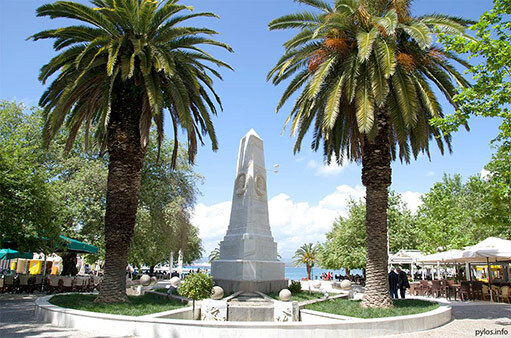
The plateia might have been created to order: a truncated triangle, touching the waterfront at its base, arcaded along the other two sides, with cafés and shops, and a lot of small tables and much-used chairs beneath plane trees, and some palms and a conifer, rising over a pavement of gleaming stone. A monument, an obelisk of white marble, was flanked by two cannons, supported on stone cradles. Children ran about; elders drank and smoked. There was no hotel on the square itself but I soon found one, perfectly situated, on a road that ramped up from the plateia, overlooking the town and the enormous bay.


Although never (rather oddly) named in the novel, this is clearly the plateia (Πλατεία) or main square of Pylos (Πύλου)
description

Teresa first visited the town on the death of her mother, and separation from her then husband, and is returning now 9 years later after the death of her father. Her account mixes her memories of her first visit, with her encounters with many of the same people - Petros, a mechanic, actually from the UK, John an Englishman there to avenge a death, Niko with who she has a brief love affair, and Xanthe a waitress, on this follow-up trip, their lives typically having moved on, although one gains a sense that hers hasn't.

On both trips, she writes an almost real-time commentary on her actions, and on her visit this time she re-reads her notes from the previous trip to reconfirm or deepen her memories:

The position of the restaurant, with tables at the water’s edge, determined the choice. The waiter enquired, ‘Just one?’ I heard an undertone of sympathy. ‘Oh yes,’ I told him, with a face that signified huge pleasure that this was so. I was aware of intermittent scrutiny. A single female diner, looking around, might be misconstrued as someone in need of company, so I took out the notebook and pen, to raise a modest barrier. It signified Do Not Disturb clearly enough, I would have thought, but it did not work. The man was intrigued, I wrote. ‘You are a writer?’ he asked, charmed – ‘Lord, no,’ I said, and left it at that, compounding the enigma. I made a note of the sunset’s colouring, I see. Water almost motionless, oil-like – a superfine oil – so many colours in the surface: violet, indigo, peach, brass, dark jade. The more one looks, the more there are. Not enough names for them.


Parts of the novel read rather like a version of a Deborah Levy or Rachel Cusk novel - and a rather lesser version I'd have to say.

Where it gets more intriguing is that Teresa's mother was a mathematician specialising in zero-one laws and topology: The first Borel-Cantelli lemma, the second Borel-Cantelli lemma, Kolmogorov's zero-one law, the Vietoris topology, the Hewitt-Savage zero-one law - I remember the words as though they were the names of magic tricks or fabulous cities.

The first Borel-Cantelli lemma essentially says that if E1, E2 are a sequence of events in some probability space, if the sum of the probabilities of the events {En} is finite, then the probability that infinitely many of them occur is 0. The classic example is random variables X(n) where X(n) is zero with probability 1/(n*n), then since the sum of 1/(n*n) for n=1 to infinity converges π*π/6, as proven by Euler to solve the Basel problem, which is finite, then with probability 1, via the lemma, only a finite number of the X(n) will be zero.

I must admit my maths is rather rustier on Vietoris topology but I asked ChatGPT how this might relate to Teresa's story:

In the Vietoris topology, we don’t just consider individual points (moments, people, places) but how clusters of these elements intersect and reappear over time.
• Teresa’s return to the Greek town mirrors the idea of convergence in Vietoris topology—her past and present experiences overlap, forming a new understanding of her grief and identity.
• The recurring characters (John, Petros, Niko, Xanthe) act like subsets in the topology of her life, their stories intersecting in unexpected ways. These connections, like neighborhoods in the Vietoris topology, determine how Teresa’s sense of self evolves.
• The novel’s structure—where past and present encounters echo each other—resembles how Vietoris topology considers both containment (the past enclosing the present) and intersection (the shared moments that bind people together).


As for zero-one theorems - like Borel-Cantelli, Kolmogorov and Hewitt-Savage - these generally are classes of problem where the probability of something tends either to zero or one, although in some complex cases it may not be clear which.

Which links to the somewhat unexpected coda to the novel when Teresa returns to her corporate role and normal life, and is going through a draft of a fictionalisation of the events she has just described with Patrick, I think a lover, himself an author of a rather intriguing sounding prize-longlisted novel about a professional cycling) with him giving feedback as to how the story could work better in novel form with some tweaks to the story and the characters:

Leaving aside any judgement as to the quality of the work, it would be a misstep to make a poet of the garage man. It would 'strain the characterization.

I appeal, on the grounds of veracity. 'That's what he is,' I object.

Reality is neither here nor there, Patrick insists. Verisimilitude is what counts.


A fascinatingly constructed novel, if not entirely successsful. 3.5 stars.
Profile Image for Sofia.
1,349 reviews295 followers
August 18, 2025
Without care, there is no connection....

One Boat tries to talk about a lot of things, there is grieving at the loss of a mother and a father, grieving at the loss of a marriage. Teresa has chosen a particular quiet village in Greece as her place designate to grieve and get herself together. She has come here nine years ago at the death of her mother and now once again at the death of her father. She goes around the village, thinking ‘thoughts’ and interacting with the village people, with Petros for philosophy of life, with Nikos for sex, with Xanthe for complicity, with John for some moral dilemma. Ah there are also dreams involved though I found it hard to distinguish these from the other moments.

I found One Boat to be rather fragmentary with Teresa all over the place and the writing following her. In fact, I think that Buckley plays around with the idea that all this is our life, true and valid. However, if he wants my attention while reading then let me confirm that I found it extremely hard to make heads or tails re what I was reading. As Patrick says in the book itself, I needed momentum, I needed a direction. Otherwise, I remain lost in the book and I’m already lost enough in my own life, my own thoughts, my own dreams and I did not have the reading impetus to care about Teresa.

An ARC gently provided by author/publisher via Netgalley.
Profile Image for Nat K.
522 reviews232 followers
September 20, 2025
***Longlisted for the Booker Prize 2025***

“...the view opened out and water appeared: a huge bay, with mountains beyond, on the horizon. Then I saw the town, and the words arose o in my head, as clearly as if they were being spoken: ‘This will be the place.’ “

A quiet coastal town off the tourist track. A place where café tables look out onto a courtyard, with the sea a stone's throw away.

”No English overheard in the course of a meander through the streets.”

The perfect place to grieve and reminisce. To put thoughts and memories in order. Perhaps to even make sense of a life which hadn't been questioned before.

Teresa has returned to the same Greek island nine years after having been there previously. She is grieving the loss of her father and the end of her marriage. This is also the place where she had earlier grieved the loss of her mother.

On both occasions she comes armed with notebooks in which she writes down snippets of conversations and observations. The same people still live in this little town who were there on her first visit. Also older, with the challenges life has thrown their way.

"Thoughts put themselves in order, or not."

Quietly contemplative, this is such a lyrically beautiful book for me. I loved the dreamlike quality of the writing. It reminded me so much of Deborah Levy's “August Blue”.

Book 3 of my Booker Prize longlist odyssey. My reviews for the longlist are completely of order, purely because life has gotten in the way. Fingers and toes crossed this makes the shortlist.

”A long life and a short life are the same, because the present is the only life we have - the same for everyone.”
Profile Image for Chris.
612 reviews183 followers
August 21, 2025
Buckley’s descriptions are beautiful but I’m afraid I didn’t get along with his philosophising and I had trouble connecting to the characters. The relationship between Teresa and the others felt off and I wondered why she was mourning in the Greek village at all, surrounded by people she hardly knows. Maybe I just didn’t get it.
Thank you Fitzcarraldo and Netgalley UK for the ARC, but I’m sad to say this wasn’t for me.
Profile Image for Dianne.
676 reviews1,225 followers
August 10, 2025
Nicely written, but the introspection factor was a little too close to navel-gazing for me. I found it tedious at times.
Profile Image for David.
744 reviews3 followers
September 19, 2025
In which case, the scrutinizer has to be scrutinized, too, if we're doing a comprehensive self-inspection. Which begs the question: who's scrutinizing the scrutinizer? And where do we find the scrutinizer of the scrutinizer of the scrutinizer? I halted there - the repetition was beginning to irritate...

Oh, I think this scrutinizer (David) of that scrutinizer (Jonathan Buckley) of that scrutinizer (the protagonist quoted above) began to get irritated much earlier. This short novel about a self-absorbed visitor to a Greek island, who writes self-consciously about her interactions and feelings, as she reminisces about writing self-consciously about her interactions and feelings during a visit nine years earlier, when she spent time reminiscing and writing self-consciously about her interactions and feelings, was a hall of mirrors I did not need to visit.

Often gorgeous at the sentence level but... to what aim?

2.5 stars
Profile Image for Kate O'Shea.
1,326 reviews193 followers
April 13, 2025
I confess that I struggled to get into this short novel. I liked the premise of the woman returning to a place she'd felt safe and encountering the same people but with, perhaps, different results.

The first time corporate lawyer, Teresa, goes to the town is after the death of her mother; The second following the death of her father. She meets the same inhabitants whose circumstances have all changed to some extent. She remains there for some weeks whilst writing an account of her time and experiences.

There really are no conclusions in the book. It felt more like a woman struggling with various philosophies for life but never coming to a conclusion. The most interesting part for me was her meeting with a man called John who was struggling to come to terms with the suicide of his sister. But again, this does not have a conclusion.

There were times when I thought it was beginning to flow, only for Teresa to get involved in a dream sequence or a philosophical discussion and I lost my way again.

Perhaps this book wasn't for me.

Thankyou to Netgalley and Fitzcarraldo for the advance review copy.
Profile Image for Puella Sole.
294 reviews166 followers
August 26, 2025
Čitanje ove knjige započela sam taman neposredno nakon ponovnog gledanja filma Before Midnight, što će reći da je opšta atmosfera – smještanje radnje u Grčku i insistiranje na razgovoru kao načinu iščitavanja prirode junaka i njihovih životnih strahova, utjeha i nadanja – u mojoj glavi napravila neraskidivu poveznicu između ova dva ostvarenja, iako se zapravo umnogome razlikuju.

Radnja je smještena u malo priobalno mjesto u Grčkoj, a mi pratimo junakinju koja se u istom mjestu našla ponovo, u razmaku od devet godina – oba puta nakon smrti roditelja. Oba puta obilježena su susretima sa prilično živopisnim mještanima – tu su instruktor ronjenja Niko, koji se u tom međuvremenu od devet godina oženio, zatim auto-mehaničar Petros, koji je napisao i zbirku poeziju – o kojoj drugi mještani, hm, imaju prilično ujednačeno mišljenje, Ksanta, konobarica u kafeu na trgu… Povratak istim junacima, na isto mjesto susreta – ali svakom od njih je tih devet godina životnog lutanja (naravno da junakinja čita Ilijadu i Odiseju, i to zanimljivim redoslijedom) donijelo i odnijelo nešto. Perspektiva će se sve vrijeme klackati između junakinjinog prvog i drugog susreta sa svima njima, ali akcenat neće biti na samim događajima, koliko zapravo na razgovorima koji se vode. Upravo ti narativni skokovi, koje zna biti teško pratiti s istom dozom budnosti i zainteresovanosti, kao da su u sukobu s ležernim prizvukom usputnih razgovora. O toj suprotstavljenoj prirodi onoga kako bi narativ trebalo da se izgradi i kako je to zaista i učinjeno čitalac će imati priliku da čita na zadnjim stranama romana.

Ipak, koliko god je ova knjiga imala sve preduslove za ono što volim da vidim u književnosti, ta istrzanost između prenaglašene kontemplativnosti i neopterećenosti svakodnevice ostavila je na mene ništa drugo do prilično maglovit utisak nefokusiranosti.
Profile Image for Joy D.
3,134 reviews330 followers
August 25, 2025
Protagonist Teresa returns to a coastal town in Greece after her father’s death, the same place she visited when grieving her mother nine years earlier. During her stays, Teresa encounters a cast of memorable characters: John, a British visitor intent on a personal vendetta; Petros, an eccentric mechanic who also writes poetry; Niko, a handsome diving instructor; and Xanthe, a waitress in one of the cafés. They talk about longings, regrets, and the passing of time. Teresa examines her life trajectory and ponders how tiny individual lives appear in the grand scheme of the universe.

The narrative combines the two timelines into one flowing storyline, interspersed with Teresa’s comments jotted into a notebook she carries with her. It is a contemplative artistic novel written in beautiful prose. It explores themes of grief, identity, and human existence. I felt immersed in the setting and appreciate how this type of remote peaceful town could serve as a refuge. There is a most unusual change of focus inserted into the final pages of this novel, which felt jarring, but otherwise it flows well. I enjoyed it as a meditation on memory, loss, and impermanence.
Profile Image for Claire.
1,220 reviews314 followers
September 18, 2025
I enjoyed this quiet, meditative novel which is more focused on philosophical observations about life and human relationships than it is any particular plot. Many comparisons have been made to Cusk and Levy, and I consider these valid although One Boat didn't reach quite those exquisite heights for me. One Boat is structurally sound, and beautifully written on a sentence level. I wasn't entirely sure I got everything that it was trying to do, but it was a lovely read.
Profile Image for Elaine.
964 reviews487 followers
September 1, 2025
Booker Book 10 of 13; 7 of 10 rating.

I loved the beginning of this book. Maybe because I've been a solo woman traveler returning to seaside towns after a period of years, with the friend at the cafe where you hang out all the day and the former dalliance and the waterside chats with townsfolk and hot hikes to the ruins above the town where you suddenly have epiphanies about the meaning of life! It's not that unusual a traveling tale I guess, but Buckley captured it well (and I bought our narrator as a woman, though I see some others didn't). And the doubling back in time worked for me too. And the introspective dialogues... to a point. And I enjoyed the metafictional ending too.

There's a dip towards the end where the ponderous musing as dialogues bog down. And the plot such as it is didn't quite fly for me. But all in all, I thought a well-crafted little book that captures that feeling so well of being the tourist who sticks around for longer than the expected night or two...
765 reviews95 followers
August 7, 2025
3,5

I read this because of its Booker long listing - as others have noted: for fans of Rachel Cusk.

It is about a British woman who travels to the Peloponnese on her own to contemplate the loss of her father and make time to think. She's visited the same little town 9 years earlier when her mother died, and she revisits that first stay based on the notebook she kept. She also looks for the people she met.

I suspect the Booker-judge rooting for Katie Kitamura picked this one as well. It is a similar little book in that it creates a suspenseful atmosphere not by a spectacular plot but by withholding important background information. Some of it is never revealed.

Buckley's work is more philosophical though, it explores big questions, and conversations are important to unpick them.

Somewhat unfortunately, I was more impressed by the accessible way the ideas were described than fascinated by the philosophical ideas themselves.

It was all quite enjoyable, but lost me a bit in the final chapters (except for the surprising final chapter!). Nice to have read it, but don't see this make the shortlist.
Profile Image for Mau (Maponto Lee).
411 reviews131 followers
August 31, 2025
Esta es una novela difícil de encasillar. A simple vista, parece una historia sobre una mujer, Teresa, que viaja a un pequeño pueblo de la costa griega tras la muerte de su padre. Allí, el ritmo lento del lugar, las conversaciones con los habitantes, los recuerdos de una visita anterior y el eco del duelo por su madre se entrelazan en un tapiz que mezcla lo cotidiano con lo existencial. Sin embargo, más que contar una trama definida o explorar en profundidad a sus personajes, Buckley utiliza todo ese escenario como un vehículo para desplegar reflexiones filosóficas: sobre la vida y la muerte, sobre lo que significa ser humano, sobre la naturaleza y la evolución, sobre el paso del tiempo y la fragilidad de la memoria.

Teresa es el hilo conductor, pero no necesariamente el centro emocional. Es un personaje más bien sobrio, introspectivo, que parece moverse en piloto automático entre recuerdos, charlas con lugareños y escritos personales. Su “viaje” no es tanto externo como interno: es un proceso de pensamiento, de digestión de ideas. Eso hace que, en momentos, uno la sienta más como un instrumento narrativo que como una persona viva. John, el hombre que conoció años atrás y que aún carga con la muerte violenta de su sobrino, aparece como contrapunto: representa la forma en que el dolor puede volverse una herida permanente, imposible de cerrar. Petros, el mecánico excéntrico, funciona más como una voz que bordea lo fantástico o lo anecdótico, alguien que aporta fragmentos de historias que uno nunca sabe si creer o no. Niko, el instructor de buceo, y Xanthe, la camarera, son figuras que encarnan la vitalidad, la sensualidad y lo mundano, pero también son vehículos para que Teresa dialogue sobre lo que significa estar vivo, desear, perder.

La novela se mueve más por motivos y símbolos que por giros narrativos. El mar es el más evidente: aparece como espacio de profundidad, de misterio, de peligro y de calma al mismo tiempo. Es un espejo del inconsciente, de lo que no se termina de entender pero se intuye. La repetición de escenas cotidianas (caminatas, conversaciones en cafés, observación de la fauna y la flora) refuerza la idea de que la vida no avanza en línea recta sino en espirales, repitiendo y transformando lo mismo. El duelo, en sus distintas formas, atraviesa todo: el de Teresa por sus padres, el de John por su sobrino, el de los otros personajes por oportunidades perdidas o amores que no avanzaron.

El estilo de Buckley es muy particular: escribe con una prosa sobria, lenta, y de pronto lanza frases que parecen aforismos o meditaciones filosóficas. No hay grandes clímax ni escenas de tensión dramática, sino una especie de oleaje constante, con picos de reflexión que sorprenden en medio de la calma. Por momentos la lectura resulta absorbente, porque uno se encuentra pensando en cuestiones que van mucho más allá de los personajes. Pero otras veces esa misma insistencia en lo reflexivo puede cansar, porque los personajes se sienten sacrificados en pos de la idea, y la narración corre el riesgo de volverse abstracta o demasiado distante.

Lo mejor del libro es la capacidad de Buckley para detenerse en lo aparentemente insignificante y convertirlo en materia de pensamiento. Un detalle natural, una frase casual en una conversación, una sensación mínima se expanden hasta tocar temas universales. Eso es un logro notable. Lo que menos convence es que, al darle tanto peso a esa dimensión filosófica, la novela se despoja de carne narrativa: los personajes no terminan de ser tridimensionales y, si uno busca una historia que lo atrape por emoción o intriga, probablemente se sienta frustrado.

No es una obra para quienes buscan una trama con giros claros o un arco de personajes potente. Contextualmente, se puede leer también como una exploración de nuestro tiempo, donde la incertidumbre sobre identidad, libre albedrío y el sentido de lo humano vuelve a estar en el centro de muchas discusiones culturales y filosóficas.

One Boat es una experiencia de lectura más que una historia. Tiene momentos brillantes y sugerentes, pero también pasajes que pueden sentirse densos o desconectados si uno esperaba una novela más tradicional. Es de esos libros que dejan una huella ambigua: no necesariamente lo disfrutas en todo momento, pero te deja pensando mucho después de haberlo terminado.
Profile Image for leah.
518 reviews3,380 followers
October 17, 2025
as soon as this was compared to rachel cusk’s outline it was curtains for me
Profile Image for Rick Bennett.
190 reviews7 followers
August 3, 2025
A quiet, wistful (at times philosophical) novel. Although I usually prefer books with a strong plot and a clear ending, I enjoyed this. Actually on balance it wasn’t that plotless and wasn’t anywhere near as obtuse as some other Booker longlisted books I’ve read in the past. The conversations between characters feel natural and well observed and the scenes often feel like separate little snapshots of life. Vignettes? Is that the right word?
I found myself relating to the main character Theresa much more than I expected. Just out of curiosity I’d be interested to hear if there’s a difference of opinion between male and female readers in this regard.
There’s a slightly surprising turn near the end - a bit clunky maybe? But overall, this was a very enjoyable and rewarding read.
Profile Image for Scott Baird (Gunpowder Fiction and Plot).
533 reviews181 followers
August 21, 2025
DNF @ 75 pages - I am so bored.

A man punches another man in the face, killing him. Our narrator (who is apparently called Theresa, but could have been called John or even Fido the dog for all they're created) meets the deceased uncle? (could be sister, lover, best friend, dog) and they discuss it. Producing the most boring and unimaginative philosophical conversation, completely removed from any sort of character emotion.

I believe this novel is set on a Greek Island, but I'm unsure, it could be South Africa, Sri Lanka or a boarding kennel.

Even the prose is ugly, with chains of dialogue sitting in the same paragraph without a line break, making the reading of a conversation confusing and difficult to tell who is speaking.

Terrible in so many ways.

Full Review Here - https://youtu.be/Nj00wbSgU9o?si=TgZAL...
Profile Image for Lou.
278 reviews21 followers
August 7, 2025
I really struggled to engage with this book. In fact that’s all I have to say about it.
Profile Image for cardulelia carduelis.
680 reviews39 followers
September 8, 2025
what the fuck. But in the mildest, most bored tones. In the most, indulgent and overwritten ways.

Initially I was intrigued by the impenetrable, winding, time-slip narrative that Buckley offers. There is the lusty mediterranean, the blue of sea and sky and potentially rekindled affairs.
But soon the obsfucation revealed itself to be a pretentious device, that there was nothing beneath it.

I'm actually really glad we have the story of Petros in here because it is a perfect metaphor for this book. Our narrator (who is very smart, independent, oh and super sexy and a laywer by the way but pretty in an unconventional way, not like other women) decides to revisit the Greek coastal town where she recovered from the loss of a parent, 10 years before - same reason, different parent. While there she decides to drop in on the characters she met during the last trip. Some she slept with, some she flirted with, some she just patronized (in all senses of the word). All of them are bewildered or mildly put out that she's back and bothering them.
Handsome, tour-boat owner Niko seems particularly concerned she's looking to start up where they left off because he's married now. Coffee shop owner Xanthe shares this news with some warnings and seems constantly perplexed that our narrator is back, that she hasn't moved on. And then there's Petros. Petros is the town grump. He's a mechanic and he has nice dogs, one of which prompted a a chat with our narrator the first time around. Since she was last in town, Petros hit his head and wrote a book of poetry. The poetry is widely regarded by the locals as simplistic nonsense. But our narrator sees something deeper. Simple isn't lacking in depth she cautions. Haiku's are world renowned, she lectures. She spends 10's of pages trying to convince the guy of the hidden depths of his own words, something he resolutely denies.
In this reading experience, I am Petros. Buckley is trying to convince me with narrative tricks and words that there is a deeper meaning here but there really isn't. It's all just pretentious nonsense. Our not-like-the-other-girls narrator is so convinced of her own importance that she derives meaning from the banal and takes us along for the ride with her journaling. Perhaps this is all an elaborate joke and Buckley just convinced to read 150 pages of satire.. but I fear not.

There was one part of the book, around page 60, where I thought the plot was getting started. We encountered a character with a very interesting reason for being in town. I still wonder if he and Petros's injury are connected - although I'm probably making meaning where there is none, hoping for a plot. But he just vanishes after that and we are wandering in the banal again. Let's say Petros and John do share that connection (you know what I'm talking about if you've read this) - why isn't that episode explored more? Why this clunky narrator?

When we spoke again, I made no mention of my research. Nothing significant would have been changed had I done so.
Nothing significant would have been changed if this book didn't exist at all.
This book irritated and bored me in equal measures, it was not fun to read. I had to really force myself not to skim. This sentence, I think, holds up a mirror to the readership that might enjoy it:
The narcissism of the process - the enhanced allure of the person who finds you alluring.
Did I completely miss the boat on this one? I guess I'll go read other reviews now and find out.


===== Booker Prize Longlist 2025 ======
It's been 9 years since I last read a booker longlist and decided I'd jump back in and see if it felt like a prize worth following again. Here's the reviews in the order I read them:
1) Love Forms by Claire Adam
2) The South by Tash Aw
3) Universality by Natasha Brown
4) Flashlight by Elizabeth Choi
5) One Boat by Jonathan Buckley
6) Audition by Katie Kitamura
7) The Rest of Our Lives by Ben Markovits
Profile Image for Елиана Личева.
316 reviews64 followers
August 15, 2025
One Boat
Джонатан Бъкли
Fitzcarraldo Editions
(няма български превод)

Първата прочетена от мен книга след обявяването на списъка може да се каже, че беше разочарование. Имам изключително love and hate отношение към книги, които са маркетирани като „тихи“, дълбоко насочени към вътрешния свят на героите и с по-кратък обем. В този случай, както често се случва, обемът има и няма значение. Тоест, както всичко може да се сведе до няколко реда поезия, така може да бъде обхванато и в богатството на дебели томове, като Одисей или други класики. Част от модерната минималистична проза ми пасва изключително много. Друга част, какъвто е случаят с One Boat, не ми пасна изобщо.

Краткостта на този роман ми се стори прекалено обикновена. Честно казано, на моменти звучеше повече като книга, написана с цел да бъде „разказ между две приятелки на по едно кафе“, темите за правото, вината и престъпленията за мен са доста повърхностно засегнати и сцените силно ми напомниха на "Чужденецът" от Камю, но в доста опростен вариант. Не виждам какво изтъква One Boat, за да бъде включена в този списък – особено в рамките на тези 170 страници. По един доста повърхностен и обикновен литературен начин опознахме сравнително комерсиална дама, което предполагам за някои е именно чарът на книгата, може би те ще открият себе си в героинята, в съжденията ѝ и в това нейно леко откъсване от ежедневието, което служи като ретроспективен поглед към себе си.

Но за мен, като читател, който подхожда към тази книга с очакването, че е част от литературни награди, това не беше достатъчно, очаквах нещо повече.
Profile Image for Alex.
817 reviews123 followers
September 2, 2025
ONE BOAT by Jonathan Buckley


**


Fitzcarraldo's first Booker Prize longlisted novel felt like an exciting choice, but unfortunately was a choice that fell flat. At times offering a flare of insight, the writing felt mostly soulless, too clinical to convey any emotional affectation.


A recently separated women returns to a Greek island she visited many years before, meeting up with characters she bonded before. They update her about their lives, reminisce about past conversations, ruminate about the future. It is unclear what the protagonist aims to get from this journey, besides material for a creative project of some sort, and her time ends anticlimactically, all persons largely unchanged or moved by her decision to recapture something she has lost or forgotten. 


When I began reading, there felt echoes of Rachel Cusk, but the verve was lacking. I was grasping at the text, trying to figure out what the author was getting at, getting nothing. And despite the protagonist being a woman, her perspective felt oddly male-coded, making me question Buckley's ability to write women characters. 


I left the novel feeling extremely non-plussed, wondering why this denied another book a spot on the longlist.


#bookerprize #bookstagramreadsthebooker #bookerprizelonglist #bookprizes #fiction #literaryfiction #books
Displaying 1 - 30 of 381 reviews

Can't find what you're looking for?

Get help and learn more about the design.