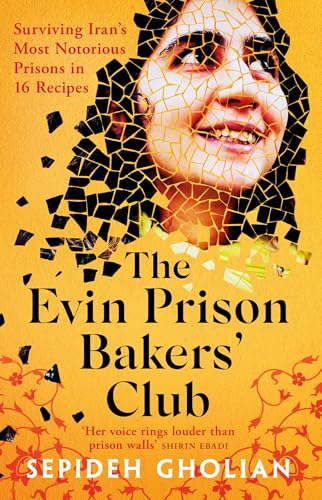
How do you cheer up a woman who has spent hours cleaning prison toilets with a broken mop? The secret is in a tres leches cake. In Iran’s prisons, women endure they are beaten, interrogated, and humiliated in a thousand ways. Even a whisper to a fellow inmate can be punished. Yet – in spite of anything and everything – they they bake. They console each other, cry together, dance together.
Sepideh Gholian, in prison since 2018, bakes scones for Nazanin Zaghari-Ratcliffe’s daughter, a pumpkin pie for Nobel Peace Prize winner Narges Mohammadi, madeleines for Marzieh Amiri, serving time for a May Day demonstration in 2019. The Evin Prison Bakers’ Club is a call to stand up for Woman, Life, Freedom by a woman still fighting for a free Iran.
This is a powerful book about finding hope and joy in the bleakest circumstances. Set in a women's prison in Iran, it portrays the horrible conditions the inmates have to live in, often without even committing a crime. These women have been jailed for protesting against the dictatorship and the regime, refusing to wear the compulsory hijab and basically anything the leadership considers a crime.
Amidst the torture they undergo at the hands of the guards and the attempts at forced confessions and having their children taken away from them in some cases, the women try to retain their sanity and sense of self that drove them to fight for independence in the first place. They do this by baking sweet treats that are specific to each of them, representing their most important qualities. Whether quick scones or oven free cookies or traditional Iranian desserts, the process of making these, singing songs and just spending time together lets them rise above their squalid circumstances and desperation.
I found it a very tough but inspirational read especially given the lack of an end date for the torture many of them are subjected to. That they can shore themselves and others by baking is such a wonderful idea to behold. It is a matter of survival but with such spirit that refuses to break down despite the worst kind of hardship.
The author has herself been incarcerated since 2018 so the voice is very authentic and the tale of how this book came about is quite interesting too. Throwing light upon a terrible reality and choosing to do it from this perspective is a very unique idea.
One of the most heart and gut wrenching books I read this year for my " Food in Indian literature" book club where we discuss food related books every month. This book is a first hand account of women interred in an Iranian prison for trivial and non existent crimes committed by them. they find camaraderie and support by baking /making Iranian Sweets together... this is a tale of hope against oppressive regimes across the world
This book is important and I recommend you get a copy.
That said, it's not a 'great' book and you should perhaps be aware of its limitations.
The book was created from writing that seems to have been smuggled out of Evin prison - Teheran's notorious incarceration centre - in multiple parts. The editor who has pulled it together admits it's not entirely clear which bits go together or in what order it was intended to be read.
A lot of the content is very coded - the writer is (as far as I'm aware) still alive and in prison and consequently, there are things that can't be published for her safety.
If you are very knowledgeable about Iran and the regime's punishment of those who disagree with it, you may well recognise the names of the women in this book. If you've a more casual aquaintance with the topic, you'll probably know just a few - and if you're British, you'll recognise Nazanine Zagari Ratcliffe and her daughter Gabriella. For others, the names will get confusing - but the 'crimes' they've been locked up for will still resonate.
I've long had an aversion to books that mix cooking and biography - but I was willing to make an exception for this one because the making of sweet treats is so integral to the story.
I was also very moved by the poetry - they are a very poetic bunch of women, for sure.
I was moved and confused in almost equal measures. I hope the author will eventually gain her freedom, move somewhere safer, and then blow the lid off what's really going on in Iran's prisons.
Had I not read a half dozen books set in/around Afghanistan & India prisons I don't think I would have been able to get through this book of essays. But because I have I could picture these women, living out sentences that are not earned, in conditions inhumane, but still with a drive to find joy in the relationships they are building with one another despite their realities. I especially enjoyed the parts where they've added steps for dancing, and singing, or listening to a specific song into the recipe instructions.
The Evin Prison Baker’s Club by Sepideh Gholian is a powerful memoir of a political prisoner that reminds us hope and joy can exist even in the darkest of places, sometimes through something as simple and comforting as baking.
Sepideh shares her harrowing experience inside brutal and notorious prison system, where she was held, transferred, and subjected to severe mistreatment. Amidst the hardship, she found moments of resistance and connection through baking for fellow inmates. Each recipe she shares is more than just a dessert, it carries emotional and cultural meaning, offering comfort in a place designed to break spirits.
This memoir is a uniquely beautiful and brave way to tell her story, blending activism with humanity. It’s also a call to stand in solidarity with the women who continue to fight for freedom. Sepideh’s courage during strikes and protests for economic and social justice is deeply inspiring. Her recognition as one of the most influential voices of our time is truly well deserved.
I read The Evin Prison Bakers’ Club as part of the ShelterBox Book Club, and although I’d followed recent events in Iran on the news, I hadn’t grasped the full extent of the abuse faced by women there, particularly within the prison system. This book was an eye‑opener. At times it made for incredibly difficult reading, but it felt like necessary reading too. The experiences of these women, their courage and their endurance, will stay with me long after closing the final page.
Threaded through the narrative are the recipes the women baked for one another during some of their darkest moments in Evin Prison. These small acts of care provided fleeting glimpses of joy and humanity for these women. Because of this, the book will appeal not only to readers wanting to understand more about the atrocities committed against women in Iran, but also to those who enjoy and find comfort in cooking and baking.
This is a book that I won't forget. I joined the Shelterbox book club were they post to you monthly. I glad that is one of these books as its an emotive read , beautifully translated and filled with the horrors of being imprisoned as a woman in Iran. The inclusion of each recipe for each woman is such a lovely inclusion making it more personable a read and makes you feel more connected to each woman. It's an inspirational read about strong women , not afraid to challenge for their beliefs. I also liked the poetry that was slipped into certain chapters- it added so much to this book!
I have an immensely huge sweet tooth. Rasgullas, tres leches, jalebi with rabri, strawberry tarts, anything sugary sends me calling heaven. And yet, this book brought me face to face with the actual sweetness of life: freedom.
Sepideh Gholian, the author, is currently imprisoned in Evin Prison, Tehran’s most notorious facility where truth-speakers are punished. Political prisoners, student leaders, activists, journalists, women who dared to exist too loudly, they all disappear behind its cold, iron gates. Through this book, Sepideh introduces us to the women she met inside, her cellmates and comrades, each reduced by the state, yet clinging to dignity, identity, and hope. And to each of them, she dedicates a dessert. Sixteen recipes. Sixteen women. Sixteen unspeakable losses. One is imprisoned for her husband’s alleged involvement in terrorism. Another is forced to self-abort in a dark, filthy bathroom just to save her mother and sister from “honour killing.” As you read on, what starts as recipes for tres leches or scones becomes a shrine. These are no longer desserts. They are memorials. Sugar and butter laced with grief.
The book is hauntingly surreal. The author's words carry defiance like oxygen, even as she recounts systematic torture, public humiliation, and psychological warfare. In a place designed to erase people, baking becomes a language of protest. Of memory. Of love. And here’s the most astounding part: Sepideh sent this book to the outside world in scraps - texts, photographs, pieces smuggled through layers of surveillance. Page by page, she defied a regime that thrives on silence. This is not just a memoir or a cookbook. It is a rebellion in prose, bound by recipes. Read it if you care about women. Read it if you care about freedom. And read it especially if you still believe desserts are just sweet.
A remarkable book that should be mandatorily read by everyone. Enduring inhuman violence, torture and humiliation in the prisons of Iran, women who have been imprisoned on mostly unfounded grounds/without evidence come together and find community and empathy—both forbidden sins in these prisons—in food and baking. So heartbreaking to read that this horrific reality coexists in our world and no international institution has the courage to intervene and protect the women of Iran, who have been fighting relentlessly for decades for their freedom from oppression.
3.5* As a person living in a free and liberal country, this short book is an eye-opener on so many levels. Do not take freedom for granted. A remarkable book, especially how it came to be available in the free world!
A truly relevant story told through the eyes of a woman fighting for her rights and the rights of all other women from within the walls of a prison (at the time of writing). 16 recipes serve as pillars and make for a unique narrative device. I struggled to keep up with the writing style, but slow, deliberate attention is what this story deserves.
a unique memoir combined with recipes giving a first-hand account of the conditions and treatment of her fellow prisoners and activists in Evin women's prison in Iran with a recipe dedicated to each of them. very powerful.
I felt I had to give this book 5 stars based on the content and the hardship the author has been through. I found it an easy read in terms of the style and read the last 2/3s in one sitting. However, it is definitely not easy to read about the abuse and treatment of all these women. I did like the inclusion of the recipes throughout - I want to try them all! And the little asides about letting your hair down and dancing provided some light relief. Read through Shelterbox Book Club.
In the depths of one of Iran’s most notorious political incarcerations, Evin Prison, a group of women discover ingenuity amid cruelty through the art of baking. Sepideh Gholian’s "The Evin Prison Bakers’ Club" is a literary work that demonstrates the boundless power of resolve spooned alongside creativity, sisterhood, and simple acts that blossom into rebellion.
The book serves as a monument articulating the simmering fury and power of baked goods alongside unshakeable determination. Inhaled during dispersed break intervals across cell blocks, daily baked goods drip in both defiance and humanity’s fragility. Food shape memories and through each weary bite, these women lap up soldier-like dignity.
“The Evin Prison Bakers’ Club” is an evocative account that captures the stories of women in the prisons of Iran and their immense courage and fortitude. This book stands out because of the mixture of recipes and stories. Readers across the globe shall be able to relate to its themes of hope, resistance, survival, and many more.Every recipe in this book holds the weight of survival.
The Evin Prison Bakers’ Club is one of the shortest and most heartbreaking things I’ve ever read. It’s the kind of book you finish in a single sitting and then carry with you for days, unsure how to return to your own life unchanged.
Reading it from America, and more specifically from the safety of my own small, comfortable bubble, was quietly disorienting. We become so consumed by minor inconveniences, by the small frictions of daily life, that we forget how radically different the stakes are elsewhere. This book doesn’t let you forget. It doesn’t shout or sensationalize; it simply tells the truth, and that truth is devastating.
What struck me most was the humanity threaded through unimaginable confinement. In a place designed to erase individuality and hope, something as simple as baking becomes an act of resistance, of dignity, of survival. The tenderness of these moments makes the surrounding cruelty even harder to bear.
This isn’t a book you “enjoy” in the traditional sense. It tears you apart quietly, deliberately, and without apology. But it feels necessary. It widens your perspective, humbles you, and reminds you how fragile and precious freedom truly is.
I don’t know how anyone reads this and walks away unchanged.
The book recounts experiences of prisoners in Evin Prison in Iran. It is one of the country’s most notorious detention centres for activists and dissidents. The author was arrested in 2018 for supporting striking workers and speaking out against the Iranian government. Inside prison she encounters women from many backgrounds: activists, journalists, mothers, scientists, and ordinary prisoners. The memoir tells their stories of interrogation, humiliation, and endurance under a harsh prison system. One prisoner held in solitary confinement for 412 days before being handed a 10-year sentence describes as having a strict daily routine of “twenty-one and a half hours of reading books, one hour of sleep, fifty-five minutes of asking to be executed, half an hour of calisthenics and five minutes of cooking and baking”.
Each short chapter focuses on one woman prisoner or a particular moment in prison life, and ends with a recipe for cake, biscuits etc. I am not sure whether the recipes have actually been baked or whether they are just a memory of their past life and a hope for the future and normality. It’s a remarkable and deeply affecting book, definitely not an easy or comfortable read. The memoir is harrowing, and at times heartbreaking, yet the author’s purpose is unmistakably clear. As a journalist and political prisoner, she bears witness and brings to light the injustice experienced by thousands living under a repressive regime.
Structurally the book can feel slightly disjointed and disorienting, but you understand why when you find out the book’s editing process from fragments that have been smuggled from prison and the editor’s job not easy trying to piece them together. As you read on, the narrative feels more intentional moving between personal stories and reflections and the recipes act as records of memory and solidarity amongst the women. Their voice, their stories and dignity are preserved and not erased.
What gives the book its extraordinary power is the knowledge that its author is still incarcerated and that these experiences are not just history but part of an ongoing reality for thousands. Nazanin Zaghari-Ratcliffe is mentioned an Iranian-British citizen, who was detained in Iran from 2016 to 2022 on charges of insurrection and propaganda activities was released in 2022, but many are still there. In January 2025 a British couple motorcycling through Iran were detained on espionage charges and have been sentenced to 10 years in prison.
This is an important book that deserves a wide audience.
This is a curious book, not really a memoir, more a prose poem, a hymn to the resilience of women in the toughest situations. Assembled from fragments smuggled out of Evin Prison, it intersperses the gruesome episodes with the recipes for cream puffs, madeleines and similar baked goods. It isn’t always very clear.
It has impact because of the accounts of torture and interrogation of individual women, the shadow characters in a shadow play, whose real life details are mostly given in footnotes, but whose resilience and at times exuberance overflows, including in the cooking.
The protagonist is suffused with guilt because she has managed to secretly abort her child, a grim episode. Even grimmer is her certainty that she, her mother and sister would be subject to “honour” killing, if her pregnancy were ever discovered.
The conditions in Evin prison itself sound fairly relaxed, with some at least sleeping in a dorm, not cells, and access to a library, tv, permission to put on a play, and of course, a kitchen for the baking. The downside is CCTV everywhere including the loos, and endless interrogations . The other prisons mentioned sound far worse.
The book is short, in a large font. It is a quick read, unless you stop to ponder why women are so widely suppressed in so many cultures. I’d recommend it , but not as a bedtime read. For interest, it’s a five star, but it’s not comfortable reading and hard to follow., so just 4*.
I had this from the Shelterbox book group, a UK disaster relief charity.
Sepidah Gholian’s unusual memoir combines vignettes of fellow prisoners, letters, poems, songs, and, of course, recipes. It’s almost magic realism with the author describing a friend as an elephant, a mermaid, and a moving island. This unique approach marginally mitigates the horrific treatment of all the prisoners. I found the fact they’re given free rein in a kitchen astonishing, adding to the feeling of unreality.
I’m sure I would have valued this more had I better knowledge of Iranian history, culture, and language. I feel like this book deserves a 5 rating, but I didn’t appreciate it properly due to my ignorance. Because of my difficulty I gave it a 4.5, unfair to the book, I know.
As an update on the prison, I learned that it was bombed by Israel in June, 2025, less than two weeks after the author was released. The administration area and the hospital wing were targeted and many prisoners and employees were killed. By now, September 2025, the author has probably been imprisoned again.
Whenever I heard about memoirs I always find myself to inclined towards them. This happened when I heard about The Evin Prison Bakers' Club.
This book is a story of hope, rebellion and also make us believe that hope can be part of our lives even if we are going through the darkest times of our lives. Baking is not just making cookies, cakes, but this is a sign of Rebellion. How baking can act as a medium wherein prisoners can come together. Each recipy of the dessert does not only limit to the dessert but also a testament to shared, love, culture and affection towards the inmates.
This book is a unique portrayal in the way of memoir wherein the Sepideh story has been shared that how she has faced all injustice and still raised her voice.
This book is not just a memoir but a portrayal of hope against fear, support during odd circumstances. Also, a mirror about women of Iran and their solidarity.
Vital and acutely topical reading, this provides valuable testimony of the lives of some of the women who have been thrown in prison in Iran for made up crimes, by the totalitarian regime. It is often a harrowing read as the author, a several time inmate of the prison recounts the dramas and battles to survive. The danger and fear of finding oneself pregnant is illuminated ever so starkly as women are pushed to make horrible choices out of fear of the consequences.
I followed this up with the BBC documenary Prisoner 951 on Nazanin Ratcliffe's 6 year ordeal, much of which was also in this prison, and that complements this book very well for illuminating the way women are completely at the mercy of state authorities.
The interspersing of prose with the recipes can feel disjointed at times, but in reflecting inmate's grasping for a connection to their outside world, to the life with family and friends before imprisonment, to retain their sense of who they are, it is effective.
Devoured in three hours on a rather drizzly Sunday for this months Shelterbox Bookclub read. Sepideh introduces us to the political activists inside Evin Prison, the hauntingly real torture they experience and desserts laced with cinnamon, syrups and nuts, dedicated to the brave women.
Storytelling in many cultures began in kitchens, where recipes themselves are not merely ingredient and instruction. One dedication, Maryams Apple Pie, of which a key ingredient; "If you've got long hair, let it down". Others include dance and daffodils.
The cadence of Sepideh's storytelling provides a glimpse into the beauty of Persian language, which seems sweet and poetic like the recipes, yet at juxtaposition to the very real torture and torment. I did find it initially tricky to understand the layout of the storytelling, but given the context in which the memoir was pieced together, I'd recommend pushing through any initial discomfort, to hear Sepidehs story.
Disturbing, powerful, resilient. Graphic descriptions of torture and violence, against the backdrop of innocently baking cakes and cookies. A testament to female friendship and perseverance through insane hardships, and how women seek comfort and community despite adversity.
That said, the way it is delivered is very disjointed and lacks the flow of the typical memoirs I read. There was a LOT of information to take in, as the 16 recipes were dedicated to fellow prisoners. This was not a personal, anecodatal memoir about Sepideh's life. The ending felt very rushed and lacked the impact the rest of the book was having. If this had been longer I feel I would have been able to rate more highly.