Jump to ratings and reviews
Rate this book

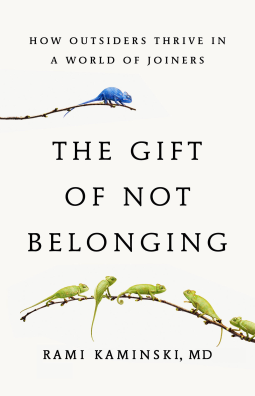
The Gift of Not Belonging: How Outsiders Thrive in a World of Joiners

Rate this book
The first book to explore the distinct personality style of the otrovert — someone who lacks the communal impulse and does not fit in with any social group, regardless of its members — and to reveal all the advantages of being an otrovert and how otroverts contribute to the world.

If you were the kid who never wanted to go to summer camp, if you prefer spending time with friends one- on-one than going to parties, if you would rather forgo your vacation than travel with a tour group, and if you often engage in acts of silent rebellion against group norms and traditions, you are very likely an otrovert.

Dr Kaminski has been studying this personality style for over 30 years. He explains that, while otroverts enjoy deep and fulfilling one-on-one relationships, within groups they feel alienated, uncomfortable, and alone. Unlike introverts, who crave solitude and are easily drained by social interactions, otroverts can be quite gregarious and rarely tire from one-on-one socialising. And unlike loners, or people who have been marginalised based on their identity, otroverts are socially embraced and often popular — yet are unable to conform with what the group collectively thinks or cares about.

And therein lie the great gifts of being an otrovert. When you have no affinity for any particular group, your sense of self-worth is not conditioned on the group’s approval. And, best of all, you know no other way to think other than to think for yourself. The Gift of Not Belonging urges otroverts to embrace their unique gifts, and equips them with the knowledge and tools to thrive in a communal world.

240 pages, Hardcover

First published June 17, 2025

500 people are currently reading
6182 people want to read

About the author

Rami Kaminski

3 books26 followers

Ratings & Reviews

What do you think?
Rate this book

Friends & Following

Create a free account to discover what your friends think of this book!

Community Reviews

5 stars
233 (26%)
4 stars
251 (28%)
3 stars
260 (29%)
2 stars
81 (9%)
1 star
46 (5%)
Displaying 1 - 30 of 133 reviews
Profile Image for Apple.
20 reviews
August 17, 2025
This is a weirdly self-serving book and I wouldn’t recommend it. The author presents a new personality profile—the otrovert—but provides only his own anecdotal evidence to support his claims. He talks up all the positive attributes of otroverts (of which he is one) while simultaneously insulting everyone else. He is especially critical of individuals who prefer socializing over solitude (extroverts) and takes a dim and inaccurate view of introverts (meek). He dismisses neurodivergence as a possible explanation for otroversion by limiting his discussion of autism and ADHD to the narrow DSM definitions. The personalities he describes (including his own) seem easily explained by some combo of introversion and neurodivergence. I think there is an interesting and important discussion to be had about the gifts of not belonging, and I appreciated many of his insights, but the overall premise of this book lacks credibility. (Also, I pulled my old copy of Quiet off the shelf to double check that I remembered it correctly. Susan Cain’s book on introversion is heavily researched and very worth reading.)
Profile Image for Chris Boutté.
Author 8 books289 followers
August 4, 2025
I can’t remember the time I binged a book this fast. Granted, it’s a short read, but I felt seen by this book. Rami Kaminski is a psychiatrist with 40+ years of experience, and writes about “otroverts”. Typically, I get annoyed when authors try to come up with their own terms, but this one made sense. It’s about people who feel like outsiders and who view and interact with the world differently.

I’ve recently been thinking about re-reading Quiet, the famous book about introverts, but I connected with this book even more. In the summary it says, “Unlike introverts, they are not shy or quiet, and do not quickly tire from one-on-one socializing. Yet in large groups they feel uncomfortable, alienated, and alone.”

I usually see books like this and am like, “Oh great. Another book trying to make people feel like special little snowflakes who nobody understands,” but hey, I guess I’m that special snowflake in this case lol. This book felt like Kaminski was documenting my life and inner world. He helped me understand why I’m not a fan of socializing, but I can do it when necessary. With the stories of his many patients, I realized I’m not the only one who feels this way either.

This book helped me feel less bad for regularly avoiding social situations and seeing the world differently. He explains how otroverts don’t really follow social norms, and just kind of do their own thing. Not because they’re trying to rebel, but just because we understand why the norms are there but think some of them are a bit silly. Unfortunately, many people aren’t fans of this.

I will say, I might be extremely bias because I connected with this book so much. At certain points, I was thinking, “Is this how people feel when they read about their astrological signs or take the Myers-Briggs test?” But whatever, I just embraced it.

In my opinion, if you can connect with a book like this and it makes you feel less alone, and it doesn’t hurt anyone, lean into it. That’s exactly what this book did for me. Now, I’m trying to get my fiancee to read it since we both fall into this ontrovert camp. I’m definitely going to re-read it any time I’m feeling like a weirdo.

Oh, one last thing. As he describes otroverts, I kept thinking, “Oh great. People are going to use this as a way to self-diagnose themselves as autistic,” but the author does an excellent job explaining that this is not autism. I think most of the people who think they’re autistic would read this book and realize what’s actually going on rather than trying to slap a label on that isn’t suited for them.
Profile Image for Jannik.
4 reviews
August 30, 2025
This book is a confused, self-congratulatory mess that never delivers on its central idea. When you begin by bungling the definitions of introversion and extroversion completely before introducing your half-formed concept of a third category, you're off to a bad start... And what follows is an incoherent attempt to elevate this idea into a movement, while refusing to allow for any nuance. It's very binary. Either you are otrovert, or... well, you're pretty much just laden with any kind of negative character trait you could think of. The book goes through a lot of them for all of the different non-otroverts. All the while otroverts are portrayed as the unsung heroes and weridly defined down to the most miniscule and random details, such as not enjoying playing soccer.

The writing leans heavily on self-promotion. At one point, under the guise of “independent, original thinking,” the author proudly declares himself not just good but excellent at what he does. And yet, he refuses to use any sort of scientific methods to underpin his ideas. He relies solely on anecdotal experience, subjective perception and a healthy dose of hybris regarding his own character to lay out his theory in the form of universal facts. And so, the substance never matches the swagger. The book is littered with random claims presented one after the other —“Introverts are shy,” “People with ADHD are fundamentally communal,” or the absurd suggestion that “otroverts do not display any of these cognitive particularities” (speaking of neurodivergence) — with no citations or evidence and no respect for the fact that people are many things at the same time and being an "otrovert" surely can not make you immune any kind of neurological condition...?

The tone often veers into the downright dumb, such as describing how “for communal people, a flag is imbued with special value … but for the otrovert it is merely a piece of cloth.” Passages like this reduce complex human experiences to caricatures, seemingly only to highlight the supposed superiority of the “almighty otrovert.” Often times, it seems the book is trying to pander to a post-pandemic generation of isolated readers looking to rebrand their solitude as uniqueness, rather than confronting the reality of them having willfully withdrawn into online comfort zones.

To its slight credit, the book does accidentally land on some generic life advice—“live your life the way you want, not anyone else’s”— but that could apply to anyone, not just self-styled “otroverts.” And this thin sliver of superficial and trivial usefulness is buried beneath pages of pseudo-facts, shallow thinking, and a fundamental misunderstanding of the very concepts it tries to redefine.
Profile Image for Cat.
37 reviews44 followers
Read
June 17, 2025
I received a review copy from the publisher but will be holding my review because of the following : my copy is missing a bibliography and there is no evidence beyond the anecdotal that would back up the author’s claims. I was also unable to find recent scholarship published by the author on the subject, which would be the norm when positing a new theory in psychology. This information combined with a recent ethics accusation, which may or may not be accurate, is concerning. I will post my review once I have additional information regarding the book’s contents and the author’s ethos,
Profile Image for Emily St. Amant.
529 reviews34 followers
Did Not Finish
August 29, 2025
DNF. Don’t recommend. The author believes he has discovered a new personality type based mostly on his own experience. What he describes is easily explained by a number of other well-researched and established theories- I can think of introversion, neurodivergence, personality disorders (or subclinical symptoms of those), and attachment issues off the top of my head. Additionally, I’ve learned as a both a therapist and middle-aged person, that feeling “different” is actually incredibly common. We live in a very superficial culture that leaves many - if not most- feeling emotionally disconnected from others, even if nothing is “wrong.” This lack of vulnerability required for true connection has left so many people feeling alone in a crowd. I don’t know how this book got green-lit, but clearly no experienced mental health professionals vetted this. And by experienced, I mean therapists that don’t just work with rich and famous people.
Profile Image for Ishie Sancho.
88 reviews
September 5, 2025
I'm honestly not sure how to feel about this book.

On the one hand, it tells me everything about myself that I want to hear. There's nothing wrong with me; I'm not neurodivergent or introverted or socially flawed; I just reject groupthink and group dynamics and am super special and awesome for it.

Problem being, it tells me everything about myself that I want to hear, and it rings a bit false, while simultaneously discarding the vast majority of the population as communal sheep whereas we, the otroverts, are above all of that.

My reluctance to group affiliation and skepticism of politics and organized religion could be a result of a "special otrovert mind", or it could be the result of ADHD, extensive bullying, and an unstable home life with a lot of moving around that caused me to not really fit in anywhere, thus intrinsically skeptical of "groups" since I've never had the opportunity to belong to one.

So I don't know. It was a fast read. It also seems somewhat suspicious that the author not only identifies himself as an otrovert, but has an institution for otroverts with quizzes that will pretty much identify anyone as an otrovert, which seems a profit motivated way to tap into a society that increasingly lacks a sense of belonging.

I'm also a physician. So an entire book written by a psychiatrist that lacks references, peer review, and relies entirely on anecdotes and vibe checks seems... unscientific, to say the least.

OTOH, the book was a gift from someone who was like "Here. This is you." So maybe he's onto something.
Profile Image for jeremy.
1,212 reviews319 followers
June 1, 2025
in the gift of not belonging: how outsiders thrive in a world of joiners, rami kaminski, psychiatrist and founder of the otherness institute, offers an intriguing introduction and overview of the otrovert personality. coined by kaminski himself, an otrovert (from the spanish otro meaning ‘other’) “embodies the personality trait of non-belonging: remaining an eternal outsider in a communal world. unlike those with relational disorders, otroverts are empathetic and friendly, yet struggle to truly belong in social groups, despite no apparent behavioral distinctions from well-adjusted individuals.”

self-identifying as otroverted, kaminski’s fascinating pop-psy book uses case studies of his own patients as well as his own research to proffer a new personality type distinctive from the more well-known introvert and extrovert (this is definitely not a melding of the two). otroversion is characterized by a lack of communal impulse, a sense of (and preference for) being an observer as opposed to a participant, non-conformity, and independent, original thinking (eschewing hive mind groupthink), among other qualities. with examples from his clinical work spanning decades, kaminski makes a convincing and thoughtful case. engagingly written, the gift of not belonging seeks to teach about the otrovert personality, with emphasis on what makes them different, while looking across the course of a life spanning childhood, adolescence, romance, work, old age, and death.
Profile Image for Renato.
496 reviews7 followers
August 4, 2025
QUICK NOTE TO READERS: The appendix comes with an "Are you an otrovert?" style quiz. I would suggest doing the quiz before reading deep into this one and then circle back after you have completed the book to make sure there is no recency bias in the quiz results. (I had completed about 40% of the book at the time and, despite my best attempts to not be influenced by the content, I scored a 236/280 and this will never know if that score is accurate. You have been warned!


I came to this title with great apprehension, because the desire to be dropped into a category to give your life more context is always great, but there are always snakeoil salesmen along the road to self-actualization that are not based on actual science (I AM CALLING YOU OUT, BRIGGS-MEYER).

Otrovert
[noun, adjective ot-truh-vert; verb ot-truh-vert] An "otrovert" embodies the personality trait of non-belonging: remaining an eternal outsider in a communal world. Unlike those with relational disorders, otroverts are empathetic and friendly, yet struggle to truly belong in social groups, despite no apparent behavioral distinctions from well-adjusted individuals.

There are 2 points of contention that I am slamming my head against preventing to allow me to accept this designation:
a) While the author is a practicing doctor, the concept is derived from his patient files. Much like Sigmund Freud (whose theory of psychoanalysis was based on wealthy Austrian female patients, and ignored certain aspects of their medical history), his current data is shallow and anecdotal. Also, the designation of otrovert is also something that he applies to himself. I would welcome being convinced otherwise when I see this idea successfully jump through the hoops of scientific rigour.
b) His definition of otrovertism carves into the introvert/extrovert dynamic, and I feel that some of his terms are redefined solely to serve his argument. I am a dyed-in-the-wool introvert and some of his termsfor this book (i.e. that both introverts and extroverts are actually both communial) make no sense to me. Of course, I could actually be an otrovert and have mislabelled myself incorrecty. I am open to this idea, but please see point A

That said, and I am being 100% genuine here, I have never felt more seen than I do in this discussions in this book. If an otrovert is actually a thing, then I am definitely it.

If I see more science (or footnotes and a bibliography from Kaminski's work), I would gladly revisit my review here.

147 reviews5 followers
September 9, 2025
One sentence review: A catchy idea, but without scientific grounding the otrovert feels more like a flattering horoscope than a real personality type.

Longer version:
This book introduces a new personality type, the otrovert—an independent thinker who resists group norms, may be socially skilled and even popular, yet doesn’t draw energy from social interactions. It’s a description that will appeal to anyone who has ever felt like an outsider. And that’s exactly the problem: the book relies heavily on the Forer effect, offering traits vague and flattering enough to apply to almost anyone.

As the book progresses, Kaminski ascribes more and more qualities to the otrovert: how they think, behave at work, and approach relationships. In his telling, the otrovert becomes a kind of mythical figure—and unsurprisingly, the author identifies as one himself.

What bothers me most is that Kaminski’s authority rests on anecdotes and self-study, not scientific research. Unlike established models such as the Big Five, which see traits as continua, he presents the otrovert as a rigid and highly detailed category. Some readers may embrace the label and love the book, (much like Thomas Erikson’s color-coded personality types). I closed it disappointed by how unscientific it turned out to be.
Profile Image for Nursebookie.
2,938 reviews470 followers
July 7, 2025
TITLE: THE GIFT OF NOT BELONGING
AUTHOR: Rami Kaminski
PUB DATE: 06.17.2025

Have you ever felt like an outsider, even when you're surrounded by people?

You’re not alone! Dr. Rami Kaminski’s eye-opening book The Gift of Not Belonging introduces us to the concept of the otrovert—someone who doesn’t quite fit into any group, not because they’re shy or introverted, but because they simply don’t feel a sense of belonging, no matter how popular or socially connected they are.

Unlike introverts, who seek solitude to recharge, and extroverts, who thrive in large groups, otroverts often feel most at peace when they’re alone or in small, intimate settings. But here’s the twist: not belonging is actually a hidden strength. Kaminski reveals how embracing this unique perspective can lead to a rich, fulfilling life. Rather than trying to fit in or follow societal norms, you can learn to trust your own instincts and build deep, meaningful connections on your terms.

In a world that constantly pushes us to be part of a group, it’s easy to feel disconnected when you don’t “belong.” But Kaminski argues that the lack of fitting in can actually give you the freedom to create your own identity and live authentically. It’s a powerful reminder that not belonging isn’t a weakness—it’s a gift.
Profile Image for Lily.
79 reviews2 followers
August 3, 2025
I found the book very relatable, impactful, and thought-provoking. I find the tone off-putting, and that second impression is reinforced by how much the author is personally highlighted in the promotional materials. To some extent this is normal for book promotion, but viscerally, he reminds me too much of charismatically abusive community leaders. I realize that sounds very specific, but - it's a vibe.

So, I don't quite know where that leaves me. I'm interested in other people's takes on the book, and if there are any other sources.
... oh yeah, the fact that there are absolutely no citations is bad. Actually I'm editing my rating down just for that. Thought provoking, but on shaky factual ground.
Profile Image for Cindy.
181 reviews65 followers
July 7, 2025
This author defines a new personality type to add to the extrovert/introvert dichotomy, the otrovert, which is basically a person who doesn't feel like they belong to any group. I understand the distinction, I don't think it's trivial. However, I feel like the book is hurt by the author also identifying as an otrovert. In many cases, it's hard to tell if some of the characteristics he defines are a characteristic of him or a characteristic of every otrovert. For instance, he mentions that otroverts have emotional self sufficiency because they don't rely on group validation. However, in my opinion, that doesn't mean they don't rely on validation from an individual, especially an individual whose ideas they respect and find valid. I also don't think otroversion is necessarily the default in the sense that if you leave a person to naturally mature in the world, they will become an otrovert. I think it's likely that something happens in life that would drive a person to become an otrovert, maybe minor trauma related to fitting in (nothing drastic like severe bullying), having a parent who is resistant to exposing the child to new experiences, growing up isolated from other children, etc. One part I found interesting was the section on empathy. The author talks about how many feel empathy by assuming that others are like them and going from there (I would have done X if I was in this situation), but the otrovert starts at the internal state of the individual, which makes them less judgmental.
Profile Image for Ari Chand.
102 reviews33 followers
October 27, 2025
This book is a welcome and provocative new addition to extend the longstanding (extrovert – introvert) binary. I sent the new disclaimer to several friends who would resonate it. I have never felt a strong communal drive and resonated quite strongly with the sentiments of this book describing the new classification as the ‘observer’ who needs little reassurance on their own unique value systems and strong attachment to autonomy of the self, self-discovery, fluidly gregarious and social within comfortable and deeply connected relationship.

Otroverts, he describes, are self-reflexive and highly socially adept yet emotionally detached from groups, capable of deep empathy without needing tribal identification or belonging. Much like other popularly oriented psychology book’s the narrative moves fluidly between personal narrative, patient notes, broader cultural reflection alongside visual symbolism and reflection. The through line of his argument is quite simple and clear, those who do not fit neatly into groups are not broken, they are just wired differently for meaning.

From a creative who always seems to have seen the world sideways and as interconnected complexity his words can feel like long awaited validation. For readers engaged in the restlessness of creative practice like artists, writers, musicians and thinkers who value separateness and often live in the margins between belonging and estrangement to translate their sense of distance into aesthetic insight. Kaminski gives that state of being a new vocabulary.
Profile Image for Anita.
354 reviews36 followers
October 3, 2025
finally, a group I can belong to!
Profile Image for Yvonne.
203 reviews
August 30, 2025
In the great social dialogue about who is an Extrovert and who is an Introvert, Dr. Rami Kaminski has side-stepped this whole discussion with his introduction of a different personality type: the Otrovert. Dr. Kaminski, who has over 40 years as a practicing therapist, discovered in the therapy sessions that he led that there was a type of personality that was not covered by EXT or INT. These patients of his disliked joining big groups, craved one-on-one socialization and often had a strong, internal sense of values and self-worth. This book is a wonderful tool for anyone who has admonished themselves for not being "social enough" or "cooperative" or "trying harder to make friends." I found this book fascinating not the least because I often feel alone in large social gatherings but also because now I have had some reference for the specific ways that I view majority opinions, authority and "the 'in' crowd." This is a guide I'd wished I'd had through high school and college.
Profile Image for Sylvia JS.
113 reviews
November 11, 2025
Too repetitive. I put this book down about halfway through and I won't finish it. I understand the otrovert concept, but somehow I feel that a lot of "loneliness" that might go with this concept is simply overlooked. I found the test at the end a good selling idea; a bit odd, but why not. Might do the test for fun.
181 reviews
October 10, 2025
Kaminski has touched upon something valuable here, but I found it frustrating how rigid he is in his definition. I identify pretty strongly with about 90% of the things he says, and my score for the "are you an otrovert" quiz at the end indicates that I very, very clearly am without question. And yet, he continually said things like "an otrovert would never..." and I'd think "yes I absolutely would". Perhaps he is too mired in his own otroversion to see some nuances. Or perhaps it's just a lack of imagination. Why does someone who lacks a communal drive HAVE to be conflict averse? Couldn't a lack of care for what the community thinks lead to being perfectly comfortable with conflict? Is it really impossible for an otrovert to be competitive or career driven? (As if finding success in one's career can't be intrinsically motivated 🙄.) His insistence that there's only one way to be an otrovert seems rigid and honestly very silly, since it runs counter to his goal of getting this idea out there and understood better by more people. I spent much of this book wanting to argue with him about his own theory.

The majority of the book is about helping people accept and feel validated in their otroversion. This makes sense, as I'm sure many people really need that. But if you're like me, and you immediately recognize these qualities in yourself but have already accepted them and long ago stopped feeling any need to orient yourself towards what other people like or want, then the majority of this book will not be useful to you.

I can definitely see otroversion being a distinct personality type or neuro-atypicality, but I'm not convinced it has anything to do with the introvert-extrovert spectrum. Kaminski seems to misunderstand what that spectrum even is. The idea that it's about levels of shyness is really antiquated, most definitions nowadays consider it to be about where one draws energy from (the self vs others). I've known shy extroverts and outgoing introverts. I'd argue that otroversion is really just a type of introversion, or at least that most otroverts are ALSO introverts.
Profile Image for Amelia.
17 reviews3 followers
November 9, 2025
I wish I had read other reviews before buying this book. It feels like an ode to a narcissistic mind, basically a long explanation justifying rude or dismissive behavior presented as a sign of depth and uniqueness. The author seems to claim that these so-called otroverts are the only people capable of being creative, thinking outside the box, or resisting “hive mentality.”

Coming from an MD, it is surprisingly anecdotal and lacks any real scientific grounding. The otrovert idea might sound new, but it is mostly opinion dressed as theory. Can’t introverts be creative and insightful? Or extroverts? Or are we all just a pack of followers waiting for otroverts to show us the way?

What also baffles me is the idea that otroverts are the true empaths, while people who value community or connection are merely being “nice” because they are told to be nice, not because they actually understand empathy. That framing feels deeply misguided, since empathy is not exclusive to those who distance themselves from others.

Much of what he describes as otrovert traits could easily be found in people on the spectrum or in narcissists. Creativity and free thinking are not limited to those who reject belonging, they are qualities anyone can have. Yes, we do live with forms of collective or “hive” mentality, but being part of a community does not make us mindless followers. It does not erase individuality, independence, or the need for boundaries and solitude.
Profile Image for Jung.
2,063 reviews48 followers
Read
August 26, 2025
There are countless books about how people can connect better, join groups more effectively, and find their place in a collective. Yet "The Gift of Not Belonging" by Rami Kaminski takes an entirely different perspective, arguing that not fitting in is not a weakness but a hidden strength. Many people experience a subtle, aching sense of being on the outside looking in. They follow the scripts of laughter, conversation, and small talk, yet remain aware that their sense of belonging feels performed rather than authentic. Kaminski identifies these individuals as 'otroverts,' a term he introduces to describe people who neither orient themselves inward like introverts nor outward toward groups like extroverts. Instead, they stand at an unusual angle to social life, one that grants them freedom, independence, and insight, even if it often leaves them misunderstood.

Kaminski presents the otrovert as a figure who complicates conventional categories. These individuals often display warmth, charisma, and strong interpersonal skills in one-on-one situations but are uninterested in conforming to the expectations of groups. Unlike introverts, they are not overwhelmed by social energy, and unlike extroverts, they do not seek validation through crowds. Their orientation is not toward fitting in but toward preserving their autonomy. This tendency, Kaminski argues, is not a defect to be cured but a natural disposition, as fundamental as being left-handed. Trying to mold them into joiners inevitably creates dissonance and unhappiness. Accepting their difference, on the other hand, allows them to thrive.

Because their behavior doesn’t easily fit stereotypes, otroverts are often misread. Many people assume they are introverts who dislike company or that they suffer from social anxiety. But Kaminski stresses the difference. Introverts retreat inward because they find group dynamics overwhelming, while otroverts remain outward-facing but detached from group identity. They notice every signal and cue, yet feel no compulsion to participate in the shared illusion of belonging. Others mistake them for rebels or contrarians, but this too is inaccurate. They are not deliberately resisting norms out of ideology - they simply do not perceive collective identity as meaningful in the first place. Even their ability to perform socially, by adopting roles like host or entertainer, can be deceptive, masking the fact that beneath the performance lies an enduring independence.

Kaminski highlights how challenging it can be to live as an otrovert in a society designed around conformity. From childhood onward, individuals are trained to share, cooperate, and seek validation through group membership. Most people internalize this training until it feels natural. Otroverts, however, never fully absorb it. They may learn to play along for survival, but the sense of belonging never becomes authentic. This dissonance can create tension in families, schools, and workplaces, where conformity is rewarded and nonconformity is often pathologized. Too many otroverts end up mislabeled with disorders they do not have, from anxiety to developmental conditions, when in truth their difference lies in orientation, not pathology.

Life for an otrovert unfolds in distinctive stages. In childhood, they often prefer the company of adults to peers, exhibit deep curiosity, and resist group play. They may excel in areas that interest them but struggle with activities that require broad conformity, like team sports or group projects. Adolescence can be especially difficult, since it is a stage where the pressure to belong intensifies. Some otroverts cope by adopting exaggerated personas that mimic extroversion, though this often leads to unhappiness until they return to their authentic selves. In adulthood, the workplace presents another obstacle. Corporate culture, with its endless meetings and collaborative requirements, can feel suffocating. Many otroverts flourish only after finding careers that grant independence, creativity, or leadership roles where they set the terms of engagement. Interestingly, Kaminski notes that aging often brings relief. As communal people panic at the fragility of belonging, otroverts, long accustomed to standing apart, are more at peace with solitude and mortality.

The central message of Kaminski’s work is not simply diagnostic but celebratory. Otroverts possess unique advantages precisely because they are detached from collective identity. Their independence from groupthink allows them to question assumptions others take for granted. This capacity for critical distance makes them natural innovators, willing to ask 'what if' in environments dominated by conventional wisdom. Kaminski describes his own work with patients once labeled 'nonresponders' in psychiatric care - individuals dismissed as hopeless cases. Refusing to accept the system’s consensus, he reevaluated them individually and discovered that with the right support, many could reclaim fulfilling lives. This refusal to bow to collective judgment exemplifies the otrovert’s strength.

Otroverts also benefit from profound self-trust. Where communal people often crave reassurance, otroverts rely on their own instincts, even when those instincts defy the expectations of others. This allows them to make unconventional choices without succumbing to guilt or doubt. They also bring authenticity to relationships. Though they dislike group dynamics, they excel in one-on-one connections where conversation bypasses superficialities and heads straight into substance. These bonds, while fewer in number, are often marked by loyalty, depth, and sincerity. Finally, their refusal to abandon their inner world equips them with unusually rich imaginations. While communal people often suppress thoughts or feelings they fear are socially unacceptable, otroverts explore them freely, drawing creative power from their inner lives.

Kaminski’s insights challenge the assumption that happiness depends on fitting in. He argues instead that fulfillment comes from embracing one’s authentic disposition. For otroverts, this means rejecting the exhausting charade of constant belonging and instead cultivating a life centered on meaningful work, genuine relationships, and the freedom of solitude. Far from being a flaw, otroversion offers a rare vantage point from which to see clearly the illusions of conformity. In a world preoccupied with blending in, otroverts remind us of the transformative potential of standing apart.

Ultimately, "The Gift of Not Belonging" redefines what it means to thrive. Kaminski shows that otroverts, who might once have been dismissed as misfits, actually embody strengths that society urgently needs: independence of thought, resilience in solitude, and the courage to question assumptions. Their lives remind us that true connection does not require conformity and that individuality can be a source of profound power. In celebrating otroverts, Kaminski invites all readers to reconsider the value of belonging itself. Perhaps the deepest belonging comes not from losing oneself in the crowd but from embracing the freedom of authenticity. In this sense, the gift of not belonging is not just for outsiders - it is a lesson for everyone.
Profile Image for Olivia Champion.
1 review
December 22, 2025
I wish I could give this book more than five stars. I’ve spent my entire life believing something was wrong with me, constantly feeling like I needed to fix myself because I thought the only “right” way to exist was the way everyone else did—the way society accepted. This book made me feel truly seen for the first time. It felt as if every page was speaking directly to who I am, and that experience was both deeply validating, incredibly relieving, and completely freeing. For the first time, I understand myself, and I know now that I don’t need to fix anything. It’s okay to simply be me. I’ve never felt this clarity before, and I’m proud to finally be unapologetically myself—without the pressure to change to fit in. Reading this book felt like finding the light I’ve been searching for my entire life.
Profile Image for Gemimah.
61 reviews
October 14, 2025
I was disappointed by the narrow and limited description of neurodiversity, despite the author's new label describing a massive overlap of symptoms of neurodiversity. I understand his point is to highlight that this new discovery is a separate state (but they're not mutually exclusive) and the focus was on neurotypical people. I think it needs more scientific thought.
Profile Image for Hanan Al Mahmoud.
159 reviews4 followers
February 18, 2026
A focused exploration of a personality type for readers who feel suspended between introversion and extroversion or who struggle with standing apart from group norms.

A personally affirming read that articulated long-held experiences of feeling visibly different.
Profile Image for Bryen.
50 reviews
November 23, 2025
Interesting concepts. I’m not sure how much research backs up the authors claims of a new personality type, but hey intro/extrovert/ ambivert.. now otrovert, I can see it.
31 reviews1 follower
January 9, 2026
Some of the best advice I’ve ever received. Deeply philosophical in the last sections.
168 reviews
July 22, 2025
Really interesting conceptually, though in a few parts I thought the assertions of what people would or wouldn't do were overly universalized for a personality category that the author claims is quite large. I generally don't like sweeping statements of commonality. I really did enjoy the broader sweep of the book and the case it builds. It was nice to know that lots of other people couldn't care less about pop culture, think it's dumb to conform for the sake of conforming and did even when young, and genuinely can't understand why respect would be based on someone's title instead of their leadership capabilities and ideas. It would have helped during the 10 years I spent despising working in a big bureaucracy and wondering why those around me were so unbothered by all the things that didn't work or weren't efficient.
Profile Image for Michelle.
2 reviews3 followers
September 23, 2025
Interesting idea and thesis but lacked any solid theoretical grounding, no citations from others in the field, no real studies or data, only anecdotal experiences from the author’s career as a psychiatrist. I understand it’s written for a lay audience but I couldn’t trust his information without more context. It also seemed to me that the author was projecting many of his own personal experiences onto the broader group of "otroverts," and the venn diagram of "otroversion" and "Rami Kaminski's personal quirks" might be a circle. I wish the book had been more thoroughly researched.
Profile Image for James Horn.
288 reviews9 followers
March 28, 2026
It’s a shame this personality type wasn’t identified sooner. If you know someone who is an Otrovert this is indispensable reading, and even if you don’t, you should read this, because maybe you do and don’t know it.
Profile Image for Julia Jenne.
100 reviews9 followers
September 22, 2025
I wish this book had been better fleshed out, more heavily researched and just generally more credible because I identified so much with this premise and admittedly a lot of the book was very validating (yes I am a special snowflake) but yeah I would echo a lot of the criticism about the total lack of scientific rigour lol
Profile Image for SelfDeveloper.
46 reviews
January 2, 2026
First Impressions- Yikes, I was so excited to read this book, I selected it as number 1 out of 100 to read for the year. I initially thought that by talking about himself in the intro was clever and would mean he wouldn't keep inserting his individual non-professional perspective throughout the book, I was wrong. It happened regardless. I thought I'd learn a lot, I only ended up highlighting with tabs 9 things, 7 of which were to bring up later as critique. This was a read I truly had to endure. 


Thoughts and feelings-

I feel this book is an awful amalgamation of pop psychology meeting literary clickbait. I expected to learn more about why it is a gift to not belong. Instead I got a psychologist trying to be the next big thing by pathologising the feeling of not belonging, gatekeeping it and rebranding it under the new buzzword ‘otrovert’. For someone who claims to have spent 40 years studying something, its a shame there isn't a single study or any real valid points of interest to this label he ruthlessly dissects continually. 


Likes- Towards the very end chapters it was less painful to read and I felt slightly empowered to not fit in but it doesn't really help the fact that everything I read up to that point and beyond it was essentially entirely useless to me. The few times he spoke of his professional work outside the ortovert hammering was genuinely interesting and its a shame it wasn't explored more. I respect the work he did helping patients deemed unresponsive to treatment. I like that he advocated for letting people be themselves and easing up on social pressure, but these moments were rare and could have been expanded rather than the hyperfocus on irrelevant material. If there was more of a focus on not caring about others opinions and being self lead, and how to maintain these positions in a society that looks down upon or punishes that, then it wouldn't have been half bad. It had one interesting reference that would have been super helpful if I hadn't read it elsewhere first.


Dislikes-

On page 27 he says being an otrovert is binary, you either are or aren't. Then in the later chapters (page 67)  he says we are all born this way, and throughout the whole book says definitively in excessive detail how an otrovert would act in specific situations, leaving no room for nuance, growth or personality differences. That isn't just poor psychology, it's dangerous. People's lives are vastly more complex than a single artificial diagnosis. The human mind is the most complex thing in the universe that we know of, of course people don't all fit into rigid, neat little boxes. regardless of how convenient that might have been for your wannabe best seller.

The majority of the book is spent praising this arbitrary category of people, its feeling like there's a lot of projection and superiority complex going on. I took the test at the back of the book and I am by his standards, undoubtedly an otrovert. Page 113 explains what type of comedians such people make… in case anyone cared… anyone? Page 42 ‘They would never, for example, attend a political rally, participate in a walkout to protest company policies…’ and blah blah. It is so specific and arbitrary, it leaves no room for nuance.  Randomly name dropped lots of past famous people, as if we can retrospectively diagnose a dead patient we have never met before… sloppy work through and through. I regret giving a few hours of my life to this book, but I have reading goals to uphold. If you want to hear in 1000 similarly useless ways how otraverts are so special and superior, buy this book, you won't be disappointed. This is some ego stroking trash, i hate it, thanks.

Also it's subtle and casual but he describes a 14 year old as handsome. why do I need to know you find the child attractive?
where's the peer reviewed studies and cited scientific studies huh Dr?
I am at a loss how a Psychologist thinks publishing this is okay. I felt like I was reading something long and drawn out from 'Im 14 and this is deep'
my god,
it's a hell no from me Rami.
Displaying 1 - 30 of 133 reviews