A Brightest Day for Superhero Storytelling: A Review of Green Lantern by Geoff Johns Omnibus, Volume 1
Few characters in superhero comics have embodied reinvention as profoundly as Green Lantern. More than Batman’s evolving mythos or Superman’s eternal struggle with relevance, Green Lantern—or more accurately, the Green Lantern mythology—has been a perpetual work in progress, defined not just by who wields the ring, but by what the ring represents.
And then came Geoff Johns.
With Green Lantern by Geoff Johns Omnibus, Volume 1, collecting Rebirth #1-6, Green Lantern #1-25, Green Lantern Corps #1-5, and relevant tie-in issues, we are given a masterclass in modern superhero storytelling. This is not merely a return of Hal Jordan; it is a statement of purpose, a bold reclamation of a mythos that had been left in creative disrepair, and above all, a reminder that superhero fiction, when done properly, is not just about powers and spectacle, but about the characters who wield them.
This volume is, in every sense, a triumph—one that deserves to be studied, not merely read.
The Challenge: Rebuilding a Hero, Restoring a Mythos
By the early 2000s, Green Lantern was in narrative exile.
Hal Jordan, the once-golden boy of the DC Universe, had been unceremoniously turned into a genocidal villain (Parallax) and later a cosmic ghost (the Spectre).
Kyle Rayner, his replacement, was a fine character in his own right—a relatable everyman thrust into greatness—but the mythology surrounding him felt diminished, as if Green Lantern had become a singular, personal story rather than a grand cosmic epic.
The broader Green Lantern concept—once a universe-spanning space opera, a mythological exploration of willpower, duty, and responsibility—had fractured.
Johns’ task, then, was not merely to bring Hal Jordan back, but to rebuild the Green Lantern franchise from the ground up.
And he does so with precision, spectacle, and a deep understanding of superhero mythology.
The Art: The Visual Language of Power
A superhero is only as good as his depiction, and Johns had the great fortune of collaborating with some of the best artists in modern comics—Ethan Van Sciver, Carlos Pacheco, Ivan Reis, and Patrick Gleason—all of whom understood that Green Lantern is, fundamentally, about scale, about light, about making willpower visible.
Ethan Van Sciver (Green Lantern: Rebirth) renders Hal Jordan’s return with an almost operatic grandeur, his artwork bursting with impossibly intricate details that make the ring’s power feel tangible, nearly overwhelming.
Carlos Pacheco and Ivan Reis bring a cinematic fluidity to the action sequences, ensuring that Green Lantern’s hard-light constructs feel weighty, real, and undeniably awe-inspiring.
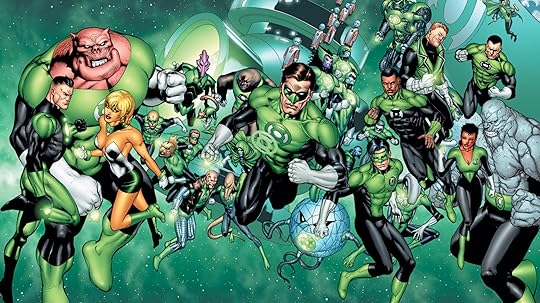
Patrick Gleason, in Green Lantern Corps, proves that the Green Lantern universe is not merely Hal Jordan’s playground, but an entire galactic civilization, one filled with alien creatures, towering citadels, and glowing emerald chaos.
This is Green Lantern storytelling at its absolute finest—bold, kinetic, and utterly immersive.
The Themes: Power, Fear, and Redemption
What separates Johns’ work from so many other superhero relaunches is that he is not merely telling a superhero story—he is telling a story about power, responsibility, and redemption.
The Redemption of Hal Jordan
Johns, understanding that simply ignoring past mistakes is lazy storytelling, chooses instead to embrace them.
Hal Jordan is not simply brought back; he is rebuilt. His sins as Parallax are explained not as a moral failing, but as a manipulation of his greatest strength: his willpower. His return is not just a resurrection, but a test of character—can a fallen hero be great again?
By making Hal face his past without being defined by it, Johns crafts a compelling arc that is not merely about heroism, but about atonement, about proving that true heroes are not those who never fall, but those who refuse to stay down.
Fear vs. Willpower: The Psychology of Green Lantern
One of Johns’ greatest contributions to the Green Lantern mythos is the formalization of fear as the antithesis of willpower.
The introduction of Parallax as an actual entity of fear, rather than just a concept elevates the Green Lantern mythology to a new level of thematic depth.
The central struggle of Green Lanterns—that they must possess an unyielding will to overcome fear—becomes not just a personal challenge, but a cosmic one, a war between fundamental emotional forces.
Fear is not simply an obstacle in Johns’ Green Lantern—it is the enemy, an active force that seeks to consume, to corrupt, to dominate.
This is where Green Lantern truly becomes modern mythology, exploring psychological struggles through a grand cosmic lens.
The Worldbuilding: Expanding the Green Lantern Universe
Johns does not merely reestablish Hal Jordan. He expands the Green Lantern universe into something far richer, far grander than ever before.
The Green Lantern Corps, once a vague concept, is now a fully realized intergalactic police force, complete with military structures, cultural conflicts, and political intrigue.
The Guardians of the Universe, formerly aloof cosmic arbiters, become flawed, secretive figures whose decisions carry massive, often catastrophic consequences.
The seeds of the emotional spectrum, which would later explode into the Sinestro Corps War, Blackest Night, and Brightest Day, are subtly planted here—setting the stage for a mythology that feels as vast and intricate as any in superhero fiction.
This is how you revive a franchise: not by undoing the past, but by building something larger from its ruins.
The Verdict: A Modern Superhero Epic
Few superhero relaunches can claim to have completely redefined a character’s mythology, but Green Lantern by Geoff Johns Omnibus, Volume 1 does exactly that.
It is, without question, one of the greatest superhero runs of the modern era, a story that takes an iconic character, rebuilds him from the ground up, and restores his mythology to a level of grandeur previously unseen.
Johns does not merely tell Green Lantern stories. He tells stories about power, about the human mind, about what it means to wield extraordinary ability in the face of fear.
And that, more than any glowing ring or cosmic battle, is why this volume remains essential reading.
If you have not yet read Green Lantern by Geoff Johns Omnibus, Volume 1, then you are depriving yourself of one of the finest superhero sagas ever written.
Because some myths fade.
But this one?
This one burns.
As well it should.