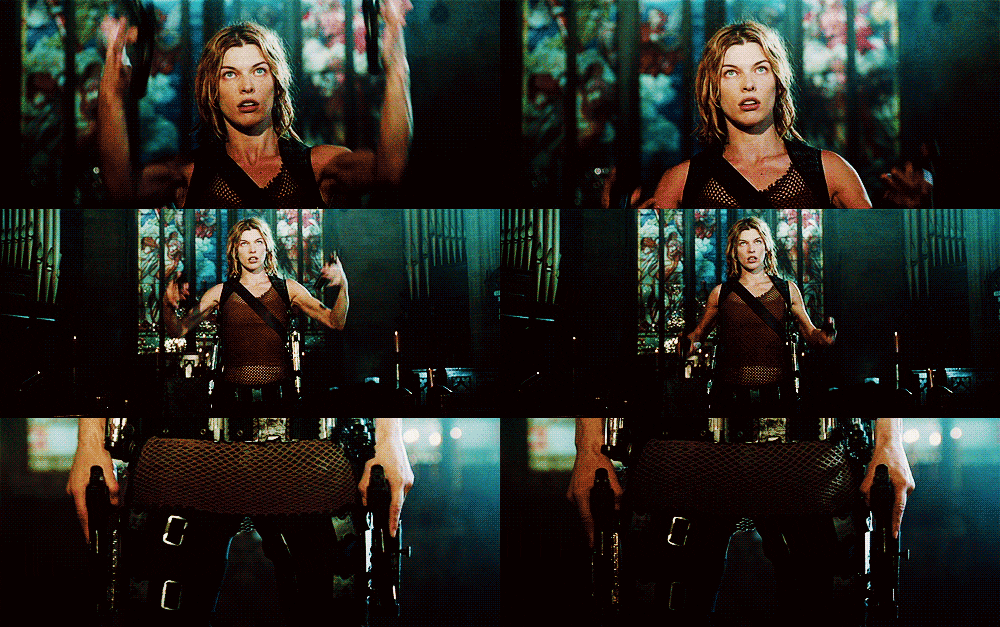
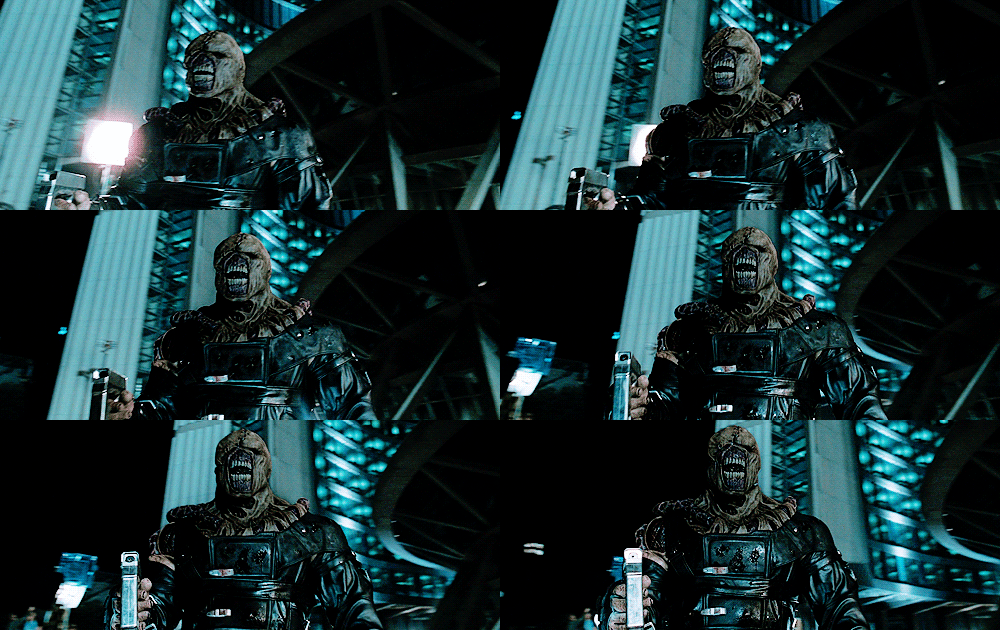
With the streets of Raccoon City swarming with the living dead, Jill Valentine of the RCPD and her companions struggle to get out of the city alive, only to come face to face with the Umbrella Corporation's latest bioweapon, a prototype soldier known as "Nemesis," that kills anything in its path.
What can I say accept that the author has done it again. He has given the characters new life and personalities. My heart broke for Matt who was stuck in Nemesis's body. I loved every bit of this book and am looking forward to the next.
Resident Evil began as a Japanese video game in 1996, which spawned a bunch of other video games, comics, cartoons, movies, and novels. I've never played any of the games, nor watched more than a couple of the films, nor read very many of the books, but I did enjoy DeCandido's novelization of this second film, which was based on the script written by Paul W.S. Anderson. He provides a lot more background and explanation, which explained a lot of the film which had left me confused. Evil Umbrella, zombies in Raccoon City, how can you not sympathize with characters named Jill Valentine and Alice in wonderland? And wow, -lots- of zombies... disengage critical thought and enjoy the ride.
I love the Resident Evil movie franchise and I enjoy film novelizations so it seems like these would be right up my alley, but I can only recommend this novel with very heavy caveats.
I'll get the good stuff out of the way first. As far as being the book-of-the-movie, this book succeeds well. There's a lot of backstory that had to be left out of the movie, and it's all filled in very nicely here. The book explains why Umbrella was foolish enough to reopen the Hive, why Jill Valentine was suspended prior to the movie, why Angela Ashford is alive to be rescued in the first place, and how it is that Alice got from point A (the hospital) to point B (the church) in the first place. Considering that those were pretty gaping points in the excellent movie, it's nice to have those filled in.
However, I really have to register a complaint with a lot of the characterization in this novel. I don't know how much of this was left up to author DeCandido and how much of it was handed to him in the form of a script from the franchise owners, but several characters have been changed radically here, and not for the better. It seems like everyone who is fated to die has been amped up into the worst people possible, which sucks the pathos out of the novel. Worse, the characterizations rely heavily on offensive stereotyping. So now the Scottish guy in the church where Terri, Jill, and Peyton hides is a "papist" whose internal monologue browbeats into the reader that our doomed red shirt is a sexist, a murderer, a religious extremist, a racist, and probably also a jaywalker. VERY SUBTLE.
Carrying on this trend: the S.T.A.R.S. team that Nemesis encounters has been changed from an organized squad trying valiantly to defend their town to "glorified beat cops". The sniper on the roof -- one of my favorite no-name characters in the movie franchise -- is a loose cannon from Texas (because he has a cowboy hat in the movie, SO OF COURSE) who has been reprimanded four times for excessive force and the S.T.A.R.S. team didn't even realize he was up on the roof covering their position; he was just up there for fun and to "practice shooting". This is basically the exact opposite of how this scene plays out in the movie, and the change is not a good one, in my opinion.
The worst change of all, however, and the reason this book was bumped down to 2 stars in my review, is that of the character of L.J. Wayne. Now, I have just come away from re-watching "Apocalypse" because this bothered me so much and I want to be accurate. I love L.J. Wayne in this movie. He has gallows humor and can smile in a crisis (as can every other main character in this movie), yes, but there's a deep seriousness underneath as he struggles to survive the outbreak. He adapts quickly and easily to new situations, and despite his easy slang way of speaking, he has a certain erudition when he jokes that a new acquaintance can use his nickname "on account of the informal situation" and later when he pulls out a relatively obscure comic book reference in dialog.
That's movie L.J. Wayne. The L.J. Wayne in this book, however, is completely unrecognizable to me. He's happy-go-lucky to the point of being almost unable to process new information or assess the severity of a situation. He talks incessantly, which implicitly endangers the team since the zombies are drawn to noise. When he meets Terri Morales -- the weather reporter for the local news channel -- he becomes obsessively star-struck at meeting a "celebrity", and mourns her death only because "There goes my chance at stardom". He flings around racially charged terms, both at himself and at others: he refers to Carlos as a four-letter racial slur for Hispanic people (S*), he refers to white characters as a seven-letter racial slur for white people (C*), and he refers to black characters as a six-letter racial slur for black people (N*). Of the six instances of the N* word that occur in this novel (none of which, I hasten to add, occur in the movie), five of them are uttered by Wayne.
Later, Jill Valentine continues this lovely trend of racist dialog by repeatedly characterizing Wayne as a "roach" and additionally addressing Wayne as "boy"; whether the term is meant here in the classic racist sense or in the new extra-crispy version that involves a comparison to a dog, I didn't and don't care because at that point I was *done*. There's no excuse for all this gratuitous racism, in my opinion, and I will take a moment to point out that book author DeCandido and movie writer Anderson are both white men. I feel like that's a touch relevant here.
Some readers may read Wayne's dialogue as modern and edgy, but I personally feel there's a difference between a black artist reclaiming racial terms and a white artist putting those terms in the dialogue of a fictional black character -- especially when that sort of dialog is completely omitted in the original, on-screen characterization for that character. I finished this novel and I was pleased with the actual plot and the filling of the movie gaps, but the blatant and unnecessary characterization changes to make half the characters offensive stereotypes about black people, Scottish people, and Southern people, I personally did not appreciate in the least.
This is based on my favorite Resident Evil film, Resident Evil Apocalypse. My favorite part is when Alice is fighting Nemesis. The saddest part is when Alice got killed, but she was brought back to life! Yeah!!
Alice is back and almost everyone is dead. Alice found out that Umbrella infected her with the T-virus and somehow her blood fused with the virus. She is flexible and great at fighting. Raccoon City is surrounded by a huge wall and noone could get in or out. Alice and the survivors are in the city! She met a former cop called S.T.A.R.S. who is woman named Jill Valentine. Jill was with her partner and a weather channel girl. Matt was mutated by a monster and turned into a monster himself who is called Nemesis. Umbrella controls his every move and wants him to fight Alice to see who is supreme. The creator of the T-virus himself, Dr. Ashford, told Alice and the others that the city is going to be nuked. He told them that he can get them out of the city if they get his daughter who is in her school. They went to the school and met a few new people; a man named LJ and a former Umbrella staff, Carlos Olivera. Jill found Dr. Ashford's daughter, Angie Ashford, who had the anti-virus within her lunchbox. They went to the helicopter area to meet Dr. Ashford. A man who is controlling Nemesis, Cain, was there with his thugs. He shot Dr. Ashford and forcing Alice to fight with Nemesis. Alice impalded Nemesis into a metal stick thing. Alice found out that Nemsis is Matt by his eye. Alice refused to finish him and fought off Cain's thugs. Matt gained control and helped her. A helicopter aimed the guns at Alice, but Matt stepped in and destroyed the helicopter with his rocket launcher. It blew up and landed on Matt, instantly killing him. Part of the debris hit Alice and made a nasty wound in her chest. Carlos helped her get on the remaining helicopter. They all got in and took off. Alice grabbed Cain and pushed him off the copter. Cain got eaten by zombies and left the city. The city got nuked by the missle, making the copter shake. A piece of metal was flying towards Angie, but Alice moved in front of her and was impalded by the metal. The copter crashed, killing Alice. The others left her body and ran off to hide. A scientist named Dr. Isaacs, found her body. He took her to his labratory to bring her back to life. She revived in 3 weeks and woke up naked in a water tank. He got her out of the tank and asked her if she can remember everything. She told him her name is Alice and she remembers everything. She killed almost everyone in the lab and left. Alice could feel that she got some new powers and got even more stronger. As she got out, she saw Jill, Carlos, LJ, and Angie in a black truck. She got in and they left the city. Dr. Isaacs smiled as Alice had a chip in her head which made her his revived old project, Project Alice.
This entire review has been hidden because of spoilers.
Secara keseluruhan, karena udah tau ceritanya jadi bacanya lebih ke deg-degan-gembira mengantisipasi kejadian yang bakalan terjadi (^///^ )> Ringan dan menyenangkan~
POV-nya dibikin beragam, ada yang dari sudut pandang 'tokoh-numpang-lewat-yang-bentar-lagi-juga-koit', dan ada yang dari si Alice dan si Jill. Kadang sebel juga bacanya kalo yang 'ngomong' si LJ, kebanyakan misuh-misuh ga penting ( ̄  ̄|||) Pas momen 'lawan bos terakhir', POV-nya malah si
Mungkin bukan tipe bacaan yang "wow-banget!", dan pas baca pun sering ta' selang-seling sama buku lain, tapi bacanya menghibur. Dan aku ga akan nolak untuk baca prekuel ataupun lanjutannya lagi semisal nemu bukunya (^-^)
This was a book of 279 pages I devoured over an afternoon. It’s the same humorous author as the first book, Resident Evil: Genesis. Many quotes are humorous and I found myself laughing at loud at the whit.
However, I do feel some discomfort with the racial stereotypes written so eagerly as to show L.J. as a black man from the hood as very over done. I know it was the character as he was portrayed, almost as a ‘Pimp,’ but I think it could have been toned down a lot. Thus, I’ve docked two stars; especially after thoughts from Jill considering him worse than a cockroach.
There’s just no need for the amount of stereotyping that needed to be done with the character.
I really love the Resident Evil video games and movies; however I did not like this book. I didn't like the writing style and it seemed like the author was compensating for his lack of artistic composition by inserting bad/big words. The plot was handed to him on a silver screen, yet he did little to build up excitement or convey strong emotions. It was very hard to continue reading it; the only reason I finished it was because I did not want to have to start another book for this month's book review. You don't have to waste your time reading this, just watch the movie.
Another solid RE novel. Though not as good as S.D. Perry's original novel based on the games, K-RAD certainly takes the movies one step further and actually makes them GOOD! Recommended.
This is the second novel by the author I've read which is based on the screenplays for the Resident Evil films and I enjoyed reading it. It sticks to the actual story in the Resident Evil Apocalypse film and is a well written zombie adventure.
Jill is a cop who was suspended for telling the truth over another outbreak recently, part of a huge coverup by the Umbrella Corporation. Being seen by former colleagues as a lunatic, Jill is somewhat vindicated when she arrives at the station to collect her things and the zombie outbreak has begun. I can understand her whole 'I told you so' attitude as she walks through, killing the threats and then leaves to get herself safely out of town. When she arrives at the exit from Racoon City, she finds a quarantine area where people are checked for the virus before they are allowed to leave, and the area is managed by her former boss. An infected man starts biting people and the Umbrella Corporation seal off the city and refuse to let anyone else leave.
Alice wakes up in the hospital and makes her escape onto the ravaged streets where it is clear that the virus has escaped the Hive despite all of her efforts. She walks the streets, discovering that she has new found powers that help her to take on even the worst of the mutant creatures. Her path collides with Jill, her boss and a reporter Terri who is determined to get news of the outbreak to the outside world and become famous again. A special forces team inside the quarantine zone have been abandoned and are having to survive together on the streets and try to find a way out.
Charles, creator of the Red Queen, invented the virus to treat his daughter for a genetic illness but The Umbrella Corporation turned it instead into a bio-weapon. Now his daughter Angela is missing somewhere in the city and he sees Alice and the special forces groups moving in the area and decides to offer them a way out of the city if they can find her. Cain, the cause of the outbreak, is obsessed with the idea of testing his mutated projects and cares little for all the innocents and law enforcement officers who are going to die.
But Alice is not the only enhanced human that is on the streets. The Umbrella Corporation have unleashed the Nemesis program, turning Matt into a mutated monster/super soldier and the zombie killing fields are the perfect place to see him test out his skills...with the plan to have him fight Alice to see how good their creations are.
I enjoyed reading the novel which is based closely on the film. The author gives you that story and delves a little deeper into the characters to flesh them out a bit. Enjoyable zombie fun.
I absolutely love all of the Resident Evil Books. I play all the games as well as watch all of the movies to. The books rock though and I read all of them quite a bit.
Unfortunately, the story's overuse of swearing and offensive language was a big let down. It was immensely overused and served no purpose to the story or even to highlight a person's character, and would have been a much more enjoyable read without it. As it is, the extensive swearing became a drag and became a desire to skip pages to actually read story rather than cussing.
Not to mention its use of offensive terms like the n-word, which was completely unneeded. You don't need all this swearing to create a good story or highlight a person's character. The swearing is almost a get-out clause, unable to find more creative ways of presenting a character except through swearing. Made all the characters unlikable and I wouldn't have cared if any of them died.
But the story overall is good. Worth reading still if you're going through the series, though if the swearing continues like this I may just abandon the series in pursuit of something more amenable. People swear, this is fine, it's just so overused.
The second book of the Resident Evil series doesn't disappoint. This time around, we are introduced to more characters now that the infection has hit all of Racoon City. All of hell has been broken loose and police units all over the ciy have been dispatched in an attempt to contain the threat. However, the threat is so large that eventually Umbrella orders a lockdown of Racoon city and now things really start to heat up. Alice is reintroduced and thrown into another debacle which of cours, she must resolve using her unnatural ability. She teams up with soldiers from Umbrella who were betrayed by the very corporation that hired them. Alice is introduced to a new type of monster created by the evil corporation and must try to escape the city as the threat is uncontainable and must be destroyed by all means. Less of the history of Alice, and more of the action currently taking place, this book and the movie really encompasses what it is like to be a character in Resident Evil.
Wer Zombis mag, liebt das Buch ;) Ich liebe resident Evil, ich hatte das Buch schon solange hier liegen, vor einiger Zeit hatte ich mal Resident Evil Genesis gelesen. Die Bücher sind natürlich an den Film angepasst , aber sie sind besser . Viel besser beschrieben und ich gehöre zu denen die im ersten Teil gesagt haben das Alice für mich einfach nicht nach RE gehört, aber langsam ändert man dann doch seine Meinung ( kenne ich doch alle Filme). Alice gibt der Geschichte nochmal was neues. In dem Buch treffen wir auch Jill Valentine , die auch in dem Spiel nun sehr bekannt ist. Eine Polizistin mit dem Herzen am rechten Fleck und meine totale RE Figur der Nemesis, fand den ja schon mega im Film , hier wird er auch nochmal super herüber gebracht. Für RE Fans ein muss, man muss es gelesen haben. Und in Büchern gibt es immer mehr Infos was man im Film eben nicht so mit bekommt.
Ich liebe resident Evil, ich hatte das Buch schon solange hier liegen, vor einiger Zeit hatte ich mal Resident Evil Genesis gelesen. Die Bücher sind natürlich an den Film angepasst , aber sie sind besser . Viel besser beschrieben und ich gehöre zu denen die im ersten Teil gesagt haben das Alice für mich einfach nicht nach RE gehört, aber langsam ändert man dann doch seine Meinung ( kenne ich doch alle Filme). Alice gibt der Geschichte nochmal was neues. In dem Buch treffen wir auch Jill Valentine , die auch in dem Spiel nun sehr bekannt ist. Eine Polizistin mit dem Herzen am rechten Fleck und meine totale RE Figur der Nemesis, fand den ja schon mega im Film , hier wird er auch nochmal super herüber gebracht. Für RE Fans ein muss, man muss es gelesen haben. Und in Büchern gibt es immer mehr Infos was man im Film eben nicht so mit bekommt.
While I love the idea of the Resident Evil world, I was not a fan of this book. It's not that it's poorly written but it reads with the expectation that the reader has already seen the movie and their for wastes no time with spoiling the climax of the the Nemesis program. And that to me is a problem, because having seen teh movie or not, relieving the plot twist in the beginning of the book only seems to work of the Columbo series and then Dexter (though it's only in the regards of the crimes Dexter commits).
If you want something easy to read, I guess it's ok, but it was one of the books I have little problems with leaving behind when I moved from the states to Europe.
Again not bad. The story is fun especially for a fan of the movies. But the writing isn't the best especially action sequences but it is a novelization so understandable. For me the worst parts were: "Alice checked to see if the shotgun was loaded. It was. She pumped the shotgun" A sniper using a shotgun for long range even if it uses slugs not shot LJ having uzis instead of desert eagles like the movie. When alice is surprised that Morales listened to her despite not knowing her and also suposing its her bad assery that made her listen. Or ya know Morales listened because it was a good idea and she's not stupid? So little things like that definitely gave me pause on my second reading.
"April 6, 2017 – 8.0% "And it happen... they ain't smart as we know them as we see them... after all each program by itself created has it's own glitches... no brains.. or let's put it as non-brainers.
As second that's how diseases got spread!" April 6, 2017 – Started Reading"
- One more thing, let's put it as the last thought for this book... if this happens which you see here... it's going to be chaos. But still it's a possibility and let's pray for this to don't happen.
The possibilities of such virus is that it could wipe out a whole world!
OK, so that Nemesis kind of having a mind was TERRIBLE, but also it was a need since someone had to narrate the chapters with only him alive at the end. Plus, they gave like half a page to that last battle scene.
But, this world of novelizations by DeCandido is really good. I loved how a lot of little things from the first book came back here, like the place where Lissa and Alice had dinner and things like that.
And I learned that the guy who left to die the woman at the beginning of the movie was also the one on the church, that was cool.
This story was pretty good. The novel is very similar to the movie from what I recall. The action was on point although sometimes a bit silly sounding because, after two pages of describing a scene, the author tells you that only took ten seconds to occur.
The novel was nice to get a better perspective of the characters. The author describes their thoughts and gives a better explanation for their actions throughout the story.
Resident Evil Apocalypse is my favorite in the (admittedly kind of crappy) movie series so I was excited to check out the novelization in the hopes that it would flesh some parts out and give more depth to the characters. Unfortunately, all the campy goodness in the movie is sucked out of the book until we're left with a zombie shambling through scenes that I've already seen. Lackluster. I'd rather rewatch the movie. 2/5
Better than the movie. I just hate the bad language that the author used. I can't imagine actually talking like that. It made the characters seem shallow that they couldn't come up with a better noun, adjative or verb than the F word. Still I read it and It made some of the movie make more since. So yeay for that!
Like many movie novels, this was pretty close to the movie's playout. The one thing I felt was a little different was it went more into the scientist's minds that were creating the havoc of the Nemesis program. When you read the characters, you often picture the people who played them in the movies (partly why I like to read before I watch, but in this case, it came afterwards).
You can clearly tell the author was a man. The way he wrote constantly About Alice having “mind blowing sex’ and describing terribly how breasts move. The movie was great and showed everything that could’ve made a great book.. yet the author clearly didn’t give a shit and ignored it all. Most of the time LJ was referred to as “the black one” which is disgusting.
I know it wasn't based on the games so this is no more than just nitpicking but this book as well as it's predecessor was full of more errors than the movies. You could tell he knew nothing about the REAL source material and was written to have more sex appeal than the movie itself.