

What do you think?

The Tango Singer
A hypnotic novel in which an American student’s quest to find the greatest living tango singer leads him deep into the labyrinth of Argentina’s past. It is 2001, and inflation is spiraling out of control in Argentina as Bruno Cadogan, an American graduate student specializing in Borges, arrives in Buenos Aires. Cadogan is on the trail of Julio Martel, an elusive tango singer rumored to be even better than Carlos Gardel, the greatest singer of the 1920s and ’30s. Martel has never recorded and his strange, powerful performances, at seemingly arbitrary sites around the city, are always unannounced. Cadogan finds lodging in a boarding house rumored to be the setting of the famous Borges story ''The Aleph,'' and soon finds himself drawn into the tangle of legends surrounding the singer’s life. As the economic tension grows and the city hovers on the verge of riots, Bruno begins to believe that Martel’s increasingly rare performances are in fact far from random—that they instead form a map of the darkest moments in the city’s past.
256 pages, Paperback
First published January 1, 2004
About the author
Tomás Eloy Martínez
38 books115 followersTomás Eloy Martínez obtained a degree in Spanish and Latin American literature from the University of Tucumán, and an MA at the University of Paris. From 1957 to 1961 he was a film critic in Buenos Aires for the La Nación newspaper, and he then was editor in chief (1962-69) of the magazine Primera Plana. From 1969 to 1970 he worked as a reporter in Paris. In 1969 Martínez interviewed former Argentine President Juan Domingo Perón, who was exiled in Madrid. These interviews were the basis for two of his more celebrated novels, La Novela de Perón (1985) and Santa Evita (1995). In 1970 he and many former writers of Primera Plana worked at the magazine Panorama, where Martínez was the director.
On 15 August 1972 he learned of the uprising of political prisoners in the jail at Rawson, Chubut Province. Panorama was the only publication in Buenos Aires that reported the correct story of the affair in Rawson, which differed significantly from the official version of the de facto Argentine government. On 22 August he was fired at the behest of the government, whereupon he went to Rawson and the neighboring city of Trelew where he reported the Massacre of Trelew in his book The Passion According to Trelew. The book was banned by the Argentine dictatorship.
For three years (1972-75) Martínez was in charge of the cultural supplement of La Nación, after which he lived in exile (1975-83) in Caracas, Venezuela, where he remained active as a journalist, founding the newspaper El Diario. In his book "The Memoirs of the General" he recounts that he was threatened by the "Triple A", the Alianza Anticomunista Argentina, and on one occasion, gunmen held a pistol to the head of his 3-year-old son because they were witnesses to a crime Martínez believed to be an operation led by the far-right paramilitary group. He subsequently started the newspaper Siglo 21 in Guadalajara, Mexico, and created the literary supplement Primer Plano for the newspaper Página/12 in Buenos Aires.
Martínez has also been a teacher and lecturer. He taught (1984-87) at the University of Maryland. In 1995, he took a position as distinguished professor and director of the Latin American Studies program at Rutgers University, New Jersey. He lived in nearby Highland Park, New Jersey until about 3 years ago when he returned to Argentina to live. He wrote columns for La Nación and the New York Times syndicate, and his articles have appeared in many newspapers and journals in Latin America.
He has published a number of books, one of which, Santa Evita, has been translated into 32 languages and published in 50 countries. He was awarded the Guggenheim and Woodrow Wilson fellowships, and won the 2002 Alfaguara award for the novel Flight of the Queen. His works deal primarily (but not exclusively) with Argentina during and after the rule of Juan Domingo Perón and his wife, Eva Duarte de Perón (Evita).
Martínez died in Buenos Aires after a long battle against a brain tumor.
On 15 August 1972 he learned of the uprising of political prisoners in the jail at Rawson, Chubut Province. Panorama was the only publication in Buenos Aires that reported the correct story of the affair in Rawson, which differed significantly from the official version of the de facto Argentine government. On 22 August he was fired at the behest of the government, whereupon he went to Rawson and the neighboring city of Trelew where he reported the Massacre of Trelew in his book The Passion According to Trelew. The book was banned by the Argentine dictatorship.
For three years (1972-75) Martínez was in charge of the cultural supplement of La Nación, after which he lived in exile (1975-83) in Caracas, Venezuela, where he remained active as a journalist, founding the newspaper El Diario. In his book "The Memoirs of the General" he recounts that he was threatened by the "Triple A", the Alianza Anticomunista Argentina, and on one occasion, gunmen held a pistol to the head of his 3-year-old son because they were witnesses to a crime Martínez believed to be an operation led by the far-right paramilitary group. He subsequently started the newspaper Siglo 21 in Guadalajara, Mexico, and created the literary supplement Primer Plano for the newspaper Página/12 in Buenos Aires.
Martínez has also been a teacher and lecturer. He taught (1984-87) at the University of Maryland. In 1995, he took a position as distinguished professor and director of the Latin American Studies program at Rutgers University, New Jersey. He lived in nearby Highland Park, New Jersey until about 3 years ago when he returned to Argentina to live. He wrote columns for La Nación and the New York Times syndicate, and his articles have appeared in many newspapers and journals in Latin America.
He has published a number of books, one of which, Santa Evita, has been translated into 32 languages and published in 50 countries. He was awarded the Guggenheim and Woodrow Wilson fellowships, and won the 2002 Alfaguara award for the novel Flight of the Queen. His works deal primarily (but not exclusively) with Argentina during and after the rule of Juan Domingo Perón and his wife, Eva Duarte de Perón (Evita).
Martínez died in Buenos Aires after a long battle against a brain tumor.
Ratings & Reviews
Friends & Following
Create a free account to discover what your friends think of this book!
Community Reviews
Displaying 1 - 30 of 115 reviews

November 26, 2019
Homage to Buenos Aires. An American graduate student from New York arrives in Buenos Aires for a few months to do research on his dissertation. His field is literature and he’s interested in the relationship between tango and the writing of the famous Argentinian Jorge Luis Borges. He has heard of a tango singer, Julio Martel, rumored to be even better than the renowned Argentinian tango singer Carlos Gardel. (Perhaps like me, you assumed tango was just about the dance, not the singing.) Martel, the singer he seeks, has never made any recordings and he sporadically appears unannounced in the streets to sing.

Borges is famous for his writing about labyrinths. The student's quest to find the greatest living tango singer leads him into multiple labyrinths: the city itself (its geography and street map) and the chaotic maze of its economy and politics. Even though he does not get to hear Martel sing , because of his spontaneous, unannounced schedule, he comes to believe that the sites where Martel sings are creating some kind of code on a map.
As soon as he arrives, the student makes good friends with a male companion. The author implies this is gay relationship, although it is understated: the only physical interaction we read of is the student caressing the hair of his friend while he lies in bed. But when they break up, the student obsessively looks for him throughout the city.

How chaotic was Buenos Aires during this time (2001)? Inflation was spiraling out of control and people didn’t know how much money was worth. Banks closed and limited the amounts that could be withdrawn. Street demonstrations were constant, blocking major routes and transportation systems. Gangs of homeless boys roamed the streets. Argentina had five people acting as President within two weeks.
The student finds lodging in a boarding house that is rumored to be the setting of the famous Borges short story "The Aleph" – a tiny point of brilliant light that encapsulates the entire universe. His friend, kind of a con man, starts thinking of ways to get the basement resident evicted so they can turn the cellar into a tourist attraction.
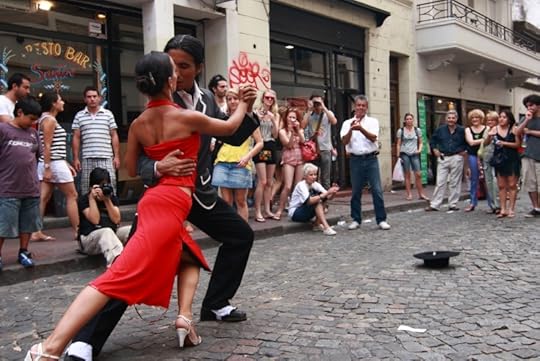
The student discovers that Martel sings at locations to honor or memorialize those who died at sites of atrocious events in the city’s history such as massacres by the military of civilians, sometimes 300 people. As the story progresses we get some vignettes of these events and more extended stories of a couple of people: a Polish Jewish prostitute who bought her way out of sexual slavery and became famous, and the story of one of Martel’s friends who was involved in stealing the body of a famous general and making a trade for another body.
Although the talk of riots, demonstrations and political chaos seem to contradict it, it does seem to me the author is in love with the city. We get a lot about the architecture of the city, street names and locations where Borges and other authors lived (such as Ernesto Sabato). So there is a lot of local color of the city, its cafes, tango studios, museums and so on.
By the time the student actually meets Martel, he is old, sickly and in and out of the hospital. He learns his story from Martel’s woman friend.
There is some good writing:
Of Scandinavian tourists in the city: “They spoke in a guttural English, which permitted intermittent conversations, as if the distance might leave the words hanging in mid-air.”
“Borges…had the intuition, later confirmed by the idealist philosopher Francis Herbert Bradley, that time is an incessant agony of the present disintegrating into the past.”
“The language of Buenos Aires shifted so quickly that that the words appeared first and then reality arrived, and the words carried on when reality had already left.”
Of street kids who collect cardboard in wheelbarrows: “[they] whistled music so good you could lean your head back on it: the poor kids put their hands in their pockets and all they found was the good weather, which was enough to let them forget for a moment the scorching bed where they wouldn’t sleep that night.”
“My [Presbyterian] father believed that good luck was a sin, because it discouraged effort.”

All in all a good story that gives you the feeling of having been in Buenos Aires.
Photos: Buenos Aires from buenosaires.gob.ar/sites
Demonstration in Buenos Aires in 2001 from i.ytimg.com/vi/r9yMkZifP_w/maxresdefa...
Street tango from outwardon.com
The author from Goodreads
Borges is famous for his writing about labyrinths. The student's quest to find the greatest living tango singer leads him into multiple labyrinths: the city itself (its geography and street map) and the chaotic maze of its economy and politics. Even though he does not get to hear Martel sing , because of his spontaneous, unannounced schedule, he comes to believe that the sites where Martel sings are creating some kind of code on a map.
As soon as he arrives, the student makes good friends with a male companion. The author implies this is gay relationship, although it is understated: the only physical interaction we read of is the student caressing the hair of his friend while he lies in bed. But when they break up, the student obsessively looks for him throughout the city.
How chaotic was Buenos Aires during this time (2001)? Inflation was spiraling out of control and people didn’t know how much money was worth. Banks closed and limited the amounts that could be withdrawn. Street demonstrations were constant, blocking major routes and transportation systems. Gangs of homeless boys roamed the streets. Argentina had five people acting as President within two weeks.
The student finds lodging in a boarding house that is rumored to be the setting of the famous Borges short story "The Aleph" – a tiny point of brilliant light that encapsulates the entire universe. His friend, kind of a con man, starts thinking of ways to get the basement resident evicted so they can turn the cellar into a tourist attraction.
The student discovers that Martel sings at locations to honor or memorialize those who died at sites of atrocious events in the city’s history such as massacres by the military of civilians, sometimes 300 people. As the story progresses we get some vignettes of these events and more extended stories of a couple of people: a Polish Jewish prostitute who bought her way out of sexual slavery and became famous, and the story of one of Martel’s friends who was involved in stealing the body of a famous general and making a trade for another body.
Although the talk of riots, demonstrations and political chaos seem to contradict it, it does seem to me the author is in love with the city. We get a lot about the architecture of the city, street names and locations where Borges and other authors lived (such as Ernesto Sabato). So there is a lot of local color of the city, its cafes, tango studios, museums and so on.
By the time the student actually meets Martel, he is old, sickly and in and out of the hospital. He learns his story from Martel’s woman friend.
There is some good writing:
Of Scandinavian tourists in the city: “They spoke in a guttural English, which permitted intermittent conversations, as if the distance might leave the words hanging in mid-air.”
“Borges…had the intuition, later confirmed by the idealist philosopher Francis Herbert Bradley, that time is an incessant agony of the present disintegrating into the past.”
“The language of Buenos Aires shifted so quickly that that the words appeared first and then reality arrived, and the words carried on when reality had already left.”
Of street kids who collect cardboard in wheelbarrows: “[they] whistled music so good you could lean your head back on it: the poor kids put their hands in their pockets and all they found was the good weather, which was enough to let them forget for a moment the scorching bed where they wouldn’t sleep that night.”
“My [Presbyterian] father believed that good luck was a sin, because it discouraged effort.”
All in all a good story that gives you the feeling of having been in Buenos Aires.
Photos: Buenos Aires from buenosaires.gob.ar/sites
Demonstration in Buenos Aires in 2001 from i.ytimg.com/vi/r9yMkZifP_w/maxresdefa...
Street tango from outwardon.com
The author from Goodreads

June 20, 2019
Buenos Aires, 2001
Labyrinths. Labyrinths are mentioned 37 times in this novel, and 5 times in one paragraph towards the end. Into this labyrinthine story walks Bruno Cadogan. It is shortly before the fall of the Twin Towers in New York City that he arrives in Buenos Aires to work on ”a dissertation on Jorge Luis Borges’ essays on the origins of the tango”. Borges apparently asserted that the only true tangos were those composed prior to 1910. The focus of Bruno's visit is to meet and listen to Julio Martel, a tango singer of extraordinary talent, and reputedly even better than the legendary Carlos Gardel. ”When Martel imitated Gardel, he was Gardel, she said. When he strove to be himself, he was better.” By sheer chance and good luck Bruno manages to secure a room in the very house on Garay Street which features in The Aleph by Borges. And sure enough, there is the nineteen step staircase mentioned in Borges's story.
What follows is a clever, winding and twisting tale about trying to find not only the elusive Martel, but also the aleph. ”That night I had the impression that Martel could be in two or three places at once, or in none. I also thought he might not exist at all and was just one more of the city’s many fables." "Martel’s plans were as hard to fathom as those of a cat.” Martel is frequently compared to a cat. Martel pops up in unexpected places and sings about Argentina's past, his own past and present, as well as of individual tragedies and betrayals. His voice range astounds:
And Buenos Aires? ”The language of Buenos Aires shifted so quickly that the words appeared first and then reality arrived, and the words carried on when reality had already left.” It is a city where nothing is as it seems, a city which can be the most beautiful in the world, a labyrinth (yes, that word again!) where Bruno can lose himself or find himself lost. He loses track of his writing and he loses track of himself. He soon loses himself in a suburb where ”The houses were side by side, with no spaces in between, but the architects had devised a way to make straight lines look curved, or vice versa." "I had the sensation that, the more I walked, the more the sidewalk lengthened, as if I were moving on an endless ribbon.” Bruno discovers that both time and place have a certain elasticity here. But it is also a time and a place where the mood is changing, because this was the height of the severe financial crisis (Bruno has to queue for hours to draw on his Fulbright Scholarship funds, and each amount is limited by law) and by late November serious unrest develops and as a result the country experiences several changes in government.
Does Bruno find the aleph? More importantly, does he find Estéfano Caccace also known as Julio Martel? Does he get to hear that voice? Now that would be telling... what I can tell you is that it is a magical tale full of musical and literary allusions. Although it is not flawless (perhaps the word 'labyrinth is used once too often?) it is as exciting as the tango itself, as well as mentally stimulating.
”‘The Aleph,’ I said, is a short story by Borges. And also, according to the story, it’s a point in space that contains all points, the story of the universe in a single place and a single instant.” I shall now have to read The Aleph, shan't I?
Recommended particularly for those who love the works of Jorge Luis Borges and/or singer songwriter Carlos Gardel.
Labyrinths. Labyrinths are mentioned 37 times in this novel, and 5 times in one paragraph towards the end. Into this labyrinthine story walks Bruno Cadogan. It is shortly before the fall of the Twin Towers in New York City that he arrives in Buenos Aires to work on ”a dissertation on Jorge Luis Borges’ essays on the origins of the tango”. Borges apparently asserted that the only true tangos were those composed prior to 1910. The focus of Bruno's visit is to meet and listen to Julio Martel, a tango singer of extraordinary talent, and reputedly even better than the legendary Carlos Gardel. ”When Martel imitated Gardel, he was Gardel, she said. When he strove to be himself, he was better.” By sheer chance and good luck Bruno manages to secure a room in the very house on Garay Street which features in The Aleph by Borges. And sure enough, there is the nineteen step staircase mentioned in Borges's story.
What follows is a clever, winding and twisting tale about trying to find not only the elusive Martel, but also the aleph. ”That night I had the impression that Martel could be in two or three places at once, or in none. I also thought he might not exist at all and was just one more of the city’s many fables." "Martel’s plans were as hard to fathom as those of a cat.” Martel is frequently compared to a cat. Martel pops up in unexpected places and sings about Argentina's past, his own past and present, as well as of individual tragedies and betrayals. His voice range astounds:
”Sabadell and I were surprised, Alcira told me, when he burst out singing in the car, in a baritone voice, a verse from Return that reflected, or at least to me seemed to reflect, his conflict with time: I’m afraid of the showdown / with the past that returns / of confronting my life. Stranger still was that he repeated the melody in F, in a deep bass voice and then, almost without a breath, he sang it as a tenor. I’d never heard him switch his voice from one register to another, because Martel was a natural tenor, and he never played with his voice this way again, at least not in front of me.”
And Buenos Aires? ”The language of Buenos Aires shifted so quickly that the words appeared first and then reality arrived, and the words carried on when reality had already left.” It is a city where nothing is as it seems, a city which can be the most beautiful in the world, a labyrinth (yes, that word again!) where Bruno can lose himself or find himself lost. He loses track of his writing and he loses track of himself. He soon loses himself in a suburb where ”The houses were side by side, with no spaces in between, but the architects had devised a way to make straight lines look curved, or vice versa." "I had the sensation that, the more I walked, the more the sidewalk lengthened, as if I were moving on an endless ribbon.” Bruno discovers that both time and place have a certain elasticity here. But it is also a time and a place where the mood is changing, because this was the height of the severe financial crisis (Bruno has to queue for hours to draw on his Fulbright Scholarship funds, and each amount is limited by law) and by late November serious unrest develops and as a result the country experiences several changes in government.
Does Bruno find the aleph? More importantly, does he find Estéfano Caccace also known as Julio Martel? Does he get to hear that voice? Now that would be telling... what I can tell you is that it is a magical tale full of musical and literary allusions. Although it is not flawless (perhaps the word 'labyrinth is used once too often?) it is as exciting as the tango itself, as well as mentally stimulating.
”‘The Aleph,’ I said, is a short story by Borges. And also, according to the story, it’s a point in space that contains all points, the story of the universe in a single place and a single instant.” I shall now have to read The Aleph, shan't I?
Recommended particularly for those who love the works of Jorge Luis Borges and/or singer songwriter Carlos Gardel.

September 14, 2017
How do you write a city? How, with a pen, do you delve into the consciousness of a people? How, with mere words do you portray a society, its streets and parks, its political chaos, its passions and, yes, the soul of its literature and its music? But, of course, I should not leave out the tango, the very spirit of the city. How, especially, if that city is Buenos Aires? A city that overflows with all of those things. And who would dare to try, knowing that Jorge Luís Borges had already been there?
Tomás Eloy Martínez has taken on this task admirably. In his story, a young American graduate student, Bruno Cadogan, who is writing a thesis on Borges and the tango, is lured to BA by the rumour of a voice, a tango singer who went by the pseudonym of Julio Martel, . . . and of whom it was said, although there are no recordings, that, “He’s better than Gardel.” (Words which, if spoken in BA and not in New York, would inspire a charge of heresy.)
Thus, Eloy Martínez has set up the reader for a mysterious, joyous excursion through the ‘labyrinths’ of BA. An excursion that takes us throughout the city, into the setting of Borges’s ‘The Aleph’, into the time of Péron, the era of the military dictatorship, the protests in the streets. We are guided through various moments of BA history, both minor and major. Mostly, we wander the streets of BA with no apparent plan, only to find ourselves at the heart of the city.
As well, we are guided through the music of the tango, the old tango of which Borges wrote. The tangos lost in the houses of ill-repute of the past, often heard only by immigrant dock workers and sailors passing through.
I must admit that I had a bias towards this book. Buenos Aires is a city that sits at my core. I once had the pleasure of spending five weeks there, mostly wandering. I walked numerous kilometres each day, rain or shine. I rode the buses and the “Subte”, always popping up into the sunlight totally disoriented by that sun shining brightly in the northern hemisphere. I discovered a city of rich and poor, modern and antique. I spoke to people who sympathized with the poor indigenous people and others who claimed Argentina as a “European” country and longed for the days of the dictatorship when those people would be kept off the streets. Somehow, Tomás Eloy Martínez has evoked this many-faceted city with all of its beauty and all of its warts.
There is a story to The Tango Singer, a charming story. But I will not go into it here. The story is there to put the city of Buenos Aires on display. It does so wonderfully. A book for all who know and love, or would know and love, this most vibrant of cities. If you are one of those people, do read The Tango Singer.
Tomás Eloy Martínez has taken on this task admirably. In his story, a young American graduate student, Bruno Cadogan, who is writing a thesis on Borges and the tango, is lured to BA by the rumour of a voice, a tango singer who went by the pseudonym of Julio Martel, . . . and of whom it was said, although there are no recordings, that, “He’s better than Gardel.” (Words which, if spoken in BA and not in New York, would inspire a charge of heresy.)
Thus, Eloy Martínez has set up the reader for a mysterious, joyous excursion through the ‘labyrinths’ of BA. An excursion that takes us throughout the city, into the setting of Borges’s ‘The Aleph’, into the time of Péron, the era of the military dictatorship, the protests in the streets. We are guided through various moments of BA history, both minor and major. Mostly, we wander the streets of BA with no apparent plan, only to find ourselves at the heart of the city.
As well, we are guided through the music of the tango, the old tango of which Borges wrote. The tangos lost in the houses of ill-repute of the past, often heard only by immigrant dock workers and sailors passing through.
I must admit that I had a bias towards this book. Buenos Aires is a city that sits at my core. I once had the pleasure of spending five weeks there, mostly wandering. I walked numerous kilometres each day, rain or shine. I rode the buses and the “Subte”, always popping up into the sunlight totally disoriented by that sun shining brightly in the northern hemisphere. I discovered a city of rich and poor, modern and antique. I spoke to people who sympathized with the poor indigenous people and others who claimed Argentina as a “European” country and longed for the days of the dictatorship when those people would be kept off the streets. Somehow, Tomás Eloy Martínez has evoked this many-faceted city with all of its beauty and all of its warts.
There is a story to The Tango Singer, a charming story. But I will not go into it here. The story is there to put the city of Buenos Aires on display. It does so wonderfully. A book for all who know and love, or would know and love, this most vibrant of cities. If you are one of those people, do read The Tango Singer.

August 11, 2017
Readathon 2017 14/26 Ένα βιβλίο Νοτιοαμερικάνου Συγγραφέα.
Ο τραγουδιστή των τανγκό μας μιλάει για τον Μπρούνο Κάντογκαν, έναν Νεοϋορκέζο φοιτητή, που φτάνει στο Μπουένος Άιρες. Σκοπός του, να συναντήσει τον Χούλιο Μαρτέλ, φημισμένο τραγουδιστή τανγκό, από τον οποίο δεν υπάρχουν ηχογραφήσεις, ωστόσο θεωρείται ανώτερος του Γκαρδέλ. Με τη βοήθεια ενός παράξενου νεαρού, του Τουκουμανού, θα μείνει στην πανσιόν της οδού Γκαράι, όπου, σύμφωνα με το ομώνυμο διήγημα του Μπόρχες, βρίσκεται στο άλεφ. Στους επόμενους μήνες θα επιδοθεί σε μια κούρσα αναζήτησης του τραγουδιστή, μη διστάζοντας να παραμερίσει οτιδήποτε και οποιονδήποτε σταθεί εμπόδιο στο δρόμο του.
Στο βιβλίο ο Συγγραφέας μας ταξιδεύει πίσω στο χρόνο και μας γνωρίζει το Μπουένος Άιρες του χτες. Μας δείχνει την ιστορία τόσο της πόλης όσο και των κατοίκων της.
Μας δείχνει την διαφορετικότητα της περιοχής ανά των χρόνων και των καταστάσεων καθώς και την διαφορετικότητα των ανθρώπων που συναντά ο Μπρούνο. Ο Μπρούνο ο οποίος ξεκινάει το ταξίδι του με κάποια περιέργεια που στην συνέχεια γίνεται εμμονή. Που φτάνει στο Μπουένο Άιρες σαν τουρίστας και φεύγει σαν ντόπιος.
3 αστέρια...
Ο τραγουδιστή των τανγκό μας μιλάει για τον Μπρούνο Κάντογκαν, έναν Νεοϋορκέζο φοιτητή, που φτάνει στο Μπουένος Άιρες. Σκοπός του, να συναντήσει τον Χούλιο Μαρτέλ, φημισμένο τραγουδιστή τανγκό, από τον οποίο δεν υπάρχουν ηχογραφήσεις, ωστόσο θεωρείται ανώτερος του Γκαρδέλ. Με τη βοήθεια ενός παράξενου νεαρού, του Τουκουμανού, θα μείνει στην πανσιόν της οδού Γκαράι, όπου, σύμφωνα με το ομώνυμο διήγημα του Μπόρχες, βρίσκεται στο άλεφ. Στους επόμενους μήνες θα επιδοθεί σε μια κούρσα αναζήτησης του τραγουδιστή, μη διστάζοντας να παραμερίσει οτιδήποτε και οποιονδήποτε σταθεί εμπόδιο στο δρόμο του.
Στο βιβλίο ο Συγγραφέας μας ταξιδεύει πίσω στο χρόνο και μας γνωρίζει το Μπουένος Άιρες του χτες. Μας δείχνει την ιστορία τόσο της πόλης όσο και των κατοίκων της.
Μας δείχνει την διαφορετικότητα της περιοχής ανά των χρόνων και των καταστάσεων καθώς και την διαφορετικότητα των ανθρώπων που συναντά ο Μπρούνο. Ο Μπρούνο ο οποίος ξεκινάει το ταξίδι του με κάποια περιέργεια που στην συνέχεια γίνεται εμμονή. Που φτάνει στο Μπουένο Άιρες σαν τουρίστας και φεύγει σαν ντόπιος.
3 αστέρια...

December 23, 2012
The Tango Singer is a wonderfully resonant tour of Buenos Aires, its labyrinthine streets and twin histories: the political and the literary. Our narrator is Bruno Cadogan, a PhD student who travels to the city to research his thesis - a study of Jorge Luis Borges' essays on the origins of the tango - and instead finds himself mesmerised by the recent legend of a tango singer, the near-mythical Julio Martel. Rumoured to have an incomparably beautiful voice which has never been recorded, he performs at random, unannounced, on obscure street corners, and Bruno's mounting obsession with hearing Martel sing leads him on a disordered, dreamlike journey around the city. His narrative spins into the stories he hears from the people he meets, often running into one another with no distinction of voices, so that Bruno's 'I' becomes the 'I' of Buenos Aires itself.
Martínez draws heavily on Borges' work: direct references to the writer and allusions, usually pertaining to the maze-like nature of the Argentine capital, pepper the narrative. The Borges short story 'The Aleph' forms the basis of one of Bruno's main obsessions, as he and a friend/lover known only as 'El Tucumano' conspire to gain access to the basement of their boarding-house to entice tourists to its supposed location. In Borges' story, the aleph appears as 'a small iridescent sphere of almost unbearable brilliance' through which everything, all the universe, infinity, can be glimpsed. At first, this is just a ploy to make money; later, Bruno becomes convinced the aleph truly exists. This is just one example of the way the story spirals into an almost hallucinatory state, with the structure of the novel reflecting both the topography of Buenos Aires and its protagonist's disorientation.
If you enjoy the sort of book that really transports you to another place, I'd recommend this: more than anything else, it's a portrait of a character falling in love with a city. Martínez has a style that's lucid in every sense of the word, and the book is somehow full of texture, coming alive with the heat and the music of its setting.
Martínez draws heavily on Borges' work: direct references to the writer and allusions, usually pertaining to the maze-like nature of the Argentine capital, pepper the narrative. The Borges short story 'The Aleph' forms the basis of one of Bruno's main obsessions, as he and a friend/lover known only as 'El Tucumano' conspire to gain access to the basement of their boarding-house to entice tourists to its supposed location. In Borges' story, the aleph appears as 'a small iridescent sphere of almost unbearable brilliance' through which everything, all the universe, infinity, can be glimpsed. At first, this is just a ploy to make money; later, Bruno becomes convinced the aleph truly exists. This is just one example of the way the story spirals into an almost hallucinatory state, with the structure of the novel reflecting both the topography of Buenos Aires and its protagonist's disorientation.
If you enjoy the sort of book that really transports you to another place, I'd recommend this: more than anything else, it's a portrait of a character falling in love with a city. Martínez has a style that's lucid in every sense of the word, and the book is somehow full of texture, coming alive with the heat and the music of its setting.

October 2, 2016
Most of the time, while reading this book, I thought of giving it only two Goodreads stars. It ended up getting three, just because getting to the last third of the book I did get caught up with the overall, how shall I call it – atmosphere of Buenos Aires.
Other than that, this book is a great example why having a nice idea, some beautifully written sentences (but only a few), political relevance, "philosophical" depth, putting down in writing everything you know about Borges, endless name dropping, and some interesting side stories – does not make for a good book.
It was all too hectic and frenzy. Not hard to follow, but simply not engaging enough.
Other than that, this book is a great example why having a nice idea, some beautifully written sentences (but only a few), political relevance, "philosophical" depth, putting down in writing everything you know about Borges, endless name dropping, and some interesting side stories – does not make for a good book.
It was all too hectic and frenzy. Not hard to follow, but simply not engaging enough.

January 22, 2017
For the love of Argentina and Latin America, for the hate of travel/pilgrimage/scenery descriptive books, this one was - still - a joy. A PHD student goes to Buenos Aires to write about Borges and tango, and subsequently trace a tango singer who just shows up at random times and places to sing to no one and everyone.
Buenos Aires turn out to be labyrinthine and magically confusing, the singer always seems to slip away, and the protagonist seems to fall into a fever of getting lost among the beautiful streets and buildings. It reminded a bit of The New York Trilogy by Paul Auster, the whole thing of drawing non existent patterns on a place; it has the flavour of Latin American writing; it's full of literature, architecture, culture and Argentinian folklore. It has everything. The more I think about it, the more I like it.
The reason for 3 star rating is the dragging of some parts. Otherwise, it felt like a good creative non fiction. I kept forgetting (and still do) that all characters are fictional.
Oh and if you are reading this book, google the images of the buildings, streets and places described. They're breathtaking.
Buenos Aires turn out to be labyrinthine and magically confusing, the singer always seems to slip away, and the protagonist seems to fall into a fever of getting lost among the beautiful streets and buildings. It reminded a bit of The New York Trilogy by Paul Auster, the whole thing of drawing non existent patterns on a place; it has the flavour of Latin American writing; it's full of literature, architecture, culture and Argentinian folklore. It has everything. The more I think about it, the more I like it.
The reason for 3 star rating is the dragging of some parts. Otherwise, it felt like a good creative non fiction. I kept forgetting (and still do) that all characters are fictional.
Oh and if you are reading this book, google the images of the buildings, streets and places described. They're breathtaking.

May 27, 2011
Tomás Eloy Martínez arunca o privire nostalgica asupra tot ce inseamna tango, spectacol, Buenos Aires, sunt povesti care duc la alte povesti si contureaza sub forma unei panze de paianjen perioade din istoria Argentinei.
Cautarea lui Julio Martel se transforma in cautarea acelui Buenos Aires querido al anilor ’20-‘30, orasul lui Carlos Gardel in care legendele se nasc la tot pasul, in cafenelele si librariile unde se danseaza milonga sau in peisajul dezolant al stradutelor orasului vechi. Un oras vazut ca un labirint: strazile au nume diferite de la o saptamana la alta iar oamenii isi schimba continuu starea de spirit, tonul si limbajul.
Cautarea lui Julio Martel se transforma in cautarea acelui Buenos Aires querido al anilor ’20-‘30, orasul lui Carlos Gardel in care legendele se nasc la tot pasul, in cafenelele si librariile unde se danseaza milonga sau in peisajul dezolant al stradutelor orasului vechi. Un oras vazut ca un labirint: strazile au nume diferite de la o saptamana la alta iar oamenii isi schimba continuu starea de spirit, tonul si limbajul.

May 3, 2012
Tomás Eloy Martínez no es de mis autores favoritos, creo que me falta "argentinidad" para disfrutarlo en su totalidad.
En esta novela, lo que más me llamó la atención fue la descripción de la ciudad de Buenos Aires en plena crisis, una ciudad con mucho pasado pero un futuro incierto (hasta el día de hoy), BAires en plena crisis, tratando de rescatar su dignidad e inmensidad.
No puedo dejar de pensar que es un muy personal pase de cuentas, y tributo, del autor a la ciudad y el Tango, así con mayúscula.
En esta novela, lo que más me llamó la atención fue la descripción de la ciudad de Buenos Aires en plena crisis, una ciudad con mucho pasado pero un futuro incierto (hasta el día de hoy), BAires en plena crisis, tratando de rescatar su dignidad e inmensidad.
No puedo dejar de pensar que es un muy personal pase de cuentas, y tributo, del autor a la ciudad y el Tango, así con mayúscula.
February 12, 2023
It is such an excellent book. I recommend it to anyone who wants to learn about the city of Buenos Aires, the culture, the history, and the people. The story telling is so grabbing that I can’t believe I have completed it. Tango is a form of art with graceful melancholy. The singing can move people to tears. I am glad we had such an experience when we were in BA.

April 16, 2024
This book made me feel as if I was going crazy, sometimes in a good way but sometimes in a bad way. Could have been my bad, could have been the translation, could have been the book.

October 28, 2010
Was bogged down for weeks trying to get through this thing.
Possibly it was a terrible translation. Entire pages would have sentences that began with "I." Possibly in Spanish, with "Yo" left out, this would be bearable. As it is, the narrator comes across as extremely egocentric. He really thinks he can write his thesis on a Borges story set in Buenos Aires without seizing the opportunity to actually go there?
Mostly I stuck with the book for the descriptions of B.A. and the bits about the tango singer. I wish the narrator could have been eliminated and we could have just had the story of the tango singer. He's a mysterious character with a fascinating life, so why not tell us all of it?
Much more interesting than wandering around with our narrator.
If I had read more Borges, perhaps those illusions in the book would have seemed more meaningful. The narrator's rather caustic capitalistic involvement with the aleph was not enjoyable or illuminating.
A crying shame. This book even had a great cover---cool detail map of streets in B.A.
The tango singer's story in the hands of Louis de Bernieres or Gabriel Garcia Marquez or Isabel Allende---they would do something magnificent. An epic tale of the tragedy of 20th century B.A., from the uniquely personal to the broadly political and back again.
Possibly it was a terrible translation. Entire pages would have sentences that began with "I." Possibly in Spanish, with "Yo" left out, this would be bearable. As it is, the narrator comes across as extremely egocentric. He really thinks he can write his thesis on a Borges story set in Buenos Aires without seizing the opportunity to actually go there?
Mostly I stuck with the book for the descriptions of B.A. and the bits about the tango singer. I wish the narrator could have been eliminated and we could have just had the story of the tango singer. He's a mysterious character with a fascinating life, so why not tell us all of it?
Much more interesting than wandering around with our narrator.
If I had read more Borges, perhaps those illusions in the book would have seemed more meaningful. The narrator's rather caustic capitalistic involvement with the aleph was not enjoyable or illuminating.
A crying shame. This book even had a great cover---cool detail map of streets in B.A.
The tango singer's story in the hands of Louis de Bernieres or Gabriel Garcia Marquez or Isabel Allende---they would do something magnificent. An epic tale of the tragedy of 20th century B.A., from the uniquely personal to the broadly political and back again.

Read
July 25, 2011I remember nothing about this book; I couldn't even remember it as I was reading it. The words just evaporated from my head as I was looking at them. It took me weeks to get through and by the end it was like I was a atoning for a sin.
February 29, 2016
I was excited to read a book set in Buenos Aires but there was nothing exciting about the story and the many references of people, books, political events that I know nothing about turned it into such a tedious read I almost gave up and had to convince myself to finish it

January 6, 2020
Originalni naslov knjige je "Pjevač tanga". Iako student prati pjevača tanga, ovo jeste knjiga o Buenos Ajresu i njegovoj nasilnoj istoriji. Pjevač tanga obilazi ona mjesta gdje su se desili nekažnjeni zločini prije Perona, za vrijeme Perona, a ni nakon njega nije bilo bolje. Čitajući sve te strašne priče čitalac se površno upozanaje i sa istorijom tanga apsolutno neraskidivim od Buenos Ajresa, od bordelske pjesme do lamenta nad životm. "Sunce koje tako snažno zablista, ne pristaje na takvo pomračenje".

May 18, 2026
Here’s a strange review of an odd novel about an unusual city stuck in the past. The Tango Singer doesn’t have too much of a plot. It’s more of a mood, trying to capture the Buenos Aires of the tango days, a time that had long past by the time the main character was running around the city. The story takes us to different neighborhoods and tells some stories of people from a different time, which I guess are stories from old tango songs.
I was surprised by the author’s descriptions of all the difficulties of living in Buenos Aires, and how they’re the same ones I still experience here. The living situation never gets any better, so people romanticize a past when Buenos Aires was a world-class city. There’s a middle aged couple in an apartment across the street from us in this upper middle class neighborhood. They don’t turn on the lights during the day in their dark apartment. They stand by the window as they get ready for work. The economy has always been a struggle. This couple is living a modern-day tango, on the roof together, hanging their laundry to dry.
Spending just a month here every year has given me an understanding of this city trapped in its past, where people still look back fondly into the rearview mirror, searching for a time when there was still hope.
I was surprised by the author’s descriptions of all the difficulties of living in Buenos Aires, and how they’re the same ones I still experience here. The living situation never gets any better, so people romanticize a past when Buenos Aires was a world-class city. There’s a middle aged couple in an apartment across the street from us in this upper middle class neighborhood. They don’t turn on the lights during the day in their dark apartment. They stand by the window as they get ready for work. The economy has always been a struggle. This couple is living a modern-day tango, on the roof together, hanging their laundry to dry.
Spending just a month here every year has given me an understanding of this city trapped in its past, where people still look back fondly into the rearview mirror, searching for a time when there was still hope.

July 3, 2013
(recitire 2026) 3,5 ⭐Mi-a plăcut și la a doua citire biografia fictivă a lui Julio Martel, misteriosul cântăreț de tango și al său destin tragic. M-au emoționat profund povestea lui compusă din piese de puzzle pe fundalul Buenos Aires-ului labirintic, nostalgia tangoului de odinioară și călătoria inițiatică în care pornește Bruno, pierzându-se veșnic în orașul enigmatic și cosmopolit, obsesia secundară pentru Aleph-ul lui Borges...însă prea multă politică pentru gustul meu, ceea ce i-a știrbit din farmec. Prea multe paranteze descriind povești adiacente care planează subtil în jurul lui Marel. Nu fără legătură, totuși nu e direcția pe care mi-aș fi dorit-o chit că m-am bucurat de mai multe popasuri cu iz literar, poetic, filozofic și istoric într-o oarecare măsură.
Superb scrie Martínez, în orice caz. M-am pierdut realmente în unele pasaje, m-am topit în frumusețea lor magnetică, aproape ezoterică. Mi-au dat lacrimile citind despre lupta lui Martel cu boala, despre anonimatul la care se condamnă singur, mulțumindu-se să rămână într-o aură de legendă urbană și locală, cântând doar în locuri obscure despre care se află din om în om, parcă șoptit.
Romanul aproape că m-a făcut să-mi doresc că fi existat cu adevărat această versiune a lui Julio Martel și să se fi păstrat pe undeva o unică înregistrare semi-fantomatică în care să-i aud glasul unic, angelic, pătrunzător, așa cum îl descrie autorul, într-o manieră absolut hipnotizantă, ca și dansul de tango.
* trigger warning pentru cei ca mine, iubitori de animale: descrieri grafice și detaliate (peste care am sărit) ale chinurilor la care sunt supuse vacile la abator.
---- Cartea se mai găsește la anticariat ----
* „Viorile ce acompaniau, dezacordate și neglijente, erau acoperite de densitatea vocii, care înainta singură ca o furie de aur și transforma în aur tot ce i se ivea în cale. (...) Martel mângâia silabele de parcă ar fi fost de sticlă și le vărsa nevătămate peste un public care, după prima strofă, era deja vrăjit și tăcut.”
* „...am vizitat casa din strada Maipú, numărul 994, unde Borges trăise mai mult de patruzeci de ani și am avut senzația că o văzusem altundeva sau, mai rău, că era vorba de un decor condamnat să dispară, imediat ce aveam să mă întorc cu spatele.
(...) Am avut senzația că în Buneos Aires-ul acelor luni firele realității se mișcau în alt ritm decât oamenii și țeseau un labirint în care nimeni nu găsea nimic și pe nimeni.”
***
*Am publicat recenzia de mai jos în revista Semnebune în 2014*
„Cântăreţul de tango” de Tomás Eloy Martínez este un roman şerpuitor, care se încolăceşte în jurul cititorului cu talentul unui magician.
Buenos Aires-ul ni se descoperă într-o manieră abracadabrantă, prin ochii lui Bruno, un student american. Atras de farmecul argentinian şi de scrierile lui Borges, Brunos porneşte în căutarea unui misterios cântăreţ de tango, a cărui legendă se ţese melancolic de-a lungul unei enigme ce bântuie cele mai obscure unghere ale oraşului. El reconstruieşte destinul zbuciumat al lui Julio Martel, din crâmpeie de existenţă sordidă, păstrate în amintirea celor câţiva apropiaţi ai cântăreţului.
Pe numele său real Estéfano Esteban, Martel se naşte se naşte într-un tramvai, într-o vară toridă. Diagnosticul de hemofilie îl ţine captiv până la optsprezece ani, când picioarele îi sunt eliberate din prizonieratul ghipsurilor. În adolescenţă ştie deja peste o sută de cântece. Singura lui dragoste este tango-ul în forma sa pură, voluptoasă, vulgară. Martel posedă o voce mistuitoare, egalată doar de glasul idolului său Carlos Gardel. Totuşi, sănătatea şubredă şi nostalgia bolnăvicioasă pentru trecutul altora, fac din genialul artist un om al umbrelor, care se dăruieşte unui public restrâns. În ultima perioadă a vieţii este zărit rar în locuri alese de el şi încărcate de o istorie tragică. Asemenea unei stele căzătoare care însă nu îndeplineşte nicio dorinţă, el există doar pentru a pieri glorios. Muzica lui provine dintr-un timp al suferinţei martirizate şi al valorilor răpuse de nedreptăţi politice.
Căutarea lui Martel devine o obsesie în care se împletesc deopotrivă întrebări filosofice, întâmplări cu iz fantastic şi evenimente cu ecou într-un prezent boem, dar despiritualizat. Bruno visează să descopere, în subsolul clădirii unde a închiriat o cameră, punctul în care îşi au originea toate celelalte puncte din univers, numit „aleph” de Borges, în scurta sa povestire omonimă. Bruno bănuieşte că bibliotecarul care locuieşte acolo ştie ascunzătoarea secretă a aleph-ului. Tucumanul, singurul prieten apropiat al tânărului, se află şi el pe urmele porţii care se deschide spre infinit, nutrind speranţa că aceasta îi va aduce câştiguri băneşti.
Buenos Aires-ul este scena pe care se joacă un spectacol intens, cu personaje tulburătoare şi poveşti în ramă, alcătuind un complex tablou uman. Adevăratul Julio Martel nu are aproape nimic în comun cu eroul lui Martínez. Scriitorul argentinian reuşeşte să transforme un renume într-o legendă răscolitoare, făcându-l pe cititor să tânjească după un Martel al grotelor urbane, rămas în anonimat, dar ştiut doar de câteva suflete rătăcitoare.
Romanul „Cântăreţul de tango” a apărut la editura Curtea Veche şi aşteaptă să fie citit (de ce nu, chiar pe muzica lui Martel) de toţi cei aflaţi în căutarea unei aventuri revelatorii, în paşi de tango.
***Întreg textul acestei recenzii îmi aparține.***
Superb scrie Martínez, în orice caz. M-am pierdut realmente în unele pasaje, m-am topit în frumusețea lor magnetică, aproape ezoterică. Mi-au dat lacrimile citind despre lupta lui Martel cu boala, despre anonimatul la care se condamnă singur, mulțumindu-se să rămână într-o aură de legendă urbană și locală, cântând doar în locuri obscure despre care se află din om în om, parcă șoptit.
Romanul aproape că m-a făcut să-mi doresc că fi existat cu adevărat această versiune a lui Julio Martel și să se fi păstrat pe undeva o unică înregistrare semi-fantomatică în care să-i aud glasul unic, angelic, pătrunzător, așa cum îl descrie autorul, într-o manieră absolut hipnotizantă, ca și dansul de tango.
* trigger warning pentru cei ca mine, iubitori de animale: descrieri grafice și detaliate (peste care am sărit) ale chinurilor la care sunt supuse vacile la abator.
---- Cartea se mai găsește la anticariat ----
* „Viorile ce acompaniau, dezacordate și neglijente, erau acoperite de densitatea vocii, care înainta singură ca o furie de aur și transforma în aur tot ce i se ivea în cale. (...) Martel mângâia silabele de parcă ar fi fost de sticlă și le vărsa nevătămate peste un public care, după prima strofă, era deja vrăjit și tăcut.”
* „...am vizitat casa din strada Maipú, numărul 994, unde Borges trăise mai mult de patruzeci de ani și am avut senzația că o văzusem altundeva sau, mai rău, că era vorba de un decor condamnat să dispară, imediat ce aveam să mă întorc cu spatele.
(...) Am avut senzația că în Buneos Aires-ul acelor luni firele realității se mișcau în alt ritm decât oamenii și țeseau un labirint în care nimeni nu găsea nimic și pe nimeni.”
***
*Am publicat recenzia de mai jos în revista Semnebune în 2014*
„Cântăreţul de tango” de Tomás Eloy Martínez este un roman şerpuitor, care se încolăceşte în jurul cititorului cu talentul unui magician.
Buenos Aires-ul ni se descoperă într-o manieră abracadabrantă, prin ochii lui Bruno, un student american. Atras de farmecul argentinian şi de scrierile lui Borges, Brunos porneşte în căutarea unui misterios cântăreţ de tango, a cărui legendă se ţese melancolic de-a lungul unei enigme ce bântuie cele mai obscure unghere ale oraşului. El reconstruieşte destinul zbuciumat al lui Julio Martel, din crâmpeie de existenţă sordidă, păstrate în amintirea celor câţiva apropiaţi ai cântăreţului.
Pe numele său real Estéfano Esteban, Martel se naşte se naşte într-un tramvai, într-o vară toridă. Diagnosticul de hemofilie îl ţine captiv până la optsprezece ani, când picioarele îi sunt eliberate din prizonieratul ghipsurilor. În adolescenţă ştie deja peste o sută de cântece. Singura lui dragoste este tango-ul în forma sa pură, voluptoasă, vulgară. Martel posedă o voce mistuitoare, egalată doar de glasul idolului său Carlos Gardel. Totuşi, sănătatea şubredă şi nostalgia bolnăvicioasă pentru trecutul altora, fac din genialul artist un om al umbrelor, care se dăruieşte unui public restrâns. În ultima perioadă a vieţii este zărit rar în locuri alese de el şi încărcate de o istorie tragică. Asemenea unei stele căzătoare care însă nu îndeplineşte nicio dorinţă, el există doar pentru a pieri glorios. Muzica lui provine dintr-un timp al suferinţei martirizate şi al valorilor răpuse de nedreptăţi politice.
Căutarea lui Martel devine o obsesie în care se împletesc deopotrivă întrebări filosofice, întâmplări cu iz fantastic şi evenimente cu ecou într-un prezent boem, dar despiritualizat. Bruno visează să descopere, în subsolul clădirii unde a închiriat o cameră, punctul în care îşi au originea toate celelalte puncte din univers, numit „aleph” de Borges, în scurta sa povestire omonimă. Bruno bănuieşte că bibliotecarul care locuieşte acolo ştie ascunzătoarea secretă a aleph-ului. Tucumanul, singurul prieten apropiat al tânărului, se află şi el pe urmele porţii care se deschide spre infinit, nutrind speranţa că aceasta îi va aduce câştiguri băneşti.
Buenos Aires-ul este scena pe care se joacă un spectacol intens, cu personaje tulburătoare şi poveşti în ramă, alcătuind un complex tablou uman. Adevăratul Julio Martel nu are aproape nimic în comun cu eroul lui Martínez. Scriitorul argentinian reuşeşte să transforme un renume într-o legendă răscolitoare, făcându-l pe cititor să tânjească după un Martel al grotelor urbane, rămas în anonimat, dar ştiut doar de câteva suflete rătăcitoare.
Romanul „Cântăreţul de tango” a apărut la editura Curtea Veche şi aşteaptă să fie citit (de ce nu, chiar pe muzica lui Martel) de toţi cei aflaţi în căutarea unei aventuri revelatorii, în paşi de tango.
***Întreg textul acestei recenzii îmi aparține.***
June 10, 2025
A love letter to the city of Buenos Aires, written by a lover that had fever-induced hallucinations of its grandeur in the midst of the 2001 financial crisis. Hard to follow and even harder to understand, but stunning in its devotion to the object of its affection.

January 10, 2023
Books like this make you fall in love with cities and now I wanna go to Buenos Aires

March 26, 2019
volver
non c'è due senza tre: e, dopo avere letto questo libro, la voglia impellente di tornare a buenos aires - y asomarme al abismo - diventa smania.
non c'è due senza tre: e, dopo avere letto questo libro, la voglia impellente di tornare a buenos aires - y asomarme al abismo - diventa smania.

December 2, 2012
Martínez is another one of those writer's writers. I haven't enjoyed a literary journey, such as his book led me on, since my days of reading Camus's novels. Bruno Cadogan, the narrator, arrives in Buenos Aires ostensibly in search of the origins of tango. Thus begins a Sisyphus-worthy search for answers as Bruno desperately stalks the tracks of one mysterious tango singer, Julio Martel (oddly enough, there is a real-life Julio Martel singer). We begin to understand early on that the search goes beyond the literal and that the author (via his narrator) is excavating not only his native country, Argentina's, dark history (brutal dictators, forced prostitution of immigrant women, the Dirty War), but also the lofty literature of his compatriot, Jorge Luis Borges. Bruno is lodged in an apartment on Garay St in BsAs's San Telmo barrio, where a metaphysical story unfolds, rather has unfolded (!), in a Borges story called The Aleph. You must read The Aleph simultaneously with this novel! It's a long short story. There is a scene in The Tango Singer where the narrator is lost in a maze in a barrio, suffering heat prostration thanks to the unrelenting southern sun and no shade to offer respite. I was living in BsAs while reading this novel, so I found this labyrinthine barrio and walked it. It is there indeed but less spectacular than many of the other places in the book I had already visited (love fiction that also serves as reliable travelogue - see my review of Guided Tours of Hell). The actual apartment on Garay Street is also less than spectacular. But I can still recall the virtual experience of this book in the end, as if I myself were lying at the bottom of a stairwell staring into the dark void, watching the universe expand from the Big Bang in all directions. Perhaps it was the Borges story that imprinted this imagery on my brain. The Tango Singer put me in the same cosmos.

October 12, 2016
Jedna od knjiga ostavljenih na pola čitanja, mada sam joj toliko puta davao šansu. Vrlo dobar početak, vrlo lepo postavljena pozornica junaka koji za potrebe pisanja nekog doktorata putuje u Buenos Ajres ne bi li otkrio njegove mistične strane, gde je i kako nastao tango, gde je i kako Borhes crpeo inspiraciju za svoje književno fantastično fantaziranje, sjajno opisan dolazak u taj čaroban grad, sjajno opisan grad, i gotovo. U trenutku kada počne da kopa po tunelima i tajnama mračnih ulica, magija naglo nestane. I nema je, i nema je. I nakon četvrtog pokušaja nedavno, prestao sam da je tražim, zatvorio je zauvek i odlučio da u tom trenutku knjiga zapravo završava. I odlična je, mogu vam reći, odlična. Jer, velika je laž da se sve knjige čitaju od početka, ili čitaju do kraja. Započete i nikad dovršene knjige su blago posebne vrste.

April 17, 2016
Ya terminada esta novela solo resta decir que me gusto muchísimo. Al principio parece que solo va a tratar de un extranjero buscando a un mítico cantor de tangos, pero sin que yo lo notara se transforma en una suerte de recorrido por algunos hechos históricos de Bs. As. y de la argentina. Me pareció muy buena la forma en que T.E.M. se distancia de hechos tan cercanos (año 2001-2002) y lo relata como un extranjero podría estarlo viendo.

April 28, 2011
This book pulled me into the the simple tale of the hero trying to find the mythical Tango singer in the sprawling Buenos Aires. In a sense it was a travel guide to the city. Beautiful and haunting, one just kept reading for the mystrery and tthe sheer pleasure of it. Loved this gem of a story.

September 5, 2018
It's obvious from the get-go that this book wasn't written in English. I had to adjust to its rhythm, which doesn't quite capture the instinctual flow of a native English writer, even though some of that dreaminess intentionally builds The Tango Singer's mystical portrait of Buenos Aires. That's how some other reviewers have described this book, and that's the interpretation I like best: that what Martínez is trying to capture isn't one person's experience or the life of a singer but rather the entirety of a living, breathing metropolis.
Of course, the book is still about one graduate student's time abroad and one well-known, secretive tango singer. Bruno's story becomes disjointed in the telling, part diary, part memoir, part daydream. I found myself reading quickly in an effort to string all the bits and pieces together, for the story embraces its lack of chronology. I struggled to accept the vaguely fantastical elements, some combination of superstition and fate that enveloped Bruno's experiences. The book left me with plenty of half-enunciated concepts to contemplate, but I'm unsure how to go about thinking about them.
Strangely, I find myself agreeing with the 4-or-5-star reviewers about this book. There's something very powerful in its atmosphere and roundabout, meandering narrative. But I don't know much about Buenos Aires or Argentina. I haven't read much (any?) Borges, I don't listen to old tangos, and I'm under-educated about the history and politics of the country. It seems that most people who enjoyed this book have personal experience in Buenos Aires, judging from the sample size of people who wrote something on goodreads, so the descriptions brought back memories of places, people, and atmospheres. If you aren't familiar with Buenos Aires, Argentina, or Borges, I wouldn't recommend this read. Too many cultural references are brought into this book, ones too specific for a foreigner. And, despite the intense descriptions, it is a slow read. It's difficult to follow, disorganized, confusing--intentionally so, like culture shock, but requiring a bit of fortitude nonetheless. I may pick it up again at some point, just to re-read the last third, but I didn't enjoy this book and don't plan on passing it on.
Of course, the book is still about one graduate student's time abroad and one well-known, secretive tango singer. Bruno's story becomes disjointed in the telling, part diary, part memoir, part daydream. I found myself reading quickly in an effort to string all the bits and pieces together, for the story embraces its lack of chronology. I struggled to accept the vaguely fantastical elements, some combination of superstition and fate that enveloped Bruno's experiences. The book left me with plenty of half-enunciated concepts to contemplate, but I'm unsure how to go about thinking about them.
Strangely, I find myself agreeing with the 4-or-5-star reviewers about this book. There's something very powerful in its atmosphere and roundabout, meandering narrative. But I don't know much about Buenos Aires or Argentina. I haven't read much (any?) Borges, I don't listen to old tangos, and I'm under-educated about the history and politics of the country. It seems that most people who enjoyed this book have personal experience in Buenos Aires, judging from the sample size of people who wrote something on goodreads, so the descriptions brought back memories of places, people, and atmospheres. If you aren't familiar with Buenos Aires, Argentina, or Borges, I wouldn't recommend this read. Too many cultural references are brought into this book, ones too specific for a foreigner. And, despite the intense descriptions, it is a slow read. It's difficult to follow, disorganized, confusing--intentionally so, like culture shock, but requiring a bit of fortitude nonetheless. I may pick it up again at some point, just to re-read the last third, but I didn't enjoy this book and don't plan on passing it on.

May 5, 2018
Tomás Eloy Martínez’ novel « The Tango Singer » tells the story of Bruno Cadogan, an American student, who arrives in Buenos Aires in 2001, during the political crisis, looking for Julio Martel a mythic tango singer. This singer who was celebrated in the 40s and 50s as one the most beautiful voices of the genre rarely sings now and his health is deteriorating. He only appears for short concerts, unannounced, in unexpected and surprising spots in the city: next to the slaughterhouse or the « Palacio de la Aguas Corrientes », an amazing palace from the outside but which inside only shelters water tanks and canalizations. Cadogan follows Martel’s trace trying to understand which past secret is hidden behind the labyrinth marked on the capital city’s map by the locations of the singer last performances.
At the same time as it is a tribute to tango, Eloy Martínez’s book also brings us back to Borges and his most famous short story « The Aleph », whose title refers to the first letter in the Hebrew alphabet. Next to the pension in which Cadogan is lodging, there is a staircase leading to a basement. From one of the steps, it appears that one can discover the Aleph, this point in the space from which one can see all points.
http://www.travelreadings.org/2018/04...
At the same time as it is a tribute to tango, Eloy Martínez’s book also brings us back to Borges and his most famous short story « The Aleph », whose title refers to the first letter in the Hebrew alphabet. Next to the pension in which Cadogan is lodging, there is a staircase leading to a basement. From one of the steps, it appears that one can discover the Aleph, this point in the space from which one can see all points.
http://www.travelreadings.org/2018/04...

February 18, 2022
"O Cantor de Tango" é um livro que o escritor Tomáz Eloy Martínez escreveu, (como penso que todos os seus livros), sobre a sua pátria - a Argentina.
Mas é sobretudo sobre Buenos Aires que ele disserta nesta sua obra, uma BA bastante anarquica e confusa de uma época terrível que assolou o país políticamente, nos princípios deste milénio.
O "leit-motiv" que leva o protagonista à capital do seu país, é a busca de um cantor de tangos desconhecido e que era importante para um seu trabalho sobre a vida e obra do famoso escritor Jorge Luís Borges.
Potencialmente interessante, o livro contudo deixa-se ir num repetir de cenas e descrições de uma cidade que ele desconhece, tão descaracterizada ele a encontra.
E isso torna a narrativa menos interessante, com descrições de ruas e mais ruas, de locais e de acontecimentos trágicos, demasiado esmiuçados.
A própria história do tal famoso cantor acaba por ser dominada por essas descrições tantas vezes repetidas.
E é pena porque TEM foi um escritor com bastante potencial para falar da sua capital.
O livro foi escrito em 2004 embora só publicado mais tarde e o seu autor faleceu em 2010.
Mas é sobretudo sobre Buenos Aires que ele disserta nesta sua obra, uma BA bastante anarquica e confusa de uma época terrível que assolou o país políticamente, nos princípios deste milénio.
O "leit-motiv" que leva o protagonista à capital do seu país, é a busca de um cantor de tangos desconhecido e que era importante para um seu trabalho sobre a vida e obra do famoso escritor Jorge Luís Borges.
Potencialmente interessante, o livro contudo deixa-se ir num repetir de cenas e descrições de uma cidade que ele desconhece, tão descaracterizada ele a encontra.
E isso torna a narrativa menos interessante, com descrições de ruas e mais ruas, de locais e de acontecimentos trágicos, demasiado esmiuçados.
A própria história do tal famoso cantor acaba por ser dominada por essas descrições tantas vezes repetidas.
E é pena porque TEM foi um escritor com bastante potencial para falar da sua capital.
O livro foi escrito em 2004 embora só publicado mais tarde e o seu autor faleceu em 2010.

January 4, 2018
3.5 stars maybe? I have no doubt that the original version in Spanish flows better. The overly descriptive and romantic text doesn’t seem to work well in English but would read more beautifully and hence appropriately in the Spanish language. Also, if you haven’t been to Buenos Aires, you will have zero idea what is going on and all the references and over use of street names and historical figures will leave you lost. That said, I read this while on vacation there and thought it was a lovey story that made me wish I’d read it earlier on my trip so I could dive further into the exploration of the city just like the narrator did. My confusion with the navigation of the city was perfectly described in the novel and it made me feel more connected to the Capital knowing that the feeling is shared even with its residents. Recommendation: read it in Spanish if you can and certainly only after being in BA for a couple days.

November 29, 2024
Books that turn a city into a main character require a unique skill that not every writer has. How do you capture the essence of a city—the spirit of its people, the chaos of its politics, its streets, parks, music, and culture—using just words?
Tomas Eloy Martínez pulls this off beautifully in "The Tango Singer." The story takes place in Buenos Aires at the turn of the millennium, following a narrator's search for an elusive tango singer who performs only in hidden, unrecorded locations. The city's portrayal shifts between eerie and mysterious, crowded and threatening, making you feel as if you're walking its streets yourself.
That said, in the second chapter the author went on a yapping session bc what was that brother?? and the lack of quotation marks for dialogue was maddening. (also, I’m convinced the narrator and El Tucumano explored each other's bodies. don’t ask how I know, I just do🫣)
Tomas Eloy Martínez pulls this off beautifully in "The Tango Singer." The story takes place in Buenos Aires at the turn of the millennium, following a narrator's search for an elusive tango singer who performs only in hidden, unrecorded locations. The city's portrayal shifts between eerie and mysterious, crowded and threatening, making you feel as if you're walking its streets yourself.
That said, in the second chapter the author went on a yapping session bc what was that brother?? and the lack of quotation marks for dialogue was maddening. (also, I’m convinced the narrator and El Tucumano explored each other's bodies. don’t ask how I know, I just do🫣)

August 11, 2018
My interest in Argentinian literature and culture led me to this book, shortly after finishing “Ficciones” by Jorge Luis Borges. Little did I know that “El Cantor de Tango” was essentially an adaption of Borges’ “El Aleph”. Thankfully the Spanish in this book was much simpler than that of “Ficciones”. The simpler Spanish along with the fact that this was less abstract (i.e. a coherent story) made this a much easier read for me. However, as with anything related to Borges, it was pretty confusing at parts. The idea of labyrinths that Borges is so fond of was expressed in an especially unique way by Martinez in “El Cantor” to discuss Argentina’s troubled history. Overall, this book was a nice way to flesh out some of the more abstract ideas in “El Aleph” and other works of Borges.
Displaying 1 - 30 of 115 reviews