A neat little short story which initially starred Hercule Poirot but, in later versions, saw Parker Pyne in the role.
A regatta is taking place - you know the kind where most people at the event are actually there to watch the sailing and have a good time - rather than participate! At one of the gatherings, the participants include a diamond merchant. But then a young attendee plays a trick with a very expensive diamond and it turns into what appears to be theft. Can Poirot / Pyne explain what happened and corner the thief?
Librarian's note #1: the first version of the story has Hercule Poirot as the lead character. Later it's Parker Pyne. Thus the entry on Goodreads shows both as leads.
Librarian's note #2: this entry is for the short story, The Regatta Mystery, not the collection under the same name. Collections of short stories by the author, including the one mentioned below, are located elsewhere on Goodreads. Entries for all Parker Pyne stories can be found by searching GR for: a Parker Pyne Short Story, and the same for Hercule Poirot short stories: a Hercule Poirot Short Story.
Librarian's note #3: the story was published in anthologies including The Regatta Mystery and Other Stories, but it first came out in The Chicago Tribune in May 1936.
Librarian's note #4: this is #14 of the 14 Parker Pyne stories.
Dame Agatha Mary Clarissa Christie, Lady Mallowan, DBE (née Miller) was an English writer known for her 66 detective novels and 14 short story collections, particularly those revolving around fictional detectives Hercule Poirot and Miss Marple. She also wrote the world's longest-running play, the murder mystery The Mousetrap, which has been performed in the West End of London since 1952. A writer during the "Golden Age of Detective Fiction", Christie has been called the "Queen of Crime". She also wrote six novels under the pseudonym Mary Westmacott. In 1971, she was made a Dame (DBE) by Queen Elizabeth II for her contributions to literature. Guinness World Records lists Christie as the best-selling fiction writer of all time, her novels having sold more than two billion copies.
This best-selling author of all time wrote 66 crime novels and story collections, fourteen plays, and six novels under a pseudonym in romance. Her books sold more than a billion copies in the English language and a billion in translation. According to Index Translationum, people translated her works into 103 languages at least, the most for an individual author. Of the most enduring figures in crime literature, she created Hercule Poirot and Miss Jane Marple. She atuhored The Mousetrap, the longest-running play in the history of modern theater.
This story originally started its life with Poirot in the lead role. Poirot and the Regatta Mystery is essentially the same story but for whatever reason Christie decided to put Pyne into the driver's seat when she published the short story collection The Regatta Mystery and Other Stories in 1939. However, the essential story of a diamond theft stayed the same. Much like my reviews of each individual story.
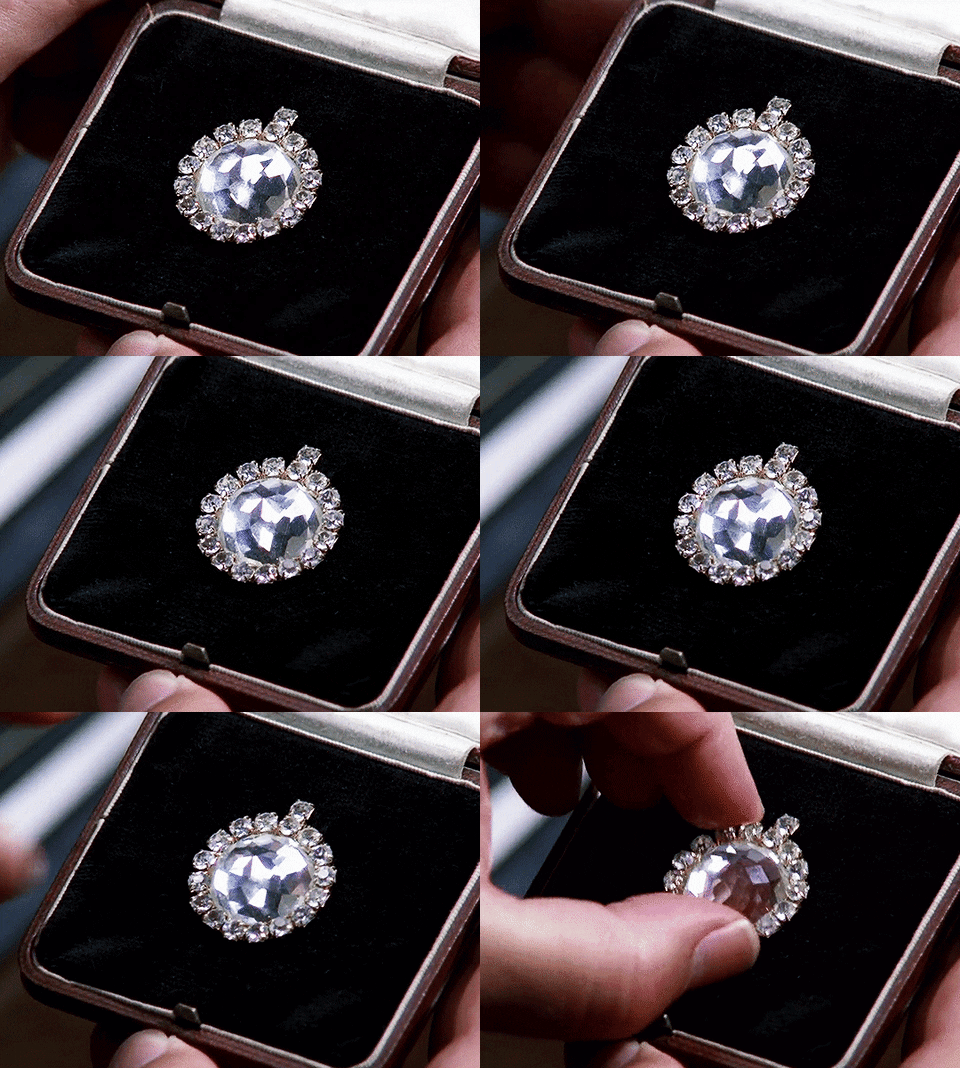
A jewel goes missing from a small party after a teenage girl in attendance bets a diamond merchant that she knows a way to steal his good luck charm. After she beats him and wins the bet, it appears that The Morning Star has actually been stolen. She tearfully explains how she did it but is then baffled by it not being where she hid it. It appears that someone in the room took advantage of the situation and stole the diamond for real!
The only person who had any interaction with the outside world after the game started is the young man who goes to see Parker Pyne. He threw down a coin and received a newspaper back. Could he have thrown the diamond down to an associate instead of a coin? And although there is no evidence against him that would hold up in a court of law, his reputation is ruined. Worse, the woman he loves now thinks he may be shady. Can Parker Pyne live up to his claims of helping his clients find happiness, solve the case, and save this poor kid's love life?
I liked this story quite a bit, but I'm partial to the locked room mysteries. Recommended!
4 Stars. One of Christie's strengths was setting an enticing scene and establishing the appropriate dramatis personae for mystery. In this case, it's the annual regatta in Dartmouth in southwest England. The story is about a criminal enterprise, the theft of a magnificent diamond, which takes place at a lovely dinner at the Royal George Hotel. Which of her readers wouldn't like to enjoy the boat races and the carnival, and take in a hot mackerel feast with such interesting people? As to those guests, Christie offers a few from the aristocratic class, one or two wealthy middle class members, and a ringer or two, often from America. In this case, respectively, Sir George and Lady Marroway, Isaac Pointz, a diamond merchant, and US businessman Samuel Leathern and his schoolgirl daughter Eve. The Regatta Mystery first appeared in the Chicago Tribune in 1936, and in a collection of stories, The Regatta Mystery and Other Stories in 1939. Initially Hercule Poirot was the detective, but my version had Parker Pyne. The challenging question? How was a diamond worth 30,000 pounds stolen? Now you too can find out. (Mar2021/No2025)
Totaal verkeerd verhaal aangeklikt op Storytel en dan maar uitgeluisterd omdat het over een kortverhaal ging. Een drietje waard maar… een lauw drietje.
A happy celebration leads up to the disappearance of the host's mascot: a huge diamond he calls the Morning Star. A young guest told the host she could make the diamond disappear and they wagered on it. She succeeded in making the diamond disappear, but then it turned out that the diamond wasn't in the room at all! How could it have left when no one went in or out?!
One of the guests is suspected because he got a paper through the window and paid for it. He approaches Mr. Parker Pyne to solve this mystery and exonerate him so that he can continue his pursuit of his lady love.
A fun little heist story of a teenage girl who challenges to steal a huge diamond, the morning star, from right under the diamond merchant's nose. Only, their little game leads to the diamond being stolen for real.
Mais uma narrativa de detetives em que pessoas aparentemente inocentes cometem crimes na frente de todos sem serem percebidos, até que uma pessoa mais atenta descobre. Muito bom.
‘The original magazine publication of the story actually featured Hercule Poirot as the lead detective in 1936, but Agatha Christie replaced him with Parker Pyne for the first book edition of the story in the US collection The Regatta Mystery and Other Stories. The story also appeared in the now out of print collection Thirteen for Luck! in 1966. It was later published in the UK collection Problem at Pollensa Bay and Other Stories (1991).’
I first read it in “The Witness for the Prosecution and Other Stories (2004)” - A collection of stories by Agatha Christie. Where it appears in its original form as Poirot and the Regatta Mystery. It is the same account. Poirot’s brings more flare to his dialogue but they are the same.
Parker Pyne was an able detective; indeed he has his own collection of stories (initially twelve (1934): “Parker Pyne Investigates”. Reprinted in 2010.
Regardless of the sleuth on hand it remains a “locked room” type of mystery and is solved by the detective away from the scene of the crime. Consequently they have not met any of the participants at the meal where the diamond disappeared. It is one of the participants who relates the events of the day. He is a hapless young man, more keen on horse racing than the yachting types. It is he who opened the window in the pub to buy a newspaper for the racing tips and results. Suspicion has fallen on him as the only possible means for the theft to have taken place as he could have dropped the stone to an accomplish through the window.
For me it is a slightly incomplete account as it introduces elements we as readers couldn’t know and therefore unlikely to be able to explain how the ‘morning star’ diamond vanished into thin air.
Great sense of place and interesting scene setting on the river Dart. Christie can draw characters in some detail if a little stereotypical at times. But her writing lifts the drama to a satisfying conclusion regardless of the detective revealing the solution to the case.
This is the second Parker Pyne mystery I read. The other one was Problem at Pollensa Bay. The Regatta Mystery was a simple little delightful mystery. It didn't involve murder and wasn't intense. This story is a little diddy about theft and while it had small boring areas, it was a calm and easy read. It put a smile on my face. I enjoyed these two Parker Pyne mysteries by Agatha Christie. In my opinion, this detective, unlike Poirot and Marple, is a little lighthearted. That is ok. I like all of Christie's detectives. Each is unique. Other Parker Pyne mysteries are in a collection called Parker Pyne Investigates. I am looking forward to reading them.
This is the first of the Parker Pyne stories that I've read, and honestly - he's not that interesting compared to Poirot, or at least not so far. The mystery itself is alright, though very convoluted for a short story, to the point where it feels a little laboured. I had to page back and forth to keep the timeline worked out.
I understand that the first version of this story featured Poirot instead of Pyne, so I'm going to read that next. I wonder how different they'll be!
An easy short read, but with an interesting mystery plot. Small party gathered to watch a regatta in Dartmouth, valuable diamond disappears in a closed room setting when a deceptively young teenage girl challenges the owner, Isaac Pointz. I love this classic type of story, where guests are suspects and someone - Parker Pyne in this case - does the big reveal at the end. I find most of Christie's short stories very good.
A compact, satisfying theft/caper involving the jewel known as the Western Star, which also plays a part in the Poirot short story “The Adventure of 'The Western Star'” from the short story collection Poirot Investigates.
I really find fun how Agatha Christie, like Stephen King and many others, drops in Easter eggs like this connecting all her different protagonists into a shared world.
actual rate: 3,5 stars i love to guess what would come next, but this one haha i missed this one too. simple story but successful at making my mind thinking a lot.