Jump to ratings and reviews
Rate this book

Zenith: New Edition #1

Zenith: Phase One

Rate this book
Berlin, 1945: The allies unleashed the second world war hero Maximan upon the German supersoldier Masterman. Maximan’s defeat was only kept secret by the nuclear bomb which destroyed both men. Forty-plus years later, and twenty years after a generation of ’60s British superpowered heroes came and went, the teenage pop star Zenith is the only superhuman left – and his only interest in women, drugs, alchohol and fame.

So when he is contacted about the threat from the many-angled ones and the impending destruction of our world, his first reaction is to steer well clear.But the superhumans of the past have other plans...

Collects

- Phase I (Progs #535–#550)
- Interlude 1: Whitlock (Prog #558)
- Interlude 2: Peyne (Prog #559)

112 pages, Hardcover

Published October 23, 2014

11 people are currently reading
456 people want to read

About the author

Grant Morrison

1,791 books4,564 followers
Grant Morrison has been working with DC Comics for twenty five years, after beginning their American comics career with acclaimed runs on ANIMAL MAN and DOOM PATROL. Since then they have written such best-selling series as JLA, BATMAN and New X-Men, as well as such creator-owned works as THE INVISIBLES, SEAGUY, THE FILTH, WE3 and JOE THE BARBARIAN. In addition to expanding the DC Universe through titles ranging from the Eisner Award-winning SEVEN SOLDIERS and ALL-STAR SUPERMAN to the reality-shattering epic of FINAL CRISIS, they have also reinvented the worlds of the Dark Knight Detective in BATMAN AND ROBIN and BATMAN, INCORPORATED and the Man of Steel in The New 52 ACTION COMICS.

In their secret identity, Morrison is a "counterculture" spokesperson, a musician, an award-winning playwright and a chaos magician. They are also the author of the New York Times bestseller Supergods, a groundbreaking psycho-historic mapping of the superhero as a cultural organism. They divide their time between their homes in Los Angeles and Scotland.

Ratings & Reviews

What do you think?
Rate this book

Friends & Following

Create a free account to discover what your friends think of this book!

Community Reviews

5 stars
215 (30%)
4 stars
303 (42%)
3 stars
152 (21%)
2 stars
30 (4%)
1 star
5 (<1%)
Displaying 1 - 30 of 78 reviews
Profile Image for Mark Lawrence.
Author 99 books55.9k followers
September 1, 2024
One of my favourite series of graphic novels. Written in the 80s with a shallow superhero who captures the decade's zeitgeist. Clever writing manages to comment on the society and politics of the time without being heavy handed. We see a rapidly expanding array of other superheroes an intriguing multiverse and some very sinister / disturbing world-eating opposition.

A very British tale from Britain's finest SFF comic, 2000AD. A comic that I read from issue 10 back in 1977 (quickly acquiring the first 9) and continued to read for another 30 years or so.


Although a creature of the 80s Zenith is suddenly, inadvertently, and sadly, current. He's typically seen in the Ukrainian colours (cyan and yellow) and sports the 'z' that's rapidly becoming the swastika of the 21st century.


Join my Patreon
Join my 3-emails-a-year newsletter #prizes


..
Profile Image for Sam Quixote.
4,801 reviews13.4k followers
May 7, 2018
Nazi superman/Lovecraftian monster wants to destroy the world - arrogant British popstar superhero gotta stop him!

Zenith is really early Grant Morrison (1987-88, back when he was still writing for 2000AD) but it’s not bad and is actually quite accessible and entertaining.

The plot is simplistic so it’s a fairly unmemorable read. The approach feels derivative of Watchmen, with its postmodern view on superheroes, and has a predictable and rushed conclusion. My main criticism though is that there’s no-one here to root for. Both heroes, already established as bastards, grudgingly save the world for selfish reasons - and we’re meant to like them??

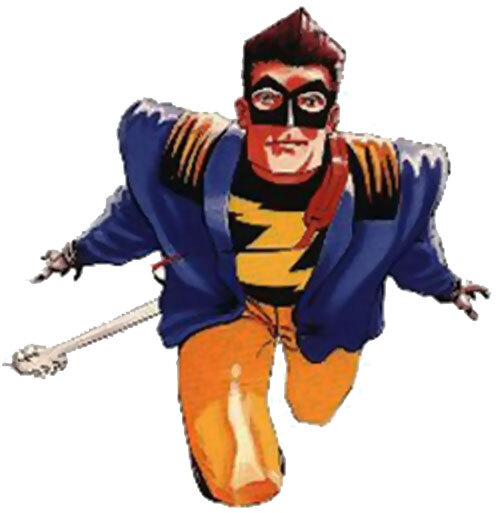
Steve Yeowell’s art is skilful though unappealing and the lack of colour doesn’t help, particularly with the perspective. Zenith’s outfit is also really lacking and unimaginative - shoulderpads and a domino mask? It suuuucks!

Zenith: Phase One has its problems but overall it’s well-written and if you enjoy Morrison’s compelling mix of modern superheroes, magic, horror and psychedelia, you’ll probably get something out of this book. In other words, Morrison fans only (though keep them expectations low)!
Profile Image for Chad.
10.3k reviews1,061 followers
July 7, 2019
Probably the best of Morrison's UK stuff. You still feel those 80's comic influences like Watchmen and V for Vendetta when reading this. Morrison writes a pretty straight forward save the world from Cthullu story with a twist on the superhero archetypes.
Profile Image for Tony Laplume.
Author 53 books39 followers
March 8, 2021
Zenith is a fascinating work, as it turns out.

This was Grant Morrison's first notable project (although by that point he'd already been writing for about a decade), his reaction to Watchmen and The Dark Knight Returns or in other words the idea that making superheroes relevant again was to make them "realistic" and therefore more violent.

He had a much simpler approach. As anyone who knows superhero comics at all will be able to tell you, the Golden Age exactly coincided with WWII. You can still see that reflected in Captain America, the curiosity still anchored in that era but successfully revived (literally) in the Marvel age that followed two decades later, the one currently reflected in a popular series of movies. Morrison took inspiration more directly from those days. He envisioned Nazis who were steeped more heavily in occultism and the idea of the superman than you're probably used to seeing (although both are running themes of the Third Reich that tend to be downplayed by the extent of the Holocaust that became its true legacy, which it should be noted also plays a role in the comics thanks to X-Men villain Magneto's origins), and came up with Masterman, empowered by fourth-dimension entities, rivaled by the British experiment known as Maximan but finally eliminated by the American atomic bomb.

Zenith holds a lot of relevance to Morrison's later work. It's been out of print for years, possibly because Morrison used a lot of characters later in the narrative he did not technically have a right to (which is a terrible excuse), but this is the first in a series of collections that is finally correcting that, and hopefully now its legacy will expand.

You can see parallels to his later Batman in the character of Mandala (as of his presentation in Phase One, anyway), for instance, or even in his latest project, The Multiversity, the idea of the latest generation of heroes having little to do and have as such become regular celebrities, be it rock stars or whatever Kim Kardashian is.

This is the first of four "phases" (or volumes; there was a limited edition that collected all four previously, but that's not any easier to come by than Zenith was before this effort), and as such you don't get the whole story here, although as an opening arc, except for the cliffhanger ending, Phase One can be read for a complete experience on its own. Like Watchmen there's a group of '60s superheroes who for one reason or another disappeared. Much of the volume concerns Zenith's efforts to recruit the surviving members in his quest to defeat Masterman's twin (if this counts as a spoiler in superhero stories, defeated Masterman is by the end).

For its relevance to comics as they actually are, and even for the fact that it made a conscious effort to expand on what comes next, Zenith absolutely deserves to be rediscovered, as well as put in an argument for being the equal of its rivals. As to whether or not it's better, that might need to be revisited in other volumes.

Most of the art is black and white, but Steve Yeowell's work is plenty vivid. The only aspect that seems dated now, nearly thirty years later, is Ruby Fox's hairstyle (almost a female Donald Trump!). Zenith himself is instantly iconic in his look, anticipating much of what the '90s would produce without being weighed down by it. In that sense, Zenith has already proven to be prescient.

I'm an unabashed fan of Morrison, so have long been interested to see what Zenith was actually like, what early Morrison himself was actually like. I think both hold up quite nicely.
Profile Image for Kevin Wright.
173 reviews19 followers
November 4, 2014
Zenith is the magnum opus of Grant Morrison's early UK comics career. While it may lack the mind-bending chaos magic of Morrison in his prime, the story is refreshingly straight-forward and lighthearted, yet still contains the seeds of Morrison's later thematic concerns.

The idea of spoiled, indolent, self-indulgent superhumans (superheroes as pop stars instead of pugilists) is one Morrison picked up again recently in Multiversity. But it was done first and arguably best with Morrissey lookalike Robert McDowell aka Zenith. The story also displays Morrison's abiding interests in magic rituals, multi-dimensional beings and multiple universes, music, fashion, and generational differences. Like the best of Morrison's work, it also takes a firm stand against the grim-and-gritty comics of the day by affirming the power of the imagination.

But, for all that, Phase One of Zenith is still more of a pastiche of influences than a fully formed statement of purpose. While reacting against Watchmen, Morrison still seems heavily indebted to Alan Moore's Marvelman. Both situate superheroes within their social and cultural contexts, integrating them into the social fabric of not only 1980s Great Britain, but of world history, and working out how they would not only operate in the real world, but also impact global events and pop culture.

Of course, the Golden Age of comics was during one of the darkest times of the 20th century. While American comics largely ignored it, the scars of World War II seem to be permanently ingrained in the British psyche. Morrison deftly balances the real world gravitas of atomic bombs, totalitarian regimes, and genocide with the sci-fi absurdity of Nazi aliens from the 4th dimension summoned by magic. He seems to be having an infectious kind of fun mixing '60s counterculture with superheroes and Aleister Crowley and H.P. Lovecraft, but he remains deadly serious in his conviction that imagination is the best weapon against authority.

While not yet at the peak of his writing powers, Morrison deftly paces a complex story told in 5-page increments. Character development is compact, but economical. It feels like there's more to these characters than what we see on the page, and while we may not be privy to their hidden depths, there's a complexity to the characters' decisions, actions, and relationships.

After being out of print for 25 years, I'd be happy with a mimeograph on the back of an eviction notice. Instead, Fleetway has put out a nice, glossy hardcover edition reproduced in sufficient size to admire Steve Yeowell's intricate and expressive artwork.
Profile Image for Sean Kottke.
1,964 reviews30 followers
December 31, 2017
Playful Lovecraftian horror, grafted into a multigenerational Gold-to-Silver-to-Bronze Age superhero saga, with a central hero who's a self-indulgent rock star, provides a trippy and light counterpoint to the tortured vigilantes of Alan Moore and Frank Miller in this late 80s saga from Grant Morrison. This series tilts my favor more toward Morrison in the pantheon of legendary comics creators.
Profile Image for Damon.
380 reviews63 followers
January 22, 2016
This story has some nice moments. I like the sketches at the back especially.
Profile Image for Kenny.
866 reviews37 followers
June 6, 2016
Morrison and Yeowell's excellent retro superhero and his groovy adventures.
Profile Image for Scott Rhee.
2,310 reviews162 followers
April 4, 2019
Reading my many Goodreads friends’ reviews has provided me with a lot of cool recommendations for books and authors that I probably would have never looked at otherwise, for whatever reason.

One of those authors is Grant Morrison, a well-known (and somewhat controversial) figure in the world of graphic novels and comic books. I say “controversial” because Morrison has garnered quite a following of comic book enthusiasts who absolutely adore him. He has also garnered an equal number of comic book fans who seem to detest him.

The reasons are varied and sundry for why his admirers like him, although, in a nutshell, the two most cited reasons appear to be that he is a phenomenal writer with a high-brow intellectual bent that is rare in the comic book world and that he likes to shake things up in well-established comic book series. (His “Final Crisis” envisioned a world in which the DC heroes lost the war against Darkseid. And he killed off Batman.) Strangely enough, the most cited reasons for why his detractors hate him are pretty much the same reasons.

I’m new to the whole Morrison love-hate fest, but I will say that my only other introduction to his work was a six-part horror series called “Nameless” that truly scared the crap out of me and actually gave me nightmares for weeks after reading it. Nothing else has come close to that kind of impact---in literature, TV, film, art, music---since I was young and made the mistake of watching Ridley Scott’s “Alien” on TV with my dad. I honestly didn’t think anything could get to me like that again. I was wrong. That’s good writing, in my opinion.

So, based on that powerful introduction to Morrison’s writing, as well as a recommendation by a fellow Goodreader (Thanks, Kevin!), I picked up one of his earlier works, a series called “Zenith”, which originally appeared in the late-‘80s in a British comic called 2000 A.D. (which may sound familiar to comic book fans as it was also the comic to introduce Judge Dredd).

“Zenith” is anything but a typical superhero comic book, in the same sense that Allan Moore’s “Watchmen” was a typical superhero comic. (Rumor has it that Morrison and Moore did not get along and harbored some hostility for one another. I have no idea if this was true, but they both seem to be very diva-ish, so I wouldn’t doubt it.)

“Zenith” does contain superheroes in it, but any other resemblance to a superhero comic book is purely coincidental. This is as dark and creepy and nightmare-inducing as “Nameless” was.

During World War II, Germany’s version of a superhero, Masterman, an Aryan behemoth bent on the domination of the free world supposedly in the name of Der Fuhrer, was turning the tide against the Allied powers. Germany was close to defeating Europe, until England created their own version of a superhero, Maximan. A final battle between the two took place in Berlin, but the Americans---not taking the chance that Masterman could be defeated---decided to test their top-secret weapon, the atomic bomb, on Berlin. That was the end of both Masterman and Maximan.

Fast forward nearly fifty years later. Most of the world’s superheroes have either retired, died, or drifted into obscurity, except for one. But it would be a misnomer to call him a superhero.

Zenith is a young dude with superpowers, but he doesn’t do much with them. He’s too busy being a rock star, getting wasted and laid every night. Zenith is an asshole.

Unbeknownst to him, however, a secret cult called the Order of the Black Sun is attempting to awaken an ancient god known as Iok Sotot, the Eater of Souls, one of many Ancient Ones that lurks in an alternate universe, waiting for an invitation into our dimension in order to destroy our world. This order also has in its possession the twin of Masterman, which has been cryogenically frozen for fifty years.

Ruby Fox, a retired superheroine named Voltage, is trying to recruit Zenith to help fight the oncoming onslaught of Masterman. She’s also trying to find the remaining few retired heroes. She wants to get the band back together.

With artwork by Steve Yeowell, “Zenith” is a fast-paced, exciting comic book series, but don’t be fooled by the presence of costumed heroes with super powers. This is a horror comic, heavily influenced by H. P. Lovecraft, with lots of blood and guts and slimy creatures with sharp teeth, guaranteed to give you nightmares.

This is so NOT for kids.

“Zenith: Phase One” is the first of, I think, four volumes. Based on what I’ve read so far, and what I know about Morrison’s sensibilities, I don’t foresee a very happy ending for Zenith and the world. I’m hooked, though...
Profile Image for Chris Browning.
1,477 reviews17 followers
November 22, 2019
Zenith started in the very second prog I ever bought of 2000AD and it was probably the main thing that made me come back week after week. I reread to see if my instincts were right about it after finishing Watchmen. And yes and no. No first: it’s not as incredibly clever as Watchmen is and not as well structured or even occasionally profound. But yes: it’s so much more fine and fizzing with ideas and silliness and strangeness and actual jolting horror. It reads like a dream because of that, because that enthusiasm is so infectious. And also
Morrison is very much sending up his worst tendencies in our titular anti hero

As stories go it’s very basics because it literally sets up the world for the smaller scale second phase, the colossal third phase which does a multiverse with British comic superheroes and the strange and horrifying fourth phase. This is the knockabout one, bold strokes and smaller, more satisfying grace notes hidden in the margins. Already Peter St John is a fascinatingly amoral antihero and the breakout star of sorts

The other thing that is striking is Yeowell’s art. Has any artist ever actually peaked on the same book he honed his skills on? The first phase is an artist getting bolder and bolder until he develops that fantastic, dreamlike blockiness of the later phases. But already in the interludes that style is coming. McCarthy’s sketches are fascinating but Yeowell was always the artist this story deserved. He may be distinctly hit and miss these days but here he’s among my favourite comic artists ever

And yeah, this is what Moore is missing for me: big ideas thrown out and played with, eccentric details, great dialogue, darkness and melancholy and horrors waiting around the edges. It’s big and bold and arrogant and kind of knows that is ridiculous and creates a central character to send those tendencies up. It’s a masterpiece and I adore it
Profile Image for Ed Dinnermonkey.
156 reviews1 follower
November 25, 2015
Despite having read 2000AD religiously for 20 years, and despite having devoured as much of Grant Morrison's output as I've been able to get my hands on, I have shamefully never got round to reading Zenith. I know, I know, it's classic 2000AD, it was a fresh and gloriously irreverent British take on superheroes yadda yadda but wow! This was a joy.

What I didn't expect was how fun it would be, what a rollickingly good page turner it is. Irreverent, yes, but not caustically cynical. This is the Grant Morrison who would write All-Star Superman, easily one of the greatest superhero funny books ever, and it's all here, in 1987, dancing across the page in Steve Yeowell's instantly recognisable ink. This is a great superhero comic today; it's a remarkably brilliant superhero comic in 1987. Enormous, cheeky, heartfelt fun.
Profile Image for Aditya Kalapatapu.
3 reviews
July 28, 2015
“I’ve told you BEFORE about drinking and flying, haven’t I? It’s a miracle you have made it home at all."


"I’m nineteen, I can fly, I can flatten BALLBEARINGS between my fingers and I’m practically invulnerable to damage. I mean ‘let’s face it .. What can possibly go WRONG?"


“You’ll be careful in Berlin, Won’t you Bill? I don’t want you ending up as just another name on a war memorial.” “Oh, I wouldn’t worry about that. I am Maximan. I expect I’ll get one all to myself.”

263 reviews5 followers
Read
July 27, 2024
It's funny to think of the revisionist superhero craze of the 1980s as a thing, given how dominant and compelling and seemingly singular Watchmen is, but there was quite a lot of it: Aside from Moore's Swamp Thing, his seminal Superman work and Killing Joke, there was also Veitch's Brat Pack/Maximortal and Miracle man and now I have caught up to Zenith by my beloved Grant Morrison.

It holds up fairly well as (what now seems to be) a straightahead supers comic with disaffected and grownup superhumans trapped in the cynical age of Thatcher. The very tight 3-4 page chapters originally printed in 2000AD make for a pretty compressed and episodic storytelling but there's nothing wrong with that. Zenith is a bit of a cypher and seems to have very little to do with music outside of us being told he's a popstar and having a couple poses with a guitar. The music bits are just window dressing, at least for now.

It was a fun bit of HPL/Cthulhu to get directly into the superheroverse, so there's that. I liked it enough to look for "Phase Two", but alas no luck at the Library.. yet.
Profile Image for Thomas Hale.
976 reviews31 followers
June 12, 2024
The first run of what feels like the 2000AD answer to Watchmen. The remains of a once-vibrant British superhuman team and a spoiled young popstar face off against a revived Nazi superweapon. It's rendered in gorgeous black and white, and the story has a lot of quirks and themes that Morrison would return to in later works. Fun!
Profile Image for Paul Spence.
1,559 reviews74 followers
March 12, 2020
Before meeting our primary characters in the book we are treated to something of a backstory as Britain develops a superhuman, Maximan, to fight against the German superhuman, Masterman, in the second World War. When the tide of their battle turns against Maximan an atomic bomb is dropped on Berlin, where they were fighting, ending the war and killing both Master and Maxi men.

With the origin of super-heroics having been established we then cut to 1984 to establish our ongoing threat: Masterman…or rather his twin.

Following this brief aside, Morrison admirably captures the essence of the time, prominently featuring society’s shift away from the hippie phase of the ’70s, and embracing ’80s rock and roll. This is done in both Brendan McCarthy’s shoulder-pad-heavy costume design and Steve Yeowell’s psychedelic ongoing art. Zenith himself is a fairly successful pop music star, and Yeowell did an excellent job of accentuating the moderate hesitation of the character as he is pulled into the role of a hero. With music being such a tremendous part of the cultural framework at that time it seems completely natural for the book to focus on a pop star.

In 1984 Zenith is seen by the public as the only active superhuman, but rather than helping society with his powers he comes across as a incredibly self-indulgent, using his powers to fly from one party to the next before flying through the roof of his own kitchen the next morning. If you’re looking for a character to sympathise with this isn’t your guy, but he is a lot of fun in this first outing.

We also get to meet Ruby Fox, a former member of Cloud 9 (a superhero team from the 60s that has dissolved). Despite going on record several times claiming that she has lost her superpowers, when she is confronted in her house by Masterman she manages to hold her own and get away to recruit Zenith to aid her in fighting Masterman and the alien race that is possessing him, giving him his abilities. It’s at this point that Eddie, Zenith’s agent, gives us our first glimpse at the larger idea being presented in Phase One. “Maybe you shouldn’t just reject the idea…think of what it would do for your career”

This is really the crux of the story, utilizing the goodwill generated by the free-loving 70s phase as a means for personal, professional gain. It’s hard for me to think about this story without drawing comparisons to Steve Jobs at Apple. Throughout the final confrontation Zenith is joined by Peter St. John (AKA Mandala), a “super-hippie” turned scrupulous politician and former member of Cloud 9. Mandala’s abilities are primarily telepathic in nature.

As the “final boss” of a villain approaches Steve Yeowell’s art shows us the intense dichotomy of Zenith’s fearful hesitance, and Mandala’s calm collectedness. Zenith’s motive seems to be at least somewhat morally founded, and he has all but dismissed Eddie’s comments about what it could do for his career. Meanwhile, Mandala is completely confident in entering the battle, and when he strikes he knows precisely what he is doing. His role in the final battle told me that he was there not for moral reasons at all, but purely because he knew the impact his involvement would have on his political career. It certainly asks the reader to think about some interesting questions regarding the importance of motive behind good works. Namely, how significant is the motive behind doing good works? Is it enough to simply have the good done, or is a deeper moral motive important?

In retrospect Morrison has stated that he sees Zenith’s Phase One story as the weakest, simply because its message is relatively transparent. Certainly an understandable self-criticism, even just from the few lines that I’ve shared in this review, but relative to most superhero books there’s plenty of genuine intrigue and interesting character flaws and development to keep readers interested.

On the artistic side of things, Steve Yeowell brings forward some really remarkable work. The astonishing thing to me is just how high of a caliber the artwork is given the time period that it was published in. Relative to modern comic artwork the level of polish is respectable, but from my exposure to comics from the 80s and 90s this is downright amazing! Not only are the action scenes easy to follow and crisp in intent, but the creature and character designs are absolutely astonishing. Particularly the primary aliens look akin to the work we have seen J.H. Williams producing for Sandman: Overture. There is an undeniable H.P. Lovecraft motif to these characters that really shines through, and the main heroes stand out very sharp against the swirling mass of teeth, eyes, and goo.

It’s understandable that this no longer stands as a pinnacle of Morrison’s work in the field, but it does serve two very valuable purposes. First, it was an incredibly valuable indicator of what Morrison was capable of as a comic writer in his early years. And secondly, although the social motives of the book might be a bit obvious it nevertheless does an excellent job at capturing the essence of the era, providing a valuable view at the concerns and personalities of society at that time.
Profile Image for Owen Watts.
104 reviews2 followers
April 15, 2022
This much-lauded 80's superhero tale, despite (even by Morrison's own admission) clearly stealing chunks from Watchmen, is a breezy number and a genuine joy to read after many years away from it. The nebulous Lovecraftian nether-gods aren't particularly compelling but the alternate history world building, solid cast of characters and contemporary British pop culture stuff is legitimately grand. Yeowell's art is crisp and unfussy and he manages both the cosmically existential and domestic with ease. Zenith certainly deserves most of its lauds - although I'll have to root through my mountains of 2000 AD back issues to carry on the story though as the GNs are notoriously hard to come by!
Profile Image for Mia.
361 reviews1 follower
October 7, 2019
Think 'The Incredibles' mixed with 'Batman' (understandable) and 'The Wayward Children series'.

This graphic novel looks at the life of superheroes after they've done their superheroeing (that is 100% a word). They've created lives for themselves and generally moved on with new and exciting projects, kind of like the Incredibles did (although exciting is possible too strong of a word) in their franchise. Where things get messy is when a younger superhero starts to make a mess of being a hero and can't protect the world from a villain that is threatening humanity.

The reason why this graphic novel reminded me of Batman is because a) all the people were flawed, even if they were heroes, because they were above human (!!!!) and b) not everything was happy, sunshines, the heroes win but darker and not afraid to sacrifice characters that we have grown to love. Obviously you'd expect that from a person who has written about 100 gazillion (totally legitimate maths, I promise) Batman graphic novels but it was nice to see that his style from those novels bleed over into this graphic novel.

I'm so excited to carry on with the rest of this series (which I will be stealing from my dad's bookshelf asap) because I could tell that there were so many more layers to the story. As I was reading the graphic novel I was mentally making notes of the storylines that weren't bought to a conclusion and let me tell you something! There were some MAJOR storylines that weren't wrapped up so I need to read the rest of the series to find out if my theories are right.

Additionally, unlike most of the people here this is my first Grant Morrison book (I think, I could be wrong) so I went into this with no expectations and came out of it wanting to read everything that he has written. Looking at his list of books that he has written / co-written I have enough books to last me about 7 years so I should be able to satisfy that itch!

(p.s. just because the story lines weren't wrapped up didn't mean that I left the story feeling unsatisfied, and if anything I left it feeling excited for the next books in the series)
Profile Image for Casper.
130 reviews2 followers
March 23, 2020
Zenith is awesome!

I haven't read any 2000ad before this, but I'm really loving the format! The 8-ish page chapters and the large magazine sized pages are super great.

Steve Yowell does an incredible job on this book! I started out hating him drawing The Invisibles, but by the end of it he was one of my favourite artists on that book. On Zenith he is on point from page one, though. I'm usually struggling with black and white pages, but the heavy lines and large pages made it easy to understand. Also the couple of pages with color were awesome, and I loved it when the story got Morrison crazy. Yowell was very good at keeping up with the craziness.

It was also amazing to see the first printing of some of Morrison's crazy ideas. He's so definable already at this stage, and though he'll evolve his style to be more refined down the line, I think reading this has helped me interpret some of his other stuff a little better.
I'm a big fan of Zenith being inherently unlikeable and a total coward. He has a lot of room for growth, but his interdimensional enemies are not giving him room to breath as everything around him is ripped to shreds and he just keeps whining.

Also this book is damn gorgeous! On the outside, too! I know this is for book reviewing but I gotta say, this is a real decorative book.

I'll be looking forward to reading the rest of the phases and displaying the entire set to hopefully have people ask about it, so I can lend them to people, cause this series is awesome.
Profile Image for Keith Davis.
1,100 reviews15 followers
November 29, 2019
Nazis from another dimension are trying to take over the world and only a British pop star can stop them.

Zenith was one of Grant Morrison's earliest published works. You can see here several of the ideas that recur throughout Morrison's career. The concept of higher dimensional beings attempting to enslave or destroy the Earth, which ran all through his Invisibles series, provides the core plot here. The idea of superheroes as pop culture celebrities, which he revisited in Final Crisis and Multiversity, shows up here for the first time. The story moves very quickly and is surprisingly violent for Morrison, but it was originally published in 2000 AD, home to Judge Dredd and other ultra-violent British comics.

I have wanted to read Zenith since becoming a fan of Morrison in the 90's. Unfortunately this edition was published without the consent of the creators due to a long running dispute over the rights to the material. Purchasing this edition was a choice between violating the wishes of the creators or probably never getting to read the series in my lifetime. It is a sad commentary on the comics industry that so much material, including the classic Watchmen series, is only available in additions that rip-off the creators.
Profile Image for Brent.
2,248 reviews195 followers
November 17, 2017
Thought I read this at least twice in 1980s but all forgotten. Sketches by (the late, great) Brendan McCarthy are as good as the fine comics storytelling art by Steve Yeowell. And, was there scripting by Morrison before this? I can't recall reading his Near Myths comic art. I never read 2000AD, the anthology magazine from the UK, so these all came to me in collected editions: in the 1980s from Titan (books) and Quality (comic books), now this, from a new fine publisher, who has done a good job with printing and reproduction.
It's sort of a 1980s hair, new wave, melodrama with superheroes and villains from a mythical UK 1940s and 1960s: a very good audition for Morrison's later work with the Marvel and DC canon.
Recommended.
Profile Image for Nate.
1,973 reviews17 followers
Read
September 18, 2019
I loved this. Zenith is one of Grant Morrison’s early comics, published in 2000 AD and a great showcase for his admiration of superheroes. It’s got everything: Nazi ubermen, hippie superheroes, Lovecraftian gods, anti-Thatcher politics, and a reluctant hero in the form of a pop star. The whole thing is very fun, and seems pretty ambitious from this first book. Morrison does a great job with the world-building here. I’m fascinated by the history and characters, and want to learn more about them. For instance, what happened to those heroes who vanished in the 60’s?

Due to the six page weekly format, the storytelling occasionally feels rushed, but it’s not much of a problem. This is good stuff all around.
Profile Image for Wombo Combo.
574 reviews13 followers
October 18, 2020
Pretty solid early superhero work from Grant Morrison. I love the idea of normal super folk fighting against horrible Lovecraftian monsters. Coming from Grant Morrison, I feel like this is a more cynical work than you'd expect. It has some nice golden age moments and isn't overly dark, but it's certainly a more mature work than I initially anticipated. Aside from a couple things, I liked this one a lot.
Profile Image for Richard Eyres.
594 reviews9 followers
September 13, 2020
I remember reading this when it first came out in 2000AD comic. I enjoyed it back then, but probably didn't fully understand it.
Bought the full collection in Hardback (special offer from Rebellion), and thoroughly enjoyed it. Glad i bought the whole lot now.
Yes, VERY 80's and British - but hell, i love that.
Profile Image for Peter.
684 reviews
December 31, 2020
The story of Zenith is a weird tale of superheroes published in 2000AD some time in the eighties. It is both retro and a very cool concept. The very British superheroes go against Nazi villains and multidimensional body snatching entities that threaten to destroy the world.
Profile Image for Dan.
170 reviews1 follower
November 9, 2014
Another 80s British semi-apocayptic Thatcher government era superpowered comic but it IS a very good one!
Profile Image for Craig Thomson.
Author 1 book2 followers
June 21, 2017
Classic Morrison, fast paced to suit the 2000AD style, but beautifully scripted with excellent art. Roll on Phase 2.
Profile Image for Martin Nisbet.
94 reviews1 follower
July 23, 2018
2000AD finally got round to superheroes in the late 80s and this was the result. Magnificent really. I'm so glad this got a good reprint after years in publishing rights dispute.
Profile Image for Brendan.
1,585 reviews26 followers
January 27, 2019
A simple superhero story that definitely points the way, with its Lovecraftian villains and hints of genetic experimentation, at Morrison’s later mindbending work.
Profile Image for Timo.
Author 3 books17 followers
September 29, 2019
The 80s was the time when "comics grew up" and "were re-invented". Some of that period stuff was so-so, some was good. This one is the latter one.
Displaying 1 - 30 of 78 reviews

Can't find what you're looking for?

Get help and learn more about the design.