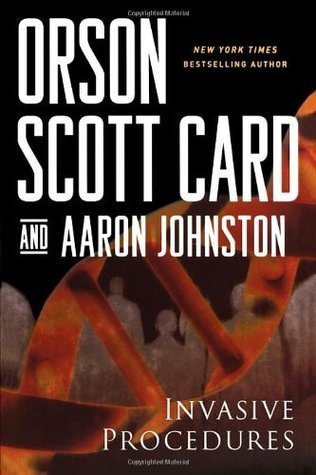
George Galen is a brilliant scientist, a pioneer in gene therapy. But Galen is dangerously insane - he has created a method to alter human DNA, not just to heal diseases, but to "improve" people - make them stronger, make them able to heal more quickly, and make them compliant to his will. Frank Hartman is also a brilliant virologist, working for the government's ultra-secret bio-hazard agency. He has discovered how to neutralize Galen's DNA-changing virus, making him the one man who stands in the way of Galen's plan to "improve" the entire human race. This taut thriller takes the reader a few years into the future, and shows the promise and danger of new genetic medicine techniques.
Orson Scott Card is an American writer known best for his science fiction works. He is (as of 2023) the only person to have won a Hugo Award and a Nebula Award in consecutive years, winning both awards for his novel Ender's Game (1985) and its sequel Speaker for the Dead (1986). A feature film adaptation of Ender's Game, which Card co-produced, was released in 2013. Card also wrote the Locus Fantasy Award-winning series The Tales of Alvin Maker (1987–2003). Card's fiction often features characters with exceptional gifts who make difficult choices with high stakes. Card has also written political, religious, and social commentary in his columns and other writing; his opposition to homosexuality has provoked public criticism. Card, who is a great-great-grandson of Brigham Young, was born in Richland, Washington, and grew up in Utah and California. While he was a student at Brigham Young University (BYU), his plays were performed on stage. He served in Brazil as a missionary for the Church of Jesus Christ of Latter-day Saints (LDS Church) and headed a community theater for two summers. Card had 27 short stories published between 1978 and 1979, and he won the John W. Campbell Award for best new writer in 1978. He earned a master's degree in English from the University of Utah in 1981 and wrote novels in science fiction, fantasy, non-fiction, and historical fiction genres starting in 1979. Card continued to write prolifically, and he has published over 50 novels and 45 short stories. Card teaches English at Southern Virginia University; he has written two books on creative writing and serves as a judge in the Writers of the Future contest. He has taught many successful writers at his "literary boot camps". He remains a practicing member of the LDS Church and Mormon fiction writers Stephenie Meyer, Brandon Sanderson, and Dave Wolverton have cited his works as a major influence.
If you're considering buying/ reading this one, be aware that Card did not write it. It's based on one of his earliest short stories, and he collaborated with Aaron Johnston in planning it, but I have no doubt that every actual word was written by Aaron Johnston. Bless his heart.
The science was boring and predictable (probably made a great and creepy short story 20+ years ago), the characterization was unbelievably superficial, the dialogue was painful. The evil characters were Dr. Evil-style evil. Bleah.
So why did I keep reading? Well, I've been abandoning a LOT of books recently, and I wanted to actually finish one I'd finished 2/3 of, instead of leaving it lying on my nightstand for months...also, I'd paid full price (at least in paperback). And to be fair, the plotting was interesting enough that I wanted to see how it would resolve. (Thus the 2 stars.) But overall, it read like the bad novelization of an utterly forgettable action movie.
Genetics is one of the reasons I'm glad we have science-fiction authors. So far physicists have conspired to make faster-than-light travel impossible (or at least highly impractical), so perhaps we won't be meeting any intelligent alien species any time soon. In the past ten years, however, our understanding of genetics and the human genome has grown considerably. As we become more adept at manipulating our genome, whether it's to cure hereditary diseases or augment healthy genes, we must confront questions that, until recently, were exclusively the domain of science fiction. We will be faced with moral crises as we struggle to define what it means to be human, whether parents should be able to choose fundamental attributes of their children, the lengths to which we will go to make people "better." These are questions without easy answers, and we are damn lucky that there are brave men and women blazing a trail, looking at our options. When considered carefully and thoughtfully, the results are stories like Nothing Human, "Act One", and Lilith's Brood.
When done poorly in the style of a thriller, well, you get Invasive Procedures.
Excuse me while I ascend into my ivory tower of literary elitism, not that I'm here to disparage the quality of thrillers in general or, indeed, engage in any sort of genre-ist bigotry the likes of which has been perpetrated upon my own beloved genres of science fiction and fantasy all too much. I won't lie, however: the title of this book nearly turned me off; I picked it up because it has Orson Scott Card's name on the cover (and it was free), and that is where the good times stopped.
Calling the characters of Invasive Procedures "cardboard" would be an affront to thick paper stock. There is not a single memorable character in this book. The bad guy, George Galen, is a stereotypical discredited scientist who leads a cult and plots to make humanity better even as he ensures his own immortality. The Healers have gone around curing people of incurable genetic diseases through the use of personalized gene therapy. To anyone other than their intended recipient, such therapies manifest as virulent and rapidly-fatal (people die within minutes of being exposed). So the fictitious Biohazard Agency, or BHA, decides it has to take the Healers down. Considering that the director of the BHA becomes one of Galen's brainwashed lackeys, complete with tremors and a penchant for referring to Galen as "the master," you can guess how well that plan goes.
This brainwashing thing really irks me. It strikes me as a very lazy way to turn good guys into antagonists and traitors. Building betrayal, laying the right seeds and creating the proper conditions for treachery, is a complicated business. It must be done subtly enough that it is believable, but obviously enough that when the reader looks back, the clues are all in place. But a solid, well-executed Face Heel Turn is just so rewarding! Brainwashing is the lazy writer's way out. It certainly can be used to great effect sometimes; this book just isn't one of them.
The trouble here with brainwashing is that it removes volition, and without volition, the conflict in the story is meaningless. If Galen just brainwashes his way into power, that is bad, but it isn't very interesting. Betrayal is interesting and dramatic because it is real, because a traitor is responsible for his or actions, whereas a brainwashed saliva addict is not.
This might be forgivable, except that volition—or the lack of it—is a big problem in Invasive Procedures. None of our characters, not even the ones not dropping Galen-spit, seem particularly interested in exercising their free will. Frank Hartman, the "hero" of the book, accomplished his major contribution prior to the story's beginning; he already has a "countervirus" when he joins the BHA. The rest of the book consists of him being manipulated by the lackey-director and demonstrating his intelligence and manliness in front of the heroine/love-interest, Dr. Monica Owens.
Of any of the characters, Monica's situation and motivation is the most acceptable. She becomes Galen's personal surgeon because he kidnaps her young son. That's understandable, I suppose. Card and Johnston don't give us much time to get beyond this most primitive need to protect. They make it clear that the brainwashing victims don't have much choice in the matter, and in a similar way they harp upon Monica's powerlessness. Powerlessness and not having a choice seems to be a big thing in this book. As with all the characters in this book, the narrator presents the basic facts of Monica's life in stark exposition. We learn almost nothing about who she is from what she does, because she does so very little. It's as if the authors are afraid to give their characters anything to do, lest the characters disrupt their precious little plot.
As far as that goes, there is nothing about Invasive Procedures that stands out to recommend it above the average thriller. Card and Johnston never dig deeper than the surface of the issues they raise, totally dashing my hopes that this book would prove any good. To be fair, they deftly manipulate the emotional consequences of the Healers' actions, tugging on heartstrings as we see a young girl suffering from sickle cell anemia. That's all well and good, but it doesn't quite balance against the hackneyed exposition and the horror-movie level bad science: a virus that kills people in minutes, a chip that rewires the brain in seconds to restore the memories of a dead man, not to mention a virus that rewrites Frank's entire genetic code!
I guess what I'm trying to say is that this book, while nominally science fiction, is not good science fiction. It asks Big Questions, but it deigns not to facilitate the Big Discussions that should naturally follow, preferring instead to force its characters to conform to a convoluted, largely unexciting and predictable plot. If you are looking for a creepy book about organ transplantation and rogue gene therapy, this is not it. Likewise, though my experience in this area is lacking, I wouldn't even recommend Invasive Procedures for its thriller qualities.
Of course, it's entirely my own fault for reading it. No one forced me, recommended it to me, or even pointed out its existence. I picked it up off a table because it was looking forlorn, knowing full well that despite Card's name on the cover, it probably wasn't going to be very good. Sometimes books like this surprise me, hence the popular adage discounting prejudice based on the cover. Sometimes books like this don't surprise me. Invasive Procedures fails across the board, with flat characters, a predictable plot, and unsatisfactory science-fictional elements.
This is a tricky one to call - I have known of the book for some time but only recently got round to buying it. The works of Orson Scott Card has always been a bit random for me - the story of Ender Wiggins is one of my all time favourites while some of his other series have struggle to inspire me (Memory of Earth - although I should try and give it another go)
However his stand-alone fiction has usually been rather good as it can be so random and varied. However I think this is the first collaboration I have read of his and I am not sure.
Now if I am not sure why such a high rating - well I will get to that, however first of all the question marks.
First of all you have some very clever ideas here mashed up with some very contrived ones now without spoiling the story or giving away spoilers you have some very details and well explained biological elements and the some sort of chip that feels like it was dropped in at the 11 hour to justify the plot.
Then you have the plot itself - it felt like it was a tale of several parts - almost as if each author did a section and handed it over to the other to add the next and you can almost see the joins.
So if its contrived and "clunky" why such the high rating - yes we are back to this. Well first of all it was a fast read it was engaging and the characters (on the whole) were enjoyable and likeable - no one likes a smug sanctimonious hero after all and if you can read past some of the more questionable science the story was a series of fast pace chases - rather like watching the Tom Cruise Mission Impossibles - if you come in with no preconceptions you will enjoy it - look for the next Robin Cook medical drama and you may be wanting. Me I had no clue (no surprise) and so was enjoying it although sitting back I do wonder what exactly was I reading.
An author's name should represent something - it's a brand after all, and gives some kind of quality assurance.
So Mr. Card: "Say it ain't so!" Did you actually write a single word of this mess? Or was it just based on your short story from way back?
Top Five Reasons why you should read this book: 1) you find ways to enjoy second-rate writing 2) you don't mind unrealistic science being used as a key element in a thriller 3) you can tolerate awkward plotting designed to keep the suspense going 4) you can overlook weak characterization (especially in which characters behave in ways that are inexplicable) 5) you have read everything else, and this is the last techno-thriller left on your shelf
It's not the worst book ever written, and there is enough within to make it worth a couple hours if you need a trashy read at the lake or on the plane...
But there's not much else remaining to redeem this book and make it worthy of recommending.
This sci fi novel has a few interesting ideas. The plot, however is so-so. The story is fast-paced and sometimes exciting. But the psychological concepts for which the author is well known for developing are not developed here as well as they could be. For example, what is it really like to have two sets of memories?
If you are looking for a fast-paced thriller for summertime reading, then this book is for you.
7/10 en 2012. No está mal, se deja leer. La maestría con la pluma del Sr Card hace que el libro tenga interés ... pero no me acaba de convencer. Tal vez porque al autor de El juego de Ender, Maestro Cantor o varias otras novelazas le exiges algo más que una historia bien contada y amena. De Card siempre espero lo máximo y aunque a esta novela basada en avances genéticos creo que no se puede reprochar nada, no acaba de convencerme.
I like Orson Scott Card, but this book is not really written by him, which I think is the problem. It's based on a short story of his, but then Aaron Johnston turned it into a screenplay and later this book. We're told in the back of the book that Aaron is a "successful Hollywood screenwriter", of the kind of movies that I don't like, I'd imagine. The writing might be fine for a screenplay when the actors will bring more to it, but I found the descriptions generic, and the attempts to express what the characters were thinking laughable. The "religious" elements of the book were unbelievable and didn't seem to fit. Also, I felt like all the science explanations were dumbed-down, so either Aaron didn't trust that people could get it or he had to dumb it down for himself.
I find OSC books compelling, immediate, sometimes shocking but always engaging. Even when I don't like his ideas I can't put his books down. This is more like a Michael Chricton novel than an OSC story, which could be fine, but it's just not executed well. Due to the slow pace and clunky writing I put this one down and will not go back to it.
I'm shocked. OSC's books normally get 3 or 4 stars, but this one just sucked. The idea behind it seemed OK - gene therapy used for morally ambiguous purposes - but the execution was awful. The writing wasn't tight, a lot of redundancy & useless description. The science was bogus, not just SF, but unbelievably ridiculous & miraculous. The characters were caricatures & the plot just became stupid. I got about halfway through &, as much as I wanted to hang on, I just couldn't. Rudnicki's reading was as good as ever, but a polished turd is still a turd. This is a turd. :(
I've since found that this was based on one of OSC's short stories, but the novel was actually written by Aaron Johnston, who apparently writes comic books. He should stick to them. I won't read anything else this author had a hand in.
This is actually a collaboration with Aaron Johnston. Originally a short story by Card, Johnston developed it into a screenplay with help from Card, and then Johnston turned the screenplay into a novel. It's well-written, definitely different from Card's usual style. I liked it a lot; it has suspense, interesting social commentary and biology, and it keeps you guessing.
This novel totally freaked me out. And not in a good, thriller kind of way: what boggled my mind the most was how a writer as smart and self-examining as Orson Scott Card could possibly allow his name to headline this sophomoric mess. The lead male and female are virtually cardboard cut-outs, and I was honestly surprised by all of one scene in this book (and that was about 300 pages in.) Otherwise, it was predictable and unexciting. Card virtually apologizes in his afterword for how the book was transposed from the "thinner" media of film (a very accurate description, by the way, and further proof of Card's self-awareness.) That said, I honestly cannot see why this was published except to a) capitalize off Card's name, and b) drag Johnston up by Card's coat-tails.
The other thing that made me scratch my head was the way the authors decided to treat the Messiah complex of the villain. There's a dissonance, for me, between the way George Galen is considered in this book and the Mormon faith of the authors. Is this supposed to be an allegory? Are the loose ends supposed to hint at, Heaven forfend, a sequel? If the authors were trying to make their readers think about the morality of gene therapy, they've pretty much failed. It was just a weird, disappointing read, a complete throw-away novel.
Two weaknesses in this novel are: a) an inadequate level of hard-science as background to some fairly significant advances in genetic technologies. b) some strained 'leaps-of-faith' of character behavior changes at some key points in the novel (no spoilers here).
Nevertheless, you will probably enjoy this novel as escapist 'vacation' reading.
It reads like a novel from a screenplay. Enjoyable, but Card did a much better job with his novelization of the screenplay from The Abyss.
This book is NOT written by Orson Scott Card. It's based on a short story written by card, but this actual book is written by Aaron Johnston.
This book started out promising, but by the end was just kind of far-fetched and lame. There were interesting ideas and medical bits through-out, but overall a bit of a let-down. 2-2 1/2 stars
It's unfortunate that a major plot point rests on the (false) idea that humans only use 10% of their brains (when will we stop perpetuating this idea? It belongs in the trash along with Myers Briggs "personality testing" and left brain/right brain woo). Otherwise, the science in the novel sounded (to me, a liberal arts major) real. The subtle reinforcement of gender norms, particularly around Delores's attire, was a bit unfortunate. More unfortunate was the underlying theme that DNA modification/gene therapy is too scary and so science just shouldn't go there. While I have been a fan of his writing since my early childhood (Ender's Game was my favorite book when I was age 10 or so), I now spot instances where Scott Card's conservative and/or religious beliefs seep onto the page.
It is apparently a tragedy that Orson Scott Card's name is attached to this book. I've read a little by him, and thought it was better then this book, and Drew has read most things by him, and, after reading this book, said that it was far below Orson Scott Card-level writing. And, if you read the front of this book, it's because the actual author of the book (whose name is listed in smaller print underneath the ginormous lettering of Card's name) just collaborated with Card for ideas, and Card didn't actually write any of it. But now bunches of people will get it because the collaboration was apparently enough to get his name on the cover.
In any case, the book was mediocre. Characterization is really important to me, and while a few characters were defined (namely, the homeless people), the two main characters might as well be called "Protagonist who can do anything" and "Love interest". Characters did things that made no sense, and were completely oblivious about other things that seemed really obvious to me. Some of the ideas in the book were really interesting, though, and were presented in an interesting enough way that I kept reading. Someone who didn't mind flatter characters would probably enjoy this more then me - if left me feeling the way I did when I tried reading one too many Dan Brown books, but that's because I think Dan Brown only has a few kinds of characters he can write. I guess I just like seeing more development beyond the "He's a smart and cunning character, and is also super strong/physically abled! She's an intelligent and quick character, who also happens to be exceptionally beautiful!" But then, I'm a sucker for characters with actual flaws (and actual personalities).
A virologist with military training, Dr. Frank Hartman, must find a way to stop a genetic scientist's insidious plan that goes beyond healing genetic disorders. This scientist, George Galen, believes he has the science to take humanity to their next step in evolution. His followers' physical advancements make them formidable opponents and the stakes our heroes have to overcome to avoid unleashing a catastrophic virus, let alone maintain their sanity, make this story a thrilling ride.
I picked up this book as a research tool into genetic therapy, but was instantly hooked by his characters, writing style, and the way he kept me guessing which way the story would turn. I felt more like I knew his characters than that I simply knew what they looked like, and that added a personal touch that kept me engaged in their lives from page one straight to the end. I walked away from this book planning a second read to further study his craft and because I just loved the feeling of such a flawless delivery of a well-crafted story.
As background - I really enjoy thrillers based on modern technology. Another bit of background- i am a huge, huge, orson scott card fan.
Having said that, you will understand why this review pains me. I really thought that i would like this book. It had everything i could want. Or so i thought. Unfortunately, despite the fun little bits about technology there were serious issues.
First, the technology was poorly thought out. Second, the characters seemed anything but believable.
Third, and what bothered me most is that Card writes stories. He can tell a story better than most other writers - not the most eloquent or beautiful language - but the story shines through. Even when he tells stories about topics I don't particularly care about he tells them so that i am interested. And in this book, the writing didn't work - it wasn't up to his standards.
What starts off as an interesting, futuristic medical thriller quickly turns fantastical and unbelievable half-way through... just like every attempt Card has made to quasy break into main stream fiction... The only saving grace is that the book is a stand alone novel... Perhaps Card should have rested on the laurels of Ender's Game and simply stopped writing there. The world of literature would be a better place for it.
This book was pretty damn bad. The science wasn’t good and the fiction wasn’t good so it wasn’t very good science fiction. I didn’t feel drawn to the characters at all, and they were not complex, and the plot I also didn’t fuck with very much which is a shame because usually the plot based novels like this one have a good plot. Sometimes novels like this one will throw so humor or something cool at you too; not this one. Basically I just thought it was really subpar in a lot of ways. I wouldn’t recommend this one.
It is hard to believe that I finally had to shelve a book with Orson Scott Card's (OSC) name on it. I rarely stop reading a novel once I start it, but after 8 hours and 25 chapters I finally said no more. I just couldn't get into the characters, and the storyline was only loosely developed. I was expecting the deep analytic style of Card that provokes thought. I chose this novel because it deals with genetic engineering and I wanted to see where the author would take us. Sadly, the author chose to take us in frantic circles. There wasn't much science to this novel. If I had to describe it in a couple of sentences, this would be it:
A mad genius of genetic engineering, "the Master", hides behind the veil of using modified viruses to deliver life-saving gene therapy to people plagued with a genetic diseases (whether they want the treatments or not). Discredited by his peers, he sets up secrets labs to not only treat those without hope, but to engineer his own super race. Unfortunately, the customized viruses are deadly to anyone who comes in contact with a patient undergoing treatment. In a mad rush to try to stop him, the government enlists the help of a scientist who inadvertently finds a "vaccine" that works against the virus. Suddenly thrust into the role of government take-down team, our protagonist discovers the true nature of the research. That is to create what amounts to genetic horcruxes of the Master in his attempt to live forever.
While this premise may sound engaging, it's really not. The characters are dolts and you spend have your time thinking WTF. This story doesn't read as a deep dive into the realities of genetic engineering or believable scenario in how viral vectors in gene therapies could be used to their detriment. Instead it is highly speculative and presents a worst case scenario without building a firm foundation in scientific research. In retrospect, I should have realized the story idea belongs to OSC, but the written execution appears to be primarily that of Aaron Johnston. I am surprised that Card allowed his name to be featured so prominently on the book cover. But I guess the publisher needed some hook to sell this novel.
Excellent! Wow! I have been a fan of Orson Scott Card for about thirty years. I will read any book that has his name on the cover and I have. I thought it was time to read this one since I'm living through the Corona Virus, and this book has a virus as a crucial part. While I'm reading this I'm finding this more and more intriguing. There are twists along the way. I'm wondering if Aaron Johnston has written any books on his own, because if he has, I will start reading them.
As I'm reading this book, I realize I'm seeing it as a movie. I check to see if it's in the works, but it doesn't look like it is. When I read the afterward I learn that Johnston is the screenwriter and that's why this is so cinematic.
This is a great book and I was sad when it was over.
I really enjoy this author. This one did not do it for me. This was about science, and unforgivable sin. I can except bad science fiction because after all it’s pushing the envelope but here the science simply made no sense whatsoever. The characters were conveniently gifted with phenomenal healing power, impressive physical strength, and stupidity. Not a good combination. And the idea that a surgeon could go ahead and do five separate transplants, all successfully, all of the areas in which she doesn’t work in the first place, cost me once again to question the flightline. The bad guys are always bad, the lost man happen to be above average, and the good guys are ultimately noble. They did not seem to be a lot of work put into this book. The plot line just did not ring true.
Picked this up because I love the Ender series so much, but was mostly disappointed. The author says he was inspired by a screenplay based on a short story by Orson Scott Card, so it's not technically by the same author, and they really have nothing in common. The book itself wasn't too bad, with an action-packed story that made for quick and easy reading, but it didn't have any of the same depth or thoughtfulness that I was looking for. The story revolves around a fairly unbelievable tale of a mad scientist using viruses to mutate genes and some unlikely medical, military and homeless heroes who save the day. I didn't hate it but certainly didn't love it either.
An interesting read. I went into this completely blind, just picked a random audiobook off the shelf at the library because I vaguely recognized the author's name.
I was interested in the plot and enjoyed the read.
Like many sci-fi books, the female characters were incredibly 2D which was frustrating as always. Most of the book it wasn't too annoying but it ended on a sour note for me here.
Don't think I'd recommend but don't regret reading either!
I read the audiobook edition, and the narrator did a great job of being engaging, it announced when the CD was over (always a godsend), and had good pacing. No complaints there!
This is unlike any of Card's other books that I've read. Perhaps that's because it's co-authored with someone else, and is based on a screen play which was in turn based on a short story of Card's. Whatever the reason, this focuses more on biological and medical science than do Card's other science fiction works, which are more in the nature of space opera. I enjoyed that about it, and found the characters interesting. It had a bit of a mystery/thriller aspect to it as well. Overall, I'd say it was a good book, not a great one like some of Card's other work.
A solid sci-fi work, though I could very much do without the casual sexism sprinkled throughout. The author portrays women first through appearances and only then considers who they are as a person, or sometimes intertwines the two completely. Just a newsflash to anyone who needs it: Women are not what they wear, nor should their worthiness be dictated by what they wear. An otherwise enthralling book, though the dialogue is very forced at times and what the author WANTS you to think of each character is kind of shoved down your throat; there isn't much room for interpretation.
interesting little book about a man made virus. the covid-19 conspiracy theorist c/would consider this as proof. though i am a little confused at how fast this man made virus kills in just moments because it takes over the whole body (faces melting off) but the treatment that virus is doing takes three days. seems like both should take roughly the same amount of time or maybe it would kill in half the time.
This is a perfectly fine medical/sci-fi thriller. I bought the book, however, because Orson Scott Card was an author. Had I not gone into reading it with the expectation of what an OSC book is like, I probably would have enjoyed it more. There was none of the humor, snappy dialogue, or piercing insights about humanity that I appreciate about him. Aaron Johnston is a competent writer who wrote this adequate novel based on an OSC short-story and they collaborated on this book.
Una gran decepción sinceramente, después de leer la maravilla que es la saga de Ender. Libro palomitero, totalmente plano, final previsible y sobre todo, cero conflicto ético moral que es lo que buscaba en este autor. La premisa inicial de los curadores podría haber sido interesante de no ser porque desde el principio se deja claro que el doctor no es más que un científico loco, megalómano y egoísta, lo cual elimina cualquier posibilidad de plantear un conflicto de alguna clase