

What do you think?

Self-Help from the Middle Ages
What can a twelfth-century monk teach us about burnout, envy, or despair? Far more than we might imagine. In Self-Help from the Middle Ages, historian Peter Jones travels through Europe’s archives and libraries to uncover a lost a world where confession was therapy, sin was diagnosis, and the Seven Deadly Sins served as a map of the human mind.
From the deserts of Egypt to the Vatican Library, from Dante’s Florence to Catherine of Siena’s cell, Jones introduces the thinkers, mystics and rebels who wrestled with the same questions that preoccupy us how to live with our flaws, forgive ourselves, and find meaning amid confusion.
Medieval lives and landscapes come vividly Siberian winters and Parisian manuscripts, lustful saints and anxious scholars, candlelit abbeys and vaults of forgotten books. Wise, surprising, and deeply humane, Self-Help from the Middle Ages reveals that the remedies we seek for our 21st-century anxieties may have been with us all along—written in brown Gothic ink on lambskin seven hundred years ago.
From the deserts of Egypt to the Vatican Library, from Dante’s Florence to Catherine of Siena’s cell, Jones introduces the thinkers, mystics and rebels who wrestled with the same questions that preoccupy us how to live with our flaws, forgive ourselves, and find meaning amid confusion.
Medieval lives and landscapes come vividly Siberian winters and Parisian manuscripts, lustful saints and anxious scholars, candlelit abbeys and vaults of forgotten books. Wise, surprising, and deeply humane, Self-Help from the Middle Ages reveals that the remedies we seek for our 21st-century anxieties may have been with us all along—written in brown Gothic ink on lambskin seven hundred years ago.
360 pages, Kindle Edition
First published April 1, 2026
Ratings & Reviews
Friends & Following
Create a free account to discover what your friends think of this book!
Community Reviews
Displaying 1 - 30 of 71 reviews

April 14, 2026
The Cold That Refuses to Leave, and the Language That Finally Knows Its Name
In “Self-Help from the Middle Ages,” Peter Jones turns the Seven Deadly Sins into a bracing grammar for burnout, vanity, longing, and the parts of the mind that do not improve on schedule.
By Demetris Papadimitropoulos | April 13th, 2026
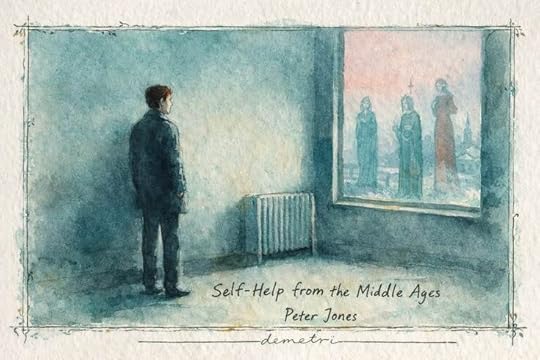
In a room held between winter light and old reflection, this solitary figure gathers the cold stillness, moral weather, and hard-won recognition at the heart of “Self-Help from the Middle Ages.”
Self-help books usually begin by flattering the buyer. Better habits. Cleaner mornings. A more obedient mind. Peter Jones begins in Tyumen, in weather that feels less seasonal than official. He is teaching medieval history, growing colder in every sense, and standing by a radiator while smoke lifts into a pink sky. The life has not blown up. It has quietly gone out of fit.
The premise arrives flirting with gimmick: the Seven Deadly Sins for the burnout era, monastic wisdom with a fresh dust jacket and a few life hacks tucked under the habit. Jones steps around the trap. “Self-Help from the Middle Ages” comes in wearing the costume of recovered wisdom, but the real book underneath is leaner, colder, and less interested in cheering anyone up. Its deepest claim is not that medieval people had the right hacks. It is that older moral language can still get closer to the bruise than our official speech about symptoms, habits, and wellness.
Jones knows the approved labels for his condition. Depression. Burnout. Therapy. Medication. He does not mock any of them. What he senses, though, is that they are often better at filing the problem than at giving it edges. They log distress. They do not always restore contour. What name would 1300 have put on this? A priest, he decides, might have called it sloth – not laziness, which is much too petty a word for the thing, but akedia, a cooling of attachment, a falling-out of love with life.
That question peels the sales varnish off and leaves the book’s real machinery humming underneath. The opening movement carries Jones from Siberian freeze to a Dublin manuscript library, where he consults William Peraldus’s “Summa of Virtues and Vices” and discovers, with the kind of shock that turns premise into necessity, that medieval language can feel unnervingly exact. The revelation is not just that sloth describes him. It is how. Peraldus’s account turns on “coldness,” then sharpens the point by arguing that lukewarmness may be worse. Coldness at least strips life down to essentials. Lukewarmness is the deadlier state – overstuffed, complacent, blind to its own hollowness. It is an excellent reversal. Jones is very good at them.
From there he moves through the seven old traps – Pride through Lust – by way of poems, manuscripts, anecdotes, and his own private weather. Before that, though, he goes back to Evagrius Ponticus, the desert monk who catalogued eight recurring “generic thoughts,” then forward through John Cassian and Gregory the Great into the full medieval afterlife of the scheme. Its hardest thought arrives before the book has fully unpacked its luggage. A “deadly sin” sounds operatic. A “generic thought” sounds like Tuesday before lunch.
That move makes the whole scheme feel less gothic and more daily. The sins stop looking like stained-glass warning labels and start resembling the mind’s favorite crooked habits. Sloth is not laziness but cold drift. Pride is not confidence but self-sealing. Envy is not simple wanting but a wish that another person’s flourishing curdle. Jones’s best move is to put the sand back into the language. He is not trying to make these words quaintly relevant. He is trying to make them sting again.
This is where the book breaks free of its own hook. It is not finally a book about medieval self-help. It is a book about the fraudulence of the upgrade fantasy. Jones keeps edging away from the hope, still busy in our century, that the mind can be tidied into reliable function if only the correct method is found. His strongest pages keep returning to recurrence. Thoughts recur. Moods recur. Humiliations recur. Purity is not on offer. Recognition is. Its governing image appears in Dublin, when Jones encounters the claim that the Jebusites within the city cannot simply be exterminated; they must be lived with. There, in one severe metaphor, is the whole philosophy. You do not evict the mind’s unwanted tenants once and for all. You govern in their presence.
That is the book’s real audacity. It does not offer the reader improvement in any familiar sense. It offers harder company. The promise is not that you will emerge corrected, optimized, finally aligned with your best morning self. The promise is that an older vocabulary may describe your compromises, vanities, numbnesses, and small private disgraces more truthfully than the softer terms to which modern life has grown attached. Jones is after recognition, not rescue. He is also after something rarer than comfort: moral precision without moral melodrama.
His prose matters because it understands that description is not garnish. It is method. He thinks in materials, rooms, temperatures. Frozen eyelashes. Thawing boots. A violet-uniformed cloakroom attendant. Rubber gloves in the manuscript library. A framed Yuri Gagarin. A university building that, in winter, becomes a submarine. These details are not there to show that the author can write. They do diagnostic work. The Siberian cold gives his inward cold a body. The “rushing river” turns paralysis into something kinetic and humiliating rather than inert. Even a comic set piece – a university photo shoot in which Jones is asked to pose as each of the seven sins, only to discover that his pride face sits perilously close to his ordinary one – does more than brighten the weather. It turns the old moral vocabulary social, embarrassing, and unmistakably current.
Then there is the book’s temper: learned, faintly sheepish, and alert to the comedy of its own seriousness. Jones can write about manuscripts and monastic psychology without sounding as if he would relish being trapped at a conference dinner with himself. He also knows when to let embarrassment puncture revelation. That helps. So does the fact that he never turns suffering into a credential. It supplies pressure, not moral prestige. The memoir is there to weight the argument, not to solicit reverence for the sufferer.
This tone matters because the material could so easily have hardened into one of two equally unhelpful books. It could have become a briskly marketable “ancient wisdom for modern problems” package, all polished consolation and strategic quotability. Or it could have become a scholar’s rebuke to the present, full of archive fumes and the faintly sour pleasure of announcing that medieval people understood everything better. Jones does neither. He writes with enough warmth to keep the book human and enough mischief to stop it from becoming pious. The effect is not charm, exactly. Charm would be too easy a word for a book this interested in frostbite. It is a more durable quality than that: composure with nerves still in it.
The structure has a good back. The opening chapters earn the scheme before the scheme begins carrying serious argumentative load. Then come the seven sins, each broken into three titled movements. The repetition is not a structural accident. It is part of the case. A book about repeated distortions should probably repeat itself, at least formally. Each section comes back through the same territory from a different edge, and by the middle one feels not a tidy list of vices but a snarl of drives, humiliations, appetites, and recurring pressures.
By the middle, though, you can hear the gears. Reframe the sin. Historicize it. Test it against modern life or Jones’s own. Gather the payoff. None of this is clumsy. If anything, it is too smooth. The book’s clarity comes with a bill, and the bill is surprise. Now and then the argument confirms itself once more when a harder complication would have done more. The design keeps the book upright but shrinks its ability to surprise itself. This is not fatal. It is the cost of a lucid system whose very elegance invites reuse.
The same neatness leaves a seam you can run a finger along in the book’s treatment of the modern world. Jones secularizes, or at least modernizes, a medieval moral scheme without reinstalling the theology that once held it together. That is a defensible bargain. Most readers are not waiting to be marched back into medieval cosmology. Still, the stitching shows. Therapy, diagnosis, and medication often arrive in brisk outline, while medieval categories get the full theatrical advantage. The contrast clarifies, but a little too obligingly. Jones wants the old terms to matter, and now and then the comparison is arranged a shade too carefully in their favor.
The best pages wriggle loose of that arrangement. Jones does not simply prettify the past. He clarifies the present. He is especially good on our habit of placing what hurts in cleaner and cleaner language. Sometimes euphemism is kindness. Sometimes it is evasion. “Self-Help from the Middle Ages” makes a convincing case that words like sloth, pride, and envy can wound vanity in a way upholstered vocabularies cannot, and that the wound may occasionally instruct. Not because medieval people were harsher and therefore wiser. Because they were sometimes better at admitting conflict into the description.
That is also why the book feels relevant without straining after relevance. Jones has the good sense not to brandish his material at the week’s headlines. Current life enters only after the medieval terms have already named, more sharply, what our own language has blurred. A late passage on Silicon Valley’s interest in the sins as a product map – envy here, anger there, sloth elsewhere – is sharp for exactly that reason. Medieval thinkers tried to name recurring distortions of desire. Contemporary platforms industrialize them. Jones makes the point, then has the tact to leave it there. He does not lunge for a cheap present-day clincher. He lets the continuity speak for itself, and because of that restraint the point lands harder.
More broadly, the book speaks to a culture abraded by improvement creed. Its courtesy has a little insolence in it: the self may not chiefly need optimization. It may need better names and less flattery. This is the sort of claim that can sound glib in summary and quite bracing on the page. Jones earns it by refusing to prettify the consequences. If the book were more frankly “helpful,” it would also be less true to the experience it describes. He is after a sterner form of usefulness, one that does not confuse being cheered up with being seen clearly.
Which is why the ending does not need to raise its voice. “The Seven, Again” offers no redemptive flourish. Anything louder would betray the enterprise. What it offers instead is a clarified restatement: these patterns are not relics, not melodramatic leftovers from a superstitious age, and not enemies to be neatly expelled. They are recurring twists in the ways we love, compare, withdraw, consume, and desire. Purity is not on offer. Recognition is.
I land at 88/100 – 4 stars. That seems fair for a book this shapely, this nimble-minded, and this a little too pleased with its own design. What remains in the room after the covers close is not the sales gimmick of medieval self-help. It is the sterner civility Jones extends. Not rescue. Not an upgrade. Better names, rougher weather, and the cold recognition that understanding the mind’s weather is not the same thing as changing it. The book begins with a man at a window in deep winter, watching smoke rise into a pink sky. It ends by giving that cold a shape – and, for once, not mistaking shape for cure.
These early compositional studies test the balance of solitude, window light, and negative space, searching for the one arrangement that could carry the book’s coldness without over-explaining it.
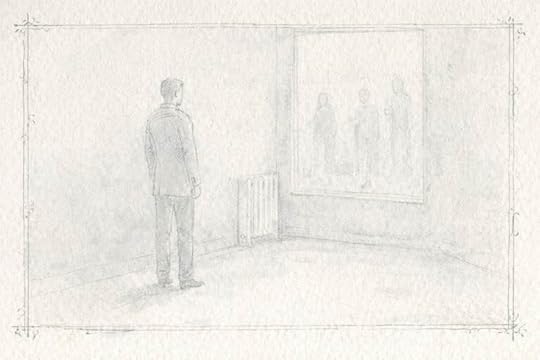
The underdrawing reveals the quiet skeleton of the final image: figure, window, radiator, and the first measured place where the older presences begin to return into view.
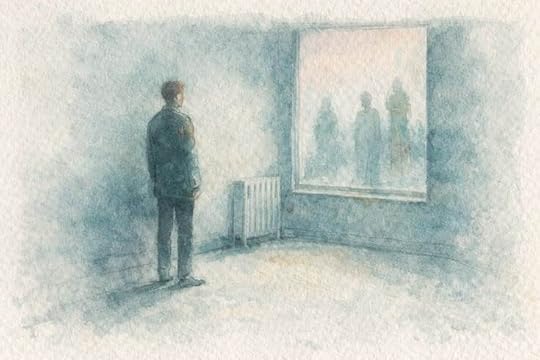
Here the painting begins to breathe, as structure gives way to atmosphere and the first washes of winter light, interior hush, and psychic weather settle across the page.
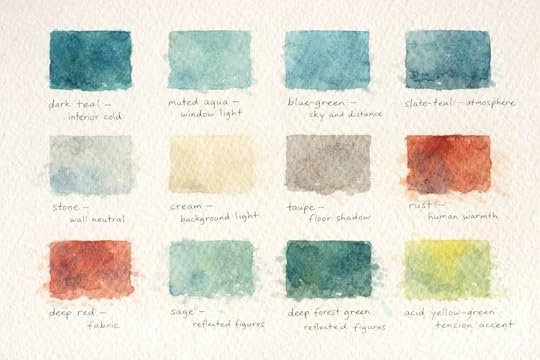
This swatch sheet shows the disciplined palette behind the final watercolor, where the cover’s greens, teals, rusts, creams, and acid yellows become the emotional grammar of the image.
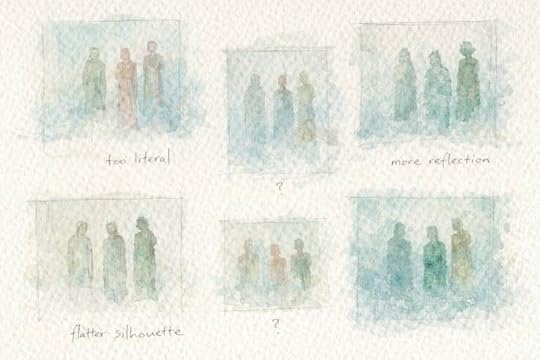
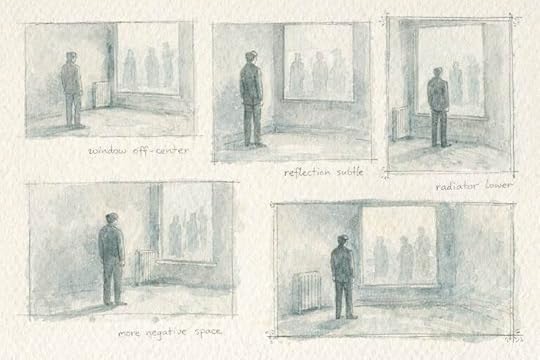
These reflected-figure studies test how the book’s old moral forms might appear in the glass – present but not dominant, symbolic but not spectral, half-memory and half-recognition.
All watercolor illustrations by Demetris Papadimitropoulos.
In “Self-Help from the Middle Ages,” Peter Jones turns the Seven Deadly Sins into a bracing grammar for burnout, vanity, longing, and the parts of the mind that do not improve on schedule.
By Demetris Papadimitropoulos | April 13th, 2026
In a room held between winter light and old reflection, this solitary figure gathers the cold stillness, moral weather, and hard-won recognition at the heart of “Self-Help from the Middle Ages.”
Self-help books usually begin by flattering the buyer. Better habits. Cleaner mornings. A more obedient mind. Peter Jones begins in Tyumen, in weather that feels less seasonal than official. He is teaching medieval history, growing colder in every sense, and standing by a radiator while smoke lifts into a pink sky. The life has not blown up. It has quietly gone out of fit.
The premise arrives flirting with gimmick: the Seven Deadly Sins for the burnout era, monastic wisdom with a fresh dust jacket and a few life hacks tucked under the habit. Jones steps around the trap. “Self-Help from the Middle Ages” comes in wearing the costume of recovered wisdom, but the real book underneath is leaner, colder, and less interested in cheering anyone up. Its deepest claim is not that medieval people had the right hacks. It is that older moral language can still get closer to the bruise than our official speech about symptoms, habits, and wellness.
Jones knows the approved labels for his condition. Depression. Burnout. Therapy. Medication. He does not mock any of them. What he senses, though, is that they are often better at filing the problem than at giving it edges. They log distress. They do not always restore contour. What name would 1300 have put on this? A priest, he decides, might have called it sloth – not laziness, which is much too petty a word for the thing, but akedia, a cooling of attachment, a falling-out of love with life.
That question peels the sales varnish off and leaves the book’s real machinery humming underneath. The opening movement carries Jones from Siberian freeze to a Dublin manuscript library, where he consults William Peraldus’s “Summa of Virtues and Vices” and discovers, with the kind of shock that turns premise into necessity, that medieval language can feel unnervingly exact. The revelation is not just that sloth describes him. It is how. Peraldus’s account turns on “coldness,” then sharpens the point by arguing that lukewarmness may be worse. Coldness at least strips life down to essentials. Lukewarmness is the deadlier state – overstuffed, complacent, blind to its own hollowness. It is an excellent reversal. Jones is very good at them.
From there he moves through the seven old traps – Pride through Lust – by way of poems, manuscripts, anecdotes, and his own private weather. Before that, though, he goes back to Evagrius Ponticus, the desert monk who catalogued eight recurring “generic thoughts,” then forward through John Cassian and Gregory the Great into the full medieval afterlife of the scheme. Its hardest thought arrives before the book has fully unpacked its luggage. A “deadly sin” sounds operatic. A “generic thought” sounds like Tuesday before lunch.
That move makes the whole scheme feel less gothic and more daily. The sins stop looking like stained-glass warning labels and start resembling the mind’s favorite crooked habits. Sloth is not laziness but cold drift. Pride is not confidence but self-sealing. Envy is not simple wanting but a wish that another person’s flourishing curdle. Jones’s best move is to put the sand back into the language. He is not trying to make these words quaintly relevant. He is trying to make them sting again.
This is where the book breaks free of its own hook. It is not finally a book about medieval self-help. It is a book about the fraudulence of the upgrade fantasy. Jones keeps edging away from the hope, still busy in our century, that the mind can be tidied into reliable function if only the correct method is found. His strongest pages keep returning to recurrence. Thoughts recur. Moods recur. Humiliations recur. Purity is not on offer. Recognition is. Its governing image appears in Dublin, when Jones encounters the claim that the Jebusites within the city cannot simply be exterminated; they must be lived with. There, in one severe metaphor, is the whole philosophy. You do not evict the mind’s unwanted tenants once and for all. You govern in their presence.
That is the book’s real audacity. It does not offer the reader improvement in any familiar sense. It offers harder company. The promise is not that you will emerge corrected, optimized, finally aligned with your best morning self. The promise is that an older vocabulary may describe your compromises, vanities, numbnesses, and small private disgraces more truthfully than the softer terms to which modern life has grown attached. Jones is after recognition, not rescue. He is also after something rarer than comfort: moral precision without moral melodrama.
His prose matters because it understands that description is not garnish. It is method. He thinks in materials, rooms, temperatures. Frozen eyelashes. Thawing boots. A violet-uniformed cloakroom attendant. Rubber gloves in the manuscript library. A framed Yuri Gagarin. A university building that, in winter, becomes a submarine. These details are not there to show that the author can write. They do diagnostic work. The Siberian cold gives his inward cold a body. The “rushing river” turns paralysis into something kinetic and humiliating rather than inert. Even a comic set piece – a university photo shoot in which Jones is asked to pose as each of the seven sins, only to discover that his pride face sits perilously close to his ordinary one – does more than brighten the weather. It turns the old moral vocabulary social, embarrassing, and unmistakably current.
Then there is the book’s temper: learned, faintly sheepish, and alert to the comedy of its own seriousness. Jones can write about manuscripts and monastic psychology without sounding as if he would relish being trapped at a conference dinner with himself. He also knows when to let embarrassment puncture revelation. That helps. So does the fact that he never turns suffering into a credential. It supplies pressure, not moral prestige. The memoir is there to weight the argument, not to solicit reverence for the sufferer.
This tone matters because the material could so easily have hardened into one of two equally unhelpful books. It could have become a briskly marketable “ancient wisdom for modern problems” package, all polished consolation and strategic quotability. Or it could have become a scholar’s rebuke to the present, full of archive fumes and the faintly sour pleasure of announcing that medieval people understood everything better. Jones does neither. He writes with enough warmth to keep the book human and enough mischief to stop it from becoming pious. The effect is not charm, exactly. Charm would be too easy a word for a book this interested in frostbite. It is a more durable quality than that: composure with nerves still in it.
The structure has a good back. The opening chapters earn the scheme before the scheme begins carrying serious argumentative load. Then come the seven sins, each broken into three titled movements. The repetition is not a structural accident. It is part of the case. A book about repeated distortions should probably repeat itself, at least formally. Each section comes back through the same territory from a different edge, and by the middle one feels not a tidy list of vices but a snarl of drives, humiliations, appetites, and recurring pressures.
By the middle, though, you can hear the gears. Reframe the sin. Historicize it. Test it against modern life or Jones’s own. Gather the payoff. None of this is clumsy. If anything, it is too smooth. The book’s clarity comes with a bill, and the bill is surprise. Now and then the argument confirms itself once more when a harder complication would have done more. The design keeps the book upright but shrinks its ability to surprise itself. This is not fatal. It is the cost of a lucid system whose very elegance invites reuse.
The same neatness leaves a seam you can run a finger along in the book’s treatment of the modern world. Jones secularizes, or at least modernizes, a medieval moral scheme without reinstalling the theology that once held it together. That is a defensible bargain. Most readers are not waiting to be marched back into medieval cosmology. Still, the stitching shows. Therapy, diagnosis, and medication often arrive in brisk outline, while medieval categories get the full theatrical advantage. The contrast clarifies, but a little too obligingly. Jones wants the old terms to matter, and now and then the comparison is arranged a shade too carefully in their favor.
The best pages wriggle loose of that arrangement. Jones does not simply prettify the past. He clarifies the present. He is especially good on our habit of placing what hurts in cleaner and cleaner language. Sometimes euphemism is kindness. Sometimes it is evasion. “Self-Help from the Middle Ages” makes a convincing case that words like sloth, pride, and envy can wound vanity in a way upholstered vocabularies cannot, and that the wound may occasionally instruct. Not because medieval people were harsher and therefore wiser. Because they were sometimes better at admitting conflict into the description.
That is also why the book feels relevant without straining after relevance. Jones has the good sense not to brandish his material at the week’s headlines. Current life enters only after the medieval terms have already named, more sharply, what our own language has blurred. A late passage on Silicon Valley’s interest in the sins as a product map – envy here, anger there, sloth elsewhere – is sharp for exactly that reason. Medieval thinkers tried to name recurring distortions of desire. Contemporary platforms industrialize them. Jones makes the point, then has the tact to leave it there. He does not lunge for a cheap present-day clincher. He lets the continuity speak for itself, and because of that restraint the point lands harder.
More broadly, the book speaks to a culture abraded by improvement creed. Its courtesy has a little insolence in it: the self may not chiefly need optimization. It may need better names and less flattery. This is the sort of claim that can sound glib in summary and quite bracing on the page. Jones earns it by refusing to prettify the consequences. If the book were more frankly “helpful,” it would also be less true to the experience it describes. He is after a sterner form of usefulness, one that does not confuse being cheered up with being seen clearly.
Which is why the ending does not need to raise its voice. “The Seven, Again” offers no redemptive flourish. Anything louder would betray the enterprise. What it offers instead is a clarified restatement: these patterns are not relics, not melodramatic leftovers from a superstitious age, and not enemies to be neatly expelled. They are recurring twists in the ways we love, compare, withdraw, consume, and desire. Purity is not on offer. Recognition is.
I land at 88/100 – 4 stars. That seems fair for a book this shapely, this nimble-minded, and this a little too pleased with its own design. What remains in the room after the covers close is not the sales gimmick of medieval self-help. It is the sterner civility Jones extends. Not rescue. Not an upgrade. Better names, rougher weather, and the cold recognition that understanding the mind’s weather is not the same thing as changing it. The book begins with a man at a window in deep winter, watching smoke rise into a pink sky. It ends by giving that cold a shape – and, for once, not mistaking shape for cure.
These early compositional studies test the balance of solitude, window light, and negative space, searching for the one arrangement that could carry the book’s coldness without over-explaining it.
The underdrawing reveals the quiet skeleton of the final image: figure, window, radiator, and the first measured place where the older presences begin to return into view.
Here the painting begins to breathe, as structure gives way to atmosphere and the first washes of winter light, interior hush, and psychic weather settle across the page.
This swatch sheet shows the disciplined palette behind the final watercolor, where the cover’s greens, teals, rusts, creams, and acid yellows become the emotional grammar of the image.
These reflected-figure studies test how the book’s old moral forms might appear in the glass – present but not dominant, symbolic but not spectral, half-memory and half-recognition.
All watercolor illustrations by Demetris Papadimitropoulos.
May 14, 2026
Zelfhulpboeken hebben vaak een twijfelachtige reputatie. Ze beloven persoonlijke groei, mentale rust of een gelukkiger leven, maar blijven vaak steken in clichés. Daarom is dit boek zo verfrissend. Jones kijkt terug naar een tijdperk dat men doorgaans associeert met religieus moralisme en achterhaalde wereldbeelden. Hij concludeert dat de Middeleeuwen misschien beter zicht hadden op menselijke zwakheden dan wijzelf.
Centraal in het boek staan de zeven hoofdzonden: trots, afgunst, woede, luiheid, hebzucht, gulzigheid en lust. Waar deze tegenwoordig vooral klinken als stoffige kerkbegrippen, laat Jones zien dat ze eeuwenlang fungeerden als een soort periodiek systeem van de geest. Middeleeuwers gebruikten de hoofdzonden niet alleen om goed en kwaad te onderscheiden, maar vooral om zichzelf beter te begrijpen.
Het hoofdstuk over luiheid is erg sterk. In de Middeleeuwen werd luiheid niet gezien als iets niet willen doen, maar als een diepere vorm van geestelijke leegte: een gebrek aan betrokkenheid bij het leven. Dit sluit naadloos aan bij de hedendaagse discussies over verveling, burn-out, depressie en ons eindeloze scroll-gedrag.
Daarnaast is het boek rijk gevuld met verhalen over middeleeuwse kunst, manuscripten, filosofie en religie. Jones gebruikt humor en haakjes naar het moderne leven en tegelijkertijd is het ook academisch onderbouwt. Ik vond het prettig te lezen dat Jones niet neerbuigend deed over mensen uit het verleden. Integendeel: hij benadrukt dat middeleeuwers net zo rationeel en nieuwsgierig waren als wij, alleen vanuit een ander wereldbeeld.
Toch is de titel van het boek wat misleidend. Het suggereert dat de lezer praktische tips aangereikt krijgt, maar de “zelfhulp” blijft wat abstract. Maar misschien is dat juist de kracht van het boek. De “zelfhulp” wordt meer gepresenteerd als: dit is wat mensen in de Middeleeuwen belangrijk vonden, en dit is de context daarbij; voel je vrij om dat, net als de auteur doet, te vergelijken met je eigen ervaringen. Er wordt niet gepretendeerd dat menselijke zwakheden opgelost kunnen worden. De boodschap is eerder dat we moeten leren leven met onze gebreken, in plaats van ze te ontkennen of uit te bannen. Volgens Jones begrepen de Middeleeuwers iets wat wij soms vergeten: de mens is nu eenmaal onvolmaakt.
Het boek zet hoe dan ook aan tot nadenken. Eigenlijk is de menselijke natuur weinig verandert, ondanks alle technologische vooruitgang.
Dank aan Uitgeverij Balans voor het recensie-exemplaar!
Centraal in het boek staan de zeven hoofdzonden: trots, afgunst, woede, luiheid, hebzucht, gulzigheid en lust. Waar deze tegenwoordig vooral klinken als stoffige kerkbegrippen, laat Jones zien dat ze eeuwenlang fungeerden als een soort periodiek systeem van de geest. Middeleeuwers gebruikten de hoofdzonden niet alleen om goed en kwaad te onderscheiden, maar vooral om zichzelf beter te begrijpen.
Het hoofdstuk over luiheid is erg sterk. In de Middeleeuwen werd luiheid niet gezien als iets niet willen doen, maar als een diepere vorm van geestelijke leegte: een gebrek aan betrokkenheid bij het leven. Dit sluit naadloos aan bij de hedendaagse discussies over verveling, burn-out, depressie en ons eindeloze scroll-gedrag.
Daarnaast is het boek rijk gevuld met verhalen over middeleeuwse kunst, manuscripten, filosofie en religie. Jones gebruikt humor en haakjes naar het moderne leven en tegelijkertijd is het ook academisch onderbouwt. Ik vond het prettig te lezen dat Jones niet neerbuigend deed over mensen uit het verleden. Integendeel: hij benadrukt dat middeleeuwers net zo rationeel en nieuwsgierig waren als wij, alleen vanuit een ander wereldbeeld.
Toch is de titel van het boek wat misleidend. Het suggereert dat de lezer praktische tips aangereikt krijgt, maar de “zelfhulp” blijft wat abstract. Maar misschien is dat juist de kracht van het boek. De “zelfhulp” wordt meer gepresenteerd als: dit is wat mensen in de Middeleeuwen belangrijk vonden, en dit is de context daarbij; voel je vrij om dat, net als de auteur doet, te vergelijken met je eigen ervaringen. Er wordt niet gepretendeerd dat menselijke zwakheden opgelost kunnen worden. De boodschap is eerder dat we moeten leren leven met onze gebreken, in plaats van ze te ontkennen of uit te bannen. Volgens Jones begrepen de Middeleeuwers iets wat wij soms vergeten: de mens is nu eenmaal onvolmaakt.
Het boek zet hoe dan ook aan tot nadenken. Eigenlijk is de menselijke natuur weinig verandert, ondanks alle technologische vooruitgang.
Dank aan Uitgeverij Balans voor het recensie-exemplaar!

July 19, 2026
Peter, you really did something here. This was full of the medieval tomfoolery that we all know and love, but it was also incredibly beautiful. There are some thoughts on the human condition and the nature of self-forgiveness that almost had me in tears. Part personal testimony, part historical exploration, this was a fascinating read. And one that I devoured (maybe I need to reread the 'Gluttony' chapter...).
May 29, 2026
Succumbs to some of the pitfalls perhaps inherent to the self-help genre (dramatized, over-generalized, over-categorized), but successful in that it gently prompted me to examine the rough edges of my Self/Selves.
I liked the simultaneous medieval historical and autobiographical lens. In the same way that observing a world distant and decontextualized from our own through science fiction allows us to access deeper truths about our own world, I think a similar phenomenon was able to occur here. Reading medieval poems about holy lust, looking at different artistic representations of Lucifer from the 1100s, and reading about a historian trying to use these to understand himself better gave me more insight into myself than therapy has recently lol. Makes me excited for the various mirrors I hope to peer into this summer and in this life. It is also comforting to situate myself in a long lineage and know that humans have been reflecting (& reflecting on the reflections of others) on these afflictions for a long time.
I appreciate that the Seven Deadly Sins were originally called the "eight generic thoughts" and that the point is not to violently excise them, but to learn to live with them, transform them, and forgive ourselves. For the purposes of accountability, at this moment, my generic thoughts are, in order of affliction: sloth, pride, lust, envy, anger, gluttony, avarice.
Some specific nuggets: I liked the thought of transforming desire (judgmental, possessive, controlling) into wonder (adoration without craving). I think this is a nice framework to think about with respect to healthy love. Related, that the problem of lust is a problem of history; while lust makes you want to rip a person out of time, real love is historical, taking a person as they are, as they have been, and as they will come to be. Also that churning is obsessing over hollow recreations of things that are already gone, and this is just a masked hyper-fixation on the self (self-obsession/pride). Needed to hear that one. Only way out is through, this was humbling to read in the best way, & I hope to one day know the tears of great peace!
Thanks to my New Haven family, Sharon, Todd, & Cliff, for gifting me this book and, as aptly attributed in the acknowledgements, "for their infinite patience, infinite generosity and infinite humour"! I think they knew this would be a good book for me to read.
I liked the simultaneous medieval historical and autobiographical lens. In the same way that observing a world distant and decontextualized from our own through science fiction allows us to access deeper truths about our own world, I think a similar phenomenon was able to occur here. Reading medieval poems about holy lust, looking at different artistic representations of Lucifer from the 1100s, and reading about a historian trying to use these to understand himself better gave me more insight into myself than therapy has recently lol. Makes me excited for the various mirrors I hope to peer into this summer and in this life. It is also comforting to situate myself in a long lineage and know that humans have been reflecting (& reflecting on the reflections of others) on these afflictions for a long time.
I appreciate that the Seven Deadly Sins were originally called the "eight generic thoughts" and that the point is not to violently excise them, but to learn to live with them, transform them, and forgive ourselves. For the purposes of accountability, at this moment, my generic thoughts are, in order of affliction: sloth, pride, lust, envy, anger, gluttony, avarice.
Some specific nuggets: I liked the thought of transforming desire (judgmental, possessive, controlling) into wonder (adoration without craving). I think this is a nice framework to think about with respect to healthy love. Related, that the problem of lust is a problem of history; while lust makes you want to rip a person out of time, real love is historical, taking a person as they are, as they have been, and as they will come to be. Also that churning is obsessing over hollow recreations of things that are already gone, and this is just a masked hyper-fixation on the self (self-obsession/pride). Needed to hear that one. Only way out is through, this was humbling to read in the best way, & I hope to one day know the tears of great peace!
Thanks to my New Haven family, Sharon, Todd, & Cliff, for gifting me this book and, as aptly attributed in the acknowledgements, "for their infinite patience, infinite generosity and infinite humour"! I think they knew this would be a good book for me to read.

previewed-decided-against
September 6, 2026I added this to my shelf upon seeing an edition with the subtitle "A Journey Into the Medieval Mind" and if anyone knows of a book that is actually that, please let me know! I'm interested in the subject but want to read a history book, not a self-help book - something that explores the differences between medieval and modern thought rather than trying to harmonize them by whitewashing medieval ideas through a modern lens.

September 20, 2026
The title of this caught my attention and as a period of history that intrigues me, I was well up for seeing what nuggets of wisdom could be passed down from an era gone by. With totally different beliefs and values, this book takes us through the 7 deadly sins and explores old manuscripts, texts and historical figures and how it could relate today.
The audiobook was well narrated by the author and provided a nice and informative backdrop whilst I did some crochet!
I enjoyed listening to the authors own experiences throughout his life, with references to research and the seven deadly sins. Aspects were more interesting to me than others but as is the case with any non fiction book!
It’s definitely worth a read / listen if you’re into non fiction, history or want a novel spin on the traditional ‘self help’ book.
The audiobook was well narrated by the author and provided a nice and informative backdrop whilst I did some crochet!
I enjoyed listening to the authors own experiences throughout his life, with references to research and the seven deadly sins. Aspects were more interesting to me than others but as is the case with any non fiction book!
It’s definitely worth a read / listen if you’re into non fiction, history or want a novel spin on the traditional ‘self help’ book.

September 3, 2026
Self Help from the Middle Ages by Peter Jones
Is Sinful.
I’m not a fan of self help guides, but I do enjoy introspection & philosophy. And luckily this book despite its name is far from a typical 21th century self help book. Rather is a meditation on the 7 deadly sins, and how they were viewed and challenged in the Middle Ages.
For those that may have turned away from the thoughts of sin, the 7 Deadly Sins are : pride, envy, anger, sloth, avarice, gluttony, & lust, surprisingly for some they are listed most to least deadly. Avarice could also be greed, not necessarily money. Think of it more in a sense of wastefulness.
Jones explores these sins via the texts of the day, art, and biographical examples. Together these sources, along with his personal stories illuminate the thinking and ultimately the guide these 7 sins give us to be better.
The section on gluttony was fascinating, all about obsession with food, sometimes to excess, sometimes to a fixation, sometimes even rejection of all food. And even documented cases of Middle Ages’ pica. In the end rather than feeling horrible about yourself these teachings are meant to force you to acknowledge, observe but not attach yourself to anything in the extreme. It’s very “everything in moderation, including moderation” as Oscar Wilde might say.
This book is for anyone who enjoys philosophy, history, and the Middle Ages. Or anyone who’s sinfully pious or devilishly pure!
Is Sinful.
I’m not a fan of self help guides, but I do enjoy introspection & philosophy. And luckily this book despite its name is far from a typical 21th century self help book. Rather is a meditation on the 7 deadly sins, and how they were viewed and challenged in the Middle Ages.
For those that may have turned away from the thoughts of sin, the 7 Deadly Sins are : pride, envy, anger, sloth, avarice, gluttony, & lust, surprisingly for some they are listed most to least deadly. Avarice could also be greed, not necessarily money. Think of it more in a sense of wastefulness.
Jones explores these sins via the texts of the day, art, and biographical examples. Together these sources, along with his personal stories illuminate the thinking and ultimately the guide these 7 sins give us to be better.
The section on gluttony was fascinating, all about obsession with food, sometimes to excess, sometimes to a fixation, sometimes even rejection of all food. And even documented cases of Middle Ages’ pica. In the end rather than feeling horrible about yourself these teachings are meant to force you to acknowledge, observe but not attach yourself to anything in the extreme. It’s very “everything in moderation, including moderation” as Oscar Wilde might say.
This book is for anyone who enjoys philosophy, history, and the Middle Ages. Or anyone who’s sinfully pious or devilishly pure!
May 17, 2026
Really enjoyed this BBC Sounds adaptation of this book - it focused on the seven deadly sins and their relevance through history to today in our modern world. Very interesting.

May 11, 2026
I was pleased that the self-help aspects were not pushy. It was more framed as here is what people valued in the middle ages, and here is the context; feel free to compare it to your own experiences as the author does.

August 17, 2026
An interesting look at the origin of the “seven deadly sins” (I preferred their original meaning and purpose before the Catholic Church got its hands on them) and how people throughout the medieval period in Europe approached sin, self, and early psychological thought. I found the chapters on sloth, avarice, and lust particularly interesting.

Review of advance copy received from NetGalley
Rating: 4* of five
The Publisher Says: From medieval historian Peter Jones comes a groundbreaking guide to navigating contemporary life through the wisdom of the Seven Deadly Sins.
Peter Jones was teaching medieval history at a university in Siberia when his third icy winter there plunged him into a dark place. Luckily, he knew something few of us know—that for all its reputation for darkness and superstition, the Middle Ages were the golden age of self-help. So he set out on a journey to explore the wisdom of medieval scholars, saints, and mystics, looking for an alternative path through the challenges of modern life.
Never in history, Jones marvels in Self-Help from the Middle Ages, has so much energy and talent gone into studying how the mind works as in the medieval centuries. Although today we think of the Seven Deadly Sins as a catalog of forbidden behavior, in the Middle Ages, at the height of their currency, they were a path to self-knowledge and self-forgiveness. Together, pride, envy, anger, sloth, greed, gluttony and lust were a psychological map that laid out seven basic patterns of thought, showing how our thinking can go astray and how we can find our way home.
In Self-Help from the Middle Ages, Jones explores each sin, searching the hellscapes of Hieronymous Bosch and Giotto, the intimate confessions of Dante and Margery Kempe, and the personal struggles of Francis of Assisi and Catherine of Siena. Along the way he discovers a treasure trove of lost truths about temptation, frustration, addiction, compulsion, burnout, rage, fear, anxiety, and grief that still pulse with life. With beautiful illustrations drawn from medieval art and literature, his book is a gift to all who love history and anyone who has ever sought wisdom from the past.
I RECEIVED A DRC FROM THE PUBLISHER VIA NETGALLEY. THANK YOU.
My Review: What happens when a scholarly British man with an advanced medieval-history degree from an American school gets a seriously good job in Russophone academia? He moves to Siberia! (Before the Ukraine war begins. He lives in Madrid now.)
Siberia. The place Russia sends people to die in misery. A byword, in US English anyway, for grim, awful exile, for the place you're sent to pay for your sins. I'm afraid this is where I start revealing my prejudices: I envied this polyglot scholar for his seriously good luck. I envied him for living a life I'm still feeling angry at being denied a chance to pursue (though Siberia was never in my mind as an option). So already two of the deadly sins ticked off—again—my life's list of the damned things committed. Oh okay, I'm getting the point now, thought I.
Siberia, the severeness of it, wore on the spirit of Author Jones. He experienced the dark night of the soul, the terrible trackless waste of depression. Being a scholar by nature the solution was obvious: you are not the first person to have this problem. How did those others handle it? The seven deadly sins offer up a schema for understanding the workings of the human mind as well as a perspective check on what your emotional weather really means.
These "sins" are, of course, deeply enmeshed with christian concepts of a religiously ordered universe. Sin more broadly is a religious concept of transgressing a divinely ordained code and appears in multiple religious traditions. It's only natural that a medievalist from England would gravitate towards concepts familiar from his scholarly activities.
In the memoir portions of this narrative, the author evokes very movingly the experience of researching, identifying, and handling medieval manuscripts that contain the seven deadly sins and their explications of how these can be used to improve one's soul. The goal in these readings iss to give the reader a map towards salvation, union with the god of the christians; but as Author Jones elucidates, how different is that goal from modern self-help books' stated goal of helping one become better, happier, more adept at navigating your life. People have sought ways to understand their inner workings, how to cultivate their minds/souls into "better" or "happier" behaviors since the oracle at Delphi...much earlier than that, I am certain, because a pithy aperçu like "know thyself" isn't a first draft, and it is carved in literal stone so it's been workshopped to a fare-thee-well, though it wasn't done in writing so the records are implicit only.
We're highly intelligent, us humans, curious about ourselves because we're so different from other creatures. We have access to the thoughts and the musings and the conclusions of millennia of our forebears. A scholar would know where and how to look for insight into issues common to us all. Descriptions of depression, of psychological maladjustments, maladaptive behaviors, and solutions to the problems arising therefrom, might vary but the impetus to look for ways to be, feel, act "better" is constant. Author Jones seeks the commonality between the seven deadly sins and modern self-help schemata because he needs help, knows our ancestors...sons, daughters, lovers, spouses just like us...needed help figuring out the best ways to be fulfilled. He accomplishes this in the way that best uses his personal strengths. He tells us about his quest in plainly personal terms, clearly stating his stakes in starting the quest. (I frame it as a quest because he's a medievalist and "happiness" is a grail quest.) It is more this strand of his narrative that I found involving, engaging. I was less invested in the rubber-meets-the-road formulations of how the personally offensive to me religious concept of the sins themselves represent paths to self-knowledge. This is a very useful and, to me, persuasive argument. It's offensive to me because the religion it's embedded within is evil and vile, used to create division and enact horrors of cruelty; if there is a "God" as they name her, and she tolerates these terrible acts committed in her nsme, she is not the kind of god who deserves worship.
None of that is addressed in this book; I can't offer an otherwise fully merited fifth star because to do so is to accept a fundamental agreement with an argument for "God" and her christian system's validity.
This is purely a personal inability to tolerate any support of the christian worldview,however tacit it may be, as in any way moral or positively constructive.
The Publisher Says: From medieval historian Peter Jones comes a groundbreaking guide to navigating contemporary life through the wisdom of the Seven Deadly Sins.
Peter Jones was teaching medieval history at a university in Siberia when his third icy winter there plunged him into a dark place. Luckily, he knew something few of us know—that for all its reputation for darkness and superstition, the Middle Ages were the golden age of self-help. So he set out on a journey to explore the wisdom of medieval scholars, saints, and mystics, looking for an alternative path through the challenges of modern life.
Never in history, Jones marvels in Self-Help from the Middle Ages, has so much energy and talent gone into studying how the mind works as in the medieval centuries. Although today we think of the Seven Deadly Sins as a catalog of forbidden behavior, in the Middle Ages, at the height of their currency, they were a path to self-knowledge and self-forgiveness. Together, pride, envy, anger, sloth, greed, gluttony and lust were a psychological map that laid out seven basic patterns of thought, showing how our thinking can go astray and how we can find our way home.
In Self-Help from the Middle Ages, Jones explores each sin, searching the hellscapes of Hieronymous Bosch and Giotto, the intimate confessions of Dante and Margery Kempe, and the personal struggles of Francis of Assisi and Catherine of Siena. Along the way he discovers a treasure trove of lost truths about temptation, frustration, addiction, compulsion, burnout, rage, fear, anxiety, and grief that still pulse with life. With beautiful illustrations drawn from medieval art and literature, his book is a gift to all who love history and anyone who has ever sought wisdom from the past.
I RECEIVED A DRC FROM THE PUBLISHER VIA NETGALLEY. THANK YOU.
My Review: What happens when a scholarly British man with an advanced medieval-history degree from an American school gets a seriously good job in Russophone academia? He moves to Siberia! (Before the Ukraine war begins. He lives in Madrid now.)
Siberia. The place Russia sends people to die in misery. A byword, in US English anyway, for grim, awful exile, for the place you're sent to pay for your sins. I'm afraid this is where I start revealing my prejudices: I envied this polyglot scholar for his seriously good luck. I envied him for living a life I'm still feeling angry at being denied a chance to pursue (though Siberia was never in my mind as an option). So already two of the deadly sins ticked off—again—my life's list of the damned things committed. Oh okay, I'm getting the point now, thought I.
Siberia, the severeness of it, wore on the spirit of Author Jones. He experienced the dark night of the soul, the terrible trackless waste of depression. Being a scholar by nature the solution was obvious: you are not the first person to have this problem. How did those others handle it? The seven deadly sins offer up a schema for understanding the workings of the human mind as well as a perspective check on what your emotional weather really means.
These "sins" are, of course, deeply enmeshed with christian concepts of a religiously ordered universe. Sin more broadly is a religious concept of transgressing a divinely ordained code and appears in multiple religious traditions. It's only natural that a medievalist from England would gravitate towards concepts familiar from his scholarly activities.
In the memoir portions of this narrative, the author evokes very movingly the experience of researching, identifying, and handling medieval manuscripts that contain the seven deadly sins and their explications of how these can be used to improve one's soul. The goal in these readings iss to give the reader a map towards salvation, union with the god of the christians; but as Author Jones elucidates, how different is that goal from modern self-help books' stated goal of helping one become better, happier, more adept at navigating your life. People have sought ways to understand their inner workings, how to cultivate their minds/souls into "better" or "happier" behaviors since the oracle at Delphi...much earlier than that, I am certain, because a pithy aperçu like "know thyself" isn't a first draft, and it is carved in literal stone so it's been workshopped to a fare-thee-well, though it wasn't done in writing so the records are implicit only.
We're highly intelligent, us humans, curious about ourselves because we're so different from other creatures. We have access to the thoughts and the musings and the conclusions of millennia of our forebears. A scholar would know where and how to look for insight into issues common to us all. Descriptions of depression, of psychological maladjustments, maladaptive behaviors, and solutions to the problems arising therefrom, might vary but the impetus to look for ways to be, feel, act "better" is constant. Author Jones seeks the commonality between the seven deadly sins and modern self-help schemata because he needs help, knows our ancestors...sons, daughters, lovers, spouses just like us...needed help figuring out the best ways to be fulfilled. He accomplishes this in the way that best uses his personal strengths. He tells us about his quest in plainly personal terms, clearly stating his stakes in starting the quest. (I frame it as a quest because he's a medievalist and "happiness" is a grail quest.) It is more this strand of his narrative that I found involving, engaging. I was less invested in the rubber-meets-the-road formulations of how the personally offensive to me religious concept of the sins themselves represent paths to self-knowledge. This is a very useful and, to me, persuasive argument. It's offensive to me because the religion it's embedded within is evil and vile, used to create division and enact horrors of cruelty; if there is a "God" as they name her, and she tolerates these terrible acts committed in her nsme, she is not the kind of god who deserves worship.
None of that is addressed in this book; I can't offer an otherwise fully merited fifth star because to do so is to accept a fundamental agreement with an argument for "God" and her christian system's validity.
This is purely a personal inability to tolerate any support of the christian worldview,however tacit it may be, as in any way moral or positively constructive.

Review of advance copy received from Netgalley
Thank you to NetGalley and the publisher for this ARC
3.5 but rounding down. I’ll be honest. I think, if the title had been something else, something a bit more telling regarding the seven deadly sins, I might have rounded up to 4. I feel like the title might be misleading to some people (possibly some of the other reviewers, after having read some of their reviews). I wasn’t expecting each chapter to represent a deadly sin. Not that I personally mind, but again, maybe a subtitle mentioning this might help (or repel) other readers.
The preface was a bit confusing and… jumbled. And I stared to wonder if this was more of a memoir or personal reflection journey. In a way, it is the author’s journey, but having read the whole thing, I can understand the reasoning a bit more. Still, once I got past that clustered beginning, I enjoyed the book, for the most part.
The writing is sometimes odd. The present tense parts are a little weird, considering I don’t think he’s actually writing as he wanders around the Siberian shopping mall or in a meeting with his colleagues. I get what he’s trying to do, but again, just a little odd (to me, anyway).
As this is non-fiction, I have to state something that bothered my nitpicky self.
When Evagrius began his brain experiment he was standing naked and alone, up to his thighs in a freezing well of water. He was then coming up to forty years old, a tall man with dark hair, soulful eyes and a deep mellow voice.
Was Evagrius known for soulful eyes and a deep mellow voice? Was it documented somewhere? If so, great. Carry on. If not… well, no need to dramatize. For all we know, maybe he had crossed eyes and a nasal twang.
Anyway…. There is a lot of truth to be found in the seven deadly sins, even if you don’t adhere to the religion that they mostly represent. The examples he gives are pretty obscure (most of them, anyway), but that’s what makes it all the better. Some examples were gross (licking syphilitic patients or drinking pus water come to immediate mind), some were sad, like Doña Juana la Loca. They all had a point, though. And everything mentioned makes it clear that the medieval people (just like any age, really) had problems and struggled with the same issues we do. Differently, yes, but ultimately the same when you boil it down.
If you’re expecting a self help book that’s actually meant as a self-help book, this isn’t exactly that kind unless you don’t mind self-help through the lens of somewhat obscure history. If you’re expecting a book about history (like a history on how people self helped…themselves… in the Middle Ages) this isn’t exactly that kind, either. It’s somewhere down the middle.
I actually enjoyed reading this, and I feel like if a few things were different, I would have given it four stars. I still recommend it, especially for people who love medieval history, religious history, obscure facts, or learning about yourself (and the author) through the wonderful world of the seven deadly sins.
I reviewed this ARC for NetGalley, and the opinions here are my own.
3.5 but rounding down. I’ll be honest. I think, if the title had been something else, something a bit more telling regarding the seven deadly sins, I might have rounded up to 4. I feel like the title might be misleading to some people (possibly some of the other reviewers, after having read some of their reviews). I wasn’t expecting each chapter to represent a deadly sin. Not that I personally mind, but again, maybe a subtitle mentioning this might help (or repel) other readers.
The preface was a bit confusing and… jumbled. And I stared to wonder if this was more of a memoir or personal reflection journey. In a way, it is the author’s journey, but having read the whole thing, I can understand the reasoning a bit more. Still, once I got past that clustered beginning, I enjoyed the book, for the most part.
The writing is sometimes odd. The present tense parts are a little weird, considering I don’t think he’s actually writing as he wanders around the Siberian shopping mall or in a meeting with his colleagues. I get what he’s trying to do, but again, just a little odd (to me, anyway).
As this is non-fiction, I have to state something that bothered my nitpicky self.
When Evagrius began his brain experiment he was standing naked and alone, up to his thighs in a freezing well of water. He was then coming up to forty years old, a tall man with dark hair, soulful eyes and a deep mellow voice.
Was Evagrius known for soulful eyes and a deep mellow voice? Was it documented somewhere? If so, great. Carry on. If not… well, no need to dramatize. For all we know, maybe he had crossed eyes and a nasal twang.
Anyway…. There is a lot of truth to be found in the seven deadly sins, even if you don’t adhere to the religion that they mostly represent. The examples he gives are pretty obscure (most of them, anyway), but that’s what makes it all the better. Some examples were gross (licking syphilitic patients or drinking pus water come to immediate mind), some were sad, like Doña Juana la Loca. They all had a point, though. And everything mentioned makes it clear that the medieval people (just like any age, really) had problems and struggled with the same issues we do. Differently, yes, but ultimately the same when you boil it down.
If you’re expecting a self help book that’s actually meant as a self-help book, this isn’t exactly that kind unless you don’t mind self-help through the lens of somewhat obscure history. If you’re expecting a book about history (like a history on how people self helped…themselves… in the Middle Ages) this isn’t exactly that kind, either. It’s somewhere down the middle.
I actually enjoyed reading this, and I feel like if a few things were different, I would have given it four stars. I still recommend it, especially for people who love medieval history, religious history, obscure facts, or learning about yourself (and the author) through the wonderful world of the seven deadly sins.
I reviewed this ARC for NetGalley, and the opinions here are my own.

May 23, 2026
When we go into a bookstore, we will notice there are tons of self-help books from all walks of life. Self-help books tend to have more of a modern take when it comes to solutions, but what if we looked to the past for advice? It is an interesting approach to this genre of books, but what if we took it a step further and looked at how medieval people viewed their own minds through the Seven Deadly Sins? Peter Jones dives into his own life experiences and the archives to explore how the sins can help us find wisdom and understanding, which is explained in detail in his book, “Self-Help from the Middle Ages: What the Seven Deadly Sins Can Teach Us About Living.”
I would like to thank Doubleday Books and Net Galley for sending me a copy of this book. I have enjoyed medieval self-help books that I have read in the past, so I wanted to see how Jones would add to this genre. I think by centering this book on the seven deadly sins, it adds depth and interest to this topic, so I was excited to see how they could be applied to one’s life.
Peter Jones was a professor of medieval history at a university in Siberia when he fell into a dark place. He turns to the Middle Ages for help, which was an era known for self-help guides written by scholars, priests, and mystics. It is through their writings that he realized how the seven deadly sins could be used as a tool to learn about self-knowledge and forgiving oneself.
It almost seems counterintuitive to rely on sins for advice on how to better our lives, but in a way, it makes sense. There have been many different iterations of the seven deadly sins, but the ones that we are paying attention to are: pride, envy, anger, sloth, avarice, gluttony, and lust. Each chapter focuses on a different sin, from the most hazardous sin to the least deadly sin. Jones explores his own experiences with the sins before diving into the archives to look at how historical figures from the Middle Ages dealt with the sins. That could range from their own life experiences to art and literature. Some of these stories were familiar to me, but the majority of this book included new information for me, which was rather exciting.
This was one of those books that took me a while to get used to what Jones was doing, but once I did, I learned a lot about the Middle Ages and the sins. It was a different approach, but I appreciate that he wrote about how the sins helped those in the Middle Ages and Jones himself. I think if you want a unique look at the Middle Ages and self-help, you will enjoy “Self-Help from the Middle Ages: What the Seven Deadly Sins Can Teach Us About Living” by Peter Jones.
I would like to thank Doubleday Books and Net Galley for sending me a copy of this book. I have enjoyed medieval self-help books that I have read in the past, so I wanted to see how Jones would add to this genre. I think by centering this book on the seven deadly sins, it adds depth and interest to this topic, so I was excited to see how they could be applied to one’s life.
Peter Jones was a professor of medieval history at a university in Siberia when he fell into a dark place. He turns to the Middle Ages for help, which was an era known for self-help guides written by scholars, priests, and mystics. It is through their writings that he realized how the seven deadly sins could be used as a tool to learn about self-knowledge and forgiving oneself.
It almost seems counterintuitive to rely on sins for advice on how to better our lives, but in a way, it makes sense. There have been many different iterations of the seven deadly sins, but the ones that we are paying attention to are: pride, envy, anger, sloth, avarice, gluttony, and lust. Each chapter focuses on a different sin, from the most hazardous sin to the least deadly sin. Jones explores his own experiences with the sins before diving into the archives to look at how historical figures from the Middle Ages dealt with the sins. That could range from their own life experiences to art and literature. Some of these stories were familiar to me, but the majority of this book included new information for me, which was rather exciting.
This was one of those books that took me a while to get used to what Jones was doing, but once I did, I learned a lot about the Middle Ages and the sins. It was a different approach, but I appreciate that he wrote about how the sins helped those in the Middle Ages and Jones himself. I think if you want a unique look at the Middle Ages and self-help, you will enjoy “Self-Help from the Middle Ages: What the Seven Deadly Sins Can Teach Us About Living” by Peter Jones.

August 19, 2026
from the book
If each of the sins is an impulse that wants us to shut ourselves away, then the remedy is to open up. It's to get out of those bubbles. To fight the temptation to burrow and hide, and find the courage to show our real faces. To live in the world, and not inside our heads.
The remedy of the 7 deadly sins:
To accept the force of our desires, and by matching them with virtues compound them into something better. When we combine pride with humility it becomes self-belief, and the confidence to use our talents for the benefit of others. When we balance the watchfulness of envy with an open heart it can become compassion, sympathy and care. Anger matched with perspective knows its limits, recognising when something is worth fighting against, and knowing what that rage can achieve. Avarice in moderation helps us find the objects that express our personalities, that build soul, that create wonder. A restrained gluttony takes food or drink as something social and character-building, and a modified lust can give us the courage to reach out to others, looking beyond the surfaces of the lives we see. Finally, if we can find a way to get through our sloth with courage, we can come to recognise that, from fields that bristle over with dead thorns, the most incredible flowers can grow.
It's been several years now since I stood by that apartment window looking out at a pink Siberian sky. So much has changed in my life and in the world. I chose to leave Russia sometime between the Covid-19 pandemic and the invasion of Ukraine, and I haven't been able to go back. It was heartbreaking and abrupt, although unlike moving there it was a choice I made with no illusions of glamour. Now I live in a city that's much warmer, although every time I eat beetroot or feel a rush of cold air in my lungs my mind is back in Tyumen. But I also go back there in my thoughts all the time, as I keep struggling to live with my failings and weaknesses. Because Siberia now reminds me of something that will stay with me until the day my heart stops beating; the final lesson of this journey through the Deadly Sins.
Self-forgiveness is one of the most valuable moves the mind can make, though also one of the hardest.
Instead of blotting out our vulner-abilities, or torturing ourselves for our failings, these maps were supposed to help us work with our envy or anger or sloth, and learn to push them in a better direction.
If each of the sins is an impulse that wants us to shut ourselves away, then the remedy is to open up. It's to get out of those bubbles. To fight the temptation to burrow and hide, and find the courage to show our real faces. To live in the world, and not inside our heads.
The remedy of the 7 deadly sins:
To accept the force of our desires, and by matching them with virtues compound them into something better. When we combine pride with humility it becomes self-belief, and the confidence to use our talents for the benefit of others. When we balance the watchfulness of envy with an open heart it can become compassion, sympathy and care. Anger matched with perspective knows its limits, recognising when something is worth fighting against, and knowing what that rage can achieve. Avarice in moderation helps us find the objects that express our personalities, that build soul, that create wonder. A restrained gluttony takes food or drink as something social and character-building, and a modified lust can give us the courage to reach out to others, looking beyond the surfaces of the lives we see. Finally, if we can find a way to get through our sloth with courage, we can come to recognise that, from fields that bristle over with dead thorns, the most incredible flowers can grow.
It's been several years now since I stood by that apartment window looking out at a pink Siberian sky. So much has changed in my life and in the world. I chose to leave Russia sometime between the Covid-19 pandemic and the invasion of Ukraine, and I haven't been able to go back. It was heartbreaking and abrupt, although unlike moving there it was a choice I made with no illusions of glamour. Now I live in a city that's much warmer, although every time I eat beetroot or feel a rush of cold air in my lungs my mind is back in Tyumen. But I also go back there in my thoughts all the time, as I keep struggling to live with my failings and weaknesses. Because Siberia now reminds me of something that will stay with me until the day my heart stops beating; the final lesson of this journey through the Deadly Sins.
Self-forgiveness is one of the most valuable moves the mind can make, though also one of the hardest.
Instead of blotting out our vulner-abilities, or torturing ourselves for our failings, these maps were supposed to help us work with our envy or anger or sloth, and learn to push them in a better direction.

May 17, 2026
Originally posted on my blog Nonstop Reader.
Self-Help from the Middle Ages is an interesting self-reflective and philosophical contemplation of modern day existence through the lens of the medieval era by Dr. Peter Jones. Released 14th April 2026 by Penguin Random House on their Doubleday imprint, it's 368 pages and is available in hardcover, audio, and ebook formats.
This is absolutely *not* "shiny happy people" instagram influencer self-help. It is a thoughtful, philosophical, accessible-but-intellectual and reasoned historical comparison of the guiding precepts from the middle ages in Europe which invites the reader to draw their own conclusions about how it should (or can) apply to self-reflection and growth.
There's no question that modern life is tiring and damaging for all but the most privileged people today. This book invites the reader to consider the medieval analysis of the seven deadlies (pride, envy, anger, sloth, avarice, gluttony, and lust) and see, through stories and historical writings left behind, what can apply to our own personal living.
The author has a brisk and intellectual style. Although he's an academic himself, the language is layman accessible "everyday" English and engagingly simple. It's annotated well and meticulously throughout, and the included chapter notes are probably worth the price of the book for further reading.
Well written and understandable and surprisingly deep.
Four stars. Highly recommended. It would be an excellent choice for public or post-secondary library acquisition, home use, or possibly as a solid non-fiction selection for book club analysis.
Disclosure: I received an ARC at no cost from the author/publisher for review purposes
Self-Help from the Middle Ages is an interesting self-reflective and philosophical contemplation of modern day existence through the lens of the medieval era by Dr. Peter Jones. Released 14th April 2026 by Penguin Random House on their Doubleday imprint, it's 368 pages and is available in hardcover, audio, and ebook formats.
This is absolutely *not* "shiny happy people" instagram influencer self-help. It is a thoughtful, philosophical, accessible-but-intellectual and reasoned historical comparison of the guiding precepts from the middle ages in Europe which invites the reader to draw their own conclusions about how it should (or can) apply to self-reflection and growth.
There's no question that modern life is tiring and damaging for all but the most privileged people today. This book invites the reader to consider the medieval analysis of the seven deadlies (pride, envy, anger, sloth, avarice, gluttony, and lust) and see, through stories and historical writings left behind, what can apply to our own personal living.
The author has a brisk and intellectual style. Although he's an academic himself, the language is layman accessible "everyday" English and engagingly simple. It's annotated well and meticulously throughout, and the included chapter notes are probably worth the price of the book for further reading.
Well written and understandable and surprisingly deep.
Four stars. Highly recommended. It would be an excellent choice for public or post-secondary library acquisition, home use, or possibly as a solid non-fiction selection for book club analysis.
Disclosure: I received an ARC at no cost from the author/publisher for review purposes
June 12, 2026
Peter Jones’s Self‑Help from the Middle Ages is a refreshing entry in a genre that often leans on pedantic listicles disguised as wisdom. Jones approaches the subject not as a guru but as a historian, which gives the book depth, originality, and a welcome sense of perspective. His central lens is the seven deadly sins—how medieval thinkers understood them, and what their reflections can teach us about living well today.
The book blends historical analysis with memoir‑like interludes from Jones’s own life in the 21st century. He moves fluidly between medieval theologians, philosophers, and writers and his own experiences with envy, pride, anger, and the rest. The result is a surprisingly contemporary meditation on timeless human failings.
The standout chapter for me was the one on sloth. Jones shows how medieval writers understood acedia not simply as laziness but as a kind of spiritual extinguishing—something that, to a modern reader, looks remarkably like depression. Their strategies for confronting acedia feel strikingly modern, even therapeutic, and Jones makes a compelling case for why we might revisit them.
If you enjoy self‑help grounded in history, you’ll find this book immensely satisfying. If you’re a history nerd, you’ll enjoy it even more. It’s thoughtful, engaging, and far more substantive than most contemporary entries in the genre.
Highly recommend.
The book blends historical analysis with memoir‑like interludes from Jones’s own life in the 21st century. He moves fluidly between medieval theologians, philosophers, and writers and his own experiences with envy, pride, anger, and the rest. The result is a surprisingly contemporary meditation on timeless human failings.
The standout chapter for me was the one on sloth. Jones shows how medieval writers understood acedia not simply as laziness but as a kind of spiritual extinguishing—something that, to a modern reader, looks remarkably like depression. Their strategies for confronting acedia feel strikingly modern, even therapeutic, and Jones makes a compelling case for why we might revisit them.
If you enjoy self‑help grounded in history, you’ll find this book immensely satisfying. If you’re a history nerd, you’ll enjoy it even more. It’s thoughtful, engaging, and far more substantive than most contemporary entries in the genre.
Highly recommend.

May 24, 2026
I went to Peter Jones' talk at the British Library earlier this week in celebration of the publication of this book, and his sense of humour alone intrigued me enough to buy the book!
Just looking at this book on a shelf can be misleading: it's not a self-book nor is it a thematic exploration of the topic through the middle ages; in fact it's a deep-dive into a familiar topic for most: the seven deadly sins. I was pleasantly surprised by the sheer expanse of this book, as it seems to glide across the genres of history, self-help, and almost biography; and it does all 3 of these commendably.
By introducing each of the sins with one of his real-life experiences, Peter creates tangible links between these medieval manuscripts and problems which are still so acute today. The self-help aspects were in no way suffocating either: each reflection was meaningful without stepping into the zones of becoming soppy or dramatic. Each sin was explored using multiple sources which really gave an interesting depth to every chapter.
The seven deadly sins have been a part of 'pop-culture' for centuries, and it's nice to see such a well-written, moving, and thorough exploration of their origins and meaning.
Just looking at this book on a shelf can be misleading: it's not a self-book nor is it a thematic exploration of the topic through the middle ages; in fact it's a deep-dive into a familiar topic for most: the seven deadly sins. I was pleasantly surprised by the sheer expanse of this book, as it seems to glide across the genres of history, self-help, and almost biography; and it does all 3 of these commendably.
By introducing each of the sins with one of his real-life experiences, Peter creates tangible links between these medieval manuscripts and problems which are still so acute today. The self-help aspects were in no way suffocating either: each reflection was meaningful without stepping into the zones of becoming soppy or dramatic. Each sin was explored using multiple sources which really gave an interesting depth to every chapter.
The seven deadly sins have been a part of 'pop-culture' for centuries, and it's nice to see such a well-written, moving, and thorough exploration of their origins and meaning.

April 30, 2026
Beautifully written, though not remotely what I was expecting. This was much more solemn and thoughtful and reflective than the colorful, cartoony cover suggested to me. Incredibly insightful! Really chock full of facts and details about religion and philosophy and science in the middle ages, and how these methods of thought would have impacted and effected the daily lives of common people. I was really pleased by the generous treatment offered to humans of the past, the recognition that they were just as capable of rational thought as we are today, simply working from a different dataset. I just don't actually believe in sin, nor was I looking for advice on how to deal with some perceived flaw in my behaviors or outlook, so the actual moralizing and "self-help" at the core of the book ultimately didn't do anything for me. But the author clearly gained some genuinely valuable understanding by examining his personal struggles through this antiquated lens, and I'm sure others will, too.

May 30, 2026
Cue the Enigma music... In all seriousness, I had reservations when I received Self-Help from the Middle Ages from Doubleday. I am not a self-help reader, and wasn't sure what I was getting into.
Peter Jones however, really surprised me. This was more of a self discovery book for the writer, making himself vulnerable at times, sharing personal anecdotes and showing how the "seven deadly sins" apply to his life, as well as ours. It's an exploration of how the meanings of many of them have evolved over time to have quite different meanings today than what the original writings intended. Of course, there's the bit about how they relate to our modern times.
Most importantly to holding my attention is that it was humorous at times, lead me to looking up some historical items, and had me making a stank face more than once. It's just a really well written history book at its heart that made me want to sit in on lectures from Jones, and a little jealous that I can't.
Peter Jones however, really surprised me. This was more of a self discovery book for the writer, making himself vulnerable at times, sharing personal anecdotes and showing how the "seven deadly sins" apply to his life, as well as ours. It's an exploration of how the meanings of many of them have evolved over time to have quite different meanings today than what the original writings intended. Of course, there's the bit about how they relate to our modern times.
Most importantly to holding my attention is that it was humorous at times, lead me to looking up some historical items, and had me making a stank face more than once. It's just a really well written history book at its heart that made me want to sit in on lectures from Jones, and a little jealous that I can't.
June 11, 2026
I wish every book read like this one.
As a history buff who psychoanalyzes myself and others constantly, this book is so far up my alley it's like I wrote it (which I could not have). Having ADHD, I find reading -- even books or topics that I love -- to be challenging sometimes. This book? I was locked in for hours. It gives you all the fun facts, just the right amount of history and the kind of perspective on mental health that feels so light and refreshing. Never once do I feel like I'm being judged when reading this book. On the contrary, I feel extremely seen and understood. This book allows you to explore your own shortcomings while feeling perfectly comfortable doing so.
I read it at the library all day and when my sister in law bought it for me, I nearly squealed. It's the kind of book that you want on your nightstand to open up whenever you feel you need a little help navigating your thoughts.
Now I want to go back to school to study history for real! I love it!
As a history buff who psychoanalyzes myself and others constantly, this book is so far up my alley it's like I wrote it (which I could not have). Having ADHD, I find reading -- even books or topics that I love -- to be challenging sometimes. This book? I was locked in for hours. It gives you all the fun facts, just the right amount of history and the kind of perspective on mental health that feels so light and refreshing. Never once do I feel like I'm being judged when reading this book. On the contrary, I feel extremely seen and understood. This book allows you to explore your own shortcomings while feeling perfectly comfortable doing so.
I read it at the library all day and when my sister in law bought it for me, I nearly squealed. It's the kind of book that you want on your nightstand to open up whenever you feel you need a little help navigating your thoughts.
Now I want to go back to school to study history for real! I love it!

July 8, 2026
I loved this book. I had attempted to read a collection of essays on the Seven Deadly Sins but they were so academic and obtuse that I found them to be unhelpful. In this book, Jones does a marveous job as a medival historian to explain the cultural ramificaitons and background behind these specific sins. Although it was not a book written from a Christian perspective I found it to be as helpful if not more helpful in explaing and expanding the ideas that sins that these ideas were trying to encapsulate.
In the introduction chapter he explains that the church required church members, a.k.a. everyone, to confess thier sins once a year. He poses the impact it had on a society for everyone to confess that they are not perfect and in fact to have failings at least once a year. In a society that rampantly seeks affirmation, this sounds foreign. I'm facinated by the societal changes that each model produces.
In the introduction chapter he explains that the church required church members, a.k.a. everyone, to confess thier sins once a year. He poses the impact it had on a society for everyone to confess that they are not perfect and in fact to have failings at least once a year. In a society that rampantly seeks affirmation, this sounds foreign. I'm facinated by the societal changes that each model produces.

May 13, 2026
This is an incredible book! Definitely going in my top reads of 2026! This book will leave you better intellectually than when you started reading it. This book allowed me to you live some of my favorite words of wisdom from various medieval philosophers and reminded me that medieval people went there a lot of the same inner tribulations as we do today but in some senses they also had better ways of dealing with sin and inner conflict. This book is extremely important and needed in todays world. Whether you were in medievalist or just someone that needs a new perspective and a pick me up this book is for you. I guarantee you'll close the book better and more enlightened and uplifted than when you started
August 20, 2026
Doing the laborious work of Academia with its triune necessities of research, writing and teaching, while living in a harsh and foreign climate, sounds awful. But Peter Jones has managed to embrace it and exhibit its fruits in this very readable book. His narration gives it the additional benefit of telling one's own story as that relates to the findings of his research on, of all things, The Seven Deadly Sins. No seminary that I know of or can imagine is teaching this stuff. But they ought to, and soon, before these invaluable and new insights are lost to false teaching, pedantry, self-righteousness, disinterest, distraction,preoccupation, entitlement, in other words, the seven deadly sins.

Review of advance copy received from Publisher
DNF at 20%. This is absolutely not for me. This leans far closer to the "self help" than the "Middle Ages" portion of the title, and as someone who is unfamiliar with the self help genre (I get my self help from therapists, not armchair psychologists), this may be a perfectly fine example. The author continuously interjects his personal experiences and opinions to the point where I am unsure if this is a serious analysis of the historical texts or if it is just the author's feelings about them. It does seem to be well written with a great deal of feeling and humor, and I am sure that any faults I've found are due to my misunderstanding of what this book is about.

May 11, 2026
Een bijzonder verrijkende kijk op de wijze waarop de zeven hoofdzonden vanaf de renaissance een andere maatschappelijke invulling hebben gekregen, want oorspronkelijk waren het geen banbliksems die gepaard gingen met schuld en boete, maar wel sociale gedragsregels. Het hele systeem van de zeven hoofdzonden was eerst en vooral een sociaal systeem, ontworpen om antisociaal gedrag te beteugelen. Het is niet ontworpen om je zuiver te maken, of een beter mens. Het is ontworpen om een goede gemeenschap te creëren, een gemeenschap waarin we voor elkaar zorgen en met elkaar samenleven. Knap geschreven, bijzonder illustratief en met een persoonlijke invalshoek
September 12, 2026
I'm rounding this one up to 5 stars
But first a warning - if you're squeamish, just really fast forward a lot once he starts getting into Catherine of Siena. For real.
Anyways - Some of it's boring, but there are some gems. The author did a really good job of mixing modern experiences and perspectives with medieval ones. He uses historical or religious (or both) characters to illustrate how the 'seven deadly sins' were thought about (which is quite different from modern), along with treatment - historic and modern.
I thought it was a really compassionate mirror, all things considered.
But first a warning - if you're squeamish, just really fast forward a lot once he starts getting into Catherine of Siena. For real.
Anyways - Some of it's boring, but there are some gems. The author did a really good job of mixing modern experiences and perspectives with medieval ones. He uses historical or religious (or both) characters to illustrate how the 'seven deadly sins' were thought about (which is quite different from modern), along with treatment - historic and modern.
I thought it was a really compassionate mirror, all things considered.

May 3, 2026
This is part memoir, and Peter Jones does not have an everyday life, so that can be quite off-putting. That said, his understanding of the seven deadly sins in medieval Europe is excellent, and I am a huge fan of people showing how premodern people understand and interact with human conditions that modern people often deny them. Mental health issues are far from new - you just need to know where to look and how. For the religious person, the self help aspect may be more helpful than I personally found it.

May 25, 2026
I really enjoyed this book, but couldn’t shake the idea that the historical vignettes were often meandering. The subject matter for each individual sin was fascinating, but on occasion I found myself wondering when particular threads would end.
I think the author did an exceptional job of being vulnerable, sharing his own experiences with these sins in a way I could do better with. This is the kind of book you read that allows you to better connect with someone you’ve already known for years, just because it changed how you think!
I think the author did an exceptional job of being vulnerable, sharing his own experiences with these sins in a way I could do better with. This is the kind of book you read that allows you to better connect with someone you’ve already known for years, just because it changed how you think!
August 12, 2026
I like it when scholars apply what they’ve researched and learned to personal experiences. Jones gives keen insights on how the medieval folk saw the Seven Deadly Sins in their lives from learned theologians to popular tales. The lynchpin to this were Jones’ experiences in his time in Siberia. Interesting anecdotes about saints like Thomas Aquinas and Catherine of Siena that made them look even more human (Aquinas’ struggles with gluttony and the possible eating disorder of Catherine).
It reminds me of Wade Rowland’s Ockham’s Razor, and it’s worth a read.
It reminds me of Wade Rowland’s Ockham’s Razor, and it’s worth a read.
September 9, 2026
Started this hoping for a cool approach to medieval/history nonfiction, but got much more of the “self-help” side than I expected. Not mad about it, but I was like, should I be taking notes??? Interesting and good, but some examples felt forced to fit the structure, and there was much more personal anecdotes than I needed.
“Although we’re speeding away from the Middle Ages, the place we’re rushing to isn’t necessarily a better understanding of ourselves”
“Self-forgiveness is one of the most valuable moves the mind can make, though also one of the hardest”
“Although we’re speeding away from the Middle Ages, the place we’re rushing to isn’t necessarily a better understanding of ourselves”
“Self-forgiveness is one of the most valuable moves the mind can make, though also one of the hardest”
Displaying 1 - 30 of 71 reviews