

What do you think?

Life at the Speed of Play: Launch Products People Love! ― A Hands-On Guide from the Founder of Zynga
An unconventional, hands-on guide to turning ideas into products that matter—and that people love—from the legendary Silicon Valley pioneer, founder of Zynga, and creator of Stanford Graduate School of Business’s product management course.
Mark Pincus has been at the forefront of each iteration of the internet. He built the original app company ahead of the mobile app economy and sold virtual goods to the masses long before in-app purchase generated $85 billion on smartphones. As the founder of Zynga, he brought us FarmVille, CityVille, and Words with Friends, launching eight hit games and reaching more than a billion users in four years.
Pincus has turned hit-making into a repeatable system, birthing one of his favorite guiding principles that “all new fails”. Life at the Speed of Play is his framework for moving faster and massively increasing your odds of success. His insights and advice are essential in the new world of AI, where speed of testing and learning defines winners.
Bursting with wit, wisdom, and a core belief in tech’s endless capacity, each chapter of Life at the Speed of Play contains actionable takeaways based on Pincus’s unorthodox “Mark-isms” including “hire people with broken resumes,” “protect investors from themselves,” and, paradoxically, to “f*** scale” in favor of quality over quantity.
What They Don’t Teach You at Harvard Business School for the twenty-first century, here is the essential “bible” for entrepreneurs, product managers, innovators, and anyone who has an idea—digital or analog—that they dream of turning into a reality.
Mark Pincus has been at the forefront of each iteration of the internet. He built the original app company ahead of the mobile app economy and sold virtual goods to the masses long before in-app purchase generated $85 billion on smartphones. As the founder of Zynga, he brought us FarmVille, CityVille, and Words with Friends, launching eight hit games and reaching more than a billion users in four years.
Pincus has turned hit-making into a repeatable system, birthing one of his favorite guiding principles that “all new fails”. Life at the Speed of Play is his framework for moving faster and massively increasing your odds of success. His insights and advice are essential in the new world of AI, where speed of testing and learning defines winners.
Bursting with wit, wisdom, and a core belief in tech’s endless capacity, each chapter of Life at the Speed of Play contains actionable takeaways based on Pincus’s unorthodox “Mark-isms” including “hire people with broken resumes,” “protect investors from themselves,” and, paradoxically, to “f*** scale” in favor of quality over quantity.
What They Don’t Teach You at Harvard Business School for the twenty-first century, here is the essential “bible” for entrepreneurs, product managers, innovators, and anyone who has an idea—digital or analog—that they dream of turning into a reality.
224 pages, Hardcover
Published June 23, 2026
Ratings & Reviews
Friends & Following
Create a free account to discover what your friends think of this book!
Community Reviews
Displaying 1 - 26 of 26 reviews
June 23, 2026
A founder’s founder, writing the book most founders won't write
Disclosure: I read this in advance ahead of having Mark on my podcast, One of One.
The subtitle promises a book about how to build great products. *Life at the Speed of Play* delivers that — fully. The Proven Better New framework alone is worth the price of the book, and the chapters on Instincts versus Ideas, Minimum Idea State, Roadmapping, and Bold Beats are the most useful, least theoretical product-making material I have read in years.
But the book's deeper gift is something the subtitle undersells. This is not just a book about how to build great products. It is a book about how to build a great company, and underneath that, how to be a great founder. The two are inseparable in Mark's hands.
Most founder books are written by people who want to be liked. Mark is not one of them. He is a founder's founder — unapologetic about his instincts, willing to be controversial, willing to stand for what he knows to be right even when the world is calling him crazy. That quality, in my experience, is much rarer than people assume. And it is the quality this book teaches.
The chapter on scale — getting people to do the right thing when you are not in the room — is the best treatment of company building I have read in a long time. The moral contract Mark made with the people who built Zynga, the practice of battlefield promotions, the demanding meritocracy, the refusal to play the fake CEO game — these are not management hacks. They are the architecture of a place a founder would actually want to live in. Which is, in Mark's words, the whole point. Build a house you want to live in.
There is also a more subtle thread running through the book that I suspect will only land for some readers. Mark is a man who has spent thirty years acting on his convictions and is now, at 60, asking what those convictions were actually in service of. The Book of Life practice that opens the book is the quiet signal of a deeper message.
Anyone building anything would be remiss not to read this book. Anyone building a company should read it twice.
Disclosure: I read this in advance ahead of having Mark on my podcast, One of One.
The subtitle promises a book about how to build great products. *Life at the Speed of Play* delivers that — fully. The Proven Better New framework alone is worth the price of the book, and the chapters on Instincts versus Ideas, Minimum Idea State, Roadmapping, and Bold Beats are the most useful, least theoretical product-making material I have read in years.
But the book's deeper gift is something the subtitle undersells. This is not just a book about how to build great products. It is a book about how to build a great company, and underneath that, how to be a great founder. The two are inseparable in Mark's hands.
Most founder books are written by people who want to be liked. Mark is not one of them. He is a founder's founder — unapologetic about his instincts, willing to be controversial, willing to stand for what he knows to be right even when the world is calling him crazy. That quality, in my experience, is much rarer than people assume. And it is the quality this book teaches.
The chapter on scale — getting people to do the right thing when you are not in the room — is the best treatment of company building I have read in a long time. The moral contract Mark made with the people who built Zynga, the practice of battlefield promotions, the demanding meritocracy, the refusal to play the fake CEO game — these are not management hacks. They are the architecture of a place a founder would actually want to live in. Which is, in Mark's words, the whole point. Build a house you want to live in.
There is also a more subtle thread running through the book that I suspect will only land for some readers. Mark is a man who has spent thirty years acting on his convictions and is now, at 60, asking what those convictions were actually in service of. The Book of Life practice that opens the book is the quiet signal of a deeper message.
Anyone building anything would be remiss not to read this book. Anyone building a company should read it twice.

July 4, 2026
A playbook on combining raw intuition with ruthless data validation, proving that focusing on super fans and core human drives beats premature scaling and corporate bureaucracy.
Journaling and Baseline Reality
Before mapping out a strategy, you must know exactly where you stand. The foundation of this process starts with journaling. It forces you to get your vision out of your head and onto the page, establishing a clear, objective baseline of your current position so you can accurately chart where the product needs to go.
Validation and Data-Backed Intuition
The traditional approach often wastes resources by building before validating. The shift here is focusing on the Minimal Idea stage, where you follow your intuition but ruthlessly validate it through data before writing a line of code. Running fake ads to gauge click-through rates and market heat ensures you are testing actual demand for the concept rather than just testing a broken minimum viable product.
Super Fans and the Seven Deadly Sins
Premature scaling is a massive trap. Instead of chasing a massive audience from day one, the objective is to completely nail the quality of the experience for a small cohort of super fans. If you can deeply connect with those power users often by mapping the core loop to one of the seven deadly sins the product will naturally generate the leverage needed to pull in a much larger audience.
Proven, Better, New
When moving into product design, you do not need to reinvent the wheel. The framework is to take what is already the proven world standard, add something slightly new, and improve a specific aspect of the human experience by a factor of ten. It is a highly tactical way to mitigate development risk while still delivering a disruptive value proposition.
The Corporate Trap and Total Objectivity
The lifecycle of Zynga is a warning about corporate bloat and culture decay. When the startup hit turbulence, bringing in seasoned professionals like Don Mattrick to run it like another Electronic Arts actually put the company in a worse position. You have to maintain total objectivity regarding new technologies and market shifts. Do not eat your own farts. You must stay grounded in the reality of what the product actually is and how players are engaging with it, rather than buying into the internal corporate narrative
Journaling and Baseline Reality
Before mapping out a strategy, you must know exactly where you stand. The foundation of this process starts with journaling. It forces you to get your vision out of your head and onto the page, establishing a clear, objective baseline of your current position so you can accurately chart where the product needs to go.
Validation and Data-Backed Intuition
The traditional approach often wastes resources by building before validating. The shift here is focusing on the Minimal Idea stage, where you follow your intuition but ruthlessly validate it through data before writing a line of code. Running fake ads to gauge click-through rates and market heat ensures you are testing actual demand for the concept rather than just testing a broken minimum viable product.
Super Fans and the Seven Deadly Sins
Premature scaling is a massive trap. Instead of chasing a massive audience from day one, the objective is to completely nail the quality of the experience for a small cohort of super fans. If you can deeply connect with those power users often by mapping the core loop to one of the seven deadly sins the product will naturally generate the leverage needed to pull in a much larger audience.
Proven, Better, New
When moving into product design, you do not need to reinvent the wheel. The framework is to take what is already the proven world standard, add something slightly new, and improve a specific aspect of the human experience by a factor of ten. It is a highly tactical way to mitigate development risk while still delivering a disruptive value proposition.
The Corporate Trap and Total Objectivity
The lifecycle of Zynga is a warning about corporate bloat and culture decay. When the startup hit turbulence, bringing in seasoned professionals like Don Mattrick to run it like another Electronic Arts actually put the company in a worse position. You have to maintain total objectivity regarding new technologies and market shifts. Do not eat your own farts. You must stay grounded in the reality of what the product actually is and how players are engaging with it, rather than buying into the internal corporate narrative

Review of advance copy received from NetGalley
The Speed of Play, the Discipline of Doubt
In Mark Pincus’s “Life at the Speed of Play,” the real art of building products is not acceleration but discernment: knowing what to test, what to keep, and what to leave behind.
By Demetris Papadimitropoulos | May 28th, 2026

“Half the Screen Is Still Empty” – A solitary builder faces the unfinished digital future, where the blank half of the screen becomes the book’s central invitation: test the instinct, spare the wrong idea, and leave room for what has not yet been built.
Do not be fooled by the title’s bright, sprinting promise. Mark Pincus’s “Life at the Speed of Play” is not finally a book about speed as proof. It has no objection to scrappiness, quick tests, or launching before the furniture has learned the floorboards. But its most useful lesson is abandonment: how to stop loving the wrong idea before it consumes the right instinct. Pincus, the founder of Zynga and an early builder, investor, and observer across several internet eras, has written a manual for builders who confuse attachment with conviction. Its best advice is not “accelerate,” but “kill sooner, test smaller, and do not let almost-good become your prettiest prison.”
Every founder book needs an origin ritual, and Pincus’s begins not with conquest but with drift. At twenty-eight, washed up in Washington, DC, pushed out of jobs, smoking, and feeling like a walk-on in his own life, he begins writing during the Jewish High Holidays. That notebook becomes his “Book of Life,” a ledger of future gratitude: what happened, what mattered, what failed, and what Future Mark would thank Present Mark for doing. The first great victory is not Zynga, not FarmVille, not a platform fight with Facebook. It is quitting cigarettes. The act is small; the pattern will carry the whole book.

“The Abyss” – The empty room between attempts becomes a workshop of suspended uncertainty, where failed prototypes and quiet light suggest that drift may also be where instinct gathers force.
Most of “Life at the Speed of Play” turns pressure into a way of refusing drift. The Book of Life and the Blue Sheets are mirrors of each other: one makes the self accountable, the other makes the company answerable. Proven Better New becomes a grammar for innovation. Bold Beats become jolts against incrementalism. The Abyss becomes the apparently idle dark in which deep instincts form. Pincus is very fond of naming things, and occasionally one wants to confiscate his label maker for an afternoon, but many of the names stick because they solve costly confusions: teams mistaking hope for evidence, motion for learning, and a respectable B+ idea for the thing that might actually work.
Even the book’s load-bearing distinction has the clean mechanical snap of something obvious only after someone says it: your instinct is probably right, but your idea is probably wrong. Pincus returns to this because it is the hinge of his career and the thought that earns the book. FreeLoader comes from the correct instinct that the web should “just work,” though its push-technology costume soon expires. Tribe.net comes from the correct instinct that online life will become social, trusted, and people-centered, though the product gets trust wrong. Zynga Poker and FarmVille succeed because Pincus finally learns how to preserve the instinct while prosecuting the idea without sentimentality.
The career story, kept brief, shows how often Pincus’s life turned on the same problem: knowing when to stop building the wrong thing. FreeLoader turns a correct instinct into a lucrative but short-lived win; Tribe.net traps a correct instinct inside the wrong social form; Zynga Poker and FarmVille turn disciplined copying, instant play, and social identity into mass-market habit; the later Zynga crisis shows what happens when a company forgets its own reasons for working. Around these episodes Pincus assembles a manual for making proof cheaper: replace bloated MVP thinking with Minimum Idea State, use Proven Better New to conserve what already works, make roadmaps and OKRs visible, ship Bold Beats, and become native to new platforms before the map exists.
Read beside “The Lean Startup” by Eric Ries and “Hooked” by Nir Eyal, Pincus’s book is less seminar room than roadmap room, and more morally vulnerable than its own swagger always admits. Ries gave founders a language of validated learning; Pincus wants the test made smaller, rougher, cheaper, and less ceremonial. Eyal explains habit-forming design; Pincus shows how habit was built, tested, monetized, and repeated inside live games. He is excellent on return, heat, social obligation, and the small levers that make recurrence feel voluntary. He is less patient with the question of when habit becomes harvest. That is where the book gets its voltage.
Its prose has the rhythm of a founder who has walked into the meeting already holding the marker. The sentences are brisk, declarative, and anecdote-driven. Pincus favors phrases built to be carried into meetings: “all New fails,” “B+ is the enemy of A,” “stay close to the metal,” “kill hope before hope kills you,” “what will our players thank us for?” The diction is plainspoken, profane, anti-corporate, and forever reaching for the nearest open window whenever consultant fog rolls in. This is not polished-marble elegance. It is liveliness in the whiteboard and weekly reckoning sense: smudged, emphatic, occasionally brilliant, occasionally overdrawn.
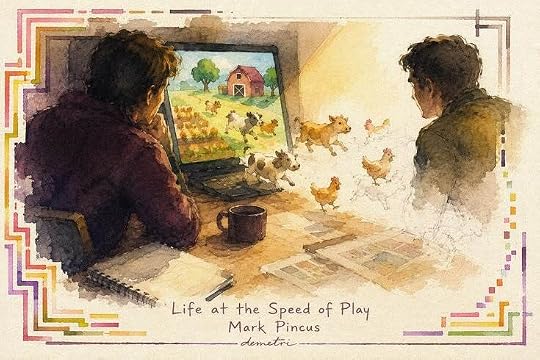
“OMFG Moment / FarmVille Animals Move” – A tiny animal escaping the screen turns product mechanics into delight, capturing the instant when a small feature suddenly opens a larger world.
Pincus is most awake on the page when the abstraction has a cow, a dog, a sauce, or a windowless room attached to it. His Bolognese recipe becomes a lesson in taste. Zinga the dog becomes both companion and company namesake. The kief bar in the basement during the dot-com winter gives the Abyss texture. The Chip Factory, Zynga’s office in a former potato-chip building, turns workplace design into a founder building a house he can bear to live in, with snacks implied and poker chips waiting in the walls. The Lonely Cow, a FarmVille prompt about a sad animal wandering away from a friend’s farm, is the perfect Pincus anecdote: ridiculous, emotionally legible, commercially explosive.
As structure, the book is less a smooth memoir than a binder with tabs, labels, and a few sharp edges. Chapters end with TL;DRs; case studies interrupt the flow; Easter Eggs appear; appendices offer a 2005 blog post and a GPT product exercise; a glossary gathers the vocabulary. The modularity earns its keep: the book wants to be used, not merely finished. The form mirrors the argument: name the thing, test the thing, repeat the thing, transfer the thing. But the structure can also feel crowded. Pincus has never met a principle he did not want to promote onto an office wall, and the reader sometimes has to separate indispensable tools from decorative residue.
Proven Better New is the book’s most bracingly useful formal contribution. Its advice is rude in the useful way: copy what already works, legally and precisely, so that originality is spent only where originality matters. Proven is what the target audience already loves. Better is what ten out of ten users would agree improves the experience. New is the glittering trap, the risky element most likely to fail. This is not a romance of invention. It is restraint against needless originality. Do not redesign the part users already love merely to prove you were in the room.
At Zynga, that discipline becomes an engine for finding heat, then franchising it. Zynga Poker is proven online poker plus instant play plus real Facebook identities at the table. FarmVille borrows farm and simulation mechanics, improves friction points, and rides the Facebook feed until casual gaming becomes a mass-market habit. CityVille, Mafia Wars, Words With Friends, expansion packs, crafting cottages, and social mechanics become a laboratory of repeatable return. The book is sharp on how one tiny intervention can make a service feel as if a new room has opened inside it. An animal moves, a bridge appears, a fake link gets clicked. In Pincus’s carnival of tests, the future sometimes enters wearing a paper mask.
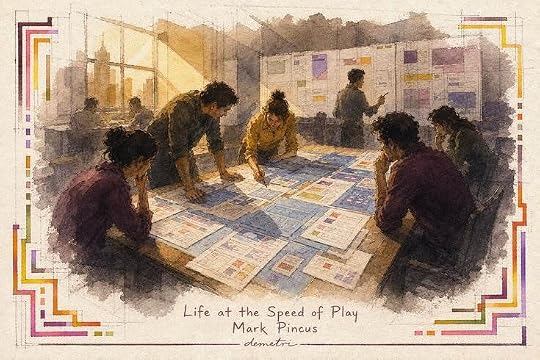
“Blue Sheets / War Room” – Around the roadmap table, ideas stop being charming theories and become commitments, measured in engineering days, expected outcomes, and the weekly pressure of proof.
Data, in this book, is never merely data. It is performance, discipline, pressure, and proof. Roadmapping is “your OS,” the weekly meeting where strategy meets engineering days and expected outcomes. Pincus’s Blue Sheets allow one team’s discovery to travel across Zynga almost instantly. His invented metrics, especially Active Social Network and Day 365 retention, are more interesting than the usual dashboard incense because they ask which behaviors predict durable value. The best chapters show a company learning by copying itself, though it is an organism that learns loudly and has no special interest in a gentle bedside manner.
In Chapter 7, “Fuck Scale,” the book reaches the point where its virtues begin arguing with one another. Pincus argues that a founder’s primary job is to be right, and that scale matters only insofar as it gets people to do the right thing when the founder is not in the room. He writes admiringly of micromanagement, distrusts routine one-on-ones, praises battlefield promotions, looks for broken résumés, and treats culture as something earned in the trenches rather than laminated on walls. Some of this clears the air; some of it removes a load-bearing wall.
Many founder memoirs become less interesting when the company succeeds. This one becomes more interesting when Zynga’s confidence starts leaking out. The Facebook fight is the book’s platform hostage drama: a landlord platform trying to tax, constrain, and potentially capture the company that has become too large on its land. Pincus refuses, Google invests, and he negotiates with Mark Zuckerberg into the small hours. Later, the IPO becomes a trap rather than a coronation. Facebook changes its algorithms, Zynga loses traffic, and the company misses mobile. Poker 2.0 alienates users. Pincus returns to a wounded company with one question that sounds less like a metric than a conscience: what will our players thank us for?

“Building on Rented Ground” – A small workspace faces a looming platform outside the window, making visible the old internet bargain: access, exposure, dependency, and the rent that comes due.
It is also the question that saves the book from becoming a sermon to the dashboard. Pincus knows, at least in flashes, that services can be squeezed until users wince. He criticizes pop-ups, monetization tics, and short-term revenue features that make a thing worse. Yet the book remains more fluent in the machinery of engagement than in the ethics of that machinery. Streaks, mystery crates, hard gates, whales, social obligation: the book describes these tools with enviable clarity. It does not always pause long enough over the distance between a user’s thanks and a user’s return.
That is the unpaid bill inside the method. “Life at the Speed of Play” is excellent on what works. It is less searching about what working too well can do. Pincus’s best counterweight is his own phrase, “what will our players thank us for?” It is a beautiful product question because it restores gratitude where metrics can become predatory. But it arrives after many pages in which user love, retention, revenue, and behavioral return sit close together, like guests at a cocktail party who may not all have been properly introduced.
Readers will also divide over founder control’s romance and trap. Pincus’s case for staying close to the metal is persuasive when the alternative is bland professional management, expensive drift, or a board applauding the wrong calm adult in the room. His regret over not buying Supercell, not acting sooner, not replacing board members, and not trusting his own product judgment gives the argument real scar tissue. But “your job is to be right” is a dangerous sentence to frame and hang above a desk. The book offers safeguards – intellectual honesty, user signal, taste, team learning – but charisma gets the louder microphone.
One reason the book remains compelling despite these limits is that Pincus is not selling the myth of founder clairvoyance. He is selling odds. The best founders, in his telling, are repeat players who reduce the cost of being wrong. They create failure machines. They lower the price of a shot on goal. They do not confuse hope with conviction. This is why the AI material feels organic rather than sprayed with topical perfume. If AI makes prototypes cheaper, faster, and stranger, then weak ideas have fewer excuses. Judgment about what to build becomes the scarcer art.
Platform dependency gives the book fresh bite. Zynga’s fight with Facebook is not merely an old platform shakedown; it is a durable lesson in building on rented ground. App stores, payment systems, social graphs, search engines, and now AI platforms all create the same uneasy bargain: access in exchange for exposure. Pincus’s advice is not subtle – keep control, do not become captive, protect your route to users – but the bluntness suits the subject. A platform can call itself open until the rent comes due.
On the book’s new planets, the argument grows more speculative and less domesticated. In “Landing on New Planets,” Pincus looks toward AI, robotics, space, crypto, and the metaverse, asking how Proven Better New works when nothing is yet proven. His answer, Fuzzy Proven, is sensible: find transferable behaviors, become native early, follow curious edges, and learn from primitive future users. The interviews with Reid Hoffman, Cyan Banister, and Neal Stephenson widen the frame, though at moments the chapter sounds like a dinner where every guest has already funded tomorrow.
Underneath the product advice, though, the book is really about drift. How does a person stop losing years? How does a team stop mistaking motion for learning? How does a company stop protecting a B+ idea because it has become too expensive to doubt? The Book of Life and the Blue Sheets are companion objects: one organizes the self, the other the company. Both ask the same severe question: what did you say mattered, what did you actually do, and what did the world tell you in return?
Like many strong business books, this one is most valuable when read partly against itself. Pincus wants builders to be fast, but his best instincts often form slowly, in the Abyss. He praises copying, but cares intensely about taste. He distrusts scale, but builds systems for repeating success at scale. He celebrates play, but studies compulsion with the eye of a watchmaker. He tells readers to burn their résumés, then offers a glossary. The contradictions do not break the book. They give it its cranky voltage.

“Burn the Résumé / Start Anywhere” – A private gesture at a desk turns the book’s final invitation into an image of defiant permission: the old credential is no longer the map, and the work can begin.
On the evidence here, “Life at the Speed of Play” is vivid, unusually concrete, and genuinely useful – strongest when it teaches disciplined abandonment, weakest when its faith in founder rightness and engagement loops outruns its moral patience. It is not built for sentence-by-sentence polish, but it has more pulse than most books on its shelf. It is a sharp operating document with memoir in its gears and a cow wandering through its metrics. My final rating is 84/100, which corresponds to 4/5 stars on Goodreads.
Speed, in the end, is not the treasure here. Honesty is. The book’s best lesson is that a builder must learn to hold the haunting instinct lightly enough to let the wrong idea die. Pincus writes as if the world is full of open doors mistaken for cages. But even an open door needs a person brave enough to walk through it without dragging a favorite B+ plan along by the collar.

“Color Swatch Sheet” – The series’ palette study gathers warm cream, lemon yellow, oxblood, mauve, olive, moss, sage, and charcoal-brown into a working map of light, tension, invention, and unfinished space.

“Compositional Thumbnail Sheet” – Early thumbnail sketches test how figure, table, phone, window light, negative space, and border might hold the book’s tension between discipline and play.
“Faint Pencil Underdrawing” – The first graphite structure reveals the review image before color: a builder, a table, a half-empty screen, and the quiet architecture of a decision not yet made.

“Watercolor Outer Border Details Study” – Border experiments translate the book’s retro cover energy into hand-painted routes, grids, thresholds, feedback loops, and broken paths that frame without enclosing.

“Screen / Interface Symbol Study” – Variations on the half-filled interface refine the central symbol of the series: what exists, what remains blank, and what the builder has not yet earned the right to fill.

“Pencil-Plus-First-Wash Stage” – The first transparent washes begin to stain the graphite plan, letting light, table, figure, phone, and border emerge while much of the paper still breathes.
All watercolor illustrations by Demetris Papadimitropoulos.
Watercolors are done on 140lb vellum and then scanned into the computer using an Epson scanner. From there, they are finalized in Procreate. All art and opinions are my own.
In Mark Pincus’s “Life at the Speed of Play,” the real art of building products is not acceleration but discernment: knowing what to test, what to keep, and what to leave behind.
By Demetris Papadimitropoulos | May 28th, 2026
“Half the Screen Is Still Empty” – A solitary builder faces the unfinished digital future, where the blank half of the screen becomes the book’s central invitation: test the instinct, spare the wrong idea, and leave room for what has not yet been built.
Do not be fooled by the title’s bright, sprinting promise. Mark Pincus’s “Life at the Speed of Play” is not finally a book about speed as proof. It has no objection to scrappiness, quick tests, or launching before the furniture has learned the floorboards. But its most useful lesson is abandonment: how to stop loving the wrong idea before it consumes the right instinct. Pincus, the founder of Zynga and an early builder, investor, and observer across several internet eras, has written a manual for builders who confuse attachment with conviction. Its best advice is not “accelerate,” but “kill sooner, test smaller, and do not let almost-good become your prettiest prison.”
Every founder book needs an origin ritual, and Pincus’s begins not with conquest but with drift. At twenty-eight, washed up in Washington, DC, pushed out of jobs, smoking, and feeling like a walk-on in his own life, he begins writing during the Jewish High Holidays. That notebook becomes his “Book of Life,” a ledger of future gratitude: what happened, what mattered, what failed, and what Future Mark would thank Present Mark for doing. The first great victory is not Zynga, not FarmVille, not a platform fight with Facebook. It is quitting cigarettes. The act is small; the pattern will carry the whole book.
“The Abyss” – The empty room between attempts becomes a workshop of suspended uncertainty, where failed prototypes and quiet light suggest that drift may also be where instinct gathers force.
Most of “Life at the Speed of Play” turns pressure into a way of refusing drift. The Book of Life and the Blue Sheets are mirrors of each other: one makes the self accountable, the other makes the company answerable. Proven Better New becomes a grammar for innovation. Bold Beats become jolts against incrementalism. The Abyss becomes the apparently idle dark in which deep instincts form. Pincus is very fond of naming things, and occasionally one wants to confiscate his label maker for an afternoon, but many of the names stick because they solve costly confusions: teams mistaking hope for evidence, motion for learning, and a respectable B+ idea for the thing that might actually work.
Even the book’s load-bearing distinction has the clean mechanical snap of something obvious only after someone says it: your instinct is probably right, but your idea is probably wrong. Pincus returns to this because it is the hinge of his career and the thought that earns the book. FreeLoader comes from the correct instinct that the web should “just work,” though its push-technology costume soon expires. Tribe.net comes from the correct instinct that online life will become social, trusted, and people-centered, though the product gets trust wrong. Zynga Poker and FarmVille succeed because Pincus finally learns how to preserve the instinct while prosecuting the idea without sentimentality.
The career story, kept brief, shows how often Pincus’s life turned on the same problem: knowing when to stop building the wrong thing. FreeLoader turns a correct instinct into a lucrative but short-lived win; Tribe.net traps a correct instinct inside the wrong social form; Zynga Poker and FarmVille turn disciplined copying, instant play, and social identity into mass-market habit; the later Zynga crisis shows what happens when a company forgets its own reasons for working. Around these episodes Pincus assembles a manual for making proof cheaper: replace bloated MVP thinking with Minimum Idea State, use Proven Better New to conserve what already works, make roadmaps and OKRs visible, ship Bold Beats, and become native to new platforms before the map exists.
Read beside “The Lean Startup” by Eric Ries and “Hooked” by Nir Eyal, Pincus’s book is less seminar room than roadmap room, and more morally vulnerable than its own swagger always admits. Ries gave founders a language of validated learning; Pincus wants the test made smaller, rougher, cheaper, and less ceremonial. Eyal explains habit-forming design; Pincus shows how habit was built, tested, monetized, and repeated inside live games. He is excellent on return, heat, social obligation, and the small levers that make recurrence feel voluntary. He is less patient with the question of when habit becomes harvest. That is where the book gets its voltage.
Its prose has the rhythm of a founder who has walked into the meeting already holding the marker. The sentences are brisk, declarative, and anecdote-driven. Pincus favors phrases built to be carried into meetings: “all New fails,” “B+ is the enemy of A,” “stay close to the metal,” “kill hope before hope kills you,” “what will our players thank us for?” The diction is plainspoken, profane, anti-corporate, and forever reaching for the nearest open window whenever consultant fog rolls in. This is not polished-marble elegance. It is liveliness in the whiteboard and weekly reckoning sense: smudged, emphatic, occasionally brilliant, occasionally overdrawn.
“OMFG Moment / FarmVille Animals Move” – A tiny animal escaping the screen turns product mechanics into delight, capturing the instant when a small feature suddenly opens a larger world.
Pincus is most awake on the page when the abstraction has a cow, a dog, a sauce, or a windowless room attached to it. His Bolognese recipe becomes a lesson in taste. Zinga the dog becomes both companion and company namesake. The kief bar in the basement during the dot-com winter gives the Abyss texture. The Chip Factory, Zynga’s office in a former potato-chip building, turns workplace design into a founder building a house he can bear to live in, with snacks implied and poker chips waiting in the walls. The Lonely Cow, a FarmVille prompt about a sad animal wandering away from a friend’s farm, is the perfect Pincus anecdote: ridiculous, emotionally legible, commercially explosive.
As structure, the book is less a smooth memoir than a binder with tabs, labels, and a few sharp edges. Chapters end with TL;DRs; case studies interrupt the flow; Easter Eggs appear; appendices offer a 2005 blog post and a GPT product exercise; a glossary gathers the vocabulary. The modularity earns its keep: the book wants to be used, not merely finished. The form mirrors the argument: name the thing, test the thing, repeat the thing, transfer the thing. But the structure can also feel crowded. Pincus has never met a principle he did not want to promote onto an office wall, and the reader sometimes has to separate indispensable tools from decorative residue.
Proven Better New is the book’s most bracingly useful formal contribution. Its advice is rude in the useful way: copy what already works, legally and precisely, so that originality is spent only where originality matters. Proven is what the target audience already loves. Better is what ten out of ten users would agree improves the experience. New is the glittering trap, the risky element most likely to fail. This is not a romance of invention. It is restraint against needless originality. Do not redesign the part users already love merely to prove you were in the room.
At Zynga, that discipline becomes an engine for finding heat, then franchising it. Zynga Poker is proven online poker plus instant play plus real Facebook identities at the table. FarmVille borrows farm and simulation mechanics, improves friction points, and rides the Facebook feed until casual gaming becomes a mass-market habit. CityVille, Mafia Wars, Words With Friends, expansion packs, crafting cottages, and social mechanics become a laboratory of repeatable return. The book is sharp on how one tiny intervention can make a service feel as if a new room has opened inside it. An animal moves, a bridge appears, a fake link gets clicked. In Pincus’s carnival of tests, the future sometimes enters wearing a paper mask.
“Blue Sheets / War Room” – Around the roadmap table, ideas stop being charming theories and become commitments, measured in engineering days, expected outcomes, and the weekly pressure of proof.
Data, in this book, is never merely data. It is performance, discipline, pressure, and proof. Roadmapping is “your OS,” the weekly meeting where strategy meets engineering days and expected outcomes. Pincus’s Blue Sheets allow one team’s discovery to travel across Zynga almost instantly. His invented metrics, especially Active Social Network and Day 365 retention, are more interesting than the usual dashboard incense because they ask which behaviors predict durable value. The best chapters show a company learning by copying itself, though it is an organism that learns loudly and has no special interest in a gentle bedside manner.
In Chapter 7, “Fuck Scale,” the book reaches the point where its virtues begin arguing with one another. Pincus argues that a founder’s primary job is to be right, and that scale matters only insofar as it gets people to do the right thing when the founder is not in the room. He writes admiringly of micromanagement, distrusts routine one-on-ones, praises battlefield promotions, looks for broken résumés, and treats culture as something earned in the trenches rather than laminated on walls. Some of this clears the air; some of it removes a load-bearing wall.
Many founder memoirs become less interesting when the company succeeds. This one becomes more interesting when Zynga’s confidence starts leaking out. The Facebook fight is the book’s platform hostage drama: a landlord platform trying to tax, constrain, and potentially capture the company that has become too large on its land. Pincus refuses, Google invests, and he negotiates with Mark Zuckerberg into the small hours. Later, the IPO becomes a trap rather than a coronation. Facebook changes its algorithms, Zynga loses traffic, and the company misses mobile. Poker 2.0 alienates users. Pincus returns to a wounded company with one question that sounds less like a metric than a conscience: what will our players thank us for?
“Building on Rented Ground” – A small workspace faces a looming platform outside the window, making visible the old internet bargain: access, exposure, dependency, and the rent that comes due.
It is also the question that saves the book from becoming a sermon to the dashboard. Pincus knows, at least in flashes, that services can be squeezed until users wince. He criticizes pop-ups, monetization tics, and short-term revenue features that make a thing worse. Yet the book remains more fluent in the machinery of engagement than in the ethics of that machinery. Streaks, mystery crates, hard gates, whales, social obligation: the book describes these tools with enviable clarity. It does not always pause long enough over the distance between a user’s thanks and a user’s return.
That is the unpaid bill inside the method. “Life at the Speed of Play” is excellent on what works. It is less searching about what working too well can do. Pincus’s best counterweight is his own phrase, “what will our players thank us for?” It is a beautiful product question because it restores gratitude where metrics can become predatory. But it arrives after many pages in which user love, retention, revenue, and behavioral return sit close together, like guests at a cocktail party who may not all have been properly introduced.
Readers will also divide over founder control’s romance and trap. Pincus’s case for staying close to the metal is persuasive when the alternative is bland professional management, expensive drift, or a board applauding the wrong calm adult in the room. His regret over not buying Supercell, not acting sooner, not replacing board members, and not trusting his own product judgment gives the argument real scar tissue. But “your job is to be right” is a dangerous sentence to frame and hang above a desk. The book offers safeguards – intellectual honesty, user signal, taste, team learning – but charisma gets the louder microphone.
One reason the book remains compelling despite these limits is that Pincus is not selling the myth of founder clairvoyance. He is selling odds. The best founders, in his telling, are repeat players who reduce the cost of being wrong. They create failure machines. They lower the price of a shot on goal. They do not confuse hope with conviction. This is why the AI material feels organic rather than sprayed with topical perfume. If AI makes prototypes cheaper, faster, and stranger, then weak ideas have fewer excuses. Judgment about what to build becomes the scarcer art.
Platform dependency gives the book fresh bite. Zynga’s fight with Facebook is not merely an old platform shakedown; it is a durable lesson in building on rented ground. App stores, payment systems, social graphs, search engines, and now AI platforms all create the same uneasy bargain: access in exchange for exposure. Pincus’s advice is not subtle – keep control, do not become captive, protect your route to users – but the bluntness suits the subject. A platform can call itself open until the rent comes due.
On the book’s new planets, the argument grows more speculative and less domesticated. In “Landing on New Planets,” Pincus looks toward AI, robotics, space, crypto, and the metaverse, asking how Proven Better New works when nothing is yet proven. His answer, Fuzzy Proven, is sensible: find transferable behaviors, become native early, follow curious edges, and learn from primitive future users. The interviews with Reid Hoffman, Cyan Banister, and Neal Stephenson widen the frame, though at moments the chapter sounds like a dinner where every guest has already funded tomorrow.
Underneath the product advice, though, the book is really about drift. How does a person stop losing years? How does a team stop mistaking motion for learning? How does a company stop protecting a B+ idea because it has become too expensive to doubt? The Book of Life and the Blue Sheets are companion objects: one organizes the self, the other the company. Both ask the same severe question: what did you say mattered, what did you actually do, and what did the world tell you in return?
Like many strong business books, this one is most valuable when read partly against itself. Pincus wants builders to be fast, but his best instincts often form slowly, in the Abyss. He praises copying, but cares intensely about taste. He distrusts scale, but builds systems for repeating success at scale. He celebrates play, but studies compulsion with the eye of a watchmaker. He tells readers to burn their résumés, then offers a glossary. The contradictions do not break the book. They give it its cranky voltage.
“Burn the Résumé / Start Anywhere” – A private gesture at a desk turns the book’s final invitation into an image of defiant permission: the old credential is no longer the map, and the work can begin.
On the evidence here, “Life at the Speed of Play” is vivid, unusually concrete, and genuinely useful – strongest when it teaches disciplined abandonment, weakest when its faith in founder rightness and engagement loops outruns its moral patience. It is not built for sentence-by-sentence polish, but it has more pulse than most books on its shelf. It is a sharp operating document with memoir in its gears and a cow wandering through its metrics. My final rating is 84/100, which corresponds to 4/5 stars on Goodreads.
Speed, in the end, is not the treasure here. Honesty is. The book’s best lesson is that a builder must learn to hold the haunting instinct lightly enough to let the wrong idea die. Pincus writes as if the world is full of open doors mistaken for cages. But even an open door needs a person brave enough to walk through it without dragging a favorite B+ plan along by the collar.
“Color Swatch Sheet” – The series’ palette study gathers warm cream, lemon yellow, oxblood, mauve, olive, moss, sage, and charcoal-brown into a working map of light, tension, invention, and unfinished space.
“Compositional Thumbnail Sheet” – Early thumbnail sketches test how figure, table, phone, window light, negative space, and border might hold the book’s tension between discipline and play.
“Faint Pencil Underdrawing” – The first graphite structure reveals the review image before color: a builder, a table, a half-empty screen, and the quiet architecture of a decision not yet made.
“Watercolor Outer Border Details Study” – Border experiments translate the book’s retro cover energy into hand-painted routes, grids, thresholds, feedback loops, and broken paths that frame without enclosing.
“Screen / Interface Symbol Study” – Variations on the half-filled interface refine the central symbol of the series: what exists, what remains blank, and what the builder has not yet earned the right to fill.
“Pencil-Plus-First-Wash Stage” – The first transparent washes begin to stain the graphite plan, letting light, table, figure, phone, and border emerge while much of the paper still breathes.
All watercolor illustrations by Demetris Papadimitropoulos.
Watercolors are done on 140lb vellum and then scanned into the computer using an Epson scanner. From there, they are finalized in Procreate. All art and opinions are my own.

July 26, 2026
I really wanted to like this book, but the more I read, the more I felt sorry for the author. His business style comes across as hectic, unfocused, and stubborn (not in a positive way). If you want to learn how to build mediocre and meh products, this book is for you.
Mark tends to reject proven concepts, then reimplement them in a crippled form and apply his own naming as if he invented new business tools. E.g., he disparages the concept of company culture but then literally describes all features of a culture and names it a moral contract. He renames growth hacks into bold beats as something new. The real cringy thing is that he can’t resist dropping hints about who he knows, who he had dinner with, and the famous actress he nearly dated.
He offers his own framework of launching new products called Proven Better New, which in reality means copying an existing working idea and growth hacking the hell out of it. There is usually nothing new added. This framework, by definition, leads to mediocrity since it starts with an unoriginal idea and an existing market full of competitors. It reads more like coping to rationalize the absence of real original ideas than a workable, useful framework.
The author's biggest success was due to his access to Mark Zuckerberg and Facebook, where he parasitized and piggybacked on its audiences while exploiting the audience using the most despicable intrusive techniques and by offering addictive games on the border of gambling. Direct access to Zuck himself gave Mark Pincus a lot of leeway and advantages. His company literally copied games invented by others and made them accessible via Facebook with exclusive levers to milk the audience.
Never in the book does Mark Pincus mention building something useful that would help people or solve a problem. All his ramblings are about finding ways to exploit the audience in more addictive ways.
Mark should have been honest with himself and not pretended to be in gaming. He'd better just launch an online casino and betting service—at least the audience would know what it signs up for. Maybe he could have been even more successful than Kalshi and Polymarket by now.
Mark tends to reject proven concepts, then reimplement them in a crippled form and apply his own naming as if he invented new business tools. E.g., he disparages the concept of company culture but then literally describes all features of a culture and names it a moral contract. He renames growth hacks into bold beats as something new. The real cringy thing is that he can’t resist dropping hints about who he knows, who he had dinner with, and the famous actress he nearly dated.
He offers his own framework of launching new products called Proven Better New, which in reality means copying an existing working idea and growth hacking the hell out of it. There is usually nothing new added. This framework, by definition, leads to mediocrity since it starts with an unoriginal idea and an existing market full of competitors. It reads more like coping to rationalize the absence of real original ideas than a workable, useful framework.
The author's biggest success was due to his access to Mark Zuckerberg and Facebook, where he parasitized and piggybacked on its audiences while exploiting the audience using the most despicable intrusive techniques and by offering addictive games on the border of gambling. Direct access to Zuck himself gave Mark Pincus a lot of leeway and advantages. His company literally copied games invented by others and made them accessible via Facebook with exclusive levers to milk the audience.
Never in the book does Mark Pincus mention building something useful that would help people or solve a problem. All his ramblings are about finding ways to exploit the audience in more addictive ways.
Mark should have been honest with himself and not pretended to be in gaming. He'd better just launch an online casino and betting service—at least the audience would know what it signs up for. Maybe he could have been even more successful than Kalshi and Polymarket by now.

August 6, 2026
After all those recommendations and online praise, I was really disappointed. It was one of the most annoying books I've read in 2026 so far. Why so?
1. The product-related advice here is mostly a laughing stock. Either "obvious obviousities" or claims like "build your own instinct". Very f_cking helpful. In general, the book is not really the actionable one.
2. It's quite clear that there two main reasons behind this book being published: money (because why not) and self-promotion. Maybe it's a middle-crisis and the author simply wanted to make a gift for himself, but ...
3. ... honestly, I don understand if people who've accomplished something exceptional or added a lot of value to the society do publish books about their own stories. Pincus earned shitloads of money on crappy idle clickers for masses, stupifiers that have ZERO value, help solve ZERO problems and simply waste people times. It was actually quite hilarious to see how he avoids the topics like:
- how the success was achieved
- what were the measures of success
- what practices they've used to optimize
4. The second play in his playbook was ... to copy. Not to invent. Not to look for synergies. Not to research for non-obvious scenarios. Simply to copy & steal, but be faster. E.g., the story of ChatGPT and Poe - it was funny to see how clueless he was about why his product was worse. The only feeling towards him I had at that point was pity.
5. Aaaaaanyway, you won't learn much from this book. Some bragging with earned money, some bragging with people he knows, some super-shallow stories how he stupified society in Zynga - boring, boring, boring.
6. It's not that he gives zero good advice, there WERE some good points there - but honestly, they'd make a good blog post, nothing more
Can't recommend it. Waste of time & money.
P.S. And his naivety when he talks about metaverse without understanding why he's endorsing the idea. Pretty childish.
1. The product-related advice here is mostly a laughing stock. Either "obvious obviousities" or claims like "build your own instinct". Very f_cking helpful. In general, the book is not really the actionable one.
2. It's quite clear that there two main reasons behind this book being published: money (because why not) and self-promotion. Maybe it's a middle-crisis and the author simply wanted to make a gift for himself, but ...
3. ... honestly, I don understand if people who've accomplished something exceptional or added a lot of value to the society do publish books about their own stories. Pincus earned shitloads of money on crappy idle clickers for masses, stupifiers that have ZERO value, help solve ZERO problems and simply waste people times. It was actually quite hilarious to see how he avoids the topics like:
- how the success was achieved
- what were the measures of success
- what practices they've used to optimize
4. The second play in his playbook was ... to copy. Not to invent. Not to look for synergies. Not to research for non-obvious scenarios. Simply to copy & steal, but be faster. E.g., the story of ChatGPT and Poe - it was funny to see how clueless he was about why his product was worse. The only feeling towards him I had at that point was pity.
5. Aaaaaanyway, you won't learn much from this book. Some bragging with earned money, some bragging with people he knows, some super-shallow stories how he stupified society in Zynga - boring, boring, boring.
6. It's not that he gives zero good advice, there WERE some good points there - but honestly, they'd make a good blog post, nothing more
Can't recommend it. Waste of time & money.
P.S. And his naivety when he talks about metaverse without understanding why he's endorsing the idea. Pretty childish.
Review of advance copy received from Author
What if each adventure we embarked on could simply be drawn out by the rules of play that we instate on ourselves? These are the type of questions that populate my head after reading "Life at the Speed of Play: Launch Products People Love!", and a deeper understanding of the bold ideas founds must concoct in order turn a singular product into a repeatable system. What I appreciated most about the book was it's openness to ambiguity and use of understandable techniques that Mark himself employed to guide the reader through the thinking behind product creation. Overall, this was absolutely a must read, especially for people looking to through some fun into their workflow.
Review of advance copy received from Author
This is a great book for anyone who wants to build tech products. I found the product building nuggets extremely useful, like the instincts vs ideas section (crazy to think that Mark thought about an SMS uber idea).
I also liked the memoir sections of the book - learning about Mark’s FB investment, Mark’s entrepreneurial journey, navigating the dot com era with Reid, his Craigslist friend, etc. And, of course, Proven Better New is a great framework which he dives into deeply throughout. Overall I thought it was 10/10. An extremely insightful great read that I’d highly recommend to any product building interested in Silicon Valley and tech.
I also liked the memoir sections of the book - learning about Mark’s FB investment, Mark’s entrepreneurial journey, navigating the dot com era with Reid, his Craigslist friend, etc. And, of course, Proven Better New is a great framework which he dives into deeply throughout. Overall I thought it was 10/10. An extremely insightful great read that I’d highly recommend to any product building interested in Silicon Valley and tech.

June 29, 2026
This is a no-nonsense playbook for anyone looking to build products and lead teams in a fast-changing world. Mark Pincus does a brilliant job of showing how to turn rapid testing and iteration into a repeatable system.
What resonated with me most was his approach to building institutional "muscle memory" for innovation. Instead of fearing failure, the book teaches you how to embrace it with confidence, step in early to course-correct, and separate your winning instincts from the ideas that just aren't working.
"After decades of building products, I've learned that your instinct is probably right, but your idea is probably wrong."
What resonated with me most was his approach to building institutional "muscle memory" for innovation. Instead of fearing failure, the book teaches you how to embrace it with confidence, step in early to course-correct, and separate your winning instincts from the ideas that just aren't working.
"After decades of building products, I've learned that your instinct is probably right, but your idea is probably wrong."

Review of advance copy received from Author
A stunning overview of how to build conviction, launch breakthrough products, move fast, learn lots… and to live life “at the speed of play”. I’m equally as inspired to get Invisalign as I am to build the next big consumer app (I’ve been playing around with on Claude Code — and I’m not a coder! I just use English!). Mark Pincus is a marvel — both in his history, successes and failures both, and in his devotion to the craft of “product making.” Reading this book felt like I was having dinner with him.

June 26, 2026
Forget boring stodgy books written by other executives. This reads like you are in Mark Pincus' kitchen as he riffs on his career and entrepreneurship while he cooks his famous bolognese. He wrote straight from his gut-- whether other people like it or not. Pure Mark!
It's particularly a great read for anyone young entering the work world, anyone whose been laid off in the current climate, or anyone in an "abyss." My favorite part of the book was how he wrote about digging out of his own "abysses" and how those were the times when the greatest things were in front of him.
It's particularly a great read for anyone young entering the work world, anyone whose been laid off in the current climate, or anyone in an "abyss." My favorite part of the book was how he wrote about digging out of his own "abysses" and how those were the times when the greatest things were in front of him.
Review of advance copy received from Author
Got an early copy and read the whole thing in a night. The tactics and frameworks are helpful, but the thing I keep thinking about is how big Pincus actually swings. The way he sees and thinks about scale is inspiring… that’s how you reach millions of people and make things people love. Also, Bold Beats is the best case I've read for the big swing over the safe one.
Essential reading for anyone betting on changemakers who want to leave the world better than they found it!

September 6, 2026
Одна з тих простих речей винесена на початок книжки й, можливо, важить чи не найбільше. «Знай свою мету – або помреш від тисячі компромісів», – пише Пінкус. Кожен окремий компроміс здається дрібним і розумним: узяти зручнішого інвестора, найняти зручнішу людину, переїхати в зручніше місто. Але вони накопичуються, і одного дня ти прокидаєшся керівником компанії, над якою більше не хочеш працювати, бо вона вже не має нічого спільного з тим, заради чого починалася.

September 19, 2026
Overall great book, enjoyed reading. Some genuinely actionable ideas. I really liked the "Proven, Better, New" framework and think there’s a lot to it.
Also this bit about culture resonated: "Culture is an output of all you do, not a conscious input. It develops organically as a result of many small and sometimes big actions as you build your product and company."
For my taste, a bit too much "see, I was right" and name-dropping for the sake of name-dropping.
Also this bit about culture resonated: "Culture is an output of all you do, not a conscious input. It develops organically as a result of many small and sometimes big actions as you build your product and company."
For my taste, a bit too much "see, I was right" and name-dropping for the sake of name-dropping.

Review of advance copy received from Author
Got an advance copy and tore through it! I really liked his point on instincts versus ideas. Basically, he says that people’s instincts are right 95% of the time, but their ideas are right maybe 25% of the time. Very helpful when parsing through the next big idea on an earnings call! The Silicon valley stories are entertaining too. Overall a fast, fun read
July 7, 2026
I received this book for free via a giveaway.
Mark Pincus the founder of Zynga, has sat down and put his wisdom into words. This book will help you build your unique product and business strategy to be successful. Learn to push past boundaries and expand ideas by engaging with the new world of AI.
Mark Pincus the founder of Zynga, has sat down and put his wisdom into words. This book will help you build your unique product and business strategy to be successful. Learn to push past boundaries and expand ideas by engaging with the new world of AI.
Review of advance copy received from Author
This is the best book I have ever read. It is perfect for students going into college. I found that I had a whole perspective change since reading this book. I can't imagine having gone through my life without reading it.
June 23, 2026
I got this book from a friend, and I didn't expect to enjoy it as much as I had. I loved how relevant this book was, and it gave me (someone who has never built a product) insight into what works vs. doesn't. Totally recommend for young people

July 29, 2026
4 stars is averaged based on the first 20% being meh, the next 70% being very good and the last 10% was just ok! I do highly recommend this to all product managers sacs start founders. Many golden nuggets.

August 1, 2026
This was a fantastic read as someone interested in the journey to build amazing products. I really gravitate toward the way Mark thinks and found several bits of the book useful to think about and apply to my own path.

August 13, 2026
I appreciate what Mark tried to achieve with this book.
I do like the part biographies mixed with frameworks books.
Also made me appreciate Mark and his sense of humor a bit more.
Don’t think it’s particularly well written, but it’s a fast read and you come out a bit happy.
I do like the part biographies mixed with frameworks books.
Also made me appreciate Mark and his sense of humor a bit more.
Don’t think it’s particularly well written, but it’s a fast read and you come out a bit happy.
August 19, 2026
Lots of valuable insights. The early chapters tend to drag on for a while and the author comes off as someone with immense confidence and resilience, right from the start. But he does build credibility by those stories and the value of his framework and other advice is not insignificant.
Review of advance copy received from Author
Absolute thriller. Taught me how to launch quickly and had a great ROI.

July 5, 2026
I have selected this book as Stevo's Business Book of the Week for the week of 7/5, as it stands heads above other recently published books on this topic.

August 20, 2026
One of the most important books you can read about startups.
August 31, 2026
Being successful in business is easy — just receive a $250,000 loan from a friend to start, and gain early access to Facebook and its huge user base to ply with your shitty online games.

September 6, 2026
Must read for anyone building products.
Displaying 1 - 26 of 26 reviews