

What do you think?

Falls #2
Under the Falls
The Pulitzer Prize–winning author of Empire Falls returns with his first stand-alone novel since Chances Are . . . —a spellbinding page-turner about a crime in a small town that exposes long-held secrets and betrayals among a group of lifelong friends
When Tyler Sinclair left Stone Mountain at eighteen, he had no plans of returning. With only a duffel bag full of clothes, a few bucks stolen from his father’s dresser, and a guitar, his most prized possession, Tyler disappeared without so much as a goodbye. Eighteen years later, and Tyler, now the frontman of a famous band aptly named Stone Mountain, finds himself returning to his hometown for a one-night-only benefit concert to support his old friend, Doc, who lost feeling in his legs following a childhood accident. As Tyler ascends the mountain, memories of his childhood come rushing back—memories of his abusive father and despondent mother, of the friends he left behind—and he quickly learns that, for many people on Stone Mountain, the past does not feel like so long ago, and not everyone has been eagerly awaiting Tyler’s return.
At the concert, resentment simmers just beneath the surface, and Tyler finds himself confronted with faces new and old: there’s Curt, Tyler’s childhood best friend, now Stone Mountain’s chief of police, and his star officer, Deb, an out-of-towner who may have bitten off more than she can chew by accepting a job in Stone Mountain. And then there’s Freddi, Curt’s wife and Tyler’s former lover, a woman whose questionable dealings and fraught history with Tyler will become the catalyst for a tragedy that will upend each of their lives and threaten to validate Tyler’s worst fear: that “Stone Mountain is the kind of place you might escape from once, if you’re lucky, but not twice.”
Under the Falls is at once a propulsive thriller, a gut-wrenching portrait of a tight-knit rural community undone by the sins of its past, and an unflinchingly honest depiction of how porous the line between right and wrong, good versus evil, can become. A stunning, deeply empathetic novel, one that takes Russo’s penchant for character-driven drama to thrilling new heights.
When Tyler Sinclair left Stone Mountain at eighteen, he had no plans of returning. With only a duffel bag full of clothes, a few bucks stolen from his father’s dresser, and a guitar, his most prized possession, Tyler disappeared without so much as a goodbye. Eighteen years later, and Tyler, now the frontman of a famous band aptly named Stone Mountain, finds himself returning to his hometown for a one-night-only benefit concert to support his old friend, Doc, who lost feeling in his legs following a childhood accident. As Tyler ascends the mountain, memories of his childhood come rushing back—memories of his abusive father and despondent mother, of the friends he left behind—and he quickly learns that, for many people on Stone Mountain, the past does not feel like so long ago, and not everyone has been eagerly awaiting Tyler’s return.
At the concert, resentment simmers just beneath the surface, and Tyler finds himself confronted with faces new and old: there’s Curt, Tyler’s childhood best friend, now Stone Mountain’s chief of police, and his star officer, Deb, an out-of-towner who may have bitten off more than she can chew by accepting a job in Stone Mountain. And then there’s Freddi, Curt’s wife and Tyler’s former lover, a woman whose questionable dealings and fraught history with Tyler will become the catalyst for a tragedy that will upend each of their lives and threaten to validate Tyler’s worst fear: that “Stone Mountain is the kind of place you might escape from once, if you’re lucky, but not twice.”
Under the Falls is at once a propulsive thriller, a gut-wrenching portrait of a tight-knit rural community undone by the sins of its past, and an unflinchingly honest depiction of how porous the line between right and wrong, good versus evil, can become. A stunning, deeply empathetic novel, one that takes Russo’s penchant for character-driven drama to thrilling new heights.
256 pages, Hardcover
First published August 11, 2026
About the author
Richard Russo
47 books5,066 followersRICHARD RUSSO is the author of seven previous novels; two collections of stories; and Elsewhere, a memoir. In 2002 he received the Pulitzer Prize for Empire Falls, which like Nobody’s Fool was adapted to film, in a multiple-award-winning HBO miniseries.
Ratings & Reviews
Friends & Following
Create a free account to discover what your friends think of this book!
Community Reviews
Displaying 1 - 30 of 632 reviews

April 1, 2026
Richard Russo is a favorite of mine. I’ve read and loved all of his novels. His forte is books about small towns with characters whose lives are shaped by the place , by their relationships with one another, as much as specific events. This novel is one of those books . I knew going into it that it was described as a crime/thriller. Even though this is not a genre I enjoy reading, I couldn’t resist because - well it’s Richard Russo. I’m going to chalk up my three stars and not more to the genre. I can’t give it less even though I didn’t fully enjoy it because I found elements of his writing that I love . From the beginning the reader is invited to the place, the past, taking us along with characters connected by their past - by shared trauma, friendship, by love, but also resentment and guilt. For more plot details you can read the description.
I received a copy of this from Knopf through NetGalley.
I received a copy of this from Knopf through NetGalley.

August 28, 2026
“Realizing that you’ve come to the end of the line, you start looking for a place to turn around and fear that there isn’t one, that you’ve waited too long.”
My experience with this book?
This is not typical Russo. Yes, he is character-driven, and he provides incredible descriptions of backdrop and scenery that can be mesmerizing. And, judging by the many low-star reviews—although I haven’t read them yet, only noted them—it may be that many readers simply do not like seeing him venture into this type of drama.
At 233 pages, this could have been a taut, suspenseful thriller. But because this is not Russo’s usual fare, that part of the story often flounders. It does, however, blend the tension of a small-town mystery with his character-driven exploration of what happens when people live with regret, guilt, and the discomfort of the past.
Tyler is returning to his hometown as a successful artist, seemingly with good intentions. But not everyone is excited to see him. Then, when something deliberate happens with serious consequences, a criminal investigation is set in motion.
This story is not going to have a dramatic, thriller-like ending. The plot is resolved, but the strength of the novel lies in its emotional core and in how the characters choose to address their conflicted history. Yet therein also lies its weakness. The thriller element sometimes feels manufactured, especially when compared with Russo’s talent for creating flawed, believable characters.
The question is whether readers will be patient with this particular presentation of Russo’s writing, as well as the variety of difficult triggers that, at times, made this an uncomfortable and challenging read. Those triggers are listed below.
In the author’s acknowledgements, Russo shares that this book began as a TV pilot script that was never produced. That revelation may explain why the story occasionally feels awkward in places and seems to struggle between being a character-driven novel and a suspenseful mystery.
Content warning triggers: substance abuse, drug addiction, depression, suicidal ideation, severe childhood trauma, domestic and physical abuse, and parental neglect.
My experience with this book?
This is not typical Russo. Yes, he is character-driven, and he provides incredible descriptions of backdrop and scenery that can be mesmerizing. And, judging by the many low-star reviews—although I haven’t read them yet, only noted them—it may be that many readers simply do not like seeing him venture into this type of drama.
At 233 pages, this could have been a taut, suspenseful thriller. But because this is not Russo’s usual fare, that part of the story often flounders. It does, however, blend the tension of a small-town mystery with his character-driven exploration of what happens when people live with regret, guilt, and the discomfort of the past.
Tyler is returning to his hometown as a successful artist, seemingly with good intentions. But not everyone is excited to see him. Then, when something deliberate happens with serious consequences, a criminal investigation is set in motion.
This story is not going to have a dramatic, thriller-like ending. The plot is resolved, but the strength of the novel lies in its emotional core and in how the characters choose to address their conflicted history. Yet therein also lies its weakness. The thriller element sometimes feels manufactured, especially when compared with Russo’s talent for creating flawed, believable characters.
The question is whether readers will be patient with this particular presentation of Russo’s writing, as well as the variety of difficult triggers that, at times, made this an uncomfortable and challenging read. Those triggers are listed below.
In the author’s acknowledgements, Russo shares that this book began as a TV pilot script that was never produced. That revelation may explain why the story occasionally feels awkward in places and seems to struggle between being a character-driven novel and a suspenseful mystery.
Content warning triggers: substance abuse, drug addiction, depression, suicidal ideation, severe childhood trauma, domestic and physical abuse, and parental neglect.

January 28, 2026
I really don't know what happened here. Richard Russo has long been ol' reliable for me. His books are funny and heartwarming and full of curmudgeonly and flawed but lovable characters. This book, which was originally a pilot script for a tv show, is a departure and not a welcome one.
I knew when I began reading and found that part of the story is told by a twentysomething Black woman (for those not in the know, Russo is a 76 year-old white man) that things were not looking good. Maybe the story would have worked better in its original form, as a serialized tv show?
Some Lingering Questions (SPOILERS ahead, be warned)
-If Tyler hated his hometown so much and wanted to distance himself, why did he name his band after it?
-Did the concertgoers, like, bring cartons of eggs into the concert?
-Did Doc really die how they said he did? He's used as a plot device and a reason for Tyler to return then quickly discarded and forgotten.
-Why is Beth so mad at Tyler? Even if he called Curtis Jr. while THEIR LIMO WAS ACTIVELY BEING PUSHED OFF A MOUNTAIN, the accident was already in motion.
-Why did Freddi tell Curtis Jr. about who she suspected his father was? She doesn't even know for sure, and she didn't tell her husband.
-Speaking of Freddi, there is nothing about this character or her motivations that I understand.
-How did Tyler figure out it was Curtis Jr. and not Freddi who was driving the hearse?
-What was Curtis Jr. planning to do when he bumped the limo off the mountain? Was he intending to kill its four inhabitants? Much like Freddi's, his motivations are a mystery. And we have so little of him in the novel that it's hard to guess.
I knew when I began reading and found that part of the story is told by a twentysomething Black woman (for those not in the know, Russo is a 76 year-old white man) that things were not looking good. Maybe the story would have worked better in its original form, as a serialized tv show?
Some Lingering Questions (SPOILERS ahead, be warned)
-If Tyler hated his hometown so much and wanted to distance himself, why did he name his band after it?
-Did the concertgoers, like, bring cartons of eggs into the concert?
-Did Doc really die how they said he did? He's used as a plot device and a reason for Tyler to return then quickly discarded and forgotten.
-Why is Beth so mad at Tyler? Even if he called Curtis Jr. while THEIR LIMO WAS ACTIVELY BEING PUSHED OFF A MOUNTAIN, the accident was already in motion.
-Why did Freddi tell Curtis Jr. about who she suspected his father was? She doesn't even know for sure, and she didn't tell her husband.
-Speaking of Freddi, there is nothing about this character or her motivations that I understand.
-How did Tyler figure out it was Curtis Jr. and not Freddi who was driving the hearse?
-What was Curtis Jr. planning to do when he bumped the limo off the mountain? Was he intending to kill its four inhabitants? Much like Freddi's, his motivations are a mystery. And we have so little of him in the novel that it's hard to guess.

August 28, 2026
Richard Russo is a master at writing character driven dramatic novels that are set in small towns, and this book is no exception. This was a multilayered and thought provoking read. Under the Falls sets up a course of events that ratchet up the tension when a group of friends and family members are faced with almost insurmountable dilemmas.
Tyler Sinclair left the small town of Stone Mountain when he was 18 years old without saying goodbye to anyone, even his best friends. Eighteen years later he comes back to town as a well-known musician of a band called Stone Mountain. Even though he is back to perform a charity concert for a friend of his who was paralyzed during a jump over the falls when they were teens, not everyone is ready to welcome Tyler back with open arms. His return becomes the catalyst to an even greater tragedy and many perplexing problems. What are these enigmatic characters willing to do or how far are they willing to go for a friend or family member? What if it costs them their marriage, their job, their reputation, or might even send them to prison?
I really enjoyed reading this book and will be recommending it to all my friends who love good contemporary literary fiction with a mystery at its core.
My sincere thanks to Knopf publishers and NetGalley for giving me the opportunity to read this DRC in exchange for an honest review.
Tyler Sinclair left the small town of Stone Mountain when he was 18 years old without saying goodbye to anyone, even his best friends. Eighteen years later he comes back to town as a well-known musician of a band called Stone Mountain. Even though he is back to perform a charity concert for a friend of his who was paralyzed during a jump over the falls when they were teens, not everyone is ready to welcome Tyler back with open arms. His return becomes the catalyst to an even greater tragedy and many perplexing problems. What are these enigmatic characters willing to do or how far are they willing to go for a friend or family member? What if it costs them their marriage, their job, their reputation, or might even send them to prison?
I really enjoyed reading this book and will be recommending it to all my friends who love good contemporary literary fiction with a mystery at its core.
My sincere thanks to Knopf publishers and NetGalley for giving me the opportunity to read this DRC in exchange for an honest review.

August 19, 2026
Reuniting in Fragments
Richard Russo’s “Under the Falls” is framed as a dark, cinematic thriller. Following Tyler Sinclair, a rock star returning to his decaying upstate New York hometown for a benefit concert, the novel attempts to explore guilt and the gravity of the past. However, the transition into thriller territory proves rocky.
The execution suffers from pacing issues that seem rooted in the book's origins as an unproduced TV pilot. Rather than a cohesive novel, the chapters often feel like disconnected, scripted scenes where narrative momentum is sacrificed for dramatic beats. Key plot points feel rushed or under-developed, leaving the reader struggling to connect with the stakes. For example, Doc’s death is dealt with so quickly it fails to resonate, and other promising characters, like Jason, seem to vaporize from the story entirely without impact. Even the climax misses the mark; moments like the concert riot, where eggs show up only for the encore, feel absurd rather than dramatic.
The character development also leaves much to be desired. While Freddi is not quite one-dimensional, she is almost unbelievably cold-hearted, and the male leads fare even worse. Tyler and his childhood best friend, Curt, are remarkably thick. Their inability to see past their own narrow perspectives makes their decision-making frustratingly obscure and makes it difficult for the reader to engage with their plight.
Ultimately, “Under the Falls” struggles to find its footing. It captures the atmosphere of a distressed mountain town effectively—Russo’s vivid descriptions of decaying architecture and the heavy, stagnant air of the valley provide a tangible sense of place. However, the thriller mechanics feel screen-engineered and forced, resulting in a book that doesn't quite live up to its potential.
This novel is best suited for die-hard Russo fans who appreciate his ability to evoke small-town rot, or for readers who enjoy screenplay-style pacing and aren't bothered by logic gaps in character motivations.
Thank you to Knopf, Pantheon, Vintage, and Anchor and to NetGalley for providing an advance reader copy in exchange for an honest review. #UnderTheFalls #NetGalley #The400Unit
Richard Russo’s “Under the Falls” is framed as a dark, cinematic thriller. Following Tyler Sinclair, a rock star returning to his decaying upstate New York hometown for a benefit concert, the novel attempts to explore guilt and the gravity of the past. However, the transition into thriller territory proves rocky.
The execution suffers from pacing issues that seem rooted in the book's origins as an unproduced TV pilot. Rather than a cohesive novel, the chapters often feel like disconnected, scripted scenes where narrative momentum is sacrificed for dramatic beats. Key plot points feel rushed or under-developed, leaving the reader struggling to connect with the stakes. For example, Doc’s death is dealt with so quickly it fails to resonate, and other promising characters, like Jason, seem to vaporize from the story entirely without impact. Even the climax misses the mark; moments like the concert riot, where eggs show up only for the encore, feel absurd rather than dramatic.
The character development also leaves much to be desired. While Freddi is not quite one-dimensional, she is almost unbelievably cold-hearted, and the male leads fare even worse. Tyler and his childhood best friend, Curt, are remarkably thick. Their inability to see past their own narrow perspectives makes their decision-making frustratingly obscure and makes it difficult for the reader to engage with their plight.
Ultimately, “Under the Falls” struggles to find its footing. It captures the atmosphere of a distressed mountain town effectively—Russo’s vivid descriptions of decaying architecture and the heavy, stagnant air of the valley provide a tangible sense of place. However, the thriller mechanics feel screen-engineered and forced, resulting in a book that doesn't quite live up to its potential.
This novel is best suited for die-hard Russo fans who appreciate his ability to evoke small-town rot, or for readers who enjoy screenplay-style pacing and aren't bothered by logic gaps in character motivations.
Thank you to Knopf, Pantheon, Vintage, and Anchor and to NetGalley for providing an advance reader copy in exchange for an honest review. #UnderTheFalls #NetGalley #The400Unit
April 12, 2026
Advanced Review Copy
The author of one of my favorite all-time books, Nobody's Fool, returns by stepping into a new genre: murder-mystery.
Tyler Sinclair is the lead singer of the famous rock band Stone Mountain, so named after the Rust-Belt upstate New York town in which he grew up. He returns for a tour stop and visits with Doc, a man who suffered a spinal injury he incurred in a dangerous stunt with Tyler when they were kids. At the concert he also comes across his old friend Curt, now the Chief of Police. Curt’s wife, Freddi, was someone Tyler was in love with way back then, and now she’s involved in something awfully fishy.
Trying to leave town, Tyler’s limo is run off the road by a familiar-looking car. Two people die, his girlfriend and bandmate Beth is critically injured, and he ends up in a hospital also desperately hurt. Looks like an accident until Curt’s deputy, Deb, looks into it. All might not be what it seems, and all those past secrets and misdeeds might come back to haunt them all…

This is one of Russo’s shorter books, coming in just around two-fifty. It reads pretty smoothly, with lots of introspection but done with clear, easy-to-grasp prose. The main characters’ rationale makes sense for the most part. The pain of the past is evident and tactile.
Mystery isn’t something I’d have expected from Russo, but he does a good job with the basic elements. The action is front-heavy, with a big swath of conversations and inner monologues right in the middle. The climax builds where it should and with plenty of swift movements and twists. He digs deep into motivation, allowing ghosts to appear and mess things up for everyone. The plot felt disjointed and confusing at times, causing me to backtrack once in a while. Memories, implanted in the multi-perspective format, interfered with the real events. I wished for just a few very clear narratives that would explain things a bit more clearly.
The characters seem not very redeemable, and some not likeable. In his past works I found the villains to have a comical side, but not here at all. Freddi is just awful, and I wasn’t sure I understood why. But there’s a seriousness and heft that bummed me out. So, I suppose nasty characters doing iffy things was kind of the point.
The setting is important here, perhaps even more so than in previous novels. Russo seems to lean hard into the book’s identity with depressed upstate. Everyone’s so messed up, so mixed up with crime and violence and jealousy, partly because of the poor economy and racism and classism. That was a theme that good, but again: I wanted more mystery.
The Acknowledgements state that this was a script for a TV pilot that didn’t make it through the writer’s strike. Maybe that would’ve helped the enjoyment here: the visuals might’ve made the setting and the crime elements pop.
(Also, when I heard “Stone Mountain,” I thought of the place in Georgia. So, I was confused. Was another town name considered?)
Still, Russo can write. He can put images in my mind and make me think. I sure hope he comes back to this setting with characters just as interesting as the ones he’d created in the past.
Thanks to the publisher and NetGalley for a complimentary copy in exchange for an honest review. Under the Falls will be released August 11, 2026.
The author of one of my favorite all-time books, Nobody's Fool, returns by stepping into a new genre: murder-mystery.
Tyler Sinclair is the lead singer of the famous rock band Stone Mountain, so named after the Rust-Belt upstate New York town in which he grew up. He returns for a tour stop and visits with Doc, a man who suffered a spinal injury he incurred in a dangerous stunt with Tyler when they were kids. At the concert he also comes across his old friend Curt, now the Chief of Police. Curt’s wife, Freddi, was someone Tyler was in love with way back then, and now she’s involved in something awfully fishy.
Trying to leave town, Tyler’s limo is run off the road by a familiar-looking car. Two people die, his girlfriend and bandmate Beth is critically injured, and he ends up in a hospital also desperately hurt. Looks like an accident until Curt’s deputy, Deb, looks into it. All might not be what it seems, and all those past secrets and misdeeds might come back to haunt them all…
This is one of Russo’s shorter books, coming in just around two-fifty. It reads pretty smoothly, with lots of introspection but done with clear, easy-to-grasp prose. The main characters’ rationale makes sense for the most part. The pain of the past is evident and tactile.
Mystery isn’t something I’d have expected from Russo, but he does a good job with the basic elements. The action is front-heavy, with a big swath of conversations and inner monologues right in the middle. The climax builds where it should and with plenty of swift movements and twists. He digs deep into motivation, allowing ghosts to appear and mess things up for everyone. The plot felt disjointed and confusing at times, causing me to backtrack once in a while. Memories, implanted in the multi-perspective format, interfered with the real events. I wished for just a few very clear narratives that would explain things a bit more clearly.
The characters seem not very redeemable, and some not likeable. In his past works I found the villains to have a comical side, but not here at all. Freddi is just awful, and I wasn’t sure I understood why. But there’s a seriousness and heft that bummed me out. So, I suppose nasty characters doing iffy things was kind of the point.
The setting is important here, perhaps even more so than in previous novels. Russo seems to lean hard into the book’s identity with depressed upstate. Everyone’s so messed up, so mixed up with crime and violence and jealousy, partly because of the poor economy and racism and classism. That was a theme that good, but again: I wanted more mystery.
The Acknowledgements state that this was a script for a TV pilot that didn’t make it through the writer’s strike. Maybe that would’ve helped the enjoyment here: the visuals might’ve made the setting and the crime elements pop.
(Also, when I heard “Stone Mountain,” I thought of the place in Georgia. So, I was confused. Was another town name considered?)
Still, Russo can write. He can put images in my mind and make me think. I sure hope he comes back to this setting with characters just as interesting as the ones he’d created in the past.
Thanks to the publisher and NetGalley for a complimentary copy in exchange for an honest review. Under the Falls will be released August 11, 2026.

Review of advance copy received from Netgalley
* thanks to Knopf for the NetGalley review copy (pub date: August 2026)
DNF @ 17% because omfg this is tedious
DNF @ 17% because omfg this is tedious

May 24, 2026
I have so many questions. I think this was a murder mystery? Maybe? But nothing was really solved. And everyone but our main character was the problem, evidently. This was all over the place and absolutely none of it made any sense.
Tyler grew up in Stone Mountain, which according to this is in the Adirondacks, but sounds more like Stone Moutnain GA to me. It was not a happy life, his dad was an abuser, and opportunities were limited to say the least. Tyler wanted to be a musician so he leaves one night without saying goodbye to start his life. He makes it big and returns to town to hold a benefit concert for a friend that was paralyzed when they were younger. Then, everything falls apart.
A list of questions I had while reading. Beware, spoilers below.
Why again did they run the limo off the mountain? Because Tyler got famous after he left without saying goodbye? And this is reason to try to kill a car full of famous people? And hold a grudge about it for 20 years?
Why tf was Freddi such a reprehensible person? And why did Russo constantly harp on her being Black? What do those two things have to do with each other?
Also, the guy with the MAGA hat actively taking orders from Freddi…. Uh, I don’t think that’s how it works?
Beth was such a nonentity, why was she even there? She was with Tyler, making music, then didn’t want to ever see him again after an accident happened in which he was also injured, but then takes him back to help him get over his opioid addiction? Say what?
Curt was the saddest character of all. So desperate for human connection, but he was awful as a human being. Yes, do look the other way while your wife trafficks drugs when you are the chief of police. WHAT COULD GO WRONG?
So Freddi and her son get away… and face no consequences because Curt takes the full blame? How about no?
And wtf was Stone Mountain, Harlem Edition? Mentioned it twice and only showed 2 people in the neighborhood.
I still don’t know if Doc died the way they said he did. What was the point of him dying? And did Tyler really intentionally push him causing the injury that paralyzed Doc?
I still don’t quite fully understand what I read. I don’t know what the point was, exactly other than a misery tour.
Thanks to Knopf, Pantheon, Vintage, and Anchor and NetGalley for the gifted eARC. All opinions are my own.
Tyler grew up in Stone Mountain, which according to this is in the Adirondacks, but sounds more like Stone Moutnain GA to me. It was not a happy life, his dad was an abuser, and opportunities were limited to say the least. Tyler wanted to be a musician so he leaves one night without saying goodbye to start his life. He makes it big and returns to town to hold a benefit concert for a friend that was paralyzed when they were younger. Then, everything falls apart.
A list of questions I had while reading. Beware, spoilers below.
Why again did they run the limo off the mountain? Because Tyler got famous after he left without saying goodbye? And this is reason to try to kill a car full of famous people? And hold a grudge about it for 20 years?
Why tf was Freddi such a reprehensible person? And why did Russo constantly harp on her being Black? What do those two things have to do with each other?
Also, the guy with the MAGA hat actively taking orders from Freddi…. Uh, I don’t think that’s how it works?
Beth was such a nonentity, why was she even there? She was with Tyler, making music, then didn’t want to ever see him again after an accident happened in which he was also injured, but then takes him back to help him get over his opioid addiction? Say what?
Curt was the saddest character of all. So desperate for human connection, but he was awful as a human being. Yes, do look the other way while your wife trafficks drugs when you are the chief of police. WHAT COULD GO WRONG?
So Freddi and her son get away… and face no consequences because Curt takes the full blame? How about no?
And wtf was Stone Mountain, Harlem Edition? Mentioned it twice and only showed 2 people in the neighborhood.
I still don’t know if Doc died the way they said he did. What was the point of him dying? And did Tyler really intentionally push him causing the injury that paralyzed Doc?
I still don’t quite fully understand what I read. I don’t know what the point was, exactly other than a misery tour.
Thanks to Knopf, Pantheon, Vintage, and Anchor and NetGalley for the gifted eARC. All opinions are my own.
This entire review has been hidden because of spoilers.
November 25, 2025
This is very sub-par for such a good writer as Russo. Curt is the only interesting character. The plot is pretty predictable. I think it needs better editing as there are way too many sentences ending with question marks. I see at the end it was originally a pilot for a tv series that did not survive the writers’ strike. Russo should have passed on it. I think he generally aims for depth in his novels. There is also zero humor and he can be a master of sarcasm clever ridicule of human nature. I am hoping it will be cleaned up before the release date next year.

August 21, 2026
UNDER THE FALLS by Richard Russo
Tyler Sinclair escaped his depressing Rust Belt hometown at 18 and never looked back. Eighteen years later, he’s a rock star returning for a benefit concert for an old friend who was paralyzed in a childhood accident involving Tyler. Cue old friends, old lovers, old grudges, buried trauma, and approximately zero people being happy to see him.
Then tragedy strikes, and suddenly all those old secrets are looking a hell of a lot more dangerous.
I enjoyed this one, but it’s definitely not Russo at his best. The mystery was pretty predictable, some of the characters felt underdeveloped, and the middle got a little tangled. BUT. Russo can write complicated, damaged people and sad little towns full of resentment like nobody’s business.
And there’s a reason this one feels a little different: Russo reveals in the afterword that it started as a TV pilot script that never made it through the writers’ strike. Honestly, that explains a lot. The abbreviated character development, the pacing, the predictability. I saw those plot twists coming a mile away.
Still, it’s Richard effing Russo. I’m going to read the man’s grocery list and probably give it 3.5 stars.
This one isn’t getting the greatest reviews, but I enjoyed it. If you love Richard Russo, it’s definitely worth your time.
Thank you, Knopf and NetGalley for the advanced reader copy in exchange for an honest review. All opinions are my own.
Tyler Sinclair escaped his depressing Rust Belt hometown at 18 and never looked back. Eighteen years later, he’s a rock star returning for a benefit concert for an old friend who was paralyzed in a childhood accident involving Tyler. Cue old friends, old lovers, old grudges, buried trauma, and approximately zero people being happy to see him.
Then tragedy strikes, and suddenly all those old secrets are looking a hell of a lot more dangerous.
I enjoyed this one, but it’s definitely not Russo at his best. The mystery was pretty predictable, some of the characters felt underdeveloped, and the middle got a little tangled. BUT. Russo can write complicated, damaged people and sad little towns full of resentment like nobody’s business.
And there’s a reason this one feels a little different: Russo reveals in the afterword that it started as a TV pilot script that never made it through the writers’ strike. Honestly, that explains a lot. The abbreviated character development, the pacing, the predictability. I saw those plot twists coming a mile away.
Still, it’s Richard effing Russo. I’m going to read the man’s grocery list and probably give it 3.5 stars.
This one isn’t getting the greatest reviews, but I enjoyed it. If you love Richard Russo, it’s definitely worth your time.
Thank you, Knopf and NetGalley for the advanced reader copy in exchange for an honest review. All opinions are my own.

April 29, 2026
Ok, how did this one get past an editor? Or, basically anyone? Not to ruin the “story” but there are so many “are you serious” moments I couldn’t finish the book. I could give 7 examples in the first 50 pages that make no sense. Time is too short for nonsense stories pretending to actually be a real storyline. Thanks to NetGalley for the ARC!

August 22, 2026
Under the Falls by Richard Russois is a stand-alone novel about a one Tyler Sinclair who left Stone Mountain, in upstate New York when he was 18 years old, taking little more than a bag of clothes, a small amount of cash and his guitar. Now , eighteen years later, he is a different person, a well known singer about to go on tour, and with his band, about to play a one time benefit concert in his hometown on the mountain. This opens up floodgates of memories for Tyler and those who remember him best who have never left Stone Mountain at all.
to be continued….
Thank you to Knopf and NetGalley for an advanced reader’s copy of this book.
to be continued….
Thank you to Knopf and NetGalley for an advanced reader’s copy of this book.
Read
September 1, 2026That explane alot
shot past music escape one lost moment
the leaf not same
break the hour truth
play past reham
thee charg crime
hard to explan who broke that brunch again
off moment
read between stage
truth dram retern
lost moment
shot past music escape one lost moment
the leaf not same
break the hour truth
play past reham
thee charg crime
hard to explan who broke that brunch again
off moment
read between stage
truth dram retern
lost moment

September 10, 2026
3.5 stars

Review of advance copy received from Netgalley
DNF at 40%. This is nowhere near the level of writing we usually get from Richard Russo. The premise was a good one, but the way the story unfolds, the way the characters interact,the tedious inner monologues and the choppy, uneven writing were enough for me to give up on this one. Maybe it would work as it was intended, as a serialized television production, but as a novel it suffers from a lack of heart and the depth required to keep readers engaged.

August 25, 2026
A relatively slender (for this author) but suspenseful, character-driven novel that demonstrates pretty conclusively that we can never leave our past behind, maybe especially when we think we have. At 18, Tyler Sinclair fled Stone Mountain, a down-on-its-luck small upstate New York town in the Adirondacks, leaving behind his abusive old man and beaten-down mother, without so much as a goodbye to his best friend and the girl he’d been seeing. He’s never gone back or even spoken again to anyone from home. Turns out, his departure was the beginning of a long run of good luck, because he’s made it, rich and famous, frontman guitarist of a band aptly named Stone Mountain. But now, years later, he’s reluctantly returning to Stone Mountain for one night only, for a benefit concert for a guy he used to pal around with, who’s been confined to a wheelchair since an accident during the summer shortly before Tyler left town. Things haven’t changed much in Stone Mountain, Tyler discovers, except his best friend is now the town sheriff, married to the girl Tyler used to see, there’s an opioid epidemic, and it seems he’s not universally welcomed. In fact, there’s a large resentment against him festering in town, as he discovers once he takes the stage. As soon as the concert is over, he and his entourage beat a hasty retreat, but the town and the mountain have one more surprise in store.
August 17, 2026
The plot is straight out of the Lifetime Movie channel. This is not the Richard Russo I remember. The characters in his prior books are so realistic and relatable while the lead in this one - Tyler Sinclair (even his name sounds fake) is just a cliche. Thankfully it’s a fairly short novel and I gave 2 stars for the young policewoman Deb. Here’s a suggestion Mr. Russo: write your next novel about her!

August 24, 2026
Richard Russo has been one of my favorite authors for going on thirty years, and I’ve devoured everything that he’s written that I could get my hands on. Russo’s supreme talent is capturing the under dog…the blue collar, doggedly devoted characters in downward spiraling towns that combine a gallows humor sensibility with self inflicted injuries and chagrined realizations about their lives.
Most of Russo’s best work is set in upstate New York, and his new novel Under The Falls follows that formula. Unlike the rest of his novels however, the genesis for this novel was a television pilot screenplay that never panned out, with Russo later taking that seed and turning it into a short novel (230 pages).
As a huge Russo fan, I found myself not feeling like this was one of his best books. There are characters and incidents in the first third of the book that seem to evaporate from the narrative downstream, and as a reader I found myself questioning why they were included at all. Learning after finishing the book that this project started as a television pilot screenplay, I came away feeling that perhaps those elements would have been explored more over the course of multiple episodes in a longer season, and what we were left with were the bare bones that Russo felt were required for the later two thirds of the book.
Overall, this book is enjoyable as an easily digestible mystery adjacent novel. There is an element of figuring out exactly what happened, even if most readers will instinctually know early on where things are headed. That said, Russo does flex his talent for writing dialogue and internal thoughts for down on their luck characters who are conflicted about their motivations and circumstances in life. Struggle, and the conflict between feelings of fatedness and free will are Russo’s bread and butter, and he exhibits his talent for it here yet again. Even if the central narrative is less compelling than normal, Russo’s talent for character work makes this an entertaining, if lighter than normal, read.
3.75 stars rounded to 4
Most of Russo’s best work is set in upstate New York, and his new novel Under The Falls follows that formula. Unlike the rest of his novels however, the genesis for this novel was a television pilot screenplay that never panned out, with Russo later taking that seed and turning it into a short novel (230 pages).
As a huge Russo fan, I found myself not feeling like this was one of his best books. There are characters and incidents in the first third of the book that seem to evaporate from the narrative downstream, and as a reader I found myself questioning why they were included at all. Learning after finishing the book that this project started as a television pilot screenplay, I came away feeling that perhaps those elements would have been explored more over the course of multiple episodes in a longer season, and what we were left with were the bare bones that Russo felt were required for the later two thirds of the book.
Overall, this book is enjoyable as an easily digestible mystery adjacent novel. There is an element of figuring out exactly what happened, even if most readers will instinctually know early on where things are headed. That said, Russo does flex his talent for writing dialogue and internal thoughts for down on their luck characters who are conflicted about their motivations and circumstances in life. Struggle, and the conflict between feelings of fatedness and free will are Russo’s bread and butter, and he exhibits his talent for it here yet again. Even if the central narrative is less compelling than normal, Russo’s talent for character work makes this an entertaining, if lighter than normal, read.
3.75 stars rounded to 4

June 29, 2026
Thank you to NetGalley for the ARC. Being a Richard Russo fan, I was excited to read his latest-a mystery/thriller which is definitely a departure from his other books. It was a quick read, memorable characters, vivid descriptions and a satisfying ending. Try it when it comes out in August.

August 15, 2026
The Distance Between Staying and Saving:
On Richard Russo’s “Under the Falls”
In Stone Mountain, friendship survives not because two men can repair what they have done to each other, but because they finally stop confusing love with the power to make things right.
By Demetris Papadimitropoulos | August 14th, 2026
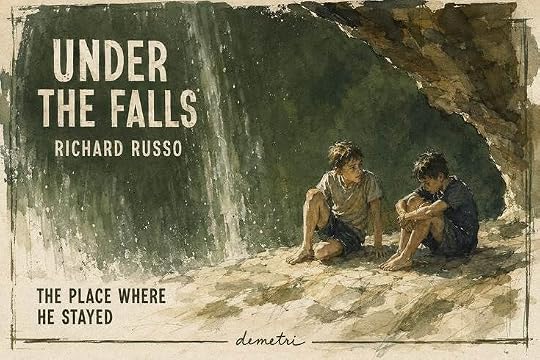
Behind the falls, Curt can do nothing to repair what Tyler has seen at home, so he does the smaller thing the novel will spend decades complicating: he stays close without trying to take control.
During the first rescue in Richard Russo’s “Under the Falls,” nobody gets saved, exactly. Eleven-year-old Tyler Sinclair has watched his father beat his mother and fled behind a waterfall, where the roar swallows whatever he might say. His best friend Curt finds him there. Curt cannot stop the violence, repair Tyler’s family or make the boy feel brave. He can sit beside him. He can tell him there was nothing a child could have done. He can promise that Tyler will not face everything alone. It is enough. The trouble starts later, when staying beside someone no longer feels like enough.
Eighteen years on, Tyler has escaped Stone Mountain in every measurable way, although the town has followed him into his band name, his songs and his guilt. He is rich and famous, returning to the Adirondacks for a benefit concert for Tim “Doc” Dockery, another childhood friend, left paraplegic after a rope-swinging accident at the local falls. Tyler was the boy who dragged Doc from the water. Doc now drives a customized orange hearse and has become a virtuoso of gallows humor. He is also less grateful for the heroic arrangement than everyone around him would prefer. He takes Tyler back to the abandoned campground, reminds him that Tyler gave the shove that sent him toward the dam, and tells him that some locals resent more than his success. Tyler has taken Stone Mountain’s humiliations, jokes, griefs and private histories and turned them into songs. His defense comes quickly: he has helped people be seen. Doc leaves him with the question he has spent eighteen years avoiding: seen by whom, and on whose terms?
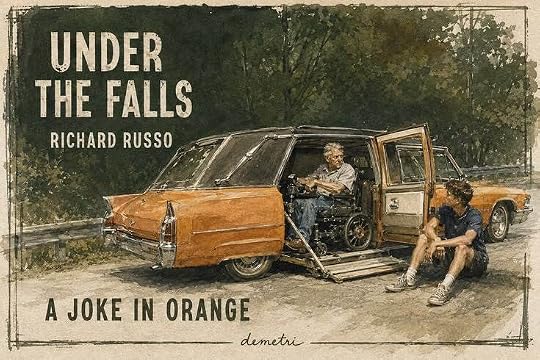
Doc’s adapted orange hearse arrives first as a joke and an assertion of independence, then slowly becomes something else entirely, turning the novel’s funniest machine into one of its most consequential pieces of evidence.
Most novels would stop there and have plenty to do. Russo adds a riot, a deadly limousine crash, a compromised police chief, a drug operation, uncertain paternity, kidnapping, opioid dependence and enough misconduct to keep a county courthouse busy for a season. The plot moves briskly, but its best shocks are rarely the ones that belong in an evidence bag. Who drove the pursuing vehicle matters. More interesting is what Curt needs to believe about Tyler, what Tyler needs to believe about his own departure, and how long each man can keep a cherished version of the past alive once the facts start pecking holes in it.
Everything in the title keeps falling. Doc hits the dam. Tyler’s signature song is “The Long Fall.” The limousine goes through a guardrail. Tyler later falls into addiction. Stone Mountain itself has been losing altitude in another sense, watching public life contract while private wealth retreats behind gates. Then there is the quieter drop, the one that comes when a flattering account of yourself stops holding your weight. Russo is too practical a novelist to turn the falls into a vaporous symbol machine. Water is cold, dangerous, privately controlled, seasonally dammed, argued over and finally restored. His metaphors keep their work boots on.
The town’s class argument is easiest to see in water. Russo’s prologue drives the reader toward the Adirondacks through prosperous resort communities and then farther into a place where the amusement park has closed, a school wing sits empty and businesses have failed. Beauty remains abundant; access to it does not. Doc explains what happened to the old campground dam. Wealthier summer residents downstream complained that it deprived them of water, helped get it removed and then enjoyed a private replacement of their own. Year-round residents, Doc says, keep finding themselves farther upstream. No sociology seminar is required. The abandoned amusement park sharpens the point: a place that once let valley families feel rich for an afternoon now sits with its rides stripped and rusting. Prosperity did not become nostalgic there; it packed up. Russo occasionally reaches for contemporary shorthand when characters talk politics, but he is better when economics becomes geography. The people who stayed are not merely Tyler without ambition. They inhabit a place whose roads out are easier to describe than to take.
Russo is best at the sentence that changes its mind halfway through. He favors longish, conversational lines with room for qualification, retreat, second thoughts and the joke deployed just before self-knowledge becomes unbearable. His characters rarely think in straight lines. A belief appears, develops an exception, encounters an inconvenient memory, changes its name and returns wearing a more respectable coat. Curt, especially, is a master of this interior housekeeping. One supposedly reasonable exception for somebody he loves prepares the ground for the next. Russo’s free-indirect style catches motive laundering itself into principle. Its weakness grows from the same habit: occasionally the sentence keeps explaining after the scene has already done the work.
It also helps that nobody here can resist a joke. Doc jokes about his wheelchair and hearse. Tyler wisecracks by reflex. The band gets distracted by dopey arguments about the Kinks. Curt meets embarrassment with ruefulness; Deb, with impatience. The humor keeps damaged people from becoming exhibits labeled Damage. More importantly, it shows how they function while the floor is giving way. Nobody schedules a solemnity appointment before making a bad decision.
Plot works the way those sentences do: a detail arrives, gets misfiled, then comes back with a second meaning. Doc’s orange hearse begins as a joke and becomes evidence. Beth’s frantic “Call him” sounds like panic until Tyler understands whom she meant. Mud on Curt’s pants is merely mud until Deb realizes it dried before his supposed arrival at the crash site. Sacred Heart Chapel first appears as the abandoned place where Tyler discovered what a guitar could sound like in a resonant room; later it becomes the site of his teenage affair with Freddi, then a prospective home, then a prison. Even the pinky promise between Tyler and Curt changes jobs. Childhood covenant becomes awkward adult reenactment and, finally, a gesture neither man needs.
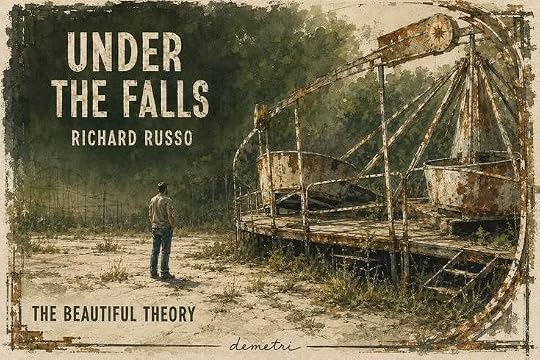
At the abandoned Tilt-a-Whirl, Curt stands inside the ruins of both a hometown pleasure and a story he has told himself for years, finally testing whether the nobler version of Tyler was ever more than the version he needed.
As in Dennis Lehane’s “Mystic River,” childhood loyalty becomes the submerged architecture of adult crime, but Russo is warmer and less fatalistic. He is interested in what happens after people discover how heavily they have edited the past for emotional survival. Ann Patchett’s “Commonwealth” illuminates a different pressure: shared private life becoming one person’s artistic property. Tyler has not merely left Stone Mountain. He has taken it with him, converted it into lyrics, stage identity and cultural capital, then treated that conversion as evidence of affection. The grievance is awkward precisely because Tyler is not entirely wrong. Art can preserve what a place cannot, and Tyler’s songs have carried Stone Mountain farther than most of its residents will ever travel. But the same act can turn shared history into one person’s property. The royalties, after all, know where to go.
Protection becomes Curt’s favorite loophole. He protects Freddi, their son Curtis Jr., Tyler, and the local accommodations by which Stone Mountain muddles through. Some of this is admirable; that is the problem. Curt is still the boy who sat beside Tyler under the falls. He is also the police chief who learns how easily discretion can become concealment. His tragedy is not that his virtues disappear. It is that they become ungoverned. Loyalty becomes permission. Mercy becomes impunity. Before long, love itself starts issuing exemptions.
Against Curt’s instinct stands Deb, the younger officer whose affection for him does not exempt him from her attention. Russo does not make her spotless. She can admire Curt, recognize the fatherly place he has occupied in her imagination, investigate him and disappoint him without deciding that everything good she once saw must have been fraudulent. When she can know what Curt has done and still call him good, the question is not whether misconduct vanishes. It does not. The question is whether judgment requires her to erase every earlier act of decency as well. Deb’s answer has weight because she reaches it after the evidence.
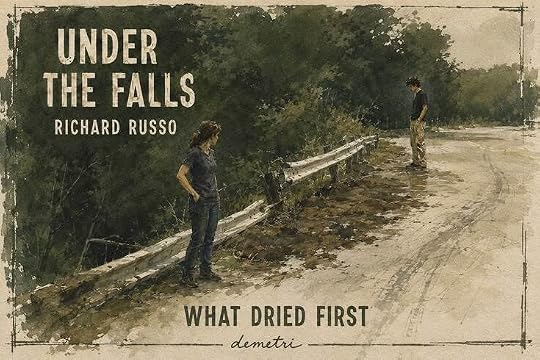
At the crash site, Deb notices that Curt’s mud has dried before the ground around him has, and a nearly invisible discrepancy becomes the difference between caring for someone and protecting him from what the evidence says.
Despite Russo’s generosity toward compromised people, he does not distribute that generosity evenly. Tyler and Curt receive enormous interior acreage in which motive, shame, loyalty, desire and culpability can coexist without hardening into a verdict. Freddi, though she drives much of the late plot, gets less room in which to become similarly irreducible. Early on, her grief for Doc and her complicated marriage suggest a richer center of consciousness, especially when Curt has to admit that what he read as sexual secrecy may partly have been ordinary devotion to a sick friend. Later, as Freddi becomes tied to the crash, the drug operation, Tyler’s abduction, the paternity secret and the book’s most troubling sexual encounter, she increasingly becomes the person whose choices force the men to discover themselves. A book wary of flattering stories gives its men a surprising amount of explanatory shelter.
It gets harder to wave that imbalance away in Sacred Heart, where Tyler is kidnapped, beaten and kept impaired with opioids before another sexual encounter with Freddi. Russo later has Tyler resist the clean comfort of describing himself only as victim. He insists that, once the drugs were available, he participated in his addiction, and he refuses to pretend that his old desire for Freddi had vanished. Russo wants him to recover agency without pretending coercion never happened. That is a difficult distinction worth attempting. But the scene is operating under badly asymmetrical power, while Freddi remains comparatively opaque. The result is not complexity so much as an unresolved blur at the exact point where the book needs the clearest eyesight. That matters because elsewhere Russo is so good at distinguishing feeling responsible from actually being responsible. Here those categories begin to slide over one another.
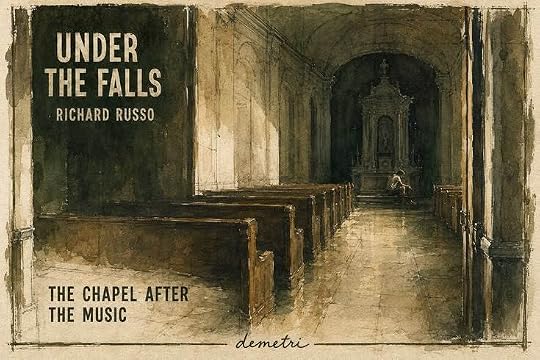
Sacred Heart has been Tyler’s refuge, rehearsal room, secret and imagined home before it becomes his prison, turning the chapel’s narrowing architecture into the novel’s darkest test of what happens when shelter becomes control.
Meanwhile, the late plot begins to collect hardware. Everett, Tyler’s captivity, the narcotics, Deb’s armed confrontation, Curt’s gun and the widening investigation all keep the pages turning, but the characters are already interesting enough sitting in parked cars and revising the stories of their lives. They do not always need another weapon in the room. The project began as a television pilot, which helps account for its appetite for reversals and cliff-edge transitions. Still, the quieter scenes have set a harder standard. An event should expose character before it merely raises the volume.
In quieter scenes, Russo does not need the hardware. Curt’s visit to the abandoned amusement park, where he stands near the Tilt-a-Whirl and finally interrogates the cherished explanation of Tyler’s departure, is one of the book’s best passages. For years Curt has preferred a beautiful theory: Tyler loved Freddi but loved Curt enough to leave rather than destroy his friend’s life. Now he permits the less flattering possibility that Tyler simply took what he wanted, pursued fame and left everyone else behind. The scene does not solve Tyler. It exposes Curt. He needs the nobler Tyler because that Tyler protects the meaning of Curt’s own loyalty.
The epilogue puts the guns away. Nine months later, the campground has been repaired and the dam rebuilt. Tyler returns with a cane, a damaged voice, a history of opioid addiction and a career no longer organized around his own indispensability. Beth has moved more fully into the foreground as a performer. Curt has lost his job, endured legal consequences and discovered, to his own surprise, that punishment can feel cleaner than endlessly maintaining the life he has compromised himself to preserve. Physical restoration is everywhere. Human restoration is nowhere.
Russo refuses the satisfying click of a laboratory answer on Curtis Jr.’s paternity. Tyler knows he could be the boy’s biological father. Curt knows it too. What Curt needs is recognition, and Tyler finally gives it: Curt is Junior’s father because Curt has done the work of fatherhood. Biology can complicate a family without being allowed to overrule the life that family has actually lived. Here Russo’s fondness for explanation earns its keep, because the distinction is not a twist to be solved but a claim about which facts deserve governing power.
Only then does Russo return Tyler and Curt to the childhood promise. Once they linked pinkies and promised to be best friends forever, as children do when they mistake sincerity for authority over the future. As adults they have betrayed, protected, deceived, rescued and disappointed each other enough to know better. They do not repeat the gesture. They do not promise forever. Their friendship becomes credible precisely when it stops making claims on eternity.
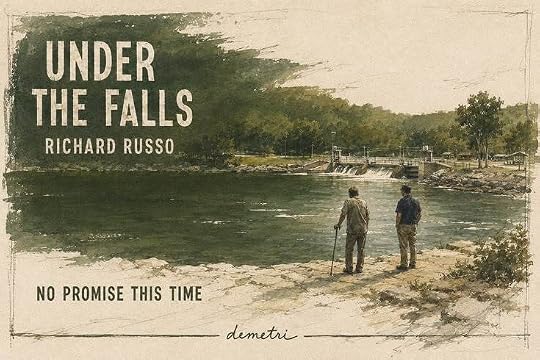
At the restored falls, Tyler and Curt leave the childhood pinky promise where it belongs, allowing friendship to survive on terms smaller than forever and more difficult to fake: presence without guarantee.
Put together, the strengths and costs leave “Under the Falls” at 84/100, or 4/5 stars. Russo’s comic suppleness, character intelligence and unusually earned ending outweigh the late machinery, occasional over-explanation and thinner treatment of Freddi without making those weaknesses disappear. The crime plot supplies the motion. What lingers is a smaller question with fewer sirens in it: how do you care for someone without quietly appointing yourself the manager of their consequences?
On the last pages, the water is running again. The dam has been rebuilt. Tyler and Curt sit near the place where one boy once learned that being saved could mean nothing more dramatic than having somebody remain beside him. After everything these men have tried to do for one another, that is the kind of help the novel finally trusts. They stay.
My In-Process Watercolor Studies
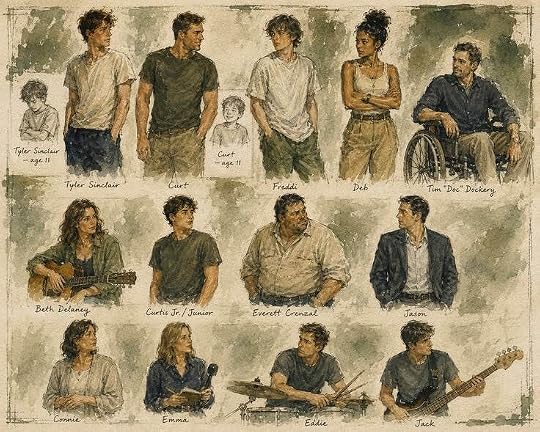
All-Character Watercolor One-Sheet
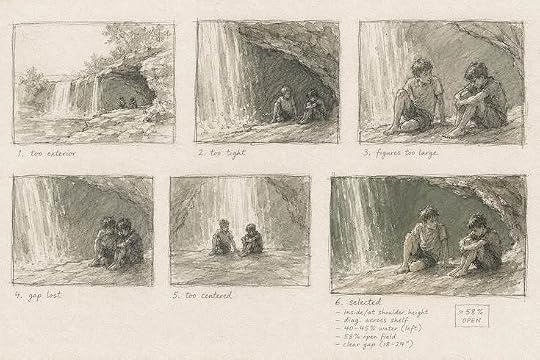
Emblematic Composition & Negative-Space Thumbnail Sheet
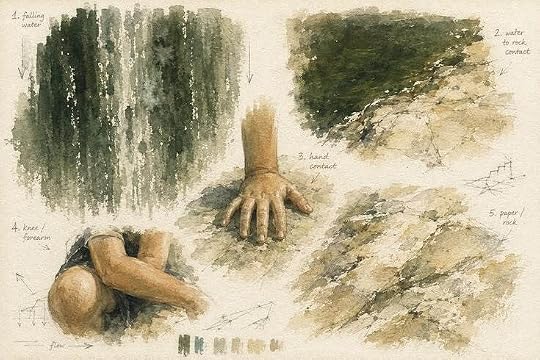
Water, Figure & Edge-Behavior Watercolor Study
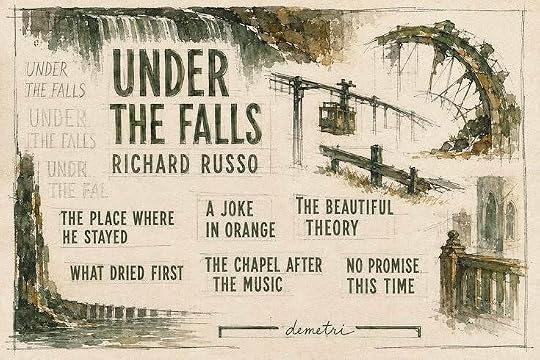
Hand-Lettering & Border Integration Study
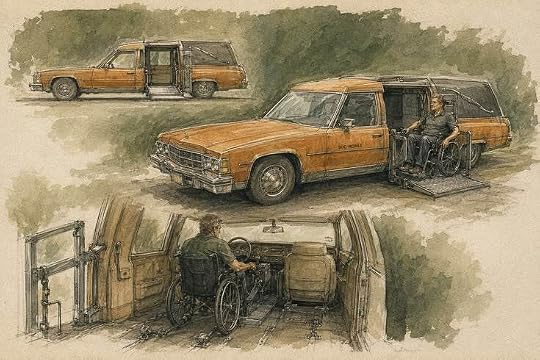
Doc-Mobile Object, Color & Mechanics Study
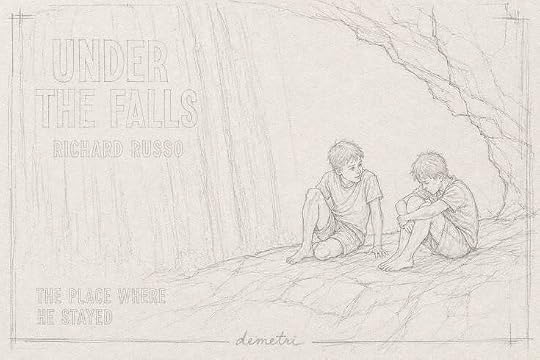
First Underdrawing Pencil Drawing
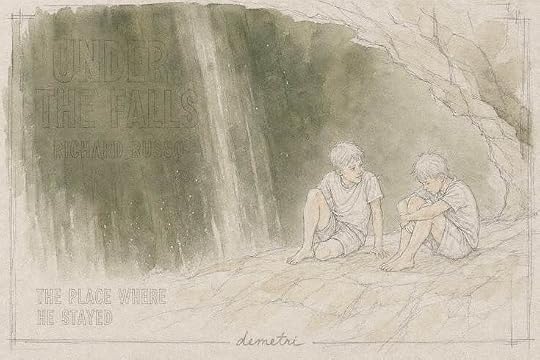
First Underdrawing Pencil Drawing with First Wash of Watercolor
All watercolor illustrations by Demetris Papadimitropoulos.
Watercolors are done on 140lb vellum and then scanned into the computer using an Epson scanner. From there, they are finalized in Procreate. All art and opinions are my own.
On Richard Russo’s “Under the Falls”
In Stone Mountain, friendship survives not because two men can repair what they have done to each other, but because they finally stop confusing love with the power to make things right.
By Demetris Papadimitropoulos | August 14th, 2026
Behind the falls, Curt can do nothing to repair what Tyler has seen at home, so he does the smaller thing the novel will spend decades complicating: he stays close without trying to take control.
During the first rescue in Richard Russo’s “Under the Falls,” nobody gets saved, exactly. Eleven-year-old Tyler Sinclair has watched his father beat his mother and fled behind a waterfall, where the roar swallows whatever he might say. His best friend Curt finds him there. Curt cannot stop the violence, repair Tyler’s family or make the boy feel brave. He can sit beside him. He can tell him there was nothing a child could have done. He can promise that Tyler will not face everything alone. It is enough. The trouble starts later, when staying beside someone no longer feels like enough.
Eighteen years on, Tyler has escaped Stone Mountain in every measurable way, although the town has followed him into his band name, his songs and his guilt. He is rich and famous, returning to the Adirondacks for a benefit concert for Tim “Doc” Dockery, another childhood friend, left paraplegic after a rope-swinging accident at the local falls. Tyler was the boy who dragged Doc from the water. Doc now drives a customized orange hearse and has become a virtuoso of gallows humor. He is also less grateful for the heroic arrangement than everyone around him would prefer. He takes Tyler back to the abandoned campground, reminds him that Tyler gave the shove that sent him toward the dam, and tells him that some locals resent more than his success. Tyler has taken Stone Mountain’s humiliations, jokes, griefs and private histories and turned them into songs. His defense comes quickly: he has helped people be seen. Doc leaves him with the question he has spent eighteen years avoiding: seen by whom, and on whose terms?
Doc’s adapted orange hearse arrives first as a joke and an assertion of independence, then slowly becomes something else entirely, turning the novel’s funniest machine into one of its most consequential pieces of evidence.
Most novels would stop there and have plenty to do. Russo adds a riot, a deadly limousine crash, a compromised police chief, a drug operation, uncertain paternity, kidnapping, opioid dependence and enough misconduct to keep a county courthouse busy for a season. The plot moves briskly, but its best shocks are rarely the ones that belong in an evidence bag. Who drove the pursuing vehicle matters. More interesting is what Curt needs to believe about Tyler, what Tyler needs to believe about his own departure, and how long each man can keep a cherished version of the past alive once the facts start pecking holes in it.
Everything in the title keeps falling. Doc hits the dam. Tyler’s signature song is “The Long Fall.” The limousine goes through a guardrail. Tyler later falls into addiction. Stone Mountain itself has been losing altitude in another sense, watching public life contract while private wealth retreats behind gates. Then there is the quieter drop, the one that comes when a flattering account of yourself stops holding your weight. Russo is too practical a novelist to turn the falls into a vaporous symbol machine. Water is cold, dangerous, privately controlled, seasonally dammed, argued over and finally restored. His metaphors keep their work boots on.
The town’s class argument is easiest to see in water. Russo’s prologue drives the reader toward the Adirondacks through prosperous resort communities and then farther into a place where the amusement park has closed, a school wing sits empty and businesses have failed. Beauty remains abundant; access to it does not. Doc explains what happened to the old campground dam. Wealthier summer residents downstream complained that it deprived them of water, helped get it removed and then enjoyed a private replacement of their own. Year-round residents, Doc says, keep finding themselves farther upstream. No sociology seminar is required. The abandoned amusement park sharpens the point: a place that once let valley families feel rich for an afternoon now sits with its rides stripped and rusting. Prosperity did not become nostalgic there; it packed up. Russo occasionally reaches for contemporary shorthand when characters talk politics, but he is better when economics becomes geography. The people who stayed are not merely Tyler without ambition. They inhabit a place whose roads out are easier to describe than to take.
Russo is best at the sentence that changes its mind halfway through. He favors longish, conversational lines with room for qualification, retreat, second thoughts and the joke deployed just before self-knowledge becomes unbearable. His characters rarely think in straight lines. A belief appears, develops an exception, encounters an inconvenient memory, changes its name and returns wearing a more respectable coat. Curt, especially, is a master of this interior housekeeping. One supposedly reasonable exception for somebody he loves prepares the ground for the next. Russo’s free-indirect style catches motive laundering itself into principle. Its weakness grows from the same habit: occasionally the sentence keeps explaining after the scene has already done the work.
It also helps that nobody here can resist a joke. Doc jokes about his wheelchair and hearse. Tyler wisecracks by reflex. The band gets distracted by dopey arguments about the Kinks. Curt meets embarrassment with ruefulness; Deb, with impatience. The humor keeps damaged people from becoming exhibits labeled Damage. More importantly, it shows how they function while the floor is giving way. Nobody schedules a solemnity appointment before making a bad decision.
Plot works the way those sentences do: a detail arrives, gets misfiled, then comes back with a second meaning. Doc’s orange hearse begins as a joke and becomes evidence. Beth’s frantic “Call him” sounds like panic until Tyler understands whom she meant. Mud on Curt’s pants is merely mud until Deb realizes it dried before his supposed arrival at the crash site. Sacred Heart Chapel first appears as the abandoned place where Tyler discovered what a guitar could sound like in a resonant room; later it becomes the site of his teenage affair with Freddi, then a prospective home, then a prison. Even the pinky promise between Tyler and Curt changes jobs. Childhood covenant becomes awkward adult reenactment and, finally, a gesture neither man needs.
At the abandoned Tilt-a-Whirl, Curt stands inside the ruins of both a hometown pleasure and a story he has told himself for years, finally testing whether the nobler version of Tyler was ever more than the version he needed.
As in Dennis Lehane’s “Mystic River,” childhood loyalty becomes the submerged architecture of adult crime, but Russo is warmer and less fatalistic. He is interested in what happens after people discover how heavily they have edited the past for emotional survival. Ann Patchett’s “Commonwealth” illuminates a different pressure: shared private life becoming one person’s artistic property. Tyler has not merely left Stone Mountain. He has taken it with him, converted it into lyrics, stage identity and cultural capital, then treated that conversion as evidence of affection. The grievance is awkward precisely because Tyler is not entirely wrong. Art can preserve what a place cannot, and Tyler’s songs have carried Stone Mountain farther than most of its residents will ever travel. But the same act can turn shared history into one person’s property. The royalties, after all, know where to go.
Protection becomes Curt’s favorite loophole. He protects Freddi, their son Curtis Jr., Tyler, and the local accommodations by which Stone Mountain muddles through. Some of this is admirable; that is the problem. Curt is still the boy who sat beside Tyler under the falls. He is also the police chief who learns how easily discretion can become concealment. His tragedy is not that his virtues disappear. It is that they become ungoverned. Loyalty becomes permission. Mercy becomes impunity. Before long, love itself starts issuing exemptions.
Against Curt’s instinct stands Deb, the younger officer whose affection for him does not exempt him from her attention. Russo does not make her spotless. She can admire Curt, recognize the fatherly place he has occupied in her imagination, investigate him and disappoint him without deciding that everything good she once saw must have been fraudulent. When she can know what Curt has done and still call him good, the question is not whether misconduct vanishes. It does not. The question is whether judgment requires her to erase every earlier act of decency as well. Deb’s answer has weight because she reaches it after the evidence.
At the crash site, Deb notices that Curt’s mud has dried before the ground around him has, and a nearly invisible discrepancy becomes the difference between caring for someone and protecting him from what the evidence says.
Despite Russo’s generosity toward compromised people, he does not distribute that generosity evenly. Tyler and Curt receive enormous interior acreage in which motive, shame, loyalty, desire and culpability can coexist without hardening into a verdict. Freddi, though she drives much of the late plot, gets less room in which to become similarly irreducible. Early on, her grief for Doc and her complicated marriage suggest a richer center of consciousness, especially when Curt has to admit that what he read as sexual secrecy may partly have been ordinary devotion to a sick friend. Later, as Freddi becomes tied to the crash, the drug operation, Tyler’s abduction, the paternity secret and the book’s most troubling sexual encounter, she increasingly becomes the person whose choices force the men to discover themselves. A book wary of flattering stories gives its men a surprising amount of explanatory shelter.
It gets harder to wave that imbalance away in Sacred Heart, where Tyler is kidnapped, beaten and kept impaired with opioids before another sexual encounter with Freddi. Russo later has Tyler resist the clean comfort of describing himself only as victim. He insists that, once the drugs were available, he participated in his addiction, and he refuses to pretend that his old desire for Freddi had vanished. Russo wants him to recover agency without pretending coercion never happened. That is a difficult distinction worth attempting. But the scene is operating under badly asymmetrical power, while Freddi remains comparatively opaque. The result is not complexity so much as an unresolved blur at the exact point where the book needs the clearest eyesight. That matters because elsewhere Russo is so good at distinguishing feeling responsible from actually being responsible. Here those categories begin to slide over one another.
Sacred Heart has been Tyler’s refuge, rehearsal room, secret and imagined home before it becomes his prison, turning the chapel’s narrowing architecture into the novel’s darkest test of what happens when shelter becomes control.
Meanwhile, the late plot begins to collect hardware. Everett, Tyler’s captivity, the narcotics, Deb’s armed confrontation, Curt’s gun and the widening investigation all keep the pages turning, but the characters are already interesting enough sitting in parked cars and revising the stories of their lives. They do not always need another weapon in the room. The project began as a television pilot, which helps account for its appetite for reversals and cliff-edge transitions. Still, the quieter scenes have set a harder standard. An event should expose character before it merely raises the volume.
In quieter scenes, Russo does not need the hardware. Curt’s visit to the abandoned amusement park, where he stands near the Tilt-a-Whirl and finally interrogates the cherished explanation of Tyler’s departure, is one of the book’s best passages. For years Curt has preferred a beautiful theory: Tyler loved Freddi but loved Curt enough to leave rather than destroy his friend’s life. Now he permits the less flattering possibility that Tyler simply took what he wanted, pursued fame and left everyone else behind. The scene does not solve Tyler. It exposes Curt. He needs the nobler Tyler because that Tyler protects the meaning of Curt’s own loyalty.
The epilogue puts the guns away. Nine months later, the campground has been repaired and the dam rebuilt. Tyler returns with a cane, a damaged voice, a history of opioid addiction and a career no longer organized around his own indispensability. Beth has moved more fully into the foreground as a performer. Curt has lost his job, endured legal consequences and discovered, to his own surprise, that punishment can feel cleaner than endlessly maintaining the life he has compromised himself to preserve. Physical restoration is everywhere. Human restoration is nowhere.
Russo refuses the satisfying click of a laboratory answer on Curtis Jr.’s paternity. Tyler knows he could be the boy’s biological father. Curt knows it too. What Curt needs is recognition, and Tyler finally gives it: Curt is Junior’s father because Curt has done the work of fatherhood. Biology can complicate a family without being allowed to overrule the life that family has actually lived. Here Russo’s fondness for explanation earns its keep, because the distinction is not a twist to be solved but a claim about which facts deserve governing power.
Only then does Russo return Tyler and Curt to the childhood promise. Once they linked pinkies and promised to be best friends forever, as children do when they mistake sincerity for authority over the future. As adults they have betrayed, protected, deceived, rescued and disappointed each other enough to know better. They do not repeat the gesture. They do not promise forever. Their friendship becomes credible precisely when it stops making claims on eternity.
At the restored falls, Tyler and Curt leave the childhood pinky promise where it belongs, allowing friendship to survive on terms smaller than forever and more difficult to fake: presence without guarantee.
Put together, the strengths and costs leave “Under the Falls” at 84/100, or 4/5 stars. Russo’s comic suppleness, character intelligence and unusually earned ending outweigh the late machinery, occasional over-explanation and thinner treatment of Freddi without making those weaknesses disappear. The crime plot supplies the motion. What lingers is a smaller question with fewer sirens in it: how do you care for someone without quietly appointing yourself the manager of their consequences?
On the last pages, the water is running again. The dam has been rebuilt. Tyler and Curt sit near the place where one boy once learned that being saved could mean nothing more dramatic than having somebody remain beside him. After everything these men have tried to do for one another, that is the kind of help the novel finally trusts. They stay.
My In-Process Watercolor Studies
All-Character Watercolor One-Sheet
Emblematic Composition & Negative-Space Thumbnail Sheet
Water, Figure & Edge-Behavior Watercolor Study
Hand-Lettering & Border Integration Study
Doc-Mobile Object, Color & Mechanics Study
First Underdrawing Pencil Drawing
First Underdrawing Pencil Drawing with First Wash of Watercolor
All watercolor illustrations by Demetris Papadimitropoulos.
Watercolors are done on 140lb vellum and then scanned into the computer using an Epson scanner. From there, they are finalized in Procreate. All art and opinions are my own.

August 20, 2026
I have read many of Richard Russo's books, and I have enjoyed all of them. Until this one. This one has almost no character development, several implausible plotlines and plot holes, and poor dialogue. I am disappointed, and cannot recommend this.
It is short. That's something.
It is short. That's something.

August 3, 2026
"Even in a shattered world, it's possible for tomorrow to be better than today."
Tyler Sinclair is a rock star and the frontman of a band named Stone Mountain - the namesake of the small town he grew up in. The irony is that after Tyler left Stone Mountain at eighteen he never went back... until the events that occurred in Under the Falls, that is. You see, Stone Mountain's band manager Jason pushes Tyler and the gang to head to Stone Mountain to do a one-night-only benefit concert for Tyler's former childhood pal Doc, who wound up severely injured after a childhood accident. But what's supposed to be a single night of rock and roll and fundraising tuns into more than what Tyler bargained for when a several unexpected and unfortunate events unfold. "Stone Mountain is the kind of place you might escape from once, if you’re lucky, but not twice."
This book tried way too hard to be thrilling, dramatic, traumatic, and the like. Yet it really missed the mark on all counts. Every single element of this book was beyond predictable. I don't want to blatantly write spoilers in this review, but I'm sure any reader could figure out exactly what was going to unfold as it did so. Of course Doc's childhood accident is tied to why Tyler didn't want to return to Stone Mountain. And the fact that his former bestie became the Chief of Police... why don't you, dear reader, take a gander at if maybe, just maybe, he might be a little bit crooked?
To top it all off, the ending didn't even really close all the loops. Even if the overarching plot was predictable, the nuances weren't explained in the end. Womp, womp.
Thanks to NetGalley for this ARC in exchange for my honest review.
Tyler Sinclair is a rock star and the frontman of a band named Stone Mountain - the namesake of the small town he grew up in. The irony is that after Tyler left Stone Mountain at eighteen he never went back... until the events that occurred in Under the Falls, that is. You see, Stone Mountain's band manager Jason pushes Tyler and the gang to head to Stone Mountain to do a one-night-only benefit concert for Tyler's former childhood pal Doc, who wound up severely injured after a childhood accident. But what's supposed to be a single night of rock and roll and fundraising tuns into more than what Tyler bargained for when a several unexpected and unfortunate events unfold. "Stone Mountain is the kind of place you might escape from once, if you’re lucky, but not twice."
This book tried way too hard to be thrilling, dramatic, traumatic, and the like. Yet it really missed the mark on all counts. Every single element of this book was beyond predictable. I don't want to blatantly write spoilers in this review, but I'm sure any reader could figure out exactly what was going to unfold as it did so. Of course Doc's childhood accident is tied to why Tyler didn't want to return to Stone Mountain. And the fact that his former bestie became the Chief of Police... why don't you, dear reader, take a gander at if maybe, just maybe, he might be a little bit crooked?
To top it all off, the ending didn't even really close all the loops. Even if the overarching plot was predictable, the nuances weren't explained in the end. Womp, womp.
Thanks to NetGalley for this ARC in exchange for my honest review.

August 5, 2026
2.5 rounded up.
My 3 stars may be a bit generous, but there is a decent story here about friendship and revisiting the past. It’s just not told in the most effective manner.
The book starts out with a great representation of a depressed upstate NY town. It is classic Richard Russo. From there, the story devolves into something somewhat sloppy. Russo is known for his crisp characterizations and descriptions of settings. There are scenes in this book that make no sense or seem disconnected. When reading the author’s acknowledgments at the end, the reader learns that this was originally a script for a pilot that never got made. That explains a lot. There are things that seem to be missing that would be filled in visually on television.
A couple of notes for Mr. Russo:
1. It is time to retire the word “cripple” when referring to a person with a physical disability. It is considered offensive.
2. Cell phones don’t ring busy.
Thank you to Knopf and NetGalley for an ARC in exchange for an honest review.
My 3 stars may be a bit generous, but there is a decent story here about friendship and revisiting the past. It’s just not told in the most effective manner.
The book starts out with a great representation of a depressed upstate NY town. It is classic Richard Russo. From there, the story devolves into something somewhat sloppy. Russo is known for his crisp characterizations and descriptions of settings. There are scenes in this book that make no sense or seem disconnected. When reading the author’s acknowledgments at the end, the reader learns that this was originally a script for a pilot that never got made. That explains a lot. There are things that seem to be missing that would be filled in visually on television.
A couple of notes for Mr. Russo:
1. It is time to retire the word “cripple” when referring to a person with a physical disability. It is considered offensive.
2. Cell phones don’t ring busy.
Thank you to Knopf and NetGalley for an ARC in exchange for an honest review.

September 8, 2026
"Under the Falls" has an intriguing premise, a famous rock star returns to the struggling hometown he fled eighteen years earlier, reopening old friendships, betrayals, romantic entanglements, and questions surrounding the accident that paralyzed one of his childhood friends.
There is plenty happening, including corruption, drug trafficking, suspicious deaths, buried secrets, and long-held resentment.
The novel moves quickly and kept me curious about how everything would unfold.
Unfortunately, I never developed much of a connection to any of the characters.
I understood the roles they played in the story, but I did not always understand their deeper motivations or feel emotionally invested in what happened to them. The multiple perspectives seemed designed primarily to reveal information and advance the plot rather than fully inhabit each character’s inner life.
The author explains that the story originated as a television pilot. Aha! That made perfect sense to me.
It feels like the opening episode of a potentially interesting series, with numerous characters and social issues introduced for later development.
Cur the checklist ... race, poverty, political extremism, police corruption, addiction, economic decline, and the opioid trade are all present.
Yet most of these ideas feel like beginnings rather than fully developed parts of the novel. The plot is lined up, but the imagined season of character development never arrives.
This was readable, compact, and occasionally suspenseful, but it felt overfilled and emotionally underdeveloped.
I have read that Russo’s other novels offer much richer characterization and a stronger sense of community, so I would still be interested in trying one that better represents his work.
There is plenty happening, including corruption, drug trafficking, suspicious deaths, buried secrets, and long-held resentment.
The novel moves quickly and kept me curious about how everything would unfold.
Unfortunately, I never developed much of a connection to any of the characters.
I understood the roles they played in the story, but I did not always understand their deeper motivations or feel emotionally invested in what happened to them. The multiple perspectives seemed designed primarily to reveal information and advance the plot rather than fully inhabit each character’s inner life.
The author explains that the story originated as a television pilot. Aha! That made perfect sense to me.
It feels like the opening episode of a potentially interesting series, with numerous characters and social issues introduced for later development.
Cur the checklist ... race, poverty, political extremism, police corruption, addiction, economic decline, and the opioid trade are all present.
Yet most of these ideas feel like beginnings rather than fully developed parts of the novel. The plot is lined up, but the imagined season of character development never arrives.
This was readable, compact, and occasionally suspenseful, but it felt overfilled and emotionally underdeveloped.
I have read that Russo’s other novels offer much richer characterization and a stronger sense of community, so I would still be interested in trying one that better represents his work.

September 6, 2026
I read Zachary Lazar’s review of Under the Falls in the NYTimes book review. In his review, Mr. Lazar asserted it was not Richard Russo’s best work. As I’ve read and liked most of Russo’s books, I still wanted to read it. Sadly, this is not Empire Falls, nor is it Nobody’s Fool. This reads like the tv pilot script it was meant to be. It was not the book for me.
Side note-I just realized I rhymed a bit in my review. It must be all the Dr. Seuss I’m reading to my grandson.
Side note-I just realized I rhymed a bit in my review. It must be all the Dr. Seuss I’m reading to my grandson.

August 22, 2026
3.75 Stars. This book was a perfect summer read. Definitely not the authors best.
September 5, 2026
Good read. Not an award winner but it kept my attention.
3.65 stars
3.65 stars

September 16, 2026
A good story that kept my attention. It was nice to visit the falls again.
August 24, 2026
This is not the author’s best work. His usual themes were all there: a small town in decline, a homecoming, guilt, regret, and class divisions. But this time they were more superficial and there wasn’t any humor. Too many unexplained storylines left me confused as to why they happened at all, like the cause for the crash and the death of a key character. The resolution was rushed and the holes still weren’t filled in. It was fast paced and held my attention but it wasn’t fulfilling.

September 6, 2026
Very much enjoyed this story about an aging rock star returning to his hometown and forced to face his complicated history, made all the more interesting because it was combined with a "whodunit" multifaceted crime story. Richard Russo never disappoints.
Displaying 1 - 30 of 632 reviews