

What do you think?

The English Monarchs
Richard II
Richard II is one of the most enigmatic of English kings. Shakespeare depicted him as a tragic figure, an irresponsible, cruel monarch who nevertheless rose in stature as the substance of power slipped from him. By later writers he has been variously portrayed as a half-crazed autocrat or a conventional ruler whose principal errors were the mismanagement of his nobility and disregard for the political conventions of his age. This book -- the first full-length biography of Richard in more than fifty years -- offers a radical reinterpretation of the king.
Nigel Saul paints a picture of Richard as a highly assertive and determined ruler, one whose key aim was to exalt and dignify the crown. In Richard's view, the crown was threatened by the factiousness of the nobility and the assertiveness of the common people. The king met these challenges by exacting obedience, encouraging lofty new forms of address and constructing an elaborate system of rule by bonds and oaths. Saul traces the sources of Richard's political ideas and finds that he was influenced by a deeply felt orthodox piety and by the ideas of the civil lawyers. He shows that, although Richard's kingship resembled that of other rulers of the period, unlike theirs, his reign ended in failure because of tactical errors and contradictions in his policies. For all that he promoted the image of a distant, all-powerful monarch, Richard II's rule was in practice characterized by faction and feud. The king was obsessed by the search for personal security: in his subjects, however, he bred only insecurity and fear.
A revealing portrait of a complex and fascinating figure, the book is essential reading for anyone with an interest in thepolitics and culture of the English middle ages.
513 pages, Paperback
First published April 2, 1997
About the author
Nigel Saul
29 books5 followersProfessor Nigel Saul (born 1952) is a British academic who was formerly the Head of the Department of History at Royal Holloway, University of London (RHUL). He is recognised as one of the leading experts in the history of medieval England.
Professor Saul has written numerous books including Knights and Esquires, The Gloucestershire Gentry in the Fourteenth Century (Oxford, 1981), and The Oxford Illustrated History of Medieval England (Oxford, 1997). His major biography Richard II (Yale, 1997) was the product of ten years' work and was acclaimed by P. D. James as "unlikely to be surpassed in scholarship, comprehensiveness, or in the biographer's insight into his subject's character".
Within Royal Holloway, Professor Saul is known for his somewhat right-wing political views. He has served as Honorary President of the college's Conservative Future Society.
Professor Saul has written numerous books including Knights and Esquires, The Gloucestershire Gentry in the Fourteenth Century (Oxford, 1981), and The Oxford Illustrated History of Medieval England (Oxford, 1997). His major biography Richard II (Yale, 1997) was the product of ten years' work and was acclaimed by P. D. James as "unlikely to be surpassed in scholarship, comprehensiveness, or in the biographer's insight into his subject's character".
Within Royal Holloway, Professor Saul is known for his somewhat right-wing political views. He has served as Honorary President of the college's Conservative Future Society.
Ratings & Reviews
Friends & Following
Create a free account to discover what your friends think of this book!
Community Reviews
Displaying 1 - 16 of 16 reviews

October 8, 2015
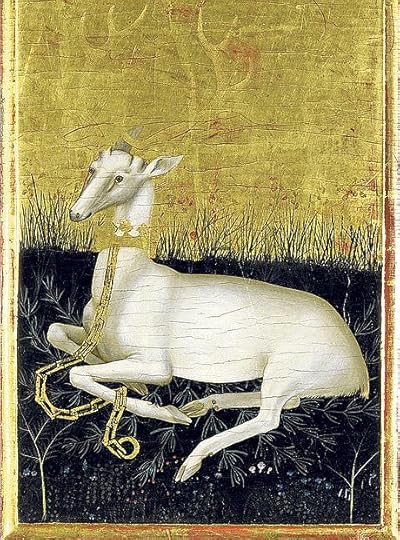
Ever since I first saw The Wilton Diptych I have wanted to know more about Richard II, and not necessarily what Shakespeare had to say about him.
As I have been exploring recently the late medieval early Renaissance period, focusing recently in The Hundred Years War, this was the perfect moment to engage in reading a bio on Richard II. This read also follows one on Richard's grandfather The Perfect King: The Life of Edward III, Father of the English Nation, which I enjoyed, even though Mortimer’s too enthusiastic defence of the monarch got a bit on my nerves at times. Saul is much more equanimous.
The biography follows a chronological order and since Richard II was crowned when he was only ten, his childhood and upbringing are important. His father and heir, the Black Prince, had died even before the King. And then his elder brother Edward also died when Richard was only four. His early history then becomes an account of the struggle of those barons who fought to exert their power and influence over the minority of the Monarch.
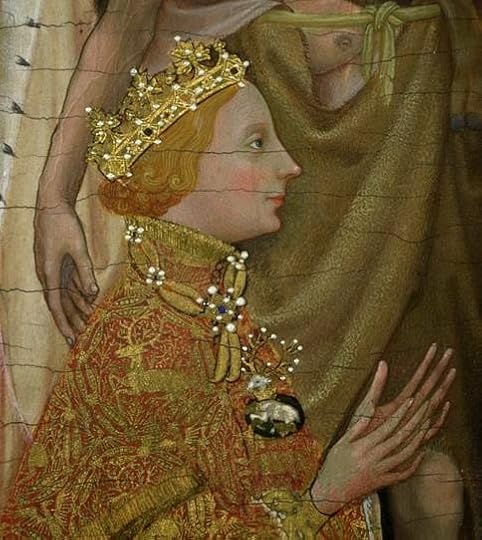
There were several landmarks during his reign. The first was the Revolt of the Peasants in the early 1380s. Similar social revolts occurred in other lands in Europe, probably a consequence of the deep troubles brought about by the Black Death. In England it was successfully solved partly thanks to the admirable way the young Richard conducted himself. We could consider this episode marked his coming of age.
And this was sealed with his marriage to the eldest daughter of the Emperor Charles IV, Anne of Bohemia. They were a happy couple and when Anne died, Richard was at a loss. The Monarchy was also at a loss because they had no children. Richard later married, but incomprehensibly, he chose too young a girl who would have to wait too long before she could bear him his heir.
A few years after the Revolt Richard had the first serious trouble with a group of nobles, the Lords Appellant. Now we would consider this as a clash of generations. The still young king kept a group of friends, his favourites, too close to him to the irritation of the elders in the court. Richard’s uncles and associates, with John of Gaunt as the most notorious of the group, managed to get rid of the group of youngsters, with charges of treason. Richard lost in this one and in the ensuing decade, apparently peaceful, he licked his wounds and occupied himself with other matters.
During those years of domestic peace Richard also negotiated a long truce with the dragging war with France. During his reign then the Hundred Years War was not. Instead he turned his attention to the West, to Ireland. He succeeded in his invasion.
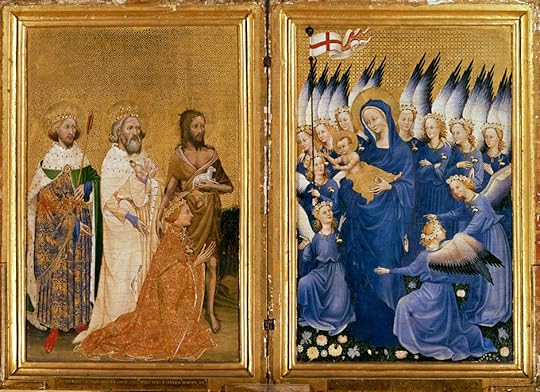
Other achievements would now be considered less controversial (especially by the Irish). He was a remarkable patron of the arts and it is in that context that my beloved Wilton diptych finds its place. Richard realized well the importance of cultivating an image. His had to be exquisitely regal. In the court etiquette, in the royal pageants, in the attires, in the large effigies, in the architecture he left his mark. It is still with us.
His last crisis brought about the heaviest loss. As the wounds inflicted by the Appellants about a decade earlier had not been healed, Richard planned to take revenge for his humiliation on those elders who had imposed their will over his. At first successful, the crisis however became a direct confrontation with the Lancaster branch and that proved fatal to Richard. The astute and wealthy John of Gaunt, with the support of his son Henry of Bolingbroke, got the upper hand. And the Crown.

Even if I wanted to get a historian’s view that would go beyond Shakespeare’s, Saul begins and ends discussing the Bard’s version of Richard II. Saul’s approach is meticulous and the book is loaded with historical data and details but in spite of having to marshal all the facts he succeeds in approaching Richard the man. And that is why I became more and more engaged while reading this book.
It is precisely his achievement in getting closer to the personality that allows Saul to conclude that (Shakespeare’s) characterization of the king and his understanding of what mattered to him probably bring us closer to the historical figure than many a work of history.
Saul can say this because he himself, as a historian, has come close, and brought us along, to the historical figure.
Now I am ready to tackle Shakespeare’s version.

April 10, 2024
Fantastic book and still, thirty years later, the best biography of Richard II out there. Generally chronological, with occasional thematic chapters - for example on Ireland, on culture, etc - it provides significant insight into both the man and his kingship. This, combined with a thorough understanding of both the primary and secondary sources, along with a light, accessible written style, make it a pleasure to read.

April 15, 2018
Nigel Saul’s biography of Richard II is a monumental work. It is well-written and engaging, with Saul seeming to take a fair and unbiased approach. There’s no sense that Saul is overly sympathetic to his subject – at times, he is unflinching to the point of seeming unsympathetic.
There is a lot of information packed in here, with the chapters based around chronological events (e.g. the Great Uprising) or thematic areas of study (e.g. Richard’s piety, court, etc). I did think that the first chapter gave a very brisk rundown of Richard II’s parents, birth and childhood, only going into detail when he became king. But then, that might be what’s to be expected in a political biography (which I gather books in the Yale English Monarch series are meant to be), rather than a more generalised biography. I wasn’t totally happy with the discussion of Richard’s sexuality, which is almost literally “he was rumoured to be in a homosexual relationship with Robert de Vere, this almost certainly wasn’t true”, but at least it was one line so the “he definitely wasn’t gay” attitude didn’t loom over the entire book.
For me, the greatest and only serious flaw of the book came in Saul’s explorations of Richard II’s mental state. A couple of times, Saul talks about how Richard’s “psychological environments” explained his behaviour, but the formation of these “environments” is largely limited to Saul speculating that something had changed in Richard’s life that changed his outlook.
But the crowning glory is the final chapter, in which Saul sums up Richard’s legacy (surprisingly not as barren as the “complete failure as a person and a king” discourse surrounding his deposition would have you believe) and then goes on to speculate about his mental state, coming to the conclusion that far from being neurotic or suffering from schizophrenia (as suggested by earlier historians), he was just narcissistic.
In these last pages, I felt that Saul reached way too far in his analysis of Richard’s character. There are times where his statements felt very presumptuous, as though he somehow knows exactly what Richard thought and was like. I also take issue with Saul classification of Richard wanting to see the body of a beloved friend who died in exile as highly morbid and proof of his narcissism. To me, that sounds like the behaviour of someone grieving and viewings of a deceased loved one's body is still common practice today.
There have been many discussions of Richard II’s mental state, with a tendency in the late 1800s and early 1900s to diagnose him as insane (despite very little contemporary evidence to support it), so I accept that it’s something a historian may feel the need to address. However, I also tend toward the argument espoused by Kathryn Warner in her more recent biography of Richard II:
As pointed out by Lauren Ashe in Richard II: A Brittle Glory, so much of what remains of Richard II is an image, whether it is one that was designed and projected by himself, one designed and projected by the Lancastrian propaganda in the aftermath of Richard’s deposition, or one projected by the apparently independent observers and chroniclers of his reign. It is impossible to know what these images reflect of his true self. It may well be that his attempts at self-aggrandizement were the result of an inflated sense of self – that he was, in fact, a narcissist. Or it may be that these images were a coping or defence mechanism that hid his weaknesses and/or provided him with a sense of security to deal with the traumas he had suffered. It’s impossible to know because the man has been dead for over six hundred years, and what is left behind gives no clear indication of his true personality and character.
Otherwise, this is an excellent book and with the final few pages excised, there would be very little to complain about.
There is a lot of information packed in here, with the chapters based around chronological events (e.g. the Great Uprising) or thematic areas of study (e.g. Richard’s piety, court, etc). I did think that the first chapter gave a very brisk rundown of Richard II’s parents, birth and childhood, only going into detail when he became king. But then, that might be what’s to be expected in a political biography (which I gather books in the Yale English Monarch series are meant to be), rather than a more generalised biography. I wasn’t totally happy with the discussion of Richard’s sexuality, which is almost literally “he was rumoured to be in a homosexual relationship with Robert de Vere, this almost certainly wasn’t true”, but at least it was one line so the “he definitely wasn’t gay” attitude didn’t loom over the entire book.
For me, the greatest and only serious flaw of the book came in Saul’s explorations of Richard II’s mental state. A couple of times, Saul talks about how Richard’s “psychological environments” explained his behaviour, but the formation of these “environments” is largely limited to Saul speculating that something had changed in Richard’s life that changed his outlook.
But the crowning glory is the final chapter, in which Saul sums up Richard’s legacy (surprisingly not as barren as the “complete failure as a person and a king” discourse surrounding his deposition would have you believe) and then goes on to speculate about his mental state, coming to the conclusion that far from being neurotic or suffering from schizophrenia (as suggested by earlier historians), he was just narcissistic.
In these last pages, I felt that Saul reached way too far in his analysis of Richard’s character. There are times where his statements felt very presumptuous, as though he somehow knows exactly what Richard thought and was like. I also take issue with Saul classification of Richard wanting to see the body of a beloved friend who died in exile as highly morbid and proof of his narcissism. To me, that sounds like the behaviour of someone grieving and viewings of a deceased loved one's body is still common practice today.
There have been many discussions of Richard II’s mental state, with a tendency in the late 1800s and early 1900s to diagnose him as insane (despite very little contemporary evidence to support it), so I accept that it’s something a historian may feel the need to address. However, I also tend toward the argument espoused by Kathryn Warner in her more recent biography of Richard II:
…it is impossible after more than 600 years to correctly diagnose Richard as neurotic or narcissistic or ‘dangerously mad’ or to know what was really going on inside his head. We should be wary of trying to analyse a person so many centuries dead, a person who lived in a world very different from our own and who had been raised from the earliest childhood to see himself as set apart from other mortals (Richard II: A True King's Fall, p. 231)
As pointed out by Lauren Ashe in Richard II: A Brittle Glory, so much of what remains of Richard II is an image, whether it is one that was designed and projected by himself, one designed and projected by the Lancastrian propaganda in the aftermath of Richard’s deposition, or one projected by the apparently independent observers and chroniclers of his reign. It is impossible to know what these images reflect of his true self. It may well be that his attempts at self-aggrandizement were the result of an inflated sense of self – that he was, in fact, a narcissist. Or it may be that these images were a coping or defence mechanism that hid his weaknesses and/or provided him with a sense of security to deal with the traumas he had suffered. It’s impossible to know because the man has been dead for over six hundred years, and what is left behind gives no clear indication of his true personality and character.
Otherwise, this is an excellent book and with the final few pages excised, there would be very little to complain about.
December 18, 2025
Docking a point from this otherwise incredible historical work because Saul’s biases felt incredibly strong in places, particularly in the last chapter.
One example from said final chapter: Saul picked an intensely personal episode about Richard reacting to the sight of Robert de Vere’s corpse to exemplify what he calls Richard’s ‘narcissistic self-dramatisation’. Robert de Vere was Richard’s lieutenant and rumoured lover, even among their contemporaries. Saul rejects the latter interpretation outright, and as such he does not allow for the possibility that Richard was simply grieving at the sight of his lover’s corpse. Clearly it’s easier to presume Richard was mentally unbalanced than to believe he could have been queer. But even if Richard and Robert de Vere had not been lovers, de Vere had been one of Richard’s only loyal friends and virtually his only real champion, so why should Richard not grieve deeply for him? How is human grief ‘narcissistic self-dramatisation’? And how do the same historians who reject evidence of queerness as ahistorical or ‘impossible to prove’ feel comfortable giving a historical figure a mental health diagnosis?
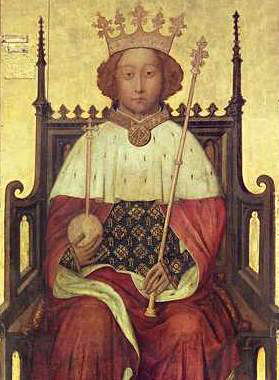
Another example: describing Richard’s features in his official portraits as ‘feminine’. They are quite clearly not. Describing Richard in his portraits as ‘feminine’ seems to be a case of a falsehood so often repeated it has become accepted and uncontroversial. If anything, in the portraits he is said to be ‘feminine’, like the Westminster one, he just looks young.
Another example: Saul claiming that 14-years old Richard facing off against the rebels of the 1381 Uprising is another example of ‘narcissistic self-dramatisation’. In any other leader (or at least in those leaders not afflicted by ‘feminine features’) this would be counted as an example of bravery. If it is possible to be misogynistic against a man, both Richard’s contemporary chroniclers and modern historians have somehow managed it, to the point where he is sometimes denied even the scant praise he does deserve.
All of these examples come from the last chapter. Up until that point I found the book very balanced and well-written. It is extremely well-researched, and my criticism of Saul above should of course not be taken as defence of Richard II, who was neither a great king nor a good person. But I was not looking to rate Richard on kingship; I was trying to flesh out the human tragedy behind the historical facts, and I found Saul’s attempt to pathologize diminished that.
One example from said final chapter: Saul picked an intensely personal episode about Richard reacting to the sight of Robert de Vere’s corpse to exemplify what he calls Richard’s ‘narcissistic self-dramatisation’. Robert de Vere was Richard’s lieutenant and rumoured lover, even among their contemporaries. Saul rejects the latter interpretation outright, and as such he does not allow for the possibility that Richard was simply grieving at the sight of his lover’s corpse. Clearly it’s easier to presume Richard was mentally unbalanced than to believe he could have been queer. But even if Richard and Robert de Vere had not been lovers, de Vere had been one of Richard’s only loyal friends and virtually his only real champion, so why should Richard not grieve deeply for him? How is human grief ‘narcissistic self-dramatisation’? And how do the same historians who reject evidence of queerness as ahistorical or ‘impossible to prove’ feel comfortable giving a historical figure a mental health diagnosis?
Another example: describing Richard’s features in his official portraits as ‘feminine’. They are quite clearly not. Describing Richard in his portraits as ‘feminine’ seems to be a case of a falsehood so often repeated it has become accepted and uncontroversial. If anything, in the portraits he is said to be ‘feminine’, like the Westminster one, he just looks young.
Another example: Saul claiming that 14-years old Richard facing off against the rebels of the 1381 Uprising is another example of ‘narcissistic self-dramatisation’. In any other leader (or at least in those leaders not afflicted by ‘feminine features’) this would be counted as an example of bravery. If it is possible to be misogynistic against a man, both Richard’s contemporary chroniclers and modern historians have somehow managed it, to the point where he is sometimes denied even the scant praise he does deserve.
All of these examples come from the last chapter. Up until that point I found the book very balanced and well-written. It is extremely well-researched, and my criticism of Saul above should of course not be taken as defence of Richard II, who was neither a great king nor a good person. But I was not looking to rate Richard on kingship; I was trying to flesh out the human tragedy behind the historical facts, and I found Saul’s attempt to pathologize diminished that.

December 14, 2016
Academic, but far less dry than one would suppose. Some chapters are more entertaining than others, and it's a bit tricky to figure out how Richard finally overstepped his bounds, but on the other hand he emerges as a (mostly) sympathetic figure who never really got a chance to prepare for his role as King.

December 23, 2023
Richard II by Nigel Saul is an excellent biography on the 2nd king in English history to be deposed and funny enough in the same century. I spent a lot of time in Richard II’s reign. From Helen Carr’s book about John of Gaunt and then after reading Saul’s book, the one on Henry IV also in the monarch series. I think Richard’s reign is up there as one of my favorites and after spending a good number of books in it I feel like it’s the one I know the most about lol.
Now this isn’t too say Richard II is my favorite king or I think he was a great king which I’d say he certainly wasn’t, but he’s certainly one of England’s more polarizing kings & the reign itself is just filled with so many interesting events, figures, and so on. Perhaps it’s just where my tastes lay. As interesting as the reigns of the more militarily minded kings who had great success & glory like a Henry II, Edward I, Edward III, and so on are, I’ve found myself more drawn the reigns of guys like Richard II & Edward II.
Anyway as I said prior this is an excellent book and while it’s the only book I’ve read solely Richard II’s reign, it’s likely the best you can do.
Now this isn’t too say Richard II is my favorite king or I think he was a great king which I’d say he certainly wasn’t, but he’s certainly one of England’s more polarizing kings & the reign itself is just filled with so many interesting events, figures, and so on. Perhaps it’s just where my tastes lay. As interesting as the reigns of the more militarily minded kings who had great success & glory like a Henry II, Edward I, Edward III, and so on are, I’ve found myself more drawn the reigns of guys like Richard II & Edward II.
Anyway as I said prior this is an excellent book and while it’s the only book I’ve read solely Richard II’s reign, it’s likely the best you can do.
July 4, 2025
Nigel Saul’s history of Richard II is a significant work of historical research and has to be essential reading for anyone interested in the Medieval period in England. The book is detailed in its exploration of the personal history of Richard, set in the context of contemporary society. Saul is fair and balanced in his view of Richard and is careful to avoid becoming either his cheerleader or detractor. We are left with a fascinating portrait of a flawed individual, unable to understand the needs of kingship in the context of society.
Ultimately, Richard’s ´… tragedy was that he mistook the illusion of the stage for the reality of the world around him.´ (p 467)
Ultimately, Richard’s ´… tragedy was that he mistook the illusion of the stage for the reality of the world around him.´ (p 467)

February 18, 2018
An exciting read for the researching historian. A very substantial and deeply researched biography.
Details and footnotes galore.
Read for personal research. I found this work of immense interest and the contents helpful and inspiring - number rating relates to the book's contribution to my needs.
Overall, this work is a good resource for the historian, researcher, and enthusiast.
Details and footnotes galore.
Read for personal research. I found this work of immense interest and the contents helpful and inspiring - number rating relates to the book's contribution to my needs.
Overall, this work is a good resource for the historian, researcher, and enthusiast.

Read
July 9, 2023Great book, very detailed on not just Richard's life but his wider world. If there's any problem, it's that the author has a somewhat circular way of recounting events, so the order of events gets somewhat confused, especially as book goes on. Still an otherwise rich book.

Want to Read
December 30, 2016I registered a book at BookCrossing.com!
http://www.BookCrossing.com/journal/14341346
http://www.BookCrossing.com/journal/14341346

August 25, 2017
A bit dry, but a very thorough and superbly footnoted short biography.

July 27, 2019
Time to go find some translations of primary sources!
October 30, 2024
Great Read
Great read, thoroughly enjoyed it. I am learning so much reading this series of books. I am 70 so it's never too late 😃
Great read, thoroughly enjoyed it. I am learning so much reading this series of books. I am 70 so it's never too late 😃

February 9, 2017
Nigel Saul’s RICHARD II was undoubtedly intended to be a definitive source for this oft-maligned monarch. Published by Yale University Press, it is a scholarly volume that unfortunately reads like one. There is a lot of information here, a bibliography as long as your arm, and footnotes on every page. I placed many bookmarks and captured many fine details such as names, dates, etc. This is the kind of book you need to read if you want to know everything about the subject; we get a good idea about his probable state of mind in the various stages of his life—especially the crisis of 1387 and his deposition of 1399. We learn that he was trying to redefine his kingship in terms that worked well for the Yorkists and early Tudors, but the political conditions in Richard’s reign were not ripe for his own success. “Richard had secured obedience by resort to collective oaths, forced loans and blank charters; Henry VII was to do the same by means of bonds, recognizances and acts of attainder. Certainly, in Richard’s reign the instruments of autocracy were less highly developed than they were to be later. But the king’s aim was essentially the same: the creation of a stronger, loftier, and more effective monarchy that could sustain its position under challenge.” Why did Richard fail? He goes on for many pages, and it’s up to the reader to assimilate all the nuances given, in addition to what we learned in earlier chapters. It’s almost too much and at times I wished for a simpler answer. Of course, there isn't one. And I guess for myself, there was just too much to absorb—too much speculation, too many digressions. I came away with the uncomfortable feeling that I didn't get a good understanding of Richard as a person. In the last chapter, Nigel concluded that Richard suffered from Narcissism, and gave his evaluation of Richard's actions based on this disorder. But by then, there were so many other interpretations for me to pick up along the way, that the Narcissist theory got lost in the shuffle. I think I would need a second reading to put things into place. Alas, I don’t think I can get through the book again. I hope my bookmarks (and the comprehensive index) prove adequate for my needs!

October 5, 2012
Excellent!
June 25, 2015
Did not pass my hundred page test. Too dry. It sounds like this is a fascinating story, but the tone of this book means I may never know for sure.
Displaying 1 - 16 of 16 reviews