For the mere sake of adventure, danger, and the -fun of the thing, - Wyndham Brandon persuades his weak minded friend, Charles Granillo, to assist him in the murder of a fellow undergraduate, a perfectly harmless man named Ronald Raglan. They place the body in a wooden chest, and to add spice to their handiwork, invite a few acquaintances, including the dead youth's father, to a party, the chest with its gruesome contents serving as a supper table. The horror and tension are worked up gradually; thunder grows outside, the guests leave, and we see the reactions of the two murderers, watched closely by the suspecting lame poet, Rupert Cadell. Finally they break down under the strain and confess their guilt.
Two men murder an acquaintance, stuff the corpse into a chest and then invite the victim’s father round to eat dinner off it! Will they be found out or will they get away with it?
Patrick Hamilton’s Rope remains a highly entertaining play some 90+ years after it was written. It helps that I’ve never seen the Alfred Hitchcock movie so the story was all new to me and I didn’t know what was going to happen. The play grabbed my attention right away with the ominous beginning and Hamilton skilfully ratchets up the tension and momentum throughout. And the ending, despite being fairly conventional, was well done.
While it was intriguing, the setup as a whole felt like a thought experiment and the killers’ motivation bothered me in being enormously contrived. They acted less like real people and more like characters in a play. Ditto the unnecessary risk of placing the body in plain view, yet hidden, though it is an effectively exciting prop for the audience so I can see why it was done. That and the way one of the murderers broke down when confronted was a bit silly too.
Those are minor complaints though and took little away from my reading enjoyment. Rope is a very compelling and gripping tale of murder most foul. And if reading plays isn’t your speed, I also recommend Patrick Hamilton’s equally thrilling dark novel, Hangover Square.
Rope is the 1929 play which made Patrick Hamilton's name and, along with another play, Gas Light, earned him the wealth with which he slowly drank himself to death over the next few decades.
Hamilton always denied that the famous American 1924 Leopold and Loeb case in which two teenagers from prominent Chicago families murdered a 14 year old boy, was the inspiration for Rope. Whatever the truth, the similarities between Rope and the Leopold and Loeb case are striking
Patrick Hamilton's Rope concerns two upper class Oxford students who, under the malign influence of Nietzsche and his theories of the Ubermensch, kill a fellow undergraduate for the “fun of the thing”. Wyndham Brandon persuades his weak minded friend, Charles Granillo, to assist him in the murder of Ronald Raglan, a harmless fellow undergraduate. They place the body in a wooden chest, and to add spice to their crime, invite some carefully chosen acquaintances, including the dead man's father, to a dinner party, the chest with its gruesome contents serving as the dinner table.
Almost 90 years on from its initial theatrical success, the play still packs a punch. Hamilton slowly and cleverly ratchets up the tension as the three lead characters react in a very different, but all in a consistently compelling, way to the drama. The tension is also combined with well observed social comedy. In short, it's wonderful.
There's a BBC Radio version of the play. This version stars the late, great Alan Rickman playing Rupert Cadell (the role played by James Stewart in the Hitchcock film) as a camp, cold, intellectual aesthete, and a survivor of the trenches with a tin leg. It is he who gives this cruel and brilliant play the merest hint of decency and compassion. It's currently on YouTube (seach Rope starring Alan Rickman).
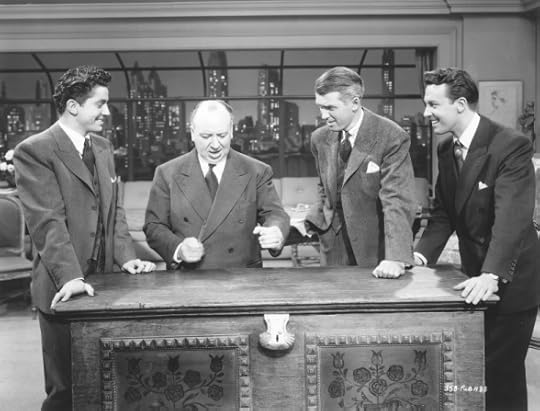
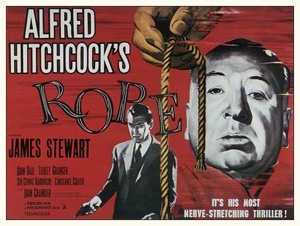
Rope was also famously turned into a Hitchcock film starring James Stewart. However, the film version, as good as it is, is set in a different time and misses out, in my opinion, on one of the crucial issues of Hamilton's original play, even though it does try to update the discussion.
The original play was set in the post-war London of the 1920s with the questions and issues raised by the First World War still very much on the minds of people. It is with this background, that Hamilton weaves in the question of when murder becomes socially and morally acceptable - when is killing murder and when is it war.
I had so far only seen the film, but the original play is really worth listening to - even if some of the dialogue and plot are a little forced.
Description: For the mere sake of adventure, danger, and the "fun of the thing," Wyndham Brandon persuades his weak minded friend, Charles Granillo, to assist him in the murder of a fellow undergraduate, a perfectly harmless man named Ronald Raglan. They place the body in a wooden chest, and to add spice to their handiwork, invite a few acquaintances, including the dead youth's father, to a party, the chest with its gruesome contents serving as a supper table. The horror and tension are worked up gradually; thunder grows outside, the guests leave, and we see the reactions of the two murderers, watched closely by the suspecting lame poet, Rupert Cadell. Finally they break down under the strain and confess their guilt.
Two men murder their fellow student for shits and giggles, then invite some friends, (including his father and his fiance) over to have supper on the chest they've concealed his body in. One of the guests becomes increasingly suspicious as the evening wears on. They believe they have committed the perfect crime, but are told at one point that even a 'motiveless' crime will have vanity as the motive, and the vain murderer will always get found out because he can't resist talking about it. Will their hubris do for them?
From BBC Radio 4 Extra: Two young undergraduates think they've committed the perfect murder. To add piquancy to their crime, they invite the victim's father and other guests to a macabre dinner party.
Starring Alan Rickman as Rupert Cadell, Adam Bareham as Wyndham Brandon, Andrew Branch as Charles Granillo, Cyril Luckham as Sir Johnstone Kentley, Moir Leslie as Leila Arden, Christopher Good as Kenneth Raglan and Olivier Pierre as Sabot
Stage, screen and radio actor and director, Alan Rickman was born: 21st February 1946 and died 14th January 2016 aged 69.
English playwright, Patrick Hamilton (1904 - 1962) once explained: "In Rope, I have gone all out to write a horror play and make your flesh creep. It is a thriller. A thriller all the time, and nothing but a thriller".
Producer: John Tydeman
First broadcast on BBC Radio 4 in Saturday Night Theatre: Murder for Pleasure in 1983.
This would've been good even if it was just an hour of people inadvertently using colloquialisms about death, but no, it's Patrick Hamilton so it gets even better. Will need to watch the Hitchcock film eventually.
It took me forever to find this play by Patrick Hamilton. Even in London I couldn't find it. Many years later I found a copy at Brand Books (fantastic used bookstore by the way) and kept it by bed for a month or two before even opening the title page.
I waited because this play to me is sort of a dream object. If you seen the Hitchcock film version of 'Rope,' you pretty much saw the play. First of all it is not as good as Hamilton's London novels. Yet this tragic man is quite a writer. I recommend it only if you are a Hitchcock fan or want to complete your Patrick Hamilton collection at home. I am keeping mine in the chest that I used as a table .......
This play does such a marvellous job of building tension. I absolutely loved the setting and societal commentary! Highly recommend if you like dark academia, historical fiction, and/or talks of murder and the like.
Rope was written by Patrick Hamilton. The only real fault I can find in this play is how the character of Rupert comes to know that a murder had been committed. I know it is not a mystery that will provide you with clues, but it seems almost supernatural that he comes to suspect the truth. Starting from the beginning two men decide to kill another for the fun of committing the killing. Brandon seems to be the stronger more aggressive of the two. Granillo seems to spend the entire night drinking. Are they acting strangely, yes, but not so much that anyone could figure it out. I have to admit the macabre ritual of serving the meal on top of the chest that contains the body is chilling to think of, but wonderfully written. I found myself at the end wondering what Rupert decision would be, would he reveal the truth. Very good play holds the tension from first to last.
This entire review has been hidden because of spoilers.
مسرحية جميلة و ممتعة جدا، أحداثها خلتني قاعد في حالة ترقب لحد آخر لحظة، ده غير إن الفكرة نفسها حلوة جدا و موجود فيها References كتير لحاجات قديمة بشكل رائع .
It took me years to get my hands on a copy, but I'm really glad I did. The play is different enough from the 1948 adaptation that I didn't just feel like I was watching an abridged version of the movie, but it doesn't offer much that is substantially different. Its analysis of human evil is still incredibly shallow, and Rupert's ending is still a bit forced. But it's a fantastic comfort read.
Again some guys who did not understand their Nietzsche properly
On May 21, 1924 the highly intelligent students Nathan Leopold and Richard Loeb killed a 14-year old neighbour, Bobby Franks, hitting him with a chisel and choking him by putting a sock into his mouth. Their only motive was sheer vanity at the thought of committing a perfect crime and their conviction, falsely aquired from a misreading of Nietzsche, that they were “supermen” to which human laws would not pertain.
Five years later, the English playwright Patrick Hamilton made their story into a drama, setting the scene in London. His anti-heroes, the two students Brandon and Granillo strangle a fellow-student and conceal his body in a large chest. In order to revel in their ghastly deed, they invite several people, amongst whom the father and aunt of their victim, for a dinner party and actually have these people partake of their sandwiches and caviar from the very chest that contains the assassinated young man’s remains. One of their guests, Rupert Cadell, a somewhat jaded poet, however, smells the rat and tries to hunt them down.
This story will seem familiar to most of us from the Hitchcock film of 1948 starring James Stewart, but the play stands in its own right, as it differs in many points from its adaptation for the screen by Hitchcock. For a start, most of the characters in the play have not known each other before meeting on that macabre occasion. Then we can hardly find anything pleasant about the main characters, as even Cadell is far from being the dandified cynic who, in his heart of hearts, is a likeable and decent man, as played by Stewart. Unlike the film, the play also provides some clues with the help of which Cadell traces down the morbid mystery. One major plus of the play is that its dialogues are more refined and nuanced than those of the film, e.g. it does not have the conversation in which Cadell, in a rather playful manner, enlarges on his salon nihilist theory of the rightfulness of murder. Instead we find him demasking common moral tenets according to which murder in times of peace is socially rejected, whereas in times of war it is even rewarded. At this stage it becomes clear that much of this character’s disillusionment and bitterness are a consequence of the atrocities he went through in World War I.
The play contains some fine scenes of suspension, although the characters lack the typical Hitchcock esprit, and it also makes you think about moral values and how they are influenced by social prejudice, e.g. the positive image of killing in times of war, or for other seemingly “noble” motives. It is just a bit of a pity that Nietzsche is dragged into this sordid affair again.
I read this after seeing a performance of the play by the college's drama group. I didn't quite catch some of the dialogue, so I wanted to read what I had missed. I enjoyed the performance more than reading the play, frankly. I noted with interest the little things added or altered by the play's director that were not in the text, things which lent a touch of humor to an otherwise serious play. Now I'll have to find the film Alfred Hitchcock made from the play. I would also like to read this author's other two "gaslight crime" plays.
By the way, I was able to read it thanks to Open Library.
This in general seems to be an ethical debate on murder. The story is really watery everything is boring, i really had a hard time trying to finish this play. I only gave two stars because of this paragraph: “It is all simply a question of scale. You, my friends, have, paradoxically, a horror of murder on a small scale, a veneration for it on a large. That is the difference between what we call murder and war. One gentleman murders another in a back alleyway in London for, let us say, since you have suggested it, the gold fillings in his teeth, and all society shrieks out for revenge upon the miscreant. They call that murder. But when the entire youth and manhood of a whole nation rises up to slaughter the entire youth and manhood of another, not even for the gold fillings in each other’s teeth, then society condones and applauds the outrage, and calls it war. How, then, can I say that I disapprove of murder, seeing that I have,* in the last Great War, acted on these assumptions myself ?”
Decent drama famously brought to the big screen by Alfred Hitchcock. It is said to be based on the Loeb and Leopold murder, which saw the students kill in the name of being Nietzsche’s Supermen. We get some suitable philosophy towards the end as the nihilistic killers justify their “motiveless” undertaking.
I got this play because it is the basis for the Alfred Hitchcock film, which I love. It is also a proto-example of what I call the Pied Piper Archetype, in which a teacher leads his students astray with his ideas of superiority. Only here there is no teacher, just an older person who shares the students' warped ideas.
The story is based on the Leopold and Loeb true-life murder case in which two geniuses murder a boy in order to commit the perfect crime. That goes on in the play too. The students are trying to follow Nietzsche's idea of living dangerously.
The older person gradually catches on to them and the play comes to a predictable end. The film vastly improves on the play, adding dialogue and featuring the rope the two strangled their "friend" with almost as a character. Also the sleuthing is much more subtle.




 https://www.youtube.com/watch?v=hukbu...